The Reason to Be Thankful

apostle paul

. . . what was the difference between the teaching of Paul and the teaching of the Judaizers? What was it that gave rise to the stupendous polemic of the Epistle to the Galatians? To the modern Church the difference would have seemed to be a mere theological subtlety. About many things the Judaizers were in perfect agreement with Paul. The Judaizers believed that Jesus was the Messiah; there is not a shadow of evidence that they objected to Paul’s lofty view of the person of Christ. Without the slightest doubt, they believe that Jesus had really risen from the dead. They believed, moreover, that faith in Christ was necessary for salvation. But the trouble was, they believed that something else was also necessary; they believed that what Christ had done needed to be pieced out by the believer’s own effort to keep the Law. From the modern point of view the difference would have seemed to be very slight. Paul as well as the Judaizers believed that the keeping of the law of God, in its deepest import, is inseparably connected with faith. The difference concerned only the logical – not even, perhaps, the temporal – order of three steps. Paul said that a man (1) first believes on Christ, (2) then is justified before God, (3) then immediately proceeds to keep God’s law. The Judaizers said that a man (1) believes on Christ and (2) keeps the law of God the best he can, and then (3) is justified. The difference would seem to modern “practical” Christians to be a highly subtle and intangible matter, hardly worthy of consideration at all in view of the large measure of agreement in the practical realm. What a splendid cleaning up of the Gentile cities it would have been if the Judaizers had succeeded in extending to those cities the observance of the Mosaic law, even including the unfortunate ceremonial observances! Surely Paul ought to have made common cause with teachers who were so nearly in agreement with him . . .

Paul saw very clearly that the difference between the Judaizers and himself was the difference between two entirely distinct types of religion; it was the difference between a religion of merit and a religion of grace. If Christ provides only part of our salvation, leaving us to provide the rest, then we are still hopeless under the load of sin. . . . Such an attempt to piece out the work of Christ by our own merit, Paul saw clearly, is the very essence of unbelief; Christ will do everything or nothing, and the only hope is to throw ourselves unreservedly on His mercy and trust Him for all.

From J. Gresham Machen, Christianity and Liberalism (1923)

Thanksgiving with the Coens?

lone biker of apocThe e-message this week from the nice folks at Christianity Today included a list of the five best movies on thankfulness. According to Annie Young Frisbee (imagine if she had married into the Boomerang clan) the Coen brothers come in at number five with – drum roll – Raising Arizona. She writes:

An ex-con and an ex-cop kidnap one of the Arizona quintuplets in hopes of creating the family they couldn’t have on their own. On the run from the law and a bunch of outlaws, their journey leads them to be grateful for the joys they have always had.

Raising is a great movie but hardly the warm fuzzy that Ms. Frisbee makes it out to be since the Lone Biker of the Apocalypse is an omen of the killer in No Country for Old Men, and the last line, said by H. I. while overlooking a Thanksgiving Day spread, about a fairer future for him and his beloved, mocks Utah. This means that it concludes with a swipe at the support Mormons gave to family values during those years when Reagan – that “sumbich”– was in the Whitehouse. (Frisbee’s take on Raising may confirm Ken Myers’ clever line that “evangelicalism is making the world safe for Mormonism.”)

For that reason, a better Thanksgiving Day pick may be Woody Allen’s Hannah and Her Sisters. Yes, it has its dark moments and Woody’s funny but starting to get old complaints about love and death. But it begins and ends with a sumptuous Thanksgiving Day meal, and it is probably Allen’s most uplifting movie – ever.

The choice for the Harts in 2009, though, is Accidental Tourist, a movie based on the novel by Anne Tyler that is set in Baltimore – a plus for all fans of Machen and Mencken – and features an idiosyncratic family and their methods of cooking turkey. Yum, yum.

German Reformation

Heidelberg 027Sebastian Heck is a church planter in Heidelberg who needs our prayers and support. He has recently sent out news about the launch of a Bible study and a terrific site for worship in the heart of the historic (and beautiful) city. You may read about it here.

(I know, this isn’t funny or smart-alecky. Apparently Tim Keller hasn’t gotten out of bed this week.)

Where All the Girls Are Strong and Some of the Boys Wear A Fez

Masons in MakingScott Clark observes an arresting inconsistency in the pages of Christian Renewal, on the order of Captain Renault’s being “shocked, shocked” to find that gambling was going in on Rick’s café (in Casablanca). CR is the Dutch-Canadian publication that gives lots of room to those who attack two-kingdom theology through the cross-hairs of Christians schools. And yet, as Clark shows, CR is seemingly silent on the sins of Masonry, and it has implications for other commandments in the Decalogue.

He writes:

So, just to keep score, according to the CR it’s unforgivable to defend Christian schooling incorrectly but it’s okay to be a Freemason? Which of these issues cuts closer to the heart of the Reformed faith: denying the uniqueness of Christ (by virtue of membership in the Lodge) or defending Christian schooling imperfectly? Why does Elliott get a pass but WSC “gets it in the neck”? Where’s the scathing editorial condemnation of this violation of the law of God?

While we are at it we should wonder about the CR’s stance on the other ground for the formation of the CRC. Where is the CR on hymnody vs psalmody? Is the CR a vocal advocate for the recovery of genuine Reformed worship? I don’t recall the CR beating the drum for ridding our churches of organs and man-made hymns.

For that matter, where are the URCs on this question? Why does our church order not follow the 1619 Church Order of Dort strictly on this? Why did not the founders of the URCs connect CRC’s departure from the regulative principle of worship to her decline? Did they imagine that if we only turned the clock back to 1959 we could make history turn out differently than the CRC did? (See Recovering the Reformed Confession on this).

Is it that we are to be “foursquare” on “Christian schooling” but liberal on the second commandment as confessed and understood by the Reformed churches since the 16th century? If so, what does that say about us? It’s essential to be “orthodox” on views that are not confessed in Heidelberg Catechism, e.g. how we teach math, but it’s acceptable to ignore the clear and consistent teaching of the Reformed faith on how we worship God? For those of us who think that the Reformed confessions, rather than social conservatism, define what it is to be Reformed this is all very confusing.

So it seems that the antithesis really boils down to who sends their children to Christian schools and who doesn’t. But when it comes to Freemansonry, one of the best examples of autonomous, French revolutionary thought – you know the kind that Abraham Kuyper denounced with institutions like the Anti-Revolutionary Party – the antithesis doesn’t look quite so antithetical.

Keller Endorses Clark

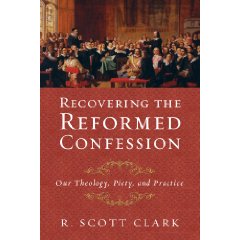
clark recoveringNot exactly, but the pastor of Redeemer Presbyterian Church in New York City did say in his interview with Mike Horton at the White Horse Inn that confessional Christianity is the answer to the problems confronting the contemporary church. Okay, he said, “confessional evangelical” Christianity, which to confessional Protestants is a bit of an oxymoron since evangelical stands closer to pietist than confessional on the spectrum of Protestant Christianity. Even so, there Keller was telling Mike and company that teaching the Heidelberg, and adding more liturgy, is what the ailing Protestant witness needs. Along the way, Keller said that confessional churches were the proper antidote to megachurches, which at least in his experience are too slick, too entertainment oriented, and too consumerist for the sophisticates who reside in Manhattan.

I sure wish Mike had asked Keller more about confessional Protestantism and where Redeemer Church is exactly on the faith and practice of Reformed Christianity. Granted, Keller was on to talk about his book, Reasons for God, which is a work of apologetics, not pastoral ministry. Even so, the discussion was revealing if only because reaching unbelievers is something that has bound Redeemer closer to Willow Creek than Keller let on with his contrast between confessional and megachurch churches.

What Keller did not concede is that he and Bill Hybels have emerged as gurus for an approach to church planting that is “seeker-sensitive.” The seekers may be suburban Chicagoans or cosmopolitan New Yorkers. But in both cases the stress has been more on winning people over than on discipling the won in the whole counsel of God, as in the Great Commission’s “everything I have commanded you.” This is not to say that evangelism is wrong or bad. It is to question whether evangelism is the paradigm for a full-service church in the tradition of Reformed confessionalism. I mean, if you classify your worship services according to musical style as Redeemer does – classical or jazz – you may not exactly have read through Clark’s Recovering the Reformed Confession about the nature and piety of confessional Protestantism.

What makes this point even more plausible is something that Keller wrote about a month before appearing on Horton’s show. At his blog Keller wrote:

The time at Willow led me to reflect on how much criticism this church has taken over the years. On the one hand, my own ‘camp’ — the non-mainline Reformed world — has been critical of its pragmatism, its lack of emphasis on sound doctrine. On the other hand, the emerging and post-modern ministries and leaders have disdained Willow’s individualism, its program-centered, ‘corporate’ ethos. These critiques, I think, are partly right, but when you are actually there you realize many of the most negative evaluations are caricatures.

Keller goes on to say that with the assistance of John Frame he has come to a new appreciation for Hybels and Willow Creek. (Note: Keller and Frame share more than tri-perspectivalism in common; they also understand the nature and character of Reformed worship in ways that contravene the regulative principle as found in both the Westminster Standards and the Three Forms of Unity.) According to Keller, applying Frame, Willow Creek manifests a “a ‘kingly’ emphasis on leadership, strategic thinking, and wise administration.” Keller admits that sometimes the Willow Creek model “obscures how organic and spontaneous church life can be.”

But that concession leads Keller once again to give another of his “with-presbyters-like-this-who-needs-evangelicals” stands for the Reformed tradition. He writes that “Reformed churches have a ‘prophetic’ emphasis on preaching, teaching, and doctrine” but the danger is “a naïve and unBiblical view” which assumes “that, if we just expound the Word faithfully, everything else in the church — leader development, community building, stewardship of resources, unified vision — will just happen by themselves.” (To complete Frame’s triangle, Keller credits the emergent church with an emphasis on community, liturgy and sacraments.”)

This perspective on the Reformed ministry does explain why Keller didn’t endorse Clark’s book. It also indicates why Keller and the rest of Redeemer’s staff need to read it. Confessional Protestants do not believe simply, to paraphrase a line from Field of Dreams, “if you preach it, they will come.” I know pastors in the Redeemer NYC diocese who accuse the Reformed tradition of being logocentric. If that means affirming the formal principle (sola scriptura) of the Reformation, then I’ll accept the label.

But church life is much more than preaching and teaching the Bible and our Reformed confessions teach this. They say all sorts of interesting things about word, sacraments, prayer, discipline, worship, the Lord’s Day, communion, ordination, and polity. They all assume that these teachings require the efforts of pastors and elders who attend session and consistory meetings, presbyter and classis, General Assembly and Synod, visit with families in their homes and the sick in hospitals, catechize the youth, practice hospitality, and prepare high-carb casseroles and jello salads for pot-luck suppers.

That kind of hands-on, local ministry is what animates confessional Presbyterianism. As Old Lifers know, it is seeker-sensitive in the best sense of the phrase, namely, serving the God who seeks Christians who worship in spirit and truth.
Deconstructing Evangelicalism

BE074639Philip Yancey writes at Christianity Today one of his last columns for a while. He is not entirely encouraged by what evangelicalism has become, though he also finds room for encouragement. As is typical of so much writing about evangelicalism, Yancey notes the ying and yang that at once makes evangelicalism successful and destructive.

On the yang, Yancey writes, “In the past year I have visited the Middle East, India, Africa, Latin America, and Europe as the guest of churches and ministries. In each place, evangelicals exude life and energy. While staid churches change slowly, evangelicals tend to be light on their feet, adapting quickly to cultural trends.”

But for yang Yancey also observes that evangelicals are slaves to innovation (some might call it idolatry but we refuse to use such freighted language — good for us!). “The Jesus movement,” he writes, “the house-church movement, seeker-friendly churches, emergent churches—evangelicals have spawned all of these. In their wake, worship bands have replaced organs and choirs, PowerPoint slides and movie clips now enliven sermons, and espresso bars keep congregants awake. If a technique doesn’t work, find one that does.”

Yancey cautions “that mimicking cultural trends has a downside. At a recent youth workers conference I attended, worship meant a DJ playing techno music at jet-engine volume while a sweaty audience crowded the stage, jumping up and down while shouting spiritual one-liners. At the risk of sounding old-fashioned, I couldn’t help questioning the depth of worship.”

Well, I’m sorry but you can’t have it both ways. Innovation means a certain kind of vigor, one that attracts “new” followers. Innovation also means you disrespect tradition and also that you have no tradition – other than a perpetual quest for innovation. Evangelicalism as conservative Protestantism — are you kidding?

But none of this prevents Yancey from staying the course with evangelicalism, and advising against not abandoning the name, but “living up to it.” In fact, he observes one encouraging trend, namely, the evangelical embrace of the Social Gospel. “The fundamentalist-social gospel divide that marked the church a century ago has long since disappeared. Now evangelical organizations lead the way in such efforts as relief and development, microcredit, HIV/AIDS ministries, and outreach to sex workers.”

What Yancey fails to realize is that the Social Gospel was originally an evangelical enterprise that married word and deed in such a way that evangelicals gave deeds of mercy equal weight with word and sacrament. Over time this evangelical wedding of evangelism and reform led to an inability to see that the eternal things of word and sacrament were truly more important than temporary forms of relief and development. In other words, evangelicalism became the path to liberal Protestantism. Evangelicalism as conservative Protestantism — are you still kidding?

Along with the email that included a link to Yancey’s article came other links to other CT articles on evangelicals. One of those by Kevin Offner in 1995 – almost 15 years ago!! – included yet another depressing assessment of evangelicalism:

Just how does one define “evangelical” today? Until recently it was clearly understood, implicitly if not explicitly, that evangelicals were fully committed to two truths: the authority of Scripture and the necessity of the new birth. And the Lord Jesus Christ, the one who saves us from our sins, was the common object of adoration. One evangelical might disagree with another on secondary matters but they both shared a common, nonnegotiable center.

Today this center has become fuzzy and elusive as American pluralism hits evangelicalism with a vengeance. Lines are being drawn not over whether one does or does not wholeheartedly affirm the gospel but over secondary matters, which in turn are often set up as litmus tests for unity.

All of this invites the question: why is anyone still considering “evangelical” a meaningful Christian identity? I sort of understand why CT does, it being the flagship magazine of “the movement.” But if Yancey and Offer see these problems, what good is keeping the evangelical moniker in use? Even more poignant is why conservative Presbyterians would continue to want to call themselves evangelical.

And You Thought New York City Was Hard to Transform

indinaImagine the hurdles that Kuyperians in Indiana who practice law are facing. In fact, look at the vow this allegedly wholesome mid-western state, known for Booth Tarkington and high school basketball – if only they’d invented hot dogs and motherhood – requires of attorneys.

Rule 22. Oath of Attorneys
Upon being admitted to practice law in the state of Indiana, each applicant shall take and subscribe to the following oath or affirmation:

“I do solemnly swear or affirm that: I will support the Constitution of the United States and the Constitution of the State of Indiana; I will maintain the respect due to courts of justice and judicial officers; I will not counsel or maintain any action, proceeding, or defense which shall appear to me to be unjust, but this obligation shall not prevent me from defending a person charged with crime in any case; I will employ for the purpose of maintaining the causes confided to me, such means only as are consistent with truth, and never seek to mislead the court or jury by any artifice or false statement of fact or law; I will maintain the confidence and preserve inviolate the secrets of my client at every peril to myself; I will abstain from offensive personality and advance no fact prejudicial to the honor or reputation of a party or witness, unless required by the justice of the cause with which I am charged; I will not encourage either the commencement or the continuance of any action or proceeding from any motive of passion or interest; I will never reject, from any consideration personal to myself, the cause of the defenseless, the oppressed or those who cannot afford adequate legal assistance; so help me God.” (From Indiana Rules for Admission to the Bar and the Discipline of Attorneys)

The nerve of the Hoosiers. No acknowledgment of God as the creator and sustainer of all things, of Christ as redeemer of his church, no sense that notions of truth and falsehood, justice or crime come from the holy standard of God’s revealed will. Even worse, no mention of a Reformed world and life view, though I suppose the mention of God helps this go down better and lifts Indiana out of the vicious depths of Gotham.

But you do have to wonder how someone committed to the Lordship of Christ in every square inch could take such a vow. Isn’t Indiana guilty of proposing a common realm in which Christian and non-Christian lawyers must serve? And wouldn’t a Christian lawyer who took such a vow be acknowledging the existence of such a common realm. (Of course, it’s not neutral either; Indiana attorneys must always root for IU to beat Michigan.)

The answer could be the difference between theory and practice. Ideally, every square inch should be ruled by Christ, but of course it doesn’t work out in practice. If this were the explanation, then why mock those who try to find a theological rationale for such a common realm (which is what two-kingdom theology attempts)? After all, a two-kingdom attorney would have no problem taking such a vow. His conscience is clear because he knows the older Protestant teaching on the civil magistrate was afflicted with Constantinianism and that expectations for a Christian state died with the passing of Israel.

But the attorney who regularly chastises two-kingdom proponents for selling out the Reformed faith and then turns around and lives with rules of Indiana’s common realm of rules for attorneys, well, that seems remarkably inconsistent if not a tad perverse. It’s as if he’s a Kuyperian in only parts of his life, like the holy times when dropping the kids off at the Christian day school and attending the school board meeting, and then in the common realm living the rest of his day under the rule of Indiana’s legal institutions. How dualistic!

Home Schoolers Beware! Why Proponents of Christian Schools in Michiana Are Out to Destroy the Family

home schoolingOkay, that’s a little over the top, but it may be a fitting response to those who use scare tactics to oppose two-kingdom theology. Our favorite theonomist in the CRC, Rabbi Bret, has posted at his blog a piece that apparently appeared in Christian Renewal, that un-American (okay, it’s Canadian) publication which touts worldviewism from its corner of Dutch-Canadian culture. (The author is an elder in the URC and a supporter of Mid-America Reformed Seminary. I thought the URC and MARS were opposed to developments in the CRC but apparently Christian schooling makes the ordination of women look trivial.)

The article in question is a review of Westminster California’s recent issue of Evangelium where the faculty write about the importance of Christian education. Now we are all for a return to the polemics of nineteenth-century America when Charles Hodge would engage in lengthy debates with the likes of Edwards Amasa Park by simply responding to articles published in another theological quarterly. But a review of a publicity piece that offers a little food for the mind of potential and existing donors? Hello!?!

As if a “review” of promotional material doesn’t prove the lengths to which the editor and author will go to try to demean two-kingdom theology, the author’s introduction seals the deal. He begins by quoting someone who doesn’t even write for Evangelium – that would be me, whom he identifies as a WSC professor. Since the author is a lawyer, you might expect him to pay respect to technicalities, which would mean identifying me at least as an adjunct professor, not a professor. But higher purposes will not get in the way of righteousness, justice, and a Christian school.

To add insult to WSC’s injury, he even quotes a comment I wrote about teaching American history to a string of interactions about worldview at this blog. What this has to do with the issue of Evangelium under review is again one of those technicalities that one would expect a practicing attorney to understand. A quotation from a random comment on a blog would likely not hold up in a court of law, or even an ecclesiastical court. But for the cause of Christian education, all evidence is legitimate, all two-kingdom comments are in contempt.

Such disregard for minor formalities may explain the author’s complete indifference to major questions of jurisdiction. The author seems to agree with the idea that parents are responsible for the education of their children. But then he assumes that parental responsibility is the equivalent of the Christian school. Here are a few illustrative quotations:

So Daniel’s mastery of pagan education while maintaining his godly faith serves as an example for the education of our covenant youth. Translation for our time: as long as your child maintains his spiritual faith, education in a non-Christian school may be a legitimate venue of choice.

Let’s pause here to note that foundational principles of Christian education do not vanish due to someone’s bad experience at a non-Reformed Christian school, or one’s favorable memory of “witnessing” to unbelievers at a public school. Rather, the issue is our principled commitment to a full-orbed, Reformed-shaped, Christian education.

Read again the representative NL2k quotations cited in the introduction to this review and ask whether these be can reconciled to our Reformed worldview. If you find they cannot, then until such errors are rejected, general affirmations coupled with contextualized qualifiers will not stem the concern over the effect NL2k could have in the Reformed churches and in our Christian schools.

Each of these quotes highlights the way that the author only thinks of Christian schools when considering a Christian education. For him, the antithesis is writ large in the subjects children study and that antithesis is manifest formally in the antagonism between Christian schools and state schools.

Pardon my interruption, but did the rapture occur and leave this author behind in the year 1960? Has he never heard of home schools where the Christian teacher is the parent? Do the advocates of Christian schools really mean to exert tyranny over Christian parents so that fathers and mothers who educate their children at home are found guilty of providing a non-Reformed education?

One line is indicative of this slight to Christian parents: “Christian parents can be like a customer deciding between a Cadillac and a Ford. One choice may be better and cost more, but either one will get you to your destination. Such a consumerist ‘common realm’ approach to education certainly strikes a discordant note from our historic Reformed ethic.”

So it comes to this, the sacred responsibility of parents to teach their children becomes for Christian school advocates something as trivial a buying a car made in Detroit. This is a long way from the sphere sovereignty taught by the likes of Abraham Kuyper in which parents do have responsibility for education. Home schooling, in fact, is the purest form of parental responsibility for education. But “reviews” like this one heap spoon fulls of scorn upon those parents who sacrifice time, careers, parts of the house, and even standing within the community to insure that their children receive a Christian education.

And here I worried about the Obama administration destroying the family. Little did I know I had to worry about the Christian school board.

Has Keller Lost His Mojo?

solarflareAlmost no one in the blogosphere seems to have noticed that last week Pat Robertson interviewed Tim Keller on “The 700 Club.” The Redeemer pastor was there to promote his new book, Counterfeit Gods.

The reason for calling attention to Keller’s appearance with Robertson is not to raise questions about would-be unholy alliances between conservative Presbyterians and Pentecostals. The appearance was a good way for Keller to promote his book, and talk shows like Robertson’s are good ways to do this. (Anyone who has watched the HBO series, “The Larry Sanders Show,” knows how the talk-show formula is supposed to work.)

Instead, the question that arises from the Keller appearance is one about the trajectory of the New York City pastor’s celebrity. Back when The Reasons for God came out and Keller gave a talk at Google as part of the company’s Authors@Google series, the pastor’s fans lit up the blogosphere with links to and comments on the event.

But with his new book, Keller is apparently settling for CBN and Robertson, and his fans do not seem to notice. (It may actually be a healthy sign that New Life Presbyterians are not watching CBN.) From Google to “The 700 Club,” from the blogs agog to silent bloggers, one wonders if we are witnessing the first phase of contemporary Presbyterianism’s brightest star’s burn out.

The Myth of Worldview Antithesis

Kuyper2Our friend and constant critic, Baus, likes to point out the incomplete reading of paleo-Calvinists in the wonders of neo-Calvinist wisdom. He also regularly recommends the work of Roy Clouser as providing a significant criticism of secular thought and the incompleteness of any thought or system that leaves out religion. Neutrality is not only a myth but a no-no.

So I was surprised to find a piece by Clouser in which he argues that faith is the most basic part of human identity, but will actually yield a Rodney King-like world in which people of different faiths will hold hands and sing “We Are the World.” This is antithesis with a heavy dose of synthesis.

On the one hand, Clouser insists that beliefs control all forms of human thinking so that faith affects all theories about the world and the way we live in it. He writes:

If theories differ according to the religious beliefs controlling them, then those of us who believe in God should have distinctive theories from those who do not share our biblical Faith. It is for this reason [my] book concludes with blueprints for constructing or reinterpreting theories so as to bring them under the control of belief in God. These include guidelines for a theory of reality, a theory of society, and a political theory, all of which consciously attempt to make the Judeo-Christian idea of God their controlling presupposition.

On the other hand, Clouser believes that such theoretical and religious differences will not result in antagonism. Instead, these differing blueprints of the world and ourselves will result in relations very much like those in a liberal, democratic social order. He responds to the question of whether such deep and profound differences will divide people and set them at odds:

For it means that theories are the products of spiritual faith communities working out explanations which differ relative to their religious beliefs. Moreover, the position goes beyond simply uncovering that religious control has in fact occurred. It argues that such control is unavoidable because the role of religious belief is embedded in the very nature of theoretical reasoning. In addition, it acknowledges that because theoretical reasoning is always faith-directed there can be no religiously neutral faculty or procedure by which religious beliefs themselves can be adjudicated. So won’t this position result in isolating the “isms” of philosophy and science and encouraging intolerance among them? . . .

The answer to such questions is that nothing could be further from the truth. First of all, pointing out the root causes of theory differences does not itself produce intolerance or lack of communication on the part of those who differ, any more than it produces the differences themselves. Intolerance and unwillingness to communicate with those who disagree are the fruits of the sin that infects human nature, not of uncovering the ultimate cause of disagreements. . .

The second part of our reply is even more important. It is that uncovering the religious roots of theoretical perspectives actually opens the way to more fruitful communication than is otherwise possible. . . . recognizing that all people have religious beliefs which regulate their theorizing can allow thinkers a mutual respect of one another’s large-scale theory differences as expressions of their alternative faiths. They may then be able to appreciate why others, starting from their contrary religious beliefs, developed their opposing theories in just the way they did. On this basis they can then explore any points of contact and agreement they may have, as well as gain greater insight into the nature of their genuinely irreconcilable differences. And this may all be done without the temptation of either side to view the other as sub-rational.

Wow! Who knew that religion was such a source of friendship and mutual good will? Sure, creeds were divisive and resulted in military conflict before the Enlightenment, and sure, the Irish are still conflicted over religion not to mention those delicate matters of Middle Eastern politcs. But apparently worldviews are swell and will give us what creeds couldn’t – a utopian world of peace and harmony.

Clouser leaves me wondering how seriously he takes faith. If it goes all the way down in one’s worldview and yet is not bothered by the false god or idol motivating my fellow interlocutor, citizen, or neighbor, how much does that faith take seriously the first of the Ten Commandments? Could it be the Clouser, like many neo-Calvinists, talks a better game of antithesis than liberal, democratic secular society allows him to practice?