
Darryl G. Hart continues his course on J. Gresham Machen at Calvary Orthodox Presbyterian Church in Glenside, PA. Â Hart explore several key aspects to Machen’s family and early life.
Month: March 2010
The Bible and the Politics of Sex
 Discussions about the relative value of special (i.e. the Bible) or general revelation (e.g. natural law) for politics and society often bog down on the politics of sex. What about abortion? It is a heinous practice that cannot be outlawed on as flimsy a basis as natural law or private conscience. What about gay marriage? The Greeks were pretty good at natural law sorts of arguments but not necessarily reliable on same-sex relationships. Or what about women in the military? (I actually think nature is far more instructive here than God’s word, having seen some of the tortured reasoning from Presbyterian communions on women serving in the military.) The idea that most Americans will rally around an argument from general revelation to ban women from the armed services seems far fetched.
And of course beyond whether or not natural law will be more effective than Scripture in public debate is the issue of what’s right. If God requires certain kinds of holiness from his people, and believers are implicated in a host of immoral activities by virtue of their citizenship and taxes at work, then shouldn’t Christians object to laws and policies on the clear grounds of the Bible?
The problem for sufficiency-of-Scripture advocates, though, is that government these days involves a lot more than sex. After all, the president’s health care legislation is more than 1,000 pages. I haven’t seen it. I know many believers are concerned about the potential for government-funded abortion. But can this piece of legislation simply be boiled down to pro-life implications? At stake are questions about the power of the federal government, the private sectors of medical insurers, drug companies, the livelihoods of physicians, and even public health. In other words, I’d bet that 99 percent of the document involves matters that Scripture won’t resolve. And yet, Christians only seem to react to those aspects of law that pertain to abortion while insisting that the Bible is the standard for public life.
An article in the New Republic recently about copyright laws and Google’s attempts to make all books available on line illustrates the weak link in the Bible only argument. The author, Laurence Lessig, starts with the case of Grace Guggenheim, the daughter of a successful documentary film maker who wanted to reproduce digitally all the films made by her father. But Guggenheim could not complete the task. Lessig explains:
Her project faced two challenges, one obvious, one not. The obvious challenge was technical: gathering fifty years of film and restoring it digitally. The non-obvious challenge was legal: clearing the rights to move this creative work onto this new platform for distribution. Most people might be puzzled about just why there would be any legal issue with a child restoring her father’s life’s work. After all, when we decide to repaint our grandfather’s old desk, or sell it to a neighbor, or use it as a workbench or a kitchen table, no one thinks to call a lawyer first. But the property that Grace Guggenheim curates is of a special kind. It is protected by copyright law.
Documentaries in particular are property of a special kind. The copyright and contract claims that burden these compilations of creativity are impossibly complex. The reason is not hard to see. A part of it is the ordinary complexity of copyright in any film. A film is made up of many different creative elements–music, plot, characters, images, and so on. Once the film is made, any effort at remaking it–moving it to DVD, for example–could require clearing permissions for each of these original elements. But documentaries add another layer of complexity to this already healthy thicket, as they typically also include quotations, in the sense of film clips. So just as a book about Franklin Delano Roosevelt by Jonathan Alter might have quotes from famous people talking about its subject, a film about civil rights produced in the 1960s would include quotations–clips from news stations–from famous people of the time talking about the issue of the day. Unlike a book, however, these quotations are in film–typically, news footage from CBS or NBC.
The point of Lessig’s example is that reproducing documentaries becomes impossible because of the fees necessary to secure permission (again) to use footage contained in the original product. For instance, one documentary on the Civil Rights movement, considered the most complete visual chronicle of the events, will never be seen again because the original permissions have expired and the company that made the film no longer exists.
Lessig goes on to raise questions about the recent settlement of Google’s plans to reproduce books on-line. He believes that a similar set of hurdles has entered the realm of books that once only applied to other media. He concludes:
I have no clear view. I only know that the two extremes that are before us would, each of them, if operating alone, be awful for our culture. The one extreme, pushed by copyright abolitionists, that forces free access on every form of culture, would shrink the range and the diversity of culture. I am against abolitionism. And I see no reason to support the other extreme either–pushed by the content industry–that seeks to license every single use of culture, in whatever context. That extreme would radically shrink access to our past.
Instead we need an approach that recognizes the errors in both extremes, and that crafts the balance that any culture needs: incentives to support a diverse range of creativity, with an assurance that the creativity inspired remains for generations to access and understand. This may be too much to ask. The idea of balanced public policy in this area will strike many as oxymoronic. It is thus no wonder, perhaps, that the likes of Google sought progress not through better legislation, but through a clever kludge, enabled by genius technologists. But this is too important a matter to be left to private enterprises and private deals. Private deals and outdated law are what got us into this mess. Whether or not a sensible public policy is possible, it is urgently needed.
This is a long article, well worth reading for those interested in law and the future of the book. And this post hardly does justice either to the article or issues involved. But the article does illustrate a point: most of what magistrates do pertains to matters far removed from the clear moral teaching of Scripture about sex and marriage. So if some are going to fault natural law for not performing a slam dunk on the hot button topics of the culture wars (abortion and gay marriage), when will those advocates of a biblical approach to politics admit that Scripture won’t resolve important questions like this one about the copyright of words and images?
Forensic Friday: Antinomianism, False and True
 One of the more arresting claims in recent theological discussions is that an emphasis on the forensic nature of justification can nurture antinomianism. This claim looks amazingly unreal given the traction that various forms of transformationalism have among conservative Reformed Protestants – from Doug Wilson’s defense of Constantinianism, the Baylys’ war with Reformed “pacifists†in the culture wars, to Tim Keller’s conception of word and deed ministry. If anything, the conservative Reformed world is awash with various expressions of neo-nomianism and legalism – not antinomianism.
What is even more amazing is that the concern with antinomianism would ever classify Lutheranism as a wing of Christianity that disregards the law. In point of fact, the real antinomians around the time of the Westminster Assembly were not Lutherans but Quakers. I know conservative Presbyterians (myself included) don’t get out much. But it is important to remember sometimes the wider setting in which the Reformed faith has grown. The people who believed they had the Spirit so truly – in Luther’s words, swallowing the Holy Ghost “feathers and all†– were not his followers in Germany but on the radical fringes of the Puritan movement.
For this reason, it may be useful to remember what Lutherans actually profess about good works and their importance for the Christian life, and compare those teachings with the musing of the Quakers.
How One is Justified before God, and of Good Works.
What I have hitherto and constantly taught concerning this I know not how to change in the least, namely, that by faith, as St. Peter says, we acquire a new and clean heart, and God will and does account us entirely righteous and holy for the sake of Christ, our Mediator. And although sin in the flesh has not yet been altogether removed or become dead, yet He will not punish or remember it.
And such faith, renewal, and forgiveness of sins is followed by good works. And what there is still sinful or imperfect also in them shall not be accounted as sin or defect, even [and that, too] for Christ’s sake; but the entire man, both as to his person and his works, is to be called and to be righteous and holy from pure grace and mercy, shed upon us [unfolded] and spread over us in Christ. Therefore we cannot boast of many merits and works, if they are viewed apart from grace and mercy, but as it is written, 1 Cor. 1:31: He that glorieth, let him glory in the Lord, namely, that he has a gracious God. For thus all is well. We say, besides, that if good works do not follow, faith is false and not true. (Smalcald Articles, XIII [1537])
And now for something completely different. This is from the 1655 letter of John Lilburn, a Quaker, held captive in England for the better part of a decade for his religious convictions and their legal and political implications.
. . . the contrariety is so great between the foresaid two Kings and Masters, that whatsoever in the King, or Ruler in the Kingdom of the world, (or fallen, or unrenewed man) and the Subjects thereof, is esteemed highly or excellent, is an abomination in the sight of God: And therefore this spiritual King having purchased all his Subjects and Servants with a glorious price, (as the greatest demonstration of love) of his own blood, by his spiritual Command requires them not to be the servants of men, but to glorify him both in body and soul; and therefore his grown up servant Paul, declares himself to be no man-pleaser, avowing himself that if he were a man-pleaser, he should, nor could not be the servant of Christ.
And therefore the same apostle, by the infallible spirit of the Lord, requires the spiritual Subjects of this spiritual King Jesus, to present their bodies a living sacrifice, holy, acceptable unto God, which (says he) is your reasonable service; and do not be conformed to this world (the kingdom of the Prince of darkness, but be you transformed by the renewing of your mind, that you may prove what is that good, and acceptable and perfect will of a God; and therefore when any man once becomes a spiritual subject of this spiritual King Christ, and dwells in him, he becomes a new creature, and old things in him are passed away, and all things in him are become new, spiritual and savoury, yes even his very thought and his words are found few and divine, his behaviour righteous and solid, his deeds upright, and free like God from all respect of persons: and although there be such a perfect and absolute contrariety between all the laws and constitutions of these two Kings or Masters, and a continual and perpetual war between the Subjects thereof, yet the weapons of the warfare of Christ’s Spiritual, Heavenly, and glorious Kingdom, handled and used by his Servants and true Subjects, who although they do walk in the flesh, yet do they not war after the flesh, and therefore their weapons of warfare are not carnal, but mighty through God, to the pulling down of strongholds, casting down imaginations, and every high thing that exalts itself against the knowledge of God, and brings into captivity every thought to the obedience of Christ. . .
Of course, this doesn’t sound very antinomian. In fact, it reads a lot like those anti-2k folks who wail and gnash their teeth over the moral failings of the United States, and also insist that Christians need to take back the nation for Christ because the antithesis between believers and non-believers is so great, and the moral gulf between the saints and pagans so wide, and the denial of Christ’s lordship so great, that we cannot trust civil affairs to the likes of Obama, Kerry, or Gore.
But what does make this quotation antinomian is that Quakers like Lilburne (along with Anabaptists) renounced by the sword and believed any government that used force was of the Devil. As such, they did not recognize the existing government as legitimate, thus making them antinomian (as in, against the established law and order).
Looks to me like there are lessons all around on the contrast between the true and false antinomians. In fact, it is hard to miss the irony that those who criticize 2k the most for being antinomian may harbor a good dose of the antithetical reading of humanity and civil authorities that put Quakers like Lilburne in jail.
Where to Put What We Sing
 Hymnals are something that Presbyterians take for granted. Rare is the lay person who picks up the book to examine it like any other, looking say at the table of contents, then at some of the indexes, and then at one or two hymns to see which tune the compilers used for a certain text. Instead, most church members look at the bulletin at the specific time for singing in the service, find the number in the hymnal, stand, and sing the chosen hymn.
Perhaps just as rare is a church member who reflects on a hymn in relation to what goes before and after it in the service. Does it follow a prayer, a Bible reading, the sermon? Did the pastor choose the hymn for a specific reason? Was it to reinforce the theme of the biblical passage, to resonate with the sermon topic, or as is often the case for hymns before the sermon, just a way to let people stand and stretch?
And most important, did the pastor choose the hymn to function as a prayer in response to what just transpired in divine worship?
This is the most important question if the dialogical principle guides the way that we order a service. If God speaks and we respond, then the way God speaks is through word (read and preached) and sacraments, and we respond by prayer (and offering). This means that congregational singing needs to fit the category of prayer, which is exactly what Calvin considered worship songs to be, and which is also why he only sang psalms. The psalter is the Bible’s prayer book.
So what then should we do with hymns like “How Firm a Foundation� Don’t get me wrong, it is a wonderful hymn and testifies to God’s faithfulness. And as the years pass it is very hard not to be moved by the line, “And when hoary hairs shall their temple to adorn, Like lambs they shall still in my bosom be borne.†It is a great hymn but it is not much of a prayer since almost all of the stanzas are in quotation marks, indicating that God is speaking to those who are supposed to be lifting up their voices to him. In which case, if we are responding to God in song, and if our response is actually words that God speaks to his people, then we are singing in a manner so that God is speaking to himself.
This dilemma may explain why Presbyterians are prone to regard hymns not according to their type of prayer – praise, thanksgiving, confession, petition – but according to the doctrine they teach. The Trinity Hymnal of the OPC puts “How Firm a Foundation†in the section dealing with “The Glory of God: His Faithfulness.†The old PCUS hymnal from 1955 put this hymn in the section, “Life in Christ, Faith and Assurance.†Neither are bad calls. But both hymnals are arranged, as reflected in their table of contents, according to doctrinal categories rather than forms of prayer for different parts of the service as part of the congregation’s response to God. In fact, the Trinity Hymnal goes so far in the direction of doctrine that it arranges the hymnal according to the chapters of the Westminster Confession.
This decision to arrange hymns according to doctrine makes sense if you buy the adage that more people learn their theology from hymns than from systematic theology. I for one do not buy this adage because of the way that most people use hymnals (mentioned above) they sing on command with little attention to the point of the song. I am also suspicious of the assumption contained in the adage because I am not convinced that the theology contained in hymns is all that clear. Granted, the answer from the catechism about saving faith may not rhyme, but it is clear.
But this begs the question of what songs are supposed to do in worship. If they are a form of prayer, then why do we have so many songs that are mini-sermons?
Where's Waldo Wednesday

18. We believe that all our justification rests upon the remission of our sins, in which also is our only blessedness, as saith the Psalmist (Psa. xxxii. 2). We therefore reject all other means of justification before God, and without claiming any virtue or merit, we rest simply in the obedience of Jesus Christ, which is imputed to us as much to blot out all our sins as to make us find grace and favor in the sight of God. And, in fact, we believe that in falling away from this foundation, however slightly, we could not find rest elsewhere, but should always be troubled. Forasmuch as we are never at peace with God till we resolve to be loved in Jesus Christ, for of ourselves we are worthy of hatred.
19. We believe that by this means we have the liberty and privilege of calling upon God, in full confidence that he will show himself a Father to us. For we should have no access to the Father except through this Mediator. And to be heard in his name, we must hold our life from him as from our chief.
20. We believe that we are made partakers of this justification by faith alone, as it is written: ‘He suffered for our salvation, that whosoever believeth on him should not perish.’ And this is done inasmuch as we appropriate to our use the promises of life which are given to us through him, and feel their effect when we accept them, being assured that we are established by the Word of God and shall not be deceived. Thus our justification through faith depends upon the free promises by which God declares and testifies his love to us.
21. We believe that we are enlightened in faith by the secret power of the Holy Spirit, that it is a gratuitous and special gift which God grants to whom he will, so that the elect have no cause to glory, but are bound to be doubly thankful that they have been preferred to others. We believe also that faith is not given to the elect only to introduce them into the right way, but also to make them continue in it to the end. For as it is God who hath begun the work, he will also perfect it.
22. We believe that by this faith we are regenerated in newness of life, being by nature subject to sin. Now we receive by faith grace to live holily and in the fear of God, in accepting the promise which is given to us by the Gospel, namely: that God will give us his Holy Spirit. This faith not only doth not hinder us from holy living, or turn us from the love of righteousness, but of necessity begetteth in us all good works. Moreover, although God worketh in us for our salvation, and reneweth our hearts, determining us to that which is good, yet we confess that the good works which we do proceed from his Spirit, and can not be accounted to us for justification, neither do they entitle us to the adoption of sons, for we should always be doubting and restless in our hearts, if we did not rest upon the atonement by which Jesus Christ hath acquitted us. (Gallican Confession, 1559)
Fighter of the Good Fight
Darryl G. Hart begins a new course on J. Gresham Machen at Calvary Orthodox Presbyterian Church in Glenside, PA.
Bracketology
 During a recent trip to Wheaton College for a conference on evangelicals and the early church I talked to several faculty about president-elect, Phil Ryken. Everyone was favorably unanimous about his initial remarks to the faculty regarding his plans for leading the institution. Some still wondered, though, whether Ryken will escalate the Reformed influences at the school. For Wesleyans, that would not be a welcome development. Who knows where the Episcopalians at Wheaton are on Wesleyan-Reformed spectrum (they have enough trouble walking the tight-rope of via media as it is)?
I responded to many on the basis of what I have observed about Ryken. He will likely distinguish his own Reformed convictions from the centrist-evangelical identity of Wheaton. After all, he grew up in that environment, has studied Protestantism enough to recognize differences between the seventeenth century and today, and is capable of working along side Protestants from a different theological tradition (Alliance of Confessing Evangelicals, for example). In other words, Ryken will bracket his Reformed convictions (whether on soteriology, ecclesiology, or worship) and work within the boundaries established by Wheaton’s statement of faith and other normative guidelines.
While this seems like a reasonable way to proceed – not to expect Wheaton to be the PCA – I wonder if the critics of two-kingdom thought would see such a distinction between the kingdom of Wheaton and the kingdom of a Presbyterian communion as either possible or laudable. After all, isn’t this bracketing of one’s ecclesial identity precisely what two-kingdom proponents advocate for the public square? We don’t expect public life to be the Orthodox Presbyterian Church but bracket the church’s norms when engaging social and political matters.
The point is that the sort of bracketing I imagine Phil Ryken will do at Wheaton is no different from the distinguishing of kingdoms performed by two-kingdom believers.
A couple of side issues do arise with this analogy. One complication is that Reformed believers who do work in environments like Wheaton’s may come to think that the interdenominational fellowship Christians enjoy at the college should really be the case in the church as well. In which case, the sort of boundaries the church draws to keep out non-Reformed teaching and practice will over time become an incumbrance or embarrassment for a Reformed Protestant. This is what happened to the New School Presbyterians.
Another complication is that critics of 2k will be tempted to think nothing wrong with the two-kingdom position imagined here. These critics might think that if only the United States were as religiously and morally plural as Wheaton College – meaning, only inhabited by evangelical Protestants – then two-kingdom theology would be acceptable. But if that’s the case, then why are two-kingdom critics willing to tolerate so much unbelief, idolatry, and immorality? Why don’t they all move to DuPage County where Republicans outnumber Democrats roughly 5.5 to 4.5?
Whatever one makes of these complicating considerations, the point stands: the sort of distinction between churchly and political identities involved in two-kingdom theology is already the experience of millions of Protestants in their vocational responsibilities here in the greatest nation on God’s green earth. It’s not radical. It is ordinary.
Forensic Friday: More Machen
Very different is the conception of faith which prevails in the liberal Church. According to modern liberalism, faith is essentially the same as “making Christ Master†in one’s life; at least it is by making Christ Master in the life that the welfare of men is sought. But that simply means that salvation is thought to be obtained by our own obedience to the commands of Christ. Such teaching is just a sublimated form of legalism. Not the sacrifice of Christ, on this view, but our own obedience to God’s law, is the ground of hope.
In this way the whole achievement of the Reformation has been given up, and there has been a return to the religion of the Middle Ages. At the beginning of the sixteenth century, God raised up a man who began to read the Epistle to the Galatians with his own eyes. The result was the rediscovery of the doctrine of justification by faith. Upon that rediscovery has been based the whole of our evangelical freedom. As expounded by Luther and Calvin the Epistle to the Galatians became the “magna Charta of Christian liberty.†But modern liberalism has returned the old interpretation of Galations which was urged against the Reformers. . . . it has returned to an anti-Reformation exegesis, by which Paul is thought to be attacking in the Epistle only the piecemeal morality of the Pharisees. In reality, of course, the object of Paul’s attack is the thought that in any way man can earn his acceptance with God. What Paul is primarily interested in is not spiritual religion over against ceremonialism, but the free grace of God over against human merit.
The grace of God is rejected by modern liberalism. And the result is slavery – the slavery of the law, the wretched bondage by which man undertakes the impossible task of establishing his own righteousness as a ground of acceptance with God. It may seem strange at first sight that “liberalism, of which the very name means freedom, should in reality be wretched slavery. But the phenomenon is not really so strange. Emancipation from the blessed will of God always involves bondage to some worse taskmaster. (Christianity and Liberalism, pp. 143-44)
Good point here on why the forensic is prior to moral renovation, not to mention the ricochet against the legalism inherent in the “Lordship of Christ†over all things without first establishing the saviorship of Christ.
Where's Waldo Wednesday

This is a true apostolic saying: What he elsewhere referred to as: “Baptised into Christ’s death and buried with Him in baptism,†he here describes as “planted together into the likeness of His death.†Thus he binds and knits together Christ’s death and resurrection and our baptism, in order that baptism should not be thought of as a mere sign, but that the power of both Christ’s death and resurrection are contained in it. And this is so in order that there should also follow in us both death and resurrection. For our sin is slain through His death, that is, taken away, in order that it may no longer live in us but die and be dead for ever.
Thus, that in baptism we are sunk under the water indicates that we too die in Christ, but that we emerge again means and imparts to us new life in Him, just as He did not remain in death but rose again. But such a life should not and cannot be a life in sin because sin has already been slain in us and we have died unto sin; but it must be a new life of righteousness and holiness. Thus we are no called “planted into Christ†and “made one with Him,†and, as it were, baked into one loaf, and we receive into ourselves both the power of His death and His resurrection, and also, the fruit or consequence of it is found in us, since we have been baptised in Him. (Martin Luther, 1535 sermon on Romans 6)
Hug Me, I'm Protestant
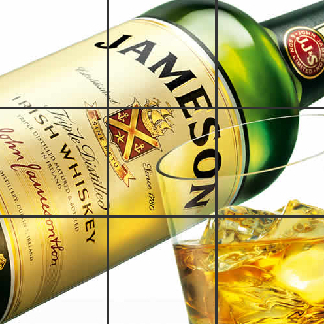 A word to the wise Old Lifer who may be out celebrating St. Patrick’s Day. Don’t! It’s an Irish festivity for a Roman Catholic Saint. You’re Protestant. Just stick to Sundays, Mother’s and Father’s Days, and July 4th.
But if you do go out to make up for the Roman Catholics who gave up whiskey for Lent, keep in mind that Bushmill’s is the Protestant Irish whiskey, produced as it is in Northern Ireland, which may be the oldest active distillery in the world.
Jameson, by contrast, is the Roman Catholic whiskey, made in County Cork.
A recent piece in the Washington Post made the arresting point that the religious identities of Irish whiskey is nonsense:
There is a dicey — and misguided — aspect of Irish whiskey loyalty that splits along partisan lines. I’ve known a lot of older Irish Americans who will drink only Jameson because it is considered the “Catholic” whiskey, as opposed to Bushmills, which is perceived as the “Protestant” whiskey. During grad school in Boston, I drank once or twice in a hard-core Irish pub where you might come to physical harm if you ordered a Bushmills. (That bar also passed around a hat once a night, and you were strongly “encouraged” to donate to “the cause”).
This idea of Catholic vs. Protestant whiskey is bunk. For one thing, from 1972 to 2005, coinciding with some the worst of The Troubles, both distilleries were owned by the same company, Irish Distillers, before Bushmills was sold to Diageo. Jameson is now owned by Pernod Ricard, a French conglomerate. Also, John Jameson was a Scotsman, and therefore in all likelihood a Protestant.
Still, the perception persists. As we were tasting, one of my friends, Kevin Meeker, who owns an Irish pub in Philadelphia called the Plough and the Stars, gave a thumbs up to Bushmills Black Bush blended whiskey. He texted his Irish managing partner, Patrick Nester, at the bar and asked whether they sold a lot of Bushmills. Nester’s reply: “Not much because u idiots think it’s a Protestant whiskey.” Perhaps it’s best, as usual, to avoid discussing religion and politics while drinking.
Maybe the confessional difference between Irish whiskies no longer holds. But in the age of Evangelicals and Catholics Together, maintaining the legitimate antagonisms between Rome and its Christian protestors is imperative. For Old Lifers it’s a treat if you can do so with spirits.
Be careful out there.
 Old Life