
If you would like to receive the entire issue, contact me on X @oldlife or via email and I will send a PDF. Here’s the introduction of the lead article by R. Scott Clark: The… More

Reformed Faith and Practice
If you would like to receive the entire issue, contact me on X @oldlife or via email and I will send a PDF. Here’s the introduction of the lead article by R. Scott Clark: The… More

Looks like the folks at Google have a better read on two-kingdoms theology and Christian nationalism than those at Microsoft. When you ask Chat GPT “which is a greater threat to American society Christian nationalism… More
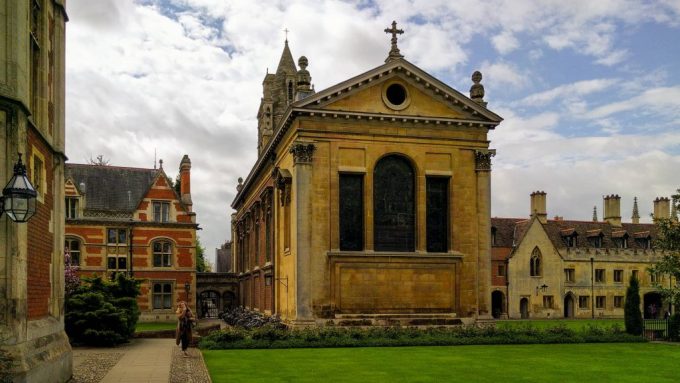
The first of these posts compared Hillsdale College and Covenant College as Christian liberal arts colleges by their course requirements in each respective institution’s core curriculum. This follow up calls attention to Professor Jay Green’s… More

Professor Jay Green’s thoughts about Covenant College and Hillsdale College have come and gone but his two articles do raise a couple of questions that may be worthy of further comment. The first has to do with the curriculum of a Christian college. The second has to do with that vexing question of Christ and culture, which runs to notions about transforming culture or integrating faith and learning. This post is about the former — curriculum — and it will read like a college catalogue because it relies on course descriptions from Covenant and Hillsdale to compare the religious dimension of a liberal arts college purporting to be Christian.
In his first post, professor Green distinguished between civilizational and confessional Christian colleges. Part of the difference stems from whether faculty actually need to affirm (believe) Christian statements of faith. At Covenant they do. For Green, Hillsdale is different because it “is a civilizational Christian college” in the sense of “acknowledging and honoring the strategically important role the faith played in laying the foundations of both Western Civilization and the American Founding.” He knows that many faculty at Hillsdale “also embrace Christianity in a confessional sense.” But because belief is not required at Hillsdale, “less time and attention are given to using Christian insights to critique things like Western Civilization and the American Founding.”
By the way, somewhere in here is a big point about ecclesiology and whether colleges should function like churches.
Not to be missed as well is an apparent assumption that Green does not develop — the idea that if you believe and teach Christianity you will critique Western Civilization and the American Founding. Does he mean to suggest that true believers will automatically be skeptical of the West and the United States? Or will they simply be willing to be critical, just as they would criticize Chinese or Islamic civilization and China and Indonesia? Or is he simply hinting that because Hillsdale is not sufficiently critical of the West and America — it is very political according to Green — the college loses its Christianness.
Whatever Green means about the relationship between Western civilization, the United States, and Christianity, his understanding of a confessional college leaves out what the apostle Paul included, namely, that those who preach the gospel out of envy or spite should be praised as long as they preach the gospel. That is, no matter the motives of the preacher or the faculty member, the content of what they preach or teach should be of first importance.
If catalogues are revealing, here is Covenant College’s description of basic courses in their core curriculum.
COR 100 The Christian Mind
This course is designed to introduce newly enrolled students to the general scope and distinctive emphases of a Covenant College education. The first portion of the course focuses on our calling in Christ and some of its implications for the task of being a student. The second portion introduces students to the Reformed tradition; and the third portion invites students to join with the faculty in addressing challenges that the tradition currently faces. 2 hours.
COR 225 Cultural Heritage of the West I
This course fosters cultural literacy by surveying important philosophical, theological, literary, scientific, and aesthetic ideas which have shaped Western culture. It begins with the earliest origins of Western culture in ancient Semitic (including Old Testament) and Greek cultures, then considers the transformation of these earlier influences successively in Roman culture, the rise of Christianity, the medieval synthesis of classical and Christian sources, and the Renaissance and Reformation. The course includes exposure to important works or primary sources, critiqued from a Christian perspective. 3 hours.
COR 226 Cultural Heritage of the West II
This course fosters cultural literacy by surveying important philosophical, theological, literary, scientific, and aesthetic ideas which have shaped Western culture. It considers the emergence of Modernism in the physical and social sciences from roots in the Renaissance and the Enlightenment as well as the effect of later reactions like Romanticism and Existentialism. The effect of these philosophical and scientific ideas on literature and other arts is also explored. The course includes exposure to important works or primary sources, critiqued from a Christian perspective. 3 hours.
Hillsdale in contrast spends a lot more time with the West’s cultural heritage though its catalogue says less about teaching from a “Christian perspective.” As part of the core curriculum students at Hillsdale take at least six courses — two in history, two in English, and two in Philosophy and Religion — that add up to 18 hours (ten more than Covenant). Here is what those courses are supposed to cover.
HST 104 The Western Heritage to 1600 3 hours The course will focus on the development of political cultures in Western Europe before 1600. It begins with a consideration of Mesopotamian and Hebrew civilizations and culminates in a survey of early modern Europe. The purpose of the course is to acquaint students with the historical roots of the Western heritage and, in particular, to explore the ways in which modern man is indebted to Greco-Roman culture and the Judeo-Christian tradition.
HST 105 The American Heritage 3 hours This course, a continuation of HST 104, will emphasize the history of “the American experiment of liberty under law.” It covers from the colonial heritage and the founding of the republic to the increasing involvement of the United States in a world of ideologies and war. Such themes as the constitutional tensions between liberty and order, opportunity in an enterprising society, changing ideas about the individual and equality, and the development of the ideal of global democracy will be examined. Attention will also be given to themes of continuity and comparison with the modern Western world, especially the direct Western influences (classical, Christian and English) on the American founding, the extent to which the regime was and is “revolutionary,” and the common Western experience of modernization.
ENG 104 Great Books in the Western Tradition: Ancient to Medieval 3 hours This course will introduce the student to representative Great Books of the Western World from Antiquity to the Middle Ages. Selections may include the Bible and works by authors such as Homer, Aeschylus, Sophocles, Plato, Aristotle, Vergil, Ovid, Augustine, and Dante. The writing content includes a variety of writing exercises that incorporate traditional compositional and rhetorical skills.
ENG 105 Great Books in the British and American Traditions 3 hours A continuation of English 104 but with a focus on Great Books in the British and American traditions. English authors may include Chaucer, Shakespeare, Milton, Swift, Wordsworth, Dickens, Yeats, Eliot; American authors may include Thoreau, Hawthorne, Melville, Whitman, Dickinson, Twain, Frost, Hemingway, Faulkner, and O’Connor. The writing emphasis continues with a variety of writing exercises that incorporate traditional compositional and rhetorical skills.
PHL 105 The Western Philosophical Tradition 3 hours A general overview of the history of philosophical development in the West from its inception with the Pre-Socratic philosophers of ancient Greece to the 20th century Anglo-American and Continental traditions. The contributions of seminal thinkers and innovators such as Socrates, Plato, Aristotle, Augustine, Aquinas, Descartes, Locke, Hume, Kant, Mill, and Nietzsche are studied. Major works by these and other important philosophers are read, analyzed, and discussed with the aim of understanding what they argued for and against in regard to metaphysical, epistemological, and ethical issues. The course investigates to what extent they influenced their own and subsequent societies, how these philosophical systems create varying views of the world and human life, and how they address the perennial questions humans universally ask, existential questions such as, “Is there purpose and meaning in life?”; epistemological questions such as, “What are the limits of human knowledge?”; metaphysical questions such as, “What is the ultimate nature of the reality in which we live?”, “Is there life after death?”, “Are humans identical to their brains?”; and ethical questions such as, “What is the fundamental criterion of right and wrong human action?” In short, the course examines the main Western philosophical thinkers and traditions in an effort to understand what they have taught, why they have so taught, and how they have helped form and shape Western civilization.
REL 105 The Western Theological Tradition 3 hours A survey of the history of Western theology, analyzing and exploring the teachings of the various theological traditions that have influenced Western Civilization. Given the dominant influence of Christianity on Western culture and society over the past 2000 years, the course makes clear the theological teachings of the major Christian traditions that have prospered and played a significant role in shaping Western societies. The connections between theology and notions of proper community and individual life, theology’s influence on Western metaphysics and ethics, and the influence theology has had on the development of modern institutions and enterprises, such as modern science, are explored. In addition, the conceptual innovations about the nature of man and his abilities which theological disputes over the nature of God and Christ have provided are pointed out and discussed. Moreover, particular notions of the religious life and of the role of religion in life that have dominated Western thought on these matters are also explored. In short, students are instructed in the basic teachings of that faith that has dominated and, until recently, to a large extent directed the course of Western civilization in order to understand how religious belief informs self-understanding, provides a comprehensive view of reality, and, by instilling a vision of human life, its purpose and proper comportment, shapes the larger culture.
One aspect to notice, irrespective of the personal convictions of professors, Hillsdale’s curriculum is set up to present Christian context for the West and American government and culture. This instruction may be too friendly to Western culture and the United States, but it is very positive about Christianity. No specific confessional tradition claims to be at the center of Hillsdale’s Christian identity (though some faculty may try). But for Hillsdale to call itself a Christian college hardly looks like a bait and switch.
What is also striking is that Hillsdale delivers these courses on the West and America through specific academic departments. These courses are both in the core and at the beginning of a sequence of an academic major. Because they are not set apart in an interdisciplinary “Core” area which may be staffed by sociologists, English professors, historians, or musicians, Hillsdale’s “Core” curriculum is not set apart in a nebulous, required, general education or interdisciplinary part of the curriculum, something that students check off before getting to real courses in English, history, and philosophy. At Hillsdale, the core courses are the real courses (even if students still check boxes when taking them because of curricular requirements). This likely accounts for why Hillsdale has so many majors in English, history, and philosophy.
The exception to this pattern at Covenant are the required “Core” courses in Bible and Theology.
BIB 111 Old Testament Introduction
This course introduces the basic theological themes, chronological framework, and literary character of the Old Testament with a focus on Genesis – Kings. It aims to provide: 1) the foundations for theological interpretation of the Old Testament, giving special attention to the covenantal framework for redemptive history; and 2) an introduction to critical theories concerning the authorship, canonicity, integrity and dating of the documents. 3 hours.
BIB 142 New Testament Introduction
The course will deal with 1) questions of introduction (authorship, canon, inspiration, integrity of the documents, dating, etc); 2) beginning hermeneutics; 3) inter-testamental history as a background to the New Testament, as well as 4) a study of the historical framework of the New Testament as a whole, and key theological concepts. 3 hours.
BIB 277 Christian Doctrine I
A survey of the major doctrines of the Christian faith. First semester investigates the biblical data on Scripture, God, man and Christ. Second semester investigates the biblical data on the Holy Spirit, salvation, Church and last things. The Westminster Confession of Faith and Catechisms serve as guidelines and resources. 3 hours.
BIB 278 Christian Doctrine II
A survey of the major doctrines of the Christian faith. First semester investigates the biblical data on Scripture, God, man and Christ. Second semester investigates the biblical data on the Holy Spirit, salvation, Church and last things. The Westminster Confession of Faith and Catechisms serve as guidelines and resources. 3 hours.
These four courses give Covenant a leg up on Hillsdale, especially if you are a Presbyterian. Covenant requires two courses that survey study of Scripture, and two that summarize Christian doctrine. These arguably constitute the most confessional pieces of Covenant’s education. But because professor Green is more concerned with what faculty believe and profess, he spends little time in his published pieces on curriculum and academic departments.
What may be the most important difference between the two colleges is the way they conduct a liberal education. Both schools advertise themselves as liberal arts colleges. But at least at their websites, Hillsdale uses language that informed a long line of liberal arts colleges in the United States. Covenant’s statements are much less liberal education-inflected and bear some of the conviction of a Bible college where the Bible is pre-eminent and the arts and sciences are second string.
Consider this answer at Covenant to the FAQ, what makes Covenant different from other top-rate liberal arts colleges?
At Covenant, why you learn something is every bit as important as what you learn. Here, you will learn to see God in every facet of your life, and you will be personally taught by acclaimed professors who could teach virtually anywhere in the world and choose to be here.
At Hillsdale’s website the following describes the College’s commitment to a liberal arts core curriculum:
Liberal learning produces cultivated citizens with minds disciplined and furnished through wide and deep study of old books by wise authors. . . . It does so by leading forth students into a consideration of what has been called, “the best that has been thought and said.”
For what it’s worth, until the so-called fundamentalist controversy, Protestant denominational colleges (even Free Will Baptists) had no trouble offering a Christian and liberal education. Those colleges offered way more courses in the arts and sciences than they did in Bible and theology. Then when the mainline Protestant denominations started to go liberal (theologically) and dabbled with notions of God revealing himself as much through literature as through Scripture, fundamentalist-leaning Protestants turned to the Bible as the core of the college curriculum — first at Bible colleges and then at liberal arts schools like Wheaton, Gordon, and Westmont. How Hillsdale pulled off what it has — a return to the Protestant denominational Christian liberal arts college without being exclusively Protestant — is anyone’s guess.
If professor Green is a bit befuddled in pigeonholing Hillsdale College, he is not alone.

(From the Winter 2010 Nicotine Theological Journal)
After a visit to my father at his local hospital, I had a worldview moment. What should have alerted me from the outset was the name of the place – St. Mary’s. But then I noticed that the spiritual services wing of the hospital had dropped off for him a brochure about their activities which was included with information about television channels and daily menus – talk about trivializing the eschaton. But the kicker was the crucifix in my dad’s ICU room. Shazzam!!! That’s a whole lot of idolatry for a man who is on a heart monitor.
But is Roman Catholic medicine really any different from Reformed medicine or even – dare I say – secular medicine. If worldviews go all the way down to the very tips of our toes, and if we can’t escape the claims of Christ in any parts of our lives, can I really look the other way in good conscience when entering a hospital room that displays an image of Christ on a cross?
And then there is the concern for quality of health care. If Abraham Kuyper was right that Roman Catholicism “represents an older and lower stage of development in the history of mankind” and if Protestantism occupies a “higher standpoint,” shouldn’t my dad try to find treatment at a Protestant hospital? Kuyper, by the way, wasn’t real complimentary of Roman Catholicism on science either.
It could be that I have once again misunderstood the claims of neo-Calvinism and that some algorithm exists for taking the gold of scientific advances from the dross of defective worldviews. But it could also be that the language of worldviews and the difference they make for every aspect of human existence is overdone, simply a rallying cry for inspiring the faithful, but not anything that would prevent my father from receiving treatment from unbelieving nurses employed by Roman Catholic administrators. Then again, the power of modernity is stunning, making all of those religious claims about connections between spiritual and physical reality look fairly foolish – as if a creed actually produces better medicine.
I mean no disrespect to the neo- Calvinists and their epistemological purity. But if they could help me out on this one, I’d be grateful. Does a Reformed worldview really make a difference for modern medicine and the ordinary decisions a sick believer must make in seeking a physician or hospital – under the oversight, of course, not of the elders but the insurance company?

The year of living Machenly prompted much attention from this writer to Machen’s training as a classicist prior to becoming a scholar of the New Testament. One instance of his serious reflection on the differences between pagan myths of gods begetting humans and the birth narratives of the New Testament came in his book, The Virgin Birth of Christ (1931). One important difference was lust. Another was polytheism:
In the pagan stories of divine begetting, polytheism is not merely incidental; it is the centre and core of the whole complex of ideas. But in the New Testament story of the virgin birth of Christ, the lofty Old Testament monotheism is abated not a whit; the awful transcendence of God, the awful separateness of God from the world, is never lost from view. Where in the New Testament story is there found any hint of a love of God for the maid of Nazareth, which could be analogous to the love of a husband for his wife? The question can scarcely even be asked, by any man of literary taste—-to say nothing of any devout Christian—without a shudder. Yet it would have not only to be asked, but also to be answered in the affirmative, if the theory with which we are now dealing were correct. The love of the gods for mortal women is the very point of the pagan stories—the thing without which they could not possibly exist. To mention any such thing in connection with the narratives in Matthew and Luke is to do violence to the whole spirit of those narratives. The truth is that when we read these narratives we are in a totally different world from that which produced the pagan stories of the loves and hates of the gods.

From the Archives: Nicotine Theological Journal (Spring 2022)
All Law, No Gospel
Even before the soldiers of justice activism landed (social justice warriors is so tired), left-of-center Progressives could praise the United States for being on the right (read moral) side of debates and events. In 2013, Aaron Sorkin penned these words for his “Newsroom” (HBO) character, Will McAvoy (played by Michigan’s own Jeff Daniels). Of course, on the grounds by which conservatives calculate American greatness, Sorkin was fashionably negative:
[T]here is absolutely no evidence to support the statement that we’re the greatest country in the world. We’re seventh in literacy, twenty-seventh in math, twenty-second in science, forty-ninth in life expectancy, 178th in infant mortality, third in median household income, number four in labor force, and number four in exports. We lead the world in only three categories: number of incarcerated citizens per capita, number of adults who believe angels are real, and defense spending, where we spend more than the next twenty-six countries combined, twenty-five of whom are allies.
But when it came to America’s proud past, McAvoy sounded a very different note and national wholesomeness was its organizing theme:
We sure used to be [great]. We stood up for what was right! We fought for moral reasons, we passed and struck down laws for moral reasons. We waged wars on poverty, not poor people. We sacrificed, we cared about our neighbors, we put our money where our mouths were, and we never beat our chest. We built great big things, made ungodly technological advances, explored the universe, cured diseases, and cultivated the world’s greatest artists and the world’s greatest economy. We reached for the stars, and we acted like men. We aspired to intelligence; we didn’t belittle it; it didn’t make us feel inferior. We didn’t identify ourselves by who we voted for in the last election, and we didn’t scare so easy. And we were able to be all these things and do all these things because we were informed. By great men, men who were revered. The first step in solving any problem is recognizing there is one—America is not the greatest country in the world anymore.
Lest it miss anyone, this was three years before the Trump presidency and MAGA merch. Sorkin’s script shows that MAGA was not an alien force in national life. It was the norm.
One hundred years before “Newsroom” aired on HBO, H. L. Mencken also noticed that moralism was a defining trait of American culture. It was synonymous with both Calvinism and Puritanism in his Germanophilic mind:
That deep-seated and uncorrupted Puritanism, that conviction of the pervasiveness of sin, of the supreme importance of moral correctness, of the need of savage and inquisitorial laws, has been a dominating force in American life since the very beginning. There has never been any question before the nation, whether political or economic, religious or military, diplomatic or sociological, which did not resolve itself, soon or late, into a purely moral question. .. . The frank theocracy of the New England colonies had scarcely succumbed to the libertarianism of a godless Crown before there came the Great Awakening of 1734, with its orgies of homiletics and its restoration of talmudism to the first place among polite sciences. . . .
Thereafter, down to the outbreak of the Civil War, the country was rocked again and again by furious attacks upon the devil. On the one hand, this great campaign took a purely theological form, with a hundred new and fantastic creeds as its fruits; on the other hand, it crystallized into the hysterical temperance movement of the 30’s and 40’s, which penetrated to the very floor of Congress and put “dry” laws upon the statute-books of ten States; and on the third hand, as it were, it established a prudery in speech and thought from which we are yet but half delivered.
Say what you will about the accuracy of Mencken’s depiction of Puritanism, his diagnosis of American moralism was even prophetic when he described the activism of the Progressive era in terms that make sense of the United States post-Trump, post-George Floyd, post-Lia Thomas:
The new Puritanism is not ascetic, but militant. Its aim is not to lift up saints but to knock down sinners. Its supreme manifestation is the vice crusade, an armed pursuit of helpless outcasts by the whole military and naval forces of the Republic. Its supreme hero is Comstock Himself, with his pious boast that the sinners he jailed during his astounding career, if gathered into one penitential party, would have filled a train of sixty-one coaches, allowing sixty to the coach.
From the Archives: Nicotine Theological Journal (Spring, 2009)
Making Sense of the PCA
I have been a minister of the Presbyterian Church in America from its founding. I attended the Convocation of Sessions, the Advisory Convention, and the first General Assembly in 1973. I have not been what one would call “a player” over the past 30 years, but I have been “involved.” I was one of the early Reformed University Ministry (RUM) campus ministers, had a full term as a member of the Committee on Mission to the World, and served on the Creation Study Committee. I edited work for children’s curriculum for Great Commission Publications. I have traveled to Japan, Philippines, Ukraine, France, and Turkey in connection with MTW mission work.
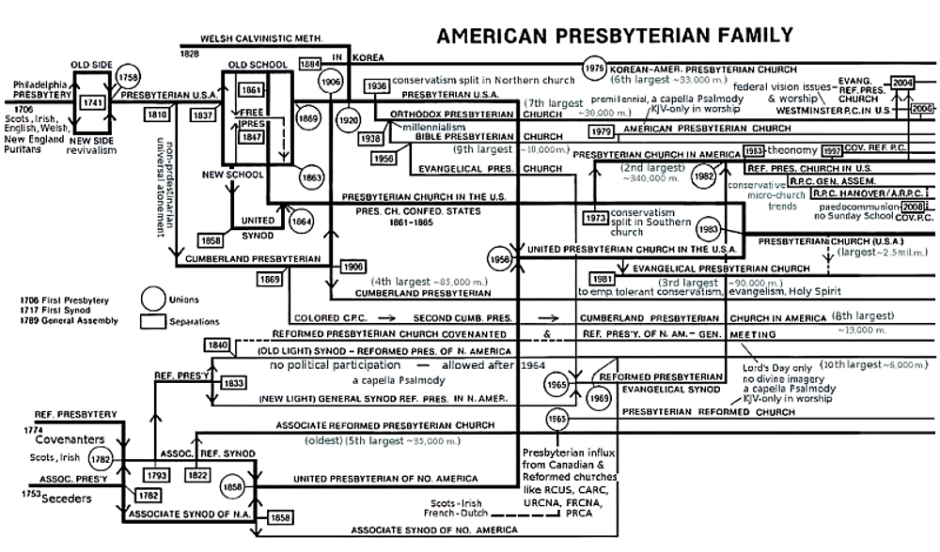
As our denomination has experienced recent tensions about confessional subscription, our mission, and worship, I have struggled to understand how we got here. My working hypothesis is that the PCA is a majority New Side/New School Presbyterian Church, with a substantial minority that is either New Side/Old School or Old Side/Old School.
The differences between the Old and New Side Presbyterians focused primarily on their differing views of revivals. The New Side believed the revivals or George Whitefield, which first disturbed and then converted sinners within and without the church and awakened and stirred to holiness and action true believers, had biblical precedents. Itinerant ordained and non-ordained speakers were often the instruments of revival. Religious experience was intensely personal and greatly concerned with whether or not one had been genuinely converted.
Old Siders had a higher view of the church as an institution, more confidence in the work of settled, ordained ministers carrying out the ordinary ministry of word and sacrament, and a greater emphasis on corporate religious life. Tensions over subscription pushed New Siders toward a looser view, with the Old Side arguing for strictness. Neither side was monolithic.
If the First Great Awakening balkanized the Old and New Sides, the Second Great Awakening returned the favor for the Old and New School Presbyterians. Despite this similarity, the major issue in the nineteenth century was not revivalism but confessionalism. Old Schoolers had differing appraisals of the earlier awakenings, but they shared a growing unease about the Second Great Awakening with its Arminian theology and its new measures.
In order to defend the theology of the Second Awakening New Schoolers had to take a broad view of the Westminster Standards and a much weaker view of what was involved in an officer’s ordination vows. The New School strongly favored mission over theology while the Old School held that theology defines and directs mission. Because of its emphasis on mission the New School favored working with parachurch societies to accomplish evangelism and missions, while the Old School believed the church alone was responsible for spreading the gospel and building up the saints. Part of the mission-orientation of the New School was its commitment to engage social issues, such as slavery and temperance, as part of an effort to Christianize America. Old Schoolers countered with the spirituality of the church. Not surprisingly, the New School had a low view of the church while the Old School maintained and defended jure divino Presbyterianism.
How does this explain the PCA? In my view, the majority of the PCA consists of three groups all of which share a New Side/New School orientation: the Columbia Seminary founding generation, the Reformed Presbyterian Church, Evangelical Synod (RPCES) influx, and the rising leadership consisting primarily of large urban/metropolitan church pastors and denominational executives.
Most of the founders of the PCA had been educated at the most conservative of the PCUS (Southern Presbyterian) seminaries in the 1950s and 1960s. While Columbia could trace her heritage all the way back to Thornwell, the most eloquent Southern Old School voice, little remained of Thornwell’s influence (William Childs Robinson being the exception) by the time PCA leaders received their training at Columbia. Students were considerably more conservative than the faculty at Columbia, but they were never much exposed to the old Confessional orthodoxy of the Southern Church. They believed in the Bible, in “the fundamentals,” in the gospel, and in evangelism and missions. They took their ordination vows with sincerity but they did not consider how those vows bound them to the Westminster Confession. In fact, many of these brothers were influenced by teachings that were inconsistent with Calvinism. I think of semi-Pelagianian, Invitation System revivalism, dispensationalism, and perfectionism. In addition, they were suspicious of church institutions and authority (having witnessed and experienced the corruption and abuse of the mainline Southern church) and were eager to cooperate with any evangelicals to win the world for Christ, maybe even “in this generation.”
It was not clear at the time of Joining and Receiving (J&R) in 1982 what the impact of the influx of the RPCES would be, but time has proved that it broadened and strengthened the New Side/New School segment of the PCA. The RPCES was the result of the union of the dwindling Reformed Presbyterian Church in North America, General Synod (a “new light” break-off from the Covenanters), and the larger Evangelical Presbyterian Church (from the McIntire wing of 1936.) Although RPCES was more Reformed and Presbyterian than McIntire’s Bible Presbyterians, its roots remained New School, and, though there was some indication the RPCES might move toward Princeton Old School positions, this did not materialize. The RPCES was and remains New Side/New School and so injected into the PCA another dose of New Side/New Schoolism.
What then of the rising leadership? The one word, which best catches the outlook and agenda of this group, consisting primarily of large urban pastors and denominational executives, is “missional.” In the New Side/New School tradition, mission is the church’s defining characteristic and responsible for its vitality and unity.
This “missional” orientation has been notably evident in recent worship services at the General Assembly. Mission requires us to rethink what it means to be church and to sit loose on doctrinal formulations, on polity issues, on how we worship, and on what the nature of the mission of the church is, so that as we understand more of this “post-everything” culture and figure out how to respond, we can make the necessary adjustments to further the church’s mission. This is decidedly the New Side/New School outlook, dressed in new clothes, but with the substance of the body unchanged.
This represents the majority of the PCA’ teaching and ruling elders. A majority holds to the New Side/New School type of Presbyterianism. At the same time a substantial minority in our church, with Old and New Side proclivities, holds to Old School Presbyterianism. This means that issues of doctrine, polity, subscription, worship, and mission remain live ones for the foreseeable future. The soul of the church is at stake for both the majority and minority.
William H. Smith is pastor of Covenant Presbyterian Church (PCA) in Louisville, Mississippi.

I was on the fattish side as an infant, with a scow-like beam and noticeable jowls. Dr. C. L. Buddenbohn, who fetched me into sentience at 9 P.M., precisely, of Sunday, September 12, 1880, apparently made a good (though, as I hear, somewhat rough) job of it, despite the fact that his surviving bill, dated October 2, shows that all he charged “to one confinement” was ten dollars. The science of infant feeding, in those days, was as rudimentary as bacteriology or social justice, but there can be no doubt that I got plenty of calories and vitamins, and probably even an overdose. There is a photograph of me at eighteen months which looks like the pictures the milk companies print in the rotogravure sections of the Sunday papers, whooping up the zeal of their cows. If cannibalism had not been abolished in Maryland some years before my birth I’d have butchered beautifully. (Happy Days, 1940)

From the Archives: Nicotine Theological Journal (January, 1999)
Just Grow Up
A recent visit to Yale, complete with watching a Yale-Princeton hockey game, reminded us of the suffocating ubiquity of post-1950s popular culture. Being some twenty years removed from college life it was curious to see Yale undergraduates participating in the rah-rah spirit that college students of our generation studiously avoided in the name of being independently cool. Even more surprising was to see the overwhelming support for the Yale band, an extracurricular activity that certain boomers associated with losers and nerds. But here we were, in 1998, watching kids supposedly indoctrinated in the dogma of political correctness and postmodernism not just playing in but singing along with the band. Perhaps even more remarkable was that these nineteen- and twenty-year olds knew the words to the songs the band played. The Rolling Stones, the Beatles and Credence Clearwater Revival – it didn’t matter. These students sang along. The scene was almost surreal. These college students were joining in the singing of music that in our generation was supposed to be a pronounced statement against joining anything. Of course, one of the great myths of popular culture is that of the solitary individual who does his own thing, even while two-thirds of the teenage population are doing exactly the same thing.
BUT ASIDE FROM REVEALING the conformist side of pop culture’s individualism, this scene also spoke volumes about the triumph of rock ‘n roll. Who could have imagined college students in the 1960s and 1970s singing with the college band to popular songs three decades old? Would any of us have known the words to the songs of Frank Sinatra or the Andrews Sisters? So why then won’t John, Paul, Ringo and Mick just go away? Perhaps, an even more pressing question is why people are not embarrassed to continue to live like teenagers even when they are in their forties and fifties?
One way of considering this question is to contrast the Rolling Stones’ relatively recent tour (lots of 1970s bands are doing retrospective treks, we understand) with what Frank Sinatra did for almost all of his life and with what Tony Bennett continues to do – that is, sing the songs that made them stars. It was not the least embarrassing for Sinatra to sing his kind of music because it was and is adult (don’t ask for a definition; it’s like pornography). It may not be Mozart or Vaughn Williams, but the way of singing, combined with the ethos such songs create, do not require listeners or adoring fans to act like teenagers. In other words, no one thought Frank silly singing his songs into his eighties. The same cannot be said for Mick Jagger. In fact, one cannot think of a more laughable sight than a man who is a grandfather acting like he is still the high-school deviant whose only care seems to be questioning all forms of authority.
WHICH RAISES A FURTHER question – why the triumph of rock ‘n roll in most sectors of Christian worship? Why has perpetually adolescent music become appropriate for expressing praise and adoration to the God of Abraham, Isaac and Jacob? This is not to suggest that ballads like those made popular by Sinatra would be fitting. Our preference runs to the Psalms of the Old Testament set to tunes that are either singable by all generations or chanted. But the triumph of rock ‘n roll, whether soft or not, seems to run contrary to the apostle Paul’s instructions in Titus where he told older men to be temperate, serious, and sensible, and older women to be sensible, chaste, and domestic. If this is indeed conduct fitting sound doctrine, in fact, if gravity and self-control are virtues that sound doctrine is supposed to produce, then why has Christian worship become the arena where the musical forms of the Stones, Beatles and CCR, already domesticated, are now baptized?
Of course, our culture has many problems, but it does not say good things about our churches that by failing to see any difference between serious and frivolous music they are also in danger of losing the ability to distinguish adolescence from maturity. Of course, churches who follow the lead of pop culture may become as mainstream and as ubiquitous as the Stones, but they are likely to look just as silly when they turn fifty.

From the Archives: Nicotine Theological Journal (October, 1997)
Prostitution: A Modest But Entirely Reformed Proposal
In all of the discussion in Reformed circles about the role of women in modern society, one topic has been sadly neglected. This topic relates to a profession occupied by women for centuries, but for which their contribution has never been recognized or appreciated, especially by Reformed people. Indeed this profession has usually been vilified even though the women practicing it, themselves had often been victims of the worst sort of brutalization. I speak of the profession of prostitution.
The church for centuries, in an oppressive and patriarchal manner (I may be guilty of redundancy here), has censured prostitution. But have we ever carefully examined this traditional stance of the church? In this modern time may not the spirit lead us into some new examination of the Scriptures and some new understanding of this complex issue? Have we taken seriously the testimony of women that they feel called to and fulfilled by this work? For many the money is good. Just as we have learned that making money on the Sabbath is good in the modern world, so in the matter of prostitution we may need to rethink.
Three Pillars
Let me suggest that the case for prostitution rests on three pillars. The first pillar is the key text of Scripture: “Whatever you do, do it all for the glory of God” (I Corinthians 10:31). The second is the clear parallel between slavery and prostitution. The third is understanding properly those texts that seem to condemn prostitution.
THE FIRST PILLAR IS CRUCIAL. I Corinthians 10:31 shows that Paul has completely broken with old forms of ethical thinking and made ethics radically teleological. Actions must be judged solely by whether the intention is to glorify God or not. Paul says that what appears to be an act of idolatry -eating meat offered to idols- is not idolatry if the intention is to glorify God. This radical reorientation of ethics has been largely missed by the church through the centuries, but it is time to allow this seminal verse to have its full weight in our thinking. It is not actions but intentions that determine whether something is right or wrong. Our children have been trying to help us see this point for a long time with their oft repeated observation, “I didn’t mean it.”
Once this text really grips us, we cannot help but see its application to prostitution. It is not the action, but the intention that is crucial in evaluating any human activity. If one feels called to glorify God in the calling of prostitution, then it surely is the Bible-approved thing to do.
The Bible itself gives clear application of this great principle in the case of Rahab. Rahab the prostitute is a model of faith, courage, and devotion. Scripture nowhere condemns her for being a prostitute or says that she ceased to be a prostitute. Obviously she continued to be a faithful prostitute.
THE SECOND PILLAR IN THE defense of prostitution is the obvious parallel to slavery. Prostitutes, like slaves, have often been treated like chattel. They have been abused, victimized and oppressed. They have been controlled by heartless pimps as slaves were by cruel masters.
Historically the church has sought to remedy prostitution by urging prostitutes to stop being prostitutes. But isn’t that like suggesting to slaves that the problem with slavery was the work rather than the bondage? Prostitutes do not need to stop working; they need to be liberated. They need to have their work honored and properly compensated. They need freedom to practice their profession when, where and how they choose. That kind of liberation was the solution to slavery and is clearly the only responsible solution to the enslavement of prostitutes.
The third pillar relates to biblical texts that seem to oppose prostitution. Indeed some may feel at the outset that the biblical position is so obvious that no further examination is necessary. But the history of the church teaches us that there are always alternative perspectives and interpretations of every text in the Bible. We must not feel bound to any traditional interpretation- which is, after all, just the work of men- but must be open to new ideas and the leading of the spirit. (See Jeremiah 42 and 43.)
Two kinds of texts have been used to oppose prostitution. First are the OT’s warnings about harlotry. While these texts are numerous, they are not meant to be universal in their application. In OT times prostitutes were associated with pagan temples and pagan worship. The harlotry condemned in the OT is the harlotry that links sex to idolatry and false religion. Modern prostitution has nothing to do with idolatry and so is not condemned in these texts.
The second set of texts that seems to condemn prostitution are those related to the seventh commandment, “You shall not commit adultery.” Some of you will think that this text is crystal clear. But think again. Adultery is a violation of the spiritual-physical union of a marriage. But prostitution has nothing to do with spiritual unions. It is a purely physical relationship, and so it cannot effect the personal union of marriage. Moreover many social scientists believe that prostitution has beneficial social consequences. Therefore we should recognize that prostitution is not condemned by the seventh commandment.
Now some may think that there is a still clearer biblical condemnation of prostitution. Paul did say, “Do you not know that your bodies are members of Christ himself? Shall I then take the members of Christ and unite them with a prostitute? Never!” (I Corinthians 6:15). But let us not approach this text as if we were fundamentalists. We must recognize that Paul has not given full play to his basic teleological ethics in this text. (Perhaps he even intended that I Cor 10:31 be a correction of his statement here in I Cor 6:15.) Paul seems confused about the relation of the physical with the spiritual in this one place- a confusion which he avoids in the main thrust of his writing. He probably wrote this way to encourage us to use our ingenuity to figure out his real, full meaning. In any case it is clear that Paul cannot mean what he says.
THE CONCLUSION WE MUST reach is that prostitution is not condemned in the Bible. If it is not condemned, then it must be legitimate. Indeed the general thrust of the Bible not only permits it, but rather tends to encourage it- if done to the glory of God. We may well be disobedient to God if we oppose prostitution.
My modest proposal will not, I expect, gain immediate, universal support. Such proposals seldom do. Jonathan Swift experienced that with his original “Modest Proposal” when he suggested during a famine in Ireland that parents should eat their children. Yet the reasonableness and practicality of this proposal have stood the test of time. There can be no doubt that fewer adults would have died if they had eaten their children.
My conclusion that prostitution is not only legitimate, but that it is one more profession to be redeemed by earnest Christians, may seem radical at first glance. But, thoughtful reader, I want to assure you that this conclusion has been reached following the hermeneutical principles laid down by Louis Berkhof. Indeed, this conclusion was in many ways anticipated by the great Reformer Martin Luther. He once said, “All callings are honorable with the possible exceptions of burglary and prostitution.” This great student of the Scriptures was already beginning to see the radical implications of teaching that every profession is a calling.
SO WHEN YOUR DAUGHTER comes to you with tears in her eyes and asks, “Mom and Dad, why can’t I be a prostitute?”, don’t be harsh, judgmental or old-fashioned. Don’t undermine her self-esteem. Don’t stand against the work of the Spirit to break down oppression and to redeem another area of life. Encourage her to use all her gifts. Encourage her to pursue her calling.
Thanks to the new hermeneutic, whoring has become honorable in the church.
I. M. Free
From the Archives: Nicotine Theological Journal, January 1999
Mere Confessionalism
“In essentials, unity; in non-essentials, liberty; in all things, charity.” This is the motto of the Evangelical Presbyterian Church. (The expression itself is of some antiquity, and it may date back as early as St. Augustine.) At its founding in 1981 the EPC adopted a modern language version of the Westminster Confession of Faith as its doctrinal standard. At the same time it also adopted an eight- point “Essentials of our Faith” summary statement. The latter contains boiler-plate evangelical affirmations on the Bible, God, Christ, sin, salvation, and eschatology, in language that is mildly and non-militantly Calvinistic.
Are these two documents competing doctrinal standards? An interesting debate is playing out in the EPC now regarding what confessional status, if any, its “Essentials” possess and how they relate to the Westminster Confession. The “Essentials” themselves end this way: “These Essentials are set forth in greater detail in the Westminster Confession of Faith.” But rather than solve the question, that ambiguous language only heightens the confusion. Does it mean that the WCF itself – taken as a whole – is the “Essentials” in fuller form, or merely that these eight affirmations can each be found there as well? Are the “Essentials,” in other words, what the church really believes? Should the emphasis fall on the first or second word in the denomination’s name, “Evangelical Presbyterian Church”?
MOST CONSERVATIVE Presbyterians would likely contend that the EPC has misidentified the essentials of the faith. After all, it is open to women in church office and the ongoing exercise of the charismatic gifts. At the same time, the EPC debate is instructive, because its conservative Presbyterian critics also tend to employ some form of what can be called the hermeneutic of essentials, of identifying what the church may or may not tolerate. Presbyterian theologian, John Frame, for example, in urging the creation of leg room within the confessions, laments that “the whole question of what is and what is not tolerable within the church has not been systematically analyzed.”
Frame’s quest is not new. Efforts to isolate the “essentials” within the confession are almost as old as Presbyterianism itself. Frequently, it has been the progressives who have been eager to speak of a “system of doctrine,” in order to permit their deviation from the Confession and catechisms of the church. By “system” they mean the Confession “in-as-much” as what the Confession teaches is biblical. In this fashion, Presbyterian officers hold line-item vetoes to the church’s Constitution, and the church had erected a Confession-within-the-Confession.
But it is not only progressives who speak this language. In efforts earlier in this century by conservative Presbyterians to preserve the essence of historic Christian orthodoxy, some upheld the minimal necessity of the “five fundamentals” of the faith. The unintended effect was to reduce the “essential and necessary” articles of the church’s constitution to just five.
Especially of late the rhetoric of essentials is invoked in order to separate the Bible from the Confession in the name of the Reformation principle of sola scriptura. (Indeed, often it is phrased in the language of liberating the Bible from the confession.) Increasingly Presbyterian officers seem to be declaring, “never mind the Confession, show me where that is taught in Scripture.” But for Presbyterians, an officer is committed to sola scriptura precisely to the extent that he is a Confessionalist. Confessionalism does not eclipse the doctrine of sola scriptura. Rather, a confession is the necessary means for the church to uphold Biblical authority. The Presbyterian way to point to the doctrine of Scripture is to refer to the Confession.
FRAME DESCRIBES THIS VIEW AS chauvinistic. “Although I am a Presbyterian,” he writes, “I confess that I do not share [the] desire for us always to ‘look like Presbyterians’ before the watching world.” In context, Frame’s concern is specifically about worship, but by implication his views bear upon the relationship between The Nicotine Theological Journal will likely be published four times a year. It is sponsored by the Old Life Theological Society, an association dedicated to recovering the riches of confessional Presbyterianism.
IN DESCRIBING HIS STUDENT days at Westminster Seminary (in the early 1960s), Frame recalls two features of that course of instruction: it lacked an overt “confessional or traditional focus” and there was a spirit of creativity and openness in theological reflection. He goes on to make a startling admission: “After graduation I became ordained in the Orthodox Presbyterian Church, and I confess I was rather surprised at the seriousness with which my fellow ministers took the confessional standards and the Presbyterian tradition. Eventually I became more like my fellow Orthodox Presbyterian . . . elders, but not without some nostalgia for the openness of theological discussion during my seminary years.”
Our point is not to critique WTS or any other seminary. And whether Frame has described with accuracy the curriculum of WTS in the 1960s is not our concern either. But what is revealing is the dichotomy that Frame creates between “perpetuat[ing] and recommend[ing] the confessional traditions” on the one hand (which is where he finds WTS’s education flawed), and a “flourishing of original and impressive theological thought” on the other (where he thinks WTS excelled). This difference he goes on to attribute to Westminster’s understanding of sola Scriptura, which liberated the school from traditionalism and confessionalism.
BUT FRAME’S DICHOTOMY WAS unknown to previous generations of Reformed theologians. Calvin Seminary’s Richard Muller writes the following on the harmony of Scripture and confession: “We need creeds and confessions so that we, as individuals, can approach Scripture in the context of the community of belief.” Confessions function as mediating structures, standing between Scripture and the “potentially idiosyncratic individual” as “churchly statements concerning the meaning of Scripture.” They are “normative declarations spoken from within by the church itself . . . as the expression of our corporate faith and corporate identity.”
Muller’s work on Reformed scholasticism reminds us that there was a time when confessional integrity did not compete with sola scriptura, nor did it impede theological creativity. For the scholastic mindset, Muller notes, “Once a churchly confession is accepted as a doctrinal norm, it provides boundaries for theological and religious expression, but it also offers considerable latitude for the development of varied theological and religious expressions within those boundaries.” According to the Reformers, there is no churchman and there is no theologian where there is no confession. Why is that so unimaginable today? Why has the Reformation confidence in the creeds of the church vanished?
AS WE PREVIOUSLY ARGUED (“Sectarians All,” NTJ 2.2), such anti-traditionalism only serves to locate one within a specific tradition, namely the Enlightenment, and its false claim that an individual Christian, armed with autonomous rationality can approach Scripture from a traditionless perspective. The Reformers, Muller claims, refused to approach Scripture with the false dilemma forced upon the church by its adoption of categories of Enlightenment thought.
Muller goes on to describe other pressures that our age brings to confessional integrity. He refers to the “noncredal, nonconfessional, and sometimes even anticonfessional and antitraditional biblicism of conservative American religion.” Enlightenment rationality and democratic populism combine to create what Robert Godfrey has diagnosed as the evangelical impulse toward theological minimalism. This minimalism seeks to get as many people to express everything they agree on, and preferrably on one side of one sheet of paper. These affirmations become the truly “essential truths,” and the hills for evangelicals to die on. Godfrey is echoing the thoughts of J. Gresham Machen, who in his essay, “The Creeds and Doctrinal Advance,” described this impulse in the following way:
There are entirely too many denominations in this country, says the modern ecclesiastical efficiency expert. Obviously, many of them have to be merged. But the trouble is, they have different creeds. Here is one church, for example, that has a clearly Calvinistic creed; here is another whose creed is just as clearly Arminian, let us say, and anti-Calvinistic. How in the world are we going to get them together? Why, obviously, says the ecclesiastical efficiency expert, the thing to do is to tone down that Calvinistic creed; just smooth off its sharp angles, until Arminians will be able to accept it. Or else we can do something better still. We can write an entirely new creed that will contain only what Arminianism and Calvinism have in common, so that it can serve as the basis for some proposed new “United Church” . . . . Such are the methods of modern church unionism.
This impulse stands in sharp contrast to what Godfrey calls the theological maximalism of the Reformed, which sought at least in the past to extend the boundaries of the church’s confession in pursuit of the “whole counsel of God.” Moreover, Reformed maximalism and evangelical minimalism differ not only in the size of their creeds but in the very purpose of their creeds. To quote Machen again:
These modern statements are intended to show how little of truth we can get along with and still be Christians, whereas the great creeds of the church are intended to show much of the truth God has revealed to us in His Word. Let us sink our differences, say the authors of these modern statements, and get back to a few bare essentials; let us open our Bibles, say the authors of the great Christian creeds, and seek to unfold the full richness of truth that the Bible contains. Let us be careful, say the authors of these modern statements, not to discourage any of the various tendencies of thought that find a lodgment in the church; let us give all diligence, say the authors of the great Christian creeds, to exclude deadly error from the official teaching of the church, in order that thus the Church may be a faithful steward of the mysteries of God.
BUT IS ALL OF THIS FAIR TO evangelicalism? After all, no less an evangelical icon than C. S. Lewis contended for a “mere Christianity.” Yet Lewis himself was not confused about his beliefs, which he said were found in the Anglican Book of Common Prayer. His search for a “mere” Christianity was not an alternative to the creeds of the church. Rather, he likened it to the difference between the halls and rooms of a mansion. “Mere” Christianity may bring one into the hall. “But it is in the rooms, not in the hall, that there are fires and chairs and meals.” The “worst of the rooms,” he went on to stress (perhaps thinking of a dimly lit and drearily decorated attic of Calvinistic horrors), is to be preferred over the hall.
Whatever Lewis intended, his words have been hijacked to serve unhealthy purposes. The ambiguities of the expression, “Mere Christianity,” can be found in many of Lewis’ disciples. And when it meets contemporary evangelicalism, there is a volatile mix that may prove lethal to the theological reflection and confessional identity of the church.
CONSIDER TOUCHSTONE magazine, which had recently changed its subtitle from “A Journal of Ecumenical Orthodoxy” to “A Journal of Mere Christianity.” Its editorial purpose is to “subordinate disagreements to the common agreement” because the crisis of our day is so grave. Here we must recognize the debilitating effects of the so-called culture wars on the confessional identity of the church. Abortion, Gay rights, women’s rights, funding for and legal protection of pornographic artists, evolution in the public schools — all of these are battle fronts in the increasingly rancorous struggle over the meaning and purpose of America. And these are the causes to which Christians should devote their energy.
“We need to identify the ‘real enemy’,” urges Touchstone, and that enemy is without, not within. What is said moderately in Touchstone can be found in more virulent form in Peter Kreeft’s Ecumenical Jihad. For Kreeft, mere Christianity may not even be recognizably Christian. The moral decay of America, with all of its leading indicators of spiritual decline, is creating new alliances, even among those of differing religious convictions. The old fashioned Protestant v. Catholic v. Jewish warfare is passe. So great is the threat of secular humanism and so united are we with former antagonists on the really crucial issues, that even evangelical Christians, Kreeft predicts, will eventually arrive at the conclusion that Muslims are on the right side. They may be murdering Christians in Sudan, but at least they are not massacring unborn children. Given the real crisis of our time – the decline of Western Civilization – this is “no time for family squabbles.” This is not merely cultural warfare but spiritual warfare that will unite Protestants, Catholics, Orthodox, Jews, Muslims, Buddhists, and maybe even an occasional natural-law-advocating atheist.
(Don’t be too alarmed by all this. The Holy Spirit is at work among pious Muslims, Kreeft assures Christian skeptics, and in heaven these Muslims will come to learn that the Allah they served was the God of the Scriptures. What is more, Kreeft goes on to comfort Catholics that Protestants will ultimately come to venerate the blessed Virgin Mary, if not in this life then in the next. So the very ecumenical Kreeft eventually emerges from the closet and is outed by the end of his own book as a good, confessional Catholic.)
TOUCHSTONE MAGAZINE ultimately appeals to experience over doctrine. “Mere Christianity,” it states, is found ultimately not in doctrine but lies in “the character of a man.” Similarly, Kreeft argues that beyond theological differences, we find mere Christianity where there is love. This privileging of experience over doctrine prompts us to wonder whether efforts to arrive at evangelical essentials owe less to C.S. Lewis than to Friedrich Schleiermacher, the 19th-century father of modern theological liberalism.
Fundamental to Schleiermacher’s method was his division between the kernel and husk of the Christian faith. The latter is the practice of Christianity, that which is culturally conditioned, and the former is the “essence of the Christian faith,” stripped of these acculturated accretions. It was this non-negotiable kernel that Schleiermacher desperately sought to preserve. The husk is what is offensive to unbelievers, specifically, 19th-century elites of Protestant Europe. The task of the church, therefore, is to remove the objectionable and make Christianity attractive and relevant.
SCHLEIERMACHER IS NOT alone in this methodology. In our century, Tillich’s “method of correlation” and Bultmann’s program of demythologization likewise restated biblical message in language free from pre-modern superstitions and categories more friendly to modernity. A little closer to home, seeker-sensitive worship owes much to 19th-century liberalism, in order to make church accommodating to unchurched Harry and Sally. All of these are efforts to repackage the Christian faith.
In his book, Rumor of Angels, sociologist Peter Berger says that whenever one engages in this method, one is making a cognitive adjustment to the worldview of modernity. In the case of liberalism, the result can be “a profound erosion of the traditional religious content, in extreme cases to the point where nothing is left but hollow rhetoric.” But however practiced, this adjustment or “bargaining” is always a process of “cultural contamination,” because in the encounter between the church and modernity, modernity always wins.
Berger’s point, of course, is that you cannot adjust the wrappings and leave the core unaffected. But is it a stretch to link contemporary evangelicals with a Schleiermacher? We may not see language like kernel or husk, much less something as ominous as demythologization. But substitute “message” and “method,” and it begins to sound familiar. How many times have you heard it said that we must maintain our message but we must change our method, because the world is changing, and at a dizzying pace at that. Or think about the churches that describe their “philosophy of ministry” in brochures for first-time visitors without reference to their theological standards. And then there is “worship style.” How is it that churches can offer two morning services that are “identical” except for the music? Let us not forget that Friedrich Schleiermacher was as desperate as Bill Hybels to present Christianity in relevant and meaningful ways to a skeptical culture.
IN DAVID WELLS’ TERMS theological liberalism and contemporary evangelicalism both quarantine theology from ministry. By dividing message from method, both permit theological convictions to play a diminishing role in the life of the church. On more and more matters, evangelicals are suggesting that theological considerations are irrelevant, overshadowed by the more urgent need for cultural relevance or evangelistic effectiveness. According to Wells,
It is not that the elements of the evangelical credo have vanished; they have not. The fact that they are professed, however, does not necessarily mean that the structure of the historic Protestant faith is still intact. The reason, quite simply, is that while these items of belief are professed, they are increasingly being removed from the center of evangelical life where they defined what that life was, and they are now being relegated to the periphery where their power to define what evangelical life should be is lost.
SCHLEIERMACHER’S METHOD should serve as ample warning that theological minimalism is a false messiah. It is sure to destroy what it claims to preserve, not only when it is in the hands of liberals, but also when it is practiced mildly by conservative evangelicals. A lowest common denominator is an ecumenical dead end. A Reformed church whose worship disguises its Reformed identity is simply not reformed.
Presbyterians would do better to affirm a “mere” Confessionalism, and regard, along with our ancestors, the standards of the church as liberating and not constrictive. Further, Presbyterians might want to acknowledge, however humbling it might be, that they stand to learn something here from the Lutherans. Our Lutheran counterparts seem far more vigilant in their confessional identity than Calvinists. At a recent gathering of the Alliance of Confessing Evangelicals, Missouri Synod theologian, David P. Scaer, struck at the heart of the evangelical dilemma:
Any survival and recovery of Reformation theology cannot be made to depend on a further compromise which identifies an essential core of agreement in order to save it. . . . This kind of agreement immediately puts Lutherans at a disadvantage, since they must concede what makes them Lutherans.
In observing the eager participation of the Reformed in such holy grail pursuits of essentials, Scaer wonders whether the Reformed have made such a suicidal concession. We can hardly improve on Scaer’s conclusion: “Distinctions between essential and non-essential do not belong in the confessional vocabulary.”
Which leads to the unpleasant conclusion that a “confessing evangelical” is a contradiction in terms. Perhaps then Reformed need to cultivate among themselves the same dis-ease for the term “evangelical” as Machen had for “fundamentalist” in his day. Although he reluctantly accepted the term, he couldn’t abide the artificial reduction of a full-orbed Calvinism into a list of fundamentals. So instead of asking what church officers can get away with and how churches can be innovative, Reformed should second Machen: “isn’t the Reformed faith grand!”
“IN ESSENTIALS UNITY; IN NON-essentials, liberty; in all things, charity.” This is a motto that the Presbyterians can embrace. We need not concede it either to charismatic Presbyterians or broad evangelicals, but only if we define essentials in a confessionally self-conscious way. In our standards, there is unity – mere confessionalism. The search for essentials ends when the church adopts her standards. Beyond our confession, there is liberty, and with it openness and even diversity, in theology, worship, and life. And what about charity? By worldly standards, confessionalism does not permit a hermeneutic of charity, for that is a charity of indifference and tolerance. But confessionalism does cultivate a biblical charity that rejoices in the truth, and believes all things.
JRM

From the book that kind of made him famous, the reason for being worried about liberal Protestantism:
The plain fact is that liberalism, whether it be true or false, is no mere “heresy”–no mere divergence at isolated points from Christian teaching. On the contrary it proceeds from a totally different root, and it constitutes, in essentials, a unitary system of its own. That does not mean that all liberals hold all parts of the system, or that Christians who have been affected by liberal teaching at one point have been affected at all points. There is sometimes a salutary lack of logic which prevents the whole of a man’s faith being destroyed when he has given up a part. But the true way in which to examine a spiritual movement is in its logical relations; logic is the great dynamic, and the logical implications of any way of thinking are sooner or later certain to be worked out. And taken as a whole, even as it actually exists today, naturalistic liberalism is a fairly unitary phenomenon; it is tending more and more to eliminate from itself illogical remnants of Christian belief. It differs from Christianity in its view of God, of man, of the seat of authority and of the way of salvation. And it differs from Christianity not only in theology but in the whole of life. It is indeed sometimes said that there can be communion in feeling where communion in thinking is gone, a communion of the heart as distinguished from a communion of the head. But with respect to the present controversy, such a distinction certainly does not apply. On the contrary, in reading the books and listening to the sermons of recent liberal teachers–so untroubled by the problem of sin, so devoid of all sympathy for guilty humanity, so prone to abuse and ridicule the things dearest to the heart of every Christian man–one can only confess that if liberalism is to return into the Christian communion there must be a change of heart fully as much as a change of mind. God grant that such a change of heart may come! But meanwhile the present situation must not be ignored but faced.
Christianity is being attacked from within by a movement which is anti-Christian to the core. (Christianity and Liberalism, 160)
 Old Life