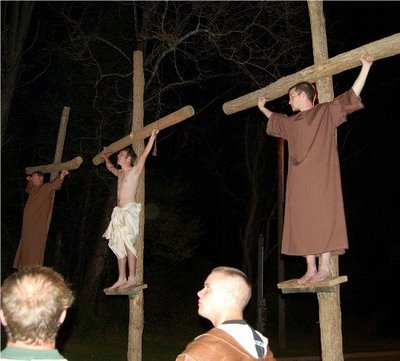
On the Road to Duality

This is not the right path. But to introduce the concept to 24/7 Christians it may be a place to begin.

The new book is called Christian -Atheist, by some megachurch pastor somewhere. The email from Christianity Today plugging the book asked, “Are you living a dual existence?” My answer, “why, yes I am.” In fact, hyphenation is exactly what the life of exile requires – we live here but this is not our home. The advertisement adds, “If you profess a belief in God, but live as though He doesn’t exist, you may be more divided than you think. Read The Christian Atheist and join author Craig Groeschel as he looks to resolve a conflict that affects the lives of countless Christians.”

I do think I’ll pass.

But it is an interesting thought experiment whether the way I ride the subway, cross the street, teach at a secular university, root for the Phillies, or read John Updike differs from non-Christians performing those same tasks in any sort of visible way. At least, it does differ on the common days of the week since my Christian self avoids teaching, rooting, and reading Updike on the Lord’s Day. Crossing the street and riding the subway may actually be works of necessity to participate in worship.

So even if the dichotomy is wrongheaded – Christian-Atheist – the idea of hyphenation is one that needs to be cultivated, as in Christian-Americans, Christian-Phillies fans, and Christian-historians. We have a lot of divided loyalties out there 24/6, and negotiating them is the task of that wonderful Protestant doctrine of vocation.

(By the way, why doesn’t the Christian side of this guy shave?)

Where's Waldo Wednesday

Chapter 13 – Of the Gospel of Jesus Christ, of the Promises, and of the Spirit and Letter

The Ancients Had Evangelical Promises. The Gospel, is indeed, opposed to the law. For the law works wrath and announces a curse, whereas the Gospel preaches grace and blessing. John says: “For the law was given through Moses; grace and truth came through Jesus Christ” (John 1:17). Yet not withstanding it is most certain that those who were before the law and under the law, were not altogether destitute of the Gospel. For they had extraordinary evangelical promises such as these are: “The seed of the woman shall bruise the serpent’s head” (Gen. 3:15). “In thy seed shall all the nations of the earth be blessed” (Gen. 22:18). “The scepter shall not depart from Judah . . . until he comes” (Gen. 49:10). “The Lord will raise up a prophet from among his own brethren” (Deut. 18:15; Acts 3:22), etc.

The Promises Twofold. And we acknowledge that two kinds of promises were revealed to the fathers, as also to us. For some were of present or earthly things, such as the promises of the Land of Canaan and of victories, and as the promise today still of daily bread. Others were then and are still now of heavenly and eternal things, namely, divine grace, remission of sins, and eternal life through faith in Jesus Christ.

The Fathers Also Had Not Only Carnal but Spiritual Promises. Moreover, the ancients had not only external and earthly but also spiritual and heavenly promises in Christ. Peter says: “The prophets who prophesied of the grace that was to be yours searched and inquired about this salvation” (1 Peter 1:10). Wherefore the apostle Paul also said: “The Gospel of God was promised beforehand through his prophets in the holy scriptures” (Rom. 1:2). Thereby it is clear that the ancients were not entirely destitute of the whole Gospel.

What Is the Gospel Properly Speaking? And although our fathers had the Gospel in this way in the writings of the prophets by which they attained salvation in Christ through faith, yet the Gospel is properly called glad and joyous news, in which, first by John the Baptist, then by Christ the Lord himself, and afterwards by the apostles and their successors, is preached to us in the world that God has now performed what he promised from the beginning of the world, and has sent, nay more, has given us his only Son and in him reconciliation with the Father, the remission of sins, all fullness and everlasting life. Therefore, the history delineated by the four Evangelists and explaining how these things were done or fulfilled by Christ, what things Christ taught and did, and that those who believe in him have all fullness, is rightly called the Gospel. The preaching and writings of the apostles, in which the apostles explain for us how the Son was given to us by the Father, and in him everything that has to do with life and salvation, is also rightly called evangelical doctrine, so that not even today, if sincerely preached, does it lose its illustrious title.

Of the Spirit and the Letter. That same preaching of the Gospel is also called by the apostle “the spirit” and “the ministry of the spirit” because by faith it becomes effectual and living in the ears, nay more, in the hearts of believers through the illumination of the Holy Spirit (2 Cor. 3:6). For the letter, which is opposed to the Spirit, signifies everything external, but especially the doctrine of the law which, without the Spirit and faith, works wrath and provokes sin in the minds of those who do not have a living faith. For this reason the apostle calls it “the ministry of death.” In this connection the saying of the apostle is pertinent: “The letter kills, but the Spirit gives life.” And false apostles preached a corrupted Gospel, having combined it with the law, as if Christ could not save without the law. (Second Helvetic Confession)

Machen and the Crisis of Western Civilization

Darryl G. Hart speaks about Machen’s experience through World War I.  This is part three of a series on Machen taught at Calvary OPC in Glenside, PA.

Download

This and That's Big Adventure


For those who may be wondering why N.T. Wright is speaking at the church of one of the founders of the Gospel Coalition – as in justification by faith alone coalition – Justin Taylor may have a clue. Here is a quotation from a piece in Christianity Today from 2008 on Keller and the gospel:

Tim Keller and his Redeemer Presbyterian Church in New York City fall somewhere between Wright and Dever. Writing for Leadership [JT: , Keller answered this year’s question for the Christian Vision Project, “Is our gospel too small?” (The article is not yet available online.) In so doing he took a stab at defining the gospel. “Through the person and work of Jesus Christ, God fully accomplishes salvation for us, rescuing us from the judgment for sin into fellowship with him, and then restores the creation in which we can enjoy our new life together with him forever.”

It’s the last clause of this sentence that makes the difference. Is God’s plan to renew creation part of the gospel message? If so, is it the center of the gospel or a peripheral component of the Good News? Again, how you answer these questions affects how you will live, and how you will expect fellow church members to act.

“When the third, ‘eschatological’ element is left out, Christians get the impression that nothing much about this world matters,” Keller wrote. “Theoretically, grasping the full outline should make Christians interested in both evangelistic conversions as well as service to our neighbor and working for peace and justice in the world.”

______________

Doug Wilson is sounding more and more like Mark Horne.

So, saving faith yields, trembles, and embraces. It yields obedience, it trembles at threats, and it embraces promises. But its principal acts are accepting, receiving, and resting upon Christ alone for justification. These are indeed its principal acts, but saving faith does other things. It hunts down the red law passages and yields obedience to them. It comes across passages which threaten divine displeasure, and saving faith trembles at these red law passages also. But what is saving faith doing responding to the law passages at all? Don’t the law passages just beat you up? No — in the broader context they are part of God’s saving intention for us. They are gospel. They are totus lex, part of the covenant of grace.

Then what do you do with Paul’s assertion that “the law is not of faith”? Or what do you do with the Protestant protest against Rome that we are saved not by works but by faith?

______________

Apparently Craig Higgins, who pastors one of the congregations in the Redeemer New York network of Redeemer-like churches in the New York vicinity, is still a Presbyterian. Will N. T. Wright tempt him to become an English Christian?

______________

If abortion is an abomination, why isn’t this blasphemy?

______________

Forensic Friday: Calvin on Faith and Repentance

Even though we have taught in part how faith possesses Christ, and how through it we enjoy his benefits, this would still remain obscure if we did not add an explanation of the effects we feel. With good reason, the sum of the gospel is held to consist in repentance and forgiveness of sins [Luke 24:47; Acts 5:31]. Any discussion of faith, therefore, that omitted these two topics would be barren and mutilated and well-nigh useless. . . . For when this topic is rightly understood it will better appear how man is justified by faith alone, and simple pardon; nevertheless actual holiness of life, so to speak, is not separated from free imputation of righteousness. Now it ought to be a fact beyond controversy that repentance not only constantly follows faith, but is also born of faith. For since pardon and forgiveness are offered through the preaching of the gospel in order that the sinner, freed from the tyranny of Satan, the yoke of sin, and the miserable bondage of vices, may cross over into the Kingdom of God, surely no one can embrace the grace of the gospel without breaking himself from the errors of his past life into the right way, and applying his whole effort to the practice of repentance. There are some, however, who suppose that repentance precedes faith, rather than flows from it, or is produced by it as fruit from a tree. Such persons have never known the power of repentance, and are moved to feel this way by an unduly slight argument. (Institutes, III.3.1)

Church Cemeteries Make Sense

I got lost on the way out of a cemetery in Bucks County, Pa. yesterday. This was slightly embarrassing since I was escorting relatives from out of town who were completely unfamiliar with the local roads. I knew the roads. My problem was getting out on to the road.

Like many “memorial” parks, this one had roads that go in circles. Its sweeping access lanes are supposed to mingle with the greenery to create a pastoral feeling. Never mind that you are in a machine using fossil fuels to negotiate this “green” space. These sorts of burial grounds arose as alternatives to church cemeteries both to accommodate non-believes and to emphasize death as a wholesome form of rest, one not necessarily connected to church teaching about the fall, sin, death, and the resurrection.

These “secular” cemeteries were also designed to be more user friendly in that they functioned as parks where not only survivors of loved ones would go to continue to pay their respects on anniversaries and holidays but even those unrelated to the deceased might go to enjoy the scenery.

What any observer of urban history knows, though, is that grids function much better than cow paths when designing a city. William Penn’s original plan for Philadelphia, with streets running East and West between the Delaware and Schukyl rivers, and others running perpendicularly North and South between South and Vine Streets, made the city much easier for pedestrians, developers, and even drivers. Compared to Boston or New York which as villages relied on existing Native American and livestock trails, Philadelphia was a real city.

Church cemeteries (as well as military) tend to follow Penn’s ideas about arranging space – rows, grids, symmetry. They are more efficient by providing more space for bodies and they accommodate more visitors in search of loved ones.

Ironically, memorial parks tend to follow the patterns of suburban developers like William Levitt, who bequeathed to us Levittown. His subsections with pastoral names like Stonybrook, or Farmbrook, or Holly Hill, also included circular drives that surrounded winding streets to give, apparently, the featureless design of his homes a natural and inviting feel. What he didn’t account for was how many of the new residents in Levittown would get lost, like I did yesterday, because of curving lanes and cookie cutter facades.

Where's Waldo (a Day After) Wednesday

The office of the Holy Ghost is to produce sanctification in the people of God. This he performs immediately from the Father and the Son. It is for this reason that he is called the Spirit of holiness. The office of the Holy Ghost may be said to embrace the following things: to instruct, to regenerate, to unite to Christ and God, to rule, to comfort and strengthen.

1. The Holy Ghost enlightens and teaches us that we may know those things which we ought, and correctly understand them according to the promise of Christ . . . .

2. The Holy Spirit regenerates us, when he creates in our hearts new feelings, desires and inclinations, or effects in us faith and repentance. . . .

3. He unites us to Christ, that we may be his members and be quickened by him, and so be made partakers of all his benefits. . . .

4. He rules us. To be ruled by the Holy Spirit is to be guided and directed by him in all our actions, to be inclined to follow that which is right and good, and to do those things which love to God and our neighbor require, which comprehends all the christian virtues of the first and second table. . . .

5. The Holy Ghost comforts us in our dangers and afflictions. . . .

6. The Holy Ghost strengthens and establishes us when weak and wavering in our faith, and assures us of our salvation, or what is the same thing, he continues and preserves in us the benefits of Christ even unto the end. . . . (Zacharias Ursinus, Commentary on the Heidelberg Catechism, “Lord’s Day Twenty, Of God, the Holy Ghost,” pp. 277-78)