
 Not exactly, but the pastor of Redeemer Presbyterian Church in New York City did say in his interview with Mike Horton at the White Horse Inn that confessional Christianity is the answer to the problems confronting the contemporary church. Okay, he said, “confessional evangelical†Christianity, which to confessional Protestants is a bit of an oxymoron since evangelical stands closer to pietist than confessional on the spectrum of Protestant Christianity. Even so, there Keller was telling Mike and company that teaching the Heidelberg, and adding more liturgy, is what the ailing Protestant witness needs. Along the way, Keller said that confessional churches were the proper antidote to megachurches, which at least in his experience are too slick, too entertainment oriented, and too consumerist for the sophisticates who reside in Manhattan.
I sure wish Mike had asked Keller more about confessional Protestantism and where Redeemer Church is exactly on the faith and practice of Reformed Christianity. Granted, Keller was on to talk about his book, Reasons for God, which is a work of apologetics, not pastoral ministry. Even so, the discussion was revealing if only because reaching unbelievers is something that has bound Redeemer closer to Willow Creek than Keller let on with his contrast between confessional and megachurch churches.
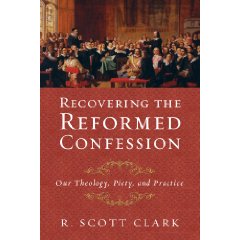
What Keller did not concede is that he and Bill Hybels have emerged as gurus for an approach to church planting that is “seeker-sensitive.†The seekers may be suburban Chicagoans or cosmopolitan New Yorkers. But in both cases the stress has been more on winning people over than on discipling the won in the whole counsel of God, as in the Great Commission’s “everything I have commanded you.†This is not to say that evangelism is wrong or bad. It is to question whether evangelism is the paradigm for a full-service church in the tradition of Reformed confessionalism. I mean, if you classify your worship services according to musical style as Redeemer does – classical or jazz – you may not exactly have read through Clark’s Recovering the Reformed Confession about the nature and piety of confessional Protestantism.
What makes this point even more plausible is something that Keller wrote about a month before appearing on Horton’s show. At his blog Keller wrote:
The time at Willow led me to reflect on how much criticism this church has taken over the years. On the one hand, my own ‘camp’ — the non-mainline Reformed world — has been critical of its pragmatism, its lack of emphasis on sound doctrine. On the other hand, the emerging and post-modern ministries and leaders have disdained Willow’s individualism, its program-centered, ‘corporate’ ethos. These critiques, I think, are partly right, but when you are actually there you realize many of the most negative evaluations are caricatures.
Keller goes on to say that with the assistance of John Frame he has come to a new appreciation for Hybels and Willow Creek. (Note: Keller and Frame share more than tri-perspectivalism in common; they also understand the nature and character of Reformed worship in ways that contravene the regulative principle as found in both the Westminster Standards and the Three Forms of Unity.) According to Keller, applying Frame, Willow Creek manifests a “a ‘kingly’ emphasis on leadership, strategic thinking, and wise administration.†Keller admits that sometimes the Willow Creek model “obscures how organic and spontaneous church life can be.â€
But that concession leads Keller once again to give another of his “with-presbyters-like-this-who-needs-evangelicals†stands for the Reformed tradition. He writes that “Reformed churches have a ‘prophetic’ emphasis on preaching, teaching, and doctrine†but the danger is “a naïve and unBiblical view†which assumes “that, if we just expound the Word faithfully, everything else in the church — leader development, community building, stewardship of resources, unified vision — will just happen by themselves.†(To complete Frame’s triangle, Keller credits the emergent church with an emphasis on community, liturgy and sacraments.â€)
This perspective on the Reformed ministry does explain why Keller didn’t endorse Clark’s book. It also indicates why Keller and the rest of Redeemer’s staff need to read it. Confessional Protestants do not believe simply, to paraphrase a line from Field of Dreams, “if you preach it, they will come.†I know pastors in the Redeemer NYC diocese who accuse the Reformed tradition of being logocentric. If that means affirming the formal principle (sola scriptura) of the Reformation, then I’ll accept the label.
But church life is much more than preaching and teaching the Bible and our Reformed confessions teach this. They say all sorts of interesting things about word, sacraments, prayer, discipline, worship, the Lord’s Day, communion, ordination, and polity. They all assume that these teachings require the efforts of pastors and elders who attend session and consistory meetings, presbyter and classis, General Assembly and Synod, visit with families in their homes and the sick in hospitals, catechize the youth, practice hospitality, and prepare high-carb casseroles and jello salads for pot-luck suppers.
That kind of hands-on, local ministry is what animates confessional Presbyterianism. As Old Lifers know, it is seeker-sensitive in the best sense of the phrase, namely, serving the God who seeks Christians who worship in spirit and truth.
 Old Life
I would have agreed with you 2 years ago. Reformed Protestants often talk about how practice is nearly as important as doctrine, because doctrine reinforces and propels, or undermines, belief. The approach and tone represented in this post have been, to me, a “practice” that has helped undermine the position defended and made me sympathetic to your opponents’ positions in a way that would have shocked my former self.
LikeLike
Andy, I think you read way too much into Darryl’s post here. I believe it is evident that you missed the whole point when you insisted that this post is an attempt to portray this “practice” as undermining the Reformed position. The point being raised here is that the Reformed tradition, which is not simply about doctrine but also includes piety and PRACTICE, has never been lacking. There is no need for the Reformed to, as Keller and Frame suggests, incorporate seeker-sensitive principles and methods which are hardly even biblical.
You claim that you were of the Reformed persuasion two years ago, but I highly doubt that. I suggest you read R.S. Clark’s Recovering the Reformed Confession.
LikeLike
How did Keller’s comments about Willow Creek make you feel?
LikeLike
As the folks over at the White Horse Inn have said a couple of times, it’s through the God-appointed means that pleases Him to save, and bless His people. It is through the boring, the prescribed, and the every day activities granted by Scripture. If I were to say that following Scripture by the letter, specifically the book of Acts and other pastoral letters, as reflected by the confessions, needs some supposed new “thing” discovered by Willow creek or the EMC, then I would be affirming the insufficiency of Scripture—that I believe is the main issue.
It is a surprise to me how such a change of opinion came to Tim Keller, just as was recently with Tim Challies, through a single visit of Willow Creek.
LikeLike
JM, how exactly is word & sacrament ministry “boring”? It may be to those who are simply lacking the spiritual taste buds for it, but for us, who are being saved, and for those of us who are in the ministry, is it not the greatest drama there ever was?
LikeLike
I didn’t mean “boring” in a derogatory sense. I meant it in the context of discipline and order—where the teaching and preaching of the Word and the administration of the sacraments does not by necessity require to be “fun”, more often than not it is “boring”. But I don’t mean to use the word “boring” in the sense that it word and sacrament is un-interesting and un-engaging, as a matter of fact the opposite is true. But I meant it in such a way that Word and sacrament requires much labor, in catechisis, discipleship, in preaching and teaching. In contrast from the seeker/emergent-model it does not need to stir up “excitement”, rather it stirs us up in a more serious state of being of “reverence and awe.”
LikeLike
Hi Joel de Leon,
I noticed a typo in my comment. I meant to say that practice undermines or reinforces belief. I’m not sure if that’s what made you misunderstand my point or not. My point is simply that I was TR and loved to take pot shots at Evangelicalism all the while agreeing with DGH that it doesn’t actually exist. (It occurs to me, in fact, that it was 2 years ago exactly that I spent Thanksgiving weekend reading _Deconstructing Evangelicalism_ on the same sister-in-law’s mustard yellow vintage sofa upon which I’ll probably spend reading _Counterfeit Gods_ this weekend.)
It might not dispel your doubts. But, I’m a minister in the Associate Reformed Presbyterian Church, and I’m probably the second most “Reformed” guy among the 13 of our churches in this county. I also have Clark’s book staring at me on my shelf. It’s been in queue for a year now. But it’s moved further down the list due to the practices (*this* was my point) represented in the tone of DGH’s post and among his ilk.
What’s changed me? Well, Sinclair Ferguson came to be minister at my church in Columbia, SC. Being around him for 4 years or so did not dim my critical eye for much of Evangelical America’s foolishness—if anything it added a layer of Scottish criticism to it. But he also made me see that its ridiculous to expend so much of my energy on polemics and constructing a Presbyterian identity and so little on Christ for sinners. He once told us interns that he can count on one hand the worship occasions in which he was overwhelmed by the sense of the presence of God among his people, and that none of them were in Presbyterian churches. He also modeled the sort of charitable evangelical ecumenism that I also see in Keller through his conference speaking, etc. (e.g., sitting on a Piper panel next to Driscoll!!!???!!!).
And other things. I fancy myself as pretty darn Reformed. But I’m getting less mean the more I stop reading and listening to mean people.
LikeLike
Sebastian, yes, it is the greatest drama that ever was. But I’m not sure that edification and excitement are the same. This seems to be the categorical mistake of the evangelicals. And it seems that when confessionalists make the same mistake they end up, like the evangelicals they mean to contrast, trying to sell something that refuses to be a commodity on human terms. It seems to me no insult to characterize God’s dealing with us as “boring, prescribed and ordinary†since it has seemed to pleased him to do so.
LikeLike
Hi DGH,
I read his blogpost about Willow Creek and listened to his interview on WHI before I saw Clark’s tweet and was directed to your post. TK’s post surprised me in some ways. But it really just struck me as a pastor trying to think of the things that WC did best and be nice about it. The point seemed to be that WC runs a tight ship, and so does God in his kingly administration.
LikeLike
Not that it counts for anything but I’d have to disagree with Ferguson’s advice to you. I’m also not sure that John Murray, one of Ferguson’s heroes, would either.
LikeLike
You disagree with his advice about polemics vs. Christ for sinners, his advice about Presbyterian identity formation, or advice about evangelical ecumenism? And I didn’t say he gave me advice per se. Just that he made me see things differently than my absentee mentors (MR/WHI/WSC/etc.), through his tone, engagements, and off-the-cuff commentary.
Also, I used to be the type who thought it was ridiculous when Presbyterian churches didn’t put “Presbyterian” in their church’s name. Again, I heard an “outsider”–Ferguson–comment at a Sovereign Grace preachers’ conference that he thinks it’s unfortunate how we’re so keen to put our distinctives all across our “front doors” and signs; what divides us from other true Christians rather than what unites us with them. That was surprising, but it certainly gave me pause.
Finally, whether the Scot Ferguson’s instincts about how to exalt Christ as understood in Reformed faith and practice in the USA in 2009 conform to the Scot Murray’s instincts about how to do so in the USA in 1969 doesn’t really say much about the wisdom of either man’s instincts. Also, Murray was a professor; Ferguson is primarily a pastor.
Thanks for the enjoyable dialog.
LikeLike
Andy, I disagree with most of what you said (though of course in a nice, evangelical way). I believe the Bible teaches the Reformed faith, including Reformed doctrine, worship, and polity. Why wouldn’t I emphasize being Presbyterian then if I think it communicates what the Bible teaches? Also, why are you a Presbyterian if you think it is an accident in relationship to some evangelical substance? Wouldn’t it be better simply to be a “Christian” or a “biblican”?
A
LikeLike
I believe also that the Bible teaches Reformed doctrine, worship, polity, and more. But “Presbyterian” on a sign somewhere does not communicate “we’re a church that teaches the Reformed faith because the Bible does, too.” And the Reformed faith does not teach that “Reformed” or “Presbyterian” ought to be on your church letterhead. These labels might do a better job of communicating things Scottish, white, Southern, sectarian, Korean, etc., depending on who the outsider is. My wife said that in Green Bay she and her peers within the non-denom charismatic megachurch assumed that Presbyterian meant “Catholic”.
That doesn’t mean we don’t emphasize being Presbyterian. It just means it’s not necessarily the best thing for Presbyterianism for “Presbyterian” to be on your sign. There are a lot of cradle baptists in Columbia, SC, who have discovered that, in fact, the Bible teaches the Reformed faith, by coming to hear SBF for a while. They’d have never thought of themselves as Presbyterian–and indeed militated against that identity for cultural reasons, only to find in a round-a-bout way that they ARE Presbies. I imagine the same is true in Manhattan.
Although you might wish that First Pres Columbia and Redeemer Pres Manhattan would get “Pres” off their signs since they don’t measure up.
LikeLike
You should change the name of your blog to “I Hart Keller†or something, because this blog has quickly become obsessed with critiquing Keller. By all means, spend time on it, but the edification value is quickly diminishing. To borrow from Keller himself, you might be “over desiring†this thing a little too much.
LikeLike
I have long maintained that blogs are not the place to go for edification. They are a place to chat with people who can’t assemble for a pint.
I may be obsessed with Keller, as you suggest, but then that would apply to a lot of evangelical Presbyterians who make him the poster boy for the way to do Presbyterian ministry. I suspect that if I posted a number of favorable pieces on Redeemer and Keller you would not call me obsessed. Like beauty, obsession may be in the eye of the beholder.
Blogs comment on items of note usually. Reformed blogs comment on items of Reformed note usually. Keller is an item of note, this is a blog dedicated to Reformed faith and practice, you do the ergo.
Out of curiosity, did you find Keller’s puffery on Hybels edifying?
LikeLike
Yeah Darryl, stop being so mean. I used to be Reformed until I read all the unkind things here. So I burst into tears and decided to become a pietist.
LikeLike
Nick, I thought you Brits were made of sterner stuff. Then again, you did give the world Methodism.
LikeLike
Stern stuff? We’re rock hard. Just look at Rowan Williams. That dude has a face like flint.
LikeLike
PS, what do you get when you cross a Calvinist with a Methodist?
LikeLike
Banner of Truth?
LikeLike
LOL!
LikeLike
I agree Darryl, there is as much obsession coming from the other side. Had I found you quoting and confirming Keller one post after another, I would have just thought of you as a clone, which is far worse than an obsessed critic. So I’ll tip my hat to you in at least being original.
Pint or no pint, I think we can sharpen up a bit and pursue edication, just as we seek to glorify God in all that we do.
Regarding Keller and Hybels, I appreciated Kellers irenic approach. Keller has consistently utilized the typologist method (which I appreciated in Niebuhr and see Frame doing as well) which utilizes a hermeneutic of appreciation before a hermeneutic of critique. Keller could have offered more criticism but isn’t that what everyone was doing?
So to quote Niebuhr, “The typologist needs to remember that he is not constructing a value scale. His enterprise is directed toward neither explanation nor evaluation, but toward understanding and appreciation. . . . [The typologist] will belong to one of the types, himself and will have a preference for it; but one purpose of typology is that of helping him understand his own type as one of many and so to achieve some measure of disinterestedness.”
LikeLike
Rev. Stager: I wanted to commend your commitment to a more irenic Reformed ethos and public face. Dr. Ferguson is indeed a wonderful role model. He is stoutly Reformed in his theology and practice, but eschews the kind of harsh rhetoric that abounds among some of us TRs, especially in the fever swamps of Reformed blogs. Ironically, the mean-spirited polemicists don’t see that their tone undercuts the effectiveness and reach of their own arguments. They speak to one another in an echo chamber. They have little or no influence outside of that chamber, other than a negative influence. By contrast, five minutes of the kind of irenic and positive presentation made by a godly man like Dr. Ferguson is ultimately more persuasive and effective than all the angry rants put together. I’m grateful that there are many such men as Dr. Ferguson in the Reformed camp. Another wonderful example of an irenic, Reformed voice and face is Dr. Dennis Johnson of WSC and, near and dear to two kingdoms enthusiasts, Dr. David VanDrunen, an eloquent and learned advocate and defender of two kingdoms theology. Dr. VanDrunen exemplifies how to engage in polemics with those with whom he disagrees in an irenic, respectful, peaceful fashion. His tone is always respectful and adult. Notably, you don’t find him engaging in polemical rants on blogs in stentorian tones with strident rhetoric. His argumentative pieces are all the more effective for that. I encourage those who aspire to be polemists in the good sense to model Johnson and VanDrunen.
LikeLike
Mr. Stager, so it’s a form of polemics to put Presbyterian on your sign or letterhead? I actually like the kind of polemics in which Mr. Murray, Machen, and Hodge engaged. Your position would seem to be that they were wrong to engage in polemics for the sake of the Reformed faith.
Sullivan: I know of some folks in the Church of Scotland and at WTS who would have liked Dr. Ferguson to be a tad more polemical in the form of Mr. Murray. Sorry, but I’m a guy who studied too much Machen and saw what happened when folks didn’t “fly the Reformed banner high.” I mean, plenty of “nice” people communed in the PCUSA.
LikeLike
DGH: There is polemics and then there is polemics. It’s not the doing of polemics that is the issue here, but the way they are done. I have always had great respect for the polemics of Machen, Hodge and Murray. They were unfailignly courteous and respectful. They did not engage in snarky scarcasm or ridicule of their debate partners, publicly or privately. They chose their battles carefully and strategically. They did not shoot of sparks for the sake of being provocatuers. They represented accurately the views of those with whom they disagreed. Those who knew Mr. Murray describe him as a remarkably gracious man in manner and speech, as you probably are aware. Further, their polemics were in keeping with the sylistic conventions of their day and conducted with due regard for the prevailing sensibilities of their day. The same can’t be said for many TRs today.
We Reformed could be far more effective in advancing and defending the Reformed faith if we took cognizance of common grace ideas of persuasion techniques, which, among things, involve projecting what many Reformed TRs ridicule, “niceness.” It is possible to be gracious and polemical, as evidenced by those who accomplish this. I have significant differences with Tim Keller on theology, ethos, and piety. But I have to give him high marks for his irenic approach. He is effective because he is irenic and courteous. His style works, and more importantly, it is befitting a Christian, especially a Christian with a high view of grace.
LikeLike
There’s polemics and then there’s your definition of polemics which seems to have a high regard for a style that is not polemical. Fine, do what you will with polemics. But I’m not sure you can have your cake (Keller) and eat it too (Hodge, Machen, and Murray).
LikeLike