
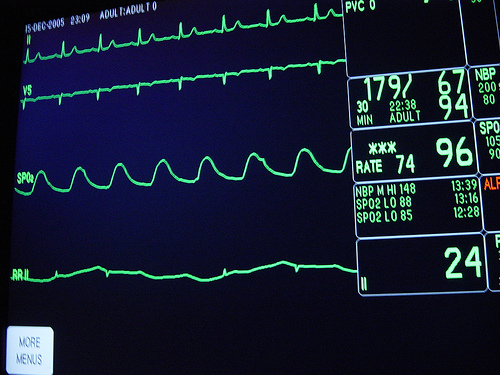
 After a visit to my father at his local hospital, I had a worldview moment. What should have alerted me from the outset was the name of the place – St. Mary’s. But then I noticed that the spiritual services wing of the hospital had dropped off for him a brochure about their activities which was included with information about television channels and daily menus – talk about trivializing the eschaton. But the kicker was the crucifix in my dad’s ICU room. Shazzam!!! That’s a whole lot of idolatry for a man who is on a heart monitor.
But is Roman Catholic medicine really any different from Reformed medicine or even – dare I say – secular medicine. If worldviews go all the way down to the very tips of our toes, and if we can’t escape the claims of Christ in any parts of our lives, can I really look the other way in good conscience when entering a hospital room that displays an image of Christ on a cross?
And then there is the concern for quality of health care. If Abraham Kuyper was right that Roman Catholicism “represents and older and lower stage of development in the history of mankind†and if Protestantism occupies a “higher standpoint,†shouldn’t my dad try to find treatment at a Protestant hospital? Kuyper, by the way, wasn’t real complimentary of Roman Catholicism on science either.
It could be that I have once again misunderstood the claims of neo-Calvinism and that some algorithm exists for taking the gold of scientific advances from the dross of defective worldviews. But it could also be that the language of worldviews and the difference they make for every aspect of human existence is overdone, simply a rallying cry for inspiring the faithful, but not anything that would prevent my father from receiving treatment from unbelieving nurses employed by Roman Catholic administrators. Then again, the power of modernity is stunning, making all of those religious claims about connections between spiritual and physical reality look fairly foolish – as if a creed actually produces better medicine.
I mean no disrespect to the neo-Calvinists and their epistemological purity. But if they could help me out on this one, I’d be grateful. Does a Reformed worldview really make a difference for modern medicine and the ordinary decisions a sick believer must make in seeking a physician or hospital – under the oversight, of course, not of the elders but the insurance company.
Postscript: yes, I am preoccupied with neo-Calvinism. Shouldn’t Keller’s fans be happy? Oh, wait a minute.
 Old Life
When our pre-natal daughter was diagnosed with Turner syndrome, the nice doctor explained that that he would set up an immediate “evacuation.” We didn’t really know what he was talking about, or if that was necessary, or, in our grief, what to think. Thanks be to God we told him we would call back. After we did some research we figured out that he was offering to arrange to kill our daughter so she wouldn’t die. When we did call, we told the nurse we would not need to set up an abortion. She tried to tell us we were unwise. We didn’t agree. Her final response was . . . unkind. I care only say that I’m happy that we had already made up our minds before we called.
We went to a Catholic hospital instead. The doctor explained that some people abort, and why, but that they didn’t do it at that hospital, and she was happy to help us keep the baby as long as we could, even with a 1% chance she would survive.
She didn’t survive. But I’m eternally grateful to have had a Catholic doctor so that I don’t have to live with the knowledge that I was responsible for her murder.
I don’t know of any Reformed hospitals, so I can’t say for sure if they would make a difference over a Catholic one. But who knows? It would probably take some number of years, but after some time I bet a Reformed worldview would make some kind of difference.
After all, modern medicine – the world over – came from Christian Europe and America. What is traditional medicine like in non-Christian locations? Traditional Chineese medicine? Traditional Native American? Traditional African? Traditional Hindu? If worldview is so neutral, why doesn’t medicine look the same in every culture?
LikeLike
I will light Dr. Hart’s cigar for him on this one. He may not be a “real” doctor like at the hospital there (he has one of those Piled Higher and Deeper degrees that I would like to get one day), but I had my Van Til for breakfast and can tell you that he does not believe worldviews are neutral.
Still, you ask a good question.
LikeLike
Looking back, I probably shouldn’t have said “worldview is so neutral,” because I wouldn’t imagine that any Christian would claim that, so, Dr. Hart, I apologize. “if a creed DOESN’T produce better medicine . . .” would have been a more accurate and fair statement. Until somebody in the blog world figures out that computers can edit text, I guess my old statement will have to stand. Maybe Reformed people should start designing blog templates with a “repent” button instead of an “edit” one.
LikeLike
Take it a step further: Could a Reformed Christian serve as a Doctor, nurse, etc. in a Catholic Hospital?
LikeLike
Matt, take it another step: which would be better? For a Reformed Christian to serve in the PCA’s new hospital (not that it actually exists), Our Merciful Mother of Suffering Sinners Roman Catholic Hospital of the Holy See, or City Health, and why?
LikeLike
J. Kru,
After all, modern medicine – the world over – came from Christian Europe and America. What is traditional medicine like in non-Christian locations?
The Hippocratic Oath came from the father of western medicine, Hippocrates (460 BC – ca. 370 BC). Granted, modern medicine and Hippocratic medicine may be as far removed from each other as modern democracy and Grecian democracy. But the roots of the formers still owe way more to the latters than to the doctrines of sin, grace, incarnation and resurrection. So, I’d wager that traditional medicine looks an awful lot like what we moderns would expect if we were teleported back across time and place to non-Christian Greece.
Matt,
Could a Reformed Christian serve as a Doctor, nurse, etc. in a Catholic Hospital?
My Reformed doctor did, and my Reformed mechanic labored within a secular company. They have both gone into private practice. Both are 1Kers, but this 2Ker still gets as excellent service as he did when they labored in non-Reformed environs. Imagine that, good service in the midst of un-Reformed (bad 1K) theology. According to 1K rules that say theology has some direct or obvious bearing on earthly endeavor, I should be finding fault with my 1K physician and mechanic instead of lauding their skills. But all I ask is that I get good service from them in their six days and that they don’t serve idols on the seventh.
LikeLike
Since the issue is one of common grace and not of saving grace, I would leave that decision up to the conscience of the individual Christian. The issue at City Health (I assume that illustrates a so-called “secular” hospital) is over the freedom of a Christian to stand against practices that clearly are sinful (such as abortion). But, as in any situation a Christian in the city of man finds himself, there will be a tension. I personally would hope that the PCA does not start a hospital. The church’s business is the preaching of the Gospel, the administration of the sacraments, and the practice of church discipline; not in performing surgery.
BTW, I applaud your decision regarding your daughter. I would have done the same.
LikeLike
Matt, I would agree. And I also hope that the PCA doesn’t start a hospital. But I do hope that a bunch of men from the PCA start a hospital.
This is something that I hear from 2K folks all the time, and it seems like a false dilemma. Either it should be subject to the Bible, and the church should do it, and the Pastors should be instructing doctors on how to do a heart transplant, or else the church has nothing to do with it. What if I put it like this: when a doctor goes to work, he should obey the Bible.
Zrim – nice use of italics.
Why has medicine developed one way in largely Christian Europe, another in Africa, and another in India. All modern medicine comes from the US and Europe. Why is that? If you go to Haiti right now you can find someone who will attempt to cure you with voodoo. Worldview matters.
So the doctrine of incarnation might not apply to medicine. Here’s another common 2K problem. “If I can’t understand how the Bible might affect the practice of something, the Bible does not affect that practice.” Maybe you’re a doctor, but I don’t know enough about medicine and the medical industry to know.
A third problem: the idea that worldviews must have immediate impact. They don’t. It may take a hundred years. Cultures and worldviews are stews, not fried eggs, and they need to cook all day. But I think that Bible’s teaching on anthropology, sexuality, life, and suffering would all play into how a hospital was run, and what kinds of decisions they would make.
That doctors spend time and money trying to figure out how to turn a man into a woman – would that happen in a medical industry committed to Christ as Lord? A painless way to kill someone because they’re suffering – is this a Biblical view of life?
Fourth problem I perceive in 2K: the teaching of the Bible, and the application thereof, is limited to justification. I know you’re not actually saying this, but I hear statements like “the church’s business is preaching the Gospel.” Fine. But what is the Christian doctor’s business?
LikeLike
“If worldviews go all the way down to the very tips of our toes, and if we can’t escape the claims of Christ in any parts of our lives, can I really look the other way in good conscience when entering a hospital room that displays an image of Christ on a cross?”
I go to a Catholic university, and we had a discussion (in ART class, no less) on Ex Corde Ecclesia and what makes a Catholic university “Catholic”. One of the things that came up were the crucifixes on the wall in every classroom. She asked the class if they bothered anyone. A Muslim student said, “Yeah, it bothers me, but it comes with the territory.” I said, “Its in violation of the second commandment, but it doesn’t bother me because to me its just an ugly man on two planks of wood. Jesus Christ is risen.” The professor rolled her eyes, the Muslims were amused, and the Catholics had no idea what I was talking about.
A couple days later in the class, a discussion of “kitsch” art came up. I cited the crucifixes as kitsch “because everyone knows they’re just a cheap political ploy on the school’s part to reinforce its Catholic image.”
Maybe things like that just don’t matter because they’re obviously false and kitsch-ish?
I am thankful to God that I received such a thorough refutation of the legitimacy of abortion from so many angles -ethics, physiology, molecular biology, history. On the other hand, that particular professor made my blood curdle whenever she decided to talk about religion for no reason… apparently “God doesn’t fit into our boxes” and “muhammad is a true prophet of God”
Is JPII a cultural transformer? Have you ever read Ex Corde Ecclesia? I dunno, there is all this high sounding talk of the Gospel. A “Catholic university” seems kind of a contradiction from a tradition thats supposedly all about natural law.
LikeLike
There’s nothing wrong with going to a Roman Catholic hospital. Medical care is for emergency purposes and therefore I’m pretty sure you are supposed to do what can during those times.
The bigger question is, should a Reformed Christian who believes in Sola Scriptura and God’s providence run to the doctor for a pill every time they have a stomach ache or a slight fever? In our fallen world we have become so dependent on medicine in our normal daily life, that it’s rare to find someone not swallowing pills every day. I’m not talking about the broken arm or the heart attack, but the over dependence we have developed on medicine in general.
LikeLike
J. Kru,
What if I put it like this: when a doctor goes to work, he should obey the Bible.
I’d rather he obey his medical training. The Bible says nothing about how to fix me.
So the doctrine of incarnation might not apply to medicine. Here’s another common 2K problem. “If I can’t understand how the Bible might affect the practice of something, the Bible does not affect that practice.â€
Here’s the 1K problem: “I really, really think the Bible has direct and obvious bearing on worldly endeavor, so it does.†But until the Bible makes it to the requisite medical syllabus, this is just religious fantasy. But even my 1K mechanic doesn’t consult his Bible when fixing my brakes.
A third problem: the idea that worldviews must have immediate impact. They don’t. It may take a hundred years. Cultures and worldviews are stews, not fried eggs, and they need to cook all day..
The categories 2K presumes are eternal and temporal, not immediate and gradual. You are right to say that in the temporal order things come fast (trivial) or slow (enduring). But 2K is saying that the eternal doesn’t bear on the temporal because all things temporal—whether trivial or enduring—are yet fading away. In this way, 1K is a form of prosperity gospel in that it has the basic premise that heaven implies earth, and saying that the pay off is way down the temporal road doesn’t make it any less prosperity oriented. If anyone thinks that prosperity gospel is only about trivial things (cash and bling) and has nothing to do with things enduring (medicine and statecraft), he gravely underestimates its deception.
Fourth problem I perceive in 2K: the teaching of the Bible, and the application thereof, is limited to justification. I know you’re not actually saying this, but I hear statements like “the church’s business is preaching the Gospel.†Fine. But what is the Christian doctor’s business?
You’re asking about institution and individual. In a word, the gospel is the reconciliation of God to sinners by faith grace alone, through faith alone, on account of Christ alone to the glory of God alone. That is the church’s sole mission as an institution, to administer the gospel so defined. Per sola scriptura, that is the principle of the spirituality of the church, which admittedly is justification bent. Why is this so begrudged? One gets the disconcerting sense that being made right with God somehow not good enough, a sort of variation on “faith AND…â€
The individual believer who practices medicine should carry out his vocation as a covenant-keeper the same way any other believer carries out his vocation. I realize it puts 1Kers into orbit, but there is such a thing as general revelation. And it defines how vocation is to be done. That is how a believer should go about his vocation, the way general revelation defines it. The institutional church gets her orders from special revelation about her mission the individual believer gets his from general revelation about his vocation.
LikeLike
JK, not to pile on to Zrim’s good response, but here are a couple of other considerations. The point isn’t that worldviews need to have an immediate impact — though sometimes the way religious identity is described among worldview proponents makes it seem as if my worldview will affect everything I do — like when I enter the public square. That’s pretty immediate. But the larger problem is the selective analysis of worldview interpretation — as if Christianity alone bears responsibility for the advance of medicine, democracy, economics, what have you. This amounts to a form of boosterism in the guise of intellectual history.
You also object to the 2k proposition that the church is to proclaim the gospel, not set up hospitals. Don’t you think preaching the gospel is ultimately more important than building hospitals. After all, the lives a physician saves will still die — even Lazarus did. So the reality of death and the life to come is a pretty pressing one with which healing bodies, no matter how valuable, cannot compare. And then on top of this, if the church is going to be distracted from preaching the gospel, who else is going to do it?
Can’t you recognize that the 2k position is really trying to preserve the integrity of the gospel and the integrity of the church?
LikeLike
Zrim
I’d rather he obey his medical training. The Bible says nothing about how to fix me.
Unless your problem is that you’re a woman trapped in a man’s body.
Again, the 2K problem: the Bible doesn’t contain technical details about ____, therefore the Bible has nothing to say to the practice thereof.
Dr. Hart,
You also object to the 2k proposition that the church is to proclaim the gospel, not set up hospitals.
I do NOT object to this proposition. Sorry to give that impression, I probably wasn’t clear.
I object to the notion that the Bible has nothing important to say to the people setting up the hospital.
Can’t you recognize that the 2k position is really trying to preserve the integrity of the gospel and the integrity of the church?
I do recognize that, and I think it’s a worthy goal. I think that it oversteps, and paints with rollers when it should be using a Isabey Pure Kolinsky Sable Round #12. But the inherent value of 2K is why I keep coming back to it, a.k.a. following Zrim around the internet. It seems to be a very large pill to swallow, almost as large as a big glass of Kool-Aid, if you get my drift. I wish it was more “user-friendly” and could speak into the lives of everyday Christians. For example: churches have always run charities, food pantries, and used clothing centers, that sort of thing. I know that 2K people don’t oppose this. But the way it’s portrayed, I would half expect a homeless person to be sent back to the street being told, “Be warm! Be well fed! And here’s a Gospel tract for you, too!” The newest convert knows this is wrong, and a mockery of Christianity.
I know that’s not really the case in a 2K church, but until 2K followers can get into the nuance of their position, it will remain an itsy-bitsy little corner in a tiny little corner within a small corner of the world. I would be happy for the central message of 2K to expand.
LikeLike
JK, how about some nuance on your side? What does the Bible say about building a hospital? What kind of construction? What kind of services? What kind of medicine? The kind available in Jesus’ day? When it comes down to it, you’re going to follow the conventions of modern medicine and then lay a gloss of biblical isogesis over top of it to give yourself that warm feeling of being biblical.
And also, what churches have always provided aid and charity to the poor and hungry? And which poor and needy? State churches did. I get that. But a big debate has emerged since the separation of church and state, including since the rise of the welfare state. 2kers don’t deny the reality and necessity of diaconal work. But they do question the poor exegesis that turns all the poor and needy into wards of the institutional church.
If you haven’t read it, I’d encourage you to read Machen’s essay, “The Responsibility of the Church in the New Age.” It is available in his Selected Shorter Writings and it appears as an appendix to Hart and Muether, Fighting the Good Fight. It represents a long tradition of reflection, especially among southern Presbyterians, on the spiritual nature of the church.
LikeLike
Again, the 2K problem: the Bible doesn’t contain technical details about ____, therefore the Bible has nothing to say to the practice thereof.
But, J., medical texts don’t contain technical details about fixing cars either. Are you saying that when my doctor refuses to consult Car & Driver at my yearly he’s being irrelevant?
So, I’m curious, you seem to be saying that the Bible, while it contains no technical information on medicine, it contains something a believing medical practitioner needs to know that he can’t get from general revelation. What is that, ethics like First do no harm? He’s got Hippocrates for that who figured it out without the Bible. Granted, it aligns nicely with the second commandment, but the point of the second commandment isn’t to make good doctors but righteous people—which are two entirely different projects.
But the way it’s [2K] portrayed, I would half expect a homeless person to be sent back to the street being told, “Be warm! Be well fed! And here’s a Gospel tract for you, too!â€
You’re thinking of the Red-State Fundamentalists. I have a whole family of them. But confessional 2Kers don’t do tracts because they also have a robust ecclesiology. And we make a distinction between transformationalism and charity. My transformer church loves to think her social programs are actually changing the world, but that doesn’t keep me from pitching in money and hands to show charity. It just makes me giggle to myself.
LikeLike
Zrim, I’m going to push the point. The Bible does contain information that every doctor should know. First, that human life in the womb is valuable. Second, suicide is not a righteous or good option in any case. Third, men are men, and cannon become women, and should not try to be. If general revelation were good enough, we would have no abortion, euthanasia, and gender-reassignment surgery.
LikeLike
Not a question my wife or I have to grapple with as we benefit from the Presbyterian Healthcare System in our city. We go to Presbyterian Hospital with Presbyterian Doctors….well they may not be Presbyterian but they work for them..
LikeLike
Machen? J. Gresham Machen? You mean the one wrote this:
“If you go into a city where there are many people of the Christian Reformed Church, you
will see scattered here and there throughout the city certain school buildings which are
not public schools and are not parochial schools of the Roman Catholic Church. These
are the “Christian Schools†in which an integral part of the instruction given is instruction
in that system of truth that the Bible contains. These schools are not under ecclesiastical
control, but are conducted by assocations of parents. In an overwhelmingly predominant
way, however, they are conducted and supported by the people of the Christian Reformed
Church. Those people pay their taxes like other citizens, but in addition to that part of
their taxes which goes to the support of the public schools they give – voluntarily and out
of love to God and to the children of His covenant – what is needed for the maintenace of
the Christian Schools. They love God and love their children too much to allow Christian
instruction to be tagged one day in seven as a kind of excrescence upon an education
fundamentally non-Christian. They have tried to make the education of their
children Christian throughout. God has wonderfully blessed them in that effort.”
Oh, that Machen!
Although many CRC people have abandoned this tradition, it has been carried on by many in the URC because, as Machen said: “They love God and love their children too much to allow Christian instruction to be tagged one day in seven as a kind of excrescence upon an education fundamentally non-Christian.”
I’ll drink an India Pale Ale to that.
LikeLike
J.Kru,
If general revelation were good enough, we would have no abortion, euthanasia, and gender-reassignment surgery.
Yes, and the Holocaust would never have happened, etc., etc. But sinners sin because they are sinners, not because they don’t have the right rule book. This is Paul’s whole point about the law being weak as it depends on human sinfulness. What 1K doesn’t take very seriously is the reality of sin and sure seem to have one heckuva sunny view on human nature. It also seems to me that those who shudder at the idea that God is indeed creator and sustainer of all things and governs them by natural law, and instead want the Bible pulled out to rule general society, ironically seem to reveal less faith in God, not more.
Consider the fact that all the church needs is special revelation, but there are still heresies and idolatries that run rampant. One might be inclined to reach for an antidote to keep things from going wrong. But Scripture is still sufficient to rule the church and needs no help from general revelation. In the same way, just because things go wrong in the civil world is no good reason to reach for a book that God has not ordained to rule it.
LikeLike
Jonah,
I live in Little Geneva and am a member of the CRC. I don’t know how in thee heck you get the idea that the tradition Machen describes has been abandoned around here. If only the CRC took her confessional heritage as seriously as she takes Christian day schooling. One might be inclined to think the URC is an improvement in this regard, but methinks Mr. Mark Vander Molen represents the educational legalism that abides.
As far as Machen goes, one can find a good measure of transformationalism therein, but there are also better bits and pieces like this:
In Baltimore I attended a good private school. It was purely secular; and in it I learned nothing about the Bible or the great things of our Christian faith. But I did not need to learn about those things in any school; for I learned them from my mother at home.
LikeLike
Zrim quotes from Machen: “In Baltimore I attended a good private school. It was purely secular; and in it I learned nothing about the Bible or the great things of our Christian faith. But I did not need to learn about those things in any school; for I learned them from my mother at home.”
But do you think that your quote from Machen negates the other quote from Machen that I gave? Rather, Machen laments the fact that he “learned nothing about the Bible or the great things of our Christian faith” in the secular school he went to. The fact that he “learned them from [his] mother at home” should be expected in a Christian home regardless of what school the children attend. Attending a Christian school may not always be realistic but it should be pursued and promoted. In fact, Machen sees this as something to be promoted: “They love God and love their children too much to allow Christian instruction to be tagged one day in seven as a kind of excrescence upon an education fundamentally non-Christian.” Herein Machen implies that his own situation was an exception to the rule, not the rule to be pursued.
I grant that Christians can be like Daniel who learned from the Chaldeans, but Daniel was taken away from Judah by force against his will, and thus can only be appealed to as an example in a limited fashion.
LikeLike
Jonah: you’re channeling Dr. K. well. This post was about Roman Catholic hospitals. But when everything looks like a Christian day school, the discussion turns to Christian education. Is that what they teach in Christian schools? In my classes, when students don’t address the question, their grade suffers.
You mean, of course, the Machen that died in a Roman Catholic hospital? (BTW, are you really prepared to endorse everything Machen wrote?)
LikeLike
JK, I guess physicians should also study the Koran and the Book of Mormon. I guess we should throw in the Douay Bible, since all of these “sacred” texts give you the morality you want.
LikeLike
Jonah,
Machen is not lamenting that he had no formal religious instruction in his secular school. Rather, his point is that the home, not the day school, is ordained to nurture religious devotion. The home makes, the school educates and the church saves human beings. It doesn’t “negate” the previous quote, it just shows that even the best of us can be products of our time. Calvin was a theocrat whose 2K didn’t always nicley match up with his policies.
But the post is about health care. I know what Christians doing health care and education is, but I don’t know what a Christian hospital or school are. Even fellow 2Kers, against transformationism, sometimes are fond of saying that “if the church doesn’t build hospitals somebody else will.” It’s a good point, because it understands that health care is a facet of culture and outside the mission of the church. But it always strikes me as curious that the rules change when it comes to education, and all of sudden there really is such a thing as Christian schools. And offerings should be taken to off set the cost, and elders should encourage and promote it instead of liberty of conscience.
The body and the mind are very good things, but they are still temporal and passing away, to be renewed upon glorification. If believers can accept health care from idolaters I don’t see why they can’t receive education from them as well. Unless one thinks the mind is superior to the body and that eternity bears on it in ways it doesn’t the body, or maybe you think eternity bears on both and believers should build their own hospitals and schools? But I’m good with just building churches.
LikeLike
Excuse my ignorance but I am relatively new to reformed theology (and a recovering Anglican)…what is meant by 1K and 2K?
LikeLike
2k stands for two-kingdom theology, 1k is what some 2k folks use to describe critics of 2k theology, especially when 1k describe 2k as R2k, as in “radical two-kingdom.” And then there is the nice touch of R2kV — “radical two-kingdom virus.” 1k would then stand for an inability to distinguish between Christ’s rule as redeemer (in the church) and his rule as creator (in the state and family). For the 1k position, it’s all about Christ’s rule, and if you don’t say it the way they do — “Christ’s Lordship over everything, all the time, without differentiation,” then you’re wrong.
LikeLike
Easily, the article is actually the sweetest on this noteworthy topic. I concur with your conclusions and will thirstily look forward to your approaching updates. Just saying thanks will not just be enough, for the great lucidity in your writing. I will instantly grab your rss feed to stay abreast of any updates.Gratifying work and much success in your business dealings!Thank you.
LikeLike
I just feel that this information is tremendously helpful. I’m sure the following quote will appeal to your interest. – “Failure is not the only punishment for laziness; there is also the success of others.” ~ Jules Renard (1864 – 1910)
LikeLike