
In 1986 the OPC almost became part of the PCA. In the General Assembly report that laid out the rationale for Joining & Receiving, the OPC’s committee on ecumencity noted the following characteristics of the two communions. (Keep in mind that one of those denominations was 50 years old, the other only 14.)
Strengths
PCA
•Visibility
•Attractive name (though indistinguishable for the general public from the PCUSA)
•Vigorous evangelism
•Aggressive church extension and foreign mission programs
•Expressed commitment to Scripture and the Westminster Standards
•Expressed determination to instruct members in the Reformed faithOPC
•Commitment to the Reformed faith as the teaching of Scripture
•Theological and ecclesiastical stability that has had world-wide influence for the Reformed
•Practicing Presbyterianism vs. hierarchical and congregational practice
•Church-oriented mission
•Willingness to expend prolonged time and effort to establish soundly-biblical bases for programs and actions
•Revised Form of Government
•Enrichment of the church by willingness to use the insights of other Reformed churches at home and abroad
•International Reformed ecumenical participationWeaknesses
PCA
•Delegation of judicatories’ functions to commission
•Selective discipline
•Uneven indoctrination of new churches
•Problematical elements in the Form of Government
•Danger of loose subscription by officers
•Inadequate discussion at general assembly, a hindrance to mature biblically-based decisions
•Tendency toward domination of policy by staffs
•Competition among agencies for funds
•Methods of evangelism
•Opposing tendencies: bureaucracy/ congregationalism
•Involvement with non-Reformed foreign mission agencies
•Loyalty to regional (southern. presbyterian) distinctivesOPC
•No means of assuring Reformed training of candidates for the ministry
•No publication for exchange of opinion
•Weakness in local evangelism
•Growing ignorance of Church’s reason for existence
•Growing ignorance of the doctrine of the church
•Frequent inadequate preparation of covenant children and adult candidates for communicant membership
Aside from what these lists reveal about both communions, another consideration worth raising is how much has changed in 23 years in both churches. From the squint of oldlife, these differences appear even more glaring in 2010 than they did in 1986. But the biggest question may be why with these differences in front of them a majority of OPC commissioners voted in favor of J&R (not a sufficient majority, though, to send the matter to the presbyteries for ratification.
 Old Life
What is meant by the OPC Weakness of “No publication for exchange of opinion”?
Does not Ordained Servant or New Horizons fit that role?
LikeLike
To a degree but because they are in-house organs, as opposed to the Presbyterian Guardian’s independence, they can’t stray as far from the middle of the road.
LikeLike
If I may offer a general observation after looking at the lists: it looks like these two synods are struggling with the same thing my synod (LCMS) has been infighting over for many years: uniformity of teaching and practice within the churches [thus, we have wars over worship, liturgy, and the infiltration of CGM, Emergent, etc. within our midst (the erosion of the distinctives within our synod is getting worse)].
As for why some OPC commissioners would vote in favor of J & R with PCA: I would hazard that the OPC (like our synod) struggles with a percentage of pastors/members who perhaps do not understand or appreciate the distinctives of their church body and/or do not see the necessity to be ever vigilant to defend and preserve them. The temptation to turn doctrinal borders into permeable boundaries and a tendency to drift towards a bigger tent ecumenical mentality may be something that we will always face?
I almost smile at the common struggles among the different confessions who seek to be faithful. I’m tempted to propose (tongue-in-cheek) that our theme song could be Kermit’s “It’s not easy being green.”
LikeLike
Celebrity Personalities
PCA
– Tim Keller
– R. C. Sproul
OPC
– Richard Gaffin
– Charlie Dennison
LikeLike
Thanks for the explanation. Appreciate it.
JJ,
Would add Phil Ryken and Richard Phillips to the “celebrities” category of the PCA.
LikeLike
When the PCA was formed in 1973, were there ever discussions about those churches leaving the PCUS and joining the OP? If not, was it because they wanted to preserve some of their Southern mojo? Or because they were more broad than the OP? Both?
LikeLike
Let’s not go here. Not very confessional Presbyterian. But if you’re using the deceased, why not Machen and Van Til?
LikeLike
Pat, since the UPCUSA and PCUS didn’t reunited until 1983 and sectional differences were a big part of the delay, I’d find it likely that the PCA was too southern to look north to the OPC. But that’s just a hunch. Sean Lucas is the guy to answer the question since he’s writing on the founding of the PCA.
LikeLike
My bad, dgh. Not trying to pin the negative connotations of “celebrity” on any of these guys, just calling it like I see it (without intending to assess the validity or invalidity of there being such a thing).
LikeLike
I know that there are many elders in the PCA who have issues with the WCF standards regarding Sabbath. What might some other examples of loose subscription to the standards?
Also, does the OPC allow for an elder to take exception to various standards in the Confession?
LikeLike
The standing and unanswered question….why, in 1973, did the PCA not join the OPC? Answer that one and the rest will follow.
LikeLike
The PCA wrote the old REC (Reformed Episcopal Church) in 1973 asking them to join the PCA…they were Philadelphia-based Reformed Anglicans. Bishop Higgins, while close to the PCA and OPC in most matters, responded that the REC was Episcopalian in governance and was committed to the old, good, and godly Prayer Book. (Drs. Horton and Riddlebarger were REC clergyman for three years at St. Luke’s REC in California, Prayer Book men.) This was and remains an enigma to this scribe.
LikeLike
Specifically, the enigma refers to the PCA request of the REC to join them.
LikeLike
Dr’s. Horton and Riddlebarger were in the REC? Interesting.
LikeLike
DGH
As I recall from my time at WTS Ed Clowney was very much in favor of J and R and Van Til was very much opposed to it. Also some in the PCA made it clear that Norman Shepherd would be dealt swiftly with if the two denominations merged and this alarmed a number of people (even those who were not pro Shepherd)who felt slighted by the insinuation that they were going soft on the Reformed doctrine of justification.
LikeLike
As Bob Godfrey says, the REC is the only communion where you kneel to receive grape juice.
LikeLike
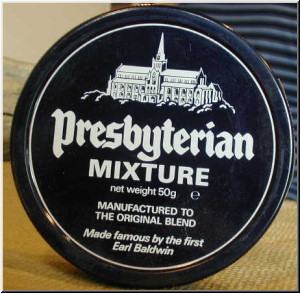
Darryl, if “Presbyterian Mixture” is the outcome of a merger between the OPC and PCA, let them stay miles apart. What an awful tobacco! 😉 However, I trust a be a better taste in Presbyterianism might be attained, if we mix the strengths of both…!
LikeLike
Jed, the Regulative Principle, taught in ch. 21 and in the Shorter Catechsim re: the second commandment, would be other areas of exception taking in the PCA. Frame and Keller have been outspoken on this.
The OPC is less formal in its allowance of taking exceptions. We have not had the debates over strict, honest, and loose subscription, the way the PCA has. John Muehter has a good historical essay on this, “The Confidence of our Brethren,” in a book called the Practice of Confessional Subscription.
I’m not saying this makes the OPC superior or inferior, just different.
LikeLike
Yeah, but it’s a great tin.
LikeLike
True, true…
LikeLike
Sorry to be slow on the uptake. Some of the founders of the PCA (esp G. Aiken Taylor) hoped that the PCA would serve as a destination point for all conservative Presbyterians/Reformed to merge into; others were too southern to want to merge with what was perceived to be the more doctrinally particular (read: “cranky”) OPC; still others were sensitive to the PCUS liberal accusation that all the conservatives came from WTS and BJU (hey, wait, that’s where I came from)–merging with the OPC might feed those perceptions. Still, the ecumenical voices won out in 1975 and 1986 in the two attempts to merge/J&R with the OPC (and in 1982 with the RPCES).
I still think that the “mainline” nature of the PCA at its founding (which I argued in NTJ an issue or two ago) was a big part of all the PCUS conservative thinking–they wanted others to merge with them; they didn’t really seriously consider merging with anyone else. Only those who are used to thinking of themselves as “mainline” would seriously believe that their denomination would be a destination point for everyone else.
LikeLike