

For those who may be wondering why N.T. Wright is speaking at the church of one of the founders of the Gospel Coalition – as in justification by faith alone coalition – Justin Taylor may have a clue. Here is a quotation from a piece in Christianity Today from 2008 on Keller and the gospel:
Tim Keller and his Redeemer Presbyterian Church in New York City fall somewhere between Wright and Dever. Writing for Leadership [JT: , Keller answered this year’s question for the Christian Vision Project, “Is our gospel too small?†(The article is not yet available online.) In so doing he took a stab at defining the gospel. “Through the person and work of Jesus Christ, God fully accomplishes salvation for us, rescuing us from the judgment for sin into fellowship with him, and then restores the creation in which we can enjoy our new life together with him forever.â€
It’s the last clause of this sentence that makes the difference. Is God’s plan to renew creation part of the gospel message? If so, is it the center of the gospel or a peripheral component of the Good News? Again, how you answer these questions affects how you will live, and how you will expect fellow church members to act.
“When the third, ‘eschatological’ element is left out, Christians get the impression that nothing much about this world matters,†Keller wrote. “Theoretically, grasping the full outline should make Christians interested in both evangelistic conversions as well as service to our neighbor and working for peace and justice in the world.â€
______________
Doug Wilson is sounding more and more like Mark Horne.
So, saving faith yields, trembles, and embraces. It yields obedience, it trembles at threats, and it embraces promises. But its principal acts are accepting, receiving, and resting upon Christ alone for justification. These are indeed its principal acts, but saving faith does other things. It hunts down the red law passages and yields obedience to them. It comes across passages which threaten divine displeasure, and saving faith trembles at these red law passages also. But what is saving faith doing responding to the law passages at all? Don’t the law passages just beat you up? No — in the broader context they are part of God’s saving intention for us. They are gospel. They are totus lex, part of the covenant of grace.
Then what do you do with Paul’s assertion that “the law is not of faith� Or what do you do with the Protestant protest against Rome that we are saved not by works but by faith?
______________
Apparently Craig Higgins, who pastors one of the congregations in the Redeemer New York network of Redeemer-like churches in the New York vicinity, is still a Presbyterian. Will N. T. Wright tempt him to become an English Christian?
______________
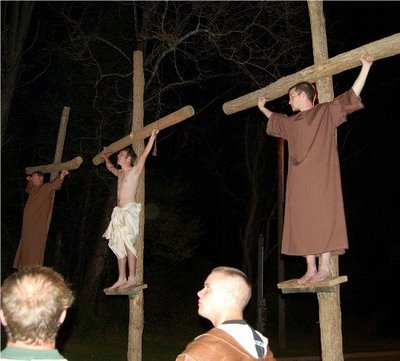
If abortion is an abomination, why isn’t this blasphemy?
______________
 Old Life
DGH
Like Richard Baxter-who Wilson resembles in so many ways- Doug has no reference point other than his own idiosyncrastic mindset. Abandon all hope ye who enter this domain.
LikeLike
If abortion is an abomination, why isn’t this blasphemy?
I imagine certain Reformed theocrats would say that it is. But then the next question might be, If the abomination calls for the faithful to pickety-protest outside clinics, then where are the pleadings to do the same against the blasphemy outside churches? The rhetoric usually includes something about what is happening to innocent images conceived in sin, but if marring innocence were the problem one would expect even greater indignation where a truly innocent image perfectly begotten was being made graven. But I didn’t see a trace of that outside any of the Krustianity churches this morning.
LikeLike
I daresay one can confess the biblical truth that God is about the business of renewing his creation, which will come in force one day, without confusing the kingdoms, without redirecting the church’s mission toward some failed attempt to make “the world a better place” (everybody now: “For you and me, you just wait and see…”).
LikeLike
Chris,
The problem is that Jesus lived and died only for that aspect of creation which was made in his image and likeness, which is to say, his people. It seems to me that that is how we may say we are being sanctified (or renewed). If we say “that God is about the business of renewing his creation” then mustn’t we also then say he lived and died for that aspect of creation that doesn’t bear his image and likeness? If so, then we must be saying he lived and died for fish, trees, cities and education. But groaning for the sons of God to be revealed seems altogether different from being renewed.
Or here’s another way to say it. My neo-Kuyperians (who talk about God presently renewing creation as well) pray for the sanctification of their musical instruments during the stated service. I think music is boss, but that’s pretty odd, to pray for harpsichords and organs to be sanctified. The only way it makes sense is if one isn’t distinguishing between imago Dei creation and non-imago Dei creation.
LikeLike
I think I agree with your fundamental point, Zrim (yet I see no problem whatsover praying over inanimate objects to be set apart for holy use, as seen throughout the entirety of the OT). Definitely there’s a distinction, but more needs to be said.
Here’s where Scripture trumps the tradition for me. In a certain sense indeed the Messiah “lived and died for that aspect of creation that doesn’t bear [God’s] image and likeness.” I mean, there’s Col 1:20 (“…and through [Christ Jesus] to reconcile to [God] all things, whether on earth or in heaven, making peace by the blood of his cross”), which has certainly been abused by neo-Kuyperians and social-gospelers alike, but at the very least speaks of something cosmic in the same breath as the atonement.
Denying this, it seems to me, leads to casting a suspicous eye on the endgame—a renewed creation. God’s not just fixing souls; he fixing everything—and his people are of course caught up in that.
LikeLike
Chris,
Praying for objects to be set aside for holy use seems still diffrent from praying for their sanctification. That is to say, I know how a flute can be set aside but I’ve no idea how it is sanctified.
I agree that something cosmic is being spoken of in the same breath as the atonement, certainly. That’s what I take a groaning non-image Dei creation to mean. So I am not denying a renewed creation. I’m just saying there seems to be some important distinctions to be made about the what’s being renewed presently (and how) and what is waiting for renewal.
LikeLike
If Rick Philips can bless the sacred American sniper, why can’t “the church” in New York City bless NT Wright’s version of Christendom? I am beginning to wonder if you really believe in “the church” in New York City.
In my opinion, the main problem Wright has is not the preterism which distracts us from the second coming of Jesus into a focus on “the church”. At the end of the day, Wright is more Arminian than universalist—he still has a future distinction of those who stay in the covenant and those who do not, and this all depends on infants growing up and keeping “covenant conditions”
Wright’s fundamental problem is his rejection of Christ’s death as substitutionary punished for the guilt of the elect imputed to Christ. Wright thus regards a book like “Pierced for Our Transgressions” as a fundamentalist obstacle to his Christendom project.
The reason Wright is so comfortable discarding justification based only on Christ’s death is that Wright has confidence in the water of “the church” to make Christians by the Holy Spirit’s regeneration. We see this in his essay in Justification in Perspective: Historical Developments and Contemporary Challenges (Paperback), Bruce McCormack, editor, (Baker, 2006)
I quote from Wright on p 260: “This declaration, this vindication, occurs in the future, as we have seen, on the basis of the entire life a person has led in the power of the Spirit, that is, it occurs, on the basis of ‘works’ in Paul’s redefined sense…just as the final justification will consist not in words so much as in an event, namely the resurrection of the person, so the present justification consists not so much in words but in an event, the event in which one dies with the Messiah and rises to new life with him. In other words, baptism. I was delighted to rediscover…that not only Chrysostom and Augustine but also Luther would here have agreed with me.
http://www.patheos.com/blogs/protestprotest/2015/10/would-n-t-wright-be-popular-if-people-knew-his-politics/#disqus_thread
LikeLike
What Rick Philips does in playing off the Lordship of Jesus against some narrow focus on the forgiveness of sins is very typical of those who emphasize having a “Reformed worldview”.
Jack Miller—-Wright offers a false choice by suggesting that “preoccupation” with who gets to heaven and by extension ‘how’ – somehow precludes also focusing on how one is “to live in the here and now.” The implicit message is ‘don’t focus on those peripheral personal salvation issues’, thus weakening a Biblical teaching that one should be rightly “preoccupied” with their salvation… not in some self-centered pursuit of spirituality but by growing in our trust in Christ’s death for our sins, His merit and obedience for our justification, and in a thankful obedience to His commands.
Jack Miller—Secondly, Dr. Wright’s teaching advances the idea that the gospel is not about how one gets saved from sin (by grace through faith in Christ alone), rather refocusing God’s purpose on building the kingdom of God here on this earth by righting wrongs and countering injustice in society. Though there are important things to be taught regarding our deeds unto others in this world, this shift in emphasis by Dr. Wright subtly moves the believer away from the gospel.
From N.T. Wright:
Wright—-“For Paul, what he means by ‘the gospel’ is not, despite some of our current usage, the description of a way of salvation… ‘The gospel’ is not, in particular, identical with the doctrine of justification. ‘The gospel’ is not itself the same thing as the revelation of God’s righteousness….; ‘the gospel’ itself refers to the proclamation that Jesus, the crucified and risen Messiah, is the one, true and only Lord of the world… [Paul] has presented his gospel, not as a message about how individuals get saved from sin and death, though that is of course taken for granted…..
Back to Jack Miller—“No reformer identified “the righteousness of God” as the same thing as the gospel. As a response to Wright’s wrongs – Paul did present his gospel as good news for sinners as to their salvation from sin and death precisely because it does proclaim how God in Christ justly justifies the ungodly… once Wright’s interpretations are subtly established, one can be moved away from the gospel of God’s grace through faith in Christ’s merit alone for our salvation as the heart of the Good News.”
http://theworldsruined.blogspot.com/2010/02/nt-wright-and-redeemer-church-in-nyc.html
LikeLike
Machen— I think I am just about as strongly opposed to the reading of the Bible in state-controlled schools as any atheist could be. For one thing, the reading of the Bible is very difficult to separate from propaganda about the Bible. I remember, for example, a book of selections from the Bible for school reading, which was placed in my hands some time ago. Whether it is used now I do not know, but it is typical of what will inevitably occur if the Bible is read in public schools. Under the guise of being a book of selections for Bible-reading, it really presupposed the current naturalistic view of the Old Testament Scriptures
.
Machen—But even where such errors are avoided, …the Bible still may be so read as to obscure and even contradict its true message. When, for example, the great and glorious promises of the Bible to the redeemed children of God are read as though they belonged of right to man as man, have we not an attack upon the very heart and core of the Bible’s teaching? …When any hope is held out to lost humanity from the so-called ethical portions of the Bible apart from ITS GREAT REDEMPTIVE CORE, then the Bible is represented as saying the direct opposite of what it really says. ”
http://thechristiancurmudgeonmo.blogspot.com/2015/08/apocalypse-now-in-mississippi.html
LikeLike