
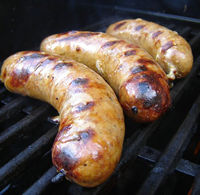
 Our friendly interlocutor, Zrim, took a dose of exception to the recent post here about drinking and smoking with Mike Horton – not with Mark Dever. He makes the plausible point that many Reformed types have graduated from a fundamentalist piety to the full-orbed one of smoking, drinking, and maybe even cussing, as part of the cage-phase of becoming Reformed.
He writes:
I have found it crowded with more or less two types: ascetic legalists and sophomoric libertarians who used to be ascetic legalists. . . . Then there is the liberty camp. Blowing smoke into the faces of their past, these find true piety to be measured by relative consumption. There seems always something to prove to some phantom somewhere in the individual or collective self, real or imagined. The way an adolescent speaks a bit higher on the phone so her parents know she is fraternizing with the neighborhood bad boy, certain libertarians want the details of their consumption known to their phantoms.
As I have admitted, this is a point that all Reformed Protestants who revel in the strong consciences need to consider.
But from the other side of the aisle comes the Reformed tradition itself. One of the more puzzling features of the original Protestant movement was a concern for eating meat – an act that hardly anyone but the most world-and-life view crazed would regard as essentially religious.. In one of the earliest Reformed creeds, Zwingli’s “Sixty-Seven Articles,†we read that the Christian “is free to eat all foods at any time.†This stemmed from the first outbreak of Protestantism in Zurich, eating sausage on Friday, a day on which Roman Catholics fasted by abstaining from meat. And not very long after Zwingli’s creed came the Tetrapolitan Confession which devoted four chapter to eating – or more precisely, to eating in contrast to fasting. One of the chapters was “Of the Choice of Meats.†The chapter on fasting has this:
When, therefore, we saw very evidently that the chief men in the Church beyond the authority of Scripture assumed this authority so to enjoin fasts as to bind men’s consciences, we allowed consciences to be freed from these snares, but by the Scriptures, and especially Paul’s writings, which with singular earnestness removes these rudiments of the world from the necks of Christians. . . . For if St. Paul (than whom no man at any time taught Christ more certainly) maintains that through Christ we have obtained such liberty in external things that he not only allows no creature the right to burden those who believe in Christ, even with those ceremonies and observances which God himself appointed, and wished in their own time to be profitable, but also denounces as having fallen away from Christ, and that Christ is of none effect to those who suffer themselves to be made servant thereto, what verdict do we think should be passed on those commandments which men have devised of themselves, not only without any oracle, but also without any example worthy of being followed, and which, therefore, are unto most not only beggarly and weak, but also hurtful; not elements – i.e., rudiments of holy discipline – but impediments of true godliness? (Ch. VIII)
One possible point to draw from this difficult prose, as sophomoric as it might appear, is that to have a theological journal, the NTJ, dedicated to the chemical found in tobacco is to bear witness to a prominent streak in the Reformed tradition about the importance of proclaiming and demonstrating Christian liberty. If meat on Friday was the way to expose the tyranny of man-made rules and false teaching in the sixteenth-century church, how much more is tobacco today a way to expose the sacred cows of both believers and citizens in the greatest smoke-free nation on God’s green earth?
 Old Life
I’m just glad I don’t smoke cigars. Only pipe, but that’s always been Presbyterian practice, right? And since it’s always been, it’s got to be right!
Good points, Darryl. It’s easy to forget that eating meat used to be an issue of conscience as well, way before the Reformation…
LikeLike
(Mmmm, red meat. Just yesterday at lunch I was raving about the Brazilian Steakhouse over a medium burger–with a Catholic. How’s that for Galatian sociology?)
Good point. But, while it may not be as tasty, I suppose I’d rather duke out Christian liberty over education. It’s better at teasing out latent legalism amongst the Reformed since most have seemed to make legalism only synonymous with substance use. That, plus substance use just seems so yesterday, man.
LikeLike
Zrim, and what public spaces exactly have you found for lighting up? Substance use is very much today when the substance in question is tobacco.
LikeLike
Sebastian Heck,
Actually, there was a time when pipe smoking was verboten in certain Presbyterian circles. One of my older cousins remembers that a minister was expelled from a local Presbyterian (UPCNA) church for just such an offense in the 1940’s.
Tobacco chewing needs to make a comeback. Not snuff, real man’s tobacco. Let me meet a confessional 2K minister that cogitates over Levi Garret or Beech Nut and I will supply him some good home grown pork sausage for his Friday supper.
LikeLike
Sorry, Richard G., but can’t go with you on chewing. Here’s why, from the Oct. 1997 issue of the NTJ:
In our first issue (“Sabbath, Psalms and Single-Malt,†Jan. 1997) we opined that the pages of the NTJ would be open to arguments for chewing tobacco even though the editors have no real inclination to take up the practice. A recent piece in First Things (“Tobacco and the Soul,†Apr. 1997) has forced us to reconsider our initial openness.
The author, Michael P. Foley argues that different forms of tobacco consumption correspond to different parts of the soul. Cigarettes appeal to the appetitive side of the soul, “a fact that explains their association with both food and sex.†People with strong desires, he writes, demand instant gratification and, therefore, cigarettes. Cigars, however, correspond to the spirited part of the soul, the quest for power and reputation, thus, explaining the popularity of cigars among politicians, business moguls, etc. Pipes relate to the rational part of the soul, hence the common image of wise people smoking pipes, such as the Oxford don or Sherlock Holmes.
BUT WHEN IT COMES TO THE USE of tobacco not involving fire (here Foley notes that fire has historically been emblematic of reason) the associations are not so flattering. Chewing tobacco corresponds to the “nonhuman — or more accurately, subhuman — parts of the soul.†It is, in Foley’s words, “a quintessentially subhuman activity. . . the rumination of bovine men. Or perhaps we should say it is camel-like, for camels not only chew, but spit as well.†That is why Foley says we “usually associate [chewing tobacco] with men of limited acumen.â€
In case you were wondering, the author puts snuff into the same category, though with the difference that it is not quite as disgusting even though more unnatural (because not taken through the mouth.)
This is not to say that Mr. Foley’s word is the last on chewing tobacco. But he articulated concerns that we had even though we couldn’t quite put our finger on them when we wrote the first editorial. For that reason, unless the protest is too strong, we will not be considering any submissions on nonflammable consumption of tobacco. We believe the acumen of our readers is much too high to do otherwise.
LikeLike
I come from a confessional Reformed background that has always accepted the principle that Christians are free in Christ. When tobacco products are involved, I think the question isn’t ‘are we free to use them?’ but ‘is it wise to use them?’ Answer to question #1- of course. Question #2- probably not. It doesn’t seem that you can make the same argument against the eating of meat. After all, meat doesn’t slowly damage your body (the Temple of the Lord) over time.
LikeLike
Evan,
1. I’ve heard that the average American dies with three pounds of red meat in his bowels, and given the cultural backlash against Atkins, etc., something tells me there is plenty of fodder for the legalist case (soft or hard) that meat slowly damages the temple of the Lord.
2. I’m not wild about liberty then wisdom model. I think it’s best to go with liberty then liberty. The liberty then wisdom model seems to function as a way to backtrack or take away with second hand what the first gave, as in “Sure, you can send your kids to public schools, but is it really wise (wink-wink)?” By doing this, one soft legalist wants us to know he’s spiritually concerned for the body (substance use), the other for the mind (education), but in both cases I tend to think he’s more concerned about what someone else is doing with his liberty.
LikeLike
Zrim, you make a good point about balance.
What I didn’t think to say when I commented earlier was the context of the Reformed backlash against fasting from meat on Friday- namely, the institutional church placing a binding rule on the individual conscience of the believer. There’s an enormous difference between a desire to be consistent with the Scriptures’ clear statements on liberty and an approach to living that is generally contrary for the sake of making a point. Your comment that was quoted in this post is really insightful in that I often feel those who indulge do it to shove it in the face of everyone; it’s an ‘I do it because I can’ way of life. All I intended to say with my wisdom comment was that just because you can doesn’t mean you should and perhaps looking like a pietist isn’t so bad after all. What matters is not the action itself but the intent, associations, and effect of the action.
LikeLike
Dr. Hart,
I realize that accusations of obtuseness leveled at any of the NTJ co-conspirators shouldn’t be thrown around lightly, but you leave me little choice here. Chewers are men of limited acumen? Little better than cud chewing cattle, and stinking camels? I am afraid you have been duped by Foley’s folly here.
Chewing is the industrious utilization of the human form alone, unaided by crass machines such as lighters and pipes to bring about the enjoyment of tobacco. The human form is the apparatus for the intake of tobacco, allowing the user to enjoy tobacco in a more visceral and elemental form. Even smokers would benefit from the occasional plug, as they would get a better sense for the taste of tobacco that hasn’t been forever chemically altered by fire.
A more informed approach to tobacco use would more reticent to acknowledge that each form of tobacco has its proper time and place.
LikeLike
Evan, you really have to believe me when I say that some of us enjoy smoking for the associations, effect, and action, all of which can have a wholesome outcome, as in sitting around and enjoy conversation aided by primary and second hand smoke.
Jed, you might have a point if you were out in the field and picking leaves straight from the plant for your ingestion. But I’m thinking that plenty of machines are involved in the harvest, curing, cutting, and canning of chewing tobacco. Plus, animals can chew. Only humans can figure out how to start a fire and figure out which objects are worthy of burning.
LikeLike
Oh, I’m well aware of the enjoyment involved in a smoke and good conversation. I’ve been known to light up a Clove or two myself on occasion. But I don’t see any reason to run around shouting about how free I am- see how I’m not like those legalists- and I know when it’s best to keep my mouth shut for the sake of preserving witness. It’s not about being right and being able to prove it.
LikeLike
Evan,
All you needed to say was how you enjoyed cloves, that explains it all. It is the Christian non-smokers smoke of choice, also enjoyed might I add by ladies all over the land! You’re wisdom/temple arguments are severely impaired, since the only thing less healthy than inhaling a clove is drinking a cup of pure tar and broken glass shards. My temple hurts simply at the thought.
All ribbing aside, your experience may be a bit different than mine, but I’ve never encountered an impairment of witness by lighting up, or indulging my camelistic nature in popping in a chew. Could it be that you are fighting an evangelical ghost here? Heck, enjoying a smoke with a non-xian might even diffuse a common misconception – namely that a xian must maintain certain moral perceptions. Not to say that smoking ought to be the Reformed version of the tract, just to say it might not hurt your witness as badly as you allege (unless you light up in a cancer ward).
LikeLike
hehe
Well Jed, I never said I always followed my own advice. In the context in which I grew up, smoking might actually put some other Christians off. At the same time, it’s true that it can open people up or put them at ease. That, however, was exactly the point I was (apparently unsuccessfully) trying to make when I used the phrase “intent, associations, and effect.” It’s on a case by case basis that I have to ask myself those questions because there’s not one universal answer to the liberty question that covers every possible circumstance. Hence my slightly sarcastic comment about being better than those legalists who are, of course, always other people and never myself.
LikeLike
Dr Hart,
There will be no Pennsylvania home grown pork sausage for you! Quoting from a journal with neconservative leanings no less!
Chewing is essentially a culturally protestant activity, because it can can be enjoyed during manual work. We lock the church from Monday to Saturday and get out into the toil of the everyday World, rather than hiding in contemplation. Chewing connects us directly to the Clay from which we were formed. Smoke is wispy and gnostic.
While I have enjoyed every form of tobacco except a hookah, I believe chewing to be the most manly and honest use.
Jed,
You are spot on about common misconceptions. Among many non churched country people I have met in northern West Va and my native Western Pa, there is actually genuine surprise that I smoke/chew, occasionally drink, AND am a professing believer who regularly attends services.
LikeLike
Evan,
I have found that’s lots of Reformed talk about education the way Baptists talk about substance use. So here’s my educational version of blowing smoke in legalist faces: “Public schools should be thoroughly secularized and Christian kids should be in them.” It’s really fun and cathartic to say, but something tells me it may be a function of still smarting from being told by my PCA pastor friend that I would never be an elder in his church if I continued to publically school my kids. It reminds me of all that “carnal Christianity/second class Christians” fubar of my former IFCA days. Harrumph.
But the thing about blowing smoke in legalist faces is that, much as they deserve it and it does absolute wonders for the exorcising of personal demons, it doesn’t really tend to advance the conversation. It just entrenches the legalist further. So I’ll accept the category of wisdom, but for different reasons. On this one I prefer to take the cues of the WASPs who don’t think substance non/use makes any comment one way or another about personal piety, which just seems like the more natural posture of liberty.
For the record, if I were inclined in my preferences for tobacco it would definitely be a pipe.
LikeLike
WASPs and polite non-disclosure ftw!
LikeLike
Excellent point concerning liberty and wisdom and how they’re conscripted or put against one another.
I am curious about how baseball became known to some as the thinking man’s sport in light of chaw chewing being “a quintessentially subhuman activity. . . the rumination of bovine men.” My mind goes immediately to Lenny Dykstra of the Phillies and him having chaw drool going down the side of his mouth. Intelligent looking? Well…
On the side, the Flood family fortunes were started upon my grandfather cleaning spitoons for Wells Fargo. Great-grandpa died when grandpa was 16 so grandpa had to drop out of high school to start pulling the family’s weight.
I enjoy pipesmoking, at times with a glass of cognac. Smoking a pipe brings something subtle out of the cognac, flavor-wise.
LikeLike
As a former cigarette smoker, when someone pointed out that my body is a temple I referred them to Isaiah 6:4 where we are told that “the temple was filled with smoke”. What I was doing was quite biblical.
LikeLike
Nick, nice to hear you are among the living.
LikeLike
With a comment like that I wish he was around here more. His sense of humor fits in with the 2Kers and his quoting Scripture out of context fits in with everyone else.
LikeLike
On an unrelated note, anyone interested in reading the lawsuit against Patrick Edouard, Covenant Reformed Church, the URCNA, and the Covenant Reformed Church elders can find it by clicking on my name. Interesting (and sad) suit with potentially broad implications.
LikeLike
DV I’ll be blogging on the Edouard petition later tonight.
LikeLike
I just want it noted that the post proper was sort of about me.
PS, Nick, nice wisecrack.
LikeLike
I’m only among the living because I quit smoking (at least that’s what my evangelical friends tell me).
I’m sure we can get some pro-smoking mileage out of “the smouldering wick he will not snuff out” passage. I love eisegesis.
LikeLike