
 After saying my morning prayers (see, I am devout), tending to the livestock, and fixing the coffee, I tuned into my favorite radio show (my wife’s most hated) to learn not only that Phillies had lost but that Osama Bin Laden had lost his life. To hear sports-talk radio hosts commenting on life, death, and terrorism was obviously strange, though they would have also been my path to news of 9-11 if streaming audio were available back in the dark days of Windows XP.
But even stranger and more inappropriate was to listen to sports fans chime in with glee about Mr. Laden’s death. To treat this man’s execution and burial like another Joe Blanton loss is clearly not fitting. What the event seems to call for is a ceremony – akin to the one in which President participated at the National Cathedral after 9/11. My Old Life sensibility tempts me to conclude that our culture cannot ceremonialize the death of a national enemy because we are no longer a ceremonial culture – too much Praise & Worship worship. But this would be a cheap shot in the worship wars. What is actually the case is that human beings have a long history of celebrating an enemy’s death in a manner more appropriate to a sporting even. Just think of what the Italians did to Mussolini. The communist Partisans captured him, executed him, and then hung him by his feet in a public square in Milano where the locals proceeded to jeer and throw rocks. Don’t underestimate human vindictiveness.
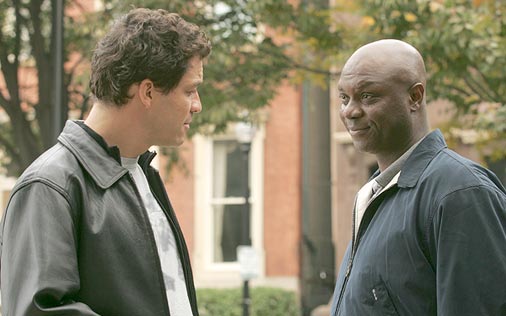
But don’t underestimate either the dark side of this bright moment in this chapter in the chronicles of justice. Since I have been re-watching Season Three of The Wire – the season where the fate of the drug lords, Stringer Bell and Avon Barksdale is settled – I have thought about the events of last night through the lens of human frailty so brilliantly depicted in that award-winning HBO series.
First, I heard on NPR that one of the oddities about Mr. Laden’s compound was that such a massive and expensive place would not have either internet or phone service. Boy, does that have The Wire written all over it. To evade the special unit given the task of catching Avon, which had used a fairly sophisticated system of wire taps, even to be able to track disposable phones, the head of the entire drug enterprise went without a phone altogether. To contact him, people had to talk to his minions, or executive minions. Mr. Laden didn’t need to be a fan of The Wire to see the logic of going without electronic communication, but sometimes life does imitate art.
Second, if Mr. Laden were an American citizen selling drugs or directing terror, chances are the authorities would not have had the freedom to kill him on sight. Their first action would have been to capture him, read him his rights, and then start the wheels of U.S. jurisprudence rolling – which might involve some roughing up behind closed doors in police office buildings. But if Mr. Laden were like Avon, he would likely still be alive (if he did not resist arrest).
Third, what kind of strategy did the American military use in killing Mr. Laden? In The Wire the mayor and police chief are often more interested in symbolic victories – declines in statistics, or drugs piled on tables for journalists to see and photograph – than the real source of the problem. In other words, they are more interested in winning re-election than in strategic allocation of resources. In which case, was Mr. Laden a target of military and intelligence officials? Or was he a trophy for administrators in the Pentagon to maintain budgets and for the White House to look tough on terror?
Another layer in managing the publicity of Mr. Laden’s death is the relationship among the United States, its Western and middle-Eastern allies, and Pakistan. Military and civilian authorities are choosing their words carefully to prevent embarrassment for the Pakistanis. What The Wire’s police chief Burrell says to his Colonels is different from what he says to the mayor behind closed doors which is different from what Burrell says to the press. Another instance of personal, professional, and civic calculations is Tommy Carcetti’s decision to run for mayor of Baltimore. As one of the few white councilmen in the city, the only shot he has to defeat the black incumbent is if another black councilman runs in the Democratic primary and splits the African-American vote, thereby letting Tommy emerge as the great white hope – who even during the mayoral campaign is calculating how to manage city politics in a way that will allow him to run for state (governor) and or federal (senator) office. Celebrators should not let Mr. Laden’s death prevent them from seeing the layers of interests – what the Coen brothers do when exploring the mixed motives of their characters – that inform presidents, generals, chiefs of staff, kings, ministers of parliament and journalists in their massaging of, taking credit for, or distancing from this event.
Last, celebrators should remember the experience of Bushy Top, Jimmy McNulty, once he finally hit his target. Jimmy had to do some real soul searching about whether he was going after Avon and Stringer for the sake of the city, his commander, or personal fulfillment – colleagues did tell him he needed to get a life. To the degree that his own identity was bound up with convicting one of B&B Enterprises’ co-owners, Jimmy also saw how incomplete he was. The defeat of Avon and Stringer turned out to be a thin reed on which to hang Jimmy’s search for meaning. The death of Mr. Laden will generate great ebullience. Americans should beware of the rapid and scary descent on the other side of this roller coaster ride.
What in anyway does any of this have to do with Reformed faith and practice? In keeping with the neo-Puritan insistence on application, the theological payoff of a Wired reading of Mr. Laden’s death is this: although the Bible teaches human depravity God’s word doesn’t really explore it in its amazing and complicated depth – as in the wickedness that clings to the best of human actions – the way that productions like The Wire do, or the Coen Brothers’ movies, or even the occasional French film like Jean de Florette. To be alert to the variety and tenacity of human sinfulness, you need to look at the poignant portrayals of human existence that come from some of the best artistic expressions (though the Old Testament has its moments).
What the Bible does teach is the remedy for sin. Its salvation is not a government that enforces God’s law or even that reinforces the rule of law, as good as those forms of rule may be. The only remedy is a savior whose work of redemption is so amazing that he could even, pending faith and repentance, save Mr. Laden from his obvious sin.

 Old Life