Worldview Politics

As I have come to understand it, a Reformed world-and-life-view is a hard outlook to acquire. It starts and requires regeneration by the Holy Spirit, or so it would seem since a worldview is a basic reality to a person’s existence. Seeing through the glasses of faith, accordingly, requires having faith, something that comes only through effectual calling. This worldview also needs doses of philosophy and theology so that viewers of the world have the intellectual equipment to construct the theories and apply truth to real life. A worldview goes so deep, as readers of Machen keep reminding me, that even the great Westminsterian would say that “two plus two equals four” looks different to a Christian compared to a non-believer. (Though it is still unclear whether all settings in life – from the family dining room to the halls of Congress need to bear all the weight of such metaphysical significance. For instance, does the unbelieving cashier need to admit her reliance on borrowed capital before I receive my change? I don’t think so.)

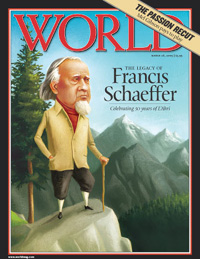
Since a worldview is such an acquired taste, I have found it unendingly odd to see people without a Reformed world-and-life-view defending those political candidates and their intellectual influences who possess a Reformed world-and-life-view. I find this particularly odd since the proponents of worldview would typically regard those without a worldview as being at odds with their understanding of total truth. I am referring in particular to recent posts by journalists and religious historians who discount the dominionist spin that is still being put to Michele Bachmann and Francis Schaeffer. (Truth be told, I talked to one of these authors – Charlotte Allen – for the better part of an hour while she was preparing her column. And I was frustrated to see that the illumination I may have offered did not make a dent in her aim of discrediting the bias of liberal journalists. She even took down the exact title of my recent book to include in her column. Oh, the missed fame! Oh, the loss of royalties!!!!!!!)

No matter what the folks without a correct worldview make of Francis Schaeffer’s ties to dominionism, it is hard to read his account of the antithesis and find trustworthy people like Ross Douthat, Charlotte Allen, and Matt Sutton who apparently do not have either the faith or the theological and philosophical training to attain to a worldview.

Here’s one example from How Should We Then Live?

. . . in contrast to the Renaissance humanists, [the Reformers] refused to accept the autonomy of human reason, which acts as though the human mind is infinite, with all knowledge within its realm. Rather, they took seriously the Bible’s own claim for itself – that it is the only final authority. And they took seriously that man needs the answers given by God in the Bible to have adequate answers not only for how to be in an open relationship with God, but also for how to know the present meaning of life and how to have final answers in distinguishing between right and wrong. That is, man needs not only a God who exists, but a God who has spoken in a way that can be understood. [81]

I wonder what Douthat, Allen, and Sutton think about the power of their own intellects as they survey the reactions to Bachmann and Schaeffer. Or have they been checking their perceptions against the pages of holy writ?

But if the non-worldviewers are a little uncomfortable with Schaeffer’s distinction between the Bible and autonomous reason, they might experience real pain when reading his application of the antithesis to the American experiment. About the Moral Majority he wrote in A Christian Manifesto:

The Moral Majority has drawn a line between one total view of reality and the other total view of reality and the results this brings forth in government and law. And if you personally do not like some of the details of what they have done, do it better. But you must understand that all Christians have got to do the same kind of think or you are simply not showing the Lordship of Christ in the totality of life. [61-62]

It does seem strange that a Reformed world-and-life-view would find its fulfillment in a political organization comprised of Protestants, Roman Catholics, and Jews, and headed by a fundamentalist Baptist. But we are talking about the United States, which H. L. Mencken called “the greatest show on earth.”

Schaeffer did not stop there. He also argued that the United States was the fruition of the gospel:

The people in the United States have lived under the Judeo-Christian consensus for so long that now we take it for granted. We seem to forget how completely unique what we have had is a result of the gospel. The gospel indeed is, “accept Christ, the Messiah, as Savior and have your guilt removed on the basis of His death.” But the good news includes many resulting blessings. We have forgotten why we have a high view of life, and why we have a positive balance between form and freedom in government, and the fact that we have such tremendous freedoms without these freedoms leading to chaos. Most of all, we have forgotten that none of these is natural in the world. They are unique, based on the fact that the consensus was the biblical consensus. And these things will be even further lost if this other total view, the materialistic view, takes over thoroughly. We can be certain that what we so carelessly take for granted will be lost. [70-71]

Again, I wonder where Schaeffer’s defenders fall on the spectrum of the two competing worldviews, and how much they actually embrace the biblical consensus that allegedly informed the work of Thomas Jefferson, John Adams, and Ben Franklin.

The problem here is not that people should consider Schaeffer to be scary. Like many of his defenders have said, either explicitly or implicitly, he really didn’t mean what he seemed to say. He was not really so intolerant as his antithetical outlook demonstrated. He did not want a theocracy. But if that is so, then just how important is this worldview thing? If it results in high-falutin’ rhetoric and pragmatic reality, then what is the point of promoting all of those books and institutions that teach a worldview?

The problem that really needs some ‘splaining is not whether Schaeffer is scary but the strange disparity between the deep-down diving nature of worldview – it is part and parcel of new life in Christ – and how easily accessible it is, and even attractive, to those without such a worldview. A high octane version of worldview should reveal and make poignant the discrepancies between the lost and the saved, between the philosophically initiated and the believing simpletons. But it does not. A worldview, even of the antitheticial variety taught by Schaeffer, is for non-worldviewers like a puppy mutt – maybe not the first choice to take home from the pound but still a cute dog. Was the antithesis really supposed to be so easily domesticated?

Of course, I understand the angles that historians and journalists have in this contretemps over Bachmann. A writer like Douthat – whom I admire greatly and read for profit – may not qualify as a Kuyperian or neo-Calvinist-lite – but he can see the value of evangelical readers of Schaeffer to electoral politics in the United States. He also sees a way to point out the bias of liberal journalists, such as when they score points against Bachmann’s spiritual influences but not against Obama’s. All is fair in the coverage of religion and politics.

But the reception of Schaeffer and the watering down of worldview sure does cheapen what was supposed to be such a distinct and unique part of Reformed Protestantism. I wonder why more worldviewers are not objecting to the debasement of their valuable coin.

Say Hello to Nelson Kloosterman, James Jordan, Tim Keller, and David Bayly

Theonomy and R. J. Rushdoony have never been so popular. Ever since Ryan Lizza’s piece on Michele Bachman in the New Yorker appeared, bloggers and columnists had been taking shots at the journalist for allegedly writing a hit piece on the congresswoman from Minnesota. The latest to weigh in is Michael Gerson, George W. Bush’s speech writer, and a columnist for the Washington Post. According to Gerson:

The Dominionist goal is the imposition of a Christian version of sharia law in which adulterers, homosexuals and perhaps recalcitrant children would be subject to capital punishment. It is enough to spoil the sleep of any New Yorker subscriber. But there is a problem: Dominionism, though possessing cosmic ambitions, is a movement that could fit in a phone booth. The followers of R.J. Rushdoony produce more books than converts.

So it becomes necessary to stretch the case a bit. Perry admittedly doesn’t attend a Dominionist church or make Dominionist arguments, but he once allowed himself to be prayed for by some suspicious characters. Bachmann once attended a school that had a law review that said some disturbing things. She assisted a professor who once spoke at a convention that included some alarming people. Her belief that federal tax rates should not be higher than 10 percent, Goldberg explains, is “common in Reconstructionist circles.”

The evidence that Bachmann may countenance the death penalty for adulterers? Support for low marginal tax rates.

Since theonomists recently dismissed me and other 2kers as infidels for not supporting the death penalty for adultery, Gerson’s words have a certain poignancy. As I argued at Front Porch Republic, the word Dominionism is proving to be a real distraction from a much bigger issue for Protestants who may not be as obscure as the Dominionists (wherever they are — do they have a website, journal, or institution?). Theonomy or Reconstruction may be acquired tastes among Reformed Protestants who hold neo-Calvinism dear, but a wide swath of conservative Calvinists — some whom Gerson knows — defend the Kuyperian view of the antithesis in ways that make the world safe for Michele Bachmann and many evangelicals who also see the social world in black and white categories. The reason for this convergence owes to a rejection of appeals to the light of nature in favor of special revelation and regenerate interpretations of the Bible alone (to be interpreted by regenerate people, mind you) for arriving at Total Truth. Such conservative Protestants may not follow theonomists in supporting the death penalty for disobedient adult covenant children, but they do believe the Bible should be the basis both for the public square and arguments about how the best way to run the public square.

As I pointed out in one comment at Greenbaggins:

. . . there are at least three different critiques of 2k but those critiques are also at odds:

1) the 16th century view of the magistrate and his duties to promote the true religion is one critique. (But this critique is marginal to contemporary Reformed communions because all the Presbyterian and Reformed churches of which most of us here are members have repudiated those views and revised our confessions).

2) the generally Kuyperian view that Christ is Lord of all things which reads the relationship between general and revelation in a particular way against 2k. (This is generally Kuyperian because this view is only implicit in Kuyper who also rejected the 16th century view of the magistrate and who also held up the ancient philosophers as models of political philosophy despite their lacking special revelation.) If someone could actually explain the Kuyperian view it would be very helpful and I have ask Mark many times for it and he keeps avoiding an answer.

3) there is the theonomist critique which is a reading of the law of recent vintage (though it may pull from earlier Reformed thinkers) and which has no standing in any of the Reformed churches represented here (as in people asking for the magistrate to execute adulterers).

These three critiques are not in agreement and the third would actually have to take as much issue with the first two as with 2k because those other positions don’t follow the law any more than 2k does (as theonomists understand the law).

So with all of this hostility, it would be useful for the critic to identify himself and what the model or standard is for which he stands. The first two critiques hold up part of a historical example and use that against 2k to show that 2k has departed from a certain standard. But the entire Reformed world has moved from those earlier expressions. So the first two critiques need to explain what the new model is now that Reformed churches have moved on.

Theonomists don’t really need to identify themselves. I generally get their objection. I just don’t see why theonomy is as much a problem for Calvin as it is for Kuyper.

In other words, the one position available to conservative Protestants for demonstrating that they do not hold a view of biblical law comparable to sharia — the 2k theology and its use of the order of creation and the moral sense that all people have — is anathema or nonsensical to many who call themselves neo-Calvinists, evangelicals, and theonomists. As I (the one in all about me) have also argued, at least the theonomists are consistent. But what folks like Gerson seem to be in denial about is the working assumption that prevents most evangelicals folks from embracing 2k — that God’s truth only comes from the Bible and the regenerate who alone have the capacity, through the lens of Scripture, to understand the created order aright.

This doesn’t make Bachmann or Keller, or Kloosterman, or the Baylys dominionists — the Federal Visionaries are another matter. But they are all using the same play book — an understanding of worldview that relies on the basic distinction between the redeemed and the lost. For that reason, outsiders like Lizza and others outside the Christian camp, may have trouble knowing when a Christian entering the public square is going to follow Scripture or not. I am still waiting to hear the argument that says we will follow biblical teaching for civil laws on marriage, sex, and murder but not on idolatry, blasphemy, or the Sabbath. Until the critics of 2k start to criticize each other — sort of the way that conservatives were wondering when feminists would turn on Bill Clinton for his dalliance with Monica — knowing how to distinguish Dominionists from the rest of the Bible-onlyists will require a special playbook.

Forensic Friday: Who's Lutheran Now?

From Luther’s sermon for the seventh Sunday after Trinity (1534):

Thus St. Paul says: “Know ye not, that to whom ye yield yourselves servants to obey, his servants ye are to whom ye obey: whether of sin unto death, or of obedience unto righteousness?” and this means, as you now through grace are bound to obey God and live according to His Will. For you must be in the service of one master, either of sin which brings you into death and the wrath of God, if you remain in it it, or of God in grace, to serve Him in newness of life. Therefore you must no longer be obedient to sin, for you are now released from its power and dominion.

Sin will not be able to rule over you, for you are no longer under the Law but under grace. That is, you can now resist sin because ye are now in Christ and have received the power of His resurrection.

Either Luther was reading Vos, or the forensic-centric reputation of Lutherans is a caricature. Or maybe the priority of justification was biblical after all.

Where's Waldo Wednesday: Dazed and Confused

Why is it that discussions of the law and sanctification invariably circle back to union with Christ? My own hunch, expressed several times, is that union becomes the way to cement sanctification to justification, especially if neither is prior to the other but union precedes both. This way, supposedly, Protestants can look Roman Catholics straight in the eye and to the charge that justification by faith alone is antinomian reply, “pound sand.”

Bill Evans stirred up the hornet’s nest with some contested hypotheses about the different emphases in Reformed circles as demonstrated in an exchange between Kevin DeYoung and the grandson of Billy Graham whose name I cannot pronounce or spell without buying a couple more vowels. Evans appealed to union to once again cut the Gordian knot between the forensic and moral renovation, but that did not satisfy Sean Lucas or Rick Philips. (Jared Oliphint has a good list of the various iterations of this discussion.)

Since so many have weighed in on Evans’ provocations, I will only make one brief comment about his initial post. He wrote this, which I believe to be typical of the kind of confusion that comes when asserting the simultaneity and denying the priority of justification and sanctification:

. . . it is unconvincing to suggest that Paul does not use the expectations and sanctions of the law as a motive for sanctification. More than once the Apostle provides extensive vice lists of behavior forbidden by the law of God, adding that those who behave thus “will not inherit the kingdom of God” (1 Corinthians 6:9-10; Galatians 5:19-21; Ephesians 5:3-5). That sounds like motivation to me!

Well, a quick check of Calvin’s commentary on that passage in Galatians (recently preached by my pastor) shows that the Geneva pastor did not interpret Paul to be motivating believers to obey God’s law “or else.” On Calvin Galatians 5:21, Calvin writes:

Paul does not threaten that all who have sinned, but that all who remain impenitent, shall be excluded from the kingdom of God. The saints themselves often fall into grievous sins, but they return to the path of righteousness, “that which they do they allow not,” (Rom. vii. 15) and therefore they are not included in this catalogue.

In fact, gratitude, not fear of punishment, is the chief motivation for the Christian life throughout the most influential Reformed creeds.

I will also express some bafflement at Rick Phillips denial of any legitimacy to the idea that justification “causes” sanctification when he can assert that union “causes” justification and sanctification. If causal language is a problem for justification priority folks, why can causal language (which justification prioritoryists seldom use crudely) be applied to union?

Jared Oliphint tries to bring the whole question of the relation between justification and sanctification or between the indicative and the imperative back to the historia salutis.

Eschatology. Eschatology. Eschatology. It may initially sound foreign, but eschatology is the background of and essential to the gospel. What sets the stage for how we are justified, how we are sanctified, and what’s called the “order of salvation” is what was accomplished in history by Christ to make possible those benefits you receive by being in Christ; the history of salvation is the context for the gospel and your own personal salvation.

But the appeal to the historia soon swerves back to micromanaging the ordo salutis:

Because of the already/not yet aspect to all of reality now, that reality must inform discussions regarding the gospel, salvation, what Christ has done, what he will do, etc. There is a sense (already) in which we are no more justified or sanctified now than we ever will be, even in the new heavens and the new earth. But there is another (not yet) sense where there is still work to be done in us and with God’s unredeemed, temporary creation. While this already/not yet tension is still a reality here while our Lord tarries, the indicative of who we are as believers united with Christ and receiving every spiritual blessing (Eph 1:3) as a result is never in tension with what God calls us to do here as his sons and daughters in Christ.

As an aside, do unionists ever talk about union being already/not yet? If eschatology goes all the way down and colors all the benefits of redemption, then the answer would appear to be “yes.” But the permanence and necessity of union never seems to allow for a concession that union also partakes of the two-age construction.

Yet, when Oliphint tries to clarify the relationship between justification and sanctification from the perspective of union and the historia salutis, he winds up with an explanation that adds very little to or resolves the recent discussions.

When sanctification is defined as “getting used to your justification” or “forgetting about yourself” and the law and the gospel/grace are in a tug of war of emphasis, do you not see that the entire crucial context and substructure of what Christ accomplished and how he applies it in your life is missing? Sanctification is a dying to sin and rising with Christ and has so much more to do with what Christ did for you than in your disposition of just letting the reality of the benefit of judicially being declared righteous sink in; not to mention the need to distinguish for clarity’s sake the difference between being definitively sanctified (1 Cor 1:2; 6:11; Heb 10:10,14) through our union with Christ and progressively sanctified (Rom 12:2) over time in the life of believers.

That sounds awfully antinomian. Sanctification has to do with what Christ did. So my imaginary Roman Catholic interlocutor is now wondering why the Reformed doctrine of sanctification or union does not lead to complacency? After all, Christ did it all.

To avoid that charge, Oliphint resorts to a legal “must”:

As redeemed believers we must do good works “for Jesus” as God works in us progressively to sanctify and we must do so as good and faithful servants of the Savior who requires that of us, but not do them from a false motivation to earn our salvation already achieved for us by Christ. We obey as God’s new creatures, groaning with creation for our Savior to come and complete his work in us.

This attempted resolution is not necessarily wrong. Neither is it particularly different, despite all the gloss of Vos, from what Reformed theologians have tried to say about God at work in the believer as the believer works. Another way of saying this is the third use of the law. We needed the historia salutis for that?

From my blinkered theological mind, the big question seems to be how the law functions in the life of the believer and in what way it is necessary. Here the Shorter Catechism appears to be remarkably helpful. It distinguishes two sets of requirements.

The first is what are the duties God requires of man (39)? This is the lead question for the explanation of the Decalogue. And second, after the law is parsed, the catechism asks another “require” question: What does God require of us that we may escape the wrath and curse of God due to us for sin (85)? (Notice the difference between the law required of all men and the requirements associated with the “us” of the redeemed.) From here the catechism goes on to discuss the means of grace.

A recognition of these distinct requirements and their stated audiences plausibly leads to the conclusion that the law is not a means of grace. Clearly, the law is not in view when the catechism explicitly addresses the means of grace – that is, word, sacrament, and prayer. This doesn’t mean that the law is bad, not to be followed, or not a standard of conduct. But following the law as a requirement does not contribute to justification – or to sanctification, for that matter. Attending to the means of grace, however, does contribute to salvation as a way of reassuring believers that God has promised to save them from their sins.

In other words, following the law is only the fruit of salvation, not the means of salvation (which includes justification and sanctification).

One last thought: since starting this post I see that Evans cannot let Oliphint or others have the last word, and so he writes this:

I firmly believe that balance in the Christian life is possible and that our people see the glory of God not only in the grace of justification but also in the demands of God’s law and in the way that the whole of Scripture marvelously fits together–what WCF 1.5 calls “the consent of all the parts, the scope of the whole (which is to give all glory to God), the full discovery it makes of the only way of man’s salvation, and the entire perfection thereof.” And to this end we must proclaim the whole counsel of God. This means that we proclaim the imperatives of transformation as well as the gratuity of justification. Furthermore, we must do this without separating them, for both are found in Christ. Law without grace and mercy is just as unbalanced as grace and mercy without law.

As mechanical and confusing as “the imperatives of transformation” and the “gratuity of justification” as a formulation is, I don’t understand how Evans is not attaching an “or else” to “do this.” And I don’t for the life of me understand how this is a comfort, or how it does not undermine the assurance of the gospel. After all, everyone has a sense of justice and the idea that no matter what I do I belong to God because of Christ’s work on my behalf does not seem to be fair. Surely, I can prove my worth if I obey God’s law. But this is precisely what is so marvelous about the gospel, and why the law should send shivers down the spine of all people. No one can keep the law, not even the saints. That’s why good works are filthy rags. The only bleach available to make us presentable at the day of judgment is not the white hot flame of the law but the blood of Christ. Like the gospel, using a red fluid that will only stain to make ourselves clean makes no sense. But it’s the only hope for those who know that the law will always show the filth of human depravity and the dirt of good works.

Tim Bayly Does His Impersonation of St. Peter

Apparently the Brothers B have dyslexia, though I am open to other explanations for how they garble other peoples’ writings and ideas. Tim Bayly has written yet another blast of their loud trumpet against 2k theology. This time they identify with the plow boy who knows right from wrong and they pit the common person against the egg-head academics who argue for a two-kingdom perspective and do so by often invoking the apostle Paul. Never mind that the simple apostle, Peter, like the Baylys apparently, found Paul hard to understand sometimes. The plow boy in the Baylys is a cocky little fellow who knows what he knows and disregards any instruction even after he steps in a big pile of mule manure because he was reading Bayly Blog on his I-Phone.

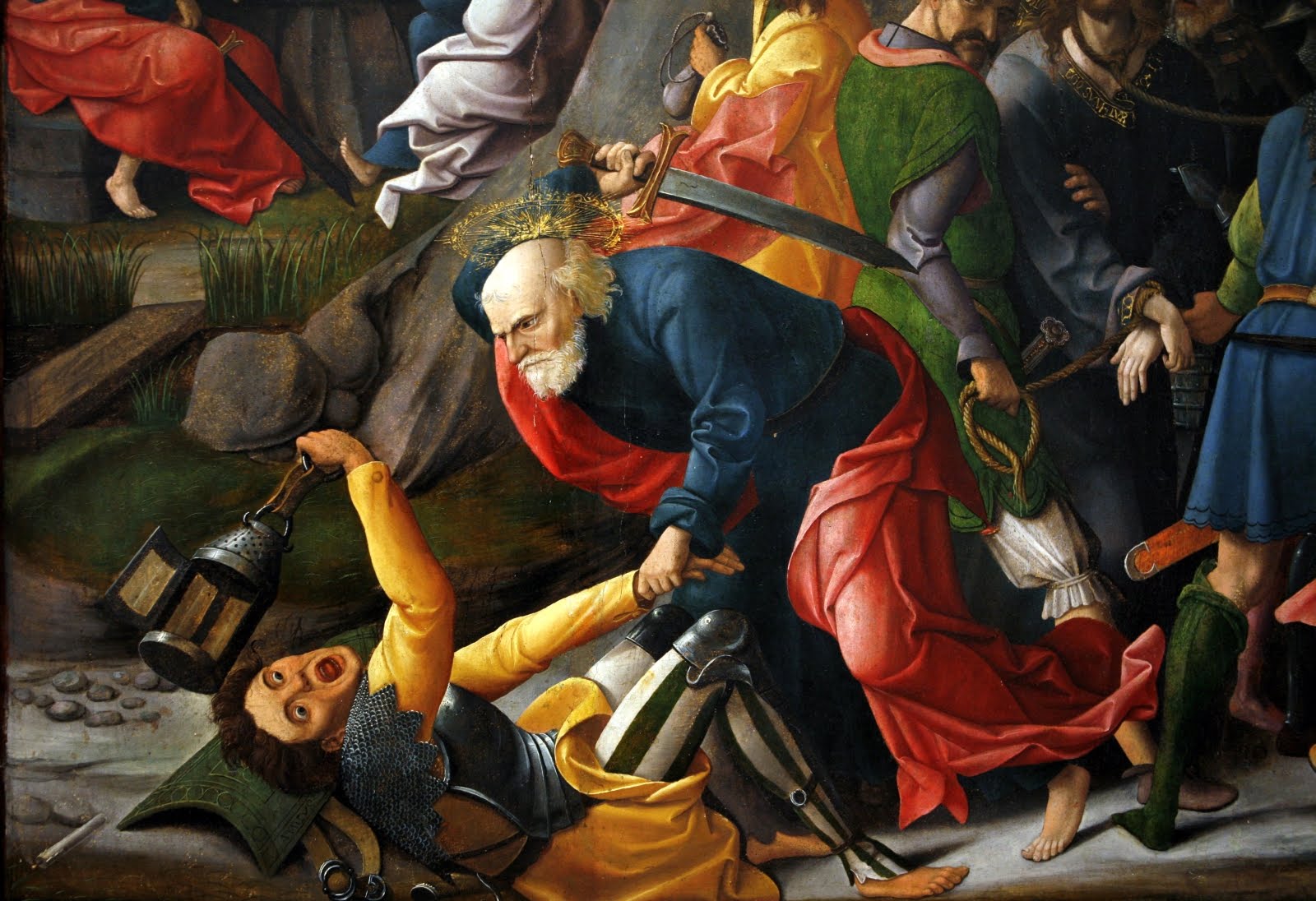
Aside from identifying with Peter’s roots as a man of the fishermen, the Baylys seem to be fond of rushing to judgment and action like the apostle did when evil is prevailing over the good. It was Peter, after all, who committed the only act of outright political defiance by the apostles when he raised the sword and took a swipe at one of the soldiers who arrested Jesus. Anyone with an ounce of sympathy for Christ can also appreciated Peter’s desire and courage in defense of his Lord at a time of great injustice. But Peter still didn’t understand, like the Baylys, that Christ’s kingdom comes not by a physical but a spiritual sword.

That is what 2k strives to clarify, the spiritual nature of the church.

But here is how the Baylys once again misrepresent 2k in tones quite out of tune with the love the repeatedly profess:

They [2k men] are fixated on silencing the voice of their fellow citizens who are religious, particularly those citizens who profess faith in Jesus Christ. Their endless political message is that no man may speak for God outside the privacy of his own home and church-house; and that if he does choose to speak as a citizen of these United States, he must be ever so careful to make it clear he’s not speaking for God or His Church. Our form of government requires him to parse his words and mince his sentences and nuance his tone so that no civil magistrate or fellow citizen will feel threatened by Christians-as-Christians, let alone Church-members-as-Church-members or Church-officers-as-Church-officers. This is the nature of our civil compact, and if religious people speak for God and His Church and people, they are violating that civil compact.

Wrong! The Bible actually requires ministers to parse their words carefully. And the Reformed interpretation of Scripture insists that ministers have a biblical warrant for when they declare what the Lord requires. And lo and behold, one of the doctrines the Bible teaches is liberty of conscience. Again, the egg-headed apostle Paul, did a good job of teaching a doctrine that plow boys and Brothers Bayly have trouble grasping when he talked about the liberty that Christians have to eat meat offered to idols.

According to the Bible, idolatry is wrong.
Also, according to the Bible, meat produced by idolatry is not wrong.
Also, according to the silence of Scripture, ministers are not required to shut down the butchers who sell the meat produced in false temples.

Let’s see about the Baylys red-letter edition of the Ten Commandments.

According to the Decalogue, murder is wrong.
Also, according to the Bible, the penalty for murder is not specified (unless you are a theonomist), which means Christians are free to support and oppose the death penalty.
Also, according to the Bible, ministers are not required to petition the government to punish murderers. Christians themselves as citizens may be free to do so.
But ministers cannot condemn as sinful something about which Scripture is silent.

In which case, the Baylys have substituted their word for the word of God in denouncing as sinful 2k theology.

Here’s the icing on the cake: 2k theology was the doctrine that informed J. Gresham Machen’s opposition to the church’s support for Prohibition and teaching Scripture in public schools. According to Machen:

. . . you cannot expect from a true Christian church any official pronouncements upon the political or social questions of the day, and you cannot expect cooperation with the state in anything involving the use of force. Important are the functions of the police, and members of the church, either individually or in such special associations as they may choose to form, should aid the police in every lawful way in the exercise of those functions. But the function of the church in its corporate capacity is of an entirely different kind. Its weapons against evil are spiritual, not carnal; and by becoming a political lobby, through the advocacy of political measures whether good or bad, the church is turning aside from its proper mission. . . .

Now, of course, the Baylys are not required to affirm Machen’s argument, and their previous credentials within a communion that excommunicated Machen might account for their lack of sympathy for his spirituality of the church idea. But if they are going to re-write the informal rules governing conservative Presbyterianism post-1950 and banish Machen from the list of worthies, they will need to do more than blow their trumpet. They might actually need to read and think about Machen’s reading of Scripture.

At Least He Has An Ergo

Nelson Kloosterman and Brad Littlejohn have been tag-team reviewing David VanDrunen’s recovery and defense of two-kingdom theology. Apparently, VanDrunen is deficient because he does not follow Abraham Kuyper (according to Klooserman’s pious desires) or Richard Hooker (by Littlejohn’s Anglophilic standards). Never mind that VanDrunen may have historical, theological, or biblical reasons for arguing the case for natural law and two-kingdom theology.

Recently, Littlejohn reviewed VanDrunen’s Living in God’s Two Kingdoms and summarized the two-kingdom perspective as follows (with a little instruction in Latin from Kloosterman):

1) Christ has fulfilled Adam’s original task.
2) Therefore [Latin, ergo], Christians are not called to fulfil that task.
3) Christians do not need to earn eternal life by cultural labours; they already possess the eternal life that Christ has won for them.
4) Our work does not participate in the coming of the new creation–it has already been attained once and for all by Christ.
5) Our cultural activity is important but temporary, since it will all be wiped away when Christ returns to destroy this present world.

Sounds pretty good to me (except for number 5 which is a bit of a caricature), but it also makes sense theologically since you wouldn’t want to argue the opposite of these deductions, would you? Do you really want to be on the side of affirming that Christians earn eternal life through cultural labors?

Such a question does not appear to be sufficiently troubling for Littlejohn or Kloosterman who regard VanDrunen as betraying the genius of a culturally engaged Christianity. According to the former, with a high five from the latter:

. . . for VanDrunen, the suggestion that we are called to participate with Christ in restoring the world suggests synergism, suggests that Christ is not all-sufficient—if we have something to contribute to the work of redemption, then this is something subtracted from Christ, something of our own that we bring apart from him. Solus Christus and sola fide must therefore entail that there is nothing left to do in the working out of Christ’s accomplishment in his death and resurrection, that we must be nothing but passive recipients.

Here we find, then, that Puritan spirit at the heart of VanDrunen’s project–the idea that God can only be glorified at man’s expense,** that it’s a zero-sum game, and that thus to attribute something to us is to take it away from Christ, and to attribute something to Christ is to take it away from us. If Christ redeems the world, then necessarily, we must have nothing to do with the process. But this is not how the Bible speaks. He is the head, and we are the body. We are united to him. He looks on us, and what we do, and says, “That is me.” We look on him, and what he does, and say, “That is us.” He invites us to take part in his work—this is what is so glorious about redemption, that we are not simply left as passive recipients, but raised up to be Christ-bearers in the world.

Sorry, but I missed the ergo after union with Christ. We are united with Christ, ergo, we take part in redeeming the world? How exactly does that follow?

Actually, God’s glory is not a zero-sum game but redemption is. Somehow my blogging may glorify God. Somehow my cat, Isabelle, doing her best impression of a rug, is glorifying God. Somehow John F. Kennedy, as the first Roman Catholic president of the United States, glorified God. Which is to say it is possible for the glory of God to be differentiated and seen apart from the work of redemption. Since the heavens declare the glory of God and Christ did not take human form in order to redeem the heavens, such a distinction does not seem to be inherently dubious.

But to turn cultural activity into a part of redemption does take away from the all sufficiency of Christ or misunderstands the nature of his redeeming work (not to mention his providential care of his creation). And this is the problem that afflicts so many critics of 2k, even those who claim to be allies for the proclamation of the gospel. You may understand the sole sufficiency of the work of Christ for saving sinners, but if you then add redeeming culture or word and deed ministries to the mix of redemption, you are taking away from Christ’s sufficiency, both for the salvation of sinners and to determine what his kingdom is going to be and how it will be established. Maybe you could possibly think about cultural activity as a part of sanctification where God works and we work when creating a pot of clay. But as I’ve said before, the fruit of the Spirit is not Bach, Shakespeare, or Sargent; if you turn cultural activity into redeemed work you need to account for the superior cultural products of non-believers compared to believers.

To Littlejohn’s credit (as opposed to Kloosterman who fails to notice that Littlejohn has anything positive about VanDrunen), he does see merits in VanDrunen’s position:

In short, I really do salute VanDrunen’s intention to liberate Christians for cultural engagement as a grateful response to Christ’s gift, but I have a hard time seeing how he can give any meaningful content to this, given the theological foundations he has provided.

Actually, VanDrunen supplies plenty of theological justification for his view of Christ and culture since he sees important layers of discontinuity between Israel and the church (which many Kuyperians, Federal Visionaries, and theonomists fail to see and refuse to concede any ground to Meredith Kline). It does not take much imagination to see that the Israelites, even the ones who trusted in Christ during his earthly ministry, were completely unprepared for the new order that was going to emerge after the resurrection. They were still committed to Jerusalem, the Temple, the sabbath, and eating kosher. And Paul, who set the Gentiles free from those obligations, even submitted to the old arrangements for the sake of unity. But the new order of the church was completely unprecedented in the history of redemption to that point in time.

I see no reason why the next age of redemptive history will similarly exceed any expectation that we have based on our experience of this world. In fact, it strikes me that those who can’t imagine a very different order in the new heavens and new earth — what, after all, is it like to be male and female without marriage or reproduction? — are so tied to the arrangements and attractions of this world that they cannot set their minds on things above.

The Forgotten Mark Hatfield

The governor of Oregon and U.S. Senator, Mark Hatfield, died last Sunday. For many evangelicals born after 1970, Hatfield’s name is obscure. But during the 1960s and 1970s he was a model for evangelical political engagement. Only after the rise of the Moral Majority under Jerry Falwell and the Reagan Revolution did Hatfield’s brand of liberal Republicanism disappear as an option for born-again Protestants. But now that a younger generation of evangelicals, recovering from Falwell and Bush fatigue, is looking for a less conservative and (even) more compassionate way of doing what Jesus would do in the public square, reflections on Hatfield’s legacy will likely be positive.

Hatfield makes an important appearance in From Billy Graham to Sarah Palin as a representative of what might have been had Falwell and the Moral Majority not come along. As important as Hatfield was, especially by inspiring the likes of Jim Wallis, he committed the same error as Falwell — baptizing politics in the name of Jesus. Here is an excerpt from the book:

Hatfield initiated any number of pieces of legislation on domestic and foreign policy that struck many as naively idealistic. From American consumption of food, and dependence on fossil fuels to the United States’ production of a nuclear arsenal, Hatfield was often ready with proposals that reflected his own understanding of what would Jesus do if he were an American Senator. Aside from legislative proposals, the Oregonian also used his own limited bully pulpit to prick the conscience of fellow Americans. Two resolutions from the 1970s stand out. In 1974 Hatfield called for a National Day of Humiliation, Fasting and Prayer on which Americans would humble themselves, acknowledge their dependence on their creator, and “repent of their national sins.” The Senator’s home newspaper referred to the proposed day as the time “we all eat humble pie.” The same year, Hatfield proposed a “Thanksgiving Resolution” that would have called upon Americans to identify with the world’s hungry, and encouraged fasting on all holidays between Thanksgiving Days of 1974 and 1975. To publicize this resolution, Hatfield hosted a luncheon in the Senate where eaters were treated to a one-course meal consisting of a hard roll.

Hatfield’s political sensibility made no sense to conservatives leaders in the GOP but it resonated with the young evangelical desire for a religiously motivated politics. In several books, such as Between A Rock and A Hard Place, Hatfield insisted that politicians and citizens who followed Christ should be committed to four basic ideals: identifying with the poor and oppressed against exploitative institutions and social structures, opposition to all forms of violence and militancy, resisting a materialistic life-style, and understanding political authority as essentially a form not of rule but service. “Our witness within the political order must hold fast,” Hatfield wrote, “with uncompromised allegiance, to the vision of the New Order proclaimed by Christ.” As such, the role of the Christian politician was always prophetic — the Senator drew much inspiration from the case of the Old Testament prophet, Jeremiah. “Our allegiance and hope rest fundamentally with [Christ’s] power, at work in the world through his Spirit, rather than in the efficacy of our world’s systems and structures to bring about social righteousness in the eyes of God.”

For Hatfield, whose close exposition of the Bible was more substantial than most of the evangelicals who were writing about politics, a fundamental tension existed between Christianity and politics. This world’s structures of governance and economic productivity were essentially corrupt. Rather than regarding the role of the civil magistrate as one of restraining such evil until the return of Christ and the establishment of a new order, Hatfield believed the Christian politician’s duty was to implement those longed-for patterns of justice and righteousness in the present. As utopian as such an ideal might appear, the Oregonian’s reliance on the Bible forced evangelicals to take him seriously. For the younger evangelicals, and especially those attracted to an alternative form of politics, Hatfield’s arguments expressed exactly the themes that should characterize Christian social concern. But even older evangelicals, who were more comfortable with the label of conservative and who channeled their political energies into the GOP, could not dismiss Hatfield because of his standing in the Senate and his appeal to Scripture. If evangelicals had actually been comfortable with political theories derived from reflection on human nature and the created order, they might have dismissed Hatfield as just one more radical idealist who happened to know his Bible. Because he spoke the language of Bible-based, Christ-centered social activism and political responsibility, Hatfield was another in a long line of American Protestants who thought he was doing the Lord’s work.

At Least Theonomists Are Consistent (well, maybe not)

I participated yesterday in my first interview on my new book (all about me, remember), From Billy Graham to Sarah Palin, yesterday on a local Detroit Christian radio station. The host was gracious but unfortunately we talked much less about the book than about his and my own differences over theology and politics. One take-away from the exchange was that many evangelicals, if this host is representative, think they are political conservatives simply because they are conservative Christians. No matter that American conservatives have been discussing the boundaries of the Right for over fifty years in such outlets as the National Review, Modern Age, or the American Conservative, a conversation led initially by the likes of William F. Buckley, Jr. and Russell Kirk. I actually invoked Michigan’s own Kirk yesterday, twice. And I don’t think it had any effect. Evangelicals seem to believe they are conservative because they follow the Bible and it doesn’t faze them that folks like Kirk and Buckley let the Bible seldom if ever enter into their considerations of conservatism.

The most frustrating part of the interview was the phenomenon I have repeatedly observed here and at other blogs — the appeal to Scripture selectively. As readers might well imagine, the interviewer was opposed to abortion and gay marriage, as am I, and believed that biblical teaching should be followed by the U.S.A. I responded with a question about the commandments that precede the sixth and seventh (fifth and sixth for the Protestant-challenged) and the answer distinguished between America as a republic and not a theocracy. Evangelicals believe that their designs have nothing to do with theocracy even when they follow a book that does describe a polity that at the very least had theocratic aspects.

The frustration escalated when I brought up the example of Michele Bachmann who is receiving questions about the place of her husband in the White House should she win the election. Biblical teaching does require women to submit to their husbands and so journalists, whether for gotcha reasons or not, do have plausible reasons for asking how Bachman’s evangelical faith would square her political power with the Bible’s call for wifely submission. (This is the same kind of question, by the way, that journalists put to Morman and Roman Catholic politicians who seemed to be under obligation to authorities in competition with the U.S. Constitution.) The response, quite sensible, was to distinguish the spiritual aspects of Bachman’s life from her political responsibilities. But if you can do that with Bachmann’s marriage, why can’t you do so with the civil institution of marriage more generally? After all, if biblical teaching demands that marriage be between a man and a woman (which it does lest anyone think I’ve gone soft), why aren’t evangelicals also calling for policy and legislation that would enforce biblical teaching about divorce, or about the way Paul describes the relationship between a husband and a wife? Also, if you are going to appeal to the Bible for certain aspects of public policy, is it really bad form for journalists to inspect Scripture to see how far such appeal will take a candidate? Saying that suggestions that evangelicals are theocrats is silly just isn’t much of a defense.

But if you believe in natural law or that the light of nature does reveal certain ethical norms, then it is possible for evangelicals to oppose gay marriage and abortion without appealing to Scripture and bringing up that unfortunate business about women wearing hats.

During the interview I did think that theonomists are more consistent than your average evangelical. Theonomists want all of the Bible to inform public policy, and I also suspect that theonomy gained a hearing in the 1980s as the more consistent, philosophically and theologically compelling, critique of secular politics and secular humanism than what folks like Jerry Falwell and Francis Schaeffer were offering.

And then I actually picked up a book by Greg Bahnsen and had to scratch my head about such consistency. For some reason, Bahnsen was eager to follow Old Testament teaching but drew the line at jihad. Not even general equity could prompt him to embrace God’s reasons for the Israelites purging the promised land of the pagan tribes. “The command to go to war and gain the land of Palestine by the sword,” Bahnsen wrote, “is not an enduring requirement for us today.” How this squares with Bahnsen’s earlier assertion that “God’s law as it touches upon the duty of civil magistrates has not been altered in any systematic or fundamental way in the New Testament,” is a mystery. [By This Standard, pp. 5, 3] After all, the command to go to war against the pagan tribes was hardly a local circumstance but a reflection of God’s holy and righteous opposition to sin and unbelief and a revelation of how he will punish it.

The take away is that the world of biblical politics is filled with inconsistencies. Of course, we all have our problems. But evangelical politicians should at some point not be surprised but expect to receive questions about where the appeal to the Bible begins and ends, that is, in which areas they are prepared to be 1k and in which domains they will follow 2k teaching. Until both Christians and secularists receive such an explanation, political biblicists will continue to be exasperated and exasperating.

What's Good for the Immanentizer is Good for the Post-Millennialist

Alan Jacobs pushes back against Andrew Sullivan’s recent denunciation of Christianism. According to Sullivan:

Christians will look back on this period, I believe, with horror. The desire to control others’ lives and souls through politics is so anathema to the Gospels it will one day have to be exposed and ended. Until then, we just have to keep our spirits up and attend to our own failures as Christians, which, of course, are many.

Jacobs thinks he has the perfect antidote to Sullivan, and his name is Martin Luther King, Jr. Jacobs seems to think that King was doing what today’s Christians are doing, namely, arguing for conformity between the law of God and the laws of the United States:

[King] could have stayed in his prayer closet instead of politicking; he could have attended to his own failures as a Christian, which of course were many; he could have forgiven white Southerners instead of judging them. But no. He became an “outside agitator,” marching into ordinary American communities and telling them that their local laws, and indeed in some cases federal laws, were not to be obeyed — and why? Because they conflicted with the law of God! Notice the arrogance with which he associates his cause with God Himself. He even asserts that “human progress” only happens when “men [are] willing to be co-workers with God.” His whole vision for America is Christian and Biblical through and through: in his most famous speech he simply identifies the American situation with that of the Biblical Israel: “I have a dream that one day every valley shall be exalted, and every hill and mountain shall be made low, the rough places will be made plain, and the crooked places will be made straight; ‘and the glory of the Lord shall be revealed and all flesh shall see it together.'” Talk about “the desire to control other people’s lives and souls”!

Well, I’ll take the bait. King’s immanentized political theology and identification of the United States with Israel was as bad as Jerry Falwell’s or now Rick Perry’s. That doesn’t stop Jacobs who explains, “After all, Dr. King’s faith commitments were at least as encompassing in their scope, as universal in their claims, as publicly political as Rick Perry’s . . .” Thinking of the United States as the New Israel is wrong no matter who is doing it and no matter what the cause.

But Jacob’s comparison is far fetched for at least three reasons. First, the Christian or Religious Right has not faced the same sorts of obstacles that African Americans did and IN some cases still do. Trying to glom evangelical politics on to the Civil Rights movement is just plain bad form (and this is from someone who doesn’t care for the increased power of the federal government that came with Civil Rights legislation). Second, King was not running for president. sponsoring a prayer rally around the same time that you are contemplating entering the Republican bid for the presidential nomination is almost as tacky praying before a NASCAR race and thanking the Lord for a “smoking hot” wife. Third, King’s appeal was much more common at a time when mainline Protestants dominated public life and appealed to Christian theology for social reform. For some reason, evangelicals don’t seem to understand that the United States has changed a lot since 1963, along with the etiquette governing public speech about the United States as a Christian nation. If not everyone, including the media elites, believes the United States to be a biblical polity, then maybe you don’t bring up the Bible if you want to persuade the media elites. Maybe also you don’t pray in public with a humongous U.S. flag at your back.

One last point: when Christians enter the public square and start using theology for political purposes, Christian doctrine always, always, always suffers. It happened with the Social Gospel. It happened with Martin Luther King, Jr. It happened with Reinhold Niebuhr. And it’s happening with Rick Perry. Consider the following from a report about the recent prayer rally:

The lineup of speakers at The Response reflect the impact of new charismatic and Pentecostal movements, especially those emphasizing spiritual warfare and round-the-clock prayer and worship, and which have produced another sort of army. That one is not particularly intrigued by the horse race of politics, but rather focused more exclusively on the supremacy of Jesus and preparing for his return.

That caused some controversy for the organizers of Perry’s event, which included speakers and endorsers who follow the New Apostolic Reformation. The NAR’s strident language of spiritual warfare and emphasis on prophecy, signs, and wonders, has drawn scrutiny. But it has the same dominionist aims of the old religious right, even while employing some new rhetoric.

The NAR has also drawn criticism from conservative evangelical “discernment” ministries that consider it heretical—a criticism that Response organizers dismissed. A week before The Response, Marsha West, a conservative writer and editor of the website Email Brigade, wrote a scathing blog post; which she published on the website of Response host the American Family Association, and which was subsequently taken down. West complained that the NAR, which she considers unbiblical, was involved in The Response.

West told me in an email that she was “thoroughly disgusted with Christian Right leaders who have joined forces with a group that is, by definition, a Christian cult. Because of CR leader’s lack of discernment, the NAR is now becoming mainstream.” (According to her website, West also considers Mormonism, the emergent church, new age spirituality, word of faith, homosexuality, and more to be unbiblical.) In the NAR, she particularly identified Mike Bickle of the International House of Prayer, who played a big role in The Response. “[T]hese people are what the Bible calls ‘false prophets’… not true Christians,” West wrote. When I asked Garlow [Jim Garlow heads Newt Gingrich’s nonprofit, Renewing American Leadership]about West’s complaint, he shrugged it off, saying that he was not familiar with the term New Apostolic Reformation, even though he knew its founder, Peter Wagner. “I have a lot of confidence in him spiritually,” Garlow said of Wagner.

“There are a lot of theological differences here, but we’re focusing on one issue: Jesus,” Garlow added. “It’s not about whether Perry becomes president, it’s about making Jesus king.”

Does Jacobs actually believe Garlow? Can he not see that Sullivan is just a little bit justified in being skeptical about today’s “Christian” politics?

Who's Radical Now?

The Brothers Bayly are persistent in besmirching two-kingdom theology and its proponents but their latest swipe is rich indeed. They have reprinted a mysterious piece (impossible to find anywhere else on the Net) about the enormities of the Obama administration. Nathan Ed Schumacher is the author and Tim Bayly’s foreword runs ever charitably as follows:

This piece . . . demonstrates that the silence of Emergent and R2K men in the face of the wickedness and oppression in our public square is of the same fabric. Fear of man is a principle that knows no boundaries.

I keep wondering why fear of God pertaining to the ninth commandment, you know one of those laws that the Baylys would seem to want to prevail in the public square, does not inform the way these fellows write about Christians — not to mention officers — in the church. But I digress.

Schumacher, it seems, had a conversation with a graduate of a seminary on the West Coast – hmmm – about the woes of the nation and why more ministers were not speaking publicly about such matters. Schumacher contended with the seminary graduate that the difficulties facing the United States were not simply political but moral in nature. But the seminarian responded that the church should only speak to spiritual matters. Schumacher responded:

Here we have a spirituality radically disconnected from morality – an ethereal religion not connected to historic Christianity and its application of ethics to the real world. What kind of “spirituality” or theology is this that can disregard morals, ethics, and God’s Law and even silently abide open murder?

So what is Schumacher talking about when it comes to immorality in the United States? It turns out that morality is closely tied to politics.

We live in an astonishing time in America where the President is making open war domestically on the Constitution, and openly making unlawful wars internationally – such wars outlawed by the Constitution and long vested by the Rule of Law as war crimes and open murder – and formally recognized as such by the Nuremberg trials. When a President publicly usurps the Constitution, making an open show of violating its limits on exercising power, whether it be by his making illegal war, giving secret orders, punishing American soldiers for exposing truth, building secret prisons, operating torture chambers, running kidnapping operations (rendition), publicly asserting his right to kill American citizens with no trial or process, openly publicly stealing money via “bailouts”, taxing in violation of the Constitution, openly violating the Bill of Rights, creating illegal Federal agencies and programs, etc., ad nausem, then what does that mean according to the Principles of Law? It means, without question, that he has invoked the Law of Belligerents against the American people by acting as a belligerent upon the American people themselves, because publicly assaulting their Constitution is, in fact, an assault upon them. In other words, the President is openly making war upon the American people by these belligerent actions – actions which are open, public, and undeniable. If you don’t understand this, you are not paying attention. Our Constitution formally defines this as treason.

Schumacher’s solution is for the church to call a synod:

It is long past time for church Officers to convene formal and official church councils and synods all across this land to address the open lawlessness and public sin and crimes of what passes for “our government”- and to address the way forward. Nevertheless, it is probable that they can be expected to refuse to do this – and likely that they will always have a long list of lofty “spiritual reasons” as to why they cannot accept responsibility. But if church Officers, who are the official voices of moral authority, refuse to do this then there is a deafening silence and they cannot expect to be found faithful – and the rest of us will suffer the continuing consequences of their dereliction of duty – praying that God will raise up some “Thomas Beckets” who are jealous for the church, the Law of God, and who will have the courage to say “No” to our present political “king”.

In the comments on this post, the Baylys add a curious wrinkle to the clear overreach (clear according to what follows below). When one commentator brought up the example of the apostle Paul who did not seem to be overly upset by the rule or policies of Caligula, Tim and David ever lovingly responded:

. . . we don’t need to see it happening constantly with the Apostle Paul or John the Baptist or Jesus or Augustine or Calvin or Edwards or Machen in order to know that the R2K men are wrong when they oppose the church and her officers standing against theft, oppression, rampant gross immorality, the repudiation of the rule of law, and the massive bloodshed of the slaughter of hundreds of millions of wee ones.

When you find yourself arguing that John the Baptist is no model for pastors today, you should wonder whether, just maybe, your cowardice has gotten the best of your faith.

Two aspects of this response are striking. The first is the Bayly habit of hitting below the belt – that is, questioning masculinity rather than formulating an argument. The second is that the Bible really does not need to be our guide because the existing evils are so enormous. Paul, Jesus, and the rest of the apostles may not have led protests against their societies, but their silence is only an opening for the Baylys’ shouting. Never mind that a cardinal conviction of Reformed Protestantism is that officers in the church, whether individually or collectively, need a biblical warrant for using their authority.

I do wonder why the Baylys do not recognize how partisanly political their moral hectoring looks. It is not as if Obama is the first president to abuse the powers of the Constitution or propose questionable economic policies. Can the Baylys or Schumacher remember the former president’s apparent disregard for the Constitution in the Gulf War, the Medicare bailout, or the Patriot Act? Do they not know that Christians on the Left opposed Bush in terms remarkably similar to the way they castigate Obama, thus making party affiliation more than biblical interpretation the basis for moral posturing?

I also wonder if the Baylys have ever heard of the United States Civil War and the debates that Old School Presbyterians had over support for the federal government. The 1860s was a time of grave national crisis also driven by a hotly disputed moral issue and the Old School General Assembly of 1861 decided to address the matter through the clumsy Spring Resolution. Here we have a church doing exactly that for which Schumacher calls and the Baylys approve — an Assembly addressing a moral and political question. And yet, Charles Hodge, a man who voted for Lincoln, believed secession was treasonous, and that treason was immoral, opposed the church taking a stand on matters that literally broke the United States apart. Hodge wrote:

. . . a man who acts on the theory of secession, may be justly liable to the penalty of the civil law; he may be morally guilty in the sight of God; but he has committed no offense on which the church can take cognizance. We therefore are not inconsistent in asserting, 1. That secession is a ruinous political heresy. 2. That those who act on that doctrine, and throw off allegiance to the Constitution and the Union, are guilty of a great crime; and, 3. That nevertheless they are not amenable in this matter to the church. The question whether they are morally guilty, depends on the question whether their theory of the constitution is right. If they are right, they are heroes; if they are wrong, they are wicked rebels. But whether that theory is right or wrong it is not the province of the church to decide.

The reason why the church cannot decide such political and constitutional matters, even when morality is involved, is that the Bible does not address these topics. Hodge explained:

The church can only exercise her power in enforcing the word of God, in approving what it commands, and condemning what it forbids. A man, in the exercise of his liberty as to things indifferent, may be justly amenable to the laws of the land; and he may incur great guilt in the sight of God, but he cannot be brought under the censure of the church.

What the Baylys (as well as most critics of the spirituality of the church) miss is the distinction between morality and authority. The Baylys go knock-kneed whenever a 2k person suggests that a moral truth should not necessarily be advocated by the church. The Bayly logic seems to be that if it is right, then all authority must be used to execute the right. But biblical teaching would also prompt questions about who has authority to enforce the good. Just because I believe drivers who pass me on the right are wrong does not mean that I have power to pull those drivers over and lock them up in our basement. The Baylys desire to marshal the church’s power behind their interpretation of the Constitution (and their assessment of the culture wars) comes dangerously close to ecclesiastical vigilantism: the church can and should do whatever is right and not bother with the technicalities such as the confession of faith or Book of Church Order. Ironically, then, in the Baylys’ twisted logic, the very constitution of the church becomes expendable in the defense of the United States Constitution.

A related point that the Baylys miss is how radical their views are compared to the supposed radicality of 2k. Charles Hodge was by no means the most vociferous proponent of the spirituality of the church. But he could see the folly of positions like the Baylys on good 2k grounds. Hodge was not a radical and neither are 2k proponents. In contrast, the Baylys’ disregard for the constitution of their church and the teachings of their confession of faith several steps down the road to anarchy.

And they call 2kers antinomian? Call again.