
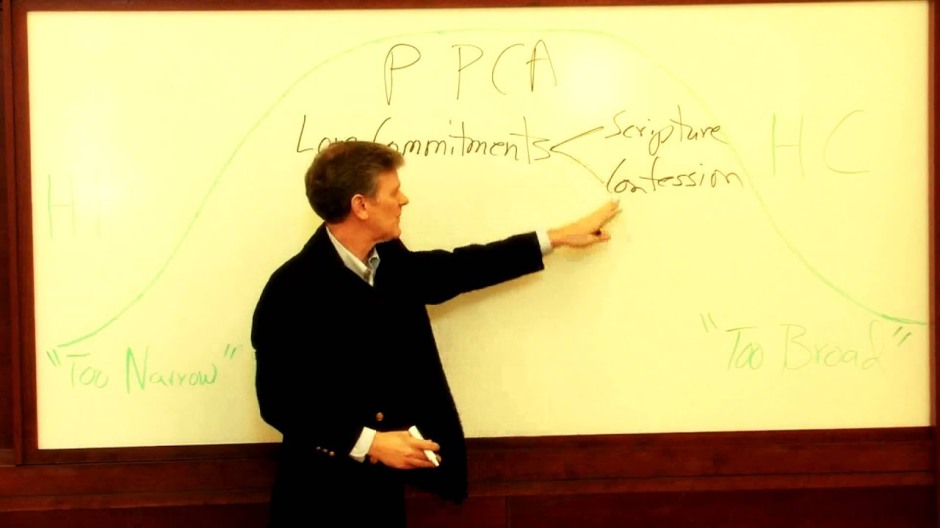
While American Presbyterians think more about Chattanooga than Tehran — thanks to the PCA General Assembly — here is the second installment from contributors to the Spring 2010 issue of the Nicotine Theological Journal on the denomination’s 2010 Strategic Plan.
This one comes from Lane Keister, who was then a PCA pastor serving in CRC and RCA congregations in North Dakota.
No doubt many in the upper echelons of the PCA were quite disturbed to find resistance to the ideas of the Strategic Plan (hereafter SP). After all, this was a plan designed to unify the denomination, and very little unification has happened as a result of this plan. Most of the action points of the plan passed with very significant minority opposition. Furthermore, the reasons for the majority vote were not always admirable. There were a fair number of people voting just in order to show confidence in the leadership, or because they liked certain people championing the cause of the plan. Many had not even read the plan. This tends to remind me of the way in which the government health care package was passed. In my opinion, this is a terrible way to do the business of the church. If people are going to go to General Assembly, they are responsible for knowing what is on the docket, and being prepared for the arguments, such that real debate can happen.
I was speaking with my brother-in-law, an OPC minister, and he mentioned that he had watched a good deal of the debate on the floor, and was frankly shocked at how little actual debate transpired. He immediately asked when we were going to arrive at our senses, and proceed to a delegated assembly (like the OPC). This point is profoundly relevant, since a great deal of the expenses that the Administrative Committee incurs have to do with the General Assembly, and one of the most controversial aspects of the SP was the funding proposal. There are too many delegates to have the GA at any regular church of the PCA, even our largest. The expense of renting a convention center in a major city is astronomical. Furthermore, the debates cannot be tight and to the point with so many delegates at the assembly. My brother-in-law added that the “debate” was little more than political posturing, with very little in the way of biblical, confessional, or church polity argumentation. This has been true of the PCA’s GA for many years now. Someone needs to propose a delegated model. The Administrative Committee no doubt needs to be funded (they foot the bills for the Standing Judicial Committee, among other things). However, it would lower expenses and allow for greater parity between the number of ruling and teaching elders conducting the church’s business. As Benjamin Shaw argued, the interests of the people who want “more seats at the table” (Shaw only mentions women, but probably this is true of the other groups mentioned; this certainly seems to be Shaw’s drift) would be served better by ruling elders than by teaching elders. Greater parity means they have a greater voice.
On the funding plan itself, I have been of two minds. On the one hand, Ligon Duncan’s arguments are very plausible. The Administrative Committee needs funding, and all too often, we have been going about things in a congregational way. On the other hand, critics who argue that the plan constitutes a violation of conscience have a point. Personally, I am not persuaded by the critics. Why would this arrangement violate a person’s conscience any more than the current registration fee does? The response is that the Administrative Committee is a denominational agency, and that we are setting a precedent by making funding of the hierarchy mandatory. This is plausible, but we still make funding of the denominational agency mandatory through registration fees for GA. This problem, again, would be alleviated through a delegated assembly. As many have said, connectionalism has to go both ways. It cannot only be a grass-roots movement from bottom up. Otherwise, we are just congregationalists with some Presbyterian tendencies.
Some of the more controversial wording of the SP was changed. Other NAPARC denominations will be happy to know that commissioners called early for eliminating language about leaving NAPARC (North American Presbyterian and Reformed Council). So also was the language that could implied a safe haven for heretics to propagate their errant views with no accountability. More “seats at the table” cannot be granted constitutionally, and so this language also dropped out.
I was pleased to see that the Northwest Georgia Presbytery’s proposal (calling for greater attention to the traditional ordinances) passed, although I was disconcerted to see that it did not function as a substitute for the SP. Very clearly, it was intended that way. The overture had everything to do with how one goes about doing God’s will in the church. Is it by some strategic plan, or is it by the means of grace God has instituted? So now the PCA has in effect said that we need the means of grace plus this strategic plan in order to succeed as a denomination.
 Old Life
2 thoughts on “Son of The PCA Back in the Day”