The Next President?

What he or she should do:

It’s not enough that we elect someone who will defend the religious liberties of Christians. The next president needs to be sensitive to the interests and concerns of many groups who find themselves increasingly in tension with one another and the State: Muslims, atheists, Christians, the LGBTQ community, immigrants, black people, poor white people, and law enforcement. There will be laws, court rulings, and policies established in the next presidency that will help define how these groups live together in the near future. We can expect decisions concerning anti-discrimination laws, illegal immigration and refugees, gender and sexuality in public education, religion and gender in the military, and criminal justice reform. One of the most prized qualities in presidential candidates should be a desire to pursue principled pluralism, not merely protecting the interest of one group.

Sounds like the Bishop of Springfield should be the one:

Still there are others who have distanced themselves because they feel unwelcomed. The reasons here can vary, but key among them are race and cultural differences, a sense of gender inequality as well as sexual orientation.

Others have been treated unkindly, impatiently, or rudely by clergy, religious, ministers, and staff of parishes — all which is unacceptable. I ask your forgiveness. I make my own the words of Pope Francis, and say to you, “Believe me, in spite of its slowness, the infidelity, the mistakes, and the sins that may have and may still be committed by those who compose the Church, it has no other sense and aim if not to live and witness to Jesus: He has been sent by (the Father) ‘to bring good news to the poor … to proclaim release to the captives and recovery of sight to the blind, to let the oppressed go free, to proclaim the year of the Lord’s favor.’” (“An open dialogue with non-believers” La Repubblica, 9/11/13).

This Jubilee Year of Mercy allows us an opportunity to acknowledge our need as a diocese for forgiveness and healing from past sins and hurts, as well as to look forward to the future in hope.

That is what evangelization is all about, looking forward to the future with hope, sharing our hope which is the Good News of Jesus Christ with others, regardless the path of life they walk.

“Evangelizing,” as Blessed Pope Paul VI once said, “means bringing the Good News into all the strata of humanity … both the personal and collective consciences of people, the activities in which they engage, and the lives and concrete milieu which are theirs” (Evangelii Nuntiandi, 18).

The Holy Father went on to explain, that “evangelization loses much of its force and effectiveness if it does not take into consideration the actual people to whom it addresses, if it does not use their language, their signs and symbols, if it does not answer the questions they ask, and if it does not have an impact on their concrete life”(EN, 63).

This fact came across clearly in our diocesan survey. As one person commented, “I believe there is a huge gap between what the priests are doing and what the people need.” Others noted the need for “priests of the diocese to get out among the people … where they are at” because “people are not just going to walk into the churches and rectories.”

There is much truth to these honest reflections; our communities must be inviting and energetic environments, founded both in our traditions but also the reality of everyday life. Such efforts are not just the responsibility of some of us but rather all of us: clergy, women and men religious, lay faithful … we are all in this together; evangelization is, for each and every one of us, our call and responsibility as the baptized. We need to evangelize those who are with us each week for Mass, that they, in turn, may be empowered to become evangelizers themselves.

We need to evangelize those who were once, but are no longer with us: We need you, we need your presence, your gifts and your talents. We need you to complete our community, to enrich it, to
make it better and more effective. I would ask you to join with us as a diocese in rediscovering your spiritual roots. While acknowledging disagreements or negative experiences, perhaps we can also reflect on what it was about the Catholic faith you may have loved, what may have brought you comfort and peace, and what you are missing through your absence.

Would You Let Your Wife Be a Physician?

We’ve seen this one before. Tim Challies applies the skin test to movies to argue against watching a performance that involves bare breasts:

What would it take for you to be okay with your wife participating in that scene? Would you send her off to work tomorrow knowing that she would be topless for hours at a time, that she would be rolling around on a bed with another man as a crew looked on, as they adjusted the lighting, as they practiced different angles, as the director instructed her, “No, put your hands there. Move in that way…” She would not be having sex with him, but she would be doing her best to act like it, to make others believe it. She would be taking all she knows of the movements, the motion, the pleasure of sex with you and imitating it with this other man. Wife, what would it take for you to be okay with your husband stripping her and kissing her and carrying her to bed? My guess is that you cannot imagine any scenario in which that would be tolerable, in which that would be moral and right. Now hold onto that conviction for a moment.

Why exactly is this a slam dunk?

Consider women who serve as physicians and examine men’s private parts (among others) for a living. Why doesn’t the skin test apply to careers in medicine? Heck, what about nurses who bathe men in hospital beds?

And it’s not just a question of exposed flesh. If we made comfort with-what-the-missus does a standard for engaging with the world, what do we do with a woman who is a defense attorney and represents people she knows to be guilty before the law? Or for those complimentarians out there, what do you do when your wife serves in the military? Leave the OPC?

The point is that we all have different standards for different levels of engaging the world. When my wife comes before session, either I recuse myself because I am going to have to relate to her as an elder rather than as her husband, or I put on a different vocational hat. Same goes for when I enter the voting booth. I don’t use the same standard for a political candidate that I do either for a wife or for a minister.

Life comes with different standards. For pietists that concession is the road to hypocrisy. For Old Lifers, it’s just life on planet earth between Christ’s advents.

Those Were Really the Days

Christendom, Schristendom:

I recently described the tumultuous years 1675-1685, and how they shaped the future of Europe and North America. Here, I want to explore the implications for the politics of religion in this era, and for some of the stereotypes we might have. Everyone knows that religion played a vital role in the Early Modern era: according to customary stereotypes, Protestants fought Catholics, Catholics fought Protestants, and Christians struggled against Muslims. All those statements are correct as far as they go, but they stand in need of some nuance. (Orthodox Christians also had their conflicts, but I will leave those out here).

As they say in Hail Caesar: Would that it were so simple …. [mirthless chuckle].

To recap briefly, I described the Protestant-led Hungarian/Magyar revolt against the (Catholic) Holy Roman Empire in the late 1670s. That in turn led to the Muslim Ottomans intervening on the side of the Hungarian rebels. The resulting war led to the siege of Vienna in 1683, and the ensuing battle, which really marked the end of Islamic expansion into Europe. Most historians would agree that this really marked a turning point in European (and world) history.

Looking at the battle of Vienna, several thoughts come to mind. For one thing, it is odd to realize just how late that happened, and how in fact it coincides so closely with an event like the settlement of Pennsylvania or (almost) the Salem witch trials – or indeed, the height of the Royal Society in London. It’s also sobering to think through the “might have been” of an Ottoman victory in that war, which might theoretically have extended Islamic power deep into southern Germany, and who knows how much further? If that had occurred, then the immediate cause would have been tensions and persecutions between Protestants and Catholics within the Holy Roman Empire.

Further afield, an Ottoman victory would, oddly, have been good news for France’s Most Christian King, Louis XIV (1643-1715). Both Louis and the Emperor Leopold were zealous Catholics, who (as we have seen) actively persecuted Protestants within their own realms, and both wished to uproot those Protestant minorities completely. Even so, dating back to the sixteenth century, the Catholic French had a long-standing entente cordiale with the Ottomans, on the basis that both had a common enemy in the Habsburgs. In the 1540s, the French allowed the Ottoman fleet to winter at their port of Toulon, and built mosques to make the Turkish forces feel welcome.

Recall that the Empire included what we would today call Germany and Belgium as well as Austria (and several other countries). When Louis tried to push the French border eastward to the Rhine, he was encroaching on Imperial territory. He was the Empire’s aggressive neighbor on the West, as the Ottomans were on the East. Cooperation made great sense, regardless of faith.

Hence, the revival of the alliance in the 1670s. The (Catholic) French originally supported the (Protestant) Hungarian/Magyar revolt, and later:
In 1679 and 1680, Louis XIV through his envoy Guilleragues encouraged the Ottoman Grand Vizier Kara Mustafa to intervene in the Magyar Rebellion against the Habsburg, but without success. Louis XIV communicated to the Turks that he would never fight on the side of the Austrian Emperor Leopold I, and he instead massed troops at the eastern frontier of France.

That is what gave the Ottomans the confidence to launch the assault on Vienna, although at the last minute in this campaign, Louis shifted his support to the Habsburgs. So much for any sense of Christian political unity, or indeed of Christendom as such.

A few years afterwards, Ireland witnessed the pivotal Battle of the Boyne (1690). The Protestant William III defeated the Catholic James II in a victory that established Protestant supremacy in the island for two centuries afterwards. Not surprisingly, the battle lives on as a potent myth for both sides in Irish religious divisions. William was “of Orange,” and still today, Protestant Orangemen proclaim King Billy’s triumph each year when they march on the anniversary of the Boyne, on July 12. Patriotic Irish Catholics see the Boyne as a national calamity.

Yet neither Catholics nor Protestants ever like to confront the full context of the battle. When Calvinist William triumphed in 1690, his victory was celebrated joyously by his international Catholic allies, including the Emperor Leopold, and the Pope, Alexander VIII. Austrian (Catholic) cathedrals sang a Te Deum to hymn the victory. Why? Because James II was allied to Louis XIV, and any defeat of Louis must be excellent news, not to mention long-overdue payback. My enemy’s enemy is my friend, and arguably a great Christian warrior.

Religious politics in this era were distinctly messy.

Would a Christian emperor like Constantine have prevented this? An infallible pope certainly did not.

What about a Christian lord like Jesus who sits at the Father’s right hand? In which case, Christ’s rule may have a lot less to do with Europe, America, South Africa, or Scotland and a lot more to do with NAPARC.

Disloyalty

Rod Dreher admits to feeling unpatriotic during his visit to Monticello:

I had a very disconcerting moment, an unusual feeling, I think, for an American to have in a place like Mr. Jefferson’s house. We stood with the guide in the parlor, admiring the oil portraits Jefferson hung along the wall — most of them of historical figures he admired. On the southern wall were three portraits in a row: Francis Bacon, Isaac Newton, and John Locke — described by Jefferson as “my trinity of the three greatest men the world has ever produced.” That, plus the marble bust of Voltaire flanking one side of the door in the entrance hall, really brought home to me how much a man of the Enlightenment Jefferson was. All the Founding Fathers were, but ignorant as I am about colonial history, I had not realized how deeply Jefferson identified with the Enlightenment.

As someone who has been doing a lot of reading lately in European intellectual history, and who has very mixed feelings about the Enlightenment, I was startled by the feeling that Jefferson was, well, wrong about some important matters. Obviously this is contestable, and I expect that most Americans would disagree. The only reason I bring it up was because I felt a bit profane, even unpatriotic, having those thoughts there…. I had a faintly similar sense of alienation. I wondered: Had I been alive during the Revolution, would I have been a Loyalist to the Crown, for the same reasons that being in Jefferson’s house and being confronted in his art by his Enlightened sensibilities made me feel so surprisingly alien.

Protestants don’t experience such a conflict in the presence of the Bible.

If Roman Catholics disagree with the pope, do they feel un-Christian? Can anything other than loyalty to the Bishop of Rome be acceptable in Roman Catholicism?

Grammatico-Historical Interpretation of the Constitution

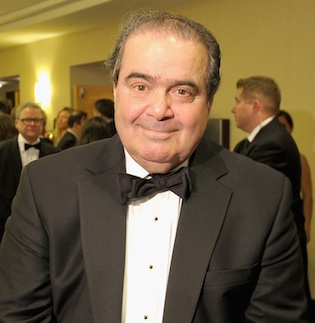
Lots of posts out there about Antonin Scalia as the faithful Roman Catholic. But the man sure sounded like he learned how to read the Constitution from Protestants:

Nonetheless, there is no escaping a verdict on his influence on American jurisprudence, and that verdict is not affected by the fact that he was a good buddy to prominent liberals. He was an advocate of two judicial ideologies, neither of which is intellectually tenable and which conflict with each other. Originalism was Scalia’s core ideological commitment, the idea that the Constitution should be interpreted as it was understood at the time of its ratification. He employed Originalism to question the idea that the Constitution is a “living document,” as liberal jurists held.

To be sure, there was a need for a conservative corrective after the high court starting snooping around the “penumbras” of the Constitution. As Justice Elena Kagan said in mourning Scalia’s death, “His views on interpreting texts have changed the way all of us think and talk about the law.” But, whether the Constitution is alive or not, the people whose government it intends to frame are most certainly alive and their circumstances change. Laws that cannot change with the lived circumstances of a people soon become disconnected from reality, and that disconnect will lead to the law being held in derision or ignored. . . .

Scalia’s other ideological commitment was to Textualism, the idea that the actual words must be interpreted in a kind of fundamentalist manner. This could conflict with Originalism. For example, an originalist would, like an historian, search for explanations as to what was intended by the drafters of a given text, to confirm that original intent and guarantee against latter day misinterpretations. But, Scalia famously loathed citations to legislative history. Textualism rests on the supposition that the Constitution is a self-interpreting text and if that were true, why would we need a Supreme Court? In practice, Textualism resulted in the conclusion that any given text meant exactly what Antonin Scalia thought it meant.

Of course, it’s not clear that Scalia’s hermeneutic was all positive. But it hardly sounds like it’s a product of deferring to the magisterium or to the development of dogma.

Giving A Whole New Meaning to Celebrity Pastor

The first Bishop of Rome with his own page at IMDB?

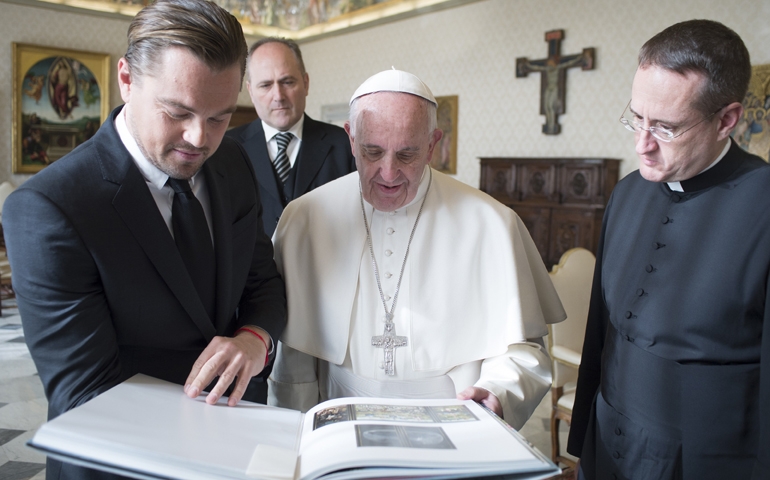
Pope Francis is set to become the first pope in history to play himself in a movie. He will star in the forthcoming film ‘Beyond the Sun,’ which will feature children around the world emulating the apostles, while searching for Jesus Christ.

The idea for the film actually came from Pope Francis himself, who pitched the story to filmmakers at the Hollywood-based AMBI Pictures, which was founded by Andrea Iervolino and Monika Bacardi in 2013. The company released the movie ‘Septembers of Shiraz’ in 2015, which starred Salma Hayek.

The Holy Father wanted to create a movie which would be able to reach out to children in order to spread the Catholic faith. His idea was to effectively portray Gospel passages and fables to youngsters.

When Ecumenism and Environmentalism Collide

Pope Francis’ determination to meet with the Patriarch of Moscow involves several risks according to Massimo Faggioli:

First, there’s the political-diplomatic dimension of the meeting. The pope is going to meet the leader of a church that is seen more and more as part of the authoritarian regime of Vladimir Putin and an ideological support for his neo-imperial foreign policy. This criticism stresses the risks to Francis’s credibility, especially if considering the role of the Russian Orthodox Church in supporting Putin’s military actions in Syria and in Ukraine. (Kirill was, however, more cautious about Ukraine, given the potential consequences of the loss of Crimea and the war in eastern Ukraine for inter-Orthodox relations between Moscow and Kiev).

Second, there’s the internal politics of the Orthodox churches, in light not only of the historical rivalries between Moscow and Constantinople for supremacy within Eastern Orthodoxy, but also of the upcoming Great Synod of the Orthodox Churches on the Greek island of Crete in June. Some see Francis as naïve in regard as to how the patriarchate of Moscow could use the meeting to assert a new supremacy at a critical time for the future of the Orthodox churches. Here too the war in Ukraine factors into the equation.

Third, there’s the ecumenical dimension of the meeting. The Russian Orthodox Church has been far less engaged in ecumenical dialogue with the Catholic Church than the patriarch of Constantinople has; in agreeing to meet with Kirill, Francis is accused of sitting at the table with a leader who has not shown the minimum amount of ecumenical spirit required to start a conversation with the pope.

Professor Faggioli leaves out the risk to the environment. Since the Pope is meeting Kirill in Cuba, both church officials will be emitting lots of carbons into an environment on the brink of overheating.

How is this trip consistent with Pope Francis’ recent prayer video?

Why Expect Mid-Westerns to Transcend Time and Place?

If other folks are products of their environment, why should the faculty and administration at Wheaton College be any different? Alan Jacobs, though, thinks that Wheaton College is provincial (and implicitly that non-white evangelicals coming through graduate school and advanced degrees hold on to their inherited culture):

I believe — I have good reason to believe — that Wheaton really, truly, seriously wants to have a faculty and student body that is more reflective of the ethnic and cultural range of worldwide evangelical Christianity. But I also saw, during my twenty-nine years on the Wheaton faculty and several years as director of the Faculty Faith and Learning program, far too many situations in which non-white faculty members were treated, if not with outright suspicion, then at least with bemusement and puzzlement, because they did not express themselves in ways that matched the cultural practices of white midwestern evangelicalism.

Heck, if the Vatican curia can’t escape the cultural blinders that come with Rome, why would we expect little old Wheaton to do so much better? I mean, with all the efforts to make Christianity of late into a cultural project, all of a sudden we’re going to expect Christians through regeneration and sanctification to act like this world is not their home, but they’re just a passin’ through? As if that pietist outlook was not the product of time and place?

Two Cities or One?

Michael Sean Winters thinks Bishop Robert McElroy’s article on the religious duties of voters has merits, but I wonder after reading this paragraph:

Most important, a spiritual political conversion requires the orientation of soul that flows from the principle of solidarity that St. John Paul II powerfully outlined as a fundamental element of Catholic social teaching. This orientation reminds us that in society we must always understand ourselves to be bound together in God’s grace and committed, in the words of “On Social Concerns,” “to the good of one’s neighbor, with the readiness, in the Gospel sense, to lose oneself for the sake of the other rather than exploiting him.”

The implications of such a spiritual stance for discipleship in voting are clearly reflected in the Compendium of the Social Doctrine of the Church: “The principle of solidarity requires that men and women of our day cultivate a greater awareness that they are debtors of the society of which they have become a part.”

I get having a sense of belonging to the rest of the people in the society of which I am a member. I don’t get what grace has to do with this.

Is it really true that Christians understand themselves to be bound together with non-Christians in God’s grace? Or if we apply the antithesis that Augustine affirmed in his formulation of 2 cities, then are we only bound together in society with other Christians? That was the construction that led European Christians to wonder about where Jews and Muslims fit in Christendom, and John Calvin to wonder about where Michel Servetus fit in Geneva.

So once again, perhaps the Bishop needs to make clear the difference between the two kingdoms, one that affirms a spiritual antithesis and a social commonness. Blurring the two will get us to King Ferdinand and Queen Isabella.

If Muslims and Christians Worship the Same God, Can't the Forgiven and Unforgiven Too?

The latest from Wheaton College is that Larycia Hawkins and the College have agreed to part ways. In the leaks that led to this apparently amicable determination was an email from Wheaton’s provost, Stan Jones, who apologized for his handling of the incident. According to Alan Jacobs, Jones wrote:

I asked Dr. Hawkins for her forgiveness for the ways I contributed to the fracture of our relationship, and to the fracture of Dr. Hawkins’ relationship with the College…. I apologized for my lack of wisdom and collegiality as I initially approached Dr. Hawkins, and for imposing an administrative leave more precipitously than was necessary.

But according to some of Jones’ critics, this apology doesn’t go far enough, as Jacobs explains, “because it does not acknowledge Wheaton’s history (and present) of structural racism and sexism.”

Jacobs then asks:

What if, when a brother in Christ apologizes and asks for forgiveness, one were to grant that forgiveness — instead of immediately criticizing him for not having provided a fully adequate account of the reasons he went astray?

I’d follow up with another question: doesn’t the spirit of Dr. Hawkins’ show of solidarity with Muslims provide an analogy for how Jones’ critics might reach out to Wheaton’s provost? I mean, if you can overcome the division between Islam and Christianity by donning a hijab during Advent, can’t you go without a latte for the month of February to show solidarity with Wheaton’s administration?

Jacobs concludes:

So to those who say that Provost Jones’ apology is inadequate, my answer would be: of course it is inadequate. Every act of penitence, including yours and mine, is inadequate.

That could also be instructive for those who think Purgatory is going to take care of residual human guilt. Once humans sin — think one little bite of a piece of fruit — can you ever go back to being acceptable inherently?

No hope without alien righteousness.