The Jimmy-Carter Roots of Jerry Falwell

I have long suspected that the acrimony between left and right in U.S. politics stems not only from the Religious Right and the inevitable upping of the ante of civil matters to moral or eschatological significance, but also to the self-righteousness that accompanies the conviction (w-w alert) that one’s policy or vote is an expression of faithfulness to God. I also have long felt that Jimmy Carter exhibited the latter tendencies — self-righteousness — and was a particularly poor sport in the way he took Ronald Reagan’s victory in 1980. I thought then that Carter believed he had lost to a dumber and inferior man, and so was responsible for launching the Democrats’ sense of intellectual superiority. (Republicans counter with patriotic/civil religious superiority.)

It turns out that I (all about me) not have been that far off, and this from Jonathan Yardley who voted twice for Carter (thanks to John Fea):

Religion is a tricky business, never more so than when it gets mixed up with government. Although Balmer pays due respect to the argument that “religion functions best from the margins of society and not in the councils of power,” that “once a religious group panders after political influence, it loses its prophetic voice,” he does not convince me that Carter, either as governor of Georgia in the early 1970s or as president in the second half of that decade, really “understood that the Christian faith had flourished in the United States precisely because the government had stayed out of the religion business.”

To the contrary, Carter brought religion (religiosity, too) into the national government more directly and intensely than any president before him in the 20th century. He campaigned as a religious man, speaking repeatedly, openly and almost boastfully about his religious convictions, about the centrality of prayer to his daily life, about the joy he took in being “born again.” Balmer sees this as a redemptive response to the cynicism and venality of the Nixon years, and unquestionably there is some truth to that. But Carter made religion a campaign weapon as well as a private belief, which was not appreciably less calculating than Nixon’s disregard for the Constitution and the common decencies.

If Carter’s presidency was indeed redemptive, why is it that in the 31 / 2 decades since it ended, American politics has been plunged into one of the most bitterly partisan periods in the country’s history? Granting for the sake of argument Balmer’s apparent belief in the sincerity of Carter’s religious beliefs and his commitment to “progressive evangelism,” it remains that it was Carter who brought religion into the public arena and thus opened the way for others whose evangelical beliefs are the polar opposite of his own. Balmer would have us believe that the rise of the religious right was in large part due to the clever political manipulations of Paul Weyrich, Jerry Falwell and others, but it was Carter who made it possible for them to present themselves as a legitimate political opposition. If it is permissible to grant a political role to “progressive evangelism,” why is it any less legitimate to grant a similar role to those whose evangelism “emphasized free-market capitalism, paid scant attention to human rights or the plight of minorities, and asserted the importance of military might as resistance to communism”?

For the five cents that it’s worth, my own political views are far closer to Carter’s than to those who carry the banner of the religious right — I actually voted for him twice, though holding my nose the second time — and Balmer is right that there is more than a little to admire in the record of his brief presidency, but he was his own worst enemy: smug, self-righteous, sanctimonious, humorless, vindictive and exhibitionistic about his piety. He was too haughty and aloof to deal effectively with friends and foes in Congress — foreshadowing the presidency almost three decades later of Barack Obama — and he never understood how to talk to the American people, as made all too plain by his well-intentioned but tin-eared address to the nation in July 1979 about the “crisis of confidence” from which the country ostensibly was suffering.

The American Jesus on the Un-American Calvin

Zach Hunt has read Calvin and he is disgusted. Here’s part of what he has to say to Calvin himself:

[Quotations from Calvin on predestination and human wickedness] are, as you demonstrate so well, the logical conclusions of your theology of divine sovereignty and, therefore, at the very heart of what you believe about God. Worse, this isn’t a case of you overstating without thinking through the conclusions. You’re clear that this sort of God who ordains genocide, murder, rape, children abuse, and every other conceivable horrendous act is the God you worship. . . .

The bigger issue I have, John, is that you have a tendency (cause I’ll be the first to admit they’re not all like this) to create incredibly arrogant and sometimes hateful followers who are just as cold, calculating, and callous in their theology and selective in their use of scripture as you are. Just like you, too many of your prominent followers today denounce their critics as heretics while praising God for a whole host of evil things that happen in the world from earthquakes and tornadoes to the marginalization, oppression, and destruction of people made in the image of God.

John, I don’t know how to say it any other way – you’ve got a bad habit of making disciples that aren’t very christlike in their love, mercy, compassion, and grace towards others.

This may or may not be a fair reading of Calvin, but it does do justice to those parts that are hard to square with modern notions about life, liberty, and the pursuit of happiness. And yet Americans continue to think that Calvinism bears some special and positive relationship to a political order committed to freedom, equality, and tolerance. In most narratives of American origins, the lines between John Winthrop’s Massachusetts and George Washington’s Philadelphia are smooth, straight, and easy to follow.

Could it be that Americans need to take a page from the Turks who seem to know that the caliph Suleyman the Great was not a forerunner of Ataturk? Consider, for instance, what ??? had to say about the current Turkish television sensation, “Magnificent Century”? Here is an interesting bit from Elif Batuman’s Feb. 17, 2014 piece on the series, “Ottomania: A Hit TV Show Reimagines Turkey’s Imperial Past.”

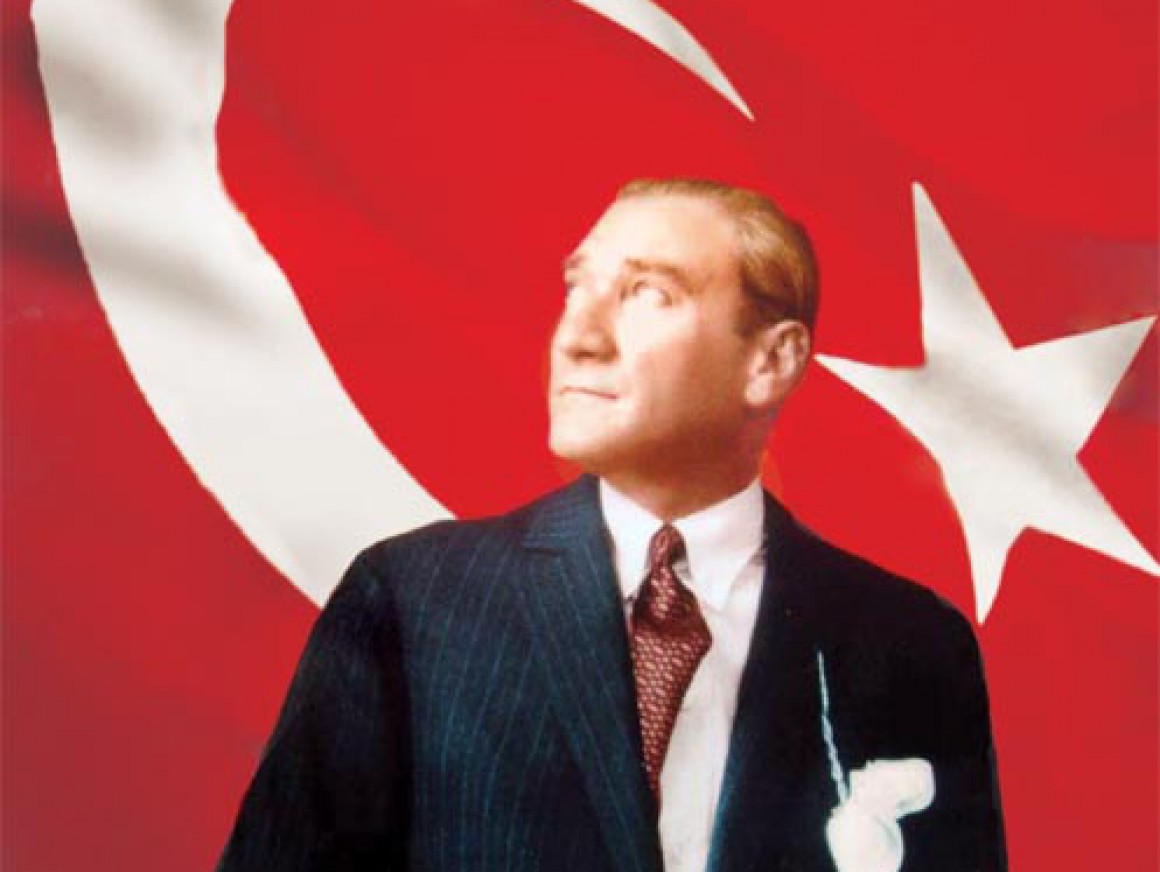
The debate over “Magnificent Century” touches on one of the key issues in Turkish politics: the question of national identity. Who were the Ottomans – enlightened cosmopolitans or decadent sociopaths? Who was Suleyman? Who are the Turks? For the first eighty years of the republic, national identity was defined largely by the figure of Kemal Ataturk, with his tailored suits, his commitment to scientific positivism and ballroom dancing, his devotion to an adopted daughter who became Turkey’s first female fighter pilot, and his emphatic rejection of all things Ottoman. Ataturk’s picture is on every denomination of Turkish currency, and hangs on the wall of every public building. It is a crime to insult his memory. . . .

The Ottoman revival has its roots in the Cold War, when the main political polarity in Turkey wasn’t Islamist versus secularist but pro-Communist versus anti-Communist. In Turkey, a NATO member and a U.S ally, widespread internal violence between leftist and rightist groups culminated in a military coup, in 1980. The new government addressed the threat of leftism by opening the Turkish market to global competition, and by promoting Islam as an ideological alternative to Communism. One result of these measure was the rise of a new class of observant Muslim businessmen – entrepreneurs who described themselves as “Islamic Calvinists,” characterized Muhammad as a merchant, and cited the Koran as an authority on limiting economic intervention by the government. Where Kemalism had its basis in economic isolationism and cultural Westernization, these businessmen wanted just the opposite: Western-style capitalism and a Turkish culture. In the Ottomans, they found the ready-made idea of a prosperous Muslim elite, trading on an equal footing with Europe but preferring halvah to profiteroles.

In some ways Turkish developments parable simultaneous U.S. history. During the Cold War, especially before 1965 when race, sex, gender, and war divided Americans, Calvinism and the Reformation became a bus stop on the modern ride from the Dark Ages to Enlightenment and the United States’ new order for the ages. In other words, religious roots became useful to both the Turks and Americans to justify national involvements. You can even compare the Religious Right to the Islamo-Calvinists – Americans who refashioned their religious and national heritages to concoct a national identity that made secular humanism illegitimate.

But unlike Turkey where the contrast between republican progress and religious past was always stark under Ataturk’s unruly eyebrows, in the United States the tension between the Puritans and the Founders was glossed or ignored. Americans, from Julia Ward Howe and Perry Miller to Rick Santorum, have rarely if ever been willing to acknowledge that Winthrop’s communitarian, religiously demanding, and exclusive Massachusetts was not what Ben Franklin, James Madison or even John Witherspoon had in mind for the United States (whether confederated or federated).

That dishonesty may be responsible for the secularist and atheistical reaction against the faith-based exceptionalism of the last four decades. It doesn’t make it pleasant or civil, but when you constantly hear about America’s Christian origins as a later iteration of the Puritans errand into the wilderness, you may want to push back.

At the very least, this dishonesty helps to explain why an HBO television series on Massachusetts Bay’s pastors’ wives will not becoming to Netflix soon. Not even the producers of Christian sentimental entertainment could turn those godly women into a series, say “Sectarians in the City,” where the distaff side of the Gospel Coalition could feel good about their small group Bible studies, enjoyment of sex, and cosmetic choices. Although, if someone could provoke the female allies to get their hubbies to read Anne Bradstreet, maybe the New Calvinists would stop being so d—d nice.

No Need to Apologize to Me

Though a short note to Tullian Tchividjian (hereafter Double T because who can spell that?) may be in order.

Mark Jones apologizes to me — 15 seconds of my 15 minutes? — in his double-dare to Double T to debate sanctification:

Commenting on what typically happens after times of revival – sorry, D.G. Hart – James Stalker wrote: “it is no unusual thing to find the initial stage of religion regarded as if it were the whole. Converts go on repeating the same testimony till it becomes nauseous to their hearers as well as unprofitable to themselves. In the religion of many there is only one epoch; there is no program of expanding usefulness or advancing holiness; and faith is only the constant repetition of a single act.” Indeed.

If I read this right (and I am still feeling a little foggy after the flight to Dublin), Jones is saying that revivalism tends to lock converts into a certain pietistical predictability. That sounds negative. Isn’t this one more strike against revivalism? Shouldn’t Jones be thanking me for leading the charge against revivalism?

But aside from (all about) me, I do wonder about a couple of matters in this kerfuffle between opposite points on the North American Presbyterian compass. First, we have yet another theological imbroglio among PCA pastors in which the courts of the church seem to have little or no bearing. No one seems to think of this as a denominational problem even though both men are part of the same communion. Could that be because the PCA has no real theological center, even avoids striving for one? To be sure, the Federal Vision was another theological problem on the PCA’s watch and some did try to remedy that situation. But it has apparently been left to presbyteries to decide. In the meantime, ministers can talk, act, and teach what they want with seemingly little sense of obligation to what will pass in the wider communion. (What happens in NYC, stays in NYC.)

Second, the conversations about sanctification are long, historical, sometimes exegetical, and incredibly abstract. Consider Paul Helm’s reflections on the controversy surrounding Double T:

Summarising, the idea that the law is no longer to be the moral guide, a point often insisted on by those dismissed as ‘antinomian’ (rather unjustly it seems to me) is clearly mistaken. The relevance of the moral law is a view endorsed by Christ and spelled out by the apostles. So in the most extended discussion of the nature of sanctification in the New Testament, Romans 12 and 13, the command to love one’s neighbour (12.9), and not to remain indebted (13.7), the laws forbidding adultery, stealing, covetousness are summed up, as Christ himself taught, as particular instances of ‘you shall love your neighbour as yourself’. (13. 8-10) But the law in not thought of primarily as obligations, duties, but as structural directions for the new life.

And this may be thought of as providential given the varieties of circumstance that the New Testament international church of Christ may find itself in. Without being relativistic, there may be across the world and down the centuries very different ways in which the injunctions are to be taken to apply to one thing and another. We must never forget that New Testament church is an international jurisdiction, by comparison with the Old Testament theocracy. . . .

All these forms of language in themselves strongly imply that Christian moral character is formed from the inside out, by means of the renewal of the mind, by the development of those seed-graces planted in regeneration. Morality is considered not of a code of separate acts of obedience which then develop in the agent corresponding habits of mind, but as an inner renewal which brings about the practice of the appropriate actions in a properly motivated manner.

This is useful, especially the point about the varieties of circumstance that confront believers. And it is these varieties that are so far from view in the shoving contest between alleged antinomians and neo-nomians. No one really asks a simple question like: so I am home from a not-so-hard day at work and it is the customary hour for an adult beverage and maybe a little ear-time with Phil Hendrie. Should I or should I not do this in my life of sanctification? Should I instead turn to Scripture with a time or prayer? Or maybe I should try to earn a little extra money with some on-line sales scheme in order to give more to foreign missions. Or maybe I should cut the grass a couple days early so that I can spend my entire Saturday in preparation for the Lord’s Day. Can I get a little help here?

Or to give the problem even greater concreteness, can someone claim to be more sanctified now than she was ten years ago even while being impolite — interrupting someone else who is speaking — to make this claim?

Which makes me wonder if we should postpone all talk about sanctification until the talkers are willing to mention specifics. The only people allowed to talk about it, in the meantime, are pastors who are preaching on texts related to the topic, church officers and parents who are catechizing children, and church officers doing the rounds of family visitation. I will grant an exemption to scholars who are writing commentaries or works of theology, but they must confine their remarks to the manuscript. Otherwise, sanctification may be a subject best left alone lest it become something so ethereal that we can affirm it without ever having to talk about how the dying to self goes in real time.

Why the Bible Cuts Both Ways — two-edged sword and all that

Peter Leithart’s comments on Eran Shalev’s American Zion: The Old Testament as a Political Text from the Revolution to the Civil War reminded me of what I learned from Sunday’s sermon (a week ago) from II Chronicles 36, the culmination of Judah’s fall from grace, the destruction of Jerusalem, and the beginning of the people of God’s status as refugees (which continues). This narrative includes the hard-to-spin wrinkle of Zedekiah, Judah’s king, rebelling against a pagan and foreign king, Nebuchadnezzar, a figure whom the Israelites would normally have regarded as a tyrant and against whom legitimately rebelled. But when Zedekiah doesn’t submit to Nebuchadnezzar, the writer likens Judah’s king to Pharoah — the stiffnecked oppressor who held the Israelites in slavery:

Zedekiah was twenty-one years old when he began to reign, and he reigned eleven years in Jerusalem. He did what was evil in the sight of the LORD his God. He did not humble himself before Jeremiah the prophet, who spoke from the mouth of the LORD. He also rebelled against King Nebuchadnezzar, who had made him swear by God. He stiffened his neck and hardened his heart against turning to the LORD, the God of Israel. All the officers of the priests and the people likewise were exceedingly unfaithful, following all the abominations of the nations. And they polluted the house of the LORD that he had made holy in Jerusalem. (2 Chronicles 36:11-14 ESV)

This is the sort of narrative that folks like John of Salisbury or Thomas Aquinas may have cited to show that tyranny was not always bad. Well, to be precise, it was bad in the sense of not being the way things were supposed to be. But not bad in the sense that this was a form of rule that God was using to punish his people.

And yet, the American colonists, led by Calvinists as we keep hearing, never stopped to consider whether King George was their Nebuchadnezzar, the Lord’s appointed ruler to mete out punishment for disobedience and infidelity. According to Leithart (following Shalev):

During the Revolution, writers and preachers turned to the historical books of the Hebrew Bible to fill out ancient Roman analyses of political corruption. George III was Rehoboam, Solomon’s son whose high taxes divided Israel, or Ahab, who seized the vineyard of innocent Naboth. The charges against King George were sometimes moderated by reference to the book of Esther: The hapless king was manipulated by Haman-like advisors who turned him against the children of the land of the Virgin. Patriots were Mordecais or Maccabees, while loyalists were “sons of Meroz,” a Hebrew town cursed because its inhabitants refused to follow Deborah and Barak into battle. Colonial writers saw links with Roman history: Washington was Cincinnatus. But Washington was also Gideon, the judge who delivered Israel and very deliberately refused an offer of kingship.

Of course, the American rebels didn’t have a prophet to tell them what to think about King George the way that Zedekiah had Jeremiah to whisper advice or shout warning. And that’s the point. Without divine revelation, how do you interpret any ruler or set of events (or culture or city or television series) as in accord with or against divine will? (And when will the students of American politics who seem to enjoy pointing out the biblical context for political debates also point out that such appeals to holy writ could very well be wrong and an abuse of Scripture?)

Blame Calvinism

It works for so much of life if you do.

In this case, journalists might ponder the coincidence of declining baptisms and church membership among Southern Baptists and the rise of New Calvinism in SBC circles:

For several years, membership in Southern Baptist churches has been in decline. The American denomination hit its peak in 2005 with 16.6 million members, and since then, communities have seen a steady drop, hitting 15.8 million members in 2012. That’s nearly one million members lost in roughly a decade—a period during which the overall U.S. population grew by more than 18 million.

But arguably, the more significant decline is happening within church communities: They’re not performing as many baptisms anymore. The top baptismal year was 1999; since then, the ritual has become more and more infrequent, dropping by about 25 percent.

After all, if there is any way to kill the buzz of evangelism, just become a Calvinist (though why Lutheranism gets a pass on the evangelism test I don’t know).

Did They Give Rise to Secession?

So here is the problem (aside from Irish department stores stocking washcloths but Irish hotels not owning them, or that no one shows up in Dublin for evening prayers when the fat ladies aren’t singing). Political philosophers and historians have given lots of attention to Calvinism as an engine of modern liberal (read constitutional) politics. Whether it’s resistance theory, the Dutch rebellion, or the so-called Presbyterian revolution of the British colonies in North America, students of Calvinism believe they have a firm read on Reformed Protestant politics as an inherently rebellious outlook, one that won’t let any human authority encroach on the Lordship of Christ. (Why we didn’t celebrate 1861 along with 1776, 1689, and 1567 prior to getting right with race is a bit of an inconsistency.)

That sounds good in theory, and it certainly turns out Calvinist (New, Neo, or Denominational) in large numbers for Fox News. But it doesn’t make sense of history where context matters. Here, the case of Irish Presbyterians are instructive. They were Scottish in background and carried around in their devotional DNA the covenants that Scottish or English-Scottish monarchs had made to ensure the protection of the true religion (Presbyterianism) and the suppression of the false (Roman Catholic or prelatical/Episcopal). But in Ulster they encountered a set of realities remarkably different from Scotland or North American colonies. They were subject politically to English authorities who trying to subdue the Irish and who wanted more Protestants but did not want to provoke the natives. They confronted a native population that was firmly Roman Catholic. And they found themselves on the outside of an ecclesiastical establishment (the Church of Ireland) that was Anglican. If you turn to Scottish history for help, you alienate the English government and your stir up your Irish neighbors. If you want to be part of the ecclesiastical establishment (the way Upper Canada would try in the nineteenth century), you’re guilty of historical anachronism. The closest situation to yours is perhaps Philadelphia which when it comes along toward the end of the seventeenth century provides an attractive alternative to Ulster for Scots-Irish.

Here is how I. R. McBride in Scripture Politics: Ulster Presbyterians and Irish Radicalism in the Late Eighteenth Century puts the challenge of placing Irish Presbyterianism on the map of political theory in the West:

It would be convenient if an analysis of theological controversy could somehow isolate a single gene that programmed radicalism into the Presbyterian Church. Unfortunately, political affiliations were not structured by religious allegiances in any simple way, but resulted from a subtle combination of theological inheritance, social factors, and political circumstances. Ulster radicalism cannot be understood outside the experience of exclusion from the institutions of the state, the social conditions of the north of Ireland, and a deep-seated ambivalence towards a British government which was both the upholder of Anglican ascendancy and the ultimate guarantor of Protestant security. Presbyterianism, furthermore, was neither homogeneous or static, but was fragmented . . . Unlike the monolithic edifices of its Anglican and Roman rivals, this fractured culture allowed theories of both religious and political dissidence to take hold and flourish.

The intellectual inheritance of the Scottish Reformation offered a rich and complex legacy of resistance and radicalism which provided a common platform on which Presbyterians of all theological preferences could unite. The basic principle that Jesus Christ was the sole lawgiver in the Church, though applied in a variety of ways, was shared by all strands of Presbyterian opinion. In its most extreme manifestation, the older ‘prophetic’ theocracy called for Church and state to be brought together to create a society in social and political conformity to the word of God, a vision still shared by those groups which adhered to the Solemn League and Covenant. In an age of social and political disruption, it retained its attraction for poorer Presbyterians in the Synod of Ulster, the Secession, and most of all the Reformed Presbytery. The political theology of the Covenanters, which asserted that all government, temporal and spiritual, must be based on those patterns allegedly found in Scriptures, was violently at odds with the development of an erastian, parliamentary regime. . . .

In their insistence on the supremacy of individual conscience over received authority, the New Lights also regarded themselves as the genuine heirs of the Reformation heritage. The call to separate Christianity from human policy echoed the fundamental Protestant dichotomy between human corruption, evidenced in the false ceremonies and beliefs which had debased the Church, and divine truth as embodied in the Scriptures. While their political principles were no doubt derived from a common Presbyterians, however, they also reflected the rationalism of non-subscribing divinity . . . . Far more important to the evolution of radical ideology was the non-subscribers’ battle for freedom of enquiry, and their conviction that civil and religious liberty were inextricably linked. . . . ‘that religious is a personal thing – that Christ is the head of the church – that his kingdom is not of this world – that the WILL OF THE PEOPLE should be the SUPREME LAW’. Here was the authentic voice of New Light radicalism. [109-110]

The spirituality of the church keeps looking better and better.

Great Nations

A trip overseas usually means a turn to the Prayer Book. In Turkey for the past two years, we conducted Christian services in various Turkish hotels by relying upon either the morning or evening prayer service. For elders who are licensed to preach looking for a place to worship in a known tongue within a society where mosques were more frequent than whiskey bottles, the Book of Common Prayer came in handy.

And so it continues to do in places where they do (mostly) speak English — like Dublin. I went to evensong yesterday at the Church of Ireland’s cathedral in Dublin and once again was impressed that if the Anglicans keep to the Bible and the prayer book, they come out okay.

One of yesterday’s readings was God’s promise to Abraham in Genesis 12:2: “And I will make of thee a great nation, and I will bless thee, and make thy name great; and thou shalt be a blessing.”

About this Calvin has little to say on the topic of national greatness (or what some call exceptionalism, nationalism, or patriotism):

Hitherto Moses has related what Abram had been commanded to do; now he annexes the promise of God to the command; and that for no light cause. For as we are slothful to obey, the Lord would command in vain, unless we are animated by a superadded confidence in his grace and benediction. Although I have before alluded to this, in the history of Noah, it will not be useless to inculcate it again, for the passage itself requires something to be said; and the repetition of a doctrine of such great moment ought not to seem superfluous. For it is certain that faith cannot stand, unless it be founded on the promises of God. But faith alone produces obedience. Therefore in order that our minds may be disposed to follow God, it is not sufficient for him simply to command what he pleases, unless he also promises his blessing. We must mark the promise, that Abram, whose wife was still barren, should become a great nation. This promise might have been very efficacious, if God, by the actual state of things, had afforded ground of hope respecting its fulfillment; but now, seeing thatthe barrenness of his wife threatened him with perpetual privation of offspring, the bare promise itself would have been cold, if Abram had not wholly depended upon the word of God; wherefore, though he perceives the sterility of his wife, he yet apprehends, by hope, that great nation which is promised by the word of God. And Isaiah greatly extols this act of favor, that God, by his blessing, increased his servant Abram whom he found alone and solitary to so great a nations (Isaiah 2:2.)

No political theology there. And why should there be since the greatness of that promise lay not in the prospects of Israel or Judah as political or social entities, both of whom would decline after Solomon, self-destruct, and become doormats for either the Babylonians or the Persians? Surely the Israelites aspired to national greatness; they wanted a king, got one good and hard, and even had a brief run with Solomon and all his wisdom. But that didn’t work out so well. And God’s promise to Abraham of national greatness was still in play, no matter what came of the nation that took the name of Abraham’s offspring. It’s all spiritual, all the time.

Day One without a Washcloth

I know this boarders on tmi, but why is it that Europeans and Turks don’t furnish hotel patrons with a simple washcloth? I get it that Americans are not in the habit of outfitting bathrooms with bidets — but neither are the Irish or the Turks. So what is the aspiring ablutionist to do? When it comes to the handy devise of said washcloth, I am willing to use that dreaded phrase, “human flourishing.”

That said, this morning’s rituals in Dublin (where I am doing some research while not crawling from pub to pub — kidding, dear but you’re probably not reading) included a full Irish breakfast in the hotel’s dining room. There I brought along a recent issue of First Things (to keep away the friendly tourist) and found a readable discussion of Robbie George’s proposal that churches should get out of the civil marriage business (April 2014). As a side point, I was struck by the number of appeals to the deeply theological accounts of marriage and how the secular version is merely an inferior copy. For one, Scripture itself doesn’t say that much about marriage, though the analogy of the church and Christ does give lots of wiggle room — yet it is only an analogy, like a piece of bread and a thimble of wine is a meal. For another, complaints about the inferior nature of secular marriage strike me as yet one more version of Christians bellyaching about the loss of Christendom — oh, how inferior a secular republic is to the deeply textured presence of faith in medieval Europe. Put not your hope in princes, their territories, or their marriages.

None of the Protestant contributors to this discussion picked up on what George’s proposal would do for Protestant ministers. Since Protestant churches know nothing of marriage as a sacrament, since marriage is a common institution not reserved for believers, the only kind of marriage that Protestants offer is a secular version. In our records we don’t keep a special class of members who are married. We have no instruction from Scripture that pastors are supposed to perform marriages (and I can’t think of any explicit cases or instruction from the Old Testament that would have led the apostles to think they needed to perform marriages, though I didn’t score high on my English Bible exam). And we have nary little instruction from Scripture about a happy home except for that impossible stuff about wives submitting and husbands loving (what pastors cover in marriage counseling before a ceremony is a true mystery — do ministers really know anything about finances or balancing a checkbook?).

So I’ll take the challenge. I propose that Reformed churches encourage their pastors to get out of the marriage racket. At the very least, it puts us out in front of that difficult situation when a gay couple wants to make an example of one of our congregations. At the most, what do we lose? So we as a body of believers accompany a couple and their witnesses (the signed ones) to the city courtroom to observe a civil marriage ceremony. Would that be so bad? Imagine the savings on flowers and wedding party attire.

On the other side, I could see abandoning the wedding ceremony for its inclusion within a Sunday morning worship service, sort of like the vows that new members take before the observance of the Lord’s Supper. So the couple would go forward, the pastor would offer some brief instruction about marriage, bride and groom would take their vows, return to their seats, and participate in the rest of the service. The reception? Coffee hour.

Imagine the even more savings!

2K as Rodney Dangerfield

I have to give credit to Jamie Smith for rattling the neo-Calvinist cage with a review of James Skillen’s recent book on Christians and politics. I agree with Jamie when he wonders out loud, can you believe we have another book about Christianity in the public square? Jamie’s liturgical side might also welcome a book on the sacraments, but he and I would likely diverge when he would want (I suppose) to talk about the sacraments in broad as opposed to my narrow (and vinegary) terms. Even so, I was glad to see Jamie mix it up with neo-Calvinists who need to get out more:

. . . what follows from all of this [Skillen’s book] feels either truistic or simply a theological rationale for a particular form of American constitutionalism—as if a “biblical” understanding of justice naturally entails the American project. “The question for Christians,” Skillen summarizes, “is this: How should we engage politically, guided by the vision of Christ’s kingdom that has not yet been revealed in its fullness?” That’s a pretty big, vague question. The answer seems at once predictable, tired, and hollow: “In the political arena, therefore, we should work for the kind of political communities in which those who fill offices of government act as public servants to uphold public justice for the common good, willingly accepting their equality with all citizens under the law.” Fair enough: but is anybody really going to disagree with that? If not, then we’re on the terrain of truism. The Good of Politics tends to do this: offer theological rationales for things you had already assumed were a good idea.

Jonathan Chaplin was someone whom Smith woke from his principled-pluralism slumbers:

Smith quotes Skillen’s summary of the political pay-off from such a vision of justice as that “we should work for the kind of political communities in which those who fill offices of government act as public servants to uphold public justice for the common good, willingly accepting their equality with all citizens under the law.” Yet he casually dismisses this vision as “predictable, tired, and hollow.” In doing so, however, he reveals less about the limits of Skillen’s accounts and more about his own failure to grasp just how globally distinctive this conception of politics really is, what an enormous achievement it has proven to be historically, and how radical and transformative it would be if American Christians actually took it seriously in their political thinking and acting. It is lazily dismissive to suggest that what Skillen’s vision amounts to is a “pretty standard liberal democratic game”—little more than “liberal proceduralism.”

I myself am fairly comfortable with a procedural republic — unfortunately, we are now a procedural empire (and we all know what empires yield — the not so good tyrant). But it seems to me that Smith has a point. If we want something a little more high octane at the Christian political theology pump, basically rolling out Christian arguments for liberal democracy isn’t going to rev the engine of anyone who walks on the antithesis wild side.

What is curious about both Chaplin and Smith’s pieces is that 2 kingdom theology isn’t even a serious option (as one way of making peace with a procedural republic or divine-right monarch or demented emperor). The working assumption of neo-Calvinists is that the spirituality of the church is not even worthy of attention. According to Smith:

On Skillen’s account, all of our political errors stem from “believing that Christ’s kingdom is spiritual, or not of this world, or only ecclesiastical, or only future.” In other words, the demons to be exorcised are dualism and clericalism: an anti-creational, a-cultural piety that cares only about heaven and/or a misguided desire to have the church rule the state. He sees this growing out of misguided beliefs. Specifically: “It is the combination of the belief that government was given because of sin and the belief that life on earth exists in negative tension with heaven that has lead to the development of almost every approach Christians have taken to government and politics.” Every approach except—you guessed it—Skillen’s (who, it should be noted, conveniently avoids the fact that John Calvin and Abraham Kuyper also saw government as a postlapsarian institution, necessary only because of the Fall).

If you identify dualism and clericalism as the threats, then your solution is going to be engagement and sphere sovereignty. In other words, if you think the problem is that Christians either don’t care about politics or want the church to run the state, then your “introduction” is going to emphasize the good of politics (and creaturely, cultural life more generally) in a way that is distinctly anti-clerical, persistently downplaying the church. And Skillen delivers, once again exhibiting the problem with the Kuyperian fixations on sphere-boundary policing. Bent on what he calls “de-ecclesiasticization,” the significance of the sacramental body of Christ is once again effectively marginalized. This standard Kuyperian trope de-politicizes the church (hence his rejection of Hauerwas’s emphasis on the church as polis) in a way that is not only wrong-headed but also mis-directed. This emphasis might be correct if there were hordes of people around looking to “establish” a particular religion or denomination as the official state religion. But is that really our problem now? Hardly.

Well, if you’re worried about the kind of generic prayer before townhall meetings that sounds Laodecian, you may actually be worried about the establishment of religion-and-I-don’t-care-what-kind-it-is.

But who says that dualism and clericalism are the threats that need to be subdued? I understand that Kuyper did. But did Jesus? Did Augustine? Was Kuyper the third Adam? Which is not to say that dualism and clericalism are the best ways of describing either the spirituality of the church or an Augustinian political theology (which says basically that because of the fall all of this talk of human flourishing is pagan). But have Skillen, Chaplin, or Smith considered the upside of dualism and clericalism? Which is to ask, have they not ever noticed that history is littered with instances that suggest Christian engagement or transformationalism is the real danger. (Sphere sovereignty seems to me a keeper, but one that actually constrains neo-Calvinists since they keep blurring the lines and taking every square inch captive.)

Just consider the religious voices that supported World War I. Here I will repeat quotations from a previous post:

The Bishop of London in 1915 said:

kill Germans — do kill them; not for the sake of killing, but to save the world, to kill the good as well as the bad, to kill the young as well as the old, to kill those who have shown kindness to our wounded as well as those fiends. . . . As I have said a thousand times, I look upon it as a war for purity, I look upon everyone who died in it as a martyr.

The Bishop of Carlisle added:

But in this war there move and work spirits deeper, stronger, more revolutionary than any or all of these — spirits of good and evil, powers of heaven and principalities of hell, invisible spirits of goodness and wickedness of which men are the instruments and the world the visible prize. . . . This present war is essentially a spiritual war; a war waged on earth but sustained on either side by invisible powers.

Not to be outdone, Protestant clergy from Harry Emerson Fosdick to Billy Sunday signed a statement that urged the U.S. in 1916 to enter the war. Here is how their faith-based argument went:

The just God, who withheld not his own Son from the cross, would not look with favor upon a people who put their fear of pain and death, their dread of suffering and loss, their concern for comfort and ease above the holy claims of righteousness and justice, and freedom and mercy and truth. Much as we mourn the bloodshed [of war], we lament even more than supineness of spirit, that indifference to spiritual values which would let mere physical safety take precedence of loyalty to truth and duty. The memory of all the saints and martyrs cries out against such backsliding of mankind. Sad is our lot if we have forgotten how to die for a holy cause.

. . . the question of all questions for our immediate consideration is this: shall the ancient Christian inheritance of loyalty to great and divine ideals be replaced by considerations of mere expediency?

Or how about the religious rationale that informed the Cold War, at least if William Inboden’s book, Religion and American Foreign Policy, is reliable. He describes the “Truman Doctrine” this way:

In a 1951 address at Washington’s famed New York Avenue Presbyterian Church, Truman preached a virtual sermon on America’s role in the world. He elaborated on the vexing relationship between the divine will, armed strength, American goodness, and communist evil. “We are under divine orders — not only to refrain from doing evil, but also to do good and to make this world a better place in which to live. . . . At the present time our nation is engaged in a great effort to maintain justice and peace in the world. An essential feature of this effort is our program to build up the defenses of our country. There has never been a greater cause. . . . We are defending the religious principles upon which our Nation and our whole way of life are founded. . . . The international Communist movement is based on a fierce and terrible fanaticism. It denies the existence of God and, wherever it can, it stamps out the worship of God . . . Our faith shows us the way to create a society where man can find his greatest happiness under God. Surely we can follow that faith with the same devotion and determination that Communists give to their godless creed.” The Cold War, in other words, had erupted not merely between two nations with contrary economic and political systems, but between two different religions. . . . Two ideologies and two systems asserted their rival claims to reality, neither one willing — or even able, if they would be true to themselves — to shrink from their confessions of truth. (114)

When you start entering the public square with religion, it becomes hard not to divide the world in antithetical ways. Truman was no Calvinist but weren’t neo-Calvinists, ever since 1789, habitually dividing the political world between the forces of good and those of — in the Church Lady’s voice — Say-TEN!

Do we really want a Christian political theology if it is going to keep baptizing the particular interests of nation-states as if those interests are those of Christ and his kingdom? Neo-Calvinists seem so intent on fixing today’s problems that they don’t seem to be capable of being sobered by the historical record of fixers who also rejected clericalism and dualism all the while collapsing the kingdom of God into the U.S.A., Germany, the UK — you name the pretty good nation.

But without 2k as an interlocutor, Smith may driven to look for sterner Christian engagement:

I wonder if. . . we don’t actually need a more robust embrace of “ideology” in this respect—a more forthright and unapologetic Christian politics that, in the name of the common Good and the good of politics, reconsiders Christendom for the missional project it was. That is the sort of question that reading Oliver O’Donovan and Peter Leithart has left me with. But it is a question that a reader of Skillen’s book could never understand.

Will Smith take the theonomic plunge and confirm what 2kers have always suspected about neo-Calvinism — it’s just one step from theonomy but marching lock step with the Federal Visionaries who pine for Christendom and Christian emperors.