A Bug or Defect?

More questions about purgatory that don’t seem to find ready answers by searching online. Could it be that if half of U.S. Roman Catholics don’t understand the Mass, numbers may be even worse for passing a test on purgatory?

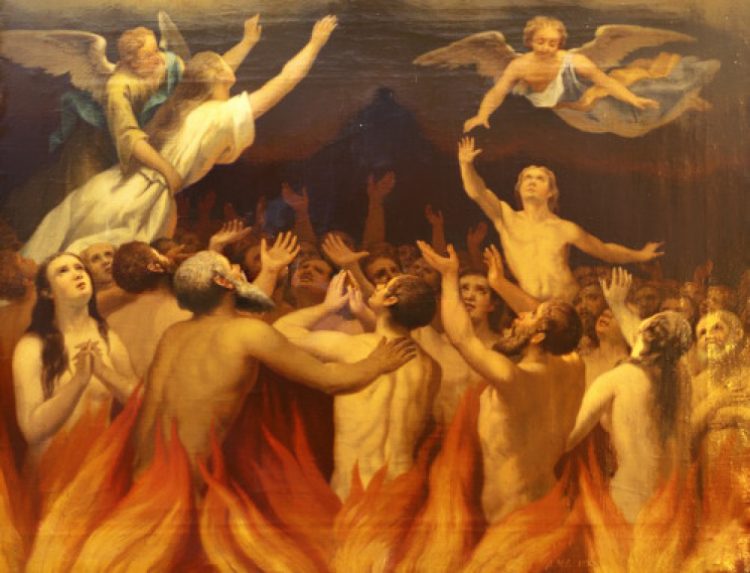
Here’s the question: does Christ’s return affect souls in purgatory? If I am in need of 1,500 years of purgation for — well, let’s not get into it — and if Jesus returns in 988th year of my time in purgatory, do I need to stay in purgatory another 512 years? It seems like a good question if you look at this answer:

The Church believes that almost everyone else, although not bad enough to go to hell, aren’t good enough to skate into heaven with no need for some introspection and purification.

Think of it like this: Joe and Max were both born on the same day and both died on the same day. Joe was a gambler, boozer, and womanizer, and he was dishonest, lazy, and undependable. Max, on the other hand, spent his life obeying the Ten Commandments, practicing virtue, and loving God and neighbor. Just before dying, Joe repents of his old ways and accepts the Lord into his heart. Should Joe and Max both go to heaven at the same time? Catholicism teaches no. The Church believes that Jesus’ death allows everyone the possibility of heaven, and his mercy grants forgiveness, but his justice demands that good be rewarded and evil punished — in this life or the next. If one man struggles all his life to be good while another lives a life of selfishness, greed, and comfort, both can’t walk through the pearly gates side by side.

Wait. Isn’t there a parable about this?

“For the kingdom of heaven is like a master of a house who went out early in the morning to hire laborers for his vineyard. 2 After agreeing with the laborers for a denarius[a] a day, he sent them into his vineyard. 3 And going out about the third hour he saw others standing idle in the marketplace, 4 and to them he said, ‘You go into the vineyard too, and whatever is right I will give you.’ 5 So they went. Going out again about the sixth hour and the ninth hour, he did the same. 6 And about the eleventh hour he went out and found others standing. And he said to them, ‘Why do you stand here idle all day?’ 7 They said to him, ‘Because no one has hired us.’ He said to them, ‘You go into the vineyard too.’ 8 And when evening came, the owner of the vineyard said to his foreman, ‘Call the laborers and pay them their wages, beginning with the last, up to the first.’ 9 And when those hired about the eleventh hour came, each of them received a denarius. 10 Now when those hired first came, they thought they would receive more, but each of them also received a denarius. 11 And on receiving it they grumbled at the master of the house, 12 saying, ‘These last worked only one hour, and you have made them equal to us who have borne the burden of the day and the scorching heat.’ 13 But he replied to one of them, ‘Friend, I am doing you no wrong. Did you not agree with me for a denarius? 14 Take what belongs to you and go. I choose to give to this last worker as I give to you. 15 Am I not allowed to do what I choose with what belongs to me? Or do you begrudge my generosity?’[b] 16 So the last will be first, and the first last.” (Matt 20)

What about a different parable, like one about surgery?

It may help to think of the purgatory in terms of a major operation to save a life. Say a doctor performs surgery on someone’s heart or brain and removes a cancerous tumor. The surgery achieves the main objective, but the wound needs to heal, and the incision needs to be cleaned and rebandaged. Purgatory is like that secondary part of recovery — the healing, cleaning, and bandaging. The belief is that the evil of sin is revealed to the person so she can totally and absolutely reject even the most venial and smallest of sins.

Well, what happens to someone who is recovering from surgery when Jesus returns? Will there still be weeping, hunger, sorrow, and forming scar tissue after Christ inaugurates the new heaven and new earth?

Looks to me like this is a defect. And this answer only compounds the problem:

All souls will receive resurrected bodies. The damned will receive eternal punishment in the flesh. Purgatory is meant to purify the soul. Once we receive our resurrected bodies, they will need completely purified souls so Purgatory ends with the Resurrection of the body.

If resurrected bodies need “completely purified souls, all the more reason to remain in purgatory for the correct amount of time.

Unless, of course, Jesus can take away sin and all its stains.

Who Is Dr. Thomas P. Roche?

So far all I know is that he taught classics (apparently) at SUNY Buffalo, was in theonomic circles for a while, and wrote one of the more amazing critiques. This is an excerpt from his piece, “Meet the Theonomists” (which is a good read):

SPACESHIP MOSCOW
Twelve years ago, the Rev. Douglas Wilson was quite literally a nobody from nowhere, the pastor of the then Community Evangelical Fellowship in undistinguished Moscow, Idaho, home of his alma mater, University of Idaho. Wilson, the son of the Rev. James Wilson, the local Evangelical Free Church pastor, was, in his father’s mode, an Arminian evangelical. His church was a 1970s-style college fellowship, the pastorate of which he had inherited in the late 1970s, when the previous pastor moved on and Wilson, the guitar leader, was elected his replacement by acclamation, without seminary training, but with a MA degree in Philosophy. Wilson proved a competent replacement, and in 1981 his church started Logos School, the progenitor Christian school in their “Classical Christian School” movement, dedicated to “recovering the lost tools of learning” along the lines of the medieval trivium, following the lead of a famous essay by this name written in the 1930s by the late British mystery novelist Dorothy Sayers, which Wilson himself (who also holds a degree in Classics) later expanded into a book. The school emphasized logic, Latin, etc., as well as theology, and fit well into the university atmosphere of the Moscow, Idaho/Pullman, Wash. (University of Idaho/WSU) environs. Neither the school nor Wilson as theologian gained much influence outside of this area, however, throughout the 80s. Then, in the late 80s, Wilson chose to preach a sermon series on Romans, and through his studies therein, was converted to Reformed soteriology. This event might well have had little effect beyond his local preaching but for reasons I do not understand, Wilson chose to expand his efforts, and quickly began to seek to expand his teachings and influence outside of his local area. I do know that Wilson, presumably in a worthy effort to learn more about the Reformed faith he had recently embraced, began various correspondences with Reformed thinkers elsewhere (James Jordan was briefly one of these), and soon Wilson was joined at his church by Douglas Jones, OPC elder (?) who had been associated with Greg Bahnsen and his ministry in Southern California. Jones became and in my opinion remains the intellectual engine behind the Moscow church; through his influence Wilson would eventually embrace covenant paedobaptism and even become a popularising author advocating the “Thousand Generation Covenant” paedobaptist promise.

Why Not Princess Di, Designated Hitters, Martinis, and Malaysia Flight 370?

Why not a book or set of essays on these topics? Why do Christians instead feel compelled to write books like these?

How should Christians approach important contemporary issues like war, race, creation care, gender, and politics?

Christians in every culture are confronted with social trends and moral questions that can be difficult to navigate. But, the Bible often doesn’t speak directly to such issues. Even when it does, it can be confusing to know how best to apply the biblical teaching.

In Cultural Engagement: A Crash Course in Contemporary Issues authors Joshua D. Chatraw and Karen Swallow Prior first offer a broadly accessible framework for cultural engagement and then explore specific hot topics in current Western culture including:

Sexuality
Gender Roles
Human Life and Reproduction Technology
Immigration and Race
Creation and Creature Care
Politics
Work
Arts
War, Weapons, and Capital Punishment
Featuring contributions from over forty top thinkers, proponents of various views on the specific topics present their approaches in their own words, providing readers an opportunity to fairly consider options.

Unique in how it addresses both big-picture questions about cultural engagement and pressing current issues, Cultural Engagement provides a thorough and broad introduction useful for students, professors, pastors, college ministers, and any believer wanting to more effectively exercise their faith in the public square.

Or this?

In his What Are Biblical Values? Collins aims to lay out, as dispassionately as possible, what the Bible actually says on a range of issues in contemporary debate—abortion, homosexuality, marriage and family, the environment, slavery, violence, and social justice.

Collins doesn’t think the Bible gives clear answers to most of these questions. The Bible is internally contradictory, a “running argument” with “conflicting values.” It doesn’t matter anyway: “Biblical values are not normative or acceptable for modern society simply because they are found in the Bible.” They have to be sifted and critiqued, both by comparison of Scripture with Scripture and by “dialogue with modern values,” which represent “clear advances in moral sensitivity.” The Bible contributes to the church’s deliberations, but “its contribution is not necessarily decisive.”

Some might contend that topics like the best aioli sauce, the merits of the Coens’ Burn After Reading, the right density for residential properties in an urban neighborhood, or the merits of circles rather than four-way stops at intersections don’t rise to the level of significance as climate change or race relations.

But that suggests the headlines are driving Christian cultural “engagement” more than than simply attending to the variety, wonder, mystery, and reality of creation (including the activities of humans). Why is someone less culturally “engaged” when keeping score of the Phillies-Dodgers game than someone else who is watching the Democratic Party’s presidential debates? If all of creation is the theater of God’s providence, why not an egalitarianism of human interests and endeavors?

In which case, Rachel Rae’s cookbook on comfort food is just as good as (if not better than) Redeemer Presbyterian Church NYC’s cookbook. Christians have no corner on cultural engagement. And if the Bible has little to say about even the matters covered in the books above, what’s the point of calling this Christian or engagement?

When Journalists (or op-ed writers) Get Biblical

Speaking of credentials for ministry, I am not sure it’s a positive development when any Tom, Maleek, or Kasheena can give speeches or write columns with the idea that they know what the Bible teaches. Bonnie Kristian (seriously) decided to challenge Mike Pompeo for a speech in which he referred to Iran’s hostility to Israel as a carry over from the way Persians regarded the Israelites in the book of Esther. In this contest, Kristian has some expertise on foreign policy and has written a book on “flexible” Christianity with a foreword by Gregory Boyd and endorsed by Jonathan Merritt (excuse the genetic fallacy). Meanwhile, Pompeo is a member of an Evangelical Presbyterian Church. He also operates under the hardship of being a member of the Trump administration.

Here is the point of contention: Pompeo doesn’t understand Esther.

The linchpin of Pompeo’s CUFI treatment of Iran was the scriptural book of Esther, which in his telling is evidence that Iran has for centuries been a hotbed of anti-Semitism. “That same twisted, intolerant doctrine that fuels persecution inside Iran has also led the ayatollah and his cronies to cry out, quote, ‘death to Israel’ for four decades now,” Pompeo said. “This is similar to a cry that came out of Iran — then called Persia — many, many years ago. The Book of Esther teaches us about this.”

No, it doesn’t. As Duke Divinity professor Lauren Winner has explained, Esther is rich in themes worth exploring: “There are a lot of lessons about how power works in this story,” challenging us to examine “our own displays of power in our own smaller empires, even if the empire is no bigger than … than our own heart.” And “Esther is also a story about exile,” Winner adds, “about being an exiled Jew, an exiled person of faith, and what it means to live in a place that is foreign, to live in a place where you are foreign, where you and your kinsman are aliens. Esther is a book about how to live with your community in a place that is indifferent to you or hostile to you.”

Kristian goes on to state that Esther is also a story about courage and she supplies a link to a piece by Rachel Held Evans.

Bottom line: Pompeo’s use of Esther is “inexcusably misleading.”

The editors at The Week actually know enough about the Bible to conclude that Kristian is on firm ground? Kristian herself appeals to a Duke Divinity School professor, with a terminal degree in religious history but who is also an Episcopal priest, and a parachurch blogger to be able to say with such certainty that Pompeo is wrong? Couldn’t a better point have been that the Secretary of State should simply use assessments of the middle East from the contemporary world rather than trotting out a part of Scripture that is likely to provoke Christians, Jews, and Muslims?

But if Kristian is going to enter the fray of the authoritative interpretation of Esther, at least let Christopher Guest have a stab:

William of Ockham is the Least of Rome’s Apologists’ Worries

Historians and apologists for Rome heap a lot of blame on William of Ockham for philosophical and theological ideas that unleashed Protestantism and produced the West’s decadence and Walmart. Why Christendom itself doesn’t receive the blame for Ockham is one of those chicken-and-egg questions, I guess.

Now it turns out that Ockham was not the only one who challenged Aquinas, the theologian Jesus founded. Duns Scotus has his own explaining to do.

It turns out he may explain the Mass better than Aquinas because transubstantiation makes Christ’s presence dependent on the location of the bread (sort of like “bread presence” rather than “real presence”):

It concerns the claim of St. Thomas Aquinas that Christ’s body is present on the altar because something that was there before, the substance of bread, has been converted into that body. The “accidents” of the bread—for example, its whiteness and roundness—remain, but these do not belong to the body of Christ; otherwise that body would have to be white and round, which it is not. So far, so good.

Among the other accidents of the bread, however, is its location, there on the altar. For what a thing is, its substance, is no more the same as where it is than it is the same as how it looks (round and white). But in that case, how can we say that Christ’s body is there on the altar—since, ex hypothesi, it cannot get its “where” from the “where” of the consecrated bread? The doctrine of transubstantiation, as explained by Aquinas, thus fails to secure the real presence of Christ’s body on the altar. “I do not know of any satisfactory answer to this problem,” Kenny continued. “If I did, I would give it. Since I do not, I must leave it, as the writers of textbooks say, as an exercise for the reader” (A Path from Rome, 1986, 167–168).

These questions may seem abstruse, perhaps even improper, since the sacrament is rather to be adored than quibbled over. But the question of Christ’s presence now on the altar is a genuine one, and central to the consecration and adoration of the Eucharist. It is a question that many others besides Thomas Aquinas sought to answer, and a seriously inquiring intellect might rightly be disturbed, even scandalized, if forbidden to ask it. But for a long time Thomas’s answer was accepted just because it was his. This was an unnecessary constriction of Catholic thought. Unfortunately, some Catholic intellectuals seem still to be constricting themselves in this way. One might call their position “exclusivist Thomism.”

According to Scotus:

The subtle Scot distinguishes between presence and transubstantiation, claiming that one can exist without the other (Ordinatio IV d.10 q.1). Christ could be there on the altar now without transubstantiation, and the bread could be transubstantiated without Christ being there on the altar. Christ’s presence on the altar is not a matter of his appropriating the “where” of the transubstantiated bread, or of his retaining this particular accident and not others.

It turns out that Scotus also differed with Aquinas on the immaculate conception in ways that may make Roman Catholics and their nostalgia for Christendom perk up:

The most famous difference between Scotus and Thomas is the doctrine of the Immaculate Conception, which Scotus got right and Thomas got wrong. But surely, one might say, we no longer need Scotus to tell us about the Immaculate Conception. Didn’t Blessed Pius IX tell us all we need to know in his dogmatic pronouncement? Perhaps. Note, though, that Thomas was not alone in failing to defend the Immaculate Conception. Every Scholastic theologian before Scotus, including fellow Franciscans like St. Bonaventure, failed in the same way. None was able to give a defense of it that would avoid creating a serious theological problem somewhere else.

Consider in this regard one of the arguments that Thomas himself gives against the Immaculate Conception (Summa Theologica III q27 a2). If the Virgin Mary had in no way incurred the stain of sin, she would not have needed Christ as her savior and so Christ would not be the savior of all men and women. Scotus’s answer is that Christ is indeed Mary’s savior, for he saved her in advance of her incurring the original sin that, as a natural descendant of Adam, she would have incurred otherwise (Ordinatio III d.3 q.1). Christ is thus her savior, as he is the savior of everyone else. Moreover, he is her savior in the most excellent way possible, for he saved her from ever having had sin, including original sin, while everyone else is saved only after incurring at least original sin.

And then there’s Scotus’ view of pets which has some appeal in this corner of Christ’s spiritual kingdom:

Can animals go to heaven or be resurrected? Pope Francis was recently reported to have said that they can—but inaccurately, as it turns out. Still, the pope said enough in his encyclical Laudato si’ to suggest the thought that it’s at least possible. Section 243 of the encyclical reads: “At the end, we will find ourselves face to face with the infinite beauty of God, and be able to read with admiration and happiness the mystery of the universe, which with us will share in unending plenitude…. Eternal life will be a shared experience of awe, in which each creature, resplendently transfigured, will take its rightful place and have something to give those poor men and women who will have been liberated once and for all” (emphasis added).

Does this remark mean that animals can or will be in heaven, not indeed as sharing the beatific vision, but as sharing resurrected life with beatified human beings? Thomists will say no because the sense-souls of animals, unlike the rational souls of humans, perish at death, and what has altogether perished cannot be brought back numerically the same. Scotus thinks this view false and argues, in his usual subtle and involved way, that the numerically same thing could in principle be recreated after having ceased to exist. He appeals in defense not only to divine omnipotence but to reported miracles of saints actually bringing animals back to life (Ordinatio IV d.44 q.1 n.19). Let those, then, who want to think of their pets being with them in heaven be consoled with Scotus, and perhaps with Pope Francis, for assuredly they cannot be consoled with Thomas. But then, if Thomas is not the unique measure of orthodoxy, there can be no harm or fear in leaving him for Scotus and Pope Francis—and one’s favorite pet.

I have no dog in this fight other than reminding western Christians that the medieval church, let alone the ancient one, was hardly as unified and regulated as contemporary Roman Catholics make it seem. By the nineteenth century, Rome may have achieved the sort of market share in Roman Catholic dioceses that on the eve of Vatican II AT&T had in the phone business. But that consolidation and coherence took awhile and came with a price.

How Slippery is the Normativity Slope?

I listened to a discussion among Asian-American PCA pastors about race and ethnicity and was surprised to hear the use of “white normativity” as frequently as they did. They object strenuously to white normativity in the church. I wonder about that way of putting it since John Frame and I are both white and yet the differences he and I have about worship have little to do explicitly with being white. I do, by the way, like the idea that Frame’s brief for Contemporary Christian Music has as much white culture attached to it as exclusive psalmody since the old canard about so-called traditional Presbyterian worship was that it was too white, male, European, and suburban (even though none of the Westminster Divines had a clue that Levittown was on the horizon of white cultural normativity).

Here is one example of the use of white normativity from one of the interlocutors’ talks/homilies/speeches:

That leads to a deeper and better informed repentance, does it not? One that names with far greater specificity, repenting of specific sins specifically…one that names with far greater specificity the problem of white cultural normativity and supremacy in the church.

If you wanted to know the instances of white normativity in the church, like too much stuff that white people like, you might be surprised to hear that wealth is an instance of white dominance in the church and a way to repent is for whites to pay ecclesiastical reparations to black and people-of-color congregations. But wait, isn’t currency itself a form of white normativity? Can you really make up for it by relying on it in the way you make up?

Aside from that logical speed bump, the real point here is how do you head down the rhetorical path that relies on intersectional ideas like white normativity and turn off before you arrive at heteronormativity. After all, for the leaders of Black Lives Matter, the systemic nature of injustice does not stop with skin color but runs all the way to sexual identity:

We are guided by the fact that all Black lives matter, regardless of actual or perceived sexual identity, gender identity, gender expression, economic status, ability, disability, religious beliefs or disbeliefs, immigration status, or location.

We make space for transgender brothers and sisters to participate and lead.

We are self-reflexive and do the work required to dismantle cisgender privilege and uplift Black trans folk, especially Black trans women who continue to be disproportionately impacted by trans-antagonistic violence.

We build a space that affirms Black women and is free from sexism, misogyny, and environments in which men are centered.

This is not some threat about where ideas lead. Some PCA pastors could make a real contribution and explain how to address racial and ethnic inequalities or discrepancies while excluding discussions of sexual orientation, gay marriage, and Christian-family-normativity in general. Since I don’t rely on the arguments that lead someone to detect white normativility and then reject it with contempt, I can’t do the heavy lifting here.

But since the PCA is at a difficult juncture about homosexual identity, some in the communion may want to ponder whether white normativity and heteronormativity tend to pick up speed on the slope of normativity.

Fun With Numbers

Would it surprise readers to learn that Tim Keller and I, according to the intersectionality meter, enjoy more privilege than 96 percent of the rest of Americans? Would it also surprise anyone that Tim Keller and I have more privilege than Donald Trump? Because if you move the slider on Christianity from Christian to Not Christian (sorry Donald), your oppression footprint decreases, from a 5 to a 14, which means Trump has more privilege than 88 percent other Americans. Throw in income, with differences for religion, and here his how the picture changes: Trump (rich) 11, me (moderate) 5, Keller (more than me), 4. So in the intersectionality sweepstakes, Tim Keller has more privilege than Donald Trump and I. (And since Keller and I are Christians, that may make both of us Christian nationalists.)

This fits what Keller himself has even admitted.

Keller acknowledged white privilege and ways he’s benefited from it, but with his characteristic wit he added, “I’m not going to feel sorry for myself because that is a very white thing to do.”

Or:

John [Piper] and I are both old enough to remember the complicity of evangelical churches and institutions with the systemic racism in the US before the civil rights movement. I took my first church in a small town in the South in the early 1970s. The courts had recently ruled that the whites-only public swimming pool, operated by the town with taxpayers’ money, had to be integrated. So what did the town do? It shut the pool down completely, and the white people of the town opened a new private swimming pool and club, which of course, did not have to admit racial minorities. Because I was a young pastor, our family was often invited to swim there, and swim we did, not really cognizant of what the pool represented.

Here’s some more fun with numbers. What does minority and majority populations mean without nationalism? The world’s total population is 7.7 billion. The United States’ population is roughly 330 million. That means Americans (third in total behind China and India) are 4 percent of the world’s population. In majority/minority statistics, that looks decidedly like a minority.

But I get it with power and wealth Americans look a lot bigger and wealthier than the rest of the world’s peoples. Doesn’t some of that size and power extend to minorities within the United States, such that Amish or Armenian-Americans in the United States have more power and wealth than people living in Nigeria or Guiana?

And what about minority groups not based on race or ethnicity but on religion? Are members of the Presbyterian Church in America — roughly 350,000 — a minority compared to Japanese-Americans at 1.4 million, or Korean-Americans, or Chinese-Americans at almost 5 million? Can ethnicity and wealth simply turn those numbers around so that a denomination that is 7 percent the size of Chinese-Americans has the same sort of privilege as — well — Tim Keller?

And don’t even get me started on how flawed Asian-American is as a category?

However you slice it, the numbers only make sense if you start with the United States and its population, which makes you some kind of nationalist.

Bill Clinton: In Red, White, and Especially Blue

This is how objections to presidential immorality sounded twenty-one years ago (from the October 1998 edition of the Nicotine Theological Journal):

Of the several disadvantages of growing up in a fundamentalist home, one was the ability of my father to detect off-color humor a mile away. (Sure, the promoters of family values would see this as a virtue. But, then again, they are the ones responsible for the Family Channel where firm parental guidance is little different from parental naivete.) I can remember those rare nights when for some reason my brother had been sufficiently well-behaved to merit staying up late – it also needs to be added that it was Friday night. And then around 11:30 we would gain access into the sophisticated adult world of “The Tonight Show” and hear the urbane (to us) humor of Johnny Carson. We would listen to Fred McMahon announce the evening’s guests and cherish the prospects of seeing Buddy Rich or Don Rickles.

BUT WE KNEW ONE OBSTACLE lay in the way of our making it past midnight. It was Carson’s monologue. If Johnny went blue – the showbiz vernacular for telling dirty jokes – then we knew dad would get up from his recliner and turn the TV off, thus forcing an abrupt end to the quality time around the tube. Sometimes Carson’s allusions to parts of the female anatomy would be tame enough to keep our father in his seat – he no doubt enjoyed Carson and wanted to see the same guests that we did. (By the way, it helped if dad fell asleep. But there would be hell to pay if he woke up to a dirty joke. And could you be really sure that he was asleep?) But in those cases where the jokes were only a shade blue, the pressure I felt was even greater than if Carson had gone ahead and told a crude one-liner. I couldn’t stand not knowing when my father would turn off the TV. And so, in some cases I would be the one to make the first move. It wasn’t because I objected to the humor, nor was it even a case of trying to protect my innocent dad from the dirty jokes that I had come to hear at school (often repeated from “The Tonight Show”). Instead, it was simply a desire to end my misery. I could not bear hearing off color jokes in my dad’s presence. If I laughed I would certainly disappoint if not anger him. If I didn’t then why bother watching?

MEMORIES OF MY YOUTHFUL late night discomfort have come back to me over the past eight months, first as a trickle, and now as a virtual geyser, as the sordid and tawdry details of our President and his intern have absorbed the nation and its media. Through it all I know that my aging fundamentalist parents sit glued to the TV, not because they are so interested in Bill Clinton’s sex life (though as registered Republicans these incidents have no doubt confirmed their prejudices). Rather, it is their habit to watch at least ninety minutes of news each night, first the local variety at 6:00, then the national edition at 6:30 – I think they still watch Peter Jennings, who has had his own intern problems, because their local news of choice comes from the ABC affiliate and they don’t have remote control. Then, they finish off the day with a dose of local news at 11:00, complete with that evening’s murders, fires, and woes of the Major League Baseball’s closest franchise.

THROUGH IT ALL, MY DEAR, devout conservative independent Baptist parents have had to hear about parts of the human body and sexual positions that had Johnny Carson ever mentioned my dad would have likely not only turned off the TV, but put it out by the curb for the next trash pick-up. I feel this obligation to go home at certain times of the evening so I can be there to turn off my parents’ TV. Many people have talked about how parents are going to explain the President’s actions to their children. But what about former fundamentalists like me? Who is going to explain it to our parents? I want to protect my parents from the evening news which is now pornographic. They don’t need to know about oral sex or stained cocktail dresses. Their lives, innocent though they may have been, would have been complete without such carnal knowledge. And this is the source of my complaint against our President. His sexual life is his business, though I can see its repercussions for the body politic and his ability to govern. But do my parents have to know? Couldn’t he have thought about all those fundamentalists out there who had never dreamed that sexual desire could take such bodily form?

Now, part of the problem may be mine. I could be suffering from the same naivete that Hamlet exhibited when he denied that his mother was a sexual creature. In other words, I may think my parents so sexually innocent that I can’t conceive of their sexual intimacy, let alone the fact that they did produce two sons. They both grew up on farms and probably know a lot more about sex than I can ever fathom. Still, if they felt the obligation to protect me from Johnny going blue, I feel a similar responsibility to protect them from Bill Clinton, who should be turning red.

Townsend Levitt

If You Go Back to 33, Why Bother with 1776?

While John Fea has tried to live tweet David Barton’s claims about America’s Christian founding, Roman Catholics in the U.S. also feel the need to make America safe for faith. Which allows a repetition of a point: not integralism but Americanism is the default setting for Roman Catholics in the U.S. That is, American Roman Catholics, contrary to the worst anti-Catholics like Paul Blanshard, were never ambivalent about American exceptionalism or the need to modify aspects of church life to assimilate the church to American ways.

And so, Roman Catholic defenders of America have come out parading once again for July 4th. A little early to the festivities was Matthew Schmitz who used the approaching national holiday to vindicate Sohrab Ahmari over against David French:

David French of National Review said that Ahmari was forsaking America’s historical commitment to “neutral principles” such as free speech and due process. By insisting that governments should re-order the public square towards the common good, Ahmari was “forsaking the framework for ordered liberty established by the Founders.”

But the idea that America was founded on “neutral principles” is a myth. From its beginnings, America has been characterized by what Tocqueville called the “intimate union of the spirit of religion with the spirit of liberty.” The Americans whose representatives drafted the Constitution did not seek to end this union, but to place it on a stable footing.

In 1813, John Adams wrote to Thomas Jefferson: “The general Principles, on which the Fathers Achieved Independence, were … the general Principles of Christianity … and the general Principles of English and American Liberty.” The former are not neutral principles.

Every early administration except Jefferson’s summoned America to days of humiliation, fasting, and prayer. Americans were urged to “confess and bewail [their] manifold sins and transgressions, and by a sincere repentance and amendment of life … and through the merits and mediation of Jesus Christ, obtain pardon and forgiveness.” Is this neutrality?

…As these men show, the belief that politics should be ordered to the common good and the highest good is not only classical and Christian, but American. We need to reinvigorate this tradition, not by going back to colonial arrangements, but by pioneering new ways to unite the spirits of Christianity and liberty.

David Barton could not have said it better, though Schmitz’s praise may seem odd for a convert from Protestantism to Roman Catholicism if only because he fails to mention his examples all came from Protestants. Roman Catholics at the time (and down to Vatican II) were hostile to civil liberty, freedom of ideas, and free markets. That difference between medieval and modern is pesky for those who embrace one of the most modern nations on earth.

Then today at The American Conservative, the man who likely decided to run Schmitz’s piece, Michael Warren Davis, another convert, wrote positively about the Puritans’ settlement in North America and their influence on the founding. He quotes John Wintrop’s “A Model of Christian Charity” and then writes:

This is the high ideal that lies at the heart of our nation’s founding: not wealth or strength or freedom, but charity. This is the divine purpose for which America was founded: that we might love as ought to love.

Love her, too, while you’re at it. Love America the way we mortals can only love when we’ve grown old enough to accept that our mother is flawed, as we are. Love her all the more because she won’t be around forever.

From the woodlands of Maine to the mountains of Virginia, from the golden shores of California to the black sands of Hawaii, from the lakes of Michigan to the endless ranges of Kansas—every last one of us has a chance to be as wise as Greeks, as virtuous as Romans, as cultured as Englishmen, and as loving as Christians. That’s worth celebrating.

Again, what a great development to have Roman Catholics praising — of all people — Puritans on the occasion of America’s birthday. Might they also recommend the Puritans’ teaching and worship to anyone struggling with the way the bishops have been conducting their affairs during abuse scandal? If not, if Protestants still need to get right with the Vatican to have an awesome Christianity, then Davis should add that the bishops were also wrong for a long time about political liberty (as in “error has no rights,” a phrase used by top Vatican officials against John Courtney Murray as late as the 1950s).

But then comes a mild corrective from yet another convert, Chad Pecknold, again from the webpages of the Catholic Herald where Davis works. Pecknold is not so convinced that Puritans were a healthy influence on the United States’ political culture of liberty:

[Tocqueville] cites approvingly Cotton Mather’s discussion of “holy liberty” in Magnalia Christi Americana. Tocqueville is struck by how this “holy liberty” is freedom for goodness, for truth, for justice, for God. In this sense, what makes Puritan liberty different from the liberty of 1789 is precisely that it is not liberty “for secular purpose,” but for holy purpose. Where France divorced liberty from religion, the Puritans united “the spirit of religion and the spirit of liberty.”

This seed, this germ, Tocqueville writes, is “the key to nearly the whole book.” So the Puritan seed was dispersed, fragmented, and scattered. Its children could favor different aspects of the originating spirit. It could combine with other species, if you will, and yet American diversity would always have this common root. Yet Tocqueville also sees something profoundly unstable in the Puritan seed — it is sectarian, and not “the whole.” The Puritan seed lacks a unifying principle, and cannot supply the American people with a stable, common creed.

In one of his more Catholic insights, Tocqueville believes the Puritan seed is made to be divided, to be diversified through a great plurality — yet moving in two directions. Tocqueville writes, “our descendants will increasingly divide into only two parts, some leaving Christianity entirely and others embracing the Church of Rome.”

Tocqueville is no Augustine for America, but he does have an important insight into American polarization. In the end, he thinks one part of America will view liberty as the flight from Christianity, and the other will see that a culture of freedom requires its full embrace.

See what he did there? On the one hand, Pecknold thinks Tocqueville recognized that the Puritans provided an unstable foundation for a nation — to much sectarianism — though it is odd that when Puritans were more doctrinally sane as opposed to their Congregationalist successors, they supported the American founding with vigor. Of late, Congregationalists have been willing to live with Jeremiah Wright as one of their pastors in good standing.

On the other hand, Pecknold, by a magic trick only rivaled by Doug Henning, makes Roman Catholics, the ones with the “full embrace” of Christianity, as the true successors to the Puritans who united the “spirit of liberty with the spirit of religion.”

It seems fairly plausible to conclude that Roman Catholics ponder the American founding more than Matthew 16:18-19. On the upside, it sure beats running the Fourth of July through Abraham Lincoln.

The Missional Church in Free Fall?

It started well seemingly with Tim Keller:

what makes a small group missional? A missional small group is not necessarily one that is doing some kind of specific evangelism program (though that is to be encouraged). Rather, (1) if its members love and talk positively about the city/neighborhood, (2) if they speak in language that is not filled with pious tribal or technical terms and phrases, nor with disdainful and embattled verbiage, (3) if in their Bible study they apply the gospel to the core concerns and stories of the people of the culture, (4) if they are obviously interested in and engaged with the literature, art and thought of the surrounding culture and can discuss it both appreciatively and critically, (5) if they exhibit deep concern for the poor, generosity with their money, purity and respect with regard to the opposite sex, and humility toward people of other races and cultures, and (6) if they do not bash other Christians and churches—then seekers and nonbelieving people will be invited and will come and stay as they explore spiritual issues.

That was 2001.

Then Kevin DeYoung raised objections even while trying not to offend the missionally minded:

(1) I am concerned that good behaviors are sometimes commended using the wrong categories. For example, many good deeds are promoted under the term “social justice” when I think “love your neighbor” is often a better category. Or, folks will talk about transforming the world, when I think being “a faithful presence in the world” is a better way to describe what we are trying to do and actually can do. Or, sometimes well meaning Christians talk about “building the kingdom” when actually the verbs associated with the kingdom are almost always passive (enter, receive, inherit). We’d do better to speak of living as citizens of the kingdom, rather than telling our people they build the kingdom.

(2) I am concerned that in our new found missional zeal we sometimes put hard “oughts” on Christians where there should be inviting “cans.” You ought to do something about human trafficking. You ought to do something about AIDS. You ought to do something about lack of good public education. When you say “ought” you imply that if the church does not tackle these problems we are being disobedient. It would be better to invite individual Christians in keeping with their gifts and calling to try to solve these problems rather than indicting the church for “not caring.”

(3) I am concerned that in all our passion for renewing the city or tackling social problems we run the risk of marginalizing the one thing that makes Christian mission Christian: namely, making disciples of Jesus Christ.

That was 2010.

Now comes Mark Galli with even more criticism (the fourth column in a series):

But it turns out that the church is not a very efficient institution for making a difference in the world. If you are passionate about feeding the hungry, for example, churches can help here and there. But if you really want to make a difference, really cut the numbers of the hungry and malnourished, it’s better to give your time to a government or nonprofit agency that specializes in such things.

The same is true whether we’re talking about sex trafficking, drug abuse, exploitation of labor, environmental degradation, and so forth. The church as church can make a donation, organize a committee, sponsor a food pantry, but it cannot really make a significant, lasting impact. It is not set up to do that. In fact, it has many other really important jobs to do.

It is called, for example, more than anything, to provide a time and place for the public worship of God and for people to participate in the sacraments/ordinances of baptism and the Lord’s supper—to meet God as we glorify him. It is also called to teach children, youth, and adults about who God is, as well as the shape and nature of the Christian life. It is a place where Christians gather to receive mutual encouragement and prayer. It’s the place where we learn to live into our destiny, to be holy and blameless in love, to the praise of God’s glory.

Galli adds that it is harder for a church to be simply a church than it is to be missional (even if the former is likely a lot less expensive):

But if you want to do something that is really hard, and if you want to push yourself to the limits, if you want to be constantly tested by love, if you want to live into your ultimate destiny—if you want to learn to be holy and blameless in love before God—there is no better place to do that than in the local church.

Many of us today rightly note the great defects in the church, most of which boil down to its superficiality. Because the church thinks it has to be missional, that it has to be a place where the world feels comfortable, it has dumbed down the preaching and the worship, so that in many quarters we have ended up with a common-denominator Christianity. It goes down easy, which is why it attracts so many and why many churches are growing. But it is a meal designed to stunt the growth of the people of God. And it is a way of church life that eventually burns people out, where people become exhausted trying to make the world a better place.

What if instead the church was a sanctuary, a place of rest and healing and life, where the fellowship of believers lived together in love, where we just learn to be holy and blameless in love before God? And what if, having encountered afresh some sort of beatific vision, we go out from church in our vocations and ministries, serving the unchurched neighbor and, by God’s grace, make a difference in their world?

You’d have thought Galli read Machen. You might have also thought that someone who taught at Westminster Theological Seminary had read Machen.

Image