David French is to Conservatism what Tim Keller is to Presbyterianism

This is a follow up and updates this in the light of even more chatter.

Sohrab’s Ahmari’s critique of French-ism, the outlook of the evangelical attorney and Iraq War veteran, David French (not to be confused with Moby), who writes for National Review was over the top. But it did capture a problem in French’s above-it-all-I-just-follow-the-Declaration-and-Constitution self-fashioning. That is one of putting convictions into practice and forming institutions to maintain them.

French says his outlook consists of:

“Frenchism” (is that a thing now?) contains two main components: zealous defense of the classical-liberal order (with a special emphasis on civil liberties) and zealous advocacy of fundamentally Christian and Burkean conservative principles. It’s not one or the other. It’s both. It’s the formulation that renders the government primarily responsible for safeguarding liberty, and the people primarily responsible for exercising that liberty for virtuous purposes. As John Adams said, “Our Constitution was made only for a moral and religious people. It is wholly inadequate to the government of any other.”

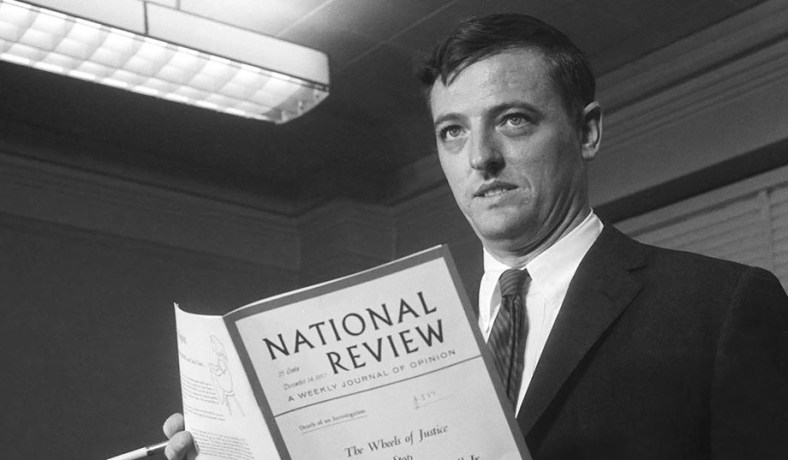
The problem is, as William F. Buckley saw when he founded National Review, that holding up the ideals of classical liberalism requires taking sides. You nominate candidates, vote in elections, and decide on laws and policy. You may believe in the Bible, by analogy, but you need to interpret it, write a creed, institute a polity, and decide who may be ordained to ecclesiastical office. Simply saying that you believe in the founding or in the Bible without taking a side politically or denominationally is to fly in a hot air balloon above the fray — except that you’re receiving a pay check from either a magazine that has for over fifty years been taking the movement conservative side of interpreting the founding or a denomination that has identified for forty years with a American conservative Presbyterian rendering of the Bible.

Both French and Keller don’t want to be partisan or extreme which is why they reach for the high-minded origins of either the U.S. or Christianity. They don’t want to fight alongside others. They may employ their own arguments either in court or as a public theologian but having the backs of others in a particular group is not the way they seem to carry it.

No Machen’s Warrior Children here.

This is why Rod Dreher sees Ahmari’s point, namely, that French positions himself above the clamor of division or controversy:

I concede that I’m more of a classical liberal than I thought I was, in that I resist a coercive political order. I am willing to tolerate certain things that I think of as morally harmful, for the greater good of maintaining liberty. Not all sins should be against the law. Again, though, there’s no clear way to know where and how to draw the line. Sohrab Ahmari uses Drag Queen Story Hour as a condensed symbol of the degrading things that contemporary liberalism forces on the public.

I am a thousand percent behind Ahmari in despising this stuff, and I am constantly mystified by how supine most American Christians are in the face of the aggressiveness of the LGBT movement and its allies, especially in Woke Capitalism. I am also a thousand percent with Ahmari in his general critique of how establishment conservatism tends to capitulate to cultural liberalism.

But French has the virtue of being virtuous, which is why Alan Jacobs sees the National Review correspondent as merely being a good Christian:

I disagree with David French about a lot of things — especially what I believe to be his sometimes uncritical support for American military action — but I admire him because he’s trying. He’s trying to “take every thought captive to Christ.” I believe that if you could demonstrate to David French that positions he holds are inconsistent with the Christian Gospel, he would change those positions accordingly. Among Christians invested in the political arena, that kind of integrity is dismayingly rare.

Hey, Dr. Jacobs! I try too. But the day I see you come alongside confessional Presbyterians and say, “they are simply trying to live out the Christian gospel” I’ll book a flight to Waco and buy you a drink.

But Jacob’s reaction is precisely the problem. To regard French’s politics as simply trying to be consistent with Christianity — aside from being a violation of two-kingdom theology — is to ignore that politics requires getting dirty and making compromises. It is not a place to pursue holiness and righteousness — though it is an occupation worthy of a vocation.

So, while David French takes his stand with Burke, Washington, Jefferson, Madison, and Jesus (as if those add up to anything coherent), French-ism is nowhere in Matthew Continetti’s breakdown of contemporary conservatism — trigger warning for #woke and Neo-Calvinist Christians who want their politics to come from either the prophets or the apostles:

The Jacksonians, Mead said, are individualist, suspicious of federal power, distrustful of foreign entanglement, opposed to taxation but supportive of government spending on the middle class, devoted to the Second Amendment, desire recognition, valorize military service, and believe in the hero who shapes his own destiny. Jacksonians are anti-monopolistic. They oppose special privileges and offices. “There are no necessary evils in government,” Jackson wrote in his veto message in 1832. “Its evils exist only in its abuses.”

…Reform conservatism began toward the end of George W. Bush’s presidency, with the publication of Yuval Levin’s “Putting Parents First” in The Weekly Standard in 2006 and of Ross Douthat and Reihan Salam’s Grand New Party in 2008. In 2009, Levin founded National Affairs, a quarterly devoted to serious examinations of public policy and political philosophy. Its aim is to nudge the Republican Party to adapt to changing social and economic conditions.

…Where the paleoconservatives distinguish themselves from the other camps is foreign policy. The paleos are noninterventionists who, all things being equal, would prefer that America radically reduce her overseas commitments. Though it’s probably not how he’d describe himself, the foremost paleo is Tucker Carlson, who offers a mix of traditional social values, suspicion of globalization, and noninterventionism every weekday on cable television.

…The Trump era has coincided with the formation of a coterie of writers who say that liberal modernity has become (or perhaps always was) inimical to human flourishing. One way to tell if you are reading a post-liberal is to see what they say about John Locke. If Locke is treated as an important and positive influence on the American founding, then you are dealing with just another American conservative. If Locke is identified as the font of the trans movement and same-sex marriage, then you may have encountered a post-liberal.

The post-liberals say that freedom has become a destructive end-in-itself. Economic freedom has brought about a global system of trade and finance that has outsourced jobs, shifted resources to the metropolitan coasts, and obscured its self-seeking under the veneer of social justice. Personal freedom has ended up in the mainstreaming of pornography, alcohol, drug, and gambling addiction, abortion, single-parent families, and the repression of orthodox religious practice and conscience.

For those keeping score at home, that’s Jacksonians, Reformocons, Paleocons, and Post-Liberal conservatives. None of them are “classical liberals.” History moves on and requires people to choose.


Apparently Calvin Did Not Receive the Neo-Calvinist Memo

Calls for a transformational, wholistic, and cosmic redemption do not die. In fact, whenever sin is readily apparent in the news, the need for a solution (or at least a response) from Christians generally involves an appeal to the gospel. What else do believers have? (Short answer: as created beings, they have a lot more — just think of all the subjects in a university or college course catalog and imagine saying after reading all that “the gospel is always the only answer to human hardship.”)

Here’s one way of talking about Cosmic Redemptive Christianity:

CRC is a redemptive-historical view of the gospel. Tim Keller’s definition of the gospel is a great example. He defines it this way: “Through the person and work of Jesus Christ, God fully accomplishes salvation for us, rescuing us from judgment for sin into fellowship with him, and then restores the creation in which we can enjoy our new life together with him forever.” The difference is subtle but overwhelming in its implication for the black experience in America.

The key phrase here is “restores the creation.” [Great Commission Christianity] sadly does not include creation, the kingdom, or redemption as a necessary part of the gospel. Leaving out “creation” explains why GCC struggled to encourage Christian involvement in social issues.

I’d define the gospel by saying it is the good news of God’s saving work in Christ and the Spirit by which the powers of sin, death, and judgment are overcome and the life of the new creation is inaugurated, moving towards the glorification of the whole cosmos.

Here’s another:

As such, this Gospel message is indeed anemic as it does not properly answer to the nature of mankind, nor the restoration of all that is the image of God in man. If man as the image of God includes not only soul, righteousness, and immortality, but also his physical nature, his social relations, and even his proper habitation, then the message of redemption—i.e., renewal “after the image of him that created him”—must of necessity be, in Bradley’s words, “the good news of God’s saving work in Christ and the Spirit by which the powers of sin, death, and judgment are overcome and the life of the new creation is inaugurated, moving towards the glorification of the whole cosmos”; that is, something like “Cosmic Redemption Christianity.”

If the message of redemption includes anything less, then man is not being restored by the Gospel; but if we take seriously all that it means to be made in the image and likeness of the Triune God, then we must likewise take seriously all that is included in man’s redemption, and craft our mission and message accordingly.

Talk about setting expectations high.

That’s not exactly what Paul told the church in Corinth (who had a fair amount of troubles — wealth gap, incest, imperial injustice):

For we know that if the tent that is our earthly home is destroyed, we have a building from God, a house not made with hands, eternal in the heavens. 2 For in this tent we groan, longing to put on our heavenly dwelling, 3 if indeed by putting it on we may not be found naked. 4 For while we are still in this tent, we groan, being burdened—not that we would be unclothed, but that we would be further clothed, so that what is mortal may be swallowed up by life. 5 He who has prepared us for this very thing is God, who has given us the Spirit as a guarantee.

6 So we are always of good courage. We know that while we are at home in the body we are away from the Lord, 7 for we walk by faith, not by sight. 8 Yes, we are of good courage, and we would rather be away from the body and at home with the Lord. 9 So whether we are at home or away, we make it our aim to please him. 10 For we must all appear before the judgment seat of Christ, so that each one may receive what is due for what he has done in the body, whether good or evil. (2 Cor 5)

That’s a tad dualistic for some inclined to a cosmic gospel. But Calvin lays it on thick in his commentary on this passage:

The body, such as we now have it, he calls a house of tabernacle For as tabernacles [512] are constructed, for a temporary purpose, of slight materials, and without any firm foundation, and then shortly afterwards are thrown down, or fall of their own accord, so the mortal body is given to men as a frail hut, [513] to be inhabited by them for a few days. The same metaphor is made use of, also, by Peter in his Second Epistle, (2 Peter 1:13, 14,) and by Job, (Job 4:19,) when he calls it a house of clay. He places in contrast with this a building of perpetual duration. It is not certain, whether he means by this term a state of blessed immortality, which awaits believers after death, or the incorruptible and glorious body, such as it will be after the resurrection. In whichever of these senses it is taken, it will not be unsuitable; though I prefer to understand it as meaning, that the blessed condition of the soul after death is the commencement of this building, and the glory of the final resurrection is the consummation of it. . . .

As, however, it is natural for all animals to desire existence, how can it be, that believers are willing to cease to exist? The Apostle solves this question, when he says, that believers do not desire death for the sake of losing any thing, but as having regard to a better life. At the same time, the words express more than this. For he admits, that we have naturally an aversion to the quitting of this life, considered in itself, as no one willingly allows himself to be striped of his garments. Afterwards, however, he adds, that the natural horror of death is overcome by confidence; [515] as an individual will, without any reluctance, throw away a coarse, dirty, threadbare, and, in one word, tattered garment, with the view of his being arrayed in an elegant, handsome, new, and durable one.

Farther, he explains the metaphor by saying — that what is mortal may be destroyed [516] by life. For as flesh and blood cannot inherit the kingdom of God, (1 Corinthians 15:50,) it is necessary, that what is corruptible in our nature should perish, in order that we may be thoroughly renewed, and restored to a state of perfection. On this account, our body is called a prison, in which we are confined.

Calvin could be wrong, though saying that about holy writ may take a little more chutzpah. Maybe Reformed Protestants misunderstood the gospel until Tim Keller started planting a church in New York City.

Or maybe, people who think about Great Commission Christianity are not shocked by sin and its consequences in this life because they look for a time and place when suffering will completely end. Meanwhile, the Cosmic Redemptive Christianity advocates are the ones who expect heaven to come down to earth and are endlessly frustrated if not enraged when it doesn’t happen.

More Questions about Timelines

If you listen to a certain podcast, you might learn that pro-life is a recently concocted notion (can forty-five years be that recent?) that white evangelicals use monochromatically to vote in ballot boxes and hector in the public square. You might even come to think that pro-life advocacy is a kind of cover for racially tinged views that prevent white evangelicals from noticing the circumstances that affect black pregnant women who face both economic hardships in providing for children and poor health care during childbirth.

If you did, you might be surprised also to read this from only four years ago (but decisively thirteen months before the 2016 POTUS election):

Abortion horrifies us because the notion of life as a gift has been infused in us by our Creator. In the account of humankind’s creation in Genesis 2, it says, “the Lord God formed the man of dust from the ground and breathed into his nostrils the breath of life, and the man became a living creature” (Gen. 2:7). God endowed all human beings with inherent dignity when he created them in his image and likeness (Gen. 1:26-27). We have an instinct for life because existence itself images the Creator.

Since God animates all humanity he has all rights over it. In Genesis 8, after the Flood he declares, “‘Whoever sheds the blood of man, by man shall his blood be shed, for God made man in his own image.’” God’s unrivaled command over the lives of all people as their Creator means he alone has the authority to declare the conditions under which life can be taken.

. . . God loves the little children, but black babies are dying by the score. According to the Center for Disease Control and Prevention, an African American woman is almost five times more likely to have an abortion than a white woman. In the state of Mississippi, white women had 665 abortions in 2006, or 22.6 percent of all abortions in that state. By comparison, black women had 2,250 abortions or 76.3 percent of the total.

Planned Parenthood’s founder, Margaret Sanger, and the crusade to legalize abortion has also been linked to the eugenics movement, an effort to perfect the human race by promoting reproduction (i.e. selective breeding) among human beings with desirable traits and to discourage reproduction (i.e. sterilizing adults or aborting children) with undesirable traits. African Americans were generally not viewed as having the traits necessary for the progress of humanity, so they were frequent targets of racist eugenicist ideas like abortion.

The disproportionate number of abortions in the Black community should cause outrage among African Americans. Instead, organizations founded to uplift people of color support institutions that tear those same people from the womb. The NAACP has openly affirmed a woman’s legalized choice to abort and Planned Parenthood financially supports NAACP national events. Another important organization, the Congressional Black Caucus partners with Planned Parenthood. In 2012, a former CBC chairman, Emanuel Cleaver even received the Margaret Sanger award from Planned Parenthood for his support of “women’s reproductive rights.” The affiliation of the NAACP and the CBC, though, should not be taken to mean that all Black people support abortion. It is an inaccurate and pejorative stereotype to say African Americans do not care about life in the womb. Yet there are reasons some black people have aligned themselves with organizations like Planned Parenthood.

. . . While the contribution of certain individuals and organizations during the Civil Rights Movement should never be forgotten, this advocacy is no reason to ignore the contra-biblical practices of abortion providers. Fortunately, many African Americans have consistently opposed abortion. Alveda C. King, the niece of Martin Luther King, Jr., has been a public advocate for life. The National Black Pro-Life Coalition spearheads many pro-life efforts among minorities.

Christians of all races must be concerned with life “from the womb to the tomb” (and beyond!). This is why Christians of any race cannot support Planned Parenthood as long as it conducts abortions. Believers must do this while continuing to creatively address other important issues. The struggle is for the right to life and the right to a quality life. Love for God and his word requires both.

Soldiers Who Die

This is a re-post from another website. Today seems as good a day as any to copy and paste.

________________

Alasdair MacIntyre complained about the modern nation-state almost 25 years ago in ways that foreshadowed some of today’s antagonism to nationalism. He wrote:

The modern nation-state, in whatever guise, is a dangerous and unmanageable institution, presenting itself on the one hand as a bureaucratic supplier of goods and services, which is always about to, but never actually does, give its clients value for money, and on the other as a repository of sacred values, which from time to time invites one to lay down one’s life on its behalf. As I have remarked elsewhere, it is like being asked to die for the telephone company. Alasdair MacIntyre, “A Partial Response to My Critics

Michael Brendan Dougherty doesn’t exactly address nationalism but instead responds to a New York Times video that makes loyalty to nation sound like a piece of human existence from a primitive time:

The video …constantly invokes borders, for a reason: To make nationality sound silly. It indeed would be dumb to base your identity “just based on borders,” but in fact the relationship is the other way around. The identity is based on a shared homeland, or territory, along with shared law. National loyalty makes possible the kind of self-sacrifice that is necessary for living in peace with strangers. And in fact, the notable thing about national loyalty isn’t the times when, aggravated, it motivates us in war. War was very common before modern nationalism. Much more notable is the everyday peace and neighborliness that national loyalty fosters between people who may not share a tribe or a religious creed. Without nationality, we may still be trying to settle the wars of religion. With it, we were able to contribute to common treasuries whereby we provide for one other regardless of our ethnic background and religion. The border is just what you draw around this home.

The Times chooses Rocky IV to belittle its subject as well. It is a silly movie, which deploys the idea of national conflict in a heavy-handed way. But its effect “on our brains” is not in itself insidious, but commonplace and even comforting. National legends and patriotic songs exist to bind our emotions and our imaginations, to our national homes and to the people that share them. Sometimes, yes, they inspire a hatred of those who might work to destroy them. The most obvious alternative to binding our emotions to our national homes isn’t some higher peace. It’s something baser, as we’ll see.

Dougherty is valuable for countering journalists and government officials who fail to recognize the ways in which nation-states have preserved order, stability, law, and prosperity more than they have also sent citizens to war for some time ignoble reasons.

But I still wonder about MacIntyre’s point. Is dying for nation (or country) truly noble? More personally, would I be willing to fight for the sake of the United States? I can conceive of dying to save my wife or being willing to die if someone demanded that I deny Christ. But the nation?

Two pieces of Americana give this question weight. One is the Stephen Spielberg movie, The Post, which isn’t great and elides many of the important questions it raises about journalism during a war and a newspaper’s conflicted interests to turn a profit, beat a competitor to the story, and report for the good of the nation (truth and social stability). But one scene was particularly poignant, the one where Katherine Graham, the paper’s owner, confronts Robert McNamara, one of the chief strategists for the Kennedy and Johnson administrations in conducting the war in Vietnam, to ask what he knew and when he knew it. Once the Pentagon Papers come out and the public knew that many in the Johnson administration never thought victory was possible, Graham wants to know how McNamara could avoid saying something when her son (who survived) went to fight in Vietnam. Simply as a friend of the family, McNamara could (and should?) have let his friend know that this war was flawed. But he did not. The question Graham thinks but never asks is “would you have let my son die for such a foolish war?”

Another war movie that avoids this point is The Fighting Sullivans, a 1944 film about the five Sullivan brothers from Waterloo, Iowa, who all died when a Japanese torpedo sank the ship on which they were serving in the Pacific during World War II. The movie turns the boys into heroes, examples of bravery, fine, upstanding citizens. The book about the movie, the family, and the town by Bruce Kuklick, The Fighting Sullivans, shows how Hollywood was guilty of hype, the Sullivan family was not as reputable as the movie portrayed them, and that the town of Waterloo was almost always ambivalent about turning the city into a monument to honor a family that was a challenge.

But Kuklick scores his biggest point when he writes in the conclusion:

10 percent of the film conveys the most important fact entailed by the call to duty in even a democratic nation in a good war. The five brothers surrendered their lives to the state. FULL STOP. For those who lose their children in war, no closure exists. FULL STOP. Such deaths defeat families. FULL STOP. It is hard to combine the sentimentality of 90 percent of the film with the shocking 10 percent. (172)

Which leaves us with MacIntyre’s question. The United States may not be great. It may only be pretty, pretty, pretty good. But even if it were great, is that good enough to sacrifice your life?

Good to Know Reformed Protestantism is not Tribal

A couple more reflections on the Poway shooting put into perspective the kind of ties that people have to Protestants with Reformed convictions. If you were completely on the outside of Reformed and Presbyterian circles, if you were an evangelical who was leaving born-again Protestantism for something progressive, you might imagine writing what Christian Stroop did for Playboy:

The pattern of evangelical homeschoolers committing racially motivated, violent crimes raises questions about how homeschooling and white evangelical subculture may be contributing factors in the radicalization of young people. Earnest’s branch of the Reformed tradition, as religious studies professor Julie Ingersoll described in detail for Religion News Service, has its origins in the defense of slavery and still valorizes overtly white supremacist theologians such as R.L. Dabney.

Some Orthodox Presbyterians are adherents of Christian Reconstructionism, an extreme right-wing version of Calvinist ideology that, as described by legislative policy analyst with the Coalition for Responsible Home Education, Kathryn Brightbill, “teaches that God’s plan for civil society is to implement Old Testament political law, including the stoning parts.” If we are determined to find solutions to America’s epidemic of gun violence and hate crimes, we must put aside taboos around criticizing Christians and take these considerations seriously. Brightbill is one of two experts on U.S. homeschooling, both of whom were homeschooled in evangelical subculture and who are now a part of the increasingly visible “ex-vangelical” movement, that I asked to weigh in on the issue.

Never mind that Stroop is against heteronormativity even while writing for a publication that put hetero into heteronormativity:

[Exvangelicals] are former insiders who testify to what they see as the traumatizing effects of living under evangelicalism’s patriarchal, heteronormative, and racist norms. As Stroop wrote for Playboy last June: “When Christian nationalists are in power and perpetrating horrors, we should oppose their dominionism not with a different reading of the Bible, but with a robust defense of pluralism and secularism.”

In contrast, if you were in a denomination that has fraternal relations with the communion in which the shooter is a member, you could imagine writing what Kevin DeYoung did:

All of us in the Reformed world were shocked and saddened to learn that the alleged Ponway Synagogue shooter was “one of us,” a theologically minded young man who belonged to an OPC congregation. Without a doubt, this is an occasion to reflect on whether any of us have been soft on anti-Semitic hatred or if any of our churches are breeding grounds for murderous angst.

And yet, by all accounts, the parents and the pastor have said the right things and seem to be the sort of people that manifestly did not create a killer. If there is any causal link it is with the radicalization that happens in apocalyptic communities on message board sites like 8chan. Just because the shooter may have stolen evangelical language or Reformed theology to make his point does not mean the Christian faith is to blame any more than Jesus was to be blamed when his disciples wanted to call down fire on the Samaritans in order to defend his honor (Luke 8:51-55). The key is that Jesus rebuked them, and so must we when we see people under our care twist our teachings or when we witness their zeal turning to violence.

In our age of political polarization, we often hear accusations—on both sides—that Tragedy A was the result of a “culture of hate” or that Horrible Atrocity B was the product of “good people saying nothing.” I suppose those arguments can be true, but as a rule they are almost always so nebulous as to be unprovable and so universal as to be non-falsifiable. If millions of people in the same “culture” never act out in violent ways and a very, very, very small number do, how effective is the culture anyway?

Again, I’m not suggesting that families or religious communities or broader societal factors never play a role—and sometimes it can be shown that they play a significant role—but as a stand-alone argument, we should shy away from “the culture” as a causal explanation for much of anything. It’s unfortunate that some of the same academics who look for finely tuned, always qualified nuances in making arguments about the past are quick to make sweeping causal claims when it comes to analyzing the present.

DeYoung failed to add the unfortunate side to ministers and church members from Reformed backgrounds who also make sweeping causal claims. On the upside, that may mean that Reformed Protestantism has less binding power than political conviction or racial/ethnic identity. That could be a reason for thanks.

Back in the Day When Some Were Planting PCA Congregations in NYC (and others were joining the PCA)

It was not an innocent time. Robert Hughes, art critic for Time magazine, wrote a book about cultural antagonisms in the United States, The Culture of Complaint. David Denby, a movie critic for New York magazine, reviewed it for the New Republic. It doesn’t sound like much has changed (except that sensitivities have escalated):

For years liberal intellectuals in this country have sounded sickly and confused. half convinced that their privileged position has disqualified them from criticizing any less powerful group, afraid of asserting what might be seen as an advantage. Something like academic Afrocentrism may be largely nonsense, but how many have the stomach to attack it? How many have the courage to say that gay artists whose lives have become nightmarish from the fear of AIDS are not necessarily better painters or sculptors? Putting it in pragmatic terms: Is making such points worth the risk of sounding like Hilton Kramer? Even if you can avoid such a ghastly outcome, the task requires a relish for combat and a willingness to hit an open target—a sort of herculean insensitivity.

Enter the bull in the shopping mall. Hughes was born in Australia but has lived in America and written art criticism for Time since 1970. He combines the curiosity and the ambitious learning of a scholar (he has written distinguished books on Australia and Barcelona) and the ready indignation and sense of timing of a great journalist. He is a controversialist, a public intellectual. The book, written in 1992, as the political tide was turning, is implicitly addressed to liberals: You are the conscience of a great country. Why be so frightened? Hughes offers a guide for the perplexed, a moral and intellectual compass for those who want to remain liberals in this culture without giving up their standards, their education, their sense of what matters. Brandishing bis sword, be charges in, laying about on all sides. He ridicules the American touchiness, the querulous tone of grievance. He talks tough to self-pitying artists, to academics, to black intellectuals and ideologues, to politicians.

So even when today it might seem like times were better just as Bill Clinton was coming into the White House, America was divided and Americans were sensitive. In New York City, Rudy Giuliani defeated David Dinkins.

More Denby:

The widespread and unstoppable confusion of formal equality (which is obtainable through law) with equality of power and gifts (which is unobtainable) has led to a kind of Tocquevillian nightmare, a culture of self-pity and envious accusation. In the art world, for instance, the overproduction of artists caused by the runaway art market of the ’80s and the general lowering of standards leads anyone not actually celebrated by the media to designate himself an aggrieved party. “What are your ‘standards’ but further oppression?” the victim demands. The “you” that figures in so much paranoid-accusatory rhetoric is, of course, the white heterosexual male, whose “standards,” a mere construction, are assumed to be inherently corrupted by power. Second, the exacerbation of the differences among us, and the cynically calculated omission of what is held in common, leads to a grim spirit of intolerance—declarations of “cultural war” on the right and calls for separatism on the African-American left. Ideology annihilates the compromises necessary to keep the country going. . . .

Hughes fears no man or woman, but most liberals shrink from hurting anyone’s feelings. That is why James Wolcott was being disingenuous when, in the course of defending Rush Limbaugh recently in The New Yorker, he called on liberals to stop whining and “lean into the microphone.” In other words, get your own demagogues, bullies and wits. But as Wolcott surely knows. American liberals have committed themselves to abandoning the narcissism of the tribe; they are committed to respecting every group in the country. If conservatives have been making most of the jokes in recent years, that’s because it’s so much easier for them. For the liberal, everyone matters. That is the American glory and the American horror.

The point of this trip down memory lane is not to try to explain Trump, though with cultural conditions like this in the early 1990s, only a few years after Ronald Reagan helped a lot of Americans to see morning in America again, it is hard not to think that little emerged in the nation’s cultural, political, and religious institutions to offer some check on what Denby himself recognized as nonsense. The gatekeepers — universities, media, journalism — only seemed to guard the gates against those who thought it was impossible not to hurt someone’s feelings. Even Jesus did that.

Denby even received confirmation of Hughes’ observations when he returned to his alma mater, Columbia University:

The queasiness and prissy-mouthed grayness are often produced by the highest motives. During a year spent at Columbia attending classes with first- and second-year students, I saw many a promising discussion of social issues dry up at the border of genuine disagreement. As soon as a student actually said anything, he or she would be greeted with the comment (from another student), “That may be true from your point of view …,” the implication being that a point of view is not a strength but a weakness. Students quickly learn to stay away from anything that might betray a social judgment. The conservative students retreat into a grouchy silence and probably listen to Limbaugh in the dorms. The liberals take up a right-minded droning politeness; they learn that the only safe thing to do is to attack “power.”

They were, of course, only imitating their betters. The post-structuralist jargon, it turns out, serves all too well to reinforce liberal squeamishness. According to the recent academic orthodoxy (and Columbia is far less orthodox in these matters than many other schools), as soon as you write or speak you are in danger of allowing language, which encodes the structures of power, to do your thinking for you. In practice, any kind of vivid or concrete speech—any-thing personal, physical, evocative, active — “privileges” one point of view or another. (A graduate student in English upbraided me tor saying that a female student with long hair had long hair. Even though I was describing a specific student, the description was “a limiting stereotype.”)

Denby and Hughes also noticed that race-consciousness was pronounced, though an Afrocentrism that celebrated the continent seems to have found an outlet in affirmations of black pride:

After acknowledging the racism inherent in many nineteenth- and twentieth-century studies of Africa, Hughes goes through the claims of Afrocentrism and dismisses them. And so with the Afrocentrist version of slavery. After insisting that no history of slavery written before about 1960 can be quite trusted to tell the truth about black cultural history, he shreds the Afrocentrist insistence that Europe was solely responsible for the slave trade, filling in the large role played before and after the European dominated slave trade by Muslim slave traders and by African tribes themselves. And he dispels the notion of an African Eden, either of the past or the present, to which African Americans can return.

What he doesn’t acknowledge is that Afrocentrism may strive without being fully believed. At Columbia, in the wake of a rampaging, nonsensical lecture by Professor Leonard Jeffries of City College, I noticed that even some of the brightest African-American students to whom I talked were unwilling to dismiss the stuff out of hand. They half-believed in it, perhaps as a way of maintaining self-respect. They may have been heading, most of them, into mainstream academic and professional careers, but by talking Afrocentrism they were not selling out to whitey. (“The Bull in the Shopping Mall,” The New Republic, May 10, 1993)

These discussions of cultural markers, race, and history were not present in NAPARC churches in 1993. But in ways that seem to contradict the logic of cultural transformation, the church is often downstream from universities and journalists.

Is It Wrong to Read John McWhorter?

I understand that German-Welsh-Americans may be selective in the African-American authors they read and quote, but since some of those who ridicule white evangelicals also recommend black conservative intellectuals like Shelby Steele and Thomas Sowell, maybe an opening exists for appealing to John McWhorter for a brief moment. Here, the instruction has less to do with how African Americans make their case for racial injustice than with the way that white Americans receive arguments about racism’s persistence and depth:

Coates is a symptom of a larger mood. Over the past several years, for instance, whites across the country have been taught that it isn’t enough to understand that racism exists. Rather, the good white person views themselves as the bearer of an unearned “privilege” because of their color. Not long ago, I attended an event where a black man spoke of him and his black colleagues dressing in suits at work even on Casual Fridays, out of a sense that whites would look down on black men dressed down. The mostly white audience laughed and applauded warmly—at a story accusing people precisely like them of being racists.

This brand of self-flagellation has become the new form of enlightenment on race issues. This brand of self-flagellation has become the new form of enlightenment on race issues. It qualifies as a kind of worship; the parallels with Christianity are almost uncannily rich. White privilege is the secular white person’s Original Sin, present at birth and ultimately ineradicable. One does one’s penance by endlessly attesting to this privilege in hope of some kind of forgiveness. After the black man I mentioned above spoke, the next speaker was a middle-aged white man who spoke of having a coach come to his office each week to talk to him about his white privilege. The audience, of course, applauded warmly at this man’s description of having what an anthropologist observer would recognize not as a “coach” but as a pastor.

Parallels between anti-racism and religion are particularly telling since McWhorter has repeatedly argued that opposition to bigotry has turned into a form of orthodoxy and people who question are heterodox at best, but likely heretics:

I have seen whites owning up to their white privilege using the hand-in-the-air-palm-out gesture typically associated with testifying in church. After the event I have been describing, all concerned deemed it “wonderful” even though nothing new had been learned. The purpose of the event was to remind the parishioners of the prevalence of the racist sin and its reflection in themselves, and to offer a kind of forgiveness, this latter being essentially the function of the black people on the panel and in the audience. Amen.

Some might see all of this as a healthy sign of moral advance. And I suppose if I had to choose between this performativity and the utter contempt most whites had for any discussion of discrimination 50 years ago and before, I’d choose our current moment. But goodness, it piles high and deep, this—well, I’ll call it fakeness. The degree of fantasy and exaggeration that smart people currently let pass in the name of higher-order thought on race parallels, again, Biblical tales.

Coates, for example, argues in one article after another that America’s progress on race has been minimal, despite pretty window dressing here and there, and that there is no reason to hope things will get any better. Yet one can be quite aware of the prevalence and nature of racism in America while also understanding that the recreational pessimism of views like Coates’s is melodramatic and even unempirical. To insist that Starbucks or even Dylan Roof define America’s progress on race is as flimsy as treating certain young black men’s misbehavior as embodying the black essence. Perfection is ever a dream; we are, as always, in transition. Everybody knows that.

The very fact that the modern equivalent of the graduate student I knew reveres Coates’s writing is a sterling indication that America has grown up quite a bit on race even in the past quarter of a century. The fact that this brand of enlightenment has not made it to every barstool and kitchen table in the country hardly disqualifies it as influential. Anyone who really thinks that on race America has merely rearranged the deck chairs on the Titanic isn’t old enough to realize that most smart white people as late as 1978 would have found The Wire about as interesting as Chinese opera.

In which case, social media banter about race these days (which also shows up in books that describe how much white churches have perpetuated racial hierarchy) has more to do with the purity of each person and less to do with those people who still experience some of the real consequences of racism in the United States:

This new cult of atonement is less about black people than white people. Fifty years ago, a white person learning about the race problem came away asking “How can I help?” Today the same person too often comes away asking, “How can I show that I’m a moral person?” That isn’t what the Civil Rights revolution was about; it is the product of decades of mission creep aided by the emergence of social media.

What gets lost is that all of this awareness was supposed to be about helping black people, especially poor ones. We are too often distracted from this by a race awareness that has come to be largely about white people seeking grace. For example, one reads often of studies showing that black boys are punished and suspended in school more often than other kids. But then one reads equally often that poverty makes boys, in particular, more likely to be aggressive and have a harder time concentrating. We are taught to assume that the punishments and suspensions are due to racism, and to somehow ignore the data showing that the conditions too many black boys grow up in unfortunately makes them indeed more likely to act up in school. Might the poverty be the key problem to address? But, try this purely logical reasoning in polite company only at the risk of being treated as a moral reprobate. Our conversation is to be solely about racism, not solutions—other than looking to a vaguely defined future time when racism somehow disappears, America having “come to terms” with it: i.e. Judgment Day. As to what exactly this coming to terms would consist of, I suppose only our Pastor of White Privilege knows.

When to Feel Empathy

The Gospel Coalition continues in the mold of George H. W. Bush by trying to find a kinder, gentler, evangelicalism. This time it is remembering the anxiety of women with unwanted pregnancies:

Women facing an unplanned pregnancy often have very reasonable, here-and-now fears. They may fear the loss of financial stability—or the loss of the ability to ever reach it. They may fear the loss of an already teetering status quo in which every available ounce of food is already consumed at home—perhaps by other children they’re already parenting. Pregnant women may lose a job, or they may not get the job they were hoping for. They may fear a violent boyfriend or father.

They may even fear pregnancy itself, which is often full of terrifying sickness, physical pain, loss of emotional control, and embarrassing bodily problems. All of these fears are real and oft-cited at crisis-pregnancy centers the country over. A common theme weaves through most of them: the fear of other people.

Evil often begets more evil. While many who support so-called abortion rights believe they’re serving needy women, they’re overlooking one critical reality: Women are often brought—reluctantly—to the abortion doctor. These women are compelled toward abortion not by their own empowering, my-body-is-my-own sense of autonomy, but by another person seeking control. Angry boyfriends, angry husbands, angry mothers, angry employers—these are so often the wind at the back of an abortion-minded woman.

Women may fear something else, too: adoption. Though morally clear, the thought is often experientially vague: It seems, or feels, much less repugnant to have a hidden medical procedure in the first weeks of pregnancy than to consciously hand over a smiling, babbling baby to a woman whose body never knew him or her. It’s cognitive dissonance, sure, but it’s a real—and understandable—fear.

This logic is not wrong. But it is peculiar the way that progressive evangelicals decide on which issues to project toughness, and on which ones to strike the pose of nice.

Imagine if John Fea had written this way about the fears of evangelicals who voted for Trump.

Imagine if Jemar Tisby had written this way about the OPC shooter in Poway.

And imagine if Joe Carter had written this way about kinism.

Lots of talk in the last five years about confirmation bias. I don’t think we have had enough of a conversation about reading between the lines and noticing agendas.

Thinking Christianly or Thinking Historically

Sometimes w-w’s collide and this is a problem for neo-Calvinists who think that integrating faith and learning is possible. What makes it especially hard to integrate one’s personal religious convictions and professional expertise is that being an expert usually means putting aside personal beliefs as much as possible in order to achieve some level of impartiality. This is not simply a question of hiding one’s faith under a bushel but also trying not to be subject to racial, nationalist, class, and gender prejudices. Of course, it never happens perfectly. But the idea of science — even historical science — is to resist personal bias. A Christian’s plea, “to live is Christ, to die is gain,” is not exactly impartial.

John Fea recently has uncovered, though I think intentionally, the challenge of being a Christian and/or doing history. In the wake of the recent news that Gordon College is doing away with a history major, he wrote this:

The skills and ways of thinking that one learns from the study of history are not something that can happen in a few courses as part of an “integrated major” like Politics-Philosophy-History. In over two decades of teaching at Christian liberal arts institutions I can attest to the fact that a historical way of seeing the world–one informed by contextual thinking, the understanding of contingency, the complexity of the human experience, a grasp of causality and change over time–is something that is cultivated through a deep dive into the discipline. You can’t come to an interdisciplinary or “integrated” conversation without grounding in a discipline.

I can’t stress the formation piece here enough–especially at a Christian college in the liberal arts tradition. (I don’t care if it is evangelical, Catholic, mainline Protestant, etc.) Research universities and big regional public institutions are sometimes different animals since faculty do not often have the sustained engagement with undergraduates.

How are we forming our Christian students intellectually if we don’t give them the opportunity to dive into a particular discipline–a particular way of seeing the world with its own set of thinking skills?

Even if conducted at an evangelical institutions, the skills of thinking historically are different from thinking Christianly, and the same goes for other academic disciplines. That also means that simply being regenerate, or having a Christian w-w, does not guarantee a historical awareness. (Though, knowing the difference in redemptive history before and after Christ’s first advent is a start.) I am not certain that a student needs to major in history to think historically. Where I teach out two course history sequence in the core curriculum gives students some awareness of historical methods and sensibility — at least that is the design. Even so, a Christian historian like Fea senses that he has a higher loyalty (in the hyphenated world we inhabit) to history than to Christianity.

Or does he?

At other times, Fea has described himself as a Christian historian:

As a faculty member at a Christian college who tries to do good historical work and be a contributing member of my profession, I realize that my decision to devote the first half of my career to a place called “Messiah College” has raised red flags. I will never know how my work as a professor at a Christian college has influenced the ways the profession has received me or my work, but I have no doubt that it has and it does. I am sure that most of my historian colleagues do not have to explain as much as I do why they teach at the place where they teach. As much as I honor and respect the work of historians, and try to participate in that work when I can, I will never feel part of the historical profession nor do I think I will ever be fully accepted within it. This used to make me feel lonely, but the older I get the less I am bothered by it.

I am an evangelical Christian. That comes with certain beliefs and ways of understanding the world that make me different from other historians and even different from other Christians at my institution, especially those in the humanities who tend to gravitate toward other Christian traditions.

In this case, Fea senses that his Christian faith separates him from historians in the guild of professional history. This is not exactly a full-bore affirmation of the neo-Calvinist notion that faith changes the way we conduct our scholarship. Fea has actually registered some dissent to the neo-Calvinist understanding of history by saying that w-w has been “enormously fruitful” but is not where he lands as a self-consciously Christian historian. Instead, he prefers the notion of vocation as an organizing principle for Christian historians. And yet, Fea does think that faith makes him different from unbelieving historians.

One area where Christian and non-Christian historians agree, is this:

I am a faculty member who wants to defend the traditional liberal arts, the discipline of history and its patterns of thinking, and the pursuit of a humanities education that transcends political and social agendas. I am often criticized by those–many of whom teach humanities in my own institution–who see the goal of Christian college education differently. I find myself constantly fighting against those who perceive the Christian college classroom as a place to moralize and preach about social and political issues. I wonder about my place in the mix.

That was in May of 2017. Since then, as I have often argued, Fea has not been free from applying a political or moralistic outlook to his understanding of political and religious history.

I wonder what happened. I sure hope it isn’t that he got #woke for Jesus.

Border Patrol with Big Green Letters

Joe Carter wants us to be cautious about attributing “cultural Marxism” to AN NEE BODEE!!

Over the past decade online culture and political tribalism have combined to bring ideas once relegated to the margins into the mainstream. We can add the tendency of politicized terms to be used in ways that have one or more connotations for a non-tribalized audience and quite another for those committed to tribalism.

A prime example is the term “cultural Marxism,” which is included in Earnest’s grievances for which “every Jew is responsible.” … When those on the political right make claims about the people at the Frankfurt School conspired to bring down Western culture or equate cultural Marxism with multiculturalism, they are—whether they recognize it or not—using the redefined and racialized meaning given by Lind.*** Of course most Christians who uses terms like cultural Marxism are not kinist. Many of them are merely repeating a term they heard used by fellow Christians and are unaware of the anti-Semitic and racialist origin. Yet it’s disconcerting when conservative Christians use language that originated from a racist worldview perpetuated by anti-Semites.****

. . .Because the term CM has become tainted its continued use by Christians undermines our ability to warn about the dangers of concepts like Critical Theory. We should invent a new term or use words already commonly accepted to refer to the concepts we are discussing. Doing so will help us to be better communicate what intend in a loving manner.

At Tablet Magazine, Alexander Zubatov is not so sure:

A short tour through some notable landmarks should suffice to show how 19th-century Marxism evolved into 20th-century “cultural Marxism” and the culture war of our present day: . . .

It is a short step from Gramsci’s “hegemony” to the now-ubiquitous toxic memes of “patriarchy,” “heteronormativity,” “white supremacy,” “white privilege,” “white fragility” and “whiteness.” It is a short step from his and Marcuse’s reconceptualization of the role of radical intellectuals to our sensationalized and politicized media outlets playing the part of a self-styled progressive vanguard riling up the allegedly oppressed and turning their incoherent rage loose on the rest of us. …It is a short step from the Marxist and cultural Marxist premise that ideas are, at their core, expressions of power to rampant, divisive identity politics and the routine judging of people and their cultural contributions based on their race, gender, sexuality and religion — precisely the kinds of judgments that the high ideals of liberal universalism and the foremost thinkers of the Civil Rights Era thought to be foul plays in the game. And it is a short step from this collection of reductive and simplistic conceptions of the “oppressor” and the “oppressed” to public shaming, forced resignations and all manner of institutional and corporate policy dictated by enraged Twitter mobs, the sexual McCarthyism of #MeToo’s excesses, and the incessant, resounding, comically misdirected and increasingly hollow cries of “racist,” “sexist,” “misogynist,” “homophobe,” “Islamophobe,” “transphobe” and more that have yet to be invented to demonize all those with whom the brittle hordes partaking in such calumnies happen to disagree.

Whatever the merits of phrases like cultural Marxism, I do find it peculiar that Joe Carter has not objected to pet categories by the Gospel Allies’ most celebrated members.

For instance, is Christian hedonism a very good way to describe sanctification?

What about Gospel Ecosystem? Why wouldn’t something like — well — church or communion work? And what’s up with using organic metaphors for urban locales? (Wendell would not approve.)

Can we produce a gospel city movement? No. A movement is the result of two sets of factors. Take for example, a garden. A garden flourishes because of the skill and diligence of the gardener and the condition of the soil and the weather. The first set of factors—-gardening—-is the way we humanly contribute to the movement. This encompasses a self-sustaining, naturally growing set of ministries and networks, which we will look at in more detail below.

If we “should invent a new term or use words already commonly accepted to refer to the concepts we are discussing,” why are some celebrity pastors immune?