
Darryl G. Hart recently joined Camden Bucey of Reformed Forum to share a few thoughts on American Presbyterianism. Â The conversation is casual and covers a range of topics including the modernist-fundamentalist debates of the early 20th century and the historical developments of women in office.
Author: D. G. Hart
What Biblicists Miss about the Bible
 (or why we need creeds)
W. G. T. Shedd stood courageously by Benjamin Warfield’s side in opposing revisions to the Westminster Standards. Shedd explains below why appealing to the Bible or to being biblical is unpersuasive. It also suggests that the individual with his Bible does not have the status (i.e. power) of God’s ordinance (WCF 31.2) that the assemblies and synods that produce creeds do. As good Presbyterians, we should always recognize that creedal formation takes place by committee. The same goes for revision.
Of course Scripture is the only infallible rule of faith. But this particular way of appealing to Scripture is specious and fallacious. In the first place, it assumes that Calvinism is not Scriptural, an assumption which the Presbyterian Church has never granted. . . . Secondly, this kind of appeal to Scripture is only an appeal to Scripture as the reviser understands it. Scripture properly means the interpretation of Scripture; that is, the contents of Scripture as reached by human investigation and exegesis. Creeds, like commentaries, are Scripture studied and explained, and not the mere abstract and unexplained book as it lies on the counter of the Bible House. The infallible Word of God is expounded by the fallible mind of man, and hence the variety of expositions embodied in the denominational creeds. But every interpreter claims to have understood the Scriptures correctly, and, consequently, claims that his creed is Scriptural, and if so, that it is the infallible truth of God. The Arminian appeals to the Articles of Wesley as the rule of faith, because he believes them to be the true explanation of the inspired Bible. . . .
The Calvinist appeals to the creeds of Heidelberg, Dort, and Westminster as the rule of faith, because he regards them as the accurate exegesis of the revealed Word of God. By the Bible these parties, as well as all others who appeal to the Bible, mean their understanding of the Bible. There is no such thing as that abstract Scripture to which the revisionist of whom we are speaking appeals; that is, Scripture apart from any and all interpretation of it. When, therefore, the advocate of revision demands that the Westminster Confession be conformed to Scripture , he means conformation to Scripture as he and those like him read and explain it. It is impossible to make abstract Scripture the rule of faith for either an individual or a denomination. No Christian body has ever subscribed to the Bible merely as a printed book. A person who should write his name on the blank leaf of the Bible and say that his doctrinal belief was between the covers, would convey no definite information as to his creed. (Shedd, Calvinism: Pure and Mixed, pp. 145-46)
Whither Wheaton?
 Andrew Chignell, a graduate of Wheaton College and son of a former Wheaton professor, created a minor kerfuffle with a piece about the outgoing college president, A. Duane Litfin, and Wheaton’s search for his successor. Chignell argues that Wheaton, the flagship institution of American evangelicalism, is at a crossroads. He also seems to try relatively benignly to settle scores for those faculty (and their progeny) who were bitterly disappointed by the 1992 appointment of Litfin when Nathan Hatch, now president of Wake Forest University, was the odds on favorite to be Wheaton’s president. The hope was that Hatch, then provost of Notre Dame, an accomplished historian, and graduate of Wheaton, would lead Wheaton into the promised land of elite, private, liberal arts colleges, with of course the evangelical convictions and piety still in place. Some of that disappointment was evident in Mark Noll’s The Scandal of the Evangelical Mind, a book whose polemical edge appealed to Wheaton faculty who wanted a true academic like Hatch as their CEO. (Full disclosure: I taught at Wheaton from 1989 to 1993 and my wife is a 1976 graduate.)
This is a minor flap for Wheaton, despite the creation of a website dedicated to Chignell’s article, because very few Wheaties, as alums are known, have bothered to write. In fact, if not for the poor performance by the owners and editors of Books and Culture, where Chignell’s article was supposed to be published – the “back story†is also at Whither Wheaton – the piece may well have floated away to the Internet’s kazigabties of unused archives, except for Chignell’s own website.
To his credit Chignell does not perform a hatchet job on Wheaton, though it was too edgy for the folks at Wheaton’s neighbor, Books & Culture. He credits Litfin with growing the college’s physical plant and endowment, for shepherding the school through potentially damaging ethos changes such as dropping restrictions against off-campus drinking and dancing, and for overseeing the adoption of a new mascot – from post-9/11 infelicity of Crusaders to the environmentally sensitive but anemic Thunder. Chignell also comments favorably on the decline of religious politics at Wheaton – when he was a student DuPage County, Wheaton’s home, was the most Republican jurisdiction in the United States. Chignell fails to mention that Litfin also oversaw a new statement of faith that dropped the premillennial and dispensationalist laden plank. This was a significant move for many who regarded Litfin, a graduate of the Philadelphia College of Bible (before doing doctorates at Purdue and Oxford), as a fundamentalist since dispensationalism was one of fundamentalism’s chief articles of faith. Wheaton’s old statement of faith reflected its affinities to anti-modernist Protestantism.
On the debit side, Chignell faults Litfin for losing good faculty because of the president’s enforcement of doctrinaire convictions. The most celebrated was the dismissal of a philosophy professor, Josh Hochshield after he converted to Roman Catholicism. But one prospective professor got away when her conjecture that the Bible did not forbid gay marriage ended her candidacy. (On the upside her admission did not prevent an appointment at Calvin College.) Also glaring for Chignell were Litfin’s views on creation, and the apparent irony of raising funds for a science center with all the bells and whistles for first-rate science when the college is committed apparently to doctrines that undermine such research and learning.
The problem for Chignell comes down to Litfin’s own understanding of maintaining a college’s Christian identity. Chignell writes:
In his 2004 book “Conceiving the Christian College,†President Litfin characterizes Wheaton as operating on a “systemic†model, whereby “all of the professors are to be scholars who embody the Christian commitments of the institution, with the expected result that genuinely Christian thinking will permeate the school’s academic and student life programs.â€
Chignell agrees that schools operating according to this model are of “immense value.†But he also thinks that the systemic model can take a number of different forms.
At the far end is what might be called the magisterial approach: here a select group of academic administrators specifies which interpretations of the core doctrines and codes are to be propagated throughout the system, and then requires that everyone signs on to those specific interpretations. At the other end is what might be called (for lack of a better term) the wiggle-room approach. Here a certain amount of space is allowed for differing—albeit still reasonable—interpretations of the propositions constituting the systemic core. That doesn’t mean that “anything goes†or that the core is ever significantly or casually altered. But administrators who adopt the wiggle-room approach will tend to be more modest and consultative in interpreting that core, and will often “agree to disagree†on issues that can reasonably be deemed ambiguous or adiaphorous.
Litfin’s fault, then, was in following the magisterial approach, especially on creation, when Wheaton needed and still needs the wiggle-room touch.
A few problems follow from this analysis. First, although I may not agree with the particulars of Litfin’s ideas about creation, Chignell fails to recognize that the faculty who got away from Wheaton were not victims of creationist tyranny. (The college’s statement on creation is hardly polemical – “WE BELIEVE that God directly created Adam and Eve, the historical parents of the entire human race; and that they were created in His own image, distinct from all other living creatures, and in a state of original righteousness.â€) The issues in the cases he mentions were Roman Catholicism and gay marriage. In which case, the contrast between a fundamentalist view of creation and a new science center is a red herring. For that matter, plenty of creationists approve of all kinds of science outside the field of biology.
Second, Wheaton’s statement of faith is hardly the Westminster Confession of Faith and Catechisms. It is a useful but meager affirmation of general Protestant verities. By its very nature it reflects the wiggle-room that fundamentalists and evangelicals tried to find to achieve a generic conservative Protestant identity. In other words, Wheaton’s statement of faith is hardly magisterial; Calvin’s is (i.e. the Three Forms of Unity). Wiggle-room enforcement of wiggle-room creeds is another issue.
Third, Chignell is overly optimistic in thinking the wiggle-room touch can keep an institution like Wheaton from turning into Oberlin. The comparison is hardly implausible because when Wheaton started it was in the vein of Wesleyan-Congregationalist perfectionism and post-millennialism running rampant in the mid-West. The affinities between Wheaton and Oberlin were strong, from the kingdom of God to anti-slavery. And yet Wheaton did not become the liberal Protestant institution that Oberlin did despite (or because of?) Finney’s revivalism. One reason is that Wheaton had a fundamentalist interlude under the presidency of J. Oliver Buswell. During that era, and then the subsequent influence of neo-evangelicalism, Wheaton’s administrators, trustees, faculty, students, and students’ parents knew that liberal Protestantism was something that good Christians wanted to avoid. Indeed, one of the important and ignored issues facing schools like Wheaton and sister institutions like Christianity Today is the presence of faculty and editors in important decision-making capacities who belong to such communions as the Episcopal Church USA or the Presbyterian Church USA. If faculty or editors at evangelical institutions reject the writings and appointments of scholars from anti-modernist communions because of views on women’s ordination or homosexuality, what sort of evangelical identity will result?
In fact, the history of American Presbyterianism shows what happens when Chignell’s wiggle-room approach if followed – you wind up in the Presbyterian Church U.S.A. with not simply wiggle-room, but lots of room for elbows, heads, feet, and even private parts. In the 1920s the church’s progressives proposed the Auburn Affirmation for the sake of giving flexibility in the church on such cardinal doctrines as the inerrancy of Scripture and the virgin birth of Christ. The number of essential and necessary doctrines was even fewer than Wheaton’s statement of faith, though the church already had a confession of faith. And that hermeneutic became the basis for the liberal church that the PCUSA is today; it would avoid taking a hard stand against anything except conservatives, favoring breadth over orthodoxy. (I concede that members of Wheaton faculty who are in the PCUSA would not regard their communion as liberal. But I don’t think they can plausibly claim that liberalism is unwelcome in the PCUSA, otherwise why would the Presbyterian Layman and the Confessing Church movement attract the numbers that they do?)
So maybe the reason that Wheaton avoids becoming Oberlin is by having presidents like Litfin who apply a measure of disciplinary pressure on academics who by nature of their scholarly and cosmopolitan impulses are not exactly known to be keepers of the orthodox flame.
And yet, this analysis of Wheaton’s conservatism is unconvincing because what has long struck me about the school is not its doctrinaire evangelicalism but its pietistic ethos. During my tenure at Wheaton I was struck how much the place had the feel of Christian summer camp, where campers (students) took math and history instead of archery and swimming from their professors (counselors). That is not necessarily a knock against Wheaton. Institutions that provide a safe Christian retreat for older adolescents and young adults, on their way to professional lives and parenting, is hardly the worst service a Christian organization can perform. But this impression rang true at a recent alumni event in Philadelphia where those in attendance viewed the promotional materials (posters and film) for the current capital campaign. What was striking was that faculty, books read and written, or graduates like Chignell who go on to excel in higher education, were not evident. Instead, the focus, especially of the film, was on the student experience, as if this were a recruiting film for prospective students. What dawned on me while watching the film was that the student experience is what attracts high schoolers to apply, parents to pay for tuition, and alums to give to the school. That is because the experience of students in all the extra-curricular activities appears to be as important to the making of a Wheatie as reading, writing, and arithmetic. Mind you, the students are very smart. They have to be to get in to a very competitive school. But do they need to be smart to stay at Wheaton? Or is what keeps them there the evangelical warmth and fellowship that comes from a personal relationship with Jesus?
Again, this could sound like a real indictment of Wheaton, and it does second from a different angle Noll’s scandal of the evangelical mind and the kind of indifference to intellectual life that has characterized born-again Protestantism. But it need not be read as evidence of anti-intellectualism at Wheaton. It could be a testimony to the institution’s uncanny ability to remain “conservative†on the basis of experience, on the vague and ethereal but in this case vital and vigorous attachment to having “Jesus in my heart.†That piety did not sustain lots of other Protestant liberal arts colleges founded in the wake of the Second Great Awakening like Oberlin. But it has for Wheaton. And perhaps Litfin’s regular speaking in chapel is one of the formal means that sustains Wheaton’s evangelical ethos. If so, Chignell’s assessment of Litfin and Wheaton misses the most important factor that the trustees should be considering in the choice of a new president.
Was Machen Wrong Not to Appeal to Union?
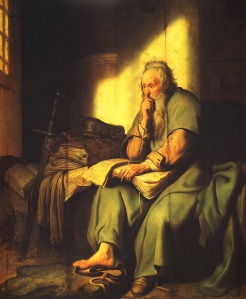 Writing on Gal. 2:19 (“For I through the law died to the law, that I might live to Godâ€), a verse smack dab in a passage where Paul talks a lot about being “in†Christ, Machen writes the following:
The law . . . led men, by its clear revelation of what God requires, to relinquish all claim to salvation by their own obedience. In that sense, surely, Paul could say that it was “through the law†that he died to the law. The law made the commands of God so terribly clear that Paul could see plainly that there was no hope for him if he appealed for his salvation to his own obedience to those commands.
This interpretation yields a truly Pauline thought. But the immediate context suggests another, and an even profounder, meaning for the words. The key to the interpretation is probably to be found in the sentences, “I have been crucified together with Christ,†which almost immediately follows. “The law,†Paul probably means, “caused me to die to the law, because the law, with its penalty of death upon sins (which penalty Christ bore in our stead) brought Christ to the cross; and when Christ died I died, since he died as my representative.†In other words, the death to the law of which Paul here speaks is the death which the law itself brought about when it said, “the soul that sinneth it shall die.†Christ died that death, which the law fixes as the penalty of sin, when He died upon the cross; and since He died that death as our representative, we too have died that death; the penalty of the law is for us done away because theat penalty has been paid in our stead by the Lord Jesus Christ. Thus our death to the law, suffered for us by Christ, far from being contrary to the law, was in fulfilment of the law’s own demands. We are free from the penalty of death pronounced by the law upon sin not because we are rebels against the law, but because the penalty has been paid by Christ. (Machen’s Notes on Galatians, p. 159)
It is striking that Machen, a none too shabby Pauline scholar, preferred to use the language of representation or substitution rather than union with Christ. And instead of seeing union as the sub-text, Machen interprets this passage in what appears to be straightforwardly forensic categories.
Forensic Friday: Vos Weighs In

To [Paul’s] view the resurrection with all that clusters around it, has behind it a still more potential principle, a principle from which in fact it springs, and in whose depths it lies anchored. And this deeper principle is that of the acquisition of righteousness, a forensic principle through and through, and yet no less than the resurrection a transforming principle also. It is especially by considering the nexus between Christ and the believer that this can be most clearly perceived: in the justification of Christ lies the certainty and the root of the Christian’s resurrection. For the supreme fruit of Christ’s justification, on the basis of passive and active obedience, is nothing else but the Spirit, and in turn the Spirit bears in Himself the efficacious principle of all transformation to come, the resurrection with its entire compass included. (The Pauline Eschatology, p. 151)
In our opinion Paul consciously and consistently subordinated the mystical aspect of the relation to Christ to the forensic one. Paul’s mind was to such an extent forensically oriented that he regarded the entire complex of subjective spiritual changes that take place in the believer and subjective spiritual blessings enjoyed by the believer as the direct outcome of the forensic work of Christ applied in justification. The mystical is based on the forensic, not the forensic on the mystical. (“‘Legalism’ in Paul’s Doctrine of Justification,†in Redemptive History and Biblical Interpretation, ed. Richard B. Gaffin, Jr., p. 384)
Why Proponents of Christian America Need to Read John Frame
 As part of his commitment to speaking the truth at length in love, John Frame has written a review of Scott Clark’s, Recovering the Reformed Confession for his website. (How long, O Lord, how long? Over 17,500 words not including 60 [!!] notes. Let me help with the math. At 250 words per page, that’s 70 [a lot of] pages.)
The review reveals a very interesting difference between Clark and Frame on the Reformed tradition. For Clark, the Reformed faith has an objective standard, found in the churches’ creeds and confessions. He concedes diversity as the churches emerged in such diverse settings as Scotland and Transylvania. But Clark (like me) finds these confessions the best way to understand what Reformed Protestantism stood for, while also providing a good deal of uniformity on what it means to be Reformed.
Frame, however, thinks this is a narrow way of understanding the Reformed tradition and suggests an alternative: “I think it better to regard anyone as Reformed who is a member in good standing of a Reformed church. I realize there is some ambiguity here, for we must then ask, what is a really Reformed church? Different people will give different answers. But, as I said above, I don’t think that the definition has to be, or can be, absolutely precise. The concept, frankly, has ‘fuzzy boundaries,’ as some linguists and philosophers say.â€
What would such different approaches to defining Reformed Protestantism mean for understanding the meaning and identity of the United States? This is no idle question since Frame draws on this analogy to identify his differences with Clark. For Frame, Clark is one of those originalists who puts much stock in the founders and the Constitution. But for Frame, the United States cannot be held to such a definite and time-bound standard. He writes:
Imagine someone saying, “if you want to know what ‘American’ means, look at the founding documents of the United States: the Declaration of Independence, the Constitution, and the writings of the founders like The Federalist Papers.†There is a certain amount of truth in that. Certainly these documents tell us much of what makes the United States different from other nations. But these documents presuppose an already existing community of ideas. For example, although they mention religion rarely, they cannot be rightly understood apart from the history of New England Puritanism, Dutch Reformed Christianity in New York, Quakerism in Pennsylvania, Anglicanism in Virginia, and so on.
And the history of America subsequent to these documents is also important. Many claim that these documents are largely neglected and/or contradicted today. There is a large disconnect between what America was at its founding and what it is today. Defining America by the founding documents, and defining it as an empirical community, lead to two different and inconsistent conceptions. People who define America only by its founding documents are likely to say that subsequent developments are “unamerican.†But so say that is merely to express a preference. That preference may be a good one. But merely to express it is not likely to persuade anyone to share that preference. This case is similar to the attempt to define “Reformed.â€
On the view I advocate, it is not possible to state in precise detail what constitutes Reformed theology and church life. But one can describe historical backgrounds and linkages, as I have done above in the example of the United States. And there are some general common characteristics, a kind of “family resemblance,†among the various bodies of the last five centuries that have called themselves Reformed. The idea that “Reformed†should be defined as a changing community is not congenial to Clark’s view. But it seems to me to be more accurate and more helpful.
A number of arresting implications follow from Frame’s analogy between the Reformed and American traditions.
One that stands out is who qualifies as a good American. If someone is Reformed because they belong to a Reformed church, then someone is a good American if they belong to the United States. That means that the liberals writing for the New York Times and the atheists writing books against Christianity are as much Americans as the U.S. faithful attending church each Sunday. In other words, the United States is what it is; it has no objective norms for determining what the nation means or who belongs to it. No matter your beliefs, you belong to the United States if you are American.
Another implication that stands out like low-hanging fruit is what Frame appears to be saying to those who spend much time appealing to the nation’s Christian founding for understanding what the nation should be today. As Frame writes above, “People who define America only by its founding documents are likely to say that subsequent developments are ‘unamerican.’ But to say that is merely to express a preference.†Likewise, to say that America was founded as a Christian nation and that the United States needs to return to its Christian heritage is, according to Frame’s argument, not objective reality but a “preference†with as much force as an opinion from Scott Clark.
I myself tend to be an originalist all the way down. I regard the Constitution to be important for understanding the United States then and now, the Reformed creeds important for understanding Reformed history then and now, and even the Bible important for understanding God’s plan of salvation then and now. Maybe this is the hobgobblin of a small mind, though I think it also has something to do with the way we read law, whether for the state or the church.
Still, Frame’s argument would appear to cut off at the knees those folks who think the American nation’s Christian origins are relevant for today. The message seems to be, “just say goodbye to ‘in God we trust.’â€
Postscript: for some reason the Bayly Brothers seemed to miss this feature of Frame’s review when they recommended it.
The Return of This and That
 Hide it under a bushel? No! But under camouflage? Yes. At least that the implied message of the new “Camo†edition of the American Patriot’s Bible. (Thanks to our mid-West correspondent.)
This pocket version of the popular American Patriot’s Bible reminds Christians of the Bible’s living legacy in the history of America, a nation built on the biblical values of God and family.
If it is fair to describe The Law is Not of Faith book as embodying the Escondido Hermeneutic, would it also be fair to describe the Kerux Apologetic as evidientialist?
And if union was as important to Calvin as many allege, why does he bury his catechetical instruction on the topic in the section on the Lord’s Supper? (Do a word search of the 1545 Catechism – who wants to read all 340-plus questions? – and check it out.)
(BTW, if we’re going to follow Calvin on union, why aren’t we also following him on eating the body and drinking the blood of Christ? If you’re going to take Calvin literally on union, don’t you also have to take him literally on Christ’s real presence in the Supper?)
Master. – Do we therefore eat the body and blood of the Lord?
Scholar. – I understand so. For as our whole reliance for salvation depends on him, in order that the obedience which he yielded to the Father may be imputed to us just as if it were ours, it is necessary that he be possessed by us; for the only way in which he communicates his blessings to us is by making himself ours.
Master. – But did he not give himself when he exposed himself to death, that he might redeem us from the sentence of death, and reconcile us to God?
Scholar. – That is indeed true; but it is not enough for us unless we now receive him, that thus the efficacy and fruit of his death may reach us.
Master. – Does not the manner of receiving consist in faith?
Scholar. – I admit it does. But I at the same time add, that this is done when we not only believe that he died in order to free us from death, and was raised up that he might purchase life for us, but recognise that he dwells in us, and that we are united to him by a union the same in kind as that which unites the members to the head, that by virtue of this union we may become partakers of all his blessings.
Master. – Do we obtain this communion by the Supper alone?
Scholar. – No, indeed. For by the gospel also, as Paul declares, Christ is communicated to us. And Paul justly declares this, seeing we are there told that we are flesh of his flesh and bones of his bones-that he is the living bread which came down from heaven to nourish our souls-that we are one with him as he is one with the Father, &c. (1 Cor. i. 6; Eph. v. 30; John vi. 51; John xvii. 21.)
Master. – What more do we obtain from the sacrament, or what other benefit does it confer upon us?
Scholar. – The communion of which I spoke is thereby confirmed and increased; for although Christ is exhibited to us both in baptism and in the gospel, we do not however receive him entire, but in part only.
Master. – What then have we in the symbol of bread?
Scholar. – As the body of Christ was once sacrificed for us to reconcile us to God, so now also is it given to us, that we may certainly know that reconciliation belongs to us.
Master. – What in the symbol of wine?
Scholar. – That as Christ once shed his blood for the satisfaction of our sins, and as the price of our redemption, so he now also gives it to us to drink, that we may feel the benefit which should thence accrue to us.
Master. – According to these two answers, the holy Supper of the Lord refers us to his death, that we may communicate in its virtue?
Scholar. – Wholly so; for then the one perpetual sacrifice, sufficient for our salvation, was performed. Hence nothing more remains for us but to enjoy it.
Epistemology and a Two-Kingdoms View
Darryl G. Hart and Camden Bucey discuss the relationship of various Christian epistemologies to a two-kingdoms approach to Christ and culture. Â The discussion has been posted at Reformed Forum.
post photo by Joel Bedford
The Noetic Effects of Regeneration and Christian America
 Below are two clips with distinct views of religion in the American founding. One comes from a decidely Christian perspective, the other from a leading historian of the United States in the era of the Constitution — some might call it secular (I prefer learned).
How Religious Were the American Founders?
The issue worth raising here is not whether the U.S. is a Christian country. It is instead what role regeneration plays in the interpretation of history, specifically the history of American independence and nation building. Do Christians, by virtue of regeneration, have more insight into history, can they interpret documents and events better, than non-Christians? Or could it be that faith actually makes one predisposed to overlook contrary evidence?
My own view is that the clip by Gordon Wood is far more accurate in weighing all the evidence about the founders than the views of David Barton. What is particularly interesting is that Wood is very kind to Baptists and Methodists, and acknowledges the importance of revivalism and evangelicalism to the new nation. He is not hostile to religion.
But for many Christian culture warriors, such concessions are not good enough, and supposedly Wood has an axe to grind because he won’t go all the way and recognize the orthodoxy of such founders as George Washington.
Meanwhile, some may want to chalk up Wood’s ability as a historian to common grace. I myself prefer to attribute it to his own vast knowledge of the American founding and the amount of time he has spent reading the sources and subjecting his arguments to peers in the field. In other words, I think Wood is smart.
Did he get those smarts from God? I believe he did. But he also used them well. I am not sure that Christian apologists for a Christian nation use either their smarts or their illumination as well.
Sixteen Reasons Not To Watch the Super Bowl

16. Remember the Sabbath day.
15. Keep it holy.
14. You have six days for all your work.
13. The Sabbath belongs to God.
12. Don’t work on it.
11. Don’t let your son work on it.
10. Or your daughter.
9. Or football players.
8. Or cheerleaders.
7. Or advertizing executives.
6. Or broadcasters.
5. For God made the world in six days.
4. Then he rested on the Sabbath.
3. For that reason he blessed the Sabbath.
2. And made it a holy day.
And the number one reason not to watch the Super Bowl. . . .
1. The Eagles aren’t playing.

