Can Fairy Tales Do More than the Holy Spirit?

As much as I live and breathe and have my being in conservative circles in the United States, I cannot understand how conservatives who are Christians can write so cheerfully about virtue and what it takes to cultivate it:

Mere instruction in morality is not sufficient to nurture the virtues. It might even backfire, especially when the presentation is heavily exhortative and the pupil’s will is coerced. Instead, a compelling vision of the goodness of goodness itself needs to be presented in a way that is attractive and stirs the imagination. A good moral education addresses both the cognitive and affective dimensions of human nature. Stories are an irreplaceable medium of this kind of moral education. This is the education of character.

The Greek word for character literally means an impression. Moral character is an impression stamped upon the self. Character is defined by its orientation, consistency, and constancy. Today we often equate freedom with morality and goodness. But this is naïve because freedom is transcendent and the precondition of choice itself. Depending upon his character, an individual will be drawn toward either goodness or wickedness. Moral and immoral behavior is freedom enacted either for good or for ill.

The great fairy tales and children’s fantasy stories attractively depict character and virtue. In these stories, the virtues glimmer as if in a looking glass, and wickedness and deception are unmasked of their pretensions to goodness and truth. These stories make us face the unvarnished truth about ourselves while compelling us to consider what kind of people we want to be.

Calvinists have a problem with this, obviously, since they put the T in Total Depravity. But shouldn’t any Christian who considers himself Augustinian or any theist who believes in the fall (recorded in the not so fair tale of Genesis)? Can’t we at least, if you’re not going to talk about effectual calling, reserve some space for baptism and the sacraments more generally?

Or, are we supposed to conclude that a kid reared on Beauty and the Beast has as much a shot at virtue as the one who’s baptized? If that’s the case, then why is cult so much the bedrock of culture?

Why Didn’t Douthat Recommend Keller?

When Ross encouraged liberals to go to church on Easter, he even mentioned Marilynne Robinson:

Liberals, give mainline Protestantism another chance.

Do it for your political philosophy: More religion would make liberalism more intellectually coherent (the “created” in “created equal” is there for a reason), more politically effective, more rooted in its own history, less of a congerie of suspicious “allies” and more of an actual fraternity.

Do it for your friends and neighbors, town and cities: Thriving congregations have spillover effects that even anti-Trump marches can’t match.

Do it for your family: Church is good for health and happiness, it’s a better place to meet a mate than Tinder, and even its most modernized form is still an ark of memory, a link between the living and the dead.

I understand that there’s the minor problem of actual belief. But honestly, dear liberals, many of you do believe in the kind of open Gospel that a lot of mainline churches preach.

If pressed, most of you aren’t hard-core atheists: You pursue religious experiences, you have affinities for Unitarianism or Quakerism, you can even appreciate Christian orthodoxy when it’s woven into Marilynne Robinson novels or the “Letter From Birmingham Jail.”

Did Princeton Seminary spook Douthat? Shouldn’t Jonathan Merritt be outraged that Douthat snubbed Keller?

What about John 18:11 Did They Not Understand?

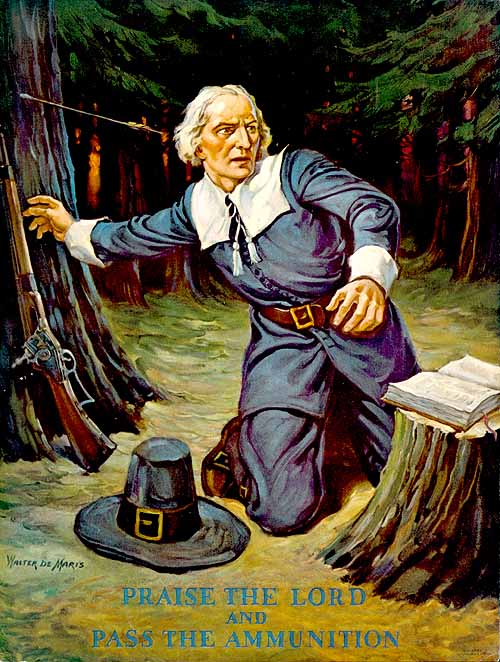
Civil religion comes in many forms, but this one (heard yesterday morning during Big Band Sunday) was stunning:

Down went the gunner, a bullet was his fate
Down went the gunner, and then the gunner’s mate
Up jumped the sky pilot, gave the boys a look
And manned the gun himself as he laid aside The Book, shouting

Praise the Lord and pass the ammunition
And we’ll all stay free

Praise the Lord and swing into position
Can’t afford to be a politician
Praise the Lord, we’re all between perdition
And the deep blue sea

Yes the sky pilot said it
Ya gotta give him credit
For a son of a gun of a gunner was he shouting

Praise the Lord, we’re on a mighty mission
All aboard, we ain’t a-goin’ fishin’
Praise the Lord and pass the ammunition
And we’ll all stay free

Praise the Lord (Praise the Lord) and pass the ammunition
And we’ll all stay free

Praise the Lord and pass the ammunition
And we’ll all stay free

The problem isn’t passing the ammunition. If you want to shoot to defend your country, that’s a responsible end. But why would your baptize retaliating against Japan’s attack at Pearl Harbor with an Hallelujah?

Christ’s kingdom in the New Testament (as opposed to the Israelites conquest of Canaan) doesn’t come by the physical sword (unless you want to get really technical about the Bible):

2 Now Judas, who betrayed him, also knew the place, for Jesus often met there with his disciples. 3 So Judas, having procured a band of soldiers and some officers from the chief priests and the Pharisees, went there with lanterns and torches and weapons. 4 Then Jesus, knowing all that would happen to him, came forward and said to them, “Whom do you seek?” 5 They answered him, “Jesus of Nazareth.” Jesus said to them, “I am he.”a Judas, who betrayed him, was standing with them. 6 When Jesus said to them, “I am he,” they drew back and fell to the ground. 7 So he asked them again, “Whom do you seek?” And they said, “Jesus of Nazareth.” 8 Jesus answered, “I told you that I am he. So, if you seek me, let these men go.” 9 This was to fulfill the word that he had spoken: “Of those whom you gave me I have lost not one.” 10 Then Simon Peter, having a sword, drew it and struck the high priest’s servant and cut off his right ear. (The servant’s name was Malchus.) 11 So Jesus said to Peter, “Put your sword into its sheath; shall I not drink the cup that the Father has given me?” (John 18)

I wonder if the Reformed and Presbyterian chaplains would object to the song.

Why Protestantism Matters

Things you may hear in Rome during holy week:

“It is more important that men and women become holy,” Cantalamessa said, “than that they know the name of the one Savior.”

“Without the Madonna, we can’t go forward in our priesthood!” Francis said.

“Each one of us has entered into our own personal tomb,” Francis said, in the one extemporaneous addition to his homily. “I’m inviting you to come out.”

“God loves like this: Until the end, giving his life for each one of us,” Francis said in his homily. “It’s not easy, because all of us are sinners, we have limits, flaws. Yes, we all know how to love, but not like God loves, without looking at the consequences, until the end.”

Could this kind of teaching be the reason the Roman church is facing a shortage of priests?

Father Douglas Grandon is one of those rare exceptions – a married Roman Catholic priest. He was a married Episcopalian priest when he and his family decided to enter the Catholic Church 14 years ago, and received permission from Benedict XVI to become a Catholic priest.

Even though Grandon recognizes the priest shortage, he said opening the doors to the married priesthood would not solve the root issue of that shortage.

“In my opinion, the key to solving the priest shortage is more commitment to what George Weigel calls evangelical Catholicism,” Grandon told CNA.

“Whether you’re Protestant or Catholic, vocations come from a very strong commitment to the basic commands of Jesus to preach the Gospel and make disciples. Wherever there’s this strong evangelical commitment, wherever priests are committed to deepening people’s faith and making them serious disciples, you have vocations. That is really the key.”

If it’s broke, why convert?

United Statesist Christianity

We need a new name for Christianity in the United States. The contributors to this podcast at Christianity Today are still lamenting the turnout of white evangelicals for Donald Trump and so one of them called for more attention to what it means to be evangelical. Are you kidding? We’ve had almost four decades of scholarship on evangelicalism, and at least three of chanting the integration of faith and learning, and we still don’t know what evangelical is? Please.

Then comes the objection to calling Lee Stroebel, whose new film is drawing attention to the Bill Hybels-spawned apologist, a fundamentalist.

A note or two about Strobel, the legal-affairs journalist. He did his undergraduate degree at a top j-school, the University of Missouri, and then went to Yale University to get his law degree. That gives some clues as to his approach to research and writing.

Strobel converted to Christianity in 1981 and, after a few years, went into ministry – becoming a “teaching pastor” at the world famous Willow Creek Community Church in the Chicago suburbs.

Now, WIllow Creek – led by the Rev. Bill Hybels – has for decades been known as, literally, a globel hub for the “seeker friendly” school of mainstream (some would say somewhat “progressive”) evangelicalism. Hybels, of course, became a major news-media figure in the 1990s through his writings and his role as one of the “spiritual advisors” and private pastors to President Bill Clinton.

Willow Creek is not a fundamentalist church.

From there, Strobel went west and for several years served as a writer in residence and teaching pastor at Saddleback Community Church, founded and led by the Rev. Rick “The Purpose Driven Life” Warren. In addition to writing one of the bestselling books in the history of Planet Earth, Warren has also received quite a bit of news-media attention through his high-profile dialogues with President Barack Obama, both during Obama’s first White House campaign and in the years afterwards.

Saddleback is not a fundamentalist church.

Fair points. I don’t think Stroebel is a fundamentalist either. But evangelical is increasingly meaningless even among Protestants who haven’t read (hades!, heard of) Deconstructing Evangelicalism.

So why not simply identify Christianity in the United States according to the degree to which its adherents adapt their faith (or pick and choose) to national norms? (Do remember that in 1899 Leo XIII identified Americanism as a heresy.) Once upon a time, Protestants came to North American and tried to transmit the version of Protestantism (works for Roman Catholics and Jews also) they brought to a New World setting. Some confessional Protestants still do this and triangulate their ministry in the U.S. according to precedents set in Europe whether at the time of the Reformation or when specific episodes upset national churches (think Scotland, England, Netherlands, Germany). Presbyterians in NAPARC still live with a foot (or – ahem – toe nail) in Old World Protestantism even as they have repudiated (except for the Covenanters) the political structures that animated their European predecessors.

But then along came awakenings and parachurch associations and increasingly Protestantism in the U.S. was known less for the fingerprints of its European origins than for those innovators (Whitefield and Moody) or structures (American Bible Society or National Association of Evangelicals) who were as independent of Old World Protestantism as their nation was of the United Kingdom. Once freed from European constraints, American Christianity used markets, earnestness, activism, and relevance as the basis for Christian identity. Evangelicalism was the kinder gentler version of fundamentalism. But neither showed the slightest bit of deference to the churches that came out of the Reformation.

Now, even the labels fundamentalist and evangelical make little difference. The gatekeepers won’t stand at the gate and even if they did the gateway has no wall to make the gate functional. Anyone can be a Christian on their own terms, with celebrities and parachurch agencies gaining the most imitators. But those instances of fame collect no dues, make no demands, and provide no institutional support. It’s like belonging to Red Sox Nation. Wear your bumper sticker. Listen to your Tim Keller sermon (now on sale for $1,500). Got to the next Gospel Coalition conference. You have Jesus in your heart and United Statesist Christianity has lots of proprietors to make your heart burn.

The good thing about United Statesist Christianity is that it allows its adherents to revel in exceptionalism. If America is a great nation, United Statesist Christianity is no less exceptional. Instead of a Pretty Good Awakening, United Statesist Christianity puts the Great back in Great Awakening.

If Princeton Refuses to Award a PCA Pastor, Why is Redeemer NYC Awarding a Liberal Congregationalist?

Word on the street has it that Redeemer Presbyterian Church has given Marilynne Robinson its first Commission of Faith and Work. Doesn’t Robinson know that Tim Keller is kind of toxic? Has she no sense of solidarity with her mainline Protestant women and LBGT+ ministers and church members? (Or, didn’t Princeton’s president know that Keller was about to approve an award to Robinson?)

Better question: why is a church whose officers subscribe the Confession of Faith and Catechisms recognizing a woman who sometimes preaches and whose theological reflections, while thoughtful, hardly line up with the PCA’s confessional teaching?

Here’s the explanation:

The commission aims to address the tide of uncertainty that the humanities now face with distinctly Christian support. Historically, in times of uncertainty and transition, the humanities have provided reminders of hope and grace to combat our fear and doubt. They center us in the miracle of the Imago Dei, sounding the peal of God’s presence in our lives. As Robinson so wisely states in one of her many erudite essays: “I experience religious dread whenever I find myself thinking that I know the limits of God’s grace, since I am utterly certain it exceeds any imagination a human being might have of it. God does, after all, so love the world.”

The logic is that the humanities are on the ropes. The humanities need support from Christians. The humanities need such support because they testify to God’s “presence in our lives.”

Imagine the testimony to God’s presence if a pastor proclaimed that Jesus Christ died for sinners. Why clutter the gospel with the valuable though limited insights of the humanities?

Humanities are valuable. So are the social and natural sciences. But the humanities are not divinity — duh. The church doesn’t gain status by hanging out with celebrity writers. It reduces God’s saving power to human aspirations.

Which novelist can say she does this?

Remember this, at least — the things in which the world is now interested are the things that are seen; but the things that are seen are temporal, and the things that are not seen are eternal. You, as ministers of Christ, are called to deal with the unseen things. You are stewards of the mysteries of God. You alone can lead men, by the proclamation of God’s word, out of the crash and jazz and noise and rattle and smoke of this weary age into the green pastures and beside the still waters; you alone, as minsters of reconciliation, can give what the world with all its boasting and pride can never give — the infinite sweetness of the communion of the redeemed soul with the living God. (Selected Shorter Writings, 205)

Postscript: Do humanists of this sort need the support of a confessional Presbyterian church?

Do you believe in sin?

Well, it depends how you define the word. The way I would read Genesis is a phenomenon . . . what it describes is a human predisposition to what amounts to self-defeat — to be given a wonderful planet and find yourself destroying it. Or, to have a wonderful civilization and then engage yourself aggressively in ways that destroy your civilization and another besides. If you look at human history or practically any human biography, it’s very hard to say that people don’t incline toward harmful and self-destructive acts, whether they intend to or not.

You are talking about sin on a large scale as you talk about it now. What about cheating on your wife?

Definite sin. A big 10. I think that in a certain way I was perhaps taught that the Ten Commandments are like a lot of the law of Moses in the sense that they name as transgressions things that you might not derive by reason as being transgressive — things like keeping the Sabbath or not making idols. These are markers in reality that are divine in their origins in the sense that human beings might not necessarily have come up with them.

Aside from that, one of the things that is true of the Bible certainly — in the case like David, for example — is that people do things that are utterly prohibitive to them, evil even. And I am speaking here of David arranging the death of Uriah so he could marry Bathsheba. And yet, there is always a huge variable at play — how does God respond to this and the difference of what we could measure as projected transgressions, the difference between that and the same thing as seen through the eyes of love or grace. These are very different things.

So I believe in sin in the sense that people do harm. I believe in grace in the sense that we cannot make final judgments about the meaning or the effect of what we do.

Christendom Exceptionalism

Not sure what Peter Leithart is working on, but recent posts on medieval and early modern Europe have shed new light on the claims that exalt Christendom and blame Protestantism for ushering in a disordered, licentious modernity.

Just how united was Christendom, you ask? Not much:

In a 1971 essay, H.G. Koenigsberger challenged the notion that the Reformation broke up a unified Europe. He criticizes historians and social scientists for assuming a norm of unity: “We have assumed that the theological and ecclesiastical unity of Catholic Christendom was its natural condition and that, in consequence, the Reformation was a dramatic break in this condition which ran counter to all previous Christian experience and which, in a sense, destroyed the natural order of things.”

Much of the essay presents an analysis of the kind of unity that existed in pre-Reformation Europe. Koenigsberger poses the question this way: “For the thousand years of the Middle Ages, Christendom and its institutions remained obstinately divided, and Christians remained distressingly prone to engage in deadly wars with each other. Why was it that only the Church survived as a unified institution?”

His first answer is sardonic: “it did not do so. Throughout the Middle Ages there existed Christian churches in Africa and Asia which were never in communion with Rome at all.”

The more elaborate answer answer is that “medieval unity, insofar as it existed, was a function of an economically poor society. The small surpluses of production of any given area would not be wanted in the adjoining area, which was probably producing the same commodities, but rather in much more distant areas. Medieval trade was, therefore, small in volume but covered large distances.”

Craft skills were specialized and scarce, and thus craftsmen had to be mobile: “Bell founding was a highly skilled and specialized craft. After a master founder had cast the three or four, or even six or eight, bells for the church of a small town, he would have to move on, for there would be no further work for him in this town nor, very likely, in the neighbouring towns. It was the same with all other skills, from the cathedral builder to the learned scholar, from the forger of fine weapons . . . . Different areas of Europe might advance in certain skills, as Flanders did in the weaving of fine cloth; but no single area of Europe could support all of the skills which European society required. Only the whole of Europe could do this.”

Cultural unity thus depended on a “thin crust of men highly skilled in the production of sophisticated commodities or in the performance of complex services. This upper crust was international in education, attitudes, and often, physical mobility; for this was the only way it could function.” Cultural unity depended on a low rate of entry into this upper crust. European unity was a unity of the “1%.”

Sounds like modern America. Substitute media elites, policy wonks, federal government workers, Ivy League professors, and Hollywood types for “thin crust of men highly skilled in the production of sophisticated commodities or in the performance of complex services” and you an American exceptionalist unity that rivals Christendom’s.

That means, the Reformation was not a break with the past but a fulfillment of medieval Europe:

Signs of centrifugal forces are evident throughout the centuries leading up to the Reformation – reforming movements within the church, sometimes breaking free into independent movements; rival papacies, with kings taking sides, anticipating the anti-papalism of their sixteenth-century Protestant counterparts. The conciliar movement tried to arrest this process but “the defeat of this movement, and the subsequent concentration of papal energies on Italian power politics made it virtually impossible for the Church to adapt itself to the changing conditions of European Society.”

Koenigsberger acknowledges that the Reformation broke the camel’s back, but sees it as the culmination of several centuries of mounting instability. He identifies two factors that made the sixteenth century decisive in this process: “the increasing political tension between the monarchies and the papacy over the question of the control of the institution of the Church and its personnel in the different countries of Europe; and the spread of the printing presses, which made the Bible available to the Christian laity and thus undermined the claim of the Church to act as the indispensable intermediary between God and man.”

Now if we reboot those arguments about the Reformation as the forerunner of 1776, we have lines of continuity between Roman Catholicism and Americanism.

The Whig historians will set us free!

Obedience Boys, Say Hello to Law Enforcement Boys

Courtesy of John Fea:

The Alabama Senate has voted to allow a church to form its own police force.

Lawmakers on Tuesday voted 24-4 to allow Briarwood Presbyterian Church in Birmingham to establish a law enforcement department.

The church says it needs its own police officers to keep its school as well as its more than 4,000 person congregation safe.

Critics of the bill argue that a police department that reports to church officials could be used to cover up crimes.

The state has given a few private universities the authority to have a police force, but never a church or non-school entity.

Police experts have said such a police department would be unprecedented in the U.S.

A similar bill is also scheduled to be debated in the House on Tuesday.

The big question: if women may not serve in combat, how about law enforcement?

Presbyterian Polity 201

Presbyterian polity 101 is rule by elders.

201 is living in submission to the rule of elders within a communion’s assemblies unless a member or officer appeals the rules.

So imagine if Tim Keller were as particular about the rules of the PCA and NAPARC as Craig Barnes, president of Princeton Seminary, is about the PCUSA:

On the question of who can receive the award: anybody can. Again, this is a family argument within the Reformed communions between the PCUSA and the PCA. And as a Presbyterian seminary, it’s in our bylaws, we have to uphold the polity and the procedures of the Presbyterian Church (U.S.A.). So once the award became a matter of affirming a man who doesn’t believe women can be ordained, you know, that’s a problem for us. And that’s what the entire controversy became about. Not [about] what I wanted, which was just to have Tim Keller on campus to speak, because we have all kinds of people speaking.

We’ve had other people receive this award in the past who aren’t particularly Reformed, even. If you look at the list of previous recipients, it isn’t that we have criteria like that for the award. It’s just that this particular issue for Presbyterians against other kinds of Presbyterians — the award just became impossible to maintain, because we were, through the award, affirming Keller’s position on women’s ordination.

What do the rules of the PCA polity say about cooperating with Baptists and Pentecostals in the ministry of word and sacrament? Think The Gospel Coalition and City-to-City (partners for C2C churches are Acts 29 and Christian Reformed Church).

Not to be missed is that the Kuyper award has not exactly gone to people who battled modernism the way Kuyper did. Notice too that if you can’t tell the difference between Presbyterians and Methodists, you may have trouble with discerning modernism.

Machen’s Warrior Mother

Another difference between New Calvinists and Reformed Protestants — sentimentality. Tim Challies does his best to present J. Gresham Machen as — we used to call them mama’s boys — the godly Christian son:

Because Gresham was a lifelong bachelor, his mother would remain the closest woman in his life until her death in 1931. This was the most grievous event he had experienced, for no one had held him in greater esteem than his mother. No one had been so unswervingly loyal to him. Perhaps no one had been so impacted by him. She once wrote to him: “I cannot half express to you my pride and profound joy in your work. You have handled in a very able manner the most important problem of the age, and you have given voice to my own sentiments far better than I could myself.” On the day the family laid her to rest, Gresham wrote, “My mother seems—to me at least—to have been the wisest and best human being I ever knew.”

God used Minnie’s powerful intellect and warm kindness to raise up a man who would benefit generations of Christians by his stalwart defense of the faith. And he continues to use such mothers to this day. Mothers, as you struggle to instruct your children in the Word and in sound doctrine, learn from Minnie that your labor is setting a strong foundation for years to come. As you strive to show steadfast love to your faltering children, learn from Minnie that God often uses such compassion to draw his children back to himself. Through your training and your tenderness, you are displaying the love of the Father.

Minnie had been her son’s first teacher and, with her husband, the one who led him to Christ. “Without what I got from you and Mother,” he would tell his father, “I should long since have given up all thoughts of religion or of a moral life. . . . The only thing that enables me to get any benefit out of my opportunities here is the continual presence with me in spirit of you and Mother and the Christian teaching which you have given me.” At his time of deepest need, she had comforted him with love and counseled him with the Word of God. She had remained loyal to him in that crisis and through every other controversy he endured. In his greatest and most enduring work, Christianity and Liberalism, it is fitting that its opening page bears this simple dedication: “To my mother.”

Tender. Warm. Kind. Compassion. Love. Loyalty. Those are all appealing words and they no doubt capture some of the relationship that Machen had with his mother, Mary Gresham.

But that portrait of the close relationship of mother and son (which those skeptical of Machen’s virtues have used to raise questions about his sexuality) doesn’t prepare New Calvinist admirers for the Warrior Children side of Machen. And to keep the spread sheets properly balanced, the New Calvinists (at least) need to remember how John Frame described the less than appealing side of Machen’s controversial proclivities:

The Machen movement was born in the controversy over liberal theology. I have no doubt that Machen and his colleagues were right to reject this theology and to fight it. But it is arguable that once the Machenites found themselves in a “true Presbyterian church” they were unable to moderate their martial impulses. Being in a church without liberals to fight, they turned on one another.

One slogan of the Machen movement was “truth before friendship.” We should laud their intention to act according to principle without compromise. But the biblical balance is “speaking the truth in love” (Eph. 4:15). We must not speak the truth without thinking of the effect of our formulations on our fellow Christians, even our opponents. That balance was not characteristic of the Machen movement.

Fighting for the sake of contention is one thing. Fighting for a Reformed church according to the word is another. Many of Machen’s warrior children think they fight for the sake of God’s word. New Calvinists tend to be skeptical, as Frame is, about the extent of battle fronts. They even call Old Calvinists mean and ornery.

As long as New Calvinists also know that Machen had critics who called him mean and ornery, they might avoid sentimentalizing Machen. If they want to sanitize him, they need to explain how Minnie Machen ever let her son become such a controversialist.