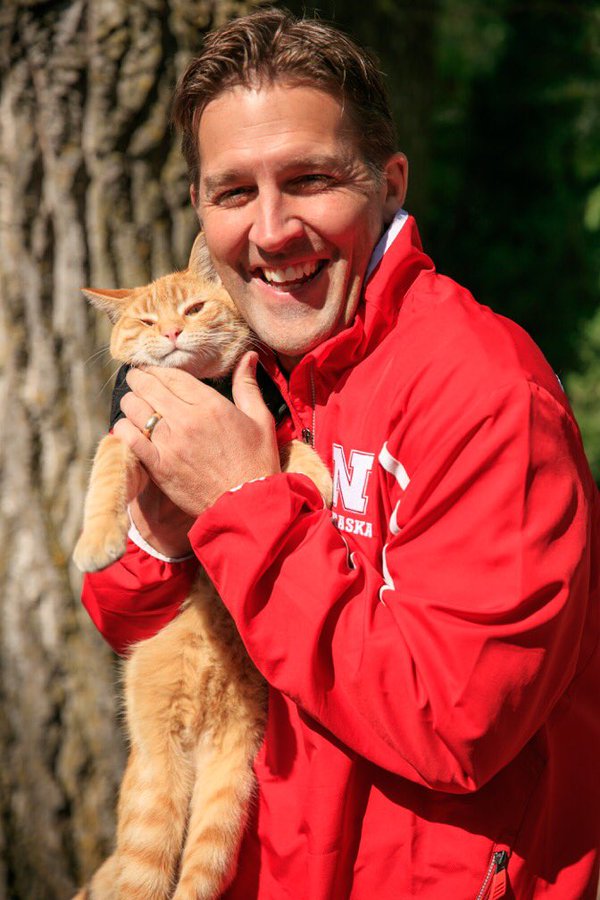
If You Don’t Like Cats, You Have a Problem with the Lord

Keep in mind:

He set the earth on its foundations,
so that it should never be moved.
You covered it with the deep as with a garment;
the waters stood above the mountains.
At your rebuke they fled;
at the sound of your thunder they took to flight.
The mountains rose, the valleys sank down
to the place that you appointed for them.
You set a boundary that they may not pass,
so that they might not again cover the earth.

You make springs gush forth in the valleys;
they flow between the hills;
they give drink to every beast of the field;
the wild donkeys quench their thirst.
Beside them the birds of the heavens dwell;
they sing among the branches.
From your lofty abode you water the mountains;
the earth is satisfied with the fruit of your work.

You cause the grass to grow for the livestock
and plants for man to cultivate,
that he may bring forth food from the earth
and wine to gladden the heart of man,
oil to make his face shine
and bread to strengthen man’s heart.

The trees of the LORD are watered abundantly,
the cedars of Lebanon that he planted.
In them the birds build their nests;
the stork has her home in the fir trees.
The high mountains are for the wild goats;
the rocks are a refuge for the rock badgers.

He made the moon to mark the seasons;
the sun knows its time for setting.
You make darkness, and it is night,
when all the beasts of the forest creep about.
The young lions roar for their prey,
seeking their food from God.
When the sun rises, they steal away
and lie down in their dens.
Man goes out to his work
and to his labor until the evening.

O LORD, how manifold are your works!
In wisdom have you made them all;
the earth is full of your creatures. (Psalm 104:5-24 ESV)

This is not a cats versus dogs thing. Like Chortles says of himself, God loves all his critters, every square inch (and all) of fur.

Lordship of Christ Over Every Spiritual Inch

Joseph Moore has a new book out on the Covenanters that argues in part that these radical Scottish Presbyterians make the proponents of Christian America look like posers. Covenanters, for instance, refused to take oaths that included an acceptance of the Constitution because the United States’ legal provisions failed to acknowledge the Lordship of Christ:

Many hard-liners, imitating their Anti-Burgher ancestors, refused to swear an oath implying support of an ungodly government. . . . Founding the nation on the authority of “We the People” represented, the RP’s maintained, a flaw in Revolutionary logic: it removed Christ from his rightful place about the state. The US Constitution was a “manifest dethroning of the Lord and his Anointed from the government. As mediator between God and all humankind, Jesus gave legitimacy to civil governments. Governments, in turn, acted to bring people to knowledge of God’s Goodness and law. Law, then, should be based on God’s word even when that law seemed to harsh for liberal American sentiments. (Founding Sins, 62-63)

For a 2k Protestant, US government poses no such difficulty. Christ is king as both mediator and creator. His creational rule over secular government doesn’t now require the ruler to acknowledge Christ’s rule as mediator. But for comprehensive Christians, making the distinction between redemption and providence is a high wire act forbidden to anyone who wants a safe earthly existence.

For that reason, the comprehensive Christian, if the Covenanters are right, could never serve as an attorney in the United States. How, for instance, could a Christian take the oath required of attorneys in Michigan?

I will support the Constitution of the United States and the Constitution of the State of Michigan;

I will maintain the respect due to courts of justice and judicial officers;

I will not counsel or maintain any suit or proceeding which shall appear to me to be unjust, nor any defense except such as I believe to be honestly debatable under the law of the land;

I will employ for the purpose of maintaining the causes confided to me such means only as are consistent with truth and honor, and will never seek to mislead the judge or jury by any artifice or false statement of fact or law;

I will maintain the confidence and preserve inviolate the secrets of my client, and will accept no compensation in connection with my client’s business except with my client’s knowledge and approval;

I will abstain from all offensive personality, and advance no fact prejudicial to the honor or reputation of a party or witness, unless required by the justice of the cause with which I am charged;

I will never reject, from any consideration personal to myself, the cause of the defenseless or oppressed, or delay any cause for lucre or malice;

I will in all other respects conduct myself personally and professionally in conformity with the high standards of conduct imposed upon members of the bar as conditions for the privilege to practice law in this State.

No mention of God, no Lordship of Christ.

This means that Moore’s point about David Barton may be as relevant for those critics of 2k who jeer from the cheap seats of neo-Calvinism.

America’s original religious Right, the Covenanters’ . . . centuries-long struggle contradicts suggests that the Constitution hallowed Christianity or allowed for the church to influence the state. European nations before and after the founding claimed their nationhood in part from their religious identity. America did not. The implication was clear. Its failure to honor God in the Constitution made the United States the first government in Western history to disassociate itself from Christianity. The Covenanters created the most thorough, logical, and sustained critique of the Christian America thesis in history by assaulting the Constitution on its own terms. Taken as a whole, this logic challenges the religious Right from its own right flank.

The expensive seats are those occupied by the Covenanters. Every other Christian nation advocate is faking.

From Crisis to Crisis

If Ross Douthat thinks conservative Roman Catholics are having trouble with the current magisterium, he should remember how liberal Roman Catholics felt a little more than a decade ago in the last years of John Paul II’s papacy:

Thirty years after Vatican II, liberal Catholicism is once again passing through a cycle of official hostility and internal disarray. In a time of crisis-mongering, it is easy to exaggerate the situation. In many sectors of American Catholicism, liberal Catholicism is the dominant outlook—in the academy, in many seminaries and diocesan agencies, among religious educators and liturgists, and, on many questions, in the Catholic population generally. Are these liberal Catholic church workers, people in the trenches, as they like to say of themselves, much affected by some of the tensions and conflicts I am going to describe? Do their moods sink and their energies flag with every week’s alarms sounded in the National Catholic Reporter? Reliable observers tell me no. Mostly they get on about their work and hope for the best.

Nonetheless, liberal Catholics have good reason to feel on the defensive and threatened from both within the church and without. Rome considers us suspect, and has been pursuing a slow but steady policy of discrediting, marginalizing, and replacing us, and now and again, where the cost appears sustainable, rooting us out. The same goal is being similarly pursued by a number of influential, well-funded movements and publications that identify themselves as “orthodox” Catholics, presumably in distinction to the rest of us who are heretics. The most obvious and fundamental working difference between these groups and liberal Catholics turns on the possibility that the pope, despite the guidance of the Holy Spirit, might be subject to tragic error. Liberal Catholics believe that this possibility, which all Catholics recognize as historical fact, did not conveniently disappear at some point in the distant past, like 1950, but was probably the case in the 1968 issuance of Humanae vitae and cannot be ruled out in the refusal of ordination to women.

But if liberal Catholics increasingly feel that they are not wanted in the church, they are hardly more welcome in the ranks of secular liberalism. American political liberalism has shifted its passion from issues of economic deprivation and concentration of power to issues of gender, sexuality, and personal choice. This shift has opened a serious philosophical chasm between liberal Catholicism and a secular liberalism that would demand an illusory stance of state neutrality, maybe even social or cultural neutrality, on all fundamental questions of lifestyle and therefore a relegation of religious claims to private life and, as Stephen Carter has argued, ultimately to trivialization.

Liberal Roman Catholicism, by the way, was not necessarily about liberal theology but about adjusting ecclesiology to the modern world of liberal politics:

Liberal Catholicism began with a concern for freedom, not of the individual, not of the dissenting conscience, not of an aspiring class, but of the Catholic church. Its pioneers were not revolutionaries but restorationists, who dreamed of restoring the church’s cultural power. Initially they rebelled not against the church’s use of the throne but against the throne’s intervention in the affairs of the church. Then they rebelled against the alliance of throne and altar because they saw the possibility of reconquering society for Catholic Christianity doomed as long as the church remained chained to bankrupt regimes. Only at the end of this process did they conclude that the freedom necessary for the church to prevail implied the general freedom of all.

What I wonder is why a bright guy like Peter Steinfels only sees two options — Roman Catholicism or secular liberalism. Is he so parochial — he worked for the New York Times mind you — to identify Protestantism with secular liberalism? Sure a liberal Roman Catholic has gotten over the idea that liberal Roman Catholicism is the church that Jesus founded.

What Would Trump Be Like as POTUS?

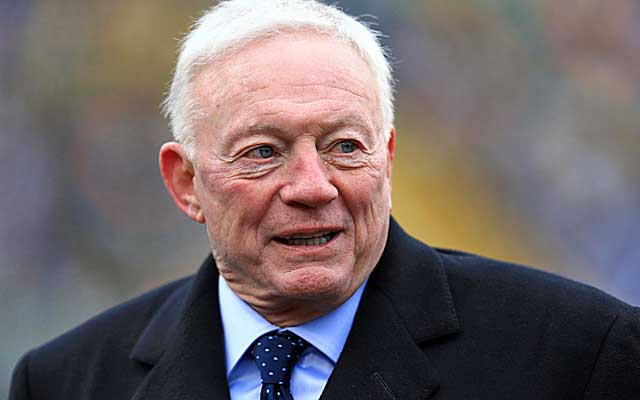
Think Jerry Jones as president of the Dallas Cowboys?

In charge but not and outspoken about it:

In the locker room after Sunday night’s 31-17 win over the Chicago Bears, Cowboys owner and general manager Jerry Jones said Dez Bryant had X-rays on his injured right knee. He said they revealed a sprain and the star receiver would have an MRI Monday.

However, during his Tuesday morning radio interview, Jones said Bryant still had not had an MRI.

“He hasn’t taken an MRI, to my knowledge,” Jones said on 105.3 The Fan’s Shan and RJ show [KRLD-FM]. “I’m assuming that he’s on go [for Sunday]. Will he get an MRI here probably later today? Maybe.

“But he certainly finished the game out. That in and of itself is a good indication. It doesn’t mean he’s going to be free of the symptoms of the injury, but again, we may look at an MRI before this day is over.”

He’s rich, he hangs out with celebrities, and he’s outspoken about it:

Jerry Jones seems to have a story about everyone he’s ever met.

This includes Grammy Award-winning couple Jay Z and Beyonce. The two attended Sunday night’s Cowboys game at AT&T Stadium.

During his Tuesday morning radio interview, Jones said he’s known Beyonce since her former group, Destiny’s Child, performed at halftime of the Cowboys’ 2004 Thanksgiving Day game at Texas Stadium.

“As a matter of fact, they were planning to perform and it was so cold you couldn’t stand it out there on Thanksgiving Day,” Jones recalled on 105.3 The Fan’s Shan and RJ show [KRLD-FM]. “And I got them all coats from Neiman Marcus. And to this day, one of the things that we kind of smile about are those jackets that we got them so that they could go out there and do a good job and give us Thanksgiving Day halftime. Boy, I’m telling you, she’s phenomenal.

What does Jones think about her husband?

“He, as an individual, is one of the neatest people that I’ve met,” Jones said. “Make no mistake about it, he’s the real deal. He’s as easy to be around, talk to, as sharp as anybody I’ve met. I see what she sees in him.”

Don’t forget that Jerry Jones is a patriot and want a great America:

“I got to give a big pat on the back to our entire team, our coaching staff, our entire organization,” Jones told the Cowboys’ flagship station. “We strongly, strongly support the flag in every way we support — and it’s almost ridiculous to be saying it — the people who for generations and generations have given it all up so that we can get out here and show off in front of millions of people on television.

“We respect that so much. That’s the real business. The forum of the NFL and the forum on television is a very significant thing. I’m for it being used in every way we can to support the great, great contributors in our society, and that’s people that have supported America, the flag, and there’s no reason not to go all out right there. And for anybody to use parts of that visibility to do otherwise is really disappointing.”

Is there room in the Constitution for Jerry Jones?

The Unsanctity!

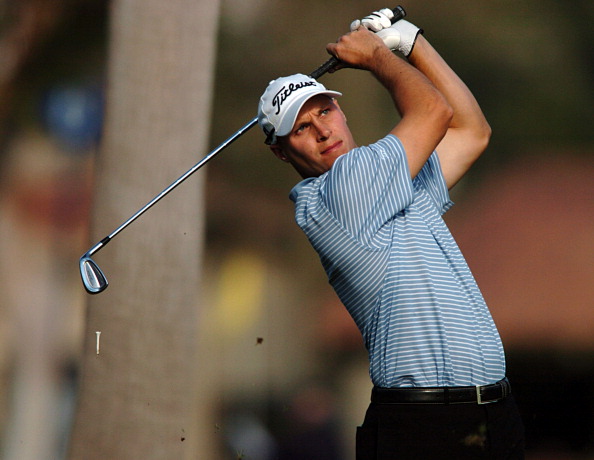
At this point, surprise and indignation are no longer in order since the disregard for the Lord’s Day among New Calvinists is so ho-hum. Yet, sometimes the ordinary is brazen in its ordinariness. Consider this paid advertisement for the Professional Golfers Association at the Allies website:

There’s a tight-knit Christian community on the PGA TOUR, including a Tuesday night fellowship that includes Bible study and worship. Tournaments run Thursday to Sunday, so it’s often hard for players to attend church on Sunday. This is their form of Christian community away from church.

No wrestling with the fourth of the Ten Commandments? Just a shrug? It’s hard. Ever heard of Eric Liddell? Sometimes, Christian athletes really do make sacrifices for their religious obligations.

Apparently, a golfer learns enough about grace on the links so he doesn’t need to comply with the demands of God’s law:

Ben Crane, one of the TOUR’s Christian players, summed this up perfectly a few years ago. He was having a tough year on the course. One of his friends asked how he was doing in the midst of his struggles. He replied:

I think he expected me to say I was really struggling because the golf wasn’t all that good. I just said, “You know, I’m doing great, because the rough season of golf has brought me closer to God. Golf was becoming too important to me. . . . These last few weeks I’ve just said, you know what, golf is not everything.”

Two years ago, Crane was injured and thought he may have to retire from the game, even though he was only 38 and keeps himself in good health. He surprisingly won a tournament a few months later.

“I had to finally become okay with golf not being in the picture,” he said, reflecting on how to find an identity apart from golf. But the gospel got him to the place where he could pray, “Lord, if it’s not golf, I will love you. But if it is, that would be really fun.” Golf was no longer his idol; he could enjoy it for what it is—a gift of grace.

I believe the person who conducted this interview attends a Presbyterian church where the Shorter and Larger Catechisms are supposed to be taught and followed. So is the lesson here that New Calvinists really are a different kind of Protestant?

Church Planters in the City Have it Rough

But is that because the city is so tough or because the folks who go into urban church planting actually believe the hype?

City people are fast paced. They adapt to change without giving too much thought to it and that’s why life becomes chaotic and out of control in the first place. When city people end up pausing to think about their overwhelming state, it’s usually too late. Ministry in the city requires a lot of reflection, prayer and, Scriptural meditation. It’s much easier to be in sync with the pace of the city than the pace of God’s heart for the city. . . .

Cities demand quality, often without compensation. Think of the talented 50 year old sax player in the subway. Get the point? Pastors in cities have to find a healthy way to deal with slow growth and even failure. Unless they do so, they will likely hit the bottle, the spoon, their wives and kids or, the x-rated sites. . . .

The city demands that you give a good reason for what you do and say. At the same time it’s always bargaining with you ideologically. It’s very hard not to compromise biblical doctrine in exchange for the approval of its inhabitants and even harder to find an honest, respectful, clear, and contextual way to communicate truth. . . .

Woody Allen would be embarrassed.

Would urban church planters have an easier time if they simply ministered to people rather than urban people? At a time when race, partisan politics, immigration, and sex balkanize people into their segregated affinity groups, do really need to add cities to the list of characteristics that isolate us from a common humanity (or nationality)? Whatever happened to neither Jew nor Greek, male nor female, slave nor free? But urban or suburban (don’t even think about rural) abideth.

Nothing Could Possibly Go Wrong

Didn’t the Reformation start with objections to the cash nexus between grace and financial contributions? So how much did the Council of Trent reform ecclesiastical abuses in the light of recent announcements about new criteria for becoming a saint?

To approve a miracle, at least 5 out of the 7 members of the body of medical experts within the congregation must approve, or 4 out of 6, depending on the size of the group, as opposed to a simple majority.

In case a miracle report is rejected on the first go-around, it may only be reexamined a total of three times.

In order to reexamine a miracle claim, new members must be named to the consulting body.

The president of the consulting body may only be confirmed to one additional five-year term after the original mandate expires.

While in the past payments to experts could be made in person by cash or check, now the experts must be paid exclusively through a bank transfer.

I don’t know about you, but my impression of the miraculous is that if part of a group of believers thinks an unusual event was not miraculous, then it probably was not. Generally speaking, the works of God are pretty straight forward to those with eyes of faith (questions about ongoing miracles notwithstanding). And do we really need science to tell validate a miracle? Isn’t faith sufficient?

But the kicker is the financial aspect to these policy changes:

In his book “Merchants in the Temple,” Italian journalist Gianluigi Nuzzi charged the congregation was among the most reluctant Vatican offices to cooperate with new transparency measures imposed as part of Francis’s project of Vatican reform, and asserted that the average cost of a sainthood cause was about $550,000.

U.S. Catholic officials traditionally have used $250,000 as a benchmark for the cost of a cause from the initial investigation on a diocesan level, to a canonization Mass in St. Peter’s Square at the Vatican, though that cost can increase depending in part of how many people take part in the canonization ceremony and the logistics of organizing the event.

In March, Pope Francis had already approved a new set of financial procedures for the congregation, outlining procedures for handling contributions and specifying which authorities are charged with overseeing the flow of money.

Also notice that even though the path to sainthood has become more — let’s say — complicated, those already saints stay saints:

The new rules are not retroactive, and hence they do not invalidate any beatifications or canonizations performed under earlier procedures.

Fulton Sheen’s advocates are no doubt disappointed.

For any apologist out there, this is the sort of thing that makes no sense to a Protestant (and is truly audacious). We do concede that sainthood can be bought. The price that Jesus paid with his precious blood is worth more than all the silver and gold you can put in a Vatican bank safe. So yes, there is a payment for sanctity. But it is entirely beyond the economic calculations of this world.

One might think that after five hundred years, Roman Catholic bishops might have learned that lesson.

What’s Wrong with the Southern Baptist Convention?

Jared Wilson observes for the Gospel Allies the 10th anniversary of the religious reporting that put the New Calvinists on the map, Collin Hansen’s Young, Restless, Reformed. My first take is that it seems odd to celebrate the anniversary of a magazine article. Why not the 20th anniversary of John Piper’s Desiring God, or the 270th anniversary of Jonathan Edwards’s dismissal from First Congregational Church, Northampton?

But stranger is Mr. Wilson’s by-line. He works for Midwestern Seminary, which has been in the orbit of the Southern Baptist Convention since its founding in 1957 and not a subsidiary of The Gospel Coalition.

As an institution of the Southern Baptist Convention, Midwestern Seminary is guided by a board of trustees elected by the Convention in its annual sessions. The trustees in turn elect faculty members and administrative officers. Upon election to the faculty, each professor subscribes to the Baptist Faith and Message 2000 statement adopted by the SBC in 2000.

Each of our faculty members participates in a local Southern Baptist church, teaching classes, serving as a deacon or leading a congregation as an interim pastor. On campus, our faculty is dedicated to equipping men and women in a variety of Christian ministries and is committed to the furtherance of the gospel of Jesus Christ.

Midwestern Baptist Theological Seminary students come from a wide variety of cultural, economic and geographical backgrounds. Like our faculty and staff, our students are committed to theological education in preparation for the practice of ministry. Midwestern Seminary has awarded more than 3,500 theological degrees.

Midwestern Seminary derives the majority of its financial support from the SBC Cooperative Program. In addition to Cooperative Program funds and student fees, alumni gifts and endowments from special friends enable the school to further its far-reaching ministry.

Here’s the question: is New Calvinism synonymous with the Southern Baptist Convention or is the former a subset of the latter? Related to this, why does someone associated with New Calvinism not have a higher loyalty to the communion to which he belongs? New Calvinism (and Gospel Coalition) is parachurch, movement oriented. The SBC is a communion. So shouldn’t someone who wants to see churches planted and grow rather put his energies into a real communion than into a movement?

This is the problem with New Calvinism. It seems to be a cover for ecclesiology and churches that have no fellowship with Old Calvinist communions. There’s nothing wrong with being Southern Baptist. At least it’s a church ethos, to modify Walter Sobchak’s phrase. New Calvinism seems mainly sneaky and self-promotional.

Re-THINK!

Here‘s how comprehensive Christianity breeds Manichaeism (and paranoia) to boot:

In the meantime, we live in the midst of a cosmic struggle. As C. S. Lewis once said:

There is no neutral ground in the universe. Every square inch, every split second is claimed by God, and counterclaimed by Satan.

Thus every act of obedience—including political obedience—is a part of Christian mission, a bold declaration that we support God’s claim to the throne. And because the assault on that throne comes from every nook and cranny of creation, we must aim our redirective efforts at every nook and cranny as well.

Does Bruce Ashford really mean to implicate cats?

But consider where this notion that the assault on Christ’s reign comes from everywhere. Christians in the United States live with non-Christians. So how do comprehensive Christians live with Jews, Mormons, Roman Catholics, and Muslims? And wouldn’t such either-or language signal some kind of aggression to those who don’t trust Christ? In other words, doesn’t this use of the antithesis turn non-Christians into people “of Satan”? If Aryan science is bad, why not Christian culture?

That’s why those inspired by Abraham Kuyper need to take a page from Augustine:

This heavenly city, then, while it sojourns on earth, calls citizens out of all nations, and gathers together a society of pilgrims of all languages, not scrupling about diversities in the manners, laws, and institutions whereby earthly peace is secured and maintained, but recognizing that, however various these are, they all tend to one and the same end of earthly peace. It therefore is so far from rescinding and abolishing these diversities, that it even preserves and adopts them, so long only as no hindrance to the worship of the one supreme and true God is thus introduced. Even the heavenly city, therefore, while in its state of pilgrimage, avails itself of the peace of earth, and, so far as it can without injuring faith and godliness, desires and maintains a common agreement among men regarding the acquisition of the necessaries of life, and makes this earthly peace bear upon the peace of heaven…

Why the Adjective “Christian” before Intellectual Might be Offputting

Michael Lind notices how odd intellectuals are and includes this observation:

The mere phrases “Aryan science” and “Jewish science” or “socialist scholarship” and “bourgeois scholarship” should send chills down the spine. Furthermore, many successful academics study, teach, and live in different countries in the course of their careers.

So why are Christians tone deaf to the consequences of modifying academic life with the adjective “Christian”? If Jewish science doesn’t make sense, will “Christian intellectual” make the medicine go down?

Alan Jacobs will not relent:

The notion that the intellectual resources of Christianity might be useful in reflecting on politics — or technology, or the arts, or engineering, or war, or climate change — and useful not only to Christians but to everyone — that’s a long-lost notion indeed. We generally assume that on any given issue of social import there might be a socialist take, or a feminist take, or a take rooted in the experience of a particular ethnic identity, that we’d benefit from hearing; but a Christian take? Not typically one of the options. There are no prominent Christian intellectuals addressing whatever happens to concern the body politic in a distinctively Christian way and for a general audience.

Jacobs assumes (along with comprensivalists like neo-Calvinists and anti-modern Roman Catholics) that Christianity has something distinct to say about modern society. The Bible is a pretty important piece of Christian reflection and its teachings about modern society seem to be minor. Jacobs also forgets that modernity is in part a reaction against Christians having too much to say for too long about politics, the arts, and war. All of a sudden moderns are supposed to forget 1100 years of western history?

The idea that Christians need to find a new way to find a seat at liberalism’s table is also anachronistic:

So it seems to me that Christians can either look for ways to get back to that table or accept their exile from it and make the best of the possibilities that exile affords. (Learning to be dissidents rather than intellectuals.) But the claim that Christians really are comfortably seated at liberalism’s table seems to be an unsustainable one.

The way to the table is the one that Jacobs and other academics have chosen — graduate school, advanced research, a Ph.D., and a teaching post. All along the way believing scholars need to negotiate the claims of science/academics and personal faith/divine revelation. To make it through to the Ph.D., land a job, and publish books with academic presses is to be prepared to sit at liberalism’s table. Gaining a seat requires a notable contribution.

I don’t think Jacobs means this, but he seems to imply that Christianity and intellectual life are so at odds that Christians really should not go to graduate school (which is why I have always thought that neo-Calvinism is theonomy lite). But the way to expertise, which is what generally counts for being an intellectual, is not through Christianity. The West tried that an moved on.