Machen Day 2025

Machen was a problem solver:

This dependence of Christianity upon a particular conception of its origin and of its Founder is now indeed being made the object of vigorous attack. There are many who maintain that Christianity is the same no matter what its origin was, and that therefore the problem of origin should be kept entirely separate from the present religious interests of the Church. Obviously, however, this indifference to the question as to what the origin of Christianity was depends upon a particular conception of what Christianity now is; it depends upon the conception which makes of Christianity simply a manner of life. That conception is indeed widespread, but it is by no means universal; there are still hosts of earnest Christians who regard Christianity, not simply as a manner of life, but as a manner of life founded upon a message-upon a message with regard to the Founder of the Christian movement. For such persons the question of the origin of Christianity is rather to be called the question of the truth of Christianity, and that question is to them the most important practical question of their lives . Even if these persons are wrong, the refutation of their supposed error naturally proceeds, and has in recent years almost always proceeded, primarily by means of that very discussion of the origin of the Christian movement which is finally to be shorn of its practical interest. The most important practical question for the modern Church is still the question how Christianity came into being. (Origin of Paul’s Religion, pp. 3-4)

Why You Don’t Need the Westminster Confession (or Calvin or Winthrop) to do Protestant Politics?

One of the tendencies in the critics of Kevin DeYoung’s defense of John Witherspoon and the American revision of the Westminster Confession (not mentioned here) is a need to base contemporary political reflection and action – even – on past Protestant models. The critics of DeYoung did this by reference to the meaning of the Westminster Confession. Others at American Reformer have also argued for a recovery of early modern Protestant politics. The advantage of this argument is that it paints Witherspoon, American Presbyterians, and always 2k advocates in the corner of departing from Reformed orthodoxy.

But what if you don’t need pre-Lockean understandings of politics and the good society to have a Protestant voice in liberal political structures? What if today’s Protestants who want to advocate for Christian norms looked to Presbyterians who both accepted the terms of liberal democracy and free markets and advocated Protestant-friendly positions on matters of political debate? What if you could be a kind of Christian nationalist without needing to read all of the pre- or early-modern Protestant theologians on the divine mandate for the Christian magistrate and a godly commonwealth?

That is what happened in the 19th century in England, Scotland, Ireland, Canada, and the United States. Presbyterianism began in 16th century England and Scotland as a force of opposition to rule by bishops and continued as a form of checks upon elites in both government and the church, Presbyterians saw overcoming injustices of the past with improvements that led to a fairer future. Such a disposition almost always places Presbyterians on the side of freedom and limited government whether in the form of freedom of conscience or ecclesiastical autonomy from meddling magistrates. This cast of mind nurtured in Presbyterians at least sympathy if not outright support for political and economic reforms that reduced the authority and wealth of the few and expanded society’s benefits as broadly as possible. Such an outlook, as in the case of the United States, could lend support for small government and reliance on voluntary associations for improving social conditions. But even where the state’s footprint in managing the forces of modernization was larger than the American form of government, Presbyterians generally supported those “good” governments whose rule extended the blessings of modern society as widely as possible.

For this reason, increase in suffrage, more extensive representation in government, free trade and better distribution of goods for more affordable prices, higher rates of literacy and advanced learning, and greater suppression of vices, not to mention the separation of church and state were all policies on Presbyterians’ horizon on the phase of their particular nation’s evolution.

Among the proponents of these views were Charles Hodge in the United States, William McKerrow in England, Thomas Chalmers in Scotland, Henry Cooke in Ireland, George Monro Grant in Canada, and James McCosh – can you believe it – in Scotland, Ireland, and the United States. These Presbyterians may have been on different places on the page of Reformed theology and Presbyterian worship, but their outlook on government and society stemmed from their understanding of Presbyterianism in its modern, liberal, political version. Advocates of the spirituality of the church or its 2k nomenclature may take issue with these Presbyterians, but they show you don’t need to turn the clock back before 1789 to have Presbyterian politics.

It goes without saying that the constellation of political and economic positions adopted by these Presbyterians was a long way from the godly commonwealth of the Scottish Reformation or England’s Second Reformation. But after the Glorious Revolution (1689), Presbyterians learned by experience and reflection that the same political arrangements that lightened the church’s burden from an overreaching magistrate were also among the tools by which modern nations could fashion a generically Christian society.

Rev Kev vs. The American Reformers (who POUNCED!!)

Kevin DeYoung deserves praise for defending John Witherspoon and the American revisions to the Westminster Standards. Some of us were doing this back in the day when the Federal Vision was echoing the theonomists. But the post-liberal turn among Protestant Christian nationalists and Roman Catholic integralists has increased the need for a defense of the American revisions and their harmonization of Reformed teaching and the American Founding (republicanism, constitutional federalism, religious liberty).

The post-liberal Protestants at American Reformer have not welcomed DeYoung’s understanding of American Presbyterians’ revisions of Westminster. Some argue for continuity between the original Westminster Confession and the 1789 revision. Others go farther and assert that even the American Revisions require an affirmation of a religious establishment.

What is largely missing from the critics of DeYoung is attention to the Covenanters (or Reformed Presbyterians) whose views are similar to theirs — the American Founding is seriously flawed — and whose understanding of the civil magistrate was the dominant view among Presbyterians at the time of the Westminster Assembly. DeYoung’s first article does in fact address the corner into which the Covenanters had painted Presbyterians. He wrote:

In 1707, the Act of Union brought together England and Scotland under the name of Great Britain. Many Presbyterians opposed the union as inconsistent with the principles celebrated in the National Covenant (1638) and the Solemn League and Covenant (1643) and as undermining the Revolution Settlement (1690) which restored Presbyterian government to the Established Church in Scotland.

DeYoung later adds the change in Presbyterianism that transpired after the Glorious Revolution of 1688. He uses John Coffey, the leading scholar of Samuel Rutherford, to describe that change:

“With the exception of the Reformed Presbyterian Covenanters and some Seceders, eighteenth-century Presbyterians found ways of distancing themselves from the Westminster Assembly’s teaching on the coercive powers of the godly magistrate in matters of religion…. In every part of the English-speaking world, Lockean ideas of religious liberty looked increasingly attractive to Presbyterians who feared Anglican hegemony or saw little prospect of becoming the dominant majority.”

Zachary Garris says the Covenanters are not in the mainstream — that’s true for America today. But it was not true for the people who wrote the Westminster Confession — Presbyterians, Puritans, and Independents from England and Scotland. In fact, Scotland’s covenants with her kings (the Stuarts) who became the kings of England as well set the standard for political theology at the Westminster Assembly. Here’s why:

The Scottish Reformation gained a victory in 1581 with King’s Confession of 1581 by which James VI (later James I of England) vowed, with Parliament, the Kirk, and the people to uphold and defend the true religion (Reformed) and oppose the false religion (Roman Catholicism).

In 1638, this time with Charles I (James’ son) imposing the Book of Common Prayer on the Scottish Kirk, Parliament, the Kirk, and the people ratified the National Covenant. The expectation was for Charles to pledge his allegiance to this covenant because of the original (King’s) covenant with his father.

Soon after the National Covenant, Scottish military went to war with Charles — you guessed it, he didn’t take the vow — in the first of two “Bishop’s Wars” (1639-1640). The Scots’ covenants and war with Charles were the trial run for the English Parliament’s civil war with the king (1642-1649), the same Parliament that called for an overhaul of the Church of England and gave the responsibility to the Westminster Assembly. The English Parliament needed military help from the Scots who in turn gave it conditioned on Parliament’s ratifying an international covenant — the Solemn League and Covenant (1643). Although that covenant had different legal justification from the Scots’ National Covenant, the Solemn League and Covenant extended to England and Wales the same cooperation among the civil government, the church, and the people to uphold the true faith (and oppose the false religion of Rome) in Scotland.

Covenanting and national covenants were hardly peripheral to seventeenth-century Presbyterianism of the Westminster Confession. Covenanting likely explains one of the oddest chapters in the Confession of Faith — chapter 22 on Oaths and Vows. (If you are in a covenanting mind set, you may likely clarify the theological import of promises taken in the civil and ecclesiastical realms.)

If you wonder where Christian Nationalism among Presbyterians comes from, you may well want to look to the Covenanters.

This covenanting backdrop is especially important for understanding the American revision of the Westminster Confession. By the 1780s, the covenanting position was not part of the Presbyterians who comprised the first General Assembly of the PCUSA. That is because the Covenanters had formed their own communion, the Reformed Presbyterian Church of North America. Which is also to say that everyone in the Presbyterian world (England, Scotland, Ireland, the United States, and eventually Canada) gave up on covenants with Scottish monarchs. The lone exceptions were the Covenanters and certain sectors of the Seceders (Associate Reformed Presbyterian Church).

Why the critics of Dr. DeYoung do not resonate with or follow the Covenanters is a mystery. So is their unwillingness to acknowledge that they desire a relationship between the church and civil magistrate like the ones the Covenanters briefly had between 1638 and 1650. There is also a good chance that the American Reformers who pounced on Dr. DeYoung agree with Covenanter assessments of the American Founding. This is the Covenanter understanding of the U.S. Constitution (which puts a dent in American patriotism):

There are moral evils essential to the constitution of the United States, which render it necessary to refuse allegiance to the whole system. In this remarkable instrument, there is contained no acknowledgment of the being or authority of God —there is no acknowledgment of the Christian religion, or professed submission to the kingdom of Messiah. It gives support to the enemies of the Redeemer, and admits to its honours and emoluments Jews, Mahometans, deists, and atheists—It establishes that system of robbery, by which men are held in slavery, despoiled of liberty, and property, and protection. It violates the principles of representation, by bestowing upon the domesticity rant who holds hundreds of his fellow creatures in bondage, an influence in making laws for freemen proportioned to the number of his own slaves. This constitution is, notwithstanding its numerous excellencies, in many instances inconsistent, oppressive, and impious.

Since the adoption of the constitution in the year 1789, the members of the Reformed Presbyterian Church have maintained a constant Testimony against these evils. They have refused to serve in any office which implies an approbation of the constitution, or which is placed under the direction of an immoral law. They have abstained from giving their votes at elections for legislators or officers who must be qualified to act by an oath of allegiance to this immoral system. They could not themselves consistently swear allegiance to that government, in the constitution of which there is contained so much immorality. (Reformation Principles Exhibited, 1807)

The differences between the PCUSA and the RPCNA reflect the changes that occurred throughout the Presbyterian world once most communions abandoned Scotland’s National Covenants. Locke made a lot more sense of British society for accommodating religious diversity than insisting on promises Stuart monarchs had made to Scotland and England. And that difference was an important factor in Witherspoon’s role in revising the Westminster Confession and Catechisms.

Dr. RevKev understands that both the moderates and the evangelicals in the Church of Scotland, as well as the Old Side and New Side Presbyterians in America had no sympathy for Scotland’s covenants. They had move on.

Critics of Dr. RevKev may refuse to be lumped with the Covenanters. That’s fine. But they do need to take the Scottish background into account both to understand the context for the Westminster Assembly and the reasons behind American Presbyterians revising the Confession of Faith.

The PCA Back in the Day: This Time for Real

This is the last of a retrospective inspired by the current assembling of the PCA General Assembly. What follows is the fourth assessment of the PCA’s 2010 Strategic Plan. It is by Martin Hedman, who was then the pastor of Mission Presbyterian Church in La Hambra, California. The entire series was published in the Spring 2010 issue of the Nicotine Theological Journal.

Sufficiency of Scripture for PCA Planning

Several years ago a young man came before our presbytery to be licensed to preach. As is our practice, the Candidates and Credentials committee led the initial questioning, asking a subset of the questions he had prepared as part of his written examination. The young man was poised and confident in his answers. Clearly he had prepared, knew his material and answers well. The committee asked this man to define justification. His answer? “Justification is an act of God’s free grace, wherein he pardons all our sins, and accepts us as righteous in His sight, only for the righteousness of Christ imputed to us, and received by faith alone.”

Beautiful answer! Right out of the Shorter Catechism. Unlike many men who try to memorize the catechism and recite its answers during a floor exam, he did not hesitate or stutter in any way. Many of his answers were just like this one, well spoken and directly from the catechism.

After asking a number of selected questions out of the written exam, the committee opened up the questioning to the floor of presbytery. As usual, a number of questions concerned matters of clarification, some to flesh out answers or reasoning, and some to explore additional territory. At one point – I don’t remember who it was but do recall it was one of the older men – a presbyter commended the young candidate on his ready answers and his felicity in using the catechism. The presbyter then asked a question something like this: “You clearly know what the doctrine of justification is. Can you tell us what it means for you in your daily life as a Christian?”

“Whoa!” I thought to myself. “Is this a veiled attack? Is it wrong for a guy to know his catechism? Was this a some squishy-soft, feel-good, pietistic jab?”

And then I watched as the young candidate really, genuinely struggled with his answer. The poise and confidence were gone as he searched an answer. What he said I don’t recall but it wasn’t very satisfying. I don’t even recall if there was a follow up by the questioner. What did stay with me was the thought that this shouldn’t be so hard to answer.

Having learned about them from the guy (i.e. R. Scott Clark) who came up with the acronyms, I am in no way interested in either QIRC (Quest for Illegitimate Religious Certainty) or QIRE (Quest for Illegitimate Religious Experience). At the same time, the Reformed faith acknowledges the necessary link between doctrine and practice. They are inseparable.

Nevertheless, too often we seem to have trouble connecting them. It may be the young theologian on the floor of presbytery who hasn’t thought through the implications of the doctrine of justification – doctrine leading to practice. Or it may be the denominational committee that wants to be strategic and forward thinking but hasn’t thought through the biblical foundations – practice without foundation in doctrine. The latter is the case with the recently proposed and passed SP for the PCA. Both problems flow from a lack of appreciation for the sufficiency of Scripture. This is especially evident in the SP.

To illustrate let me take one example from the plan itself. The original draft of the SP called for “safe places” in which to discuss controversial theological matters, or in some cases give men the opportunity to express new ideas without having to worry about being brought up on charges. Prior to actual presentation to GA the wording was changed to “civil conversation.”

First, this presupposes a problem within the PCA’s current theological environment which I do not grant but will set aside for the sake of brevity. Second and more important, the plan proposes a solution that seems completely ignorant of Scripture. Granting that there are times and places where elders, deacons and others do not hold civil conversations, and even that those occasions are far more prevalent than we ought to be comfortable with, what is the solution?

The SP proposes places to enter into civil conversations, by means of public forums at General Assembly, similar forums at presbyteries, and the gathering together of those who disagree to discuss how to get along with each other. Will this work? I have no idea. No. Wait. Actually, I do. The supposition of “uncivil” conversations also presupposes that people are getting together, in some fashion, for uncivil purposes. So, we are going to establish more places to have more conversations? And that will somehow magically make them civil? Who comes up with this sort of sociological claptrap?

Answer: those who don’t look to Scripture, in other words, those who by their proposals and actions demonstrate that they don’t take the sufficiency of Scripture seriously. Sure, maybe they do for doctrinal purposes. After all, that’s what 2 Tim 3:16 says: “All Scripture is breathed out by God and profitable for teaching, for reproof, for correction, and for training in righteousness.” Isn’t this the “go-to” verse to show that we don’t need Tradition (a la the Roman Catholics), that we are right to proclaim our belief in sola scriptura?

Of course it is. But there’s more. The last clause says that Scripture is also profitable – sufficient – for training in righteousness. And verse 17 explains why: “that the man of God may be competent, equipped for every good work.”

So, if we want men to hold civil conversations, an example of righteous living and certainly a biblically sound good work, shouldn’t we look to Scripture for how and why men should do so? Of course we should. But we don’t make that connection nearly as often as we should. We want to be wise. We want to take action, be responsible, and see results. We want something to happen as a consequence of our having done something. We are, sadly, manifestly unsatisfied with the preached and taught Word of God and the Spirit’s promised ability to make it go out and not return void. In this, we show a lack of belief in Scripture.

Do we want civil conversations? Then we need something better, something more grounded and solid than clever schemes. We need God’s Word. We need his Spirit to change hearts, convict men of sin, and produce the fruit of repentance, so that we might walk in a manner worthy of the Spirit’s effectual calling.

Here is just one, all too short, example of what we need to be saying to each other, admonishing and exhorting one another with, if we really desire godly exchanges of opinions and ideas in the PCA:

Ephesians 4:11-25 tells us, among other things, that we have proclaimers and teachers of God’s Word to help us grow up in the fullness of Christ, that we are to speak the truth in love, so that we might grow up in every way into Christ, and that we speak the truth with our neighbor because we are members of one another. We have God’s Word, we are in Christ and we are to grow up in Christ, we are united in Christ – if all these are true then how can we not be of a mind to speak truth to each other in love? If we don’t, how can we claim, how can we hope, to grow into the fullness of Christ? Far better than meetings and forums is a solid grasp of who we are in Christ and all the implications that flow from that blessed reality.

Now there’s a strategy! We believe and confess that God’s Word works effectively for the building up of God’s people in righteous and holy living. We need to put that belief into practice!

God’s Word really is sufficient – for doctrine, and yes for training and competence in righteous living, including civil conversations with our brothers and sisters in Christ.

The Latest Nicotine Theological Journal

The October 2023 issue just went out to “subscribers.” The issue will be posted at this website in three months — but the way the editors keep schedules, don’t hold your breath.

For now, here’s a taste of the really late latest:

Celebrity Pastors Think, We Don’t Have To

Mark Noll’s The Scandal of the Evangelical Mind came out in 1994 about midway in the era of peak evangelical intellectualism. This was a period, 1980 to 2010, when evangelicals embraced the scholarly task with a zeal not before evident among born-again Protestants. The former date – 1980 – marked the founding of the Institute for the Study of American Evangelicals (ISAE) at Wheaton College. Launched by Mark Noll and Nathan Hatch, with inspiration from George Marsden, at the Harvard of the Bible belt, the ISAE sponsored important scholarship from historians who studied American Protestantism. The center of energy at Wheaton became a path for evangelical colleges (most notably Calvin College – now University) to receive grants from foundations in support a variety of research projects from scholars across the disciplines. The year 2010 is notable for the cover story in The Atlantic, “The Opening of the Evangelical Mind,” by the Jewish-American sociologist, Alan Wolfe, that highlighted the strides evangelicals had made in the corridors of American higher education.

Coming mid-way in this golden age of evangelical scholarly output, Noll’s Scandal warned about not going back to old ways of thinking. The old evangelical habits – perhaps characterized as hyper-spiritualized or biblicistic – led to fundamentalist fears of theological compromise, revivalist fixation on soul-winning, and premillennialist obsession with Christ’s immanent return. Each of these intellectual tics and spiritual instincts undermined the mental discipline required for genuine scholarship. At the same time that Noll was warning about the past, he was also cheering on contemporary evangelical scholars and hoping college and seminary administrators would nurture even more scholarship. It did not hurt that this was a period when foundations like Pew and Lilly were bankrolling evangelical institutions. Pew was the most significant and reflected an effort to move beyond theological education into the arts and sciences. The Lilly Endowment’s support, typically reserved for mainline Protestants, was a recognition that evangelical scholars were catching up to scholars within the network of established Protestant institutions.

Since 2010 the evangelical mind has been buffering (like when your web browser has too many cookies). The closing of the ISAE in 2014 was one indication that either evangelicals did not have scholars to carry on what Noll and Hatch had started or that leaders of evangelical colleges no longer thought scholarship was sufficiently important for Christian higher education. Christianity Today’s decision to cease publishing Books & Culture, was another indication of evangelical mental fatigue. The magazine had aspired to be evangelicalism’s New York Review of Books. Even so, Books & Culture had always depended on subsidies from its parent company or from foundations. By 2016 the heads of Christianity Today gave up on the dream of a heady evangelical publication that monitored books and ideas.

After all of this thinking, did evangelical scholarship prevail over the scandal about which Noll warned? Do evangelicals think about the world and their faith better now than they did before the evangelical renaissance? One test is to see whether evangelicals read non-evangelicals for insights into the world. After all, evangelical scholars, if they are doing good scholarship need to keep abreast of the best scholars in their field – most of whom are not Christian. If evangelical scholars know how to use and evaluate the work of non-Christians, can ordinary Protestants in a similar way take counsel and instruction from pundits and observers who make no profession of faith?

Tim Keller may have benefitted as much as any pastor from the flowering of the evangelical mind. His ties to the seminary world (Gordon-Conwell, Westminster, Reformed) prevented his easy circulation among the historians and philosophers at colleges who were at the forefront of the evangelical mind. But Keller’s years of greatest influence coincided with those of peak evangelical mind. The atmosphere of evangelical scholarship made plausible a pastor in the wealthiest and most influential city in the world conducting a ministry that made Christianity seemingly plausible to secular elites. Evangelical minds also encouraged pastors to have a take on contemporary affairs and to do so in a distinctly Christian voice.

In 2020, the most recent Year Zero, Keller wrote a series of articles on the current things that were agitating the American people and the rest of the world (thanks in part to a global obsession with Donald Trump). The topics that absorbed Keller’s attention were Race, Racism, and Justice. The last article in the group – the big finish – was “A Biblical Critique of Secular Justice and Critical Theory.” This was precisely the sort of thinking the evangelical mind was supposed to produce. Keller spent 6,900 words – the average length of the NTJ – showing how he evaluated social justice as a Christian thinker. . . .

Christian Church (not Christian Nation) even in the Psalms?

After listening to Chris Gordon and Brad Isbell talk about Christian nationalism and two-kingdoms theology (where it did sound like Chris said “R two Gay” instead of “R two K”), I was surprised to read Martin Luther this morning on Psalm 87. That Psalm reads:

1 On the holy mount stands the city he founded;
    the Lord loves the gates of Zion
    more than all the dwelling places of Jacob.
Glorious things of you are spoken,
    O city of God. Selah

Among those who know me I mention Rahab and Babylon;
    behold, Philistia and Tyre, with Cush
    “This one was born there,” they say.
And of Zion it shall be said,
    “This one and that one were born in her”;
    for the Most High himself will establish her.
The Lord records as he registers the peoples,
    “This one was born there.” Selah

Singers and dancers alike say,
    “All my springs are in you.”

Here is how the two-kingdom Luther introduced the Psalm:

The 87th psalm is a prophecy of the Holy Christian Church, that it shall be a city as wide as the earth is, and in it shall be born Ethiopians, Egyptians, Babylonians, Philistines, residents of Tyre, and people of other lands and tongues. This shall all happen through the Gospel, which shall preach marvelous things of God, namely the knowledge of God, how one may come to God, be freed from sin, and be saved from death, through Christ. And the worship of God in this city shall also be singing and dancing, that is, they will proclaim, praise, and thank God’s grace with joy. In that city, no Moses shall plague and torment us with his Law.

Here is a sixteenth-century two-kingdom advocate, not someone from the 1990s reacting to theonomy, reading the city of God in the Old Testament and identifying it not with empire, kingdom, or nation but with the church. Of course, Luther needed a Christian magistrate (a Roman Catholic one, to boot). Without one he would have been executed. But his thoughts were on matters other than a Christian politics when looking for the kingdom of God.

What may be especially upsetting to those who subscribe recent versions of Christian nationalism is Luther’s throwing down a welcome mat at the door of the church to all tribes and ethnicities. It sure must seem odd to think of the Christian church as multi-ethnic and multi-racial when some insist that ethnic homogeneity is necessary for a Christian nation.

The jab at Moses’ law could, however, confirm the anti-nominan reputation of two-kingdom proponents. No one’s perfect.

Christian Historians Are more like John MacArthur Than They Admit

A couple of recent posts by historians that identify with the work of doing Christian history leads to the excerpt below which is a critique of trying to follow scholarly standards while believing you are doing so in the name of Jesus.

The first complained about Christian academics failing to come to the defense of a fellow Christian professor (historian) after the latter had criticized both moderate evangelicals and Christian nationalists for “[craving] genocidal rage against Palestinians” and “[wishing] to turn the Gaza Strip into a ‘parking lot.'” Some with less zeal could imagine why defending that opinion might not be a high priority. Instead, the historian feared for his and his family’s lives when the reaction of Andrew Walker at Southern Seminary “set in motion the ire of a cadre of critics, including Mollie Hemingway, William Wolfe, Tom Ascol, and Meghan Basham.”

This post led to another that praised Christian historians for a critical perspective on U.S. history too often lacking in popular evangelical pundits (think the difference between George Marsden and Francis Schaeffer). Historians add value by recognizing that “history must be critical, even prophetic” as opposed to popular leaders who “have seen long-term political goals as more important than the truth of history.”

Thinking that the current generation (or even previous ones) were innocent of politics is fairly remarkable.

All of this wind-up leads to the pitch which is that evangelical historians can come in for criticism too because they mix advocacy (political, theological, moral) with scholarly inquiry just like pastors do. What follows is part of a chapter that faults evangelical historians for having their cake – scholarship – and eating it too – adding Christian faith. They may have better credentials that Francis Schaeffer or John MacArthur, but at some level within the academy their religiously inflected scholarship looks odd, maybe not as odd as non-academic evangelicals, but still strange. (This essay was published in History and the Christian Historian, edited by Ronald A. Wells, under the title “History in Search of Meaning: The Conference on Faith and History.”)

Do Christian historians have a particular perspective or share a set of assumptions that make their writing and teaching different from that of their non-believing colleagues? Though many factors led to the founding of the Conference on Faith in History in 1967, the conviction that the faith of the Christian historian set his or her scholarship apart from that produced by the rest of the profession was probably the greatest reason for organizing the Conference almost thirty years ago and has sustained its meetings and publications ever since. According to Charles Miller, the group who met to begin the CFH came up with three qualifications for a Christian historian: a “profound faith in the God and father of our Lord Jesus Christ”; an “understanding through revelation of “the nature of man, of time, and of the universe”; and a “mastery of the craft and of the art of historian.”

What happens, then, when one of the Conference’s more accomplished members publishes a book on a significant epoch in the history of American Christianity that according to church leaders not only falls well short of demonstrating a Christian philosophy of history but also appears to deny the hand of God in the development of the evangelical movement? This is precisely what happened when Harry S. Stout, Yale University’s Jonathan Edwards Professor of American Christianity, published his study of George Whitefield, entitled The Divine Dramatist: George Whitefield and the Rise of Modern Evangelicalism. This book, which linked the revivalist’s success in part to his theatrics and business acumen, and revealed the less sanctified aspects of Whitefield’s pilgrimage, caused something of a stir among those English-speaking evangelicals of a Calvinistic persuasion who read the Banner of Truth magazine and its publisher’s many reprints of Puritan and Presbyterian pastors and theologians. Not only had Stout presented the English revivalist warts and all. But worse was the implicit conclusion that human techniques, sometimes overtly manipulative, not the work of the third person of the trinity, had been responsible for the many conversions that followed Whitefield’s itinerant preaching throughout the colonies and British isles.

The cries of “say it ain’t so, Skip, say it ain’t so,” first came in a Banner of Truth review of Stout’s biography. The portrait of Whitefield that emerged, a “bombast and showman” guilty of “shameless egocentricity,” was “barely recognisable” to readers long accustomed to Whitefield as the last Calvinistic revivalist. According to David White, the reviewer, “[i]t is fallacious and absurd to trace the origins of modern campaign evangelicalism, with its expensive publicity, deliberate conditioning by a highly charged musical atmosphere and the manipulation of massed choirs, to the straightforward proclamation of a Whitefield who stood in the best tradition of the Puritans.” Iain H. Murray, the editorial director of the Banner of Truth Trust, biographer of Jonathan Edwards and also a historian of Anglo-American revivalism, kept up the attack, using the publication of the papers from an Institute for the Study of American Evangelicals conference on trans-Atlantic evangelicalism in which Stout had a chapter as the occasion for offering his estimate of the new Whitefield. What is lacking in Stout’s handling of Whitefield, as well as in the “new approach to evangelical history,” according to Murray, is a failure to write history from “the standpoint of supernaturalism.” In fact, the whole tone of this history left Murray wondering what these so-called evangelical historians would do to the book of Acts “if they determined to re-interpret its events without reference to God.”

Stout’s response to these charges, printed in both the Banner of Truth and the Evangelical Studies Bulletin, raised and answered important questions about the nature of believers practicing the craft of history. He wrote that “professional” historians “agree to settle for something less that ultimate explanations,” and that academic “canons of evidence and interpretation” leave “off the field” notions of providence and the work of the Holy Spirit. Still, the damage had been done. A member of a body whose purpose was to reflect upon the significance of Christian teachings about creation, providence and salvation for doing history was guilty of saying that in good history, that is, history practiced by university professors, such questions did not matter.

Not being the Evangelical Theological Society which has purged from its membership scholars who appeared to deny the divine origins of Scripture, the Conference on Faith and History took no formal action against the highly regarded Yale professor. Moreover, some of its members have undoubtedly sided in this debate with Stout, in part because they agree with his assessment of the role of faith in the practice of history and also because, remembering the historic warfare between science and theology, they fear the restrictions of church dogma upon the pursuit of historical truth. But despite the tendency of CFH members as academics to prefer the cultural capital offered by Yale University over that available through the Banner of Truth Trust, Iain Murray’s defense of neo-providentialism and the supernatural in the writing of history are much closer than Stout’s critical history to the purposes and contributions of the Conference on Faith and History. Writers for Fides et Historia as well as historians who have presented at the conference’s meetings have argued overwhelmingly against a secular reading of history and have attempted in a variety of ways to articulate a Christian philosophy not just of history but also of historical research and writing.

Pointing out the resemblance between Murray’s charges and the Conference on Faith and History’s mission does not mean that Stout should be banned from the conference or prohibited from attending all conference gatherings. But his biography of Whitefield and subsequent exchange with Murray cast the aims and purposes of the Conference on Faith and History in a different light, one which reveals the difficult terrain the conference has tried to circumnavigate by promoting scholarship of the highest caliber that springs from Christian convictions. What I plan to do in this paper, then, is point out some of these connections between the Conference on Faith and History and the Banner of Truth Trust. In a nutshell, my argument will be that the writings sponsored by the conference and produced by its members show that the kind of history Iain Murray wants has not been that far removed from the kind of history the conference has tried to provide even if a little light on the Calvinism.

Comparing Christian Liberal Arts Colleges (part one)

Professor Jay Green’s thoughts about Covenant College and Hillsdale College have come and gone but his two articles do raise a couple of questions that may be worthy of further comment. The first has to do with the curriculum of a Christian college. The second has to do with that vexing question of Christ and culture, which runs to notions about transforming culture or integrating faith and learning. This post is about the former — curriculum — and it will read like a college catalogue because it relies on course descriptions from Covenant and Hillsdale to compare the religious dimension of a liberal arts college purporting to be Christian.

In his first post, professor Green distinguished between civilizational and confessional Christian colleges. Part of the difference stems from whether faculty actually need to affirm (believe) Christian statements of faith. At Covenant they do. For Green, Hillsdale is different because it “is a civilizational Christian college” in the sense of “acknowledging and honoring the strategically important role the faith played in laying the foundations of both Western Civilization and the American Founding.” He knows that many faculty at Hillsdale “also embrace Christianity in a confessional sense.” But because belief is not required at Hillsdale, “less time and attention are given to using Christian insights to critique things like Western Civilization and the American Founding.”

By the way, somewhere in here is a big point about ecclesiology and whether colleges should function like churches.

Not to be missed as well is an apparent assumption that Green does not develop — the idea that if you believe and teach Christianity you will critique Western Civilization and the American Founding. Does he mean to suggest that true believers will automatically be skeptical of the West and the United States? Or will they simply be willing to be critical, just as they would criticize Chinese or Islamic civilization and China and Indonesia? Or is he simply hinting that because Hillsdale is not sufficiently critical of the West and America — it is very political according to Green — the college loses its Christianness.

Whatever Green means about the relationship between Western civilization, the United States, and Christianity, his understanding of a confessional college leaves out what the apostle Paul included, namely, that those who preach the gospel out of envy or spite should be praised as long as they preach the gospel. That is, no matter the motives of the preacher or the faculty member, the content of what they preach or teach should be of first importance.

If catalogues are revealing, here is Covenant College’s description of basic courses in their core curriculum.

COR 100 The Christian Mind
This course is designed to introduce newly enrolled students to the general scope and distinctive emphases of a Covenant College education. The first portion of the course focuses on our calling in Christ and some of its implications for the task of being a student. The second portion introduces students to the Reformed tradition; and the third portion invites students to join with the faculty in addressing challenges that the tradition currently faces. 2 hours.

COR 225 Cultural Heritage of the West I
This course fosters cultural literacy by surveying important philosophical, theological, literary, scientific, and aesthetic ideas which have shaped Western culture. It begins with the earliest origins of Western culture in ancient Semitic (including Old Testament) and Greek cultures, then considers the transformation of these earlier influences successively in Roman culture, the rise of Christianity, the medieval synthesis of classical and Christian sources, and the Renaissance and Reformation. The course includes exposure to important works or primary sources, critiqued from a Christian perspective. 3 hours.

COR 226 Cultural Heritage of the West II
This course fosters cultural literacy by surveying important philosophical, theological, literary, scientific, and aesthetic ideas which have shaped Western culture. It considers the emergence of Modernism in the physical and social sciences from roots in the Renaissance and the Enlightenment as well as the effect of later reactions like Romanticism and Existentialism. The effect of these philosophical and scientific ideas on literature and other arts is also explored. The course includes exposure to important works or primary sources, critiqued from a Christian perspective. 3 hours.

Hillsdale in contrast spends a lot more time with the West’s cultural heritage though its catalogue says less about teaching from a “Christian perspective.” As part of the core curriculum students at Hillsdale take at least six courses — two in history, two in English, and two in Philosophy and Religion — that add up to 18 hours (ten more than Covenant). Here is what those courses are supposed to cover.

HST 104 The Western Heritage to 1600 3 hours The course will focus on the development of political cultures in Western Europe before 1600. It begins with a consideration of Mesopotamian and Hebrew civilizations and culminates in a survey of early modern Europe. The purpose of the course is to acquaint students with the historical roots of the Western heritage and, in particular, to explore the ways in which modern man is indebted to Greco-Roman culture and the Judeo-Christian tradition.

HST 105 The American Heritage 3 hours This course, a continuation of HST 104, will emphasize the history of “the American experiment of liberty under law.” It covers from the colonial heritage and the founding of the republic to the increasing involvement of the United States in a world of ideologies and war. Such themes as the constitutional tensions between liberty and order, opportunity in an enterprising society, changing ideas about the individual and equality, and the development of the ideal of global democracy will be examined. Attention will also be given to themes of continuity and comparison with the modern Western world, especially the direct Western influences (classical, Christian and English) on the American founding, the extent to which the regime was and is “revolutionary,” and the common Western experience of modernization.

ENG 104 Great Books in the Western Tradition: Ancient to Medieval 3 hours This course will introduce the student to representative Great Books of the Western World from Antiquity to the Middle Ages. Selections may include the Bible and works by authors such as Homer, Aeschylus, Sophocles, Plato, Aristotle, Vergil, Ovid, Augustine, and Dante. The writing content includes a variety of writing exercises that incorporate traditional compositional and rhetorical skills.

ENG 105 Great Books in the British and American Traditions 3 hours A continuation of English 104 but with a focus on Great Books in the British and American traditions. English authors may include Chaucer, Shakespeare, Milton, Swift, Wordsworth, Dickens, Yeats, Eliot; American authors may include Thoreau, Hawthorne, Melville, Whitman, Dickinson, Twain, Frost, Hemingway, Faulkner, and O’Connor. The writing emphasis continues with a variety of writing exercises that incorporate traditional compositional and rhetorical skills.

PHL 105 The Western Philosophical Tradition 3 hours A general overview of the history of philosophical development in the West from its inception with the Pre-Socratic philosophers of ancient Greece to the 20th century Anglo-American and Continental traditions. The contributions of seminal thinkers and innovators such as Socrates, Plato, Aristotle, Augustine, Aquinas, Descartes, Locke, Hume, Kant, Mill, and Nietzsche are studied. Major works by these and other important philosophers are read, analyzed, and discussed with the aim of understanding what they argued for and against in regard to metaphysical, epistemological, and ethical issues. The course investigates to what extent they influenced their own and subsequent societies, how these philosophical systems create varying views of the world and human life, and how they address the perennial questions humans universally ask, existential questions such as, “Is there purpose and meaning in life?”; epistemological questions such as, “What are the limits of human knowledge?”; metaphysical questions such as, “What is the ultimate nature of the reality in which we live?”, “Is there life after death?”, “Are humans identical to their brains?”; and ethical questions such as, “What is the fundamental criterion of right and wrong human action?” In short, the course examines the main Western philosophical thinkers and traditions in an effort to understand what they have taught, why they have so taught, and how they have helped form and shape Western civilization.

REL 105 The Western Theological Tradition 3 hours A survey of the history of Western theology, analyzing and exploring the teachings of the various theological traditions that have influenced Western Civilization. Given the dominant influence of Christianity on Western culture and society over the past 2000 years, the course makes clear the theological teachings of the major Christian traditions that have prospered and played a significant role in shaping Western societies. The connections between theology and notions of proper community and individual life, theology’s influence on Western metaphysics and ethics, and the influence theology has had on the development of modern institutions and enterprises, such as modern science, are explored. In addition, the conceptual innovations about the nature of man and his abilities which theological disputes over the nature of God and Christ have provided are pointed out and discussed. Moreover, particular notions of the religious life and of the role of religion in life that have dominated Western thought on these matters are also explored. In short, students are instructed in the basic teachings of that faith that has dominated and, until recently, to a large extent directed the course of Western civilization in order to understand how religious belief informs self-understanding, provides a comprehensive view of reality, and, by instilling a vision of human life, its purpose and proper comportment, shapes the larger culture.

One aspect to notice, irrespective of the personal convictions of professors, Hillsdale’s curriculum is set up to present Christian context for the West and American government and culture. This instruction may be too friendly to Western culture and the United States, but it is very positive about Christianity. No specific confessional tradition claims to be at the center of Hillsdale’s Christian identity (though some faculty may try). But for Hillsdale to call itself a Christian college hardly looks like a bait and switch.

What is also striking is that Hillsdale delivers these courses on the West and America through specific academic departments. These courses are both in the core and at the beginning of a sequence of an academic major. Because they are not set apart in an interdisciplinary “Core” area which may be staffed by sociologists, English professors, historians, or musicians, Hillsdale’s “Core” curriculum is not set apart in a nebulous, required, general education or interdisciplinary part of the curriculum, something that students check off before getting to real courses in English, history, and philosophy. At Hillsdale, the core courses are the real courses (even if students still check boxes when taking them because of curricular requirements). This likely accounts for why Hillsdale has so many majors in English, history, and philosophy.

The exception to this pattern at Covenant are the required “Core” courses in Bible and Theology.

BIB 111 Old Testament Introduction
This course introduces the basic theological themes, chronological framework, and literary character of the Old Testament with a focus on Genesis – Kings. It aims to provide: 1) the foundations for theological interpretation of the Old Testament, giving special attention to the covenantal framework for redemptive history; and 2) an introduction to critical theories concerning the authorship, canonicity, integrity and dating of the documents. 3 hours.

BIB 142 New Testament Introduction
The course will deal with 1) questions of introduction (authorship, canon, inspiration, integrity of the documents, dating, etc); 2) beginning hermeneutics; 3) inter-testamental history as a background to the New Testament, as well as 4) a study of the historical framework of the New Testament as a whole, and key theological concepts. 3 hours.

BIB 277 Christian Doctrine I
A survey of the major doctrines of the Christian faith. First semester investigates the biblical data on Scripture, God, man and Christ. Second semester investigates the biblical data on the Holy Spirit, salvation, Church and last things. The Westminster Confession of Faith and Catechisms serve as guidelines and resources. 3 hours.

BIB 278 Christian Doctrine II
A survey of the major doctrines of the Christian faith. First semester investigates the biblical data on Scripture, God, man and Christ. Second semester investigates the biblical data on the Holy Spirit, salvation, Church and last things. The Westminster Confession of Faith and Catechisms serve as guidelines and resources. 3 hours.

These four courses give Covenant a leg up on Hillsdale, especially if you are a Presbyterian. Covenant requires two courses that survey study of Scripture, and two that summarize Christian doctrine. These arguably constitute the most confessional pieces of Covenant’s education. But because professor Green is more concerned with what faculty believe and profess, he spends little time in his published pieces on curriculum and academic departments.

What may be the most important difference between the two colleges is the way they conduct a liberal education. Both schools advertise themselves as liberal arts colleges. But at least at their websites, Hillsdale uses language that informed a long line of liberal arts colleges in the United States. Covenant’s statements are much less liberal education-inflected and bear some of the conviction of a Bible college where the Bible is pre-eminent and the arts and sciences are second string.

Consider this answer at Covenant to the FAQ, what makes Covenant different from other top-rate liberal arts colleges?

At Covenant, why you learn something is every bit as important as what you learn. Here, you will learn to see God in every facet of your life, and you will be personally taught by acclaimed professors who could teach virtually anywhere in the world and choose to be here.

At Hillsdale’s website the following describes the College’s commitment to a liberal arts core curriculum:

Liberal learning produces cultivated citizens with minds disciplined and furnished through wide and deep study of old books by wise authors. . . . It does so by leading forth students into a consideration of what has been called, “the best that has been thought and said.”

For what it’s worth, until the so-called fundamentalist controversy, Protestant denominational colleges (even Free Will Baptists) had no trouble offering a Christian and liberal education. Those colleges offered way more courses in the arts and sciences than they did in Bible and theology. Then when the mainline Protestant denominations started to go liberal (theologically) and dabbled with notions of God revealing himself as much through literature as through Scripture, fundamentalist-leaning Protestants turned to the Bible as the core of the college curriculum — first at Bible colleges and then at liberal arts schools like Wheaton, Gordon, and Westmont. How Hillsdale pulled off what it has — a return to the Protestant denominational Christian liberal arts college without being exclusively Protestant — is anyone’s guess.

If professor Green is a bit befuddled in pigeonholing Hillsdale College, he is not alone.

How The Winners (Liberal Presbyterians) Write the History

What follows is an account of the modernist-fundamentalist controversy that used to be on the First Presbyterian Church (NYC) website. Thanks to the Wayback Machine, you can still find it. But now you have Old Life’s Cloud. You’re welcome.

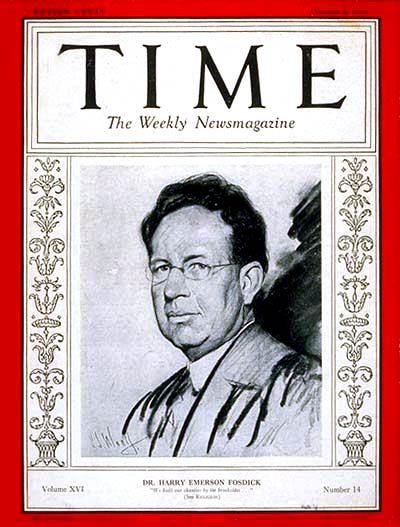
On curious aspect of this piece is how central Harry Emerson Fosdick is to First Presbyterian’s understanding of the controversy. That editorial decision allows the First Church to end the story with a kind of “my bad.” “Yes, we got a little carried away with modernism. But no apologies to conservatives like Machen who the Presbyterian bureaucratic bus ran over.”

Another is the importance of Charles Briggs. B. B. Warfield was on to something. But by the 1890s strict Presbyterianism (doctrine or church polity) was on short supply any where in the trans-Atlantic world.

______________

The Fundamentalist / Modernist Conflict

Harry Emerson Fosdick and The Fundamentalist / Modernist Conflict

The 1890s saw great changes in society: The industrial revolution and the changing of the United States from an agrarian society to an urban one.

The 1890s were also a decade of intellectual upheaval. Between the depression of 1873 and the First World War, many of the time-honored suppositions were being questioned. Darwin’s theory of evolution was one of the most prominent new ideas, challenging the authority of the Bible and the presumption of its inerrancy.

A working definition of Modernism, Liberalism and Fundamentalism in the American Protestant context is necessary to understand the basics of the conflict.

Traditionalists, later known as Fundamentalists, adopted a five-point declaration at the 1910 General Assembly that all candidates for ordination had to affirm. These five points were of course a reaction to the growing acceptance within Protestantism and, specifically the Presbyterian Church, of a more liberal interpretation of the Bible.

The five Fundamental points are:

1.The inerrancy of the Bible
2.The virgin birth of Christ
3.Christ’s substitutionary atonement
4.Christ’s bodily resurrection
5.The authenticity of Christ’s miracles

Other Christian groups adapted the five points with point two often becoming the deity of Christ rather than his virgin birth.

Many lists ended with Christ’s premillennial second coming, instead of his miracles, as the fifth point.

By the 1920s the five points had become called the five fundamentals and had become a rallying cry for conservative Christians across a broad spectrum.

As Jack Rogers, in his book Presbyterian Creeds: A Guide to the Book of Confessions, states: “This was especially true for the growing movement of independent Bible conferences, Bible schools, and independent churches influenced by Dispensationalism. This movement majored in literalistic, futuristic, interpretation of biblical prophecy which announced Christ’s imminent return following a very specific and complex timetable of attendant events. Dispensationalists also taught that all the traditional institutional churches had grown worldly and denied fundamental doctrinal beliefs.”

Modernism may be defined as a method of interpreting Christian scripture and tradition, but not a particular set of beliefs. Modernizers can be found in every period of Church history and Christian Communions. But when we speak particularly of Protestantism in the late 19th to early 20th centuries, we see a conviction in the new scientific knowledge and the most recent Biblical historical research. An application of this new knowledge presents real issues for Christians. As a result, according to Modernism, the task of interpretation must be carried forward if the saving truth of the gospel is to be understood in its relevance to contemporary life.

As for Liberalism, Daniel D. Williams, former Professor of Systematic Theology at Union, says, “It might be said with some accuracy that all theological liberals were modernists; but not all those who used modernist methods of interpretation shared the faith of the liberal theology, especially its optimistic estimate of human nature.”

Further, he says: “Liberals have taken a positive attitude toward the achievements of democratic culture and have generally stressed the ethical imperatives in the gospel.”

Williams also quotes the German theologian Adolf Harnack, who, near the turn of the century, had this classic definition of Liberal theology: “Firstly, the Kingdom of God and its coming. Secondly, God the Father and the infinite value of the human soul. Thirdly, the higher righteousness and the commandment of love.”

In the social gospel movement Walter Rauschenbusch, who was professor of Church History at Rochester Theological Seminary in the early part of the century, became a chief interpreter and prophet. His concept of social sins involved society as a whole (e.g., poverty, child labor, poor working conditions, etc.), and held that these needed to be urgently addressed. To Rauschenbusch and his followers, Christian social activism and advocacy was a compelling Biblical ethic.

The Fundamentalist / Modernist conflict began with the Charles A. Briggs heresy trial. The trial was a reaction from conservative traditionalists to Briggs’s address on January 20, 1891, at Union Theological Seminary on, “The

Authority of the Holy Scriptures.” It was an address inaugurating the opening of the new Department of Biblical Theology.

Briggs was a professor of theology at Union, and he attacked “Traditionalism,” later known as Fundamentalism, and espoused an interpretation of the Bible in the light of the “Higher Criticism.” The Higher Criticism was a method of investigating facts based on scientific investigation, inductive research, and a relative system of values.

Carl E. Hatch, in his 1969 book The Charles A. Briggs Heresy Trial, lists three main factors that stand out as transforming American Protestant theology: Darwin’s theory of biological evolution, Higher Criticism, and the study of comparative religion. Hatch further makes the point that the impact of Darwin’s theory of evolution on American Theology is well known, but that of Higher Criticism and comparative religion much less so.

Briggs had studied in Germany where the methods of Higher Criticism had begun. Julius Wellhausen had perhaps the most influence upon American theologians. He is known as the Father of Higher Criticism. Briggs’s favorite teacher at the University of Berlin, which he attended, was A.I. Dorner, a disciple of Wellhausen.

Charles A. Briggs was born in New York City on January 15, 1841. He attended the University of Virginia, but in his Junior year, 1861, returned home because the Civil War was imminent. After joining the Union Army for about a year and helping defend Washington D.C., he was released to go home, for reasons not known. He entered Union Seminary and graduated in 1863. After graduation he tried helping his father in his merchandising firm in New York, but quickly decided it was not for him. Briggs then matriculated to the University of Berlin. It was a turning point in his life.

After completing his studies, he returned to New York and in 1870 was ordained a Presbyterian minister. He served for a time at a church in Roselle, NJ, but soon found that it, too, was not to his temperament. In 1874 an invitation came to teach at Union. He was professor of Hebrew and Cognate Languages. Although he found it much more rewarding to teach than be a pastor, the subject did not afford him much opportunity to approach Biblical criticism.

Briggs had wanted to forcefully introduce the German theology into this country, but “How to do it?” was his question.

Since Union was under the control of the General Assembly, and most Presbyterian clergy were conservative and therefore disposed against the German Higher Criticism, Briggs had to be careful in what he wrote in religious publications and what he taught in the classroom.

Briggs then maneuvered to create a new department, using the Higher Criticism. But instead of using that term, he used the euphemistic “Department of Biblical Theology.” Briggs, of course, was to be head of the department.

Little opposition was encountered from Union faculty or administration for the creation of the new department. For, despite generally conservative clergy within the Church, Union’s faculty and administration at the time were more progressive and favorably inclined toward the German theology. Charles Butler, chairman of Union’s board of directors, had been a boyhood friend of Briggs and supported the plan wholeheartedly. In April of 1890 Union received $100,000 in bequest money for the new department. The board voted in the new department unanimously in November of that same year.

On January 20, 1891, Briggs gave his address inaugurating the new department.

The speech cheered Briggs’s students. They enthusiastically applauded him at points, but it angered the invited conservative guests and clergy.

The speech is very much a polemic, attacking beliefs about the Bible that the Victorians held as eternal and inviolable.

Briggs began by asserting that there were three, not one, great sources of divine authority. The first was the institutional Church, the second was reason, and the third the Bible.

“But of all three ways,” Briggs said, “no one of these has been so obstructed as the Holy Bible.” He argued that the authority of the Bible had been so wrapped in dogma and protective creeds, that “The whole trouble with the Bible today is that it has been treated as if it were a baby, to be wrapped in swaddling clothes, nursed, carefully guarded lest it should be injured by heretics and skeptics.”

As Carl Hatch relates in his book, “The net effect of this,” according to Briggs, “was to shut out the light of God, to obstruct the life of God, and to fence in the Bible, thus rendering the Bible useless.”

Briggs next attacked superstition as keeping people from the Bible. “We are accustomed to attach superstition to the Roman Catholic Mariolatry and the use of images, and pictures and other external things in worship. But superstition is not less superstition if it takes the form of Bibliolatry.” Mariolatry is idolatry of the Virgin Mary. Bibliolatry is idolatry of the Bible.

“The second barrier,” said Briggs, “keeping men from the Bible is the dogma of verbal inspiration.” These comments, reports Hatch, were “extraordinarily incendiary because the doctrine of verbal inspiration was (and still is) one of the dearest tenets of evangelical Protestantism.”

In Briggs’s third barrier, he maintained that the idea that the Scripture is inerrant is false. “The Bible itself nowhere makes the claim that it is inerrant,” said Briggs.

The fourth barrier, said Briggs, was the assumption that the authenticity of the Bible was founded upon the belief that holy men of old had written the various books.

Said Briggs: “When such fallacies are thrust in the face of men seeking divine authority in the Bible, is it strange that so many turn away in disgust? It is just here that the Higher Criticism has proved such terror in our times. Traditionalists are crying out that it is destroying the Bible, because it is exposing their fallacies and follies. It may be regarded as the certain result of the science of the Higher Criticism that Moses did not write the Pentateuch or Job; Ezra did not write the Chronicles, Ezra or Nehemiah; Jeremiah did not write the Kings or Lamentations; David did not write the Psalter, but only a few of the Psalms; Solomon did not write the Song of Songs or Ecclesiastes, and only a portion of the Proverbs; Isaiah did not write half of the book that bears his name. The great mass of the Old Testament was written by authors whose names or connection with their writings are lost in oblivion.”

At last Briggs ended his shocking pronouncements with this vigorous exhortation:

“We have undermined the breastworks of Traditionalism; let us blow them to atoms. We have forged our way through the obstructions; let us remove them now from the face of the earth, criticism is at work everywhere with knife and fire! Let us cut down everything that is dead and harmful, every kind of dead orthodoxy, every species of effete ecclesiasticism, all mere formal morality, all those dry and brittle fences that constitute denominationalism, and are barriers to church unity.”

“Let us burn up every form of false doctrine, false religion, and false practice. Let us remove every incumbrance out of the way for a new life; the life of God is moving throughout Christendom, and the spring time of a new age is about to come upon us.”

With this blistering attack upon the traditionalists, Briggs faced considerable reaction from within the Church in the form of open theological warfare. Before this, the Higher Criticism posed only a vague threat to the traditional theology. Briggs, in one speech, had moved it full throttle into a formidable threat to upset the prevailing orthodoxy.

It is interesting to note the overwhelmingly positive reaction the students had to Briggs’s speech and theological position. His students were about the same age as Harry Emerson Fosdick was at that time, and as you may remember, Fosdick reports that as a student at Colgate he himself rebelled against the old orthodoxy.

The initial public reaction to Briggs and his theological outlook was cool, but in many newspaper editorials there was a sense of outrage and dismay.

In April of 1892 the Presbytery of Cincinnati petitioned the General Assembly to take action against Briggs. By the time of the General Assembly in May, over seventy presbyteries, mostly from the Midwest, registered disapproval with the Assembly over Briggs’s teachings.

Most wanted the Assembly to order Union to remove Briggs, a power the Assembly had by the Compact of 1870 which had adjoined Union to other Presbyterian seminaries. The Compact clearly stated that the Assembly had power over the accepting or rejecting of professors.

The Union Faculty was solidly behind Briggs. Most favored the German Higher Criticism and rallied behind Briggs. Union alumni were also invited to join in the defense of Briggs. A solid majority of them did. One thing this showed was how much the higher criticism had penetrated into certain circles of American religious thought, despite an era generally marked by conservatism.

At the May General Assembly in Detroit, the Committee on Theological Seminaries, made up entirely of conservatives opposed to Briggs, voted to recommend removing Briggs as chair of the new Department of Biblical Theology.

The Cincinnati Presbytery even tried to organize a boycott by forbidding students of the Midwest to enter Union. The ploy eventually failed because it helped Union gain even greater notoriety for its theological position, thereby attracting more students, especially from New England. Union was now seen at the level of Yale and Harvard Divinity Schools.

At the same time, the Midwestern Presbyteries in 1891 put pressure on the New York Presbytery to bring a heresy charge against Briggs. In May that year a committee of inquiry, involving both liberals and conservatives in the Presbytery, recommended prosecution of Briggs.

By November of 1891 a trial had started. Briggs acted as his own counsel, making a brilliant opening statement that shifted the focus of the trial away from him personally to focus on the new theology. The trial was seen publicly as a forum on this theology, not on the heresy of Briggs’s teaching. Briggs was acquitted of heresy by a 94-39 vote.

Briggs was retried on appeal of the Portland, Oregon Presbytery, and again acquitted. However, at the General Assembly of 1893 he was suspended from the Presbyterian Church.

Meanwhile, Union separated from the Presbyterian Church over this case and retained Briggs as professor until his death in 1913.

Carl Hatch writes, “Although Briggs’ inaugural address did not actually begin a new era in American theology, biblical study in this country has never been the same since that provocative discourse.”

Fundamentalists and Liberals lived in tension in the following years. Presbyteries mostly in the Midwest and West were conservative. Those in the East were more progressive.

One area of tension was in the field of foreign missions. It was in 1921 that Fosdick went to China to ease tensions between missionaries representing churches from both sides of the fence. It was apparently the Fundamentalists that primarily wanted to be separate from their more liberal counterparts.

Reinhold Niebuhr, as a Midwesterner, saw the old traditionalist religion as a kind of rough and ready theology for the American frontier of the 19th century that had hardened into a graceless one for the 20th century.

In May 21, 1922 Fosdick preached “Shall the Fundamentalists Win?” He writes in his autobiography, “It was a plea for tolerance, for a church inclusive enough to take in both liberals and conservatives without either trying to drive the other out.” Soon after the sermon, a man named Ivy Lee, a publicist and Presbyterian, asked Fosdick for permission to reprint the sermon in pamphlet form. Fosdick gave him permission and Lee mailed copies to every Presbyterian clergy in the country. A tremendous controversy ensued, with Fundamentalists within the Presbyterian Church, led by William Jennings Bryan, calling for Fosdick’s removal at the General Assembly of 1923.

In the meantime, Clarence E. Macartney, a minister from Philadelphia, preached a response to Fosdick, titled “Shall Unbelief Win?”

That General Assembly produced a resolution directing the New York Presbytery to direct First Church to conform to the Confession of Faith in its preaching and teaching. Fosdick handed in his resignation, but it was rejected by the Session. At the 1924 General Assembly, with Macartney as moderator and Bryan as vice moderator, Fosdick’s preaching remained an issue, and a compromise was finally struck between the two factions, asking Fosdick to regularize his position at First Church by becoming a Presbyterian minister. He refused, and in October of that year the Session accepted his resignation.

Also in that year, 13 percent of the ministers of the Presbyterian Church signed a document called the Auburn Affirmation. It stated that the Five Fundamentals, which the General Assembly had reaffirmed the previous year, went beyond the facts which the Scripture and the Westminster Confession obligated them.

Fosdick’s last sermon at First Church was on March 1, 1925. It was the same year as the Scopes trial in Dayton, Tennessee, in which William Jennnings Bryan came to national prominence.

In 1923, J. Gresham Machen’s book Christianity and Liberalism was published, adding fuel to the fire. It proclaimed that liberal Christianity was “a different religion” and he attempted to argue that it sprang from different roots. Consequently, he advocated a split within the Presbyterian Church along theological lines of ideology.

Machen was a professor at Princeton Theological Seminary. His aggressively militant view contrasted as polar opposite to the one to which Fosdick expressed.

As Jack Rogers says in Presbyterian Creeds, by 1925 “there were identifiable political parties within the Presbyterian Church. One was composed of theological liberals, who believed in an inclusive church, containing any who wished to belong. Opposed to them were doctrinal fundamentalists, who argued for an exclusivist church composed only of those who agreed with the five fundamental points. The largest group, though least well organized, was made up of moderates, who were theologically conservative but were inclusivists for the sake of the peace, unity, and mission of the church.”

Charles R. Erdman, a professor of practical theology at Princeton was elected Moderator of the General Assembly of 1925. Erdman was a moderate. He proposed a Special Theological Commission to study the state of the Church.

In 1927 the commission issued its final report, saying that no one, not even the General Assembly, had the right to single out doctrines such as the five points and determine a particular interpretation of them to be “essential and necessary” for all. They affirmed that only the Judicial process of the church – i.e., heresy trials – could determine points of doctrinal interpretation in specific cases.

Fundamentalist control of the Presbyterian Church was being diminished by altering the theological decision-making by the Presbyteries.

In 1929 the General Assembly approved a reorganization of the governing boards of Princeton Theological Seminary. As a result, exclusivist Fundamentalists were no longer in control.

J. Greshem Machen was outraged. With three other faculty members, he left to form Westminster Seminary in Philadelphia, and soon thereafter, an Independent Board of Foreign Missions. It was a counter to what he felt was a too-liberal influence in the denomination’s foreign missions program.

The General Assembly declared this competition with a denominational agency unconstitutional, and ordered all Presbyterians, including Machen, to desist from this activity. Machen refused and in 1935 he left the Presbyterian Church and formed, with some of his most militant followers, the Orthodox Presbyterian Church.

By the late 1930s, the public had become tired of the tensions between the left and right within the church. Liberal theology had prevailed, but a new wind was blowing. This time, again from Europe.

As Rogers states: “It was not a well-defined school of thought but a new movement variously called ‘dialectical theology,’ ‘neo-Calvinism,’ and ‘neo-Orthodoxy.’ Among its most prominent figures were the Swiss theologians Barth and Brunner and the American Reinhold Niebuhr.”

“Neo-Orthodoxy rejected,” says Rogers, “the evolutionary idealism of liberalism, which had taught that human beings were basically good and that, by cooperating with God, people would bring the kingdom of God on earth. In contrast, Barth and others preached about human sin and a God of judgment and grace who would have to break into human history.”

Neo-orthodoxy, which essentially came out of Liberalism, did not, however, reject the Higher Criticism concerning the Bible. According to Rogers: “The defining insight of early neo-orthodoxy was that God did not reveal information in an inspired book. God was revealed in the person of Jesus Christ. A person’s encounter with Christ in Scriptures was the work of the Holy Spirit.” By the late 1950s neo-orthodoxy was well established as the dominant theology within the Presbyterian Church.

Returning to Fosdick, in 1935 he preached a sermon at The Riverside Church called “The Church Must Go Beyond Modernism.”

In it he declared, “Fifty years ago the intellectual portion of western civilization had turned one of the most significant mental corners in church history and was looking out on a new view of the world. The church, however, was utterly unfitted for the appreciation of that view. Protestant Christianity had been officially formulated in pre-scientific days. Modernism, therefore, came as a desperately needed way of thinking. It insisted that the deep and vital experiences of the Christian soul, with itself, with its fellow, with its God, could be carried over into this new world and understood in the light of the new knowledge. We refused to live bifurcated lives, our intellect in the late 19th century and our religion in the early sixteenth century. God, we said, is a living God who has never uttered his final word on any subject.”

“The church thus had to go as far as modernism but now the church must go beyond it. Modernism is primarily an adaptation, an adjustment, an accommodation of Christian faith to contemporary scientific thinking. It started by taking the intellectual culture of a particular period as its criterion and then adjusted Christian teaching to that standard. Herein lies modernism’s shallowness and transiency: it arose out of a temporary intellectual crisis; it became an adaptation to, a harmonization with, the intellectual culture of, a particular generation. That, however, is no adequate religion to represent the Eternal and claim the allegiance of the soul. Let it be a modernist who says that to you!”

Fosdick goes on to say that modernism had been too preoccupied with intellectualism, too sentimental with the belief in the idea of human progress, that it had been too centered on the achievements of humanity, putting God in a kind of “advisory” position. And finally, that modernism had lost a moral standing-ground by being too accommodating to the prevailing culture.

“Harmonizing slips easily into compromising,” said Fosdick. “To adjust Christian faith to the new astronomy, the new geology, the new biology, is absolutely indispensable. But suppose that this modernizing process, well started, goes on and Christianity adapts itself to contemporary nationalism, contemporary imperialism, contemporary capitalism, contemporary racialism – harmonizing itself, that is, with the prevailing social status quo and the common moral judgments of our time.”

“We cannot harmonize Christ with modern culture,” said Fosdick at the end. “What Christ does to modern culture is to challenge it.”

In this sermon Fosdick never renounces Liberalism – many thought he had – or even mentions it by name. Fosdick still strongly believed in humanity and its possibilities in relation to God and still believed in the progress of Christianity as revealed by God. His 1938 book A Guide to Understanding the Bible demonstrates this. But his thinking and beliefs by this time had developed more like those of the emerging neo-orthodox theology.

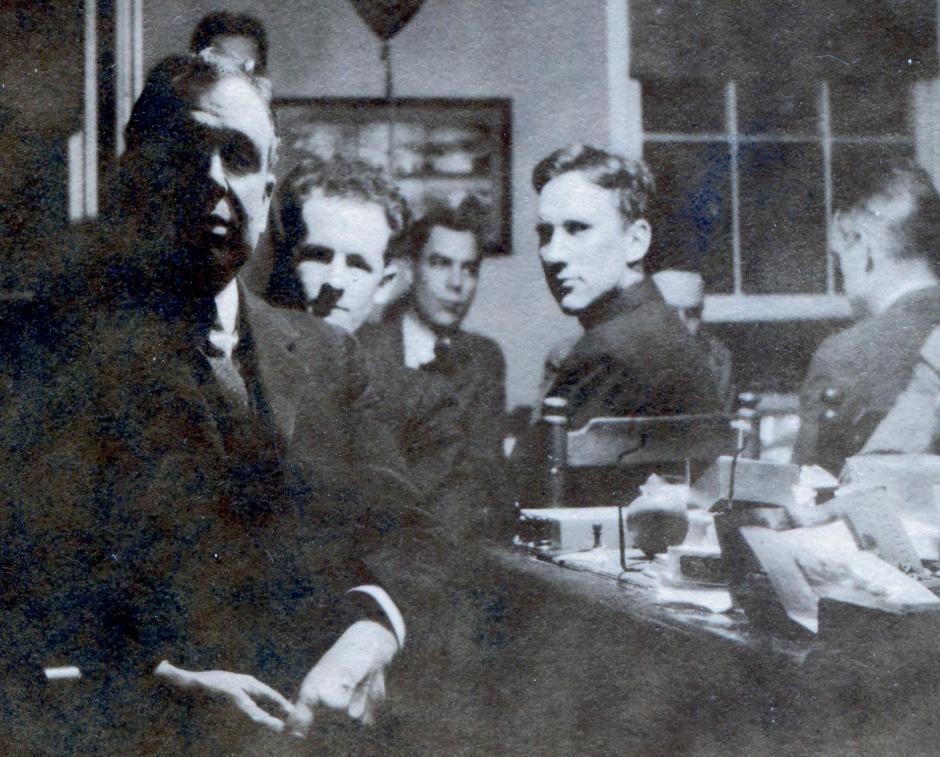
The Last Time a Pope Died (III)

From the October 2005 issue of the Nicotine Theological Journal

The Pastor with the Funny Hat

With the passing of John Paul II Protestants might be able to breathe a sigh of relief. For at least fifteen years, the papacy, through John Paul’s skillful handling of his responsibilities, has emerged as arguably the most prominent voice opposing the sins of modernity. As the veteran evangelical apologist, Norman Geisler, put it, John Paul stood up to the three main foes of evangelicalism, namely, “relativism, pluralism, and naturalism.” The best evidence of this opposition was the pope’s defense of the culture of life, which in the words of Southern Baptist theologian, Timothy George, “provided a moral impetus that [evangelicals] didn’t have internally within our community.” The papacy’s understanding of the sacredness of human life, its teaching on sexual ethics, in addition to any number of other declarations or encyclicals affirming the absolute truth of Christianity, made Roman Catholicism an attractive option for young (and sometimes old) Protestants in search of a church that would stand up for the truth, for what Francis Schaeffer used to call “true truth.” While mainline Protestant denominations descended farther into the abyss of moral relativism thanks to their fear of giving offense, and while evangelicals floundered about trying to find hipper ways to super-size their churches, John Paul II was a popular figure, seemingly approachable like the affectionate grandfather, who also refused to equivocate on some of the most important fronts of the culture war.

At his death, several pundits and journalists assessed the way in which John Paul II changed the face of Christianity around the world, improved the health of Roman Catholicism in the United States, and fundamentally altered the relations between Protestants and Roman Catholics, at least in America. Seldom mentioned is how little the Vatican changed during the deceased pope’s tenure and how much the surrounding situation did, thus significantly altering perceptions of the pope and his accomplishments. Back in 1979 during the pope’s first visit to the United States, evangelicals were still worked up about the doctrine of biblical inerrancy, even having the Roman Catholic conservative, William F. Buckley, give the opening address at one of the assemblies of the International Council on Biblical Inerrancy. The Bible was then thought to be the bulwark against relativism, materialism, and atheism, and its cultural significance was such that a prominent conservative spokesman, even from the wrong church, could offer encouraging words to conservative evangelicals.

But in the quarter of a century since then, the Bible seems to have run out of gas for Protestants as an authoritative guide to truth. Instead, the imposing voice of one person in a high-profile office (which happens to be in Vatican City) appears to be more effective in countering the drift of secularism and relativism. After all, the Bible’s truth can be fairly relative depending on the eye of the beholder. Much harder is it for one person to equivocate. This has always been the dilemma of Protestantism – its tendency to speak in multiple and conflicting voices compared to the relative unity of the papacy (some of us still remember church history lectures on the difficulties of Avignon and Rome). Before, Protestants would band together in either the National Association of Evangelicals or the National Council of Churches to try to achieve clarity. Today, the conservative ones seem to be willing to rely on the extraordinary ability and connections of the bishop of Rome.

Yet, for all of John Paul II”s gifted use of his bully pulpit, was he opposing secularism and relativism any more than my local Orthodox Presbyterian pastor? My minister has been no less clear over the course of his ten-year (and still counting) tenure in denouncing relativism and secularism. Nor was he any less forthright in condemning sexual immodesty or immorality. In fact, if anyone in our congregation had slept around or received (or performed) an abortion, discipline would definitely have followed. My pastor may not have had Continental philosophy informing his sermons or speeches at session, presbytery, or General Assembly meetings, but this may have made him even more accessible and clear than John Paul II.

Equally important to consider is whether the pope’s courage in opposing relativism, secularism and sexual license was any more effective than my pastor’s. To be sure, the local Orthodox Presbyterian minister never attracts the front pages of the New York, London, Paris, Rome or even Glenside, Pa. dailies. But that may be a blessing. It may also be a lesson that the much vaunted Roman Catholic doctrine of subsidiarity teaches. That idea says that authorities of higher rank should not do what is necessary for lesser authorities to perform. This is partly an argument, for instance, against a federal welfare system that is inefficient, impersonal, and creates a culture of dependence by either upending the work of local charities and government social programs, or by taking over duties that families and individuals themselves should perform.

The doctrine of subsidiarity, likewise, should warn against becoming dependent on the worldwide, highly orchestrated statements of one church official when what is needed is the week-in-week-out teaching and counsel of local pastors who minister to their flocks. Indeed, it is ironic to this Protestant that many young evangelicals convert to Rome because of the pope’s moral stature and careful reflection and yet find themselves in parishes and dioceses where the application of his moral teaching is very often lacking. Without wanting to beat a proud denominational breast, it does seem probable that any number of small, insignificant and seemingly sectarian denominations like the OPC or the Presbyterian Church in America or the Lutheran Church Missouri Synod or the Reformed Episcopal Church (to try to be ecumenical) are more disciplined in their sexual practices than American Roman Catholics despite those Protestant denominations’ meager public statements or formal teachings. This is not to say that John Paul II’s encyclicals are without merit – far from it. But the point stands that an encyclical is only as effective as the willingness of the local priest or bishop to apply such truth.

Golfers have a saying that you drive for show and putt for dough, which is the duffer’s way of saying that the church universal may be great on paper but is only as faithful as the local church. John Paul II used his powers as the head of the Roman Catholic church to raise the visibility of the universal church’s power and wisdom. Seldom noticed is the unintended consequence of making local clergy, church members and even Protestants dependent on a universal voice when what is most needed is the fidelity of local clergy and church members. The Protestant Reformation was partly a reaction by local churches against religious dependence on Rome. If only evangelicals were more concerned about their ecclesiological heritage and the difficult responsibilities it includes than they seem to be in seeking encouragement and affirmation from a pastor who is as far removed from their churches as Tiger Woods’ drives are from mine.

DGH