Giving A Whole New Meaning to Celebrity Pastor

The first Bishop of Rome with his own page at IMDB?

Pope Francis is set to become the first pope in history to play himself in a movie. He will star in the forthcoming film ‘Beyond the Sun,’ which will feature children around the world emulating the apostles, while searching for Jesus Christ.

The idea for the film actually came from Pope Francis himself, who pitched the story to filmmakers at the Hollywood-based AMBI Pictures, which was founded by Andrea Iervolino and Monika Bacardi in 2013. The company released the movie ‘Septembers of Shiraz’ in 2015, which starred Salma Hayek.

The Holy Father wanted to create a movie which would be able to reach out to children in order to spread the Catholic faith. His idea was to effectively portray Gospel passages and fables to youngsters.

Voluntary or Forced Exit

I was listening to another episode of the Glenn Loury Show today on the way to the office and Glenn (a few years ago now) brought up the book by Albert O. Hirschman, Exit, Voice, Loyalty. It’s about what happens when businesses or states break down and consumers or citizens need to decide whether to exit, voice dissent, or remain loyal. Hirschman doesn’t apply his argument to Christianity but I couldn’t help think of Roman Catholicism, the Reformation, and Roman Catholic defenders (at all costs, it seems) while Glenn was speaking.

I couldn’t find any reviews of Hirschman in the religious journals but Margaret O’Brien Steinfels did apply the book’s insights to the Roman Catholic Church a few years ago:

One out of every three Americans raised in the church is no longer a Catholic. These “formers” make up the second or third largest religious group in America (depending on whether Baptists are counted in their unity or diversity). In marketing terms, half these Catholics have chosen another brand of religion; the other half are “nones”—unaffiliated. It’s as if roughly 12 million people had forsaken Crest for Tom’s toothpaste, while the other 12 million stopped brushing their teeth altogether. Procter & Gamble, which makes Crest, would work hard to win back those customers: perhaps by banishing turquoise toothpaste or reducing the price. Not so the Catholic Church; it is not a manufacturer and need not be as enterprising as P&G. Does that mean lost customers are more valuable than lost sheep?

Albert O. Hirschman, a brilliant and iconoclastic economist (recently celebrated in a seven-hundred-page biography), laid out a plausible explanation for this kind of phenomenon in his classic study Exit, Voice, and Loyalty, which focuses on organizations that don’t function effectively and their dissatisfied members or customers. Some leave (the “exit” of the title); some stay (the “loyalty”). Hirschman asked why.

He recognized that exiting is easy if we’re talking toothpaste. Consumers dissatisfied with their usual brand can try another. Loyalty is more likely with organizations that invite a strong allegiance, possess a monopoly on something valued, or exact a high price for leaving—for example, families, religions, political parties, and totalitarian governments. Hirschman thinks that a strong sense of loyalty to the group makes exiting a tough, even unthinkable choice for discontented members. Instead, the dissatisfied voice their criticism rather than exit.

Back in the 1960s, when Hirschman was writing Exit, Voice, and Loyalty, voice was in vogue. Women were challenging patriarchy, Democrats protesting the war in Vietnam, Eastern European dissidents questioning Marxist orthodoxy, and Catholics debating Vatican II. These were the voices of critical members who would not or could not exit. Today the cost of exit has declined in all these arenas. Marriages became more egalitarian and divorce laws were relaxed. Ronald Reagan won the votes of FDR Democrats. The Soviet Union collapsed. The Catholic Church lost its monopoly on salvation.

Steinfels, on the progressive side of the church, could only think of Hirschman in the context of Vatican II, updating Roman Catholicism, and traditionalist opposition to such reforms. She did not think about the situation of Protestants in the sixteenth century who voiced their grievances and could not continue to do so because the hierarchy disenfranchised them within the church. This was not a voluntary but a coerced exit.

And yet, Steinfels point may have something to say to folks like Bryan and the Jasons (and their followers) who seem to embody a form of loyalty that approximates blind faith:

Some would argue that the Catholic Church, claiming a monopoly on truth as well as salvation, has no course correction to make. That has been the stand of recent popes and their episcopal appointees, who have rescinded or tinkered with Vatican II reforms and ruled out further change. Complaints have gone unheard, while conforming members have been embraced. And many have left.

Parents and friends of former Catholics now singing in a Baptist choir, serving on the vestry of an Episcopal parish, or meditating in a Buddhist monastery may be relieved that they’re still praying, still believing in something. Perhaps even the “lazy monopolists” consider that these sheep are not lost, simply misplaced. But what of the “nones,” those who abandon religion altogether or just drift away from it. We seem strangely indifferent to their exit. If 12 million people stopped brushing their teeth, we’d all take notice.

Though Hirschman is inventive in pursuing the combination and permutations of exit, voice, and loyalty that might insure an organization’s long-term survival, he recognizes that efforts to change an organization may come to nothing. He sums up this eventuality on a religious note: “the martyr’s death is exit at its most irreversible and argument at its most irrefutable.” It is ironic to think of those who give up their Catholic faith as martyrs, but their departure is at least as drastic as martyrdom. Lazy monopolists take note.

Actually, thinking of certain Protestants in the sixteenth and seventeenth centuries as martyrs is not all that ironic. Regarding those who appeal to circular arguments like motives of credibility or invincible ignorance as lazy sure looks obvious.

Did President Obama Throw Malcolm X Under the Bus?

Now that the missus and I are three seasons into West Wing, I understand that the nation’s presidents cannot say whatever is on their mind. They need to spin for so many different reasons. It’s almost like watching Tom Reagan in Millers’ Crossing.

Even so, President Obama seems to have once again provided a cliched account of Islam in the United States that “makes the rough places plain” so to speak:

Islam has always been part of America. Starting in colonial times, many of the slaves brought here from Africa were Muslim. And even in their bondage, some kept their faith alive. A few even won their freedom and became known to many Americans. And when enshrining the freedom of religion in our Constitution and our Bill of Rights, our Founders meant what they said when they said it applied to all religions.

Back then, Muslims were often called Mahometans. And Thomas Jefferson explained that the Virginia Statute for Religious Freedom he wrote was designed to protect all faiths — and I’m quoting Thomas Jefferson now — “the Jew and the Gentile, the Christian and the Mahometan.” (Applause.)

Jefferson and John Adams had their own copies of the Koran. Benjamin Franklin wrote that “even if the Mufti of Constantinople were to send a missionary to preach to us, he would find a pulpit at his service.” (Applause.) So this is not a new thing.

Generations of Muslim Americans helped to build our nation. They were part of the flow of immigrants who became farmers and merchants. They built America’s first mosque, surprisingly enough, in North Dakota. (Laughter.) America’s oldest surviving mosque is in Iowa. The first Islamic center in New York City was built in the 1890s. Muslim Americans worked on Henry Ford’s assembly line, cranking out cars. A Muslim American designed the skyscrapers of Chicago.

In 1957, when dedicating the Islamic center in Washington, D.C., President Eisenhower said, “I should like to assure you, my Islamic friends, that under the American Constitution … and in American hearts…this place of worship, is just as welcome…as any other religion.” (Applause.)

And perhaps the most pertinent fact, Muslim Americans enrich our lives today in every way. They’re our neighbors, the teachers who inspire our children, the doctors who trust us with our health — future doctors like Sabah. They’re scientists who win Nobel Prizes, young entrepreneurs who are creating new technologies that we use all the time. They’re the sports heroes we cheer for -— like Muhammad Ali and Kareem Abdul-Jabbar, Hakeem Olajuwon. And by the way, when Team USA marches into the next Olympics, one of the Americans waving the red, white and blue — (applause) — will a fencing champion, wearing her hijab, Ibtihaj Muhammad, who is here today. Stand up. (Applause.) I told her to bring home the gold. (Laughter.) Not to put any pressure on you. (Laughter.)

Muslim Americans keep us safe. They’re our police and our firefighters. They’re in homeland security, in our intelligence community. They serve honorably in our armed forces — meaning they fight and bleed and die for our freedom. Some rest in Arlington National Cemetery. (Applause.)

So Muslim Americans are some of the most resilient and patriotic Americans you’ll ever meet.

In many ways I salute the president for trying to make Islam part of the American narrative but I worry that his story line is one that suits Rotary or the Chamber of Commerce better than a president who ran and won in part because he is African-American. For blacks in the 1950s and 1960s, people that the president’s in-laws would well know (and possibly were), Islam looked more like a way to dissent from the nation’s racism and segregation than it did an on-ramp to the American mainstream. The tension between Malcolm X and Martin Luther King, Jr. was all about the dilemmas that integration posed for blacks who wanted a separate identity from the one King was cultivating:

“You don’t integrate with a sinking ship.” This was Malcolm X’s curt explanation of why he did not favor integration of blacks with whites in the United States. As the chief spokesman of the Nation of Islam, a Black Muslim organization led by Elijah Muhammad, Malcolm X argued that America was too racist in its institutions and people to offer hope to blacks. The solution proposed by the Nation of Islam was a separate nation for blacks to develop themselves apart from what they considered to be a corrupt white nation destined for divine destruction.

In contrast with Malcolm X’s black separatism, Martin Luther King, Jr. offered what he considered “the more excellent way of love and nonviolent protest” as a means of building an integrated community of blacks and whites in America. He rejected what he called “the hatred and despair of the black nationalist,” believing that the fate of black Americans was “tied up with America’s destiny.” Despite the enslavement and segregation of blacks throughout American history, King had faith that “the sacred heritage of our nation and the eternal will of God” could reform white America through the nonviolent Civil Rights Movement.

Of course, the experience of most Muslims in the U.S. — namely, immigrants from the Middle East — is distinct from that of descendants of American slaves (like Michelle Obama). But a reminder about Islam’s plausible appeal to black separatists seems necessary for doing justice to both the history of Islam and African-American life in the U.S.

Update: And what would President Obama say to Muhammad Ali, a Baptist turned Muslim, who said this about the U.S. military when refusing to serve in Vietnam?

But who is this white man, no older than me, appointed by another white man, all the way to the white man in the White House? Who is he to tell me to go to Asia, Africa, or anywhere else in the world to fight people who never threw a rock at me or America? Who is this descendant of slave masters to order a descendant of slaves to fight other people in their own country?

Calvinists and Muslims Together (again)

Even more of those days:

In 1683, a vast Ottoman army camped outside the gates of Vienna. For centuries thereafter, the siege and final decisive battle that took place would be cast as a defining moment in a clash of civilizations — that time the forces of Islam were halted at the ramparts of Christendom.

Yet look just a little bit harder and that tidy narrative falls apart. The Ottoman assault had been coordinated in league with the French King Louis XIV. And perhaps more than half of the soldiers seeking to capture the Austrian capital were Christians themselves. There were Greeks, Armenians, Hungarians, Bulgars, Romanians, Serbs, all fighting alongside Arabs, Turks, Kurds, and others in the Ottoman ranks.

One of the main figures leading the Turkish charge was Imre Thokoly, a Protestant born in what’s now Slovakia who was an avowed Hungarian nationalist. Tens of thousands of Hungarian peasants who were angry at the rapacious behavior of the Catholic Church and the imperial Hapsburg dynasty in Vienna had rallied to Thokoly’s banner.

It reflected, writes British academic Ian Almond in his 2009 book, “Two Faiths, One Banner: When Muslims Marched With Christians Across Europe’s Battlegrounds,” how “little use terms such as ‘Muslim’ and ‘Christian’ are to describe the almost hopelessly complex web of shifting power-relations, feudal alliances, ethnic sympathies and historical grudges” that shaped much of European history.

Blame It on Christendom

Another way to read the Reformation:

I’ve been reading this week historian Brad Gregory’s study The Unintended Reformation: How A Religious Revolution Secularized Society. I had imagined it to be a somewhat polemical book that blamed the Reformation for all our modern woes. That was dumb of me. It’s a genealogy of ideas and events that led to our current condition.

It didn’t start with the Reformation. The ideas that laid the intellectual groundwork for the Reformation sprung out of Catholic theological debate two centuries earlier. The corruption of the Catholic Church, and the arrogant refusal of its leaders to heed calls to reform before it was too late, were very real and present. Luther had reason. He had the intellectual framework in place, and he had emotional cause: the utter rot within the Roman Catholic establishment.

That doesn’t make the Reformation right, of course, but one does see how it was all but inevitable. Once the break happened, it proved impossible to contain the forces unleashed. “Sola scriptura” proved an impossible standard for building a new church, because various Reformation leaders had their own ideas about what the Bible “clearly” said. The fracturing of the Reformation, and the arguments among various theological factions, were there from the beginning.

My Jaws Just Got Tighter

A few days ago, Terry Mattingly, of gotcha journalism fame, mocked the Washington Post for inserting a hyphen into Marco Rubio’s comments about Jesus. Here’s the quotation:

For the next few minutes, Rubio sounded more like a Sunday school teacher than a presidential candidate holding an early January town hall. He talked about John the Baptist, he referred to Jesus as “God-made man,” and he explained his yearning to share “eternity with my creator.”

Mattingly thinks that hyphen shows how little the Washington Post’s reporters know about Nicene Christianity (even though without the hyphen it the phrase “God made man” sounds strange when applied to the eternal son of God):

…for Trinitarian Christians, Jesus is not a “man,” “God-made” but, rather, “God made man” (or perhaps “God, made man”).

This may seem like rather picky stuff, and it is. However, it’s hard to name a more central doctrine in the Christian faith than the Holy Trinity. Wasn’t there someone on the Post copy desk who has taken Christianity 101, or was this simply a bad day when it came time to handle this particular piece of copy?

Now, it’s possible that the original copy for this story actually stated that Rubio “referred to Jesus as ‘God – made man’ ” and that turned into you know what?

So, will the heretical hyphen simply vanish in the online version of this story? Here is hoping that the Post editors actually do the right thing and, perhaps with the help of someone at the Catholic University of America, produce a correction. I cannot wait to read it.

Applying that logic to the church instead of newspapers, what does Mr. Mattingly think about Pope Francis’ decision to celebrate the Protestant Reformation (posted by Rod Dreher)?

Nearly 500 years ago, Martin Luther nailed his 95 theses to the door of a German church, beginning the Protestant Reformation that led millions to break with the Roman Catholic Church and ushered in more than a century of conflict and war.

On Monday, the Vatican announced that Pope Francis will participate in a joint Lutheran-Catholic worship service in Sweden this October, kicking off a series of events planned for 2017 to commemorate the 500th anniversary of the Reformation.

The effort to mend relations with Protestants has been on the agenda of many popes before Francis, but it is a delicate endeavor. The worship service in Sweden was billed by its sponsors, the Vatican and the Lutheran World Federation, as a “commemoration,” not as a “celebration,” in order to avoid any inappropriate note of triumphalism. Some Catholics have criticized the notion of a pope celebrating the anniversary of a schism.

Some of those Roman Catholics who object to Lutheranism almost as much as the Obedience Boys do say this about the pope’s recent warming up to Lutherans:

According to Edward Pentin, a group of Lutheran pilgrims were given communion in St. Peter’s Basilica itself this week. What is significant here is that communion was offered to them unilaterally by the celebrants of the Mass — the Lutherans themselves were expecting to receive only a blessing, and the celebrants knew they were not Catholics.

It is scarcely possible that this happened without the knowledge of the Basilica authorities. Are we now seeing the practical effects of Francis’ ambivalent words on holy communion for Lutherans?

You would also think that if you knew your Canons of Trent the way Mattingly expects the Post’s reporters to know the Nicene Creed or the way we might expect the pope to know conciliar teaching, you wouldn’t be all that ready to celebrate Martin Luther. After all, Luther not only disobeyed the magisterium, but was inhuman:

Before the bar of every rational and decent person, does Luther not convict himself of utter inhumanity?

Before the bar of all that is reasonable in moral exhortation – from parental to educational to civil and criminal, does he not convict himself of a crime against all law? Is he, therefore, anarchical?

Before the bar of Catholic Dogma, supreme criterion on earth of what we know is and is not part of and/or in harmony with the Deposit of Faith, does he not convict himself of heresy?

Before the God whom we ought to honor, to whom we ought to ascribe only what is good and true and fitting, does he not convict himself of great blasphemies, greater even than the Gnostics who first attempted to ruin the Church? For the Gnostics distinguished two gods, one good and one evil. Does not Luther add to the evil by subtracting from the number of Gods, folding that Evil, which all right reason and right faith and common decency vomit out as execrable, into the one God?

So why would a Roman Catholic pontiff make amends with a church (a liberal one at that) started by such a person as Luther? And why wouldn’t Mattingly apply the same standards to Rome as he does to Washington?

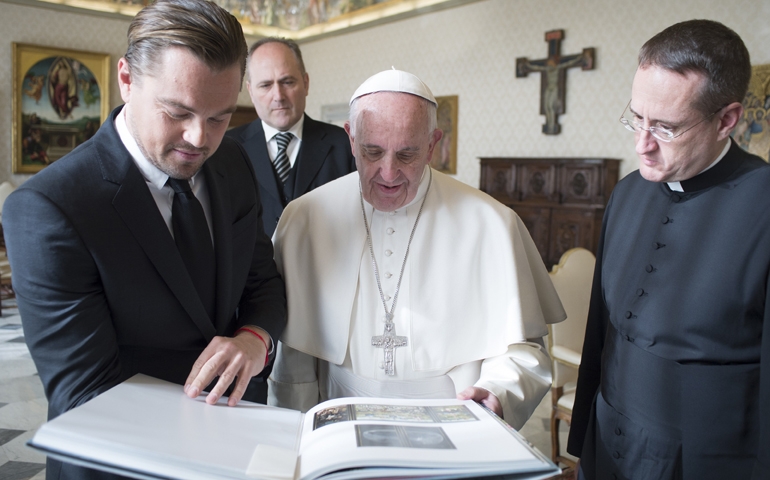
Mercy, Mercy

Pope Francis has launched the Year of Mercy and so the comments about being merciful are frequent these days. But the pope may have gotten ahead of himself when he said that Jesus needed to ask forgiveness of Joseph and Mary (and only the Remnant seems to have objected):

. . . to give credit where credit is due, the Holy Father said some very fine things in his homily for the Mass of the Holy Family. Indeed, his pronouncements nearly always contain much that is good, true and spiritually helpful. He could surely never have been elected to the highest office on earth if his track record revealed that most of what he said was foolish, mistaken, superficial or heterodox. Nevertheless, it will only take a small drop of venom to make a rich and delicious Christmas cake highly dangerous for your health. Likewise, just one shocking affirmation in a papal homily can make its overall effect deeply unsettling and dangerous for our spiritual health.

In this case, the Pope has said something which makes many of us shudder; for it is something which it is not easy to exculpate, at least at the objective level, from the charge of blasphemy. Intentionally or otherwise, he has spoken words which, taken in their natural, unforced sense, imply that the Son of God himself has committed sin.

Consider these words by which His Holiness, preaching in Italian, commented on the Gospel incident: “We know what Jesus did on that occasion. Instead of returning home with his family, he stayed in Jerusalem, in the Temple, provoking great suffering (provocando una grande pena) to Mary and Joseph, who were unable to find him. For this little ‘escapade’ (questa ‘scappatella’), Jesus probably had to ask forgiveness (dovette chiedere scusa) of his parents. The Gospel doesn’t say this, but I believe that we can presume it.”

That may raise problems for the theologically picky, but Pope Francis has also said that Mary has lots of forgiveness to give since she is the “mother of forgiveness”:

For us, Mary is an icon of how the Church must offer forgiveness to those who seek it. The Mother of forgiveness teaches the Church that the forgiveness granted on Golgotha knows no limits. Neither the law with its quibbles, nor the wisdom of this world with its distinctions, can hold it back. The Church’s forgiveness must be every bit as broad as that offered by Jesus on the Cross and by Mary at his feet. There is no other way. It is for this purpose that the Holy Spirit made the Apostles the effective ministers of forgiveness, so what was obtained by the death of Jesus may reach all men and women in every age (cf. Jn 20:19-23).

For anyone wondering if the pope’s statements might qualify as heretical and so complicate the doctrine of papal infallibility, keep in mind the fine print. In order to define infallibility in a way that made room for the seventh-century pope, Honorius, the Vatican Council had to finesse papal authority (with papal approval, of course):

In order to save infallibility it is better to admit the historical possibility of a heretic Pope, rather than shatter the dogmatic definitions and the anathemas of a Council ratified by a Roman Pontiff. It is common doctrine that the condemnation of the writings of an author is infallible, when the error is anathematized with the note of heresy, whereas, the Ordinary Magisterium of the Church is not always necessarily infallible.

During the First Vatican Council, the Deputation of the Faith confronted the problem by setting out a series of rules of a general character, which are applied not only in the case of Honorius, but in all problems, past or future that may be presented. It is not enough for the Pope to pronounce on a question of faith or customs regarding the universal Church, it is necessary that the decree by the Roman Pontiff is conceived in such a manner as to appear as a solemn and definitive judgment, with the intention of obliging all the faithful to believe (Mansi, LII, coll. 1204-1232). There are, therefore, non-infallible acts of the Ordinary Papal Magisterium, since they are devoid of the necessary defining character: quod ad formam seu modum attinet.

Pope Honorius’ letters are devoid of these characteristics. They are undoubtedly Magisterial acts, but in the non-infallible Ordinary Magisterium there may be errors and even, in exceptional cases, heretical formulations. The Pope can fall into heresy, but cannot ever pronounce a heresy ex- cathedra.

Bottom line, Pope Francis should be okay. Back to your regularly scheduled shrugging.

Today's Topic for the Epistemology Seminar

Mark Powell’s new book Papal Infallibility: A Protestant Evaluation of an Ecumenical Issue shows that the path from papal infallibility to epistemic certainty is hardly uniform or successful.

First, maximal infallibility:

[Henry Edward Cardinal] Manning’s maximal infallibility, which stressed the problems of private judgment in theological reflection, looked to the pope to decisively settle theological disputes and secure doctrinal unity. . . . However, Manning’s maximal infallibility is fraught with problems. His position is dependent on a strong foundationalism with unfeasibly high standards for knowledge that has been largely abandoned in contemporary epistemology. Rather than rescuing Manning from the problem of private judgment, maximal infallibility only continues his pursuit of epistemic certainty on an endless cycle. Infallible papal pronouncements must be properly identified, and then they too, like scripture and tradition, are subject to private interpretation. In this regard, papal pronouncements bring no more certainty than scripture and tradition do. (202-203)

Second, moderate infallibility:

[John Henry Cardinal] Newman’s moderate infallibility and his theory of doctrinal development were proposed to address many of the problems that result from maximal infallibility. The moderate position substantially limits the number of infallible papal pronouncements, and the theory of doctrinal development explains the lack of historical support for recent Catholic doctrines. Newman, though, shares many of Manning’s assumptions in epistemology. Like Manning, Newman is seeking epistemic certainty, and this certainty is required for religious claims to qualify as knowledge….

However, the complexity of Newman’s proposal subtly undermines the epistemic certainty he seeks. To avoid papal absolutism, Newman highlights the problem of identifying and interpreting infallible papal pronouncements. For Newman, the church as a whole has a part in adopting infallible papal pronouncements, and theologians in particular play a crucial role in interpreting infallible doctrines. While Newman recognizes the problem of past papal errors, some of which are quite inventive, in an attempt to preserve papal infallibility. When he considers the possibility of future papal errors, he employs a number of epistemic resources, primarily conscience, to counter these potential errors….

While the theology of doctrinal development worked in Newman’s favor for the doctrines he supported, it was also used against him by proponents of doctrines he opposed. Suddenly, Newman could no longer appeal to historical problems in contemporary doctrinal proposals since such doctrines could be legitimate doctrinal developments. Further, proponents of theological liberalism could appeal to doctrinal development to bypass historical beliefs like the Trinity and Chalcedonian christology. (203-204)

Third, minimal infallibility:

[Han’s] Kung’s minimal infallibility, which is actually a rejection of papal infallibility, refuses to engage in the epistemic practices of moderate infallibility. Kung does not call doctrinal change a doctrinal development, and he does not retain the term “infallibility” when he is in fact speaking of indefectibility. Kung admits historical problems in the doctrinal history of the Catholic Church without attempting to explain these problems away. And he is not interested in retaining the notion of religious certainty. . . .

The debate over Kung’s Infallible? An Inquiry demonstrates once again the inadequacy of doctrines of infallibility. In Infallbie? Kung gives the example of Humanae Vitae, which bans the use of artificial contraception, as an example of erroneous teaching of the Catholic magisterium that has the status of an infallible doctrine. Kung’s example, though, sparked a substantial debate over whether Humanae Vitae is indeed an infallbile exercise of either the extraordinary papal magisterium or the ordinary universal magisterium. The debate clearly shows the problem of identifying infallble doctrines by the foremost officials and theologians of the Catholic Church. Obviously, doctrines of infallibility have not brought the epistemic certainty first envisioned by Manning and even Newman. (206)

Powell’s conclusion is that with out infallibility, the pope “could still exercise primacy in the Catholic Church while exercising a different role of leadership in any potential ecumenical union, as the bishop of Rome did in the first millennium of the church’s existence.” (213)

More of Those Days

Thanks to Aaron Denlinger:

[John] Craig’s teaching role in the Dominican monastery granted him access to the library of the Roman Inquisition, and at some point in the 1550s, while taking advantage of that privilege, he stumbled across an early edition of John Calvin’s Institutes of the Christian Religion. Craig read Calvin’s work and embraced the doctrine he found therein, which, needless to say, put him in an awkward spot. Sometime shortly after this he apparently confessed his evangelical convictions to an elderly monk in his order. The aged monk responded that he shared Craig’s sympathy towards reforming ideas, but encouraged Craig to keep his mouth shut for his own safety.

But Craig, rightfully overjoyed at his new-found understanding of the gospel, couldn’t quite manage that task. His desire to tell others what he had discovered eventually led to his arrest and trial at the hands of that very institution — the Roman Inquisition — that had unwittingly provided him access to the reforming views of Calvin. Craig was found guilty of heresy and imprisoned in a cell in the basement of the Roman Palazzo dell’ Inquisizone. The Palazzo apparently bordered the Tiber, which at that time lacked the stone embankments which today keep the river in check, and Craig’s cell, according to one source, regularly filled with waist-high water, adding considerably (one imagines) to the unpleasantness of imprisonment and impending death.

Following nine months of imprisonment, Craig’s execution date was set for August 19th. The evening before he was scheduled to die, however, Pope Paul IV, who had been instrumental in the establishment of the Roman Inquisition in the 1540s and had, as Pope, considerably inflated its authority and activities, died. Paul IV was a decidedly unpopular person in Rome, not least because of the far-reaching powers he had given the Inquisition. As news of his death circulated, the Roman people naturally convened outdoors to celebrate. They subjected Paul IV’s recently erected statue in the Piazza del Campidoglio to a mock trial and, having found the same guilty of one thing or another, decapitated the marble Pope, dragged his body through the streets, and finally cast him into the river. Their taste for rioting and revenge having merely been whetted, they then sacked (and eventually burned) the Palazzo dell’ Inquisizone, murdered the resident Inquisitor and beat up his underlings, and freed seventy-plus persons who were currently imprisoned in the Palazzo’s cells, including Craig.

The OPC is the Church John Calvin Founded

That assertion would prompt guffaws throughout the Presbyterian and Reformed world and yet Roman Catholic apologists continue to make such a claim with even higher stakes: “the Roman Catholic Church is the church Jesus founded.”

Who actually looks at history this way? To think that the OPC was a gleam in the eye of John Calvin is risible if only because Orthodox Presbyterianism comes so much later and after so many different historical developments than the Reformed churches of Geneva. Someone could spot similarities in worship, polity, and theology between Geneva and the OPC. But the OPC is only a development from something that started in 1522 in Zurich even before Calvin was a Protestant convert.

It’s like saying the United States of President Obama is the nation that Thomas Jefferson and John Adams founded. Neither the Left nor the Right in the United States thinks that way. As if a nation that now extends across the entire continent, has a population 100 times greater than 1789, and possesses the largest economy and military in the world is the United States Jefferson and Adams founded.

So how close does Roman Catholicism come to Jesus? For starters, Jesus never made it to Europe. The churches with which Jesus had the greatest familiarity and presence were those of Jerusalem. Which is why Tertullian did not ask, “what hath Rome to do with Athens” (and a good thing he didn’t since Thomists may have followed Aristotle more than Peter and Paul).

If the writings of the apostles are any indication, you know the ones we typically call “the word of God,” the early church had no episcopacy. The first body to make authoritative rulings for believers was the Council of — wait for it — Jerusalem and that body showed no deference to the pastors of Rome. The theology of Paul, a big block of NT teaching, went out of its way to stress faith over observance of the law, a major point that split western Christianity and isolated Rome from the apostles according to those most zealous to protect apostolic teaching (as opposed to papal prerogative). Meanwhile, the worship of the early church was simple and according to Paul the Lord’s Supper was a not a sacrifice but a fellowship meal (just like the Passover). And worship was not in Latin, a point sure to upset the Latin-Rite proponents.

So the early records of Christianity lean much more in the direction of the Eastern churches being the original Christians. In fact, were it not for the Eastern Church and their first Christian emperor, western Christians would not have Trinitarian orthodoxy.

It may be high time to remember that Boston Americans, not the New York Yankees, won the first World Series.