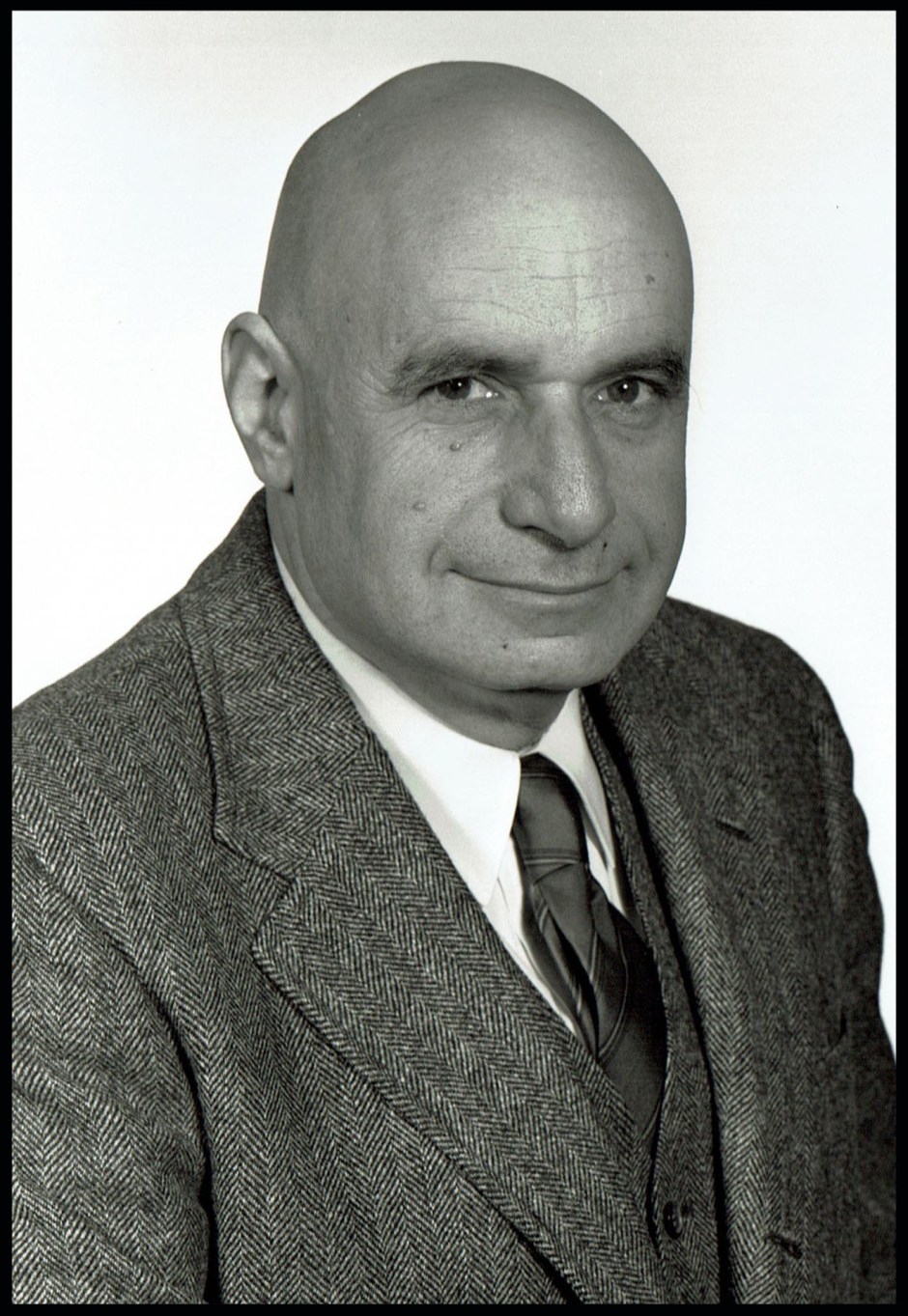
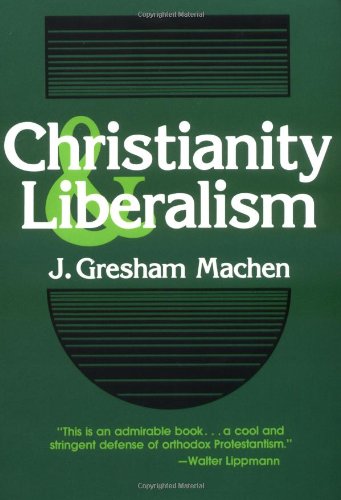
Machen Death Day 2026

That feeling when scholarship nurtures devotion.

The relation of Paul to Christ is a relation of love; and love exists only between persons. It is not a group of ideas that is to be explained, if Paulinism is to be accounted for, but the love of Paul for his Saviour. And that love is rooted, not in what Christ had said, but in what Christ had done. He “loved me and gave Himself for me.” There lies the basis of the religion of Paul; there lies the basis of all of Christianity. That basis is confirmed by the account of Jesus which is given in the Gospels, and given, indeed, in all the sources. It is opposed only by modern reconstructions. And those reconstructions are all breaking down. The religion of Paul was not founded upon a complex of ideas derived from Judaism or from paganism. It was founded upon the historical Jesus. But the historical Jesus upon whom it was founded was not the Jesus of modem reconstruction, but the Jesus of the whole New Testament and of Christian faith; not a teacher who survived only in the memory of His disciples, but the Saviour who after His redeeming work was done still lived and could still be loved. (The Origin of Paul’s Religion, p. 302)

Machen Day 2025

Machen was a problem solver:

This dependence of Christianity upon a particular conception of its origin and of its Founder is now indeed being made the object of vigorous attack. There are many who maintain that Christianity is the same no matter what its origin was, and that therefore the problem of origin should be kept entirely separate from the present religious interests of the Church. Obviously, however, this indifference to the question as to what the origin of Christianity was depends upon a particular conception of what Christianity now is; it depends upon the conception which makes of Christianity simply a manner of life. That conception is indeed widespread, but it is by no means universal; there are still hosts of earnest Christians who regard Christianity, not simply as a manner of life, but as a manner of life founded upon a message-upon a message with regard to the Founder of the Christian movement. For such persons the question of the origin of Christianity is rather to be called the question of the truth of Christianity, and that question is to them the most important practical question of their lives . Even if these persons are wrong, the refutation of their supposed error naturally proceeds, and has in recent years almost always proceeded, primarily by means of that very discussion of the origin of the Christian movement which is finally to be shorn of its practical interest. The most important practical question for the modern Church is still the question how Christianity came into being. (Origin of Paul’s Religion, pp. 3-4)

Machen Death Day 2025

My conscience troubles me about continuing to act in this particular movement [the YMCA]. What a joy it would be, on the other hand to continue the proclamation of the gospel and the teaching of the Bible!

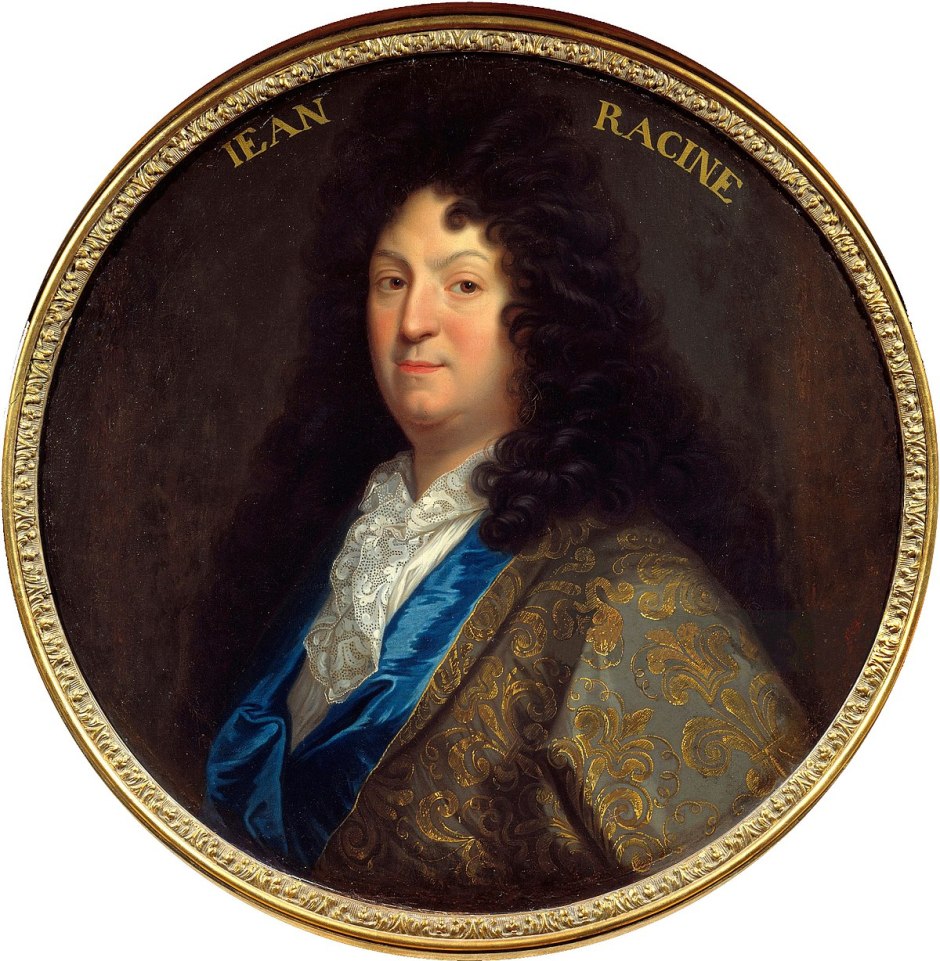
If my conscience were quite at rest on the matter of principle, upon which Dr. Stevenson and I differ so widely, I should be happy now. I have drowned my troubles in a perfect debauch of classical French drama. Christmas day was typical. There was a magnificent offering at the Théâtre Français for the matinee and the Odeon for the evening. On Dec. 24, I had a severe moral struggle. It had been reported that the Paris division wanted speakers for the Christmas services. I did not want to miss the incomparable dramatic opportunities of the day. But even after I had my tickets I could not bear to think of a Christmas entirely selfish. Texts like “Woe is me if I preach not the gospel” kept coming back into my mind. So about five o’clock I called at the office of the Paris division. I did so with fear and trembling. Just suppose I should have to miss “Esther”! What was my delight? The engagement that was given me was for the morning! Hurrah! Duty was combined with pleasure. So I spent my Christmas as follows: In the morning I went out to a camp at Clichy and preached a Christmas sermon. . . . In the afternoon beginning at 1.30 P.M. I had Racine — “Esther” followed by “Les Plaideurs.” Madame Romano in “Esther” was simply superb; I do not remember when I have seen a piece of acting that impressed me more. (J. Gresham Machen to Mary Gresham Machen, Dec. 29, 1918, from The Letters from the Front, edited by Barry Waugh, pp. 243-44)

Machen Day 2024

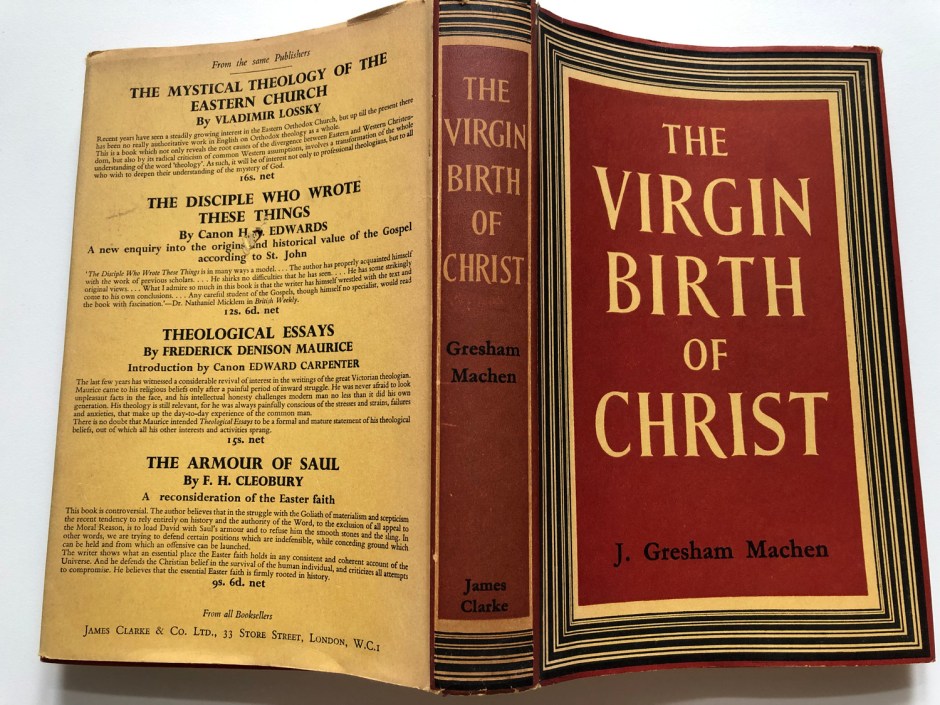
J. Gresham Machen, The Virgin Birth of Christ (1930), page 394-95.

Would our knowledge of our Saviour be essentially complete if the New Testament did not contain the passages which narrate the virgin birth?

That question, we think, should be answered with an emphatic negative; without the story of the virgin birth our knowledge of our Saviour would be impoverished in a very serious way. Exaggerations, indeed, should be avoided at this point. Even without the infancy narratives we should have much upon which to rest our faith. Christ would still be presented in the New Testament as both God and man in two distinct natures and one person forever; the significance of His Cross would still stand out in all its glorious clearness; He would still be offered to us in the gospel as our Saviour.

Yet there would be a serious gap in our knowledge of Him, and questions would arise which would be full of menace for the souls of men. How did this eternal Son of God enter into the world? Did the Son of God unite with the man Jesus at the baptism as the Gnostics supposed; was the man Jesus received up gradually into union with the eternal Son? Erroneous answers to such questions would, without the story of the virgin birth, be all too ready to hand. No doubt those erroneous answers would still be capable of refutation to a mind ideally logical and really filled with the convictions which all the Gospels and Epistles would provide. Yet they would be only too natural to the minds of men as they actually are. Without the story of the virgin birth we should be living constantly in a region of surmises like the errors of the heresiarchs in the ancient Church.

Such surmises would deprive us of the full doctrine of the incarnation upon which our souls can rest. To that doctrine it is essential that the Son of God should live a complete human life upon this earth. But the human life would not be complete unless it began in the mother’s womb. At no later time, therefore, should the incarnation be put, but at that moment when the babe was conceived. There, then, should be found the stupendous event when the eternal Son of God assumed our nature, so that from then on He was both God and man. Our knowledge of the virgin birth, therefore, is important because it fixes for us the time of the incarnation. And
what comfort that gives to our souls! Marcion, the second-century dualist, was very severe upon those who thought that the Son of God was born as a man; he poured out the vials of his scorn upon those who brought Christ into connection with the birth-pangs and the nine months’ time. But we, unlike Marcion and his modern disciples, glory just in the story of those things. The eternal Son of God, He through whom the universe was made, did not despise the virgin’s womb! What a wonder is there! It is not strange that it has always given offence to the natural man. But in that wonder we find God’s redeeming love, and in that babe who lay in Mary’s womb we find our Saviour who thus became man to die for our sins and bring us into peace with God.

Moreover, the knowledge of the virgin birth is important because of its bearing upon our view of the solidarity of the race in the guilt and power of sin. If we hold a Pelagian view of sin, we shall be little interested in the virgin birth of our Lord; we shall have little difficulty in understanding how a sinless One could be born as other men are born. But if we believe, as the Bible teaches, that all mankind are under an awful curse, then we shall rejoice in knowing that there entered into the sinful race from the outside One upon whom the curse did not rest save as He bore it for those whom He redeemed by His blood.

How, except by the virgin birth, could our Saviour have lived a complete human life from the mother’s womb, and yet have been from the very beginning no product of what had gone before, but a supernatural Person come into the world from the outside to redeem the sinful race? We may not, indeed, set limits to the power of God; we cannot say what God might or might not have done. Yet we can say at least that no other way can be conceived by us. Deny or give up the story of the virgin birth, and inevitably you are led to evade either the high Biblical doctrine of sin or else the full Biblical presentation of the supernatural Person of our Lord. A noble man in whom the divine life merely pulsated in greater power than in other men would have been born by ordinary generation from a human pair; the eternal Son of God, come by a voluntary act to redeem us from the guilt and power of sin, was conceived in the virgin’s womb by the Holy Ghost.

Machen Death Day 2024

The year of living Machenly prompted much attention from this writer to Machen’s training as a classicist prior to becoming a scholar of the New Testament. One instance of his serious reflection on the differences between pagan myths of gods begetting humans and the birth narratives of the New Testament came in his book, The Virgin Birth of Christ (1931). One important difference was lust. Another was polytheism:

In the pagan stories of divine begetting, polytheism is not merely incidental; it is the centre and core of the whole complex of ideas. But in the New Testament story of the virgin birth of Christ, the lofty Old Testament monotheism is abated not a whit; the awful transcendence of God, the awful separateness of God from the world, is never lost from view. Where in the New Testament story is there found any hint of a love of God for the maid of Nazareth, which could be analogous to the love of a husband for his wife? The question can scarcely even be asked, by any man of literary taste—-to say nothing of any devout Christian—without a shudder. Yet it would have not only to be asked, but also to be answered in the affirmative, if the theory with which we are now dealing were correct. The love of the gods for mortal women is the very point of the pagan stories—the thing without which they could not possibly exist. To mention any such thing in connection with the narratives in Matthew and Luke is to do violence to the whole spirit of those narratives. The truth is that when we read these narratives we are in a totally different world from that which produced the pagan stories of the loves and hates of the gods.

Mere Confessionalism

From the Archives: Nicotine Theological Journal, January 1999

Mere Confessionalism

“In essentials, unity; in non-essentials, liberty; in all things, charity.” This is the motto of the Evangelical Presbyterian Church. (The expression itself is of some antiquity, and it may date back as early as St. Augustine.) At its founding in 1981 the EPC adopted a modern language version of the Westminster Confession of Faith as its doctrinal standard. At the same time it also adopted an eight- point “Essentials of our Faith” summary statement. The latter contains boiler-plate evangelical affirmations on the Bible, God, Christ, sin, salvation, and eschatology, in language that is mildly and non-militantly Calvinistic.

Are these two documents competing doctrinal standards? An interesting debate is playing out in the EPC now regarding what confessional status, if any, its “Essentials” possess and how they relate to the Westminster Confession. The “Essentials” themselves end this way: “These Essentials are set forth in greater detail in the Westminster Confession of Faith.” But rather than solve the question, that ambiguous language only heightens the confusion. Does it mean that the WCF itself – taken as a whole – is the “Essentials” in fuller form, or merely that these eight affirmations can each be found there as well? Are the “Essentials,” in other words, what the church really believes? Should the emphasis fall on the first or second word in the denomination’s name, “Evangelical Presbyterian Church”?

MOST CONSERVATIVE Presbyterians would likely contend that the EPC has misidentified the essentials of the faith. After all, it is open to women in church office and the ongoing exercise of the charismatic gifts. At the same time, the EPC debate is instructive, because its conservative Presbyterian critics also tend to employ some form of what can be called the hermeneutic of essentials, of identifying what the church may or may not tolerate. Presbyterian theologian, John Frame, for example, in urging the creation of leg room within the confessions, laments that “the whole question of what is and what is not tolerable within the church has not been systematically analyzed.”

Frame’s quest is not new. Efforts to isolate the “essentials” within the confession are almost as old as Presbyterianism itself. Frequently, it has been the progressives who have been eager to speak of a “system of doctrine,” in order to permit their deviation from the Confession and catechisms of the church. By “system” they mean the Confession “in-as-much” as what the Confession teaches is biblical. In this fashion, Presbyterian officers hold line-item vetoes to the church’s Constitution, and the church had erected a Confession-within-the-Confession.

But it is not only progressives who speak this language. In efforts earlier in this century by conservative Presbyterians to preserve the essence of historic Christian orthodoxy, some upheld the minimal necessity of the “five fundamentals” of the faith. The unintended effect was to reduce the “essential and necessary” articles of the church’s constitution to just five.

Especially of late the rhetoric of essentials is invoked in order to separate the Bible from the Confession in the name of the Reformation principle of sola scriptura. (Indeed, often it is phrased in the language of liberating the Bible from the confession.) Increasingly Presbyterian officers seem to be declaring, “never mind the Confession, show me where that is taught in Scripture.” But for Presbyterians, an officer is committed to sola scriptura precisely to the extent that he is a Confessionalist. Confessionalism does not eclipse the doctrine of sola scriptura. Rather, a confession is the necessary means for the church to uphold Biblical authority. The Presbyterian way to point to the doctrine of Scripture is to refer to the Confession.

FRAME DESCRIBES THIS VIEW AS chauvinistic. “Although I am a Presbyterian,” he writes, “I confess that I do not share [the] desire for us always to ‘look like Presbyterians’ before the watching world.” In context, Frame’s concern is specifically about worship, but by implication his views bear upon the relationship between The Nicotine Theological Journal will likely be published four times a year. It is sponsored by the Old Life Theological Society, an association dedicated to recovering the riches of confessional Presbyterianism.

IN DESCRIBING HIS STUDENT days at Westminster Seminary (in the early 1960s), Frame recalls two features of that course of instruction: it lacked an overt “confessional or traditional focus” and there was a spirit of creativity and openness in theological reflection. He goes on to make a startling admission: “After graduation I became ordained in the Orthodox Presbyterian Church, and I confess I was rather surprised at the seriousness with which my fellow ministers took the confessional standards and the Presbyterian tradition. Eventually I became more like my fellow Orthodox Presbyterian . . . elders, but not without some nostalgia for the openness of theological discussion during my seminary years.”

Our point is not to critique WTS or any other seminary. And whether Frame has described with accuracy the curriculum of WTS in the 1960s is not our concern either. But what is revealing is the dichotomy that Frame creates between “perpetuat[ing] and recommend[ing] the confessional traditions” on the one hand (which is where he finds WTS’s education flawed), and a “flourishing of original and impressive theological thought” on the other (where he thinks WTS excelled). This difference he goes on to attribute to Westminster’s understanding of sola Scriptura, which liberated the school from traditionalism and confessionalism.

BUT FRAME’S DICHOTOMY WAS unknown to previous generations of Reformed theologians. Calvin Seminary’s Richard Muller writes the following on the harmony of Scripture and confession: “We need creeds and confessions so that we, as individuals, can approach Scripture in the context of the community of belief.” Confessions function as mediating structures, standing between Scripture and the “potentially idiosyncratic individual” as “churchly statements concerning the meaning of Scripture.” They are “normative declarations spoken from within by the church itself . . . as the expression of our corporate faith and corporate identity.”

Muller’s work on Reformed scholasticism reminds us that there was a time when confessional integrity did not compete with sola scriptura, nor did it impede theological creativity. For the scholastic mindset, Muller notes, “Once a churchly confession is accepted as a doctrinal norm, it provides boundaries for theological and religious expression, but it also offers considerable latitude for the development of varied theological and religious expressions within those boundaries.” According to the Reformers, there is no churchman and there is no theologian where there is no confession. Why is that so unimaginable today? Why has the Reformation confidence in the creeds of the church vanished?

AS WE PREVIOUSLY ARGUED (“Sectarians All,” NTJ 2.2), such anti-traditionalism only serves to locate one within a specific tradition, namely the Enlightenment, and its false claim that an individual Christian, armed with autonomous rationality can approach Scripture from a traditionless perspective. The Reformers, Muller claims, refused to approach Scripture with the false dilemma forced upon the church by its adoption of categories of Enlightenment thought.

Muller goes on to describe other pressures that our age brings to confessional integrity. He refers to the “noncredal, nonconfessional, and sometimes even anticonfessional and antitraditional biblicism of conservative American religion.” Enlightenment rationality and democratic populism combine to create what Robert Godfrey has diagnosed as the evangelical impulse toward theological minimalism. This minimalism seeks to get as many people to express everything they agree on, and preferrably on one side of one sheet of paper. These affirmations become the truly “essential truths,” and the hills for evangelicals to die on. Godfrey is echoing the thoughts of J. Gresham Machen, who in his essay, “The Creeds and Doctrinal Advance,” described this impulse in the following way:

There are entirely too many denominations in this country, says the modern ecclesiastical efficiency expert. Obviously, many of them have to be merged. But the trouble is, they have different creeds. Here is one church, for example, that has a clearly Calvinistic creed; here is another whose creed is just as clearly Arminian, let us say, and anti-Calvinistic. How in the world are we going to get them together? Why, obviously, says the ecclesiastical efficiency expert, the thing to do is to tone down that Calvinistic creed; just smooth off its sharp angles, until Arminians will be able to accept it. Or else we can do something better still. We can write an entirely new creed that will contain only what Arminianism and Calvinism have in common, so that it can serve as the basis for some proposed new “United Church” . . . . Such are the methods of modern church unionism.

This impulse stands in sharp contrast to what Godfrey calls the theological maximalism of the Reformed, which sought at least in the past to extend the boundaries of the church’s confession in pursuit of the “whole counsel of God.” Moreover, Reformed maximalism and evangelical minimalism differ not only in the size of their creeds but in the very purpose of their creeds. To quote Machen again:

These modern statements are intended to show how little of truth we can get along with and still be Christians, whereas the great creeds of the church are intended to show much of the truth God has revealed to us in His Word. Let us sink our differences, say the authors of these modern statements, and get back to a few bare essentials; let us open our Bibles, say the authors of the great Christian creeds, and seek to unfold the full richness of truth that the Bible contains. Let us be careful, say the authors of these modern statements, not to discourage any of the various tendencies of thought that find a lodgment in the church; let us give all diligence, say the authors of the great Christian creeds, to exclude deadly error from the official teaching of the church, in order that thus the Church may be a faithful steward of the mysteries of God.

BUT IS ALL OF THIS FAIR TO evangelicalism? After all, no less an evangelical icon than C. S. Lewis contended for a “mere Christianity.” Yet Lewis himself was not confused about his beliefs, which he said were found in the Anglican Book of Common Prayer. His search for a “mere” Christianity was not an alternative to the creeds of the church. Rather, he likened it to the difference between the halls and rooms of a mansion. “Mere” Christianity may bring one into the hall. “But it is in the rooms, not in the hall, that there are fires and chairs and meals.” The “worst of the rooms,” he went on to stress (perhaps thinking of a dimly lit and drearily decorated attic of Calvinistic horrors), is to be preferred over the hall.

Whatever Lewis intended, his words have been hijacked to serve unhealthy purposes. The ambiguities of the expression, “Mere Christianity,” can be found in many of Lewis’ disciples. And when it meets contemporary evangelicalism, there is a volatile mix that may prove lethal to the theological reflection and confessional identity of the church.

CONSIDER TOUCHSTONE magazine, which had recently changed its subtitle from “A Journal of Ecumenical Orthodoxy” to “A Journal of Mere Christianity.” Its editorial purpose is to “subordinate disagreements to the common agreement” because the crisis of our day is so grave. Here we must recognize the debilitating effects of the so-called culture wars on the confessional identity of the church. Abortion, Gay rights, women’s rights, funding for and legal protection of pornographic artists, evolution in the public schools — all of these are battle fronts in the increasingly rancorous struggle over the meaning and purpose of America. And these are the causes to which Christians should devote their energy.

“We need to identify the ‘real enemy’,” urges Touchstone, and that enemy is without, not within. What is said moderately in Touchstone can be found in more virulent form in Peter Kreeft’s Ecumenical Jihad. For Kreeft, mere Christianity may not even be recognizably Christian. The moral decay of America, with all of its leading indicators of spiritual decline, is creating new alliances, even among those of differing religious convictions. The old fashioned Protestant v. Catholic v. Jewish warfare is passe. So great is the threat of secular humanism and so united are we with former antagonists on the really crucial issues, that even evangelical Christians, Kreeft predicts, will eventually arrive at the conclusion that Muslims are on the right side. They may be murdering Christians in Sudan, but at least they are not massacring unborn children. Given the real crisis of our time – the decline of Western Civilization – this is “no time for family squabbles.” This is not merely cultural warfare but spiritual warfare that will unite Protestants, Catholics, Orthodox, Jews, Muslims, Buddhists, and maybe even an occasional natural-law-advocating atheist.

(Don’t be too alarmed by all this. The Holy Spirit is at work among pious Muslims, Kreeft assures Christian skeptics, and in heaven these Muslims will come to learn that the Allah they served was the God of the Scriptures. What is more, Kreeft goes on to comfort Catholics that Protestants will ultimately come to venerate the blessed Virgin Mary, if not in this life then in the next. So the very ecumenical Kreeft eventually emerges from the closet and is outed by the end of his own book as a good, confessional Catholic.)

TOUCHSTONE MAGAZINE ultimately appeals to experience over doctrine. “Mere Christianity,” it states, is found ultimately not in doctrine but lies in “the character of a man.” Similarly, Kreeft argues that beyond theological differences, we find mere Christianity where there is love. This privileging of experience over doctrine prompts us to wonder whether efforts to arrive at evangelical essentials owe less to C.S. Lewis than to Friedrich Schleiermacher, the 19th-century father of modern theological liberalism.

Fundamental to Schleiermacher’s method was his division between the kernel and husk of the Christian faith. The latter is the practice of Christianity, that which is culturally conditioned, and the former is the “essence of the Christian faith,” stripped of these acculturated accretions. It was this non-negotiable kernel that Schleiermacher desperately sought to preserve. The husk is what is offensive to unbelievers, specifically, 19th-century elites of Protestant Europe. The task of the church, therefore, is to remove the objectionable and make Christianity attractive and relevant.

SCHLEIERMACHER IS NOT alone in this methodology. In our century, Tillich’s “method of correlation” and Bultmann’s program of demythologization likewise restated biblical message in language free from pre-modern superstitions and categories more friendly to modernity. A little closer to home, seeker-sensitive worship owes much to 19th-century liberalism, in order to make church accommodating to unchurched Harry and Sally. All of these are efforts to repackage the Christian faith.

In his book, Rumor of Angels, sociologist Peter Berger says that whenever one engages in this method, one is making a cognitive adjustment to the worldview of modernity. In the case of liberalism, the result can be “a profound erosion of the traditional religious content, in extreme cases to the point where nothing is left but hollow rhetoric.” But however practiced, this adjustment or “bargaining” is always a process of “cultural contamination,” because in the encounter between the church and modernity, modernity always wins.

Berger’s point, of course, is that you cannot adjust the wrappings and leave the core unaffected. But is it a stretch to link contemporary evangelicals with a Schleiermacher? We may not see language like kernel or husk, much less something as ominous as demythologization. But substitute “message” and “method,” and it begins to sound familiar. How many times have you heard it said that we must maintain our message but we must change our method, because the world is changing, and at a dizzying pace at that. Or think about the churches that describe their “philosophy of ministry” in brochures for first-time visitors without reference to their theological standards. And then there is “worship style.” How is it that churches can offer two morning services that are “identical” except for the music? Let us not forget that Friedrich Schleiermacher was as desperate as Bill Hybels to present Christianity in relevant and meaningful ways to a skeptical culture.

IN DAVID WELLS’ TERMS theological liberalism and contemporary evangelicalism both quarantine theology from ministry. By dividing message from method, both permit theological convictions to play a diminishing role in the life of the church. On more and more matters, evangelicals are suggesting that theological considerations are irrelevant, overshadowed by the more urgent need for cultural relevance or evangelistic effectiveness. According to Wells,

It is not that the elements of the evangelical credo have vanished; they have not. The fact that they are professed, however, does not necessarily mean that the structure of the historic Protestant faith is still intact. The reason, quite simply, is that while these items of belief are professed, they are increasingly being removed from the center of evangelical life where they defined what that life was, and they are now being relegated to the periphery where their power to define what evangelical life should be is lost.

SCHLEIERMACHER’S METHOD should serve as ample warning that theological minimalism is a false messiah. It is sure to destroy what it claims to preserve, not only when it is in the hands of liberals, but also when it is practiced mildly by conservative evangelicals. A lowest common denominator is an ecumenical dead end. A Reformed church whose worship disguises its Reformed identity is simply not reformed.

Presbyterians would do better to affirm a “mere” Confessionalism, and regard, along with our ancestors, the standards of the church as liberating and not constrictive. Further, Presbyterians might want to acknowledge, however humbling it might be, that they stand to learn something here from the Lutherans. Our Lutheran counterparts seem far more vigilant in their confessional identity than Calvinists. At a recent gathering of the Alliance of Confessing Evangelicals, Missouri Synod theologian, David P. Scaer, struck at the heart of the evangelical dilemma:

Any survival and recovery of Reformation theology cannot be made to depend on a further compromise which identifies an essential core of agreement in order to save it. . . . This kind of agreement immediately puts Lutherans at a disadvantage, since they must concede what makes them Lutherans.

In observing the eager participation of the Reformed in such holy grail pursuits of essentials, Scaer wonders whether the Reformed have made such a suicidal concession. We can hardly improve on Scaer’s conclusion: “Distinctions between essential and non-essential do not belong in the confessional vocabulary.”

Which leads to the unpleasant conclusion that a “confessing evangelical” is a contradiction in terms. Perhaps then Reformed need to cultivate among themselves the same dis-ease for the term “evangelical” as Machen had for “fundamentalist” in his day. Although he reluctantly accepted the term, he couldn’t abide the artificial reduction of a full-orbed Calvinism into a list of fundamentals. So instead of asking what church officers can get away with and how churches can be innovative, Reformed should second Machen: “isn’t the Reformed faith grand!”

“IN ESSENTIALS UNITY; IN NON-essentials, liberty; in all things, charity.” This is a motto that the Presbyterians can embrace. We need not concede it either to charismatic Presbyterians or broad evangelicals, but only if we define essentials in a confessionally self-conscious way. In our standards, there is unity – mere confessionalism. The search for essentials ends when the church adopts her standards. Beyond our confession, there is liberty, and with it openness and even diversity, in theology, worship, and life. And what about charity? By worldly standards, confessionalism does not permit a hermeneutic of charity, for that is a charity of indifference and tolerance. But confessionalism does cultivate a biblical charity that rejoices in the truth, and believes all things.

JRM

Machen Day 2023

From the book that kind of made him famous, the reason for being worried about liberal Protestantism:

The plain fact is that liberalism, whether it be true or false, is no mere “heresy”–no mere divergence at isolated points from Christian teaching. On the contrary it proceeds from a totally different root, and it constitutes, in essentials, a unitary system of its own. That does not mean that all liberals hold all parts of the system, or that Christians who have been affected by liberal teaching at one point have been affected at all points. There is sometimes a salutary lack of logic which prevents the whole of a man’s faith being destroyed when he has given up a part. But the true way in which to examine a spiritual movement is in its logical relations; logic is the great dynamic, and the logical implications of any way of thinking are sooner or later certain to be worked out. And taken as a whole, even as it actually exists today, naturalistic liberalism is a fairly unitary phenomenon; it is tending more and more to eliminate from itself illogical remnants of Christian belief. It differs from Christianity in its view of God, of man, of the seat of authority and of the way of salvation. And it differs from Christianity not only in theology but in the whole of life. It is indeed sometimes said that there can be communion in feeling where communion in thinking is gone, a communion of the heart as distinguished from a communion of the head. But with respect to the present controversy, such a distinction certainly does not apply. On the contrary, in reading the books and listening to the sermons of recent liberal teachers–so untroubled by the problem of sin, so devoid of all sympathy for guilty humanity, so prone to abuse and ridicule the things dearest to the heart of every Christian man–one can only confess that if liberalism is to return into the Christian communion there must be a change of heart fully as much as a change of mind. God grant that such a change of heart may come! But meanwhile the present situation must not be ignored but faced.

Christianity is being attacked from within by a movement which is anti-Christian to the core. (Christianity and Liberalism, 160)

Machen Death Day 2023

A little tide me over for post-Christmas blues:

Would our knowledge of our Saviour be essentially complete if the New Testament did not contain the passages which narrate the virgin birth?

That question, we think, should be answered with an emphatic negative; without the story of the virgin birth our knowledge of our Saviour would be impoverished in a very serious way. Exaggerations, indeed, should be avoided at this point. Even without the infancy narratives we should have much upon which to rest our faith. Christ would still be presented in the New Testament as both God and man in two distinct natures and one person forever; the significance of His Cross would still stand out in all its glorious clearness; He would still be offered to us in the gospel as our Saviour.

Yet there would be a serious gap in our knowledge of Him, and questions would arise which would be full of menace for the souls of men. How did this eternal Son of God enter into the world? Did the Son of God unite with the man Jesus at the baptism as the Gnostics supposed; was the man Jesus received up gradually into union with the eternal Son? Erroneous answers to such questions would, without the story of the virgin birth, be all too ready to hand. No doubt those erroneous answers would still be capable of refutation to a mind ideally logical and really filled with the convictions which all the Gospels and Epistles would provide. Yet they would be only too natural to the minds of men as they actually are. Without the story of the virgin birth we should be living constantly in a region of surmises like the errors of the heresiarchs in the ancient Church.

Such surmises would deprive us of the full doctrine of the incarnation upon which our souls can rest. To that doctrine it is essential that the Son of God should live a complete human life upon this earth. But the human life would not be complete unless it began in the mother’s womb. At no later time, therefore, should the incarnation be put, but at that moment when the babe was conceived. There, then, should be found the stupendous event when the eternal Son of God assumed our nature, so that from then on He was both God and man. Our knowledge of the virgin birth, therefore, is important because it fixes for us the time of the incarnation. And what comfort that gives to our souls! Marcion, the second-century dualist, was very severe upon those who thought that the Son of God was born as a man; he poured out the vials of his scorn upon those who brought Christ into connection with the birth-pangs and the nine months’ time. But we, unlike Marcion and his modern disciples, glory just in the story of those things. The eternal Son of God, He through whom the universe was made, did not despise the virgin’s womb! What a wonder is there! It is not strange that it has always given offence to the natural man. But in that wonder we find God’s redeeming love, and in that babe who lay in Mary’s womb we find our Saviour who thus became man to die for our sins and bring us into peace with God.

Moreover, the knowledge of the virgin birth is important because of its bearing upon our view of the solidarity of the race in the guilt and power of sin. If we hold a Pelagian view of sin, we shall be little interested in the virgin birth of our Lord; we shall have little difficulty in understanding how a sinless One could be born as other men are horn. But if we believe, as the Bible teaches, that all mankind are under an awful curse, then we shall rejoice in knowing that there entered into the sinful race from the outside One upon whom the curse did not rest save as He bore it for those whom He redeemed by His blood.

How, except by the virgin birth, could our Saviour have lived a complete human life from the mother’s womb, and yet have been from the very beginning no product of what had gone before, but a supernatural Person come into the world from the outside to redeem the sinful race? We may not, indeed, set limits to the power of God; we cannot say what God might or might not have done. Yet we can say at least that no other way can be conceived by us. Deny or give up the story of the virgin birth, and inevitably you are led to evade either the high Biblical doctrine of sin or else the full Biblical presentation of the supernatural Person of our Lord. A noble man in whom the divine life merely pulsated in greater power than in other men would have been born by ordinary generation from a human pair; the eternal Son of God, come by a voluntary act to redeem us from the guilt and power of sin, was conceived in the virgin’s womb by the Holy Ghost. (The Virgin Birth of Christ [1930], 394-395)

Machen Day 2022: Been There, Done That

In What is Faith?, Machen defended the intellectual nature of faith and needed to counter trends in American higher education. Sounds relevant.

The intellectual decadence of the day is not limited to the Church, or to the subject of religion, but appears in secular education as well. Sometimes it is assisted by absurd pedagogic theories, which, whatever their variety in detail, are alike in their depreciation of the labor of learning facts. Facts, in the sphere of education, are having a hard time. The old-fashioned notion of reading a book or hearing a lecture and simply storing up in the mind what the book or the lecture contains this is regarded as entirely out of date. A year or so ago I heard a noted educator give some advice to a company of college professors advice which was typical of the present tendency in education. It is a great mistake, he said in effect, to suppose that a college professor ought to teach; on the contrary he ought simply to give the students an opportunity to learn.

This pedagogic theory of following the line of least resistance in education and avoiding all drudgery and all hard work has been having its natural result; it has joined forces with the natural indolence of youth to produce in present-day education a very lamentable decline. . .

The undergraduate student of the present day is being told that he need not take notes on what he hears in class, that the exercise of the memory is a rather childish and mechanical thing, and that what he is really in college to do is to think for himself and to unify his world. He usually makes a poor business of unifying his world. And the reason is clear. He does not succeed in unifying his world for the simple reason that he has ho world to unify. He has not acquired a knowledge or a sufficient number of facts in order even to learn the method of putting facts together. He is being told to practise the business of mental digestion; but the trouble is that he has no food to digest. The modern student, contrary to what is often said, is really being starved for want of facts.

Certainly we are not discouraging originality. On the contrary we desire to encourage it in every possible way, and we believe that the encouragement of it will be of immense benefit to the spread of the Christian religion. The trouble with the university students of the present day, from the point of view of evangelical Christianity, is not that they are too original, but that they are not half original enough. They go on in the same routine way, following their leaders like a flock of sheep, repeating the same stock phrases with little knowledge of what they mean, swallowing whole whatever professors choose to give them and all the time imagining that they are bold, bad, independent, young men, merely because they abuse what everybody else is abusing, namely, the religion that is founded upon Christ. It is popular today to abuse that un-popular thing that is known as supernatural Christianity, but original it certainly is not. A true originality might bring some resistance to the current of the age, some willingness to be unpopular, and some independent scrutiny, at least, if not acceptance, of the claims of Christ. If there is one thing more than another which we believers in historic Christianity ought to encourage in the youth of our day it is independence of mind. (What is Faith?, 15, 16-17)

Finally the NTJ

Here is January 2022 (woops). And here is how the NTJ will operate in a post-USPS environment (from the current issue with a little help from Scribd):

The new iteration of the NTJ comes with fewer strings and but a couple wrinkles. The journal will be available as a PDF attachment at Oldlife.org and Nicotinetheologicaljournal.org. It will be free initially and then move to a subscription basis through the latter of the two websites (for now that’s the plan but technology being what it is and editors being the age they are, who knows?). The reason for subscriptions is mainly to cover expenses of websites and the small print runs of the journal we will produce for the sake of publicity. This means that readers who want a print copy will need to produce their own.