What's The Difference Between the Gospel Coalition and the PCA?

If this were a joke, the punchline might be, “only Tim Keller’s hair dresser knows for sure.” Ba dop bop!

I understand that this question might wind up some readers, especially those who think the Gospel Co-Allies do no wrong. But it is one that need not be pejorative. It could say good things about the Gospel Coalition, for example, that it resembles the PCA. Since the latter is still a Reformed church and Reformed churches are good things, a comparison between the Coalition and a Reformed church could be possitive. Of course, the answer to the question could go the other way and liken the PCA to the Gospel Coalition, a parachurch agency that fancies itself Reformed.

The reason the question could go either way is the lengthy explanation that Tim Keller and D. A. Carson gave (though the text uses the first person singular several times) to the recent imbroglio over James MacDonald’s invitation to T.D. Jakes. They distinguish between a “boundary-bounded set” and a “center-bounded set,” and claim that the Coalition has always been a center-bounded institution. I’m still scratching my head over these concepts. They sound more like sociology than ecclesiology and I tend to be skeptical when ministers or theologians employ jargon outside their own expertise. Be that as it may, the use of these concepts does not necessarily clarify the difference between a parachurch agency like the Coalition and a Reformed denomination like the PCA.

First, the nature of a boundary-bounded body:

. . . you establish boundaries to determine who is “in” and who is “outside” the set—whether the set of true believers, or the set of faithful Presbyterians, or the set of evangelicals, or any other set. For the boundary to have any hope of doing its job, it has to be well defined. If the definitions are sloppy, the boundary keeps getting pushed farther and farther out.

What makes this definition odd, especially in reference to Presbyterians, is that Keller has been involved in the recent debates over subscription within the PCA in ways that have expanded the boundaries. Even if someone wanted to interpret the recent changes in the PCA’s constitution in a conservative manner, it would be hard to read Keller’s understanding of the PCA or his presence in those debates as placing him on the side of tightening the PCA’s boundaries. In which case, I wonder if Keller really sees that big a difference between boundary- and center-bounded identities.

Next comes the center-bounded conception:

. . . center-bounded sets don’t worry too much about who is “in” and “out” at the periphery. Instead, there is a robust definition at the center. For TGC, the center is defined by our Confessional Statement (CS) and Theological Vision for Ministry (TVM) and sustained by the Council members. There we expect unreserved commitment to these foundation documents.

This still sounds to me like a boundary-bounded set up. But what makes this different is that no one can join the Coalition.

Individuals and churches may choose to identify themselves with us and use the thousands of resources on our site, but Council members do not fall into paroxysms of doubt as to whether or not this individual or that church truly belongs to TGC: we are not a denomination, and we do not have the resources to engage in the kind of vetting at the periphery that a boundary-bounded set demands. At the margins there are many who love part of what we stand for and not other parts.

So it would seem that the big difference here is membership. The PCA has members and the Coalition doesn’t. This gets confusing because Keller and Carson, among others, are “Council Members” of the Coalition. Why some parts of the Coalition have membership and others don’t is a mystery. Yet, the same thing — that some in the PCA love, Keller included, parts of what the denomination stands for and not other parts — can be said of a denomination or a boundary-bounded set. In fact, it is true of most Reformed churches. In which case, Reformed churches may actually be much more center-bounded than the Coalition, except that the center of confessional Reformed Protestantism happens to be much bigger than the Coalition’s center, and for that matter, more biblical because the Reformed confessions try to do justice the whole word of God, not simply the bits about which guys from different denominations might agree.

One last similarity comes when Keller and Carson describe the diversity of ministries that exist outside the Coalition among the various “members'” activities:

Within these bounds, Council members discharge ministries that are highly diverse, with their own networks, specific aims, and relationships with many people outside the Council. Sometimes these relationships make other Council members uncomfortable. A Council member may choose to participate in discussions with an organization known for its laxness in doctrine and practice. He may do so in order to serve as a voice for faithful Christian confessionalism within that organization. Looking at this ministry, other Council members might evaluate things differently and warn the participating Council member that he is merely being used: it would be wiser for to avoid the association. But those are judgment calls. TGC does not normally take any position on whether a Council member’s associations are wise or expedient, even though there are not a few Council members who will offer their private judgments out of genuine affection and concern for gospel fidelity and clarity.

“Within these bounds”? I thought the Coaltion was center-bounded, not boundary-bounded. Be that as it may, this description of ministry diversity could also well apply to the PCA where the ministers who belong to the denomination have any number of ministries beyond the denomination’s. Think of New Life Presbyterianism and the different agencies that this wing of the PCA sponsors. Think of the Perimeter Church of Atlanta. Or how about Briarwood in Birmingham, Alabama? But speaking of Elephants in Rooms, what about Keller’s Redeemer Presbyterian Church? What about all of the networks that Keller has established?

Which leads to the question that I asked at the outset: how different is the Gospel Coalition from the PCA? Judging by the Tim Keller’s involvement in the Gospel Coalition and the PCA, not much.

P.S. I might actually have received more counsel on these musings from the Coalition if the Keller-Carson post had been open for comments, but not even Justin Taylor’s post about the statement permitted discussion. I guess the indirect rebuke to MacDonald was all that the Coalition could bear.
Why Does Mahaney Get More Slack Than Nevin?

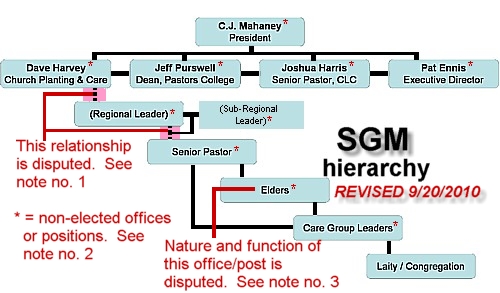
The answer appears to be that if you I have spoken at conferences with C.J., shared a meal with him after one of those sessions, or sung Sovereign Grace Music songs on stage with him, then it is possible to stand in the gap with C.J. in the current difficulty that SGM is experiencing. But if you have not done any of those relationship-building things with J.W., then it is not possible to give Nevin the benefit of the doubt.

This is another way of saying that personal knowledge and friendship appear to be significant elements in the reactions from famous evangelical Reformed figures to the news about C. J. Mahaney and the difficulties besetting SGM. Al Mohler has issued a statement of full confidence in Mahaney and so Ligon Duncan has recently issued a statement over at Reformation 21 which includes this:

It is clear that far from a scandalous cover up, our brothers at Sovereign Grace are taking these matters with utter seriousness and are endeavoring to walk in Gospel repentance and humility and fidelity. C.J. knows of my complete love and respect for him. And my brethren at Sovereign Grace know of my support and prayers for them. . . . I want to emphasize that we fully respect the process that SGM is taking to review the entire situation and that we have no intention whatsoever of joining in the adjudicating of this case in the realm of the internet – a practice as ugly as it is unbiblical.

Here’s the problem. For schlubs like me, who have had no personal interaction with Mahaney, the only information I have to go on are those formal statements that describe SGM’s work. And when I go to the website of SGM I discover that Sovereign Grace churches are weak on the sacraments, have no presbyterian polity, and also include statements friendly to charismatic views of the Holy Spirit. These official teachings and practices have nothing to do (as far as any of us know) with the current difficulties at SGM. C.J. may be guilty or innocent no matter what SGM teaches and does.

But those formal statements would be enough for me not to have personal knowledge of C.J., at least the kind that comes from parachurch conferences, networks, and alliances. All serious Reformed church members and officers, of course, may and do participate with non-Reformed in a host of voluntary organizations. You cannot exist in civil society and not participate with Baptists, Mormons, or Roman Catholics at the Parent Teachers Association, or at the committee for expanding the local library, or on the Chamber of Commerce. You might even participate with non-Reformed in religious endeavors like a college or a magazine.

But if an association or organization calls itself a ministry, I am not sure how such cooperation can exist. The reason has to do with the word “ministry” itself. It invariably goes with “the word” as in minister the word of God (except for the neo-Calvinist/evangelical clutter of “every member ministry”). And when we talk about ministry in this way, we are in the ballpark of ordination, ecclesiology, sacraments, worship, and doctrine. Ministry as such should be confessional. Cross-confessional ministries undermine confessionalism. (And if an organization has the word “gospel” in its name and does not call itself a ministry then it should cease its activities because ministering the gospel is of the essence of ministry.)

So again, I am in a dilemma regarding the current situation at SGM. I have a knowledge of C.J. that only comes from formal statements that would prevent me from entering into ministry relationships with him. And not having those ministry relationships I have no personal knowledge that he is a worthwhile friend and colleague. At the same time, I have friends and acquaintances who are assuring me that everything is basically okay with C.J. and this advice stems from personal knowledge that is grounded in a cross-confessional ministry. Reassurances about C.J. would not be coming from evangelical Reformed types if those Reformed and Baptist figures were as particular in their understanding of ministry as anyone who takes seriously the visible church should be.

Of course, it is commendable for people to stand by their friends and I commend Duncan and Mohler for not doing the self-righteous thing of throwing Mahaney under the bus simply at the accusation of misconduct. Innocent until proven guilty works in both kingdoms.

But if friendship is really a function of fellowship and such fellowship is misbegotten on confessional grounds, then standing by one’s friend may really be a form of standing by a fellow minister while having no ecclesiastical basis or status for doing so.

So I remain ignorant of C.J.’s personal charms because I remain separate from Sovereign Grace Ministries.

When Private Goes Public

(TMI Alert!) Last Sunday my wife and I were publicly received by the OPC congregation in Hillsdale, Michigan. The reception took place during a public worship service on Sunday morning. Despite all the public matters transpiring, very few people noticed. Aside from members of session who decided to receive us by letter of transfer, the email recipients who learned of the time for our reception, and the worshipers themselves who gathered last Sunday (a small group when the college is not in session), no one else knew about these public events. No one from the Hillsdale newspaper covered the event. Session filed no papers with state or federal authorities monitoring church membership. Session did not even hire a publicity firm to promote this part of the worship service. (How dare them!)

And yet it was all public.

According to the OPC’s Directory for Public Worship, Lord’s Day worship is public:

While believers are to worship in secret as individuals and in private as families, they are also to worship as churches in assemblies of public worship, which are not carelessly or willfully to be neglected or forsaken. Public worship occurs when God, by his Word and Spirit, through the lawful government of the church, calls his people to assemble to worship him together. (1.1.c

Also, according to the Directory the reception of members is also public, as in the Directory supplies directions for “The Public Reception of Church Members”:

When a person is received into membership on letter of transfer from another Orthodox Presbyterian congregation, that reception is effective at the time of the action of the session to receive him. Nevertheless, a session may deem it appropriate to welcome that person publicly into the congregation and allow him to give public expression to his faith. If this is done, it shall be made clear to the congregation that the person has already been received by action of the session. (DPW, 4.C)

Critics of 2k often point out that this dualistic doctrine is wrongheaded because it marginalizes faith and puts in a box of privacy. Instead of interacting with all spheres of life, as allegedly all Christians are required to do, 2k believers hide their faith under a bushel. Even worse, they supposedly ratchet up the binary distinction between the public and the private, leaving the former to public officials and the latter to people who do ministry.

But if I’m right about the public nature of what happened last Sunday at Hillsdale OPC, then the critics of 2k are wrong. A spiritual church is just as public as what happens in the public square. It’s just that people who believe in the spirituality of the church don’t need the people supervising the public square to validate the importance of what transpires in public spiritual activities. Public church affairs are plenty important even if the public authorities don’t notice.

Feed My Sheep — With Fast Food?

Over at Mere Orthodoxy a couple of posts have tried to identify two wings of the Young, Restless, and Reformed “movement” by applying the labels Old School and New School. Since many members of the PCA and OPC would even be unaware of this nineteenth-century division among American Presbyterians and what it meant, I was naturally intrigued by the diagnosis. I am also unpersuaded.

Both posts start from the premise that in an age of Facebook and blogging, social institutions and structures have become radically voluntary. I am not sure if this is true, especially when it comes to Christianity in the United States. Ever since the Constitution and ecclesiastical disestablishment, faith in America has been voluntary. Granted, the suppliers of religious services have expanded considerably and the golden age of Protestant denominationalism is no more. But even during the first half of the twentieth century, conservative Protestants were awash in a cornucopia of religious institutions, from Bible schools (as graduates of BIOLA should know, rights?) and faith missions, to independent congregations and celebrity revivalists.

Then comes the application of Old and New School categories by Kevin White to the Young, Restless, and Reformed:

The “Parachurch” or “New School” prefer more informal church networks and more emphasize the big conferences as the anchor points for the movement. They are more likely to identify as missional and to be part of independent churches or newer church connections. (e.g., Sovereign Grace Ministries, Acts 29, Mohlerite Southern Baptists) The parts of Reformed Theology that they emphasize are sovereignty and the doctrines of grace. You might call them the “Evangelical Reformed.”

The “Church” or “Old School” have a stronger emphasis on confessionalism and formal church polity. They more emphasize the visible church as a covenant community. The conventions are more of a supplementary fellowship opportunity. Like the 19th century Old School Presbyterians, they think revivalist, pietistic evangelicalism is a good thing, that can go hand-in-hand with the best of Protestant scholastic theology. They are more likely to emphasize Reformed ecclesiology as the context for the doctrines of grace and election. You might call them “Reformed Evangelicals.”

I sure would have thought that Acts 29 or Sovereign Grace were about as churched as the Young, Restless, and Reformed get. Those are communions of some kind. Together for the Gospel or The Gospel Coalition would appear more New School than Old School compared to the networks of congregations headed by Driscoll or Mahaney. In other words, I’m puzzled by this notion that an Old School element exists among the Young, Restless, and Reformed. Neither post mentions any examples of such an Old School contingent, a figure, or set of churches. I even wonder if the authors know about the communions that comprise the North American Presbyterian and Reformed Churches.

Mind you, the hope for a well grounded account of the church to counteract voluntarism is a welcome sign. White writes, for instance:

Once entered, membership and fellowship become a holy obligation and a familial bond, not to be broken lightly. The visible fellowship of the church is made (ideally) a living critique of unstable, self-defined voluntary culture.

Matthew Lee Anderson adds:

. . . voluntary associations of an arbitrary sort simply do not provide the stability and depth that we need for human flourishing. For that, we must look elsewhere, to God Himself, which is the first movement of the church and the fountainhead of virtue.

But when Anderson talks about the dangers of localism as a kind of nostalgia, I am not sure he understands the nature of the church. He says:

It would be easy to dismiss voluntarity and pine for a return of immobility and a small patch of land with a picket fence. But the promise of localism needs to be tempered by the perils as well. The soil is just as fallen as the pavement, and electing to reject the easy, voluntary associations of our late modern world for the involuntary ones of the local community may offer just as false a hope as the social networks did.

Well, actually, when it comes to food production, a patch of land is much better than pavement, superior in every respect. And spiritual food is best produced locally rather than corporately. It is easy to sound elitist when promoting the values of slow food over McDonald’s, and the work of a pastor is much closer to that of a slow food chef than a teenager flipping burgers at the local store of an international company. But closer to the truth is the similarity between a local pastor’s work and a mother’s. These officers prepare food (whether spiritual or physical) with a sense of what is good for the eaters. They use good ingredients and do so with a sense of what the sheep or children need nutritionally.

In which case, when Jesus told Peter to feed his sheep, our lord likely did not have in mind Peter going to the spiritual equivalent of McDonald’s to purchase burgers for the flock. Care, discernment, and preparation were as important to the feeding as the actual cooking. That leaves the megaconferences like TGC or T4G or even the Philadelphia Conference on Reformed Theology much more in the position of providing fast food than a home cooked meal since the cooks are not dining with the eaters, or spending time in between meals to see how the digestion is going or if the diet needs to be modified.

I an very glad to know that some Young, Restless, and Reformed are aware of Old School Presbyterianism. But I’d sure like to know which cooks they have in mind and what authorities are overseeing the kitchens.

Alliances, Ecumencity, and Being Reformed

The OPC’s 75th anniversary also coincided with the regular meeting of General Assembly. My pastor, whose energy consumes more calories in a day than I devour in the course of a week, wrote the daily report and perusing his summary reminds me of an important point about communions like the Orthodox Presbyterian Church. The pastor’s notes on Friday’s sessions included the report from the OPC’s Committee on Ecumenicity and Inter-Church Relations (CEIR), with a list of the various denominations with which the OPC has a relationship.

The OPC reserves the category of ecclesiastical fellowship for fifteen different churches, which include:

The Associate Reformed Presbyterian Church (ARPC)
The Canadian Reformed Churches (CanRef)
The Christian Reformed Churches in the Netherlands (CRCN)
The Evangelical Presbyterian Church of England and Wales (EPCEW)
The Evangelical Presbyterian Church of Ireland (EPCI)
The Free Church of Scotland (FCS)
The Presbyterian Church in America (PCA)
The Presbyterian Church in Korea (Kosin) (PCKK)
The Reformed Church in Japan (RCJ)
The Reformed Church of Quebec (ERQ)
The Reformed Church in the United States (RCUS)
The Reformed Churches of New Zealand (RCNZ)
The Reformed Presbyterian Church of Ireland (RPCI)
The Reformed Presbyterian Church of North America (RPCNA)
The United Reformed Churches in North America (URCNA)

According to the OPC’s rules for ecclesiastical relationships:

Ecclesiastical Fellowship is a relationship in which the churches involved are Reformed in their confessional standards, church order and life though there may be such differences between them that union is not possible at this time and there might be considerable need for mutual concern and admonition. It is to be implemented where possible and desirable by:

Exchange of fraternal delegates at major assemblies
Occasional pulpit fellowship (by local option)
Intercommunion, including ready reception of each other’s members at the Lord’s Supper but not excluding suitable inquiries upon requested transfer of membership, as regulated by each session (consistory)
Joint action in areas of common responsibility
Consultation on issues of joint concern, particularly before instituting changes in polity, doctrine, or practice that might alter the basis of the fellowship
The exercise of mutual concern and admonition with a view to promoting Christian unity
Agreement to respect the procedures of discipline and pastoral concern of one another
Exchange of Minutes (Acts) of the major assemblies
Exchange of denominational church directories (yearbooks)
Exchange of the most recently published edition of the confessional standards
Exchange of the most recently published edition of the (Book or Manual of) Church Order
Exchange of the most recent denominationally published edition of hymnals or Psalters

Runner up to ecclesiastical fellowship is a corresponding relationship, an OPC category into which eleven churches fall:

The Africa Evangelical Presbyterian Church
Free Church of Scotland Continuing
The Free Reformed Churches of North America
The Heritage Reformed Congregations
Independent Reformed Church in Korea
The Reformed Churches in the Netherlands (Liberated)
The Presbyterian Church of Brazil
The Presbyterian Church of Eastern Australia
The Presbyterian Church in Japan
The Bible Presbyterian Church
The Reformed Churches of South Africa

According to the rule book, a corresponding relationship is one in which:

. . . mutual contact with another church is undertaken to become better acquainted with one another with a view towards entering into Ecclesiastical Fellowship at some time in the not-too-distant future. It shall be implemented where possible and desirable by:

Exchange of official representatives at major assemblies
Joint action in areas of common responsibility
Consultation on issues of joint concern, particularly before instituting changes in polity, doctrine, or practice that might alter the basis of the relation
Exchange of Minutes (Acts) of the broadest assemblies
Exchange of denominational church directories (yearbooks)
Exchange of the most recently published edition of the confessional standards
Exchange of the most recently published edition of the (Book or Manual of) Church Order
Exchange of the most recent denominationally published edition of hymnals or Psalters

Finally, the last level of relationship is ecumenical contact and the OPC puts ten churches into this category:

Confessing Reformed Church in Congo
Presbyterian Free Church of India
Free Church in Southern Africa
Free Reformed Churches in South Africa
Gereja-Gereja Reformasi Calvinis
Gereja-Gereja Reformasi di Indonesia
Reformed Churches of Brazil
Reformed Churches of Spain
Reformed Presbyterian Church of India
Reformed Presbyterian Church North-East India

An ecumenical contact is a status reserved or denominations that belong to the International Council of Reformed Churches and .reflects an effort to follow the ICRC’s stated d purpose, “to encourage the fullest ecclesiastical fellowship among the member churches.”

It shall be implemented, as appropriate, by:

Meetings, both formal and informal, of delegates to the quadrennial meeting of the Conference
Welcome of official observers at the broadest assemblies
Communication on issues of joint concern
Mutual labors as members of the Conference in discharge of the purposes of the Conference

A couple of matters are worth highlighting about these lists and terms: 1) The OPC is often characterized as narrow and idiosyncratic but her ecclesiastical relationships extend well beyond the United States and (even) North America to places which U.S. parachurch agencies and alliances have no presence. 2) The list and definitions extend not to celebrity pastors but to actual churches.

All the more reason to associate the word, “reformed,” with another word, “church.” Without church, reformed makes no sense.

The Law Coalition

While working on a talk for a conference last week hosted and attended by academic conservatives, I revisited the Manhattan Declaration. My point was that so many who think themselves conservative think they also take religion seriously by injecting faith into public affairs. But what ends up happening most often is that the complexities and depth of faith are sacrificed for the sake of a common cause, and that commonality is almost exclusively moral and comes from the Second Table of the Decalogue. Listen, for instance, to the way that the Manhattan Declaration’s writers (and the Baylys and Rabbi Bret may well want to follow along) turn the sanctity of human life, traditional marriage, and religious liberty into “the Gospel.”

We are Christians who have joined together across historic lines of ecclesial differences to affirm our right—and, more importantly, to embrace our obligation—to speak and act in defense of these truths. We pledge to each other, and to our fellow believers, that no power on earth, be it cultural or political, will intimidate us into silence or acquiescence. It is our duty to proclaim the Gospel of our Lord and Savior Jesus Christ in its fullness, both in season and out of season. May God help us not to fail in that duty.

Which gospel would that be exactly? The one professed by Southern Baptists, Roman Catholics, or Eastern Orthodox? J. Gresham Machen, in one of the quotations I used recently, might have a very different understanding of such joint endeavors:

I am bound to say that the kind of discussion which is irritating to me is the discussion which begins by begging the questino and then pretensd to be in the interests of peace. I should be guilty of such a method if I should say to a Roman Catholic, for example, wthat we can come together with him because forms and ceremonies like the mass and membership in a certain definite organization are, of course, matters of secondary importance – if I should say to him that he can go on being a good Cathoilc and I can go on being a good Protestant and yet we can unite on comon Christian basis. If I should talk in that way, I should show myself guilty of the crassest narrowness of mind, for I should be shoing that I had never taken the slightest trouble to understand the Roman Catholic point of view. If I had taken that trouble, I should have come to see plainly that what I should be doing is not to seek common ground between the roman Catholic and myself but simply to ask the Roman Catholic to become a Protestant and give up evertyhing that he holds most dear.

In other words, if Trent still matters, or the the Westminster Confession still matters, the signers of the Manhattan Declaration were in serious denial about the gospel.

What is also important to observe, though, is that they are also in mega-denial. For the law that they affirm, merely calling it the gospel, is only a few brief rules outlined in Scripture. For starters, God’s law also says a fair amount about worship and church polity that again would drive Roman Catholics and Protestants not together but apart — can you say the Mass, or how about apostolic succession? (The same can be asked of the Gospel Coalition — are they ignoring the means of grace, or ecclesiology in order to affirm a meager understanding of the gospel?)

So why is it conservative to affirm the law as revealed in holy writ during public debates if you don’t affirm all of the law? And how conservative can it be to rename the law “gospel”? This is not conservative. It is actually liberal and may border on being modernist.

But saying so makes you an antinomian and a secularist? Shazam!

Al Mohler, the Gospel Coalition, and Me (about whom it always is)

Name-dropper alert: Al Mohler and I have been friends for over two decades. (The Harts used to be on the Mohler’s Christmas card list until the former’s nomadic way of life prompted USPS to stop forwarding those attractive greetings from the president’s house in Louisville.) Al and I met when we were participants in a Lilly Endowment project for young Protestant leaders. Because Lilly has historically been most interested in mainline Protestant communions, the religious leaders in Al’s and my group were mainly from the mainline. But because Lilly was aware of the growing prominence of evangelicalism in the United States, they included so-called conservative Protestants, which left Al and me the beneficiaries of mainline Protestant affirmative action. We held hands (not literally) and commiserated over the social justice orthodoxy that continued to prevail among mainliners, and we expressed mutual surprise at how little the Trinity of race-class-gender had come in for revision among those Protestants ever looking for excuses to revise. When a couple years later I was looking for a co-editor for a book on evangelical theological education, Al who had been recently appointed president of Southern Baptist, the flagship seminary of the Southern Baptist Convention, was a natural for the book project.

All of this is to say that Al and are friends, we are co-authors, and we also affirm the five points of Calvinism.

But all of this coalition potential would not generate a second look at my candidacy if Southern Seminary had an opening in church history and I applied for the job. As Calvinistic as SBTS may be, it is also an agency of one of the conventions (Southern Baptist polity is so Byzantine) within the SBC. That means that my membership and identity as an Orthodox Presbyterian is a non-starter at Southern Seminary. What may be strike-two against me is my disbelief in evangelicalism. Strike three is a less than winning personality (though the Harts’ felines, Cordelia and Isabelle seem to enjoy my ornery companionship). Even aside from these other drawbacks, not being Southern Baptist is enough of a strike to count me out – like those backyard wiffle ball versions of home run derby which dispense with all three strikes.

So big an obstacle is my ecclesiastical identity that even if I joined the Gospel Coalition Al would still not have enough approving material in my dossier to recommend me to his board for a faculty appointment. Indeed, joining TGC would arguably deconstruct my efforts to deconstruct evangelicalism, and might even send the message that I am a kinder and gentler warrior child of J. Gresham Machen. But Gospel Coalition status still would not be enough for me to clear the hurdle of Southern Seminary’s faculty requirements.

For what it’s worth, when I was academic dean of Westminster California, if we had had an opening in theology and if Al had been interested in a change of scenery, his Calvinism and courageous and commendable stands against various theological and cultural ills would not have been enough to get him to the interview stage. His Southern Baptist credentials would have failed to meet the requirements for Westminster faculty. And in case this is not obvious by now, Al’s identity as a Southern Baptist would also disqualify him from holding office in the Orthodox Presbyterian Church.

This leaves us with the following set of memberships and identities:

The Southern Baptist Convention rejects D. G. Hart because he is Orthodox Presbyterian.

The Orthodox Presbyterian Church rejects Al Mohler because he is Southern Baptist.

The ‘Gospel Coalition accepts Al Mohler and D. G. Hart no matter what their ecclesial identities (if they choose to join).

This picture would seem to make the Gospel Coalition a commendable organization in that it looks aside from seemingly petty ecclesiastical differences in order to unite seemingly conservative Protestants together in promotion of Christ as revealed in the gospel. And set of allegiances would also seem to depict the Southern Baptist Convention and the Orthodox Presbyterian Church as narrower and more divisive than the simple gospel of Jesus Christ and its proclamation.

Beneath this picture’s warm and alluring hues is the downside of the Gospel Coalition, namely, that they run their affairs as if the church does not matter, as if the gospel is independent of every church affiliation and membership (Protestant, that is). That may sound strong but ecclesiastical membership and ordination pose no apparent barrier to working with, attending, or speaking at the Coalition. The reason for setting up an organization free from denominational norms apparently is to get around the difficulty that confronts administrators at denominational seminaries and officers in churches: ecclesiastical standards are divisive and the creators of the Coalition seem to think that the gospel should not nurture such separation. For a confessional Protestant, this logic is a huge problem since confessionalists believe that the gospel not only inevitably produces good works but also is inevitably embodied in a disciplined ecclesiastical body. This is not, by the way, simply the oddity of hard-core Missouri Lutherans or vinegary Orthodox Presbyterians. It is also the outlook of Southern Baptist institutions like Southern Seminary (such as I understand it).

But an even deeper problem for the Gospel Coalition is that its cultivates its appeal through religious stars who have established their reputations not in parachurch ministries but through the churches themselves. In which case, the Gospel Coalition wants the results of the hard work of ordination and pastoral ministry in church settings without the baggage that comes in those ecclesiastical institutions. (And as long as the Gospel Coalition is an exclusively Protestant outfit, it will implicitly rely on differences that divided the Eastern and Western branches of the church, and on the churches that broke with Rome in the sixteenth century. Short of the new heavens and new earth, we can’t have Christianity in this world apart from the visible churches who translated the Bible, interpreted its teaching, established forms of worship, and determined qualifications for membership and office.)

Most if not all of the figures who attract the hearers and viewers of TGC materials and events are ministers. Their credentials come either from denominations or congregations. These communions are responsible for creating the spiritual capital that gives credibility to the Coalition’s speakers and authors. These pastors in turn add value to this capital by conducting successful ministries (leaving aside that thorny question of what constitutes success in the kingdom of God). The Coalition then assembles the most successful pastors, shorn of their denominational or congregational ties, either during the minutes it takes to conduct a Youtube video or over the course of several days at a conference. The Gospel Coalition adds no inherent value to the capital that these pastors and their churches have created and invested. No offense to Justin Taylor or Colin Hansen, but American evangelicals are not signing up to attend the Coalition conference because those young and restless editors and bloggers are speaking.

This leaves the Coalition with a product that is worth only a percentage of the ecclesiastical currency that the ministers (and the communions they represent) have created. To be sure, the gospel is of incomparable value. But Christ did not complete the gospel merely by his death, resurrection, and ascension. The last I checked, he commissioned apostles, inspired authors of sacred writings, ordained means of grace, gave instructions for planting churches, and included rules for those churches’ government and discipline. The reason would apparently be that sheep need shepherds, that believers need to hear the gospel longer than an evangelistic sermon lasts and learn of its implications for a longer time than at a two-day conference. They need to hear the gospel their entire life, and that means they need pastors and overseers who will be faithful, hence all the mechanisms to insure the creation and maintenance of sound pastoral ministry, and the rules governing how those ministers conduct worship and oversight.

Yet, the Gospel Coalition seems to regard all of this ecclesiastical work as incidental to the gospel, as a mere appurtenance. How else can one explain the indifference to the communions from which their speakers and leaders come? How else to explain that those speakers and leaders could not hold jobs or receive calls in the other speakers and leaders’ communions? For the sake of the Gospel Coalition’s gospel, those differences and separations are unimportant compared to the gospe.

But at institutions like Al Mohler’s Southern Baptist Seminary they do. For that reason, I’d rather live in the real world of respectful differences between the SBC and the OPC in their diverse efforts to follow all of Christ’s Great Commission (word, sacrament, and discipline) rather than the la la land of the Gospel Coalition where speakers and audiences act as if such differences don’t matter and where members of different communions are tempted to forget about the ecclesiastical vows and think that what happens in Chicago stays in Chicago.

Postscript on fellowship: Readers may be thinking that the point here about the church and the parachurch here make sense, but is there no room for pastors and members from different churches and denominations to fellowship together? Should the Banner of Truth stop offering conferences?

Part of the answer depends on what we mean by fellowship. If a Southern Baptist pastor cannot minister in the OPC without rejecting his former views on baptism and polity (for starters) and subscribing the OPC’s confession of faith, then it is fair to conclude that the OPC and the SBC are not in fellowship. And if a Southern Baptist transferring his membership into the OPC has to go through the same examination as someone who is a recent convert, then again fellowship is not the word we would use to describe this relationship.

Was it fellowship that I had with my parents when we prayed before meals, even though they were Baptists and I an Orthodox Presbyterian? Probably, but not in an ecclesial sense.

In which case, why do paraecclesial ideas about fellowship trump ecclesial ones? Why is a gathering of ministers at a Banner of Truth Conference more “sweet” than the relations among pastors and elders at a presbytery meeting? Or why is a Gospel Coalition conference (or a Philadelphia Conference on Reformed Theology, for that matter) more moving and invigorating than an ordinary Lord’s Day sandwiched by two preaching services?

It could be that the conferences are subjectively more moving than worship. Or it could be that spiritual standards, like the decline of cultural standards from watching too much television, have declined thanks to the prevalence of revivals, conferences, and retreats – all of those man-made devices for generating devotional excitement.

Of course, it is a free country. We do not have a federal agency regulating spiritual life (I don’t think they have one even in Moscow, Idaho). So parachurch agencies are free to have their conferences and American evangelicals are free to flock to them and feel warm and filled. At the same time, confessional Protestants are free to wonder what good these extra-ecclesial forms of fellowship are doing to the means that we do know God ordained through the clear teaching of his word. If the experiential Protestants are really serious about biblical inerrancy, wouldn’t you think they would want to be faithful to what God has inerrantly revealed about the means he has promised to use to save his people (even when they don’t feel “it”)?

Two-Kingdom Tuesday: How Can You Not Be 2K If You Are Spirituality of the Church?

Calvin makes it easy; you only have to get over the National Covenant, Kuyper, Bahnsen, and Wilson:

My kingdom is not of this world. By these words he acknowledges that he is a king, but, so far as was necessary to prove his innocence, he clears himself of the calumny; for he declares, that there is no disagreement between his kingdom and political government or order; as if he had said, “I am falsely accused, as if I had attempted to produce a disturbance, or to make a revolution in public affairs. I have preached about the kingdom of God; but that is spiritual, and, therefore, you have no right to suspect me of aspiring to kingly power.” This defense was made by Christ before Pilate, but the same doctrine is useful to believers to the end of the world; for if the kingdom of Christ were earthly, it would be frail and changeable, because the fashion of this world passeth away, (1 Corinthians 7:31;) but now, since it is pronounced to be heavenly, this assures us of its perpetuity. Thus, should it happen, that the whole world were overturned, provided that our consciences are always directed to the kingdom of Christ, they will, nevertheless, remain firm, not only amidst shakings and convulsions, but even amidst dreadful ruin and destruction. If we are cruelly treated by wicked men, still our salvation is secured by the kingdom of Christ, which is not subject to the caprice of men. In short, though there are innumerable storms by which the world is continually agitated, the kingdom of Christ, in which we ought to seek tranquillity, is separated from the world.

We are taught, also, what is the nature of this kingdom; for if it made us happy according to the flesh, and brought us riches, luxuries, and all that is desirable for the use of the present life, it would smell of the earth and of the world; but now, though our condition be apparently wretched, still our true happiness remains unimpaired. We learn from it, also, who they are that belong to this kingdom; those who, having been renewed by the Spirit of God, contemplate the heavenly life in holiness and righteousness. Yet it deserves our attention, likewise, that it is not said, that the kingdom of Christ is not in this world; for we know that it has its seat in our hearts, as also Christ says elsewhere, The kingdom of God is within you, (Luke 17:21.) But, strictly speaking, the kingdom of God, while it dwells in us, is a stranger to the world, because its condition is totally different.

My servants would strive. He proves that he did not aim at an earthly kingdom, because no one moves, no one takes arms in his support; for if a private individual lay claim to royal authority, he must gain power by means of seditious men. Nothing of this kind is seen in Christ; and, therefore, it follows that he is not an earthly king.

But here a question arises, Is it not lawful to defend the kingdom of Christ by arms? For when Kings and Princes are commanded to kiss the Son of God, (Psalm 2:10-12) not only are they enjoined to submit to his authority in their private capacity, but also to employ all the power that they possess, in defending the Church and maintaining godliness.

I answer, first, they who draw this conclusion, that the doctrine of the Gospel and the pure worship of God ought not to be defended by arms, are unskillful and ignorant reasoners; for Christ argues only from the facts of the case in hand, how frivolous were the calumnies which the Jews had brought against him.

Secondly, though godly kings defend the kingdom of Christ by the sword, still it is done in a different manner from that in which worldly kingdoms are wont to be defended; for the kingdom of Christ, being spiritual, must be founded on the doctrine and power of the Spirit. In the same manner, too, its edification is promoted; for neither the laws and edicts of men, nor the punishments inflicted by them, enter into the consciences. Yet this does not hinder princes from accidentally defending the kingdom of Christ; partly, by appointing external discipline, and partly, by lending their protection to the Church against wicked men. It results, however, from the depravity of the world, that the kingdom of Christ is strengthened more by the blood of the martyrs than by the aid of arms. (Calvin’s Commentary on John 18)

Important to notice is Calvin’s otherworldliness. The kingdom is not in this world, but it is in believers’ hearts. And it comes not through laws or enforcement of legislation, or clever policy, but by the word and Spirit. If magistrates assist the kingdom of Christ it not because of law or enforcement because Christ’s kingdom is spiritual, and therefore different from the rule of kings.

This would also mean that all those people who cite Calvin and his godly regime in Geneva, like the Baylys, Dr. Kloosterman, and Rabbi Bret are missing the point. Calvin even calls arguments like their “ignorant and unskillful. God’s kingdom is not earthly. And efforts to make this world heavenly are just one more example of immanentizing the eschaton.

I would have thought that differentiation of Christ’s rule from earthly regimes would appeal to the Vossian contingent. I wonder when will they ever come over to the 2k side. 2kers won’t bite, at least not physically.

Can Redeemer Presbyterian Church Be Redeemed?

The bloggers over at Mere Orthodoxy linked to an article by Tim Keller on the size and culture of congregations which still has me scratching my head. Originally published in 2006 in The Movement, and then again by one of the Vineyard Church’s publications, now it reappears in Redeemer’s City to City on-line magazine.

The head scratching part may also reveal my Bible-thumping past. But when a minister of the Word talks about the church wouldn’t you expect more references to Scripture than sociological hunches? Take, for instance, Keller’s nonchalant observation that size is a given and cannot be changed:

Every church has a culture that goes with its size and which must be accepted. Most people tend to prefer a certain size culture, and unfortunately, many give their favorite size culture a moral status and treat other size categories as spiritually and morally inferior. They may insist that the only biblical way to do church is to practice a certain size culture despite the fact that the congregation they attend is much too big or too small to fit that culture.

Now I am loathe to grant an inch to biblicism, but why wouldn’t the teaching of Scripture at least provide a greater check on congregational culture than the fixedness of size? For instance, if a pastor is called to perform the tasks that Paul gives to Timothy – you know, the pastoral epistles? – then if a congregation becomes too big or too small for a man to carry out those divinely appointed tasks, then perhaps the pastor and session need to reconfigure the congregation so the pastor can do what God has called him to do.

But when Keller describes the senior pastor of a large (400-800)-to-very-large congregation (above 800), the biblicist impulse is hard to suppress. He writes:

The larger the church, the more important the minister’s leadership abilities are. Preaching and pastoring are sufficient skills for pastors in smaller churches, but as a church grows other leadership skills become critical. In a large church not only administrative skills but also vision casting and strategy design are crucial gifts in the pastoral team.

The larger the church, the more the ministry staff members must move from being generalists to being specialists. Everyone from the senior pastor on down must focus on certain ministry areas and concentrate on two or three main tasks. The larger the church, the more the senior pastor must specialize in preaching, vision keeping and vision casting, and identifying problems before they become disasters.

This may be a digression, but does the bit about large churches nurturing specialists say anything about ministers of the Word — what Machen called, specialists in the Bible — sticking to Scripture rather than dabbling in sociology, even ecclesiastical sociology?

At the same time, where in the Word does it say anything about pastors as vision keepers? Or leadership for that matter? Pastoral authority held by an undershepherd is one thing, leadership is twentieth-century management-speak. So what exactly is biblical or true about these ruminations on size dynamics within a congregation? Again, I’m all for the light of nature and godly (even unregenerate) wisdom. But without some kind of biblical reflection on pastoral ministry, these ideas are even less compelling than pious advice.

The part of Keller’s article that has me scratching the other side of my scalp is his bold admission of the problems that attend very large congregations.

Of course the very large church has disadvantages as well:

Commuting longer distances can undermine mission. Very large churches can become famous and attract Christians from longer and longer distances, who cannot bring non-Christians from their neighborhoods. Soon the congregation doesn’t look like the neighborhood and can’t reach its own geographic community. However, this is somewhat offset by the mission advantages and can be further offset by (a) church planting and (b) staying relentlessly oriented toward evangelism and outreach.

Commuting longer distances undermines community/fellowship and discipleship. Christians coming from longer distances are less likely to be discipled and plugged in to real Christian community. The person you meet in a Sunday service is less and less likely to be someone who lives near you, so natural connections and friendships do not develop. This can be somewhat offset by an effective small-group system that unites people by interest or region.

Diminished communication and involvement. “A common pattern is for a large church to outgrow its internal communication system and plateau . . . as many people feel a loss of the sense of belonging, and eventually [it declines] numerically.” People are no longer sure whom to talk to about things: in a smaller church, the staff and elders know everything, but in a very large church, a given staff member may know nothing at all about what is going on outside his or her ministry. The long list of staff and ministries is overwhelming. No one feels they can get information quickly; no one feels they know how to begin to get involved. This can be offset by continually upgrading your communication system. This becomes extraordinarily important
in a very large congregation.

Displacement. People who joined when the church was smaller may feel a great sense of loss and may have trouble adjusting to the new size culture. Many of them will mourn the loss of feeling personally connected to events, decision making, and the head pastor. Some of these “old-timers” will sadly leave, and their leaving will sadden those who remain in the church. This can be offset by giving old-timers extra deference and consideration, understanding the changes they’ve been through, and not making them feel guilty for wanting a different or smaller church. Fortunately, this problem eventually lessens! People who joined a church when it had 1,500 members will find that not much has changed when it reaches 4,000.

Complexity, change, and formality. Largeness brings (a) complexity instead of simplicity, (b) change instead of predictability, and (c) the need for formal rather than informal communication and decision making. However, many long-time Christians and families value simplicity, predictability, and informality, and even see them as more valuable from a spiritual standpoint. The larger the church, the more the former three factors grow, and many people simply won’t stand for them.

Succession. The bigger a church, the more the church is identified with the senior pastor. Why? (a) He becomes the only identifiable leader among a large number of staff and leaders of whom the average member cannot keep track. (b) Churches don’t grow large without a leader who is unusually good in articulating vision. This articulation then becomes the key to the whole church. That kind of giftedness is distinctive and is much less replaceable even than good preaching. This leads to the Achilles’ heel of the church—continuity and succession. How does the pastor retire without people feeling the church has died? One plan is to divide the church with each new site having its own senior pastor. Lyle Schaller believes, however, that the successors need to be people who have been on staff for a good while, not outsiders.

This is a perplexing passage since, first, it seems to reflect the dynamics at Redeemer NYC (especially the part about the problems of succession — who will fill Keller’s shoes, Marc Driscoll?). In other words, Keller would know these problems first hand. Second, of all the other church cultures he describes, from the house congregation to the very large one, he does not devote a separate space to the problems inherent in these other sized churches. Keller does, to be sure, comment on ways that the other churches need to change if they are to become very large, in which case, being smaller is implicitly a disadvantage. (But if you’re in a place like Hillsdale, Michigan, with a population of 8,000, how could you ever become very large without putting all the other congregations out of business?)

Furthermore, Keller does mention the advantages of very large congregations. One of these is the following:

“Research and development” for the broader church. Again, the larger church is usually a good place for new curriculum, ministry structures, and the like to be formulated and tested. These can all be done more effectively by a large church than by denominations, smaller churches, or parachurch ministries.

But I thought that was the point of belonging to a denomination. After all, Great Commission Publication, the joint-effort of the OPC and the PCA, does precisely what Keller here suggests of the very large church. And what is more, they do so under the oversight of the General Assembly, which is, if you read your Bible aright, the God-appointed way to try new curricula. The assemblies of the church are, in fact, “ministry structures” in their own right.

So with all of the defects of the very large church, why is its size a given? And if Redeemer is experiencing the difficulties Keller describes, why do so many congregations want to be Redeemer-like. Maybe small is not just beautiful but – dare I say – biblical.

If Justin Taylor Gives to the OPC’s Thank Offering, I’ll Contribute to the Gospel Coalition (maybe)

Golfers know the adage that you drive for show and putt for dough. The translation for non-golfers is that 300-yard drives don’t matter if you three-putt the green on to which you’ve chipped because of your impressive – u-dah-man!! – drive. In fact, if you don’t sink your birdie putt (one under par for the golf challenged), you are not going to be much more than a duffer.

This adage would seem to apply to the Gospel Coalition, though it needs to be adjusted to this – join for show and withhold the dough. According to Justin Taylor, GC is in the midst of a year-end fund-raising effort in which supporters who contribute the most will receive ten free registrations for the GC annual conference, along with ten free nights at the conference hotel in Chicago. (Since I doubt W. C. Fields would have been much of a fan of GC, I wonder if his joke would be that second-prize is 20 free conference registrations and 20 free nights in the hotel – 30 if in Philadelphia.) And so that everyone can benefit from the effort, anyone who starts a campaign page at his or her blog or website will receive a copy of Tim Keller’s DVD curriculum, Gospel in Life.

To what purpose do contributions go? So far GC amounts primarily to a website/blog presence and a national annual conference. To accomplish this, the Coalition employs three full-time people. According to Taylor, “The Gospel Coalition (TGC) is not a church, but it does exist to serve and honor the Church. TGC is ultimately ‘a fellowship of evangelical churches deeply committed to renewing our faith in the gospel of Christ and to reforming our ministry practices to conform fully to the Scriptures.’” He adds that the Coalition is more than just a set of blogs or a conference sponsor but “ a place where ‘humble orthodoxy’ is modeled, thoughtful arguments are made, people are loved and honored, conversation is advanced, and the gospel is applied—all to the glory of God.”

Among the benefits of belonging to the Coalition is the Ordinary Pastors project. Since the link that Justin supplied for this endeavor is defective, either GC attracts no ordinary pastors or they need another staff member.

Another feature that caught my eye was GC’s directory of churches (which again has a defective link at Tayloy’s blog). This is a nifty device that shows where GC congregations can be found across the greatest nation on God’s green (and warming) earth. But the directory comes with this warning: “Disclaimer: The Gospel Coalition does not endorse all churches in the directory. We are not able to fully vet all churches.”

This is a remarkable concession and points to the relevance of applying the golfing adage about putting to GC. Apparently, churches will join GC but will not give. The advantage of this strategy is obvious – you get some free publicity and can draft off the celebrity of John Piper and Tim Keller, but you don’t have to find any money in your budget for membership dues. At the same time, why wouldn’t a coalition committed to the gospel be willing to vet anyone that joins its ranks?

So Taylor’s pitch for GC could be improved if the Coalition offered a better product. In fact, better products exist and they are called not parachurch organizations but churches. In my own case, the OPC can vouch in some way for all of the congregations that belong to its fellowship. Not only that, the OPC can vouch for all its church members who are in good standing. We also have a website with a church directory that allows people to find an OP congregation. We also have lots of publications that are widely available to anyone, whether they belong to the Gospel Coalition or to the Southern Baptist Convention or to Redeemer Presbyterian Church. And we have way more than three full-time employees – just look at our directory and see all the pastors, missionaries, and teachers. And we also have a relatively uniform product – all of our officers agree about infant baptism and follow the Westminster Confession on the Lord’s Supper. And don’t talk to me about the sovereignty of God. The OPC has the sovereignty of God coursing through its spiritual veins, from Van Til’s apologetics to its commitment to the ordinary work of proclaiming the gospel in the United States and foreign lands. For those interested in a conference, can anyone beat a visit with presbytery or an all-week’s paid trip to General Assembly?

By the way, the OPC is also having a year-end fund-drive, called our Thank Offering, which solicits offerings for the General Assembly’s programs and agencies.

If the OPC is a better philanthropic value than GC, why does Justin Taylor want his readers (including Orthodox Presbyterians like me) to give to the Coalition without mentioning better options like the OPC for spiritual investing? And a related question is why do parachurch organizations have no problem looking far and wide for contributors while churches don’t expect non-members to give to denominational or church causes? I wonder, for instance, what kind of budget Keller’s Redeemer church has allocated for the Coalition in this fiscal year? Or Piper’s Bethlehem Baptist? Shouldn’t a fund drive for GC start with GC members, especially those congregations that have more than others? Meanwhile, shouldn’t the Coalition be circumspect about raising funds from believers who should be giving to their own churches?

Of course, in that case, if church members gave to the local churches or denominations, then GC would have no budget. But since we have churches that need money, and churches that provide services superior to the Coalition, why does GC actually exist? I know such questions might seem mean spirited, further evidence of Machen’s Warrior Children’s instincts. But the parachurch folks only consider such questions impertinent because they have no sense of propriety. They have no idea that they are duplicating the work of the church and then taking energy and support from the very churches that they supposedly seek to serve.