Back by Popular Demand

Okay, one person requested a return to this golden oldie, “What We Owe Presbyterians (or, Presbyterian Justice)” (Dec. 9, 2010):

Tim Keller’s new book, Generous Justice, has him giving answers to reporters and bloggers’ questions about his argument and reasons for writing. One of those interviews came out recently at Christianity Today, under the title, “What We Owe the Poor.” Part of his strategy, as he explains, is to move people who are not convinced by the Ron Siders and Tony Campola’s of the evangelical world about the institutional church’s call to engage in social and political affairs. As such, Keller hopes to show than experience of God’s grace will inevitably lead to actions on behalf of the poor.

What those actions should be in each person’s case could differ widely. Most Americans when hearing about the poor immediately think of soup kitchens, donations, what to do when greeting a homeless person, and possible charitable organizations that provide needed services. In other words, justice for the poor should involve selflessness, taking from what you have and giving to someone in need. For Keller, caring for the poor seems to be a matter of delegating to others. As he explained in his interview with Kevin DeYoung to a question about his own personal pursuit of generous justice:

we have an excellent diaconate that works with those in need within our community. In addition, years ago I helped a group of people establish “Hope For New York,” a separate but closely aligned organization, that helps our church members give of their time and money to the needs of the whole city. As I say in the book, many churches who work among the poor establish a 501(c)3 often a “community development corporation” to do much of the direct ministry to people in need.

I wish Keller had said what his answer implies, namely, that he does not do much beyond work with and encourage others who get their hands dirty. There is no reason for a pastor to be engaged with the poor directly since he is called to other work, holy work, and since God gives different gifts and callings to members of the body of Christ. But that kind of explanation might have given an out to every other Christian who reads Keller’s book, has a full-time job, but lacks a session or diaconate to whom he can delegate his compassion. Such a person might compare his pay stub with the budget of the federal government’s Health and Human Services and conclude that he is doing as much as his pastor for the poor.

Despite this anomaly, Keller does expound a useful definition of justice. Typically we think in terms of law and order, righteousness and wickedness, as in let’s rid Washington of injustice and institute a holy and godly society. But Keller hearkens back to a classical idea where justice is “giving people their due.” “On the one hand that means restraining and punishing wrongdoers. On the other hand it means giving people what we owe them as beings in the image of God.” In which case, justice involves everything from “law enforcement” to “giving to the poor.”

Law enforcement and giving to the poor seem fairly unimaginative ways of rendering justice in this fuller sense. Other examples might include how to treat a young boy with exceptional intellectual gifts who is deciding on schools, an older woman with years of experience in child rearing or professional service who is contemplating what to do with spare time, a Senator in his home-state office who has no time to meet with constituents on a given day, a professional baseball player during the off season in an encounter at the airport who appears to want anonymity over recognition, or an auto-mechanic (see I didn’t go with plumbing) on a hot afternoon who is flummoxed by GM’s engine computers and has yet to work on your car.

In other words, a fuller account of justice might actually lead Christians to think in terms of the Shorter Catechism’s explanation of the fifth commandment: justice is “preserving the honor and performing the duties belonging to everyone in the several places and relations as superiors, inferiors, and equals.” One reason Americans likely shy away from this part of the catechism as a guide to justice is that we don’t care for those bits about superiors and inferiors. Be that as it may, preserving the honor and performing the duties would seem to cover Keller’s fuller definition of justice and while allowing for specifics instances of civil law and care for poor persons.

But why does justice for Keller only seem to extend to matters of politics or society? What about an expansive view of justice for the church, as in Presbyterian justice? What would it mean for a Presbyterian pastor to preserve the honor and perform the duties belonging to him in relation to session, presbytery, elders, General Assembly, and deacons? What would it mean also for a Presbyterian church member to do justice to the laws of his communion regarding the teachings of the confession on worship, the Lord’s Day, and Christian liberty? Furthermore, what would it mean for a Presbyterian church planter to do justice to rich people who give for the sake of establishing churches that will adhere to Presbyterian teachings and practices? What would it mean for a Presbyterian elder to do justice to those communions with whom he is in fellowship by virtue of ecumenical relations? And what would it mean for a Presbyterian denominational executive to do justice to the work of Presbyterian ministers who labored in years past to create a certain pattern of church life and teaching ministry that followed biblical teaching?

Obviously, I have my own answers to those questions. But the bigger point is why a larger conception of justice, even a generous one, does not seem to extend across the board, all the way to the claims that bind officers and members of Reformed churches by the vows they have taken to be received into fellowship and to render certain services.


Two-Kingdom Tuesday: More Spiritual (and Less Corinthian) than Thou

Contemporary Reformed Protestants are divided on their reading of the Reformation. The 2k advocates find in Calvin and others precedent for the spirituality of the church, that is, the idea that the kingdom of Christ is not to be identified with the state or the civil order but with the visible church which possesses the keys of the kingdom. The 2k critics, whether theonomists (hard or soft) or neo-Calvinist redeemers of culture, read in Calvin and others the basis for magistrates enforcing both tables of the Law, ensuring a Christian society, and even supervising the spiritual kingdom – after all, they called it a magisterial reformation for a reason.

In other words, the advocates of 2k insist that Christ’s kingdom cannot be located in temporal politics; 2k critics argue that Christ’s kingdom is in fact everywhere and that the church implements some, the state and families the rest.

What ends this contest, game, set, and match, for 2k proponents is the spirituality of the church.

Here is Calvin on the nature of Christ’s kingship:

I come now to kingship. It would be pointless to speak of this without first warning my readers that it is spiritual in nature. For from this we infer its efficacy and benefit for us, as well as its whole force and eternity. . . . For we see that whatever is earthly is of this world and of time, and is indeed fleeting. Therefore Christ, to lift our hope to heaven, declares that his “kingship is not of this world” [John 18:36]. In short, when any one of us hears that Christ’s kingship is spiritual, aroused by this word, let him attain to the hope of a better life; and since it is now protected by Christ’s hand, let him await the full fruit of this grace in the age to come. (Institutes, II. xv. 3)

Here is Calvin on the second petition of the Lord’s prayer (“thy kingdom come,” for the catechetically challenged):

God reigns where men, both by denial of themselves and by contempt of the world and of earthly life, pledge themselves to his righteousness in order to aspire to a heavenly life. Thus there are two parts to this Kingdom: first, that God by the power of his Spirit correct all the desires of the flesh which by squadrons war against him; second, that he shape all our thoughts in obedience to his rule. . . . Now because the word of God is like a royal scepter, we are bidden here to entreat him to bring all mens’ minds and hearts into voluntary obedience to it. This happens when he manifests the working of his word through the secret inspiration of his Spirit in order that it may stand forth in the degree of honor that it deserves. (III. xx. 42)

And finally, Calvin on the magistrate:

But whoever knows how to distinguish between body and soul, between this present fleeting life and that future eternal life, will without difficulty know that Christ’s spiritual Kingdom and the civil jurisdiction are things completely distinct. Since, then, it is a Jewish vanity to seek and enclose Christ’s Kingdom within the elements of this world, let us rather ponder that what Scripture clearly teaches is a spiritual fruit, which we gather from Christ’s grace; and let us remember to keep within its own limits all that freedom which is promised and offered to us in him. (IV.xx.1)

For anyone wondering why this matter is so decisive, consider the following: if Calvin is right about the spiritual nature of Christ’s kingdom, then the state’s establishment of righteousness, no matter how beneficial or comprehensive, is always outward and temporal. The state does not deal with the spiritual or eternal realities because it lacks the means to do so. And if an institution ordained by God to punish wickedness cannot advance the kingdom, how much less the media or environment?

This means that 2k advocates have no trouble explaining Calvin’s instructions to magistrates about the need for a Christian order. For starters, he didn’t know any better; he was a man of his time and regarded the religious duties of magistrates the way we take usury in the form of credit cards for granted. For the main course, Calvin wasn’t stupid; to advocate a separation between the Christian and temporal authorities was to be a radical. Calvin needed Reformed magistrates if he and others were not to wind up like Huss and Wycliffe.

But if Calvin believed, as Federal Visionists, neo-Calvinists, and various theonomists do, that temporal institutions other than the church, or cultural activities usher in the kingdom, you would think he would gut the spirituality of the church from his text. He didn’t. That would apparently mean that while outward order and righteousness is desirable and God’s providential intention for this world, it is not a blueprint for a theology of glory where supposedly more faith and morality will resurrect Christendom. Calvin was emphatic that the way of Christ’s kingdom was the path of suffering. The second petition of the Lord’s Prayer, he argued:

ought to kindle zeal for mortification of the flesh; finally, it ought to instruct us in bearing the cross. For it is in this way that God wills to spread his Kingdom. But we should not take it ill that the outward man is in decay, provided the inner man is renewed [II Cor. 4:16]. For this is the condition of God’s Kingdom: that while we submit to his righteousness, he makes us sharers in his glory. (III. xx. 42)

What 2k critics cannot fathom is Calvin’s argument that the fruit of grace is spiritual. The fiercest critics of 2k are basically Corinthian; they associate the coming of the kingdom with redeemed television, better health care, a larger GDP, decrease in crime and secularization, and faith-based policy (especially regulating sex). In which case, neo-Calvinists and theonomists cannot agree with what the Westminster Divines taught about the kingdom of the Lord Jesus Christ, namely, that it is the visible church outside of which there is no ordinary possibility of salvation. Why do theonomists keep telling us about the saving ways of sanctified laws for the polity or neo-Calvinists about the redemptive capacities of a health environment? Have they never read Calvin on the spirituality of the church or Paul on the theology of glory? The answer, apparently, is a big NO.

Lillback on Machen on Beck


(Or, why isn’t Christianity and Liberalism outselling Sacred Fire at Amazon?)

PCA pastor, Peter Lillback, invoked J. Gresham Machen the other night on the Glenn Beck show to clear up the host’s confusion about social justice and the churches. Beck, of course, thinks “social justice” is code for liberalism, big government, and Obamanian tyranny. But Lillback, who belongs to a communion where social justice in the form of “word and deed” ministry are prevalent, thinks a better, kinder, gentler, orthodoxer version of such justice exists. And on the show he did so by turning to, Machen, the most articulate defender of the doctrine of the spirituality of the church.  Unfriggingbelievable!

Here is an excerpt from the interview:

BECK: OK. I wanted — let’s start at the beginning.

And, Peter, maybe you can help me. Just on — first of all, never happened — this is not in any founding document, social justice or any of that stuff, right?

LILLBACK: The phrase “social justice” cannot be found in Constitution or the Declaration of Independence.

BECK: OK. It also isn’t — it’s not found in the Bible.

LILLBACK: No.

Mr. Snerdling, stop the tape. God is not found in the Constitution, nor is Jesus Christ mentioned in George Washington’s deistical piety, but does that prevent folks from attributing Christianity to America’s founding documents and fathers?

BECK: OK. Give me the origins of social justice.

LILLBACK: Well, let’s start in the context of Westminster Seminary. The man who started the school where I’m the president, J. Gresham Machen, wrote a book that revolutionized the 20th century. It was called “Christianity and Liberalism.”

And basically what he said is, is that liberals claim to be Christians, they use all kind of Christian vocabulary, but they give them different meanings. And that Christianity and liberalism are two different religions.

And that is the core of what you deal with now, really, a century after Dr. Machen started Westminster Seminary. The words are Christian, but they have been redefined. . . .

LILLBACK: Well, let’s put it this way: Going back into the late 1800s, there were others that were wrestling with social problems.

BECK: Right.

LILLBACK: And we think of the name Washington Gladden or Walter Rauschenbusch. These were great theologians that were trying to address problems of orphanages and lack of education.

Stop the tape again! Gladden and Rauschenbusch, the leaders and theorists of the Social Gospel were “great” theologians? If so, in what class does that put Warfield and Hodge?

BECK: Right.

LILLBACK: And there have always been social problems that need to be addressed and they were calling the church to do it.

But what had happened is that they begin to lose focus in the truth of the Bible. They stopped believing — as you called it — the individual character of salvation. Instead of one coming to the cross to find Jesus Christ as a crucified, buried and risen savior, the one who saved sinners, they started to turn to society. And they said salvation is when the society feeds you, when it gives you clothes, when it gives a better hospital.

BECK: Right.

LILLBACK: When it keeps your house from burning.

Now, all of those things were good, but that’s not the gospel. Those are implications of the gospel.

And what liberalism did is that it said, we no longer can believe in Jesus as God or Jesus crucified and risen and coming again. We can’t believe that. So, what we’ve done is we kept all the language and we’ve changed its meaning.

And that is social justice thinking: It’s liberalism in the cloak of Christianity. That was Dr. Machen’s fundamental insight.

This is a very confused reading of Machen, Christianity, and liberalism, and we shouldn’t fault the Mormon Beck for not being able to raise the right questions. Lillback seems to be saying that liberals abandoned the notion of salvation in Jesus Christ for a salvation by society (whatever that means – “nation” or “state” or “government” would be more precise since there is no Department of Society Office where I obtain my food stamps). By implication, Lillback also suggests that Machen is in line with his own and the PCA’s (unofficial) understanding of word and deed Christianity. On this view, word (gospel) and deed (social activism or justice) must go together and as long as they do the church is being faithful to its calling. The error is when you abandon the word and only retain the deed.

It should go without saying that bad things always happen when you abandon the word. But Lillback doesn’t seem to consider that word and deed ministry may also be the start of a process of abandoning the word that allows deed ministry to color the reading of the word. This certainly seems to be Machen’s point in articulating and defending the doctrine of the Spirituality of the Church, a teaching that reflect’s Calvin’s own view about the spiritual nature of the kingdom of redemption, reaffirmed in chapters 25 and 31 of the Confession of Faith, developed by subsequent theologians and stated succinctly by Machen. When asked to give a talk to the American Academy of Social and Political Scientists in 1933, a time when lots of deeds were needed in the United States, Machen refused to take the social justice bait:

There are certain things which you cannot expect from such a true Christian church. In the first place, you cannot expect from it any cooperation with non-Christian religion or with a non-Christian program of ethical culture. . . .

In the second place, you cannot expect from a true Christian church any official pronouncements upon the political or social questions of the day, and you cannot expect cooperation with the state in anything involving the use of force. Important are the functions of the police, and members of the church, either individually or in such special associations as they may choose to form, should aid the police in every lawful way in the exercise of those functions. But the function of the church in its corporate capacity is of an entirely different kind. Its weapons against evil are spiritual, not carnal; and by becoming a political lobby, through the advocacy of political measures whether good or bad, the church is turning aside from its proper mission. . . .

The responsibility of the church in the new age is the same as its responsibility in every age. It is to testify that this world is lost in sin; that the span of human life — nay, all the length of human history — is an infinitesimal island in the awful depths of eternity; that there a mysterious, holy, living God, Creator of all, Upholder of all, infinitely beyond all; that He has revealed Himself to us in His Word and offered us communion with Himself through Jesus Christ the Lord; that there is no other salvation, for individuals or for nations, save this, but that this salvation is full and free, and that whosoever possesses it has for himself and for all others to whom he may be the instrument of bringing it a treasure compared with which all the kingdoms of the earth — nay, all the wonders of the starry heavens — are as the dust of the street. (“The Responsibility of the Church in the New Age,” Selected Shorter Writings, pp. 375-76)

What Lillback needed to educate Beck about was the reality that evangelicals, like Charles Erdman and Robert Speer (who were effectively New School Presbyterians), and who like Lillback regarded humanitarian good deeds as an implication of the gospel, were opposed to Machen and what he was doing at Westminster. One reason is what Machen was telling graduates of Westminster about the source of the only real justice and satisfying righteousness, namely, the kind that comes through the work of Christ and the church’s ministry of reconciling sinners to God, like when in 1931 he told WTS graduates:

Remember this, at least – the things in which the world is now interested are the things that are seen; but the things that are seen are temporal, and the things that are not seen are eternal. You, as ministers of Christ, are called to deal with the unseen things. You are stewards of the mysteris of God. You alone can lead men, by the proclamation of God’s word, out of the chrash and jazz and noise and rattle and smoke of this weary age into the green pastures and beside the still waters; you alone, as ministers of reconciliation, can give what the world with all its boasting and pride can never give – the infinite sweetness of the communion of the redeemed soul with the living God. (“Consolations in the Midst of Battle,” Selected Shorter Writings, p. 205)

Perhaps Westminster Philadelphia needs a refresher course on its founder? I know. Beck can include Machen in his Founders Friday segments. Watch the sales of Christianity and Liberalism soar.

Why the PCA Needs the Spirituality of the Church

Regular readers of Oldlife know about the imbroglio between the Brothers Bayly and those who hold two-kingdoms and the spirituality of the church. The major objection apparently is that these doctrines won’t let the church do what activists on certain moral issues want the church to do in the public square (you know, bad ju ju versus do do). In which case, the spirituality of the church is offensive because it restrains the spiritual and moral dynamic necessary for fighting the culture wars over sex and its illegitimate consequences.

But the Baylys are not alone in wanting the church to be a culture-shaping institution. Tim Keller has recently written (thanks to oldlife reader Zeke Zekowski for the link) at his blog about the need for the church to be engaged in culture making. He writes:

Most of the young evangelicals interested in integrating their faith with film-making, journalism, corporate finance, etc, are getting their support and mentoring from informal networks or para-church groups. Michael Lindsay’s book Faith in the Halls of Power shows that many Christians in places of influence in the culture are alienated from the church, because they get, at best, no church support for living their faith out in the public spheres, and, at worst, opposition.

(A minor quibble here is that I’m not sure Lindsay shows any such thing in a work of sociology that shakes the pom-poms for evangelicals rising in elite sectors without the slightest sense of ambivalence about the theology of glory deeply embedded in [and should be haunting] the evangelical quest for greatness.)

A major kvetch is this: why do Christians pursuing communications and the arts need the church to have their hand held more than plumbers, bakers, farmers, Home Depot check-out clerks, and subway train engineers? How much does the church support the work of the average Mary or Joe? And do these modest workers complain about the church not affirming them? One would think that the perks that come with putting your name on a piece of art or a newspaper column might make up for the lack of gratification that comes with changing the filters in the boiler room of the twelve-floor apartment building.

Keller continues:

At the theological level, the church needs to gain more consensus on how the church and Christian faith relate to culture. There is still a lot of conflict between those who want to disciple Christians for public life, and those who think all “engagement of culture” ultimately leads to compromise and distraction from the preaching of the gospel. What makes this debate difficult is that both sides make good points and have good arguments.

I remain baffled why cultural engagement is a pressing need for the church. I would think it pretty important to shepherd members of Christ’s body in the notion that they are a royal priesthood, a holy nation, whose identity in Christ far transcends the work they do no matter how creative or dull. The church, it seems, has plenty of work to do to confirm Christians in the truth that even when they cease being culture makers or low-level grunts, they are still priests and citizens of a heavenly kingdom with all the affirmation that comes with belonging to Christ, in body and soul, in life and in death. Instead of taking on the task writing a confession for cultural engagement or policy prescription, better is the work of catechizing the faithful in the truths of God, man, sin, salvation, and the church. Those teachings are more important and lasting, even if they do not produce great art or Christian manuals of plumbing.

But without such a consensus on the spirituality of the church and the Christian’s otherworldly identity, communions like the PCA are in danger of becoming balkanized into either the arts-and-culture congregations, or the culture-war churches. Not only are the arts and the politics of nation-states not taught in the PCA’s confessional standards, but very difficult is the task of finding a “thus, sayeth the Lord” for such cultural ambitions.

So irony of ironies, the Baylys and Keller are on the same page in rejecting the spirituality of the church for the culturality of the church. And in so conceiving the church, pastors in the same communion end up driving each other bonkers. Keller doesn’t want the Baylys’ crusading activism and the Baylys don’t want Keller’s urban-chic programming. Wouldn’t the spirituality of the church put an end to these squabbles and make the PCA even more effective than it apparently already is?

Postscript: a good question related to this post is why the OPC does not appear to suffer from the culturality of the church, at least not in the same degree. Maybe it is because the OPC is so small we have enough sense not to beat our breasts about being change agents in the culture. We have enough trouble paying the bills of our standing committees, presbytery committees, and struggling congregations to take on the planet’s policies and art. But it could also be that the spirituality of the church that Machen taught the first generation of the OPC, leavened with the potent supplement of amillennialism taught by Vos, Murray, and Kline, has made Orthodox Presbyterians less impressed with the good, but ultimately fading, culture of this world.

What Biblicists Miss about the Bible

(or why we need creeds)

W. G. T. Shedd stood courageously by Benjamin Warfield’s side in opposing revisions to the Westminster Standards. Shedd explains below why appealing to the Bible or to being biblical is unpersuasive. It also suggests that the individual with his Bible does not have the status (i.e. power) of God’s ordinance (WCF 31.2) that the assemblies and synods that produce creeds do. As good Presbyterians, we should always recognize that creedal formation takes place by committee. The same goes for revision.

Of course Scripture is the only infallible rule of faith. But this particular way of appealing to Scripture is specious and fallacious. In the first place, it assumes that Calvinism is not Scriptural, an assumption which the Presbyterian Church has never granted. . . . Secondly, this kind of appeal to Scripture is only an appeal to Scripture as the reviser understands it. Scripture properly means the interpretation of Scripture; that is, the contents of Scripture as reached by human investigation and exegesis. Creeds, like commentaries, are Scripture studied and explained, and not the mere abstract and unexplained book as it lies on the counter of the Bible House. The infallible Word of God is expounded by the fallible mind of man, and hence the variety of expositions embodied in the denominational creeds. But every interpreter claims to have understood the Scriptures correctly, and, consequently, claims that his creed is Scriptural, and if so, that it is the infallible truth of God. The Arminian appeals to the Articles of Wesley as the rule of faith, because he believes them to be the true explanation of the inspired Bible. . . .

The Calvinist appeals to the creeds of Heidelberg, Dort, and Westminster as the rule of faith, because he regards them as the accurate exegesis of the revealed Word of God. By the Bible these parties, as well as all others who appeal to the Bible, mean their understanding of the Bible. There is no such thing as that abstract Scripture to which the revisionist of whom we are speaking appeals; that is, Scripture apart from any and all interpretation of it. When, therefore, the advocate of revision demands that the Westminster Confession be conformed to Scripture , he means conformation to Scripture as he and those like him read and explain it. It is impossible to make abstract Scripture the rule of faith for either an individual or a denomination. No Christian body has ever subscribed to the Bible merely as a printed book. A person who should write his name on the blank leaf of the Bible and say that his doctrinal belief was between the covers, would convey no definite information as to his creed. (Shedd, Calvinism: Pure and Mixed, pp. 145-46)

Keller Endorses Clark

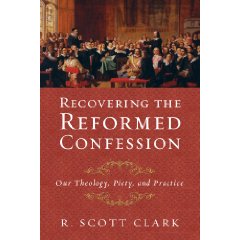
clark recoveringNot exactly, but the pastor of Redeemer Presbyterian Church in New York City did say in his interview with Mike Horton at the White Horse Inn that confessional Christianity is the answer to the problems confronting the contemporary church. Okay, he said, “confessional evangelical” Christianity, which to confessional Protestants is a bit of an oxymoron since evangelical stands closer to pietist than confessional on the spectrum of Protestant Christianity. Even so, there Keller was telling Mike and company that teaching the Heidelberg, and adding more liturgy, is what the ailing Protestant witness needs. Along the way, Keller said that confessional churches were the proper antidote to megachurches, which at least in his experience are too slick, too entertainment oriented, and too consumerist for the sophisticates who reside in Manhattan.

I sure wish Mike had asked Keller more about confessional Protestantism and where Redeemer Church is exactly on the faith and practice of Reformed Christianity. Granted, Keller was on to talk about his book, Reasons for God, which is a work of apologetics, not pastoral ministry. Even so, the discussion was revealing if only because reaching unbelievers is something that has bound Redeemer closer to Willow Creek than Keller let on with his contrast between confessional and megachurch churches.

What Keller did not concede is that he and Bill Hybels have emerged as gurus for an approach to church planting that is “seeker-sensitive.” The seekers may be suburban Chicagoans or cosmopolitan New Yorkers. But in both cases the stress has been more on winning people over than on discipling the won in the whole counsel of God, as in the Great Commission’s “everything I have commanded you.” This is not to say that evangelism is wrong or bad. It is to question whether evangelism is the paradigm for a full-service church in the tradition of Reformed confessionalism. I mean, if you classify your worship services according to musical style as Redeemer does – classical or jazz – you may not exactly have read through Clark’s Recovering the Reformed Confession about the nature and piety of confessional Protestantism.

What makes this point even more plausible is something that Keller wrote about a month before appearing on Horton’s show. At his blog Keller wrote:

The time at Willow led me to reflect on how much criticism this church has taken over the years. On the one hand, my own ‘camp’ — the non-mainline Reformed world — has been critical of its pragmatism, its lack of emphasis on sound doctrine. On the other hand, the emerging and post-modern ministries and leaders have disdained Willow’s individualism, its program-centered, ‘corporate’ ethos. These critiques, I think, are partly right, but when you are actually there you realize many of the most negative evaluations are caricatures.

Keller goes on to say that with the assistance of John Frame he has come to a new appreciation for Hybels and Willow Creek. (Note: Keller and Frame share more than tri-perspectivalism in common; they also understand the nature and character of Reformed worship in ways that contravene the regulative principle as found in both the Westminster Standards and the Three Forms of Unity.) According to Keller, applying Frame, Willow Creek manifests a “a ‘kingly’ emphasis on leadership, strategic thinking, and wise administration.” Keller admits that sometimes the Willow Creek model “obscures how organic and spontaneous church life can be.”

But that concession leads Keller once again to give another of his “with-presbyters-like-this-who-needs-evangelicals” stands for the Reformed tradition. He writes that “Reformed churches have a ‘prophetic’ emphasis on preaching, teaching, and doctrine” but the danger is “a naïve and unBiblical view” which assumes “that, if we just expound the Word faithfully, everything else in the church — leader development, community building, stewardship of resources, unified vision — will just happen by themselves.” (To complete Frame’s triangle, Keller credits the emergent church with an emphasis on community, liturgy and sacraments.”)

This perspective on the Reformed ministry does explain why Keller didn’t endorse Clark’s book. It also indicates why Keller and the rest of Redeemer’s staff need to read it. Confessional Protestants do not believe simply, to paraphrase a line from Field of Dreams, “if you preach it, they will come.” I know pastors in the Redeemer NYC diocese who accuse the Reformed tradition of being logocentric. If that means affirming the formal principle (sola scriptura) of the Reformation, then I’ll accept the label.

But church life is much more than preaching and teaching the Bible and our Reformed confessions teach this. They say all sorts of interesting things about word, sacraments, prayer, discipline, worship, the Lord’s Day, communion, ordination, and polity. They all assume that these teachings require the efforts of pastors and elders who attend session and consistory meetings, presbyter and classis, General Assembly and Synod, visit with families in their homes and the sick in hospitals, catechize the youth, practice hospitality, and prepare high-carb casseroles and jello salads for pot-luck suppers.

That kind of hands-on, local ministry is what animates confessional Presbyterianism. As Old Lifers know, it is seeker-sensitive in the best sense of the phrase, namely, serving the God who seeks Christians who worship in spirit and truth.

Military Chaplains — What's Up with That?

I have long wondered about the propriety of military chaplains. Mind you, I know some military chaplains and even have them for friends. But the complications to jure divino Presbyterianism that come from ministering as an agent of the state pale in comparison to the sort of ministerial promiscuity that goes on among the denominations (both liberal and non-Protestant) represented in the chaplaincy.

And sometimes you find support for your views in the oddest of places. I was reading John Frame’s book, Evangelical Reunion, recently and came across this:

A fellow minister in my presbytery is a navy chaplain. He is a pretty strict Calvinist, zealous to maintain doctrinal purity in the church. He would, I have no doubt, strongly oppose any candidate for the Presbyterian ministry who was charismatic in his theology.

Yet, in a recent report of his work as a chaplain, he told the presbytery that God had given him a fellow worker who was a member of the Assemblies of God. The chaplain rejoiced, for this worker was a real evangelial believer who proclaimed the gospel. There was little if any conflict between them; the theological difference seemed small compared with the great gap between the Christian and the non-Christian servicemen.

I could not help but remark (mentally!) that my fellow Presbyterian was rejoicing in a kind of alliance that he would certainly repudiate within his denomination.

Ding! Ding! Ding!

Of course, Frame was using this as an argument for greater unity and cooperation among Presbyterians and evangelicals. But can’t it also be used to pull the plug on ordaining men as military chaplains?