Debtors to Ireland

It was a soft landing mainly coming back from Dublin over the weekend. Encountering a Buffalo Wild Wings store — how could you possibly call that a restaurant — was certainly a reminder of how bizarre American culture must look even to other Westerners. Comparing a BWW to O’Neill’s pub in Dublin may not be fair. But I am not sure why one room needs what seemed like 67 television screens. Back in Dublin, not even all the screens were on even if a soccer match was available. And some patrons came to the pub to talk about the choral concert they had heard at the University, others were playing a friendly game of cards, and young men predictably were picking up girls (while also unexpectedly explaining Ireland’s strict divorce laws). Having the Fighting Irish on against U.S.C. did not make up for the difference.

The Mrs. and I spent the night in Illinois (having flown to and from O’Hare) and so worshiped yesterday at an area Orthodox Presbyterian congregation before driving back to Hillsdale. We were greeted by the invocation of a minister whose roots, according to accent, were in Scotland. I know that Ireland and Scotland represent distinct forms of resisting England, with Northern Ireland throwing an odd wrench into such patterns of resistance. But the Scottish accent was a pleasant echo of our previous Sunday’s worship in Belfast among the Evangelical Presbyterians. Helping the transition was singing the eighth-century Irish hymn, “Be Thou My Vision.” Since only two days before we had seen a round tower at Glendalough, the site of remains from a seventh-century monastery founded by St. Kevin, the line, “Be Thou my Dignity, Thou my Delight; Thou my soul’s Shelter, Thou my high Tower,” took on added significance.

One of the arresting aspects of Orthodox Presbyterian life is that we are ethnically a denomination of mongrels. Of course, the dominant ethnicity in the OPC is the one that comes to most immigrants after they have lived in the U.S. for generations. At the same time, since hyphenated Americans like John Murray and Cornelius Van Til were so crucial to the first thirty years of the OPC’s history, the denomination has always made room for European expressions of Reformed Protestantism in ways unusual among other American Presbyterian communions. This was particularly true of the OPC congregation where we worshiped yesterday. In addition to having a minister of recent Scottish origin, the session was composed of men all with Dutch names. Rare would be the mingling of Scottish or Scotch-Irish and Dutch Reformed constituencies in Ireland and Scotland. In the United States, it is at least possible if not common. Not to be missed is what the tensions among the various Reformed groups look like in North America. My sense is that the Dutch compete for dominance in ways unimaginable to the Scots and Ulster Presbyterians. Is that a function of ethnicity? Or is it the result of an intellectual tick in Kuyperianism compared to a tiredness among proponents of covenanting or the establishment principle?

The presence of pastors in American Presbyterian circles from Scotland and Northern Ireland does raise an important question about the United States’ relative hegemony in world affairs, not just politically but also ecclesiastically. Because this nation is one of the most powerful and wealthiest in the world, its congregations, even in sideline denominations like the OPC, can afford to pay pastors more than congregations can in Ireland and the United Kingdom. Carl Trueman sometime ago discussed the significance of a British invasion among Reformed and Presbyterian churches in the U.S. What I worry about is the brain drain from other parts of the world. Of course, American communions should not refuse to call men from other nations — that would be remarkably provincial and prevent Christians in the United States from benefiting from insights from other groups of believers. At the same time, American openness to internationals can be naive to the toll that the transfer of gifted pastors from other nations has on the exporting churches. Americans may benefit from gifted Brits, but what benefit to the British churches receive from losing their leading pastors?

For that reason, I propose that every time a congregation in the United States calls a pastor from another country, that congregation (and possibly presbytery or classis) also send back some form of subsidy to the communion that lost its minister to the United States. Monetary assistance would be one form that this subsidy could take. If denominations in the United States were willing to assist foreign denominations financially, perhaps some gifted ministers would remain in their native lands. But U.S. Reformed and Presbyterians might also consider sending to other Reformed communions (and picking up the tab) young ministers who for a short tenure of two or three years would help to plant other congregations or assist busy ministers in established works.

These are a couple of thoughts off the top of a jet-lagged head that may need more clarity. Whatever these ideas’ merits, Christians in the United States should consider the balance of trade within international Calvinism as much as they worry about their nation’s trade deficit.

If You Can Put A Woman in the Pulpit, You Can Self-Serve the Lord's Supper on the Moon

Thanks to Joe Carter comes a link to the news story about Buzz Aldrin’s observance of the Lord’s Supper (by himself no less) on the moon. Because NASA was receiving flack from Madalyn Murray O’Hair for the astronauts on Apollo 8 reading from Genesis, the federal authorities decided to let Aldrin commune on his own without a radio broadcast of the event.

But the Presbyterian Church that supplied Aldrin with elements and utensils has not kept the event silent:

. . . at Webster Presbyterian church – the spiritual home of many astronauts – Aldrin’s communion service is still celebrated every July, known as Lunar Communion Sunday. Pastor Helen DeLeon told me how they replay the tape of Aldrin on the moon and recite Psalm eight, which he had quoted on his return trip to Earth (“… what is man that thou art mindful of him”). The church still holds the chalice that Aldrin brought back with him. Judy Allton, a geologist and historian of Webster Presbyterian church, produced a paper, presented at a Nasa conference, arguing that communion could be an essential part of future manned space travel. She claims that rituals such as Aldrin’s communion “reinforce the homelink”.

Perhaps if the PCUSA congregation (was it PCUS or UPCUSA then?) had had the sense to see the problem with private observances of the Supper, they might have also detected the anomalies of ordaining a woman. I do wonder if Christian readers of this story will be more inclined to see this as evidence of secular government run amuk than an instance of liberal Christianity.

(Will this get me any blog-cred with the Baylys? I’m not holding my 2k breath.)

Do People Still Read Keller?

I am beginning to wonder if Tim Keller’s remarkable run of influence is beginning to expire. The reason for wondering is his recent post — an excerpt from his new book, Center Church — at the co-allies’ blog. Although Keller’s failure to be the Presbyterian minister his credentials say he is aggravate the bejeebers out of me, this time his call for a gospel movement seems tired, bordering on #sotenminutesago. It used to be that a megachurch in New York City receiving favorable press coverage in both religious and secular publications was novel. Now it’s not. Does anyone get excited about Willow Creek anymore? Or does Bill Hybels look in comparison to Rob Bell the way Larry David Lucille Ball does to Lucille Ball Larry David? At a certain point, Keller’s cheerleading for the modern metropolis and Redeemer’s cutting edge ministry sounds stale.

In this case, though, Keller himself sounds fatigued. The reason may be that the only way he can conceive of transforming the city is to concoct a set of hoops and ladders that only the Navy Seals could negotiate. According to Keller, a gospel movement requires three things: a contextual theological vision, church planting and church renewal movements (that’s only one thing even though its a mouthful and a bit redundant — you need a movement to have another movement), and specialized ministries. Here’s where tiredness sets in, at least for readers:

Based in the churches, yet also stimulating and sustaining the churches, this third ring consists of a complex of specialty ministries, institutions, networks, and relationships. There are at least seven types of elements in this third ring.

1. A prayer movement uniting churches across traditions in visionary intercession for the city. The history of revivals shows the vital importance of corporate, prevailing, visionary intercessory prayer for the city and the body of Christ. Praying for your city is a biblical directive (Jer 29:4-7). Coming together in prayer is something a wide variety of believers can do. It doesn’t require a lot of negotiation and theological parsing to pray. Prayer brings people together. And this very activity is catalytic for creating friendships and relationships across denominational and organizational bounderies. Partnerships with Christians who are similar to and yet different from you stimulates growth and innovation.

2. A number of specialized evangelistic ministries, reaching particular groups (business people, mothers, ethnicities, and the like). Of particular importance are effective campus and youth ministries. Many of the city church’s future members and leaders are best found in the city’s colleges and schools. While students who graduate from colleges in university towns must leave the area to get jobs, graduates form urban universities do not. Students won to Christ and given a vision for living in the city can remain in the churches they joined during their school years and become emerging leaders in the urban body of Christ. Winning the youth of a city wins city natives who understand the culture well.

3. An array of justice and mercy ministries, addressing every possible social problem and neighborhood. As the evangelicals provided leadership in the 1830s, we need today an urban “benevolent empire” of Christians banding together in various nonprofits and other voluntary organizations to address the needs of the city. Christians of the city must become renowned for their care for their neighbors, for this is one of the key ways that Jesus will become renowned.

4. Faith and work initiatives and fellowships in which Christians from across the city gather with others in the same profession. Networks of Christians in business, the media, the arts, government, and the academy should come together to help each other work with accountability, excellence, and Christian distinctiveness.

6. Systems for attracting, developing, and training urban church and ministry leaders. The act of training usually entails good theological education, but a dynamic city leadership system will include additional components such as well-developed internship programs and connections to campus ministries.

7. An unusual unity of Christian city leaders. Church and movements leaders, heads of institutions, business leaders, academics, and others must know one another and provide vision and direction for the whole city. They must be more concerned about reaching the whole city and growing the whole body of Christ than about increasing their own tribe and kingdom.

Who can stand in that great day? What congregation of any means is capable of maintaining members who not only have the financial resources to pay for the church staff all of these ministries require? But after these folks have worked hard for their incomes and given to the church, do they have time to volunteer for all the additional work that this movement requires? If I were a church planter (I am sort of but I understand Hillsdale is unimportant in the world of ministering to global cities), I’d close Keller’s book and look for another model.

The funny thing is that the pastoral epistles provide an alternative (not to mention the Protestant Reformation’s success in European cities) and the way to advance the kingdom of grace is not nearly as arduous as what Keller prescribes. Granted, the preaching of the word may not produce a self-sustaining movement that will rock the earth’s biggest cities. But for some reason, Paul did not peg the value of the kingdom of grace according to the gospel’s reception among city dwellers.

Three Strikes and You're Out

The piece by David Noe on Christian education (or the lack of it) has attracted a number of heated responses and none of them give much confidence that the proponents of Christian education are going to do something that is distinctly Reformed or decidedly educational. But these responses show the real weaknesses of w-w thinking and why their days are numbered unless they come up with more compelling answers and arguments.

Strike One: Noe’s piece has received much more indignation (Kuyper is turning in his grave) than it has reasoned response. Does this mean that Christian education is not interested in hard questions, only in passing on received ideas that can never be questioned lest we upset the dead? If so, I’m not sure these people are doing something that is genuinely educational, especially when it comes to teaching subjects like Shakespeare and chemistry on which Christians might have different ideas and about which Scripture is silent.

Strike Two: advocates of Christian education do not seem to notice that their practice is only generically Christian and not distinctly Reformed. (When they appeal to Augustine and Aquinas is Van Til turning in his grave?) They like to quote Cornelius Van Til who argued for an education based on a Reformed outlook. But what college or Christian day school has insisted on teaching Reformed theology, even to the Baptists and Evangelical Free Church students who enroll? Why is it that the more tenaciously an educational institution holds to the distinctness of Christian schools, the less Reformed they become? (Does question this make Dr. K.’s brain turn?)

Strike Three: advocates of Christian education invariably quote the likes of Van Til and Machen on the import of Christian schools. But the formal principle of the Reformation — sola scriptura — teaches that we are to base our faith and piety not on the doctrines and commandments of men but on the word of God. In which case, what kind of response is it to point out that Noe may disagree with Machen or Van Til? Machen was not the pope, not even the apostle Paul. He could have been wrong. Dr. Noe could be wrong. So if the advocates of Christian education want to be Christian and even Protestant, why not make a concerted exegetical case for Christian schools and colleges from the Bible, not from dead Reformed luminaries? (By the way, a wave of the hand to Deuteronomy 6 is insufficient.)

One aspect of this controversy that has yet to receive the attention it should is the difference between Dutch Calvinism and American Presbyterianism. Dutch Reformed Protestants, from the Afscheding to Dr. K., have insisted on Christian education and this reflects at least a European perspective on schooling that is foreign to the United States where public schools were always generally acceptable among American Presbyterians. Only for a brief period in the mid-19th century did Presbyterians entertain the idea of Christian schools. But the thought quickly passed and Presbyterians went back to the public schools where a generic Protestantism (via Bible reading and prayer) prevailed. Only after the Civil Rights legislation did American Presbyterians, primarily in the South, turn to private Christian schools, at least in part to avoid desegregation of public education.

The historical experiences of American Presbyterians and Dutch Calvinists rarely comes up in these discussions because Kuyperians have dominated conservative Reformed Protestantism in the United States, as if Dutch norms are the patterns for Yankees, Rebels, Farmers, and Miners. This is, as I’ve written before, one of the important features of David VanDrunen’s big book on two-kingdom theology — to show how Dutch Calvinism has dominated discussions of natural law and two kingdoms. Sometimes we need to pinch ourselves to remember that Reformed and Presbyterian churches existed before Abraham Kuyper and that they did not always do what he did. For conservative Calvinists who think Kuyper was merely following Bucer, A Lasco, and Ursinus, the idea that differences exist between the Dutch polymath and his Reformed forebears is alarming (and the source of most opposition to a certain seminary on the West Coast). But it is true. Kuyper was not the reincarnation of Calvin or Knox. That’s why they call it neo-Calvinism.

Things You Won't Hear the Young and Restless Say

This video has not gone viral the way that the one about Jesus hating religion did, but it offers another window into Calvinism among the millennials and shows that the likes of Driscoll, Mahaney, Piper, and Keller don’t have a corner on the demographic. Deciphering the logos on t- and sweatshirts and interpreting the prayers indicate that this fellow is from a southern PCUSA background, likely went to Clemson, participated in PCUSA youth culture retreats at Montreat in North Carolina, and is now studying for the ministry at my alma mater (name dropping alert!), Harvard Divinity School.

I know this video is meant to be funny and lighthearted, but by implication it has a serious side. This fellow who is clearly capable will likely find out once he passes his ordination exams that many of the PCUSA’s orthodoxies on women, gender-inclusive language, and church bureaucracy will not be laughing matters.

Some viewers have commented that this video is a great example of “inside baseball humor” for Presbyterians. It is that. But it is also an indication of how easily mocked are some of the seismic shifts from the recent past that now define the mainline Protestant denominations.

I could well imagine someone making a funny video about the culture of Orthodox Presbyterians (and if anyone is inclined to do this please make sure that you feature untucked shirttails drooping beneath suit coats). But I also think an insider would have trouble poking fun at the beliefs that have mattered to conservative Presbyterians. It could just be me, but I always find mainline efforts to accommodate women and evangelical endeavors to promote real manhood much funnier than the nature and meaning of Christ’s sacrifice.

(Thanks to our Roman Catholic correspondent)

Is Reformed Worship Ethnic?

While nursing a bad cold yesterday (which seems to be more, but heck if this child of Depression Era children is going to see a doctor), I went to the website of Independent Presbyterian Church in Savannah and heard a couple of fine catechetical sermons by senior pastor, Terry Johnson. One was on effectual calling and one on justification and adoption. I believe I heard mention of “union” twice. But I digress.

While at the church’s website I also ran across a series of posts by Terry on Reformed Worship and Ethnic Churches. It is smart and reflects Johnson’s own work on the history of Reformed worship. Terry also shows the welcome capacity to read outside biblical and theological sources to understand the common realm of culture. What follows is from the second part of the series:

There would seem to be many who think that the only “authentic” black worship is of the Pentecostal variety. The DNA of African Americans, so the theory goes, requires “emotionally expressive” music, preaching and congregational interaction. Thomas Sowell, scholar at Stanford University, Hoover Institute, offers another perspective. He connects inner-city African-American culture, including black dialect and music, the ghetto culture of violence, promiscuity, and indolence, as well as the oratorical style and the emotionalism of African-American church culture, with the northern Britains who populated the Southern states in the eighteenth century. They brought their social pathologies with them from the lawless, violent, barely civilized border regions of late 17th to early 18th century northern Britain including Scotland, and northern Ireland, and perpetuated them in what became white “redneck” culture. Poor “crackers,” as rural southern whites are sometimes called, provided the cultural context within which slave and post-emancipation African-American culture developed. It was “cracker” social and religious behaviors which southern blacks often mimicked.

Whether you agree with Johnson or Sowell, this is a perspective worth considering and one that you seldom hear from sappy evangelicals.

Let My Old School People Go

The Baylys not too long ago wondered why conservatives in the PCA were so agitated by the Federal Visionaries but calm about Tim Keller. They had a point even if one could return the favor and ask the brothers who are fraternally out of their minds why they are so worked up about Keller and seemingly indifferent to the dangers of Federal Vision (hint: antinomianism versus neo-nomianism goes a long way to explain the difference).

But the recent verdict in the trial of Peter Leithart suggests that the Baylys misunderstand the PCA altogether. Watching the release of different parts of the transcript has been jaw-droppingly astounding. The defense’s cross-examination of a witness against Leithart — Lane Kiester — was something worthy of a Hollywood production. Now comes Jason Stellman’s closing statement for the prosecution (which refers to the committee’s treatment of Kiester). Here are a few excerpts:

When Dr. Leithart was asked, why is it that people misrepresent you or misunderstand you. I was happy to hear that question asked from a member of this commission. That’s a question that I have often desired to ask of various proponents of the Federal Vision or the New Perspective on Paul. Why is it that your critics somehow never seem to be able to represent you fairly in your own estimation? Why is it that you’re never quoted fairly or in context? Why is that anyone who disagrees with you is somehow always misrepresenting you or failing to understand what you’re saying? And a follow up question would be, and why is it that all these people who misunderstand what you’re saying are all misunderstanding you to be saying the same thing? The answer that Dr. Leithart gave was, well, the reason that I’m so often misrepresented is a clash of paradigms. And I think he’s absolutely right. However, I would describe it as a clash of systems of doctrine. . . .

The Westminster Larger Catechism 69 teaches that our union with Christ is “manifested” by our “partaking of the virtue of his mediation, in [our] justification, adoption, [and] sanctification.” WLC 77 distinguishes justification from sanctification, insisting that while the latter is owing to the infusion of grace, the former is the result of the “imputation of Christ’s righteousness.”

TE Leithart writes:

The Protestant doctrine has been too rigid in separating justification and sanctification, more rigid certainly than Scripture itself…. Justification and definitive sanctification are not merely simultaneous, nor merely twin effects of the single event of union with Christ (though I believe that is the case). Rather, they are the same act.”

The confessional, Reformed doctrine of justification (which TE Leithart calls “illegitimately narrow” and “distorted”) teaches that justification is a legal declaration of God, based upon the work of Christ, by which the obedience and satisfaction of Jesus are imputed to the sinner by faith alone. TE Leithart’s desire to see justification as a “deliverdict” (or, a delivering verdict) that contains within it the deliverance of God’s people from the power of sin (which our Confession calls “sanctification”) is to collapse what Reformed theology has always distinguished (and we have already heard expert testimony to the fact that definitive sanctification is much more closely related to progressive sanctification than it is to justification).

The entire statement is valuable and Jason deserves great helpings of gratitude for his courageous stand against the vagaries and errors of the Visionaries.

But the recent verdicts acquiting Federal Visionaries by two presbyteries within the PCA raise yet again questions about the state, coherence, and discipline of the Presbyterian Church in America. Yes, the denomination has studied Federal Vision and disapproved at the General Assembly level. But life on the ground in the PCA appears to be very different from what the Assembly does. Some have been circulating the website of a congregation in the South which describes a female counselor as a pastor (though since our correspondents in the South and Northwest sent word her title has changed). The Baylys have continued to notice the feminist friendly practices of Redeemer Presbyterian Church in New York City.

But even in much less controversial ways, pastors and congregations in the PCA give evidence of uncertainty about matters Reformed. Over at Vintage73, a blog of young PCA pastors, one contributor comments on three pastoral mistakes he has made so far in his ministry. One was thinking that Rick Warren’s Purpose Driven Church would be fix what ailed his congregation:

2. Going for the silver bullet- this is the ministry mistake of thinking the latest and greatest will solve all of your problems. A few years ago we were all told that using the “40 Days of Purpose” would increase attendance and giving! Great! How do I order? Where do I sign? Churches of all stripes were using it. Sadly, silver bullets only work on werewolves (or so I’m told). Now the silver bullet may be the latest and greatest in technological advancement. “Hey, if we get a Facebook page, start a Twitter account, and use some video that will turn Andy Stanley green with envy, we’ll turn this thing around!” It’s not that we can’t glean some insights from others, but if you think you’ve found the mystery method that will solve all of your ministry’s problems that doesn’t involve theological reflection, prayer, and repentance, my advice is to take your shiny ammo back to where you got it. Here’s an idea: What about starting with a renewed commitment to the primary tools God put in the church’s toolbox such as the ministry of the Word, prayer, sacraments, worship, and fellowship? Just a thought.

This fellow seems to think that his understands it a mistake to was thinking that churches have easy cures. He also indicates a commitment to the means of grace. But even more basic was the problem of a Reformed pastors contemplating using dubious schemes from a Southern Baptist minister. If he Presbyterian pastors simply had a conviction about following Reformed teachings and practices and using Reformed sources, he Rick Warren’s methods would never have had appeal to PCA pastors considered Warren’s project.

In other words, the PCA seems to need a broken windows ecclesiology. This is the idea that if you pay attention to the little things — like what books you use in Bible studies and Sunday school, elements and order of worship, national flags in the auditorium, avoiding both the church and secular holiday calendar — the big things (Federal Vision and Keller) take care of themselves. This means that a communion that practices a level of ecclesiastical policing (i.e. discipline) at the local level will inevitably reflect that same discipline at the denominational level and in turn will likely discourage the less disciplined to affiliate or join.

Which is another way of saying that the reason why certain figures in the PCA get away with what they get away with owes to the ethos of the communion itself. Folks in the PCA show discomfort with putting limits on its officers and agencies. If Keller and the Federal Visionaries find a home in the PCA it is because the PCA is increasingly spacious. Why the denomination has lost that older sense of combating the broadening effects of liberalism is a real question. When it started the PCA was not exclusively an Old School church. But its officers and members had a shared sense of needing to oppose error and that denominations have a record of going off course. Now that liberalism is supposedly defeated, the PCA does not exhibit such wariness. Only the Old Schoolers have it and some dismiss them as crazy TR’s because — well — everyone in the PCA loves Jesus (as if liberals did not). But for Presbyterians, liberalism was not the only problem. In fact, non-Reformed communions, teachings, and practices were also erroneous. To tolerate or overlook their errors was a form of liberalism.

I cannot fathom how the ending to this denominational story will be happy.

Orthodox Presbyterians Rival Gospel Co-Allies Enthusiasm for Enthusiasm

General Assemblies are not always like this but the recent OPC GA did assume more the character of a national preaching conference (of course, minus the celebrity pastors) than a regular meeting of the church’s highest judicial body. All of the presentations from the OPC’s standing committees included historical overviews as well as substantial edification and exhortation from God’s word. Don Poundstone, a retired minister and home missionary, rounded out the proceedings with his address at the Saturday night banquet in which he argued, based on Christ’s responses to Pilate (John 18), that the OPC at its best had been a witness to the truth of Scripture and had affirmed that Christ’s kingdom is not of this world. Video recordings of most of the presentations are available here. (Foreign missions talks are unavailable because of the sensitivity of information regarding several fields of ministry.)

Arguably, one of the most moving parts of the Assembly came on Saturday morning during the presentation by the Committee on Christian Education. Part of the proceedings included a talk by Rev. John P. Galbraith, a 98-year old minister who actually studied at Westminster when Machen was still teaching and went on to serve in a variety of capacities, including General Secretary of both the Committee on Home Missions and the Committee on Foreign Missions. Even before speaking — which revealed a man with a mind still sharp and a tongue still eloquent — Galbraith received a standing ovation from commissioners and guests. The first words out of his mouth were those of the apostle Paul, “I do not understand what I do. For what I want to do I do not do, but what I hate I do.” Galbraith then added, “And you applaud me?”

As near as I could tell, Galbraith’s deflection of applause characterized the week of presentations, devotionals, and sermons. Orthodox Presbyterians were glad to have reached the seventy-fifth birthday, but but they also knew that their history was not sensational or the product of their own faithfulness. (Self-promotion alert: see this point expressed in a different way here.) As cliched as it may have sounded, the truth that human accomplishments were less responsible than God’s grace for the OPC’s “success” was overwhelming sense among all those gathered. Part of the reason must have been that the last time the OPC met to throw a birthday party — in 1986 at Tony Campolo’s Eastern University — the church also voted itself out of existence. That is, the OPC accepted the invitation from the PCA to join and be received into the newer Presbyterian denomination. The proposal did not receive the super-majority of votes needed to be sent to the presbyteries for ratification. But a majority of commissioners in 1986 were willing to hitch their own and longer story to a communion that was less than fifteen years old. After twenty-five years of developments in both denominations, hardly anyone, at least in the OPC, regrets the rejection of J&R.

And so with quiet resolve and restrained joy Orthodox Presbyterians reflected on their past and heard preachers and missionaries recount the mighty deeds of God throughout redemptive history. It was by most accounts a time of great blessing for all who attended, and even prompted some to think that the OPC should sponsor its own national conference. Its speakers, like its history, would not be famous. And so the turnout would be light, insufficient to cover expenses. But those preachers would know their Bibles. Perhaps, just as important, they’d know their place — that the power of their words depends not on their own accomplishments or celebrity but on the God who gave them the word to proclaim.

Is Edwards' Question Even the Right Question?

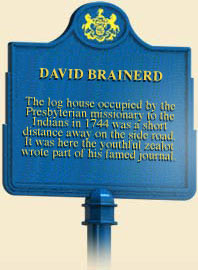
Yes, I may be OCD but my apparent fixation on Edwards has as much to do with current writing projects as taking the pulse of experimental Calvinists. Edwards’ biography David Brainerd has occupied a few mornings this week for a chapter on Calvinism and foreign missions. So sue me.

If Edwards’ defenders are still reading, and if they still think the First Pretty Good Awakening great, then perhaps they could help us all figure out what Edwards was thinking when he wrote this about Brainerd’s conversion and piety:

His first discovery of God, of Christ, at his conversion, was not any strong idea of any external glory or brightness, or majesty and beauty of countenance, or pleasant voice; nor was it any supposed immediate manifestation of God’s love to him in particular; nor any imagination of Christ’s smiling face, arms open, or words immediately spoken to him, as by name, revealing Christ’s love to him; either words of Scripture or any other: but a manifestation of God’s glory, and the beauty of his nature, as supremely excellent in itself; powerfully drawing, and sweetly captivating the heart; bringing him to a hearty desire to exalt God, set him on the throne, and give him supreme honor and glory, as the king and sovereign of the universe; and also a new sense of the infinite wisdom, suitableness, and excellency of the way of salvation by Christ; powerfully engaging his whole soul to embrace this way of salvation, and to delight in it.

Okay, so this is the standard starting point of Christian hedonism. Genuine faith begins with the convert being enraptured with God. Self-interest is forbidden. The aim of faith is to glorify and exalt God, and to deny the self and renounce pride. This description is, for that matter, close to Edwards’ own account of his own conversion.

But Edwards goes on to contrast Brainerd’s conversion with either an inferior or illegitimate kind:

His first faith did not consist in believing that Christ loved him, and died for him in particular. His first comfort was not from any secret suggestion of God’s eternal love to him, or that God was reconciled to him, or intended great mercy for him; by any such texts as these, “Son be of good cheer, thy sins are forgiven thee. Fear not I am thy God,” &c. or in any such way. On the contrary, when God’s glory was first discovered to him, it was without any thought of salvation as his own. His first experience of the sanctifying and comforting power of God’s Spirit did not begin in some bodily sensation, any pleasant warm feeling in his breast, that he (as some others) called the feeling of the love of Christ in him, and being full of the Spirit. How exceeding far were his experiences at his first conversion from things of such a nature! (Life of David Brainered, (1835], 249)

Hence, the question “what must I do to be saved” is the wrong question to ask for someone seeking salvation. Instead, Edwards seems to prefer “how must I glorify and hedonistically enjoy God?” But as close as that question is to the start of the Shorter Catechism, it is several steps removed from “What is effectual calling?” “Effectual calling is the work of God’s spirit whereby, convincing us of our sin and misery, enlightening our minds in the knowledge of Christ, and renewing our wills, he enables us to embrace Christ freely offered to us in the gospel.”

The Shorter Catechism would appear to be describing something close to the beginning of genuine belief in a Christian, and it says very little about the glory of God. It says much about the sinner’s need, and Christ’s remedy for sin, not to mention the work of the Spirit.

So I wonder what Edwards was thinking, and why so many evangelical Calvinists find his devotion appealing.

Where Have All the Presbyterians Gone? They Joined Networks

Russell Moore, academic dean at Southern Baptist Seminary, wrote a piece for the Wall Street Journal that attracted the attention of many Presbyterians thanks to his title, “Where Have All the Presbyterians Gone?” Since Moore is a Southern Baptist, perhaps he should not have weighed in on matters Presbyterian. But then again, asking the question “Where Have All the Baptists Gone?” would be silly since the Southern Baptist Convention weighs in a the largest Protestant entity in the United States. We can’t really call it a denomination or a communion because being Baptist is premised on preserving the authority and autonomy of the local congregation.

Moore’s point was not so much to tell Presbyterians to shape up but to observe the decline of denominationalism in the United States – or more accurately, the loss of denominational brands for believers’ identity, such as “Hug me, I’m a Presbyterian.” He writes:

Studies conducted by secular and Christian organizations indicate that we are. Fewer and fewer American Christians, especially Protestants, strongly identify with a particular religious communion—Methodist, Baptist, Presbyterian, Pentecostal, etc. According to the Baylor Survey on Religion, nondenominational churches now represent the second largest group of Protestant churches in America, and they are also the fastest growing.

Moore argues that the rise of megachurches corresponds to Americans looking for church for practical reasons: “Is the nursery easy to find? Do I like the music? Are there support groups for those grappling with addiction?” If people bring these concerns to a Baptist church, they may be disappointed: “A church that requires immersion baptism before taking communion, as most Baptist traditions do, will likely get indignant complaints from evangelical visitors who feel like they’ve been denied service at a restaurant.”

But Moore sees some hopeful signs for a return to an older understanding of church, grounded in a doctrinal and evangelistic identity. One sign is the growth of the Southern Baptist Convention, which has 10,000 seminarians now a six different schools.

Moore concludes:

If denominationalism simply denotes a “brand” vying for market share, then let denominationalism fall. But many of us believe denominations can represent fidelity to living traditions of local congregations that care about what Jesus cared about—personal conversion, discipleship, mission and community. Perhaps the denominational era has just begun.

The SBC may not be the best case for denominationalism not simply because it is self-consciously not a denomination but also because it hardly has the order or unity that insures a SBC congregation in Saddleback, California will be remotely similar to one in Louisville, Kentucky. But the point about the decline of denominations is fitting and the example of Presbyterians is a good one. Aside from the mainline PCUSA, which continue to hemorrhage its millions, the largest Presbyterians denominations are in the thousands: the PCA at roughly 300,000, the EPC at approximately 60,000, and the OPC bringing up the rear at around 30,000.

One factor in Presbyterian decline that Moore should not have been expected to acknowledge (since you need some local knowledge) is the phenomenon of Presbyterians becoming networkers. An irony of Moore’s piece is that it came out the same week that David Nicholas, one of the leaders in church networking, died. The founding pastor of Spanish River Church (PCA) in Boca Raton, Florida, Nicholas also established the Church Planting Network, which according to the website has nine churches around the world.

That may seem an insignificant number until you factor in that Nicholas was an important force behind two other significant church planting networks: Acts 29 and Redeemer City to City. Nicholas’ Church Planting Network may not have impressive numbers, at least according to its website, but his congregation, Spanish River, helped to plant close to forty other churches in the PCA, including Keller’s Redeemer Presbyterian Church. It is hard not to imagine that the idea for Keller’s Redeemer City to City network of churches came from Nicholas’ own Church Planting Network.

But even more impressive, if you’re of the New School Presbyterian worldview, is Nicholas’ connection to Mark Driscoll and the Acts 29 Network. According to the Acts 29 website:

Pastor Mark Driscoll founded the Acts 29 Network with Nicholas in 2000. Nicholas was influential in starting many current Acts 29 churches, and provided much support for many of our church planters.

The list of congregations associate with Acts 29 is too long to count – though it does feature some nifty logos (which also make the page a bit tardy in loading) – but it indicates another successful network that traces its roots to Nicholas. I am almost tempted to say that Nicholas is the man behind the Gospel Coalition since his fingerprints are all over two of the larger celebrities in that phalanx of Christian allies. Which makes Nicholas the leaven for yet another network of congregations, since the Gospel Coalition is also web of congregations.

And just when we were finished with Presbyterian networks comes news of yet another Presbyterian connection of congregations, in this case a group of churches from the mainline PCUSA who have finally concluded that their denomination is “deathly ill.” As such, these pastors believe a new form of connection is important for Presbyterian conservatives:

We believe the PC(USA) will not survive without drastic intervention, and stand ready to DO something different, to thrive as the Body of Christ. We call others of like mind to envision a new future for congregations that share our Presbyterian, Reformed, Evangelical heritage. If the denomination has the ability and will to move in this new direction, we will rejoice. Regardless, a group of us will change course, forming a new way for our congregations to relate. We hate the appearance of schism – but the PC(USA) is divided already. Our proposal only acknowledges the fractured denomination we have become.

In which case, the answer to Moore’s column is this: Presbyterians abandoned the structures that made their denominations tick – such instrumentalities as sessions, presbyteries, synods, and assemblies for overseeing the ministry of word and sacrament. Instead of being Presbyterian, many Presbyterians find more congenial surroundings in locales where the schmoozing, entrepreneurialism and informal alliance-building are characteristic of being the church. Have they swapped Presbyterianism for Rotarianism? Maybe so.

This is a revealing development on two levels. The first is the fading cachet of Presbyterianism itself as a religious and theological brand. Time was in the not so distant past when saying you were Presbyterian was to indicate that you were part of a broad swath of American Protestantism that was respectable, reliable, dignified, and even refined. Granted, such cultural Presbyterianism was too much bound up with the mainstream Protestant project of aiding and abetting the American way as the Protestant way. Still, being Presbyterian was desirable because it connoted a certain seriousness of purpose – like DuPont or IBM.

For conservatives outside the mainline, being Presbyterian said less about being from the right social circles and more about identifying with the Reformation and its wonder-working powers in reshaping western civilization. To be Presbyterian was to draw a connection to John Calvin and John Knox, and to place yourself within a certain trajectory of European history and the West’s heritage. To be sure, Presbyterianism was more than history or cultural significance, but it suggested a faith and worship that was older, weightier, and more profound than fundamentalism or dispensationalism.

But Presbyterianism no longer has such cultural resonance. The networkers seem to have calculated that they have less to lose by abandoning an older identity for a new constellation of congregations orbiting around a single congregation, visionary pastor, or – better yet – celebrity preacher.

The second oddity about the current Presbyterian penchant for networking is how little consideration its advocates seem to give to the ephemeral character of these ties. Say what you will about denominations, they last in ways that networks do not. Does anyone remember the Moral Majority? How about the Evangelical Alliance? So why will Acts 29 survive the career of Mark Driscoll or Redeemer City to City outlive Tim Keller? Once Jack Miller, the founder of one of Presbyterianism’s original networks, the New Life phenomenon, New Life Presbyterian congregations have persisted but the buzz no longer fizzes. So if you are a congregation looking for a larger set of associations, you may think that Acts 29 is a solid bet. But will you actually receive any of the care and oversight that a Presbyterian denomination provides through its – yes dull – but effective structures?

Of course, the more important question is whether God has ordained networks to feed his flock. Granted, some will likely argue that denominations have no such divine imprimatur. But because Presbyterian denominations do have sessions, presbyteries, and assemblies, they are actually far more biblical than any network of churches, no matter how Calvinistic its celebrity leader or creative its congregations’ logos.

Correction: The Evangelical Presbyterian Church claims approximately 115,000 members. (Thanks to one of our scrupulous readers.)