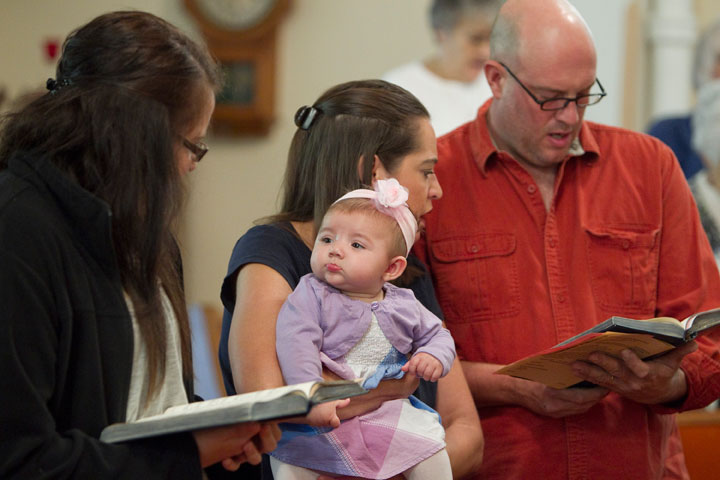
Luther Answers the Question

Such justification is hidden not only from reason and the world but also from the saints. For it is not a thought, word, or work in us, but it is quite outside and above us, for it is Christ’s going to the Father, which means His suffering, Resurrection, and Ascension. And this does not take place within the range of our senses, so that we might see or feel it; but we can grasp it through faith alone.

And this is a remarkable justification, that we should be called just or possess a righteousness which is no work or thought of ours, and is nothing in us, but is completely outside of us, in Christ, and yet is truly made ours through His gracious gift and as completely our own as if it had been attained and merited by our own selves. No reason could understand this language which gives the name justification to me where I neither do or suffer anything, neither think, sense, or feel anything, and there is nothing in me by reason of which I could be saved and made well-pleasing to God; but apart from myself and all man’s thoughts, works, and powers, I hold on to Christ (seated on high at the right hand of the Father), although I cannot see Him.

But faith can grasp it and build upon it and find strength through it in the midst of temptation. (Exposition of John 16)

Nevin: Why Revivals Aren't the Answer

This is an account of Nevin’s experience as an undergraduate at Union College. It shows what happens to children of the covenant, away at college, when confronted with the modern revival system. And this was only 1819. Yikes!

Being of what is called Scotch-Irish extraction, I was by birth and blood also, a Presbyterian; and as my parents were both conscientious and exemplary professors of religion, I was, as a matter of course, carefully brought up in the nurture and admonition of the Lord, according to the Presbyterian faith as it then stood. I say with purpose as it then stood; for I cannot help seeing and feeling, that as a very material change has come upon since, and this in a way not without serious interest for my own religious life.

What I mean, will appear at once, when I state, that the old Presbyterian faith, into which I was born, was based throughout on the idea of covenant family religion, church membership by God’s holy act in baptism, and following this a regular catechetical training of the young, with direct reference to their coming to the Lord’s table. In one word, all proceeded on the theory of sacramental, educational religion, as it had belonged properly to all the national branches of the Reformed Church in Europe from the beginning. In this respect the Reformed Churches of Switzerland, France, Germany, Holland and Scotland were of one mind; and this mind still ruled, at the time to which I now refer, the Presbyterianism of this country. True, there was no use here of the rite of confirmation in admitting catechumens to full communion with the Church; but there was, what was considered to be substantially the same thing, in the way they were solemnly received by the church session. The system was churchly, as holding the Church in her visible character to be the medium of salvation for her baptized children, in the sens of that memorable declaration of Calvin (Inst 4.1.4), where, speaking of her title, Mother, he says: “There is no other entrance into life, save as she may conceive us in her womb, give us birth, nourish us from her breasts, and embrace us in her loving care to the end” . . . .

We had no religion in college, so far at least as morning and evening prayers went; and we were required, on Sundays, to attend the different churches in town. But there was no real church life, as such, in the institution itself. . . . . All this involved, of course — although, alas, I knew it not then — a very serious falling away from the educational and churchly scheme of religion, in which I had been previously born and bred. It was my very first contact with the genius of New-England Puritanism, in its character of contradiction to the old Reformed faith, as I had been baptized into it, in its Presbyterian form. . . . It is hardly necessary to say, that circumstanced as I then was, I had no power to withstand the shock. It brought to pass, what amounted for me, to a complete breaking up of all my previous Christian life. For I had come to college, a boy of strongly pious dispositions and exemplary religious habits, never doubting but that I was in some way a Christian, though it had not come with me yet (unfortunately) to what is called a public profession of religion. But now one of the first lessons inculcated on me indirectly by this unchurchly system, was that all this must pass for nothing, and that I must learn to look upon myself as an outcast from the family and kingdom of God, before I could come to be in either in the right way. Such, especially, was the instruction I came under, when a ‘revival of religion,’ as it was called, made its appearance among us, and brought all to a practical point. . . . For I, along with others, came into their hands in anxious meetings, and underwent the torture of their mechanical counsel and talk. One after another, however, the anxious obtained ‘hope;’ each new case, as it were stimulating another; and finally, among the last, I struggled into something of the sort myself, a feeble trembling sense of comfort — which my spiritual advisers, then, had no difficulty in accepting as all that the case required. In this way I was converted, and brought into the Church — as if I had been altogether out of it before — about the close of the seventeenth year of my age. My conversion was not fully up to my own idea, at the time, of what such a change should be; but it was as earnest and thorough, no doubt, as that of any of my fellow-converts. . . . It was based throughout on the principle, that regeneration and conversion lay outside of the Church, had nothing to do with baptism and Christian education, required rather a looking away from all this as more a bar than a help to the process, and were to be sought only in the way of magical illapse or stroke from the Spirit of God;. . . An intense subjectivity, in one word — which is something always impotent and poor — took the place of a proper contemplation of the grand and glorious objectivities of the Christian life, in which all the true power of the Gospel at last lies. My own ‘experience’ in this way, at the time here under consideration, was not wholesome, but very morbid rather and weak.

Alas, where was mother, the Church, at the very time I most needed her fostering arms? Where was she, I mean, with her true sacramental sympathy and care? How much better it had been for me, if I had only been properly drawn forth from myself by some right soul-communication with the mysteries of the old Christian Creed. (My Own Life, 1870)

Faking It

A few more thoughts on the Duncan, Nevin, Helm, Edwards discussion.

The proponents of Edwards and the First Pretty Good Awakening (hereafter FPGA) are worried about nominal Christianity – that is, people who go through the motions of worship or Christian practice. Although this is an understandable concern – who would ever commend hypocrisy unless you are a vice paying tribute to a virtue – it is also an impossible concern. How does anyone know if another person is faking anything? Only God knows the heart. So the effort to eradicate going through the motions is a lot like a quest to be God (and wasn’t that what got our first parents into trouble?).

At the same time, why is it that insincerity only goes in one direction? Why is it only possible for Christian profession and practice to betray unbelief? Why can’t unholy actions betray a believing heart? Of course, I’m not trying to justify sin or worldliness. But if the heart is as fickle as pietists believe it is, why isn’t it possible for the duplicity to go both ways? Why can’t a believer’s impious actions actually betray real belief? What if someone is faking unbelief but really believes? If you think this seems preposterous, consider Peter’s thrice denying his Lord. And he became Pope!

Those skeptical about Edwards put less emphasis on the first word of “faking it” and worry more about the it. That is, they (okay, I) worry that the words or actions in question are actually fitting or biblical – fitting within the Reformed tradition or having a warrant from Scripture. Since we can’t know the human heart, at least we can take precaution that the things we do as believers and the things we say actually conform to what Scripture teaches. Let the Spirit take care of the heart, along with pastoral counsel in the privacy of one’s home.

So, for instance, when churches have Thanksgiving Day services where people stand to give testimonies, the Edwards proponents might be very much moved by the woman who stands to give thanks that she recently found a job afer a year of unemployment. And if the woman cries, the Edwardsean might be especially inclined to think this testimony spiritual and genuine. After all, the pro-FPGA saw lots of tears (and more) as evidence of the work of the Spirit. Never mind that sometimes people cry when speaking in public because they are nervous. If affections appear, then hallelujah, we have piety.

Edwards skeptics may also be moved by the emotion, but will also be sitting there going postal internally because of the impropriety of letting people, even saints, stand up and say things without any sort of screening by the pastor and elders. In other words, whether or not someone fakes a testimony, the issue in this case is that testimonies are wrong. The noun (“it”) matters more than the gerund (“faking”).

But Edwards rooters are rarely as worried about the “it” as Edwards skeptics and the reasons are that those who are interested in holy affections often take liberties with the “it” of Christian piety. That is, in order to cultivate and give expression to those genuine affections, pietistically inclined establish new practices, sometimes not having biblical warrant or foreign to the Reformed tradition, in order to fan real spirituality into aflame. The best example of this is the phenomenon of hymns. Prior to the FPGA, Presbyterians all sang psalms (or other biblical songs). But these songs were not as conducive to the revivals of Whitefield, Wesley, and Edwards as were the hymns being written expressly for revivalistic purposes by the likes of Watts and Wesley (Charles, that is).

Now maybe you are a hymn-singing kind of Presbyterian. I myself enjoy a good hymn now and then. But the historical record is remarkably undeniable that hymn singing prevailed among a group of believers previously committed to psalm-singing because those biblical songs weren’t cutting it in the effort to create believers who did not fake singing psalms but really sang hymns.

And now to bring it full circle, hymn-singing Presbyterians in the 1980s were besieged by praise-song singing Presbyterians because the old hymns weren’t up to speed with Jesus people piety.

So once you start down the road of the quest for genuine piety, it’s hard to get off before it turns into the charismatic highway.

I seem to recall Scott Clark writing a book about this.

Edwards Is Not the Answer

Paul Helm has posted his assessment of Religious Affections. Here is a longish excerpt:

In order to get where he wants to go, to establish that true religion, in great part, consists in holy affections, I think it is fair to say that Edwards is forced to considerably widen the scope of what ‘affection’ means. An affection is, after all, nothing more or less than an affect. In the text, there is a contrast between faith and sight, and references to love, and faith (or belief) and joy. Belief is obviously the key. Christians believe in one whom they do not see, and they love him, rejoicing in him with great joy. Their belief affects them in certain ways, for they feel intense love and joy, and perhaps publicly express these feelings. The joy that they feel is the expression of, perhaps a public expression of, being affected by what and who is believed and loved.

Faith and love are virtues, theological virtues, as they used to be called, the fruit of the regenerating and sanctifying work of the Holy Spirit: love, joy, peace, patience, kindness, goodness, faithfulness, gentleness, self-control. (Gal. 5 22-3) An overlapping list is also provided by Paul in Colossians. ‘Put on, then, as God’s chosen people, holy and beloved, compassion, kindness, humility, meekness, and patience, bearing with one another…forgiving each other….above all these put on love…’ (Col. 3. 12-4) Here we must remember that such virtues may lead to expressions of affection, in the sense of passions of emotions, but they may also be present, strongly present, in the absence of ‘sensible’ affection. The emotions or affections that express patience, or kindness, goodness, faithfulness, gentleness or self-control may be very varied, as varied as the circumstances in which they are called forth. One can easily conceive of situations in which , for example, kindness, is expressed in dogged determination. Think of a daughter whose life is consumed with the care of an invalid mother, or the behaviour of caring parents with an autistic child.

In fact, some of these virtues listed by Paul – kindness, faithfulness, gentleness, patience or self-control, seem to be the exact opposite of affections as Edwards would have us understand them, in which ‘the blood and animal spirits are sensibly altered’. They are, or similar to, what Edwards’s contemporary David Hume referred to as the ‘calm passions’. It may even seem that the Apostle is contrasting these virtues, the calm ones, with those that are often publicly expressed in an agitated way, for the lists we have noted have a distinctly ‘calm’ feel to them. A person may be affected by the work of the Holy Spirit, possessing his fruit, in ways that are focused and undemonstrative, which lead to restraint and constraint, which lead to the development of an undeviating routine. They need not be ‘raised’ as Edwards puts it. In his definition and his defence of affection and its place in true religion Edwards fails to remind us of this, but appropriates the term for his own political purposes. Putting the matter bluntly, his definition is an attempt to press the hysteria button.

So when he writes of ‘the religious affections of love and joy’ (95) he is, I suggest, taking liberties with these central Christian virtues in order to advance his thesis. In telling us that ‘the affections are no other, than the more vigorous and sensible exercises of the inclinations and will of the soul’, he is equating vigour and sensibility with self-consciousness and exhibitionism. That is a mistake. Paul tells us that true virtue may consist in self-forgetfulness. It is impossibly hard to derive Edwards’s claims about true religion, that it in great part consists in holy affections, from Galatians 5 or Colossians 3 without requiring that every effect of the work of the Holy Spirit in the promotion of virtue is ‘vigorous and sensible’. Had he taken these other passages of Paul as his text Edwards would have been forced to write a different book.

Vigor and sensibility are essential to Edwards’s basic idea of an affection. Having established, in a way that will be familiar to readers of his work The Freedom of the Will, that the inclination or will is moved by either pleasedness or aversion, he goes on to claim that there are degrees of such aversion or pleasedness, rising to such a height ‘till the soul comes to act vigorously and sensibly, and the actings of the soul are with that strength that (through the laws of the union which the Creator has fixed between soul and body) the motion of the blood and animal spirits begins to be sensibly altered; whence often time arises some bodily sensation, especially about the heart and vitals, that are the fountain of the fluids of the body…..and it is to be noted, that they are these more vigorous and sensible exercises of this faculty, that are called the affections’. (95-6) But Edwards cannot have it both ways. A holy affection cannot both be a vigorous and sensible affect in this sense and it also be the case that true religion consists in them, not at least according to Paul, or James.

Conclusion

The Religious Affections is an important book, but in my view it would be unwise to take its teaching on what true religion consists in very seriously. It is a book about the importance of emotion, expressed in a public, visible way, being the measure of true religion. Its significance lies in its influence upon the evolving character of Protestant evangelicalism, as a phenomenon that identified itself (as David Bebbington has pointed out) partly by activism and conversionism: revivalism, massed choirs, large gatherings of people, the penitent bench, the centrality of the public testimony, and so on. Edwards’s Protestantism was of an older kind, but it nevertheless contained elements which, in other hands, contributed to developing the distinctive features of modern evangelicalism.

Does this make Helm a high-church Calvinist? Or is it simply the case of someone spotting the difference between the quest for visible and outward piety and the inward and less showy sort that attends faith?

Another possibility — the date. Do the Brits observe April 1?

(Thanks to our southern correspondent.)

The Church Is Revival

Why are the people who long for and advocate revivals so negative? What I mean is that the desire for revival appears to breed a fair amount of discontentment. Church members aren’t godly or zealous enough, the pastor isn’t evangelistic enough, the church is too small – these are the sorts of criticisms that are just beneath the surface of calls for an outpouring of God’s Spirit upon his too cold and casual people.

To be sure, Christians can be cold and casual about matters of faith. After all, saints are still sinners and so prone to various spiritual afflictions that impede sanctification. But why do churches have to engage in extraordinary ways of displaying their commitment to Christ? Why do evangelistic rallies, intense meetings of small groups, suffusing water cooler banter with God-talk, numerous conversions, or visible displays of piety (such as listening to inferior Christian music) constitute a work of God? Why doesn’t the weekly worship by word and sacrament, or a regular meeting of session, presbytery, or General Assembly count as a work of God’s Spirit? Why can’t genuine Christian piety be ordinary?

In the case of the church, what is ordinary is actually extraordinary. If you start with the supposition that people are sinners and in rebellion against God, and then find a gathering of believers for a worship service, you may actually think that something remarkable has happened in the lives of these people. And if you consider that most Americans don’t know how to sing independently of singing along with the radio or Ipod, and then you see people on Sunday holding hymnals singing praise to God, you may actually be struck by how extraordinary congregational song is. And if you think about the history of the Christian church and recognize how prone she is to error and unfaithfulness, and then you find a communion that is orthodox in its teaching and sane in its worship, you may be tempted to think that you have experienced a taste of heaven.

And yet, revivalists and the believers who support them are never so impressed by the church in her ordinary ways. Such discontent may actually breed churches filled with malcontents. And yet, in one of the bigger ironies of church history, the revivalists are the ones considered to be the most devout and the most loving when in fact it is the opponents of revival who are actually marked by charity and patience, fruit of the Spirit last I checked, in their dealings with this entity we know as the church militant.

Desiring God or Faith in Christ?

I am falling behind on responses to the last post — the hazards of moving and orchestrating a relocation. TMI alert! But — dare I say — I am still leading family worship, pious Reformed Protestant that I try to be (TMI warning!), and this morning encountered the following from Martin Luther. It strikes me that this understanding of faith, and its different measures among the saints, is way more reassuring than the ecstasy that may accompany desiring God. Not to be missed is that Luther rightly favors the object of faith over the act of faith. The same, I would argue, could be said about charity or any of the other fruits of the Spirit.

In this Christian brotherhood no man possesses more than another. St. Peter and St. Paul have no more than Mary Magdalene or you or I. To sum up: Taking them all together, they are brothers, and there is no difference between the persons. Mary, the Mother of the Lord, and John the Baptist, and the thief on the cross, they all possess the selfsame good which you and I possess, and all who are baptised and do the Father’s Will. And what have all the saints? They have comfort and help promised them through Christ in every kind of need, against sin, death, and the devil. And I have the same, and you, and all believers have.

But this also is true, that you and I do not believe it so firmly as John the Baptist and St. Paul; and yet it is the one and only treasure. It is the same as when two men hold a glass of wine, one with a trembling, the other with a steady hand. Or when two men hold a bag of money, one in a weak, the other in a strong hand. Whether the hand be strong, or weak, as God wills, it neither adds to the contents of the bag, nor takes away. In the same way there is no other difference here between the Apostles and me, than that they hold the treasure firmer. Nevertheless, I should and must know that I possess the same treasure as all holy Prophets, Apostles, and all saints have possessed.

Otherworldly Thursday: Calvin on the Spiritual Life

As much as some critics may question my personal piety, I do daily attend to private worship and often make use of readings from the likes of the Reformers. (It grieves me to admit this since such public unction seems to be at odds with Christ’s own counsel to his followers in Matt 6: 5.) Just this morning I ran across a passage that I felt I should pass along, especially for those neo-Calvinist readers who do seem to be unaware of the difference between their own piety and the one that Calvin embodied and attempted to cultivate among the citizens and exiles in Geneva.

Here is Calvin’s comment and prayer from his lecture on Joel 2:28: And it shall come to pass afterward, that I will pour out my spirit upon all flesh; and your sons and your daughters shall prophesy, your old men shall dream dreams, your young men shall see visions.

Calvin writes:

We have explained why the Prophet began with earthly blessings. One may indeed think that this order is not regular; for Christ does not in vain remind us, that the kingdom of God ought to be first sought, and that other things shall be added in their place, (Matthew 6;) for food, and every thing that belongs to this frail life, are, as it were, additions to the spiritual life. But the Prophet designedly mentioned first the evidence of God’s favor in outward benefits; for we see how slow the perceptions of men are, and how slothful they are in seeking spiritual life. As, then, men rise to things above with so much difficulty, the Prophet makes use of the best helps; and we must indeed be dealt with as we usually deal with children. For as there is not so much discernment in them as to be influenced by reasons, we set before them what is suitable to their weak and simple comprehension; so the Prophet did; for he showed first that God would be kind to the Jews in food for the body, and having used this as a help, he then added, Afterwards I will pour my Spirit upon all flesh.

By these words the Prophet reminds us, that people act absurdly when they are satisfied with vanishing things, when they ask of God nothing more excellent than to be pampered like brute animals; for in what do the children of God differ from asses and dogs, except they aspire after spiritual life? The Prophet, then, after having set before them lower things, as though they were children, now brings before them a more solid doctrine, (for thus they were to be led,) and affords them a taste of the favor of God in its external signs. “Ascend, then, now,” he says, “to spiritual life: for the fountain is one and the same; though when earthly benefits occupy and engross your attention, ye no doubt pollute them. But God feeds you, not to fill and pamper you; for he would not have you to be like brute animals. Then know that your bodies are fed, and that God gives support to you, that ye may aspire after spiritual life; for he leads you to this as by the hand; be this then your object.” We now, then, understand why the Prophet did not at first speak of the spiritual grace of God; but he comes to it now. He began with temporal benefits, for it was needful that an untutored people should be thus led by degrees, that on account of their infirmity, sluggishness, and dullness, they might thus make better progress, until they understood that God would for this end be a Father to them.

Then Calvin prays:

Grant, Almighty God, that since we want so many aids while in this frail life, and as it is a shadowy life, we cannot pass a moment, except thou dost continually, and at all times, supply through thy bounty what is needful, — O grant, that we may so profit by thy so many benefits, that we may learn to raise our minds upwards, and ever aspire after celestial life, to which by thy gospel thou invites us so kindly and sweetly every day, that being gathered into thy celestial kingdom, we may enjoy that perfect felicity, which has been procured for us by the blood of thy Son, our Lord Jesus Christ. Amen.

I do wonder if neo-Cals ever thought about life on planet earth in this way (a radically biblical one?) then they might come around to a higher estimate of the visible church and a more sober regard for cultural endeavor.

History Is Not Rocket Science

. . . but it’s not theology either.

I wonder if they’ll be selling copies of Trueman’s new book at the conference.

If the Gospel Coalition Embraces It, Will 2k Lose Its Edge?

One of the smarter moves by 2k proponents was David VanDrunen’s to publish his sequel to Natural Law and the Two Kingdoms with Crossway, the firm with the most direct ties to the Gospel Coalition, thanks to Justin Taylor’s footprint in both organizations. So far 2k has come into print through outlier publishers, such as Jason Stellman’s Dual Citizens with Reformation Trust, an up-and-comer but not yet on a par with the Grand Rapids and Wheaton publishers; VanDrunen first published his Biblical Case for Natural Law with the Acton Institute and then his book on two kingdoms with Eerdmans – a publisher no longer regarded by sideline Presbyterians as safely orthodox; in my own case, I went to the independent trade publisher, Ivan R. Dee to produce A Secular Faith. With Living in God’s Two Kingdoms, VanDrunen has put 2k theology, with all of its initial oddities and counter-biblicist notions, squarely before the Tim-Keller loving, and John-Piper convicting masses.

Will 2k ever be the same?

Early returns suggest, yes. Here are a few of the responses to Taylor’s recent post on VanDrunen’s latest:

I’ve read VanDrunen’s book and I am surprised that you came to such positive conclusions about it. He makes a few valuable critiques of those who disagree with him, but the overall thrust of his thesis is, quite frankly, unbiblical. His exegesis is shoddy and he makes very dramatic assumptions about his theology’s continuity with historical figures. VanDrunen’s (and to a greater extent, D.G. Hart’s) iteration of two-kingdom theology does not cooperate well with Augustine’s, Calvin’s, or even Luther’s understanding of the Church’s call in the world. Reading this book can be valuable for a number of reasons, but please exercise careful discernment and wisdom before taking his claims too seriously.

John Frame’s book review on his prior book seems to suggest VanDrunen’s 2 kingdom view is unbiblical. I am thinking this book might be a waste of time.

I’m not sure which is worse. Unbiblical or waste of time. But acquiring a taste for 2k will clearly take some work.

I don’t actually believe VanDrunen will be visiting a Gospel Coalition conference soon as a plenary speaker. His arguments about “redeeming culture” and the nature of redemption will not go down easily with word-and-deed-based ministries or churches in pursuit of social justice (no matter how generous). But he has moved 2k from the sidelines to a seat at the mainstream born-again Baptyterian table. Maybe this book will turn out to be as momentous as the original Super Bowl, which brought the AFL and the NFL together for an annual game that led to the joining-and-receiving of leagues that had been previously at odds. Maybe too, in reverse of professional football’s expansion, VanDrunen’s sighting on the Gospel Coalition’s radar will prompt the allies in the Gospel Coalition to go back to church on Sunday evenings for a second service.

Desert Island Texts


I recently heard a sermon that included the point about the value of biblical memorization. Along with it came the warning about what would happen if we found ourselves in a situation without access to the Bible. If believers do not hide the word in their hearts, the logic goes, they will not have any spiritual nourishment when either deserted or imprisoned. The idea of finding yourself in a situation either hostile to Christianity or without the public ministry of the word is obviously troubling.

But upon further reflection, so is the Marcion-like canon one might actually have stowed away in one’s heart in preparation for such circumstances. Unless you are Jack Van Impe – the prophecy guy who has the entire Bible memorized (I think) – you are like me left with a very odd assortment of memorized biblical passages that may or may not come to mind in solitary confinement. In my own case, I have at one time or another memorized Psalms (1 and 23), the fortieth chapter of Isaiah, the Luke birth narrative, the Magnificat, and John 3:16 (does John 3:16 actually count?). And to pass Hebrew in seminary (received an A, mind you), I memorized the entire book of Ruth from which the final exam came. That way, as long as I knew enough Hebrew to see there the passage assigned for translation began and ended, I could “translate” “competently” for a satisfactory grade.

But again, unless you memorize the entire Bible, doesn’t committing to memory an isolated passage undermine the point of why God gave us the entire Bible? Does memorizing a passage on the love of God, or on the free offer of the gospel, or a specific parable help us to know all of what God has revealed? Granted, isolated texts contribute to the whole. But without the whole, could the isolated texts lead us astray and defeat the point of sermon exhortations to memorize more Scripture? Surely, a selective approach to the canon did not work out well for Thomas Jefferson or Marcion.

Perhaps a better memory aid to all of God’s truth is the catechism. Here is a tool that is a summary of all of Scripture. It gives the high points about God, man, Christ, salvation, the church, and Christian duty. It also is relatively easy (except for the Larger Catechism) to memorize.

This is another way of suggesting that the gap between man-made creeds and God’s word is not as large as people think. Of course, if the gap is as large as the biblicist strain of Protestantism alleges, then Christians like Gilligan better have mastered large portions of Scripture if they are going to withstand the wiles of Ginger. But if it is possible and even right for those appointed by God to teach his word to develop faithful summaries of biblical truth in the pedagogical device of questions and answers, then the texts that Christians should be memorizing in preparation for Bible-less conditions is the catechism.