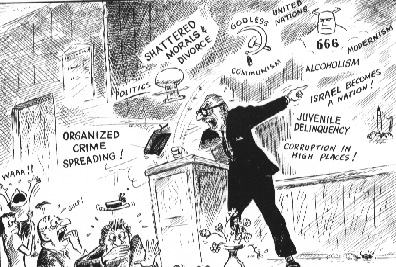
Make Christianity Pretty Good Again

That is more or less the idea that Donald Trump (on America) inspired Chris Gerhz to ponder. Here is an indication of when Trump supporters thought/think the nation was greatest (compared to other voters):

In general, Republican respondents favored the Eisenhower and Reagan eras. Democrats looked to the much more recent past: the 1990s, or even later. 2016 was the second most popular choice among Democrats.

Even among Trump supporters, the year 2015 was one of the 10 most popular choices. But there was no discernible pattern: 1955, 1960, 1970, and 1985 were all mildly popular, and the single most common response (8%) was the year 2000.

And that was true in general for Americans, regardless of party or other variables. Sanger-Katz observed that “The year’s popularity may partly reflect people’s fondness for round numbers. But many voters explained their choice by referring to a greater sense of security. The Sept. 11 attacks occurred the following year.”

The vast majority of votes were cast for years since the end of WWII, and almost no one opted for a year before 1900. (1776 did get some support.)

So I’ll ask Gerhz’s question: when was the church at its best? I imagine Protestants will not select dates between 350 and 1515. I’ll also wager that Roman Catholics (who read here) will not choose dates between 1965 and 2015. But in light of recent discussions about Mary, will Roman Catholics and Eastern Orthodox pick a date when the virgin lived on earth. In the realm of sectarian Protestantism, I suspect that Orthodox Presbyterians will not choose from the 1936 to 2016 era but prefer instead the time of the Puritans, Westminster Assembly, John Knox, or John Calvin’s Geneva.

My own preference is the antebellum period (after 1837) when Old School Presbyterians was at its height. The church was pretty sound, liturgy was sensible, theologians knew to be on the lookout for compromise, and Presbyterians were not tempted by the status (and loss of independence) that comes with ecclesiastical establishment.

Jesus Only Christianity

Since a new set of interlocutors has emerged of late I am going to persist with a contrast between Protestantism and Roman Catholicism that seems to be fairly crucial for considering the Reformation — namely, what to do about Mary. May seems to the month of our Lord’s mother, hence a number of posts at National Catholic Register (see what EWTN did there?) about Mary. To contrast the liturgical and national calendars, please keep in mind that for Americans May is Asian Pacific Heritage Month.)

Mark Shea persists with a defense of Mary’s immaculate conception and concludes that the church arrived at a two-fold doctrine of salvation (and we’re not even talking about God’s covenant with Jews — though since Mary was Jewish, I guess we are):

Jesus saves from sin in two ways just as a doctor saves from sickness in two ways: cure and prevention. Mary was prevented from contracting original sin in the moment of her conception by a singular act of grace through Christ. In her, we see, not the absence of Christ’s saving grace, but its fullest expression. Hence, she is “full of grace” and praises “God my savior” (Luke 1:47).

For confessional Protestants, that seems like a stretch since we believe in only one mediator between God and man. This implies that some persons can have a different relationship with God. If one has a unique relationship with God, why not a lot more? Why didn’t God simply reboot after Adam’s sin and “prevent” Cain and Abel from sinning?

Meanwhile, Dwight Longenecker tries to explain why Mary as Mediatrix or Co-Redemptrix is not an offense but affirms the sole mediation of Christ:

Once we have recognized that Mary suffered with Jesus we should take a moment to try to understand the depth of that identification with her son. Remember she is linked with her son like no other Mother and her son is like no other Son. How often have we seen and experienced the deep identification between a mother and her child? The child suffers at school. Mama bear steps in for she has suffered too. The child experiences hardship and tears. The mother’s heart is broken too. Only when we understand the depth of Mary’s suffering and the depth of her unique identification with her son will we begin to understand the Catholic doctrines of Co-Redeemer and Mediatrix.

We should be clear that we are not saying that Jesus’ work of redemption on the cross was in some way insufficient. Neither is his work as mediator between God and Man inadequate. We acknowledge that his redemptive suffering on the cross was full and final and totally sufficient. We acknowledge that he is the only saving mediator between God and Man. So what do we mean with these titles for Mary?

What we mean is that she participates in the full, final, sufficient and unique work of Christ on the cross for the salvation of the world. She walks beside him and through his work she joins in that work. It is like Christ’s love and sacrifice is a fast flowing river, but Mary swims in the current of that river. Her work is dependent on his work. Her participation and co-operation could not happen without his work going before and enabling all that she does.

But again the question arises, why single out Mary? Aren’t all believers united to Christ? Don’t we all swim in the current of his work? And wouldn’t it be fair to say after a reading of the New Testament that the apostles (and prophets before them) participated much more directly in Christ’s work than Mary (who is on the sidelines for most narratives)? Why not at least call Peter a Co-Redemptrix? He is after all the original Vicar of Christ. And why appeal to a special relationship between mother and child when Christ himself said that his followers bore a special relationship to himself in ways that were closer than blood relations (“Then his mother and his brothers came to him, but they could not reach him because of the crowd. And he was told, ‘Your mother and your brothers are standing outside, desiring to see you.’ But he answered them, ‘My mother and my brothers are those who hear the word of God and do it'” [Luke 8:19-21].)

The point here though has less to do with some of the questions that Longenecker and Shea raise (even as they try to answer objections). It is instead this: what would Christianity lose if Mary was not understood the way these apologists conceive her? Would Christianity be somehow deficient without the immaculate conception or Mary as co-redemptrix?

Simplicity is not always a good thing. But one way of reading the Reformation is as an effort to remove the clutter that had accumulated after a millennium of passing on the faith. Anyone who has changed residences knows the unenviable task of deciding what to do with the basement. Reformers did just that with the western church in the sixteenth century. Some might argue that they donated too many boxes with useful items to United European Charities, Inc. But if Longenecker really does affirm that Christ’s work was sufficient in and of itself (along with Christ’s Spirit, of course), why the attachment to Mary? What does her uniqueness profit the gospel or the Christian religion more generally?

And if Protestantism is really about trying to exalt the work of Christ — and doesn’t mind stepping on traditions that get in the way of seeing Christ’s sufficiency — why would it generate the hostility that it did from Rome?

Since We’re Talking about Talking

The Pertinacious Papist cautions Roman Catholic apologists about how to talk to confessional Protestants (via Greg Krehbiel). An excerpt:

Get Over Jack Chick Already

Along with these accusations of hard hearts and thick skulls comes the staple of apologetic discussion: your apologists are meaner than ours. Yes, we all know that some anti-Catholics misrepresent Catholicism. Guess what? It goes the other way, too. And yes, we all know that some people can be very mean. Guess what? People are sinners. I even heard a rumor that one of the apostles wasn’t a choir boy.

Along those lines, former Protestants who have converted to Catholicism are not necessarily experts on any form of Protestantism, including the one they left, and they can misrepresent Protestant doctrine. Do you trust a former Catholic’s knowledge of Catholicism? Then don’t expect Protestants to trust a convert’s view of Protestantism.

When it comes to the “your apologist beats up old ladies” argument, the best thing to do is to get over it. Or, as a friend says in a slightly different context, “don’t feed the energy creature.”  I’s best to ignore rude noises at the dinner table, and I think we can treat the apologetic variety of those rude noises the same way. Fussing and whining about how mean the other guy is just makes you a crybaby.

23,000 Denominations

Some Catholics have the apologetic equivalent of Alzheimers. They criticize Protestantism because there are (so the story goes) 23,000 separate Protestant denominations, all teaching different things. And then a minute later the Catholic apologist will speak to a Methodist as if he is a Baptist, or a Lutheran as if he’s a Pentecostal. If they all teach different things, then for heaven’s sake don’t treat all Protestants the same.

It is very annoying to a confessional Presbyterian to be treated as if he’s guilty of the same errors as the non-denominational charismatic. Listen to what the other guy is really saying without putting his words through an apologetic filter that says “this guy is a Protestant, and I’ve read all about those guys.” You may find that you have more common ground than you suspected.

BAD HABIT: Learning about Protestant doctrine from Catholic sources.
BAD HABIT: Learning about generic Protestant doctrine and applying it to all Protestants.
REMEDY: Let your Protestant friend speak for himself. Listen to what he’s saying without imposing any doctrinal template on his words. . . .

No One Ever Heard of ____ Until the Reformation

It’s very common for a Catholic apologist to argue that Protestant doctrine is unhistorical, that nobody held to Protestant positions until the Reformers came along and invented them all out their fevered brains. (Remember, of course, that there are all kinds of Protestants, and on many issues the Reformers would be on the Catholic side arguing against many modern Protestant beliefs.)

The claim goes like this. “No one ever heard of sola scriptura, or sola fide, or doubted the canonicity of the deuterocanonical books, [or whatever,] until Martin Luther.”

Really now. Have you read all the Christian theologians of east and west from the time of Christ until 1517? If you’re particularly ambitious, you may have read bits and pieces from a very small sample of the church fathers. The Reformers were serious scholars, and they also read the church fathers. They did not believe their doctrines to be novelties, and only an expert on the history of doctrine is qualified to say that they were. And there are experts on both sides of that question.

Pointing out the contrast between the faith of the early church and the faith of your modern Protestant friend is a very effective apologetic tool. It’s very easy to show how Catholic doctrine developed from the faith of the early church, and it’s very hard to show any continuity between the early church and the faith of Bethel Bible Church down the road. So don’t spoil a good argument with claims you can’t prove or defend.

BAD HABIT: Asserting a universal negative.
BAD HABIT: Repeating extravagant claims you read in apologetic literature that the apologist himself could not possibly have known.
REMEDY: Stick to what you really know.

What’s that Verse Scott Hahn Uses?

Every once in a while I meet someone on the train, or in a store, and I get a sense that person is an Evangelical Christian. I spent a lot of years among Evangelicals, and I got to know their mannerisms. Sometimes it’s a certain tone of voice, or a choice of words. When someone’s been baptized into Evangelicalism, it starts to wear off on him. It makes a difference.

Scripture is the same way. When you start talking to someone about the faith, it’s very obvious who has and who has not devoted himself to Bible reading. It comes out.

Again and again I’ve run across well meaning Catholic apologists who seem to know Scott Hahn better than they know their Bibles. Believe me, it shows, and every decently trained Protestant is going to spot it and recognize that apologist for what he is. The Protestant will know that the Catholic is just proof-texting — that he hasn’t internalized the text. It’s just something he cites to prove his point, and when he does read the Bible, it’s only to find ammunition for the next battle. The Protestant will assume that the Catholic apologist lacks a personal relationship with Christ, and he’ll have all the more reason to mistrust Catholic arguments.

If you’re that apologist, it’s time to stop, retire, apologize to your opponents, wish them well, and spend some time (a few years, perhaps) getting to know God through His word. Donate all your apologetics books to your priest and spend the next few years reading nothing but the Bible and the catechism. Your goal isn’t to find 25 reasons why Protestants are wrong about Baptism. Your goal is to listen to what God says to you about your soul.

When apologetics is a distant memory, if you still feel the call to witness to other Christians about the Catholic faith, praise the Lord. You’ll be better prepared.

BAD HABIT: Using the Bible like a tool to win arguments with other Christians.
REMEDY: Quit apologetics, major in Bible study and work on your personal relationship with Jesus.

What Good is an Infallible Bible?

“What good is an infallible Bible without an infallible church to interpret it?” I’ve heard that too many times to count. What good is an infallible Bible? That any Christian can seriously ask the question defies belief. We want to know what God is like. We want to know how He regards us, and what we have to do to please Him, and here we have, not just a document, and not just a pretty good document, but the very words of God.

What good is the Bible? That kind of language makes Protestants roll their eyes. “Those Catholics really don’t get it, do they?” Any serious Evangelical knows scores of people whose lives have been miraculously transformed by reading the Bible. Besides that, the Evangelical himself has personally experienced God speaking to him in the words of Scripture.

When a Catholic says, “What good is an infallible Bible?” he has given up any claim to credibility with that Evangelical. It would be like asking a man who was just rescued from the desert, “What good is water without a crystal glass to drink it in?”

BAD HABIT: Trying to magnify the church and Catholic doctrine by disparaging the Bible.
REMEDY: Always speak of the Bible reverently. Read Psalm 19 and 119 and learn to regard the Bible the way king David did. Never, ever even consider saying “What good is the Bible?” You’d be better off to cut out your tongue and chop off your fingers.

Now, some will complain that I’ve missed the point of the question. The Catholic doesn’t mean to disparage the usefulness of the Bible, but the usefulness of the Bible as the sole guide for the church. I’ll get to that, but I felt it necessary to point out the horrible blunder that is made by making the point by criticizing the Bible.

The Catholic apologist looks around at the mess in the Protestant world and wonders why Baptists interpret the Bible one way while Presbyterians, Lutherans, Methodists and the Assembly of God all interpret it differently. He concludes, correctly, that the Bible alone is not a sufficient guide to regulate faith and life.

It is clear that something else is necessary, and that something else is an authoritative church.

But the Catholic apologist typically makes two errors while making this argument. The first is to imply that authority requires infallibility, which is clearly not true since parents and governments have authority but are not infallible. The second error is to claim that infallible Scripture requires, in the very nature of the case, an infallible interpreter: that it does no good to have infallible Scripture unless someone can tell us infallibly what it says.

The obvious reply to the question “What good is an infallible Bible without an infallible church?” is “What good is an infallible church without an infallible church interpreter?”

Just as the Catholic criticizes the variety of opinion among those who confess the authority of an infallible Bible, so the Protestant can criticize the variety of opinion among those who confess the authority of an infallible church. Traditionalists come to mind.

The problem is that there has to be a break in the chain somewhere. God is infallible, we are not. If we diagram the progression from God’s infallible self-revelation to our fallible perception of that revelation — for simplicity’s sake let’s just say the steps are A then B then C then D — the infallible part has to get lost somewhere. It starts off infallible in God’s mind and ends up a muddled mess in mine. It really doesn’t matter where you put the transition; the logical problem is the same. We can ask, “What good is an infallible A without an infallible B?” just as well as we can ask “What good is an infallible C without an infallible D?” It’s simply the wrong question.

The Protestant confesses that Scripture is infallible, but the church that tells us which books belong in Scripture is not. The Catholic confesses that the Magisterium is infallible, but the ministers who teach us what the Magisterium says are not. Both have to move from an infallible something to a fallible something, so the Catholic apologist has to guard against unleashing an attack dog that bites his own leg.

BAD HABIT: Tossing around infallibility as if it solves everything.
REMEDY: Focus on the need for an authoritative church. Once that is established, then work on infallibility.
The Mystery of Dialogue

Another blog is up and running and it targets yet again Calvinists for ecumenical dialogue with Roman Catholics (most of whom converted from Protestantism to Roman Catholicism). This ecumenical endeavor, however, is different from Bryan and the Jasons Called to Communion. In fact, Bryan Cross would likely be fairly dismissive of “Catholics and Calvinists” (CaC vs. CtC). Cross once identified two kinds of ecumenism, one false, and one true. The former is wrong because it is — well — liberal:

That is because it seems to seek its goal of achieving general agreement about doctrine by way of compromise. So those who think a particular doctrine is essential feel pressured to drop their belief that this doctrine is an essential doctrine in order to attain some unity with those who think that that doctrine is adiaphorous (i.e. indifferent, non-essential). The very nature of the goal of this type of ecumenicism makes this kind of compromise essential to ecumenical progress. As someone said to me a while back, “True ecumenicism means everybody has to compromise.” And the necessary result of such a methodology is a least-common-denominator minimalism regarding doctrine, an acceptance as sufficient of something far short of the unity in communion to which Christ calls all His people.

In contrast for Cross, true ecumenism comes from recognizing the truth and unity of Roman Catholicism:

. . .this ecumenicism has complete agreement on doctrine as its goal, or more precisely, complete agreement on what each person believes to be essential doctrine. Moreover, and perhaps most importantly, it rejects compromise regarding what anyone believes to be truly essential as a means of achieving its goal. As a result, there is no pressure to compromise in order to attain this ecumenicism’s goal. Instead of proposing compromise as a means to reaching a watered-down unity, this type of ecumenicism recognizes that we are not fully united until we are doctrinally united on every doctrine about which anyone believes to be essential. In this ecumenicism we do not sweep our essential doctrinal differences under the rug. We even straightforwardly, and in genuine charity and sincerity, remind each other that the other person’s position, from the point of view of our own tradition, is nothing less than heresy.

That is not exactly a conversation starter and explains why discussions with Bryan and the Jasons generally descend to Dr. Dave Bowman’s conversation with H.A.L. 9000.

How then is CaC different from CtC? Put simply from this observer’s perspective, it’s the difference between the pre- and post-Vatican II church. While Bryan and the Jasons reflect a no-salvation/truth-outside-the-church outlook, CaC seems to embrace Vatican II’s ecumenism:

Our refusal to engage in “sheep stealing” is not merely a rhetorical front, as if that posture itself were a guise under which to carry on a still-deeper project of effecting conversions. It is also not a bracketing of theological questions for the time being, as if we will for a time carry on a project of “ground-clearing” only to then change gears and begin bringing in the sheep. We recognize that this a pervasive – and deeply problematic – style of Catholic and Reformed engagement, and we repudiate it in no uncertain terms.

Rather, our approach is rooted in the ecclesiological vision articulated by the Second Vatican Council and by other leading ecumenists that there are genuine gifts cultivated by the Holy Spirit outside the boundaries of those churches in communion with the Bishop of Rome that are genuinely beneficial to the churches which are in such communion, and which lead these churches into a deeper desire for union. We want to understand those gifts more clearly, and we want to help other Roman Catholics understand the under-appreciated richness of the Reformed tradition more deeply. We do this while seeking, of course, to have our own views as Roman Catholics – devoted first to Scripture and then to the Roman Catholic tradition expressed in such thinkers as St. Augustine, St. Thomas Aquinas, John Henry Cardinal Newman, and the great theologians of the twentieth century – come to be better understood by our brothers and sisters in the Reformed tradition.

An initial observation is this: why don’t CaCers engage in dialogue with CtCers? After all, it sure looks like Roman Catholics are on different pages when it comes to church unity and what to make of Reformed Protestants.

That conversation might then include discussions of Vatican II and the apparent rupture of the church’s understanding of its relationship to those outside the church (both other professing Christians and non-Christians). In fact, since CaC is interested in the shared use of scholasticism by Roman Catholics and Protestants, the dialogue it promotes might include trying to reconcile a church that was for much of its modern intellectual history committed to Thomism and then after 1965 opened itself to non-scholastic methods (and more). In other words, I don’t understand (maybe a dumb Protestant) how you invoke both scholasticism and Vatican II on theological discussion since the former achieved remarkable clarity and the latter was purposefully equivocal.

That difference between Vatican II and scholasticism also brings up the tricky matter of the Council of Trent. Why is it that the church that relied on scholasticism as its method for articulating theological and dogmatic truth did not open dialogue with but condemned Protestantism? Trent was not an invitation to dialogue. It put an end to it. So the challenge for CaCers is how to read 16th- and 17th-century theological sources as a way to pursue what Vatican II had in mind when those old sources drew clear lines between truth and error and pursued ecumenism far more along the lines that Bryan Cross advocates than what Pope Francis embodies.

The larger point here is one about Roman Catholics understanding Roman Catholicism. Instead of trying to understand Calvinism, making sense of Rome’s fits and starts and changes might be much more useful for dialogue (whether ecumenical or academic). For Protestants like mmmmeeeeeeEEEE, Roman Catholicism looks like a moving target. That is a mystery that needs much more attention from Roman Catholics than appreciating Luther or Calvin. In fact, as Mark Massa has argued, it is a mystery up to which the post-Vatican II church is still catching:

. . . the widespread acceptance of the seemingly self-evident truth that things change will make it increasingly difficult to propound or defend Church teaching and practice by appealing to timeless, static categories of propositional truth. This applies most particularly to the intellectual tradition of scholastic natural law, which the Catholic tradition has relied on for presenting its most important teachings since the thirteenth century. The fractious nonrecption of Paul VI’s encyclical on birth control, if nothing else, illustrates this with startling clarity. Whatever the truth of Paul VI’s teaching, the massive noncompliance accorded his encyclical shows that the great majority of American Catholics did not form their consciences along the lines of such moral reasoning, and have not since. There are of course many possible reasons for this lack of compliance on the part of the vast majority of practicing Catholics on an issue that the hierarchical Church has termed “serious matter.” Some of those reasons may indeed involve personal ignorance, sinful willfulness, or just plain selfishness. But an important reason for that noncompliance, what I would label as the main reason, is that the classical unchanging world it presupposes no longer makes sense to the vast majority of the faithful in the United States. What Bernard Lonergan so elegantly called the “transition from a classicist world view to historical mindedness” in fact describes the intellectual revolution that mainstream Catholics underwent during the sixties.

Whatever the strengths of that older classicist worldview — and it served the Catholic Church extraordinarily well for centuries — it can no longer provide plausible explanations for Church teaching . . . . The older intellectual categories of scholastic natural law, first enunciated so brilliantly by St. Thomas Aquinas in the thirteenth century, appear unable to accomplish that now. Perhaps the intellectual justification offered in its place to explain Catholic teaching will represent the most important long-term fruit of the intellectual revolution sponsored by historical consciousness in Catholic Christianity. Time will tell.

Some of us are still waiting for converts to Roman Catholicism to have a conversation with clergy and academics like Massa. It sure doesn’t seem like a meaningful conversation can take place between confessional Protestants and Roman Catholics as long as one side is so uncertain about that for which it stands.

Postscript: Comments should be open at a cite committed to dialogue.

Converts and Cradles Together?

Part of the trouble that Protestants have in trying to make sense of Roman Catholicism is the bi-polar character of Rome (in the U.S. at least) and its appeal to evangelicals. Damon Linker explains the attraction that Roman Catholicism once had for him:

I became a Catholic (from secular Judaism) in the midst of a personal crisis. I longed to find an absolute moral Truth and craved a sense of belonging with others who recognized and ordered their lives according to that Truth. Catholicism is perfect for people with such yearnings. It tells them that the Roman Catholic Church is the church of Jesus Christ most fully and rightly ordered through time. Its magisterial authority can be traced back to St. Peter and the rest of Christ’s original apostles. It publishes a 900-page Catechism filled with elaborate, absolute rules laying out in minute detail how God wants us to live. It governs itself according to an intricate code of Canon Law that first began to be formulated nearly two millennia ago.

For someone who feels troubled by a culture in a constant state of instability and change, the Catholic Church can feel like a rock in a stormy, windswept sea. Finally, something is steady, permanent, unchangeable, fixed, immobile. The church’s very stability can end up looking like the strongest sign and confirmation of its divinity. Everything changes! But not God and his church.

For someone drawn to Catholicism by the promise of order and stability, any sign of change in the church will be unwelcome, threatening. The fact that social and cultural mores shift and develop around it is an argument for retrenchment and improved outreach to a world tempted by sin in new ways. It certainly isn’t a sign that the church should adjust its teachings on faith and morals, accommodating them to the latest trends. Any such adjustment would risk diluting the Truth, and (perhaps just as bad) serve as a potentially fatal concession that the church’s teachings can be fallible. Once that door has been opened, there may be no way to close it. Remove even a single brick from the foundation, and the whole edifice could come crashing down.

What then does a convert do when she understands that the people who grew up with Rome’s promise of order and stability don’t want to perpetuate that reliability but actually desire change? John Zmirak describes where such desires come from and such aspirations must seem odd to Bryan and the Jasons:

When a large group of highly educated people who have dedicated themselves to an organization with firm doctrines, strict rules, and stern demands — such as the Catholic Church — lose their faith in those doctrines, rules and demands, what do they do with themselves instead? Shrug and join the Unitarians? Leave their rectories or convents and go find apartments, maybe jobs as high school guidance counselors?

What do families like the Pelosis, the Kennedys or the Bidens — and millions of non-famous Irish and Italian-American clans with strong ethnic and historical connections to the Church — do with themselves when they reject its teaching authority?

The history of the Catholic left gives us the answer: Such people focused on the parts of the Church’s mission that still appealed to them, such as looking out for the poor and rebuking unjust discrimination. And of course the Church has an almost 2,000 year tradition of offering the needy education, health care, and a voice in the face of genuine oppression. Many Catholics had joined the Civil Rights movement and marched for integration.

In the 1960s, there were fresh, exciting causes available for Catholics to join which modeled themselves on the Civil Rights movement’s tactics and rhetoric, whose agendas were not so compatible with traditional Christian teaching as the noble fight against institutionalized racism had been. Feminists, homosexuals, and anti-war activists began to throng the streets and demand radical changes in American law and policy, and many Catholics with left-wing sympathies and deep roots in the Democratic Party began to exert their energies on behalf of these new movements — assuring themselves that they were acting as Jesus had when he denounced the scribes and Pharisees.

Many grandchildren of Catholic immigrants to our overwhelmingly Protestant country still clung to the pretense that they were outsiders — excluded and marginalized victims of the existing American establishment. So they felt bound to make common cause with every other “outside” group, regardless of the justice of its claims. This outsider illusion made it easy for them to be right about Civil Rights … and then poisonously wrong about feminism, gay liberation, and socialist economics.

It would be like an avid reader of John Calvin (other than Marilyn Robinson) joining the PCUSA with the expectation that mainline Presbyterians actually care about perpetuating Reformed Protestantism.

While Bryan and the Jasons want Protestants to join the ecumenical discussion, shouldn’t they be having that conversation first with the folks in their own communion?

Why Did Christ Die?

Was it because sin is so heinous or because humans need a cosmic flannel graph to illustrate God’s displeasure over sin (I don’t think he is weeping about it)? Machen thinks the former:

The atoning death of Christ, and that alone, has presented sinners as righteous in God’s sight; the Lord Jesus has paid the full penalty of their sins, and clothed them with His perfect righteousness before the judgment seat of God. But Christ has done for Christians even far more than that. He has given to them not only a new and right relation to God, but a new life in God’s presence for evermore. He has saved them from the power as well as from the guilt of sin. The New Testament does not end with the death of Christ; it does not end with the triumphant words of Jesus on the Cross, “It is finished.” The death was followed by the resurrection, and the resurrection like the death was for our sakes. Jesus rose from the dead into a new life of glory and power, and into that life He brings those for whom He died. The Christian, on the basis of Christ’s redeeming work, not only has died unto sin, but also lives unto God. (Christianity and Liberalism)

But what if God can change you apart from the death and resurrection of Christ?

In the midst of this crisis, (that went on for more than a year,) I came across the teaching of Martin Luther and his followers, who, when confronted with the same apparently insoluble problem, issued a ruling that was, essentially, against God. Human nature was hopelessly corrupt, top to bottom and god Himself has no power to alter it. They described the human soul as a dung heap, over which the grace of God falls like a deep covering of snow, that changes nothing of the underlying corruption.

This nauseating and plainly wicked doctrine – essentially nihilistic – so infuriated me that I realized in a flash that it was an insult, not to me in my failings, but to God’s infinite perfection and power. My very fury at this insult made me understand at last what the Church had always held: that it is not my power, but the power of God that will change me into this “perfect” new thing. This promise was true, and it had much more to do with Him than with me.

If God can change us, why would he need to send his son to die on the cross?

But if Machen and Luther are right about the extent of sin and the irredeemable character of fallen humans apart from an alien righteousness imputed to them and received by faith, then what incentives do people have to be good?

We cannot “earn” God’s love but, alas, too often we reject it. And it is up to us to use the gifts God has given to us—including our inherent rationality as well as the Church and the aids to faith and reason it provides—to orient ourselves to the good. Through hard work we can develop our character (habits of virtue or vice that go far toward determining who we are) such that we will recognize and say “yes” to God’s will. The saint does not achieve salvation through mere right conduct, but the saint’s conduct, both spiritual and physical, help him to surrender fully to God and do His will. In doing the right thing for the right reason we orient ourselves toward what is right and thereby recognize and accept God.

. . . Good works help develop within us habits that enable us to distinguish between good and evil; good works make it more likely that we will choose the good, even when it brings with it pain and death. This, I submit, is not some prideful claim to earning one’s own salvation, but rather a recognition of both the dignity and the weakness of the human person. We have within us an impulse toward the good, which we too often ignore. We have written on our hearts a knowledge of God’s will, which we also too often ignore. By both thinking and doing right we can embrace the good, opening ourselves to the grace offered by God—who is beyond our full knowledge but who has created within us a soul capable of recognizing His will.

If we have goodness, or an openness to the good within us, why exactly did Christ have to die?

Somethings don’t develop or change. Christianity doesn’t make humanism Christian.

The Abraham Option (or been there, done that)

Kuyper, that is.

Rod Dreher leaves another hint that he has no real feel for the fundamentalist or confessional Protestant world:

That said, I think lots of Christian parents are going to have to make some hard calls now and in the years to come about moving for the sake of educating their children, and raising them in a peer environment where they are more likely to absorb the faith, or at the very least not have their faith leached out of them. Radical times call for radical measures.

Granted, the world of Dutch-American Calvinism is small and so faulting Rod for not knowing the Christian day school phenomenon is misguided. At the same time, when Abraham Kuyper is largely a household name to cultural conservatives in the U.S., you would think that Rod might know something about the tradition of family-run schools and its history that goes back to the 1850s!!!

At the same time, Rod’s proposals for the Benedict Option sound, as I’ve indicated before, like a person who has been part of mainstream churches and identified with the establishment for all of his spiritual life. For those of us who grew up on the other side of the spiritual tracks, whether fundamentalist or ethnic Protestant, we’ve known for a long time that worldliness is a danger and its a besetting sin of establishments, political and ecclesiastical.

Not New But Laodecian Calvinism

Trevin Wax argues for yet another third-way that keeps Calvinists and Arminians together in the big tent also known as the Southern Baptist Convention. As the second largest communion (if a convention qualifies) in the United States only behind Roman Catholics, forgive me if I seem to yield to the temptation of membership envy.

What if such girth comes precisely because ministers and congregations are free to follow their own theological convictions? In other words, how big would the SBC be if it had to choose between Calvinism and Arminianism?

But Wax doesn’t think that decision is necessary. He even thinks that kind of variety will make the SBC stronger (as in iron-sharpening-iron, I guess):

In the past, I’ve surmised that God may be using our Southern Baptist diversity on this issue for our overall health. I know many disagree with the idea that our diversity may be a good thing. Some Calvinists believe the SBC would be stronger if everyone shared their soteriological views and other Southern Baptists believe the SBC would be stronger if there were no Calvinists at all. I understand these perspectives, but my strong belief in God’s sovereignty gives me confidence that God will use our differing conclusions for the good of His people.

Not to sound patronizing, but Wax clearly ignores Calvinist history. Calvinists and Arminians don’t coexist. Think Canons of Dort. Think Dutch-American Calvinist disdain for “methodism.” Think Orthodox Presbyterian and Christian Reformed Church rejection of invitations to join the National Association of Evangelicals.

Of course, someone could argue that Calvinists and Arminians should put aside their differences and work together within the same commvenion. If I were Wax, I would not want to be in that land of doctrinal goo because the precedents for doctrinal toleration (or indifferentism) are not good. Contrary to Tom Nettles, it’s not departures from Calvinism that lead to liberalism (though positive estimates of human agency generally undermine Christianity). It’s actually calls for people who disagree so fundamentally to “get along” that produce the flabbiness that is Protestant liberalism.

The Major Prophet Speed Bump

I have long wondered whether the reason why covenant youth don’t understand the sacraments comes from the placement of material in the Shorter Catechism. Many young people master well the ordo salutis, but fail to answer with any precision or comprehension the catechism’s teaching on baptism and the Lord’s supper. The reason for this, I suspect, is the intervening material between justification and sanctification and the means of grace, namely, a long section on the Decalogue.

Now having spent several weeks reading through Jeremiah with the missus I wonder if the major prophets are the hill on which read-the-Bible-in-a-year practitioners die. I mean, what do you do with relentless passages like these:

“Judah mourns,
and her gates languish;
her people lament on the ground,
and the cry of Jerusalem goes up.
Her nobles send their servants for water;
they come to the cisterns;
they find no water;
they return with their vessels empty;
they are ashamed and confounded
and cover their heads.
Because of the ground that is dismayed,
since there is no rain on the land,
the farmers are ashamed;
they cover their heads.
Even the doe in the field forsakes her newborn fawn
because there is no grass.
The wild donkeys stand on the bare heights;
they pant for air like jackals;
their eyes fail
because there is no vegetation.

“Though our iniquities testify against us,
act, O LORD, for your name’s sake;
for our backslidings are many;
we have sinned against you.
O you hope of Israel,
its savior in time of trouble,
why should you be like a stranger in the land,
like a traveler who turns aside to tarry for a night?
Why should you be like a man confused,
like a mighty warrior who cannot save?
Yet you, O LORD, are in the midst of us,
and we are called by your name;
do not leave us.”

Thus says the LORD concerning this people:
“They have loved to wander thus;
they have not restrained their feet;
therefore the LORD does not accept them;
now he will remember their iniquity
and punish their sins.” (Jeremiah 14:2-10 ESV)

It tempts me to think I’d rather read Pope Francis on marriage:

243. It is important that the divorced who have entered a new union should be made to feel part of the Church. “They are not excommunicated” and they should not be treated as such, since they remain part of the ecclesial community. These situations “require careful discernment and respectful accompaniment. Language or conduct that might lead them to feel discriminated against should be avoided, and they should be encouraged to participate in the life of the community. The Christian community’s care of such persons is not to be considered a weakening of its faith and testimony to the indissolubility of marriage; rather, such care is a particular expression of its charity”.

But then Jeremiah brings me quickly back to reality:

And the LORD said to me: “The prophets are prophesying lies in my name. I did not send them, nor did I command them or speak to them. They are prophesying to you a lying vision, worthless divination, and the deceit of their own minds. Therefore thus says the LORD concerning the prophets who prophesy in my name although I did not send them, and who say, ‘Sword and famine shall not come upon this land’: By sword and famine those prophets shall be consumed. And the people to whom they prophesy shall be cast out in the streets of Jerusalem, victims of famine and sword, with none to bury them—them, their wives, their sons, and their daughters. For I will pour out their evil upon them. (Jeremiah 14:14-16 ESV)

Turns out those who claim authority (even infallibility) to speak for the Lord need to be cautious.