For the Umpteenth Time, Grace is Not Nature

Once again the lame argument that nominalism (and its Protestant progeny) severed the chain of being and gave us Walmart:

One can now readily see the theological pitfalls of this position. It means that in Genesis, when God called creation ‘good’—it was only because He said so, not because it was really good. It also contravenes the testimony of the Old Testament, where creation as seen as reflecting the beauty and goodness of God—Dreher quotes Psalm 19:2, “The heavens declare the glory of God.” Finally, Ockham’s position is at odds with the reality of the Incarnation itself, along with the reality of the visible Church and the sacramental system. (Certainly it is now apparent how nominalism helped pave the way for the Protestant Reformation.)

In the context of the Christian faith, the errors and perils of nominalism may seem manifest, but what about its broader cultural implications? As Dreher explains, once the world had been emptied of inherent meaning and bore only that meaning imposed on it by God, the next big step was to replace God with man.

How and why did this happen?

The real answer, of course, is beyond our scope, but we can briefly point to it here. (See Dreher’s second chapter, “The Roots of the Crisis” for the full summary.) Once the sacred chain connecting all being to God was severed, creation shrunk back from its Creator: the world became a smaller place.

Hello! The heavens declaring the glory of God doesn’t make the heavens a sacrament.

Hello! Affirming the profound chasm between Creator and creature (can you say transcendence?) does not destroy the light of nature that shows “that there is a God, who hath lordship and sovereignty over all, is good, and doth good unto all, and is therefore to be feared, loved, praised, called upon, trusted in, and served, with all the heart, and with all the soul, and with all the might” (Confession of Faith 21.1).

Hello! Saying that God’s ways are not our ways is not to deny that God superintends all things.

In fact, if you believe in providence:

God the great Creator of all things doth uphold, direct, dispose, and govern all creatures, actions, and things, from the greatest even to the least, by his most wise and holy providence, according to his infallible foreknowledge, and the free and immutable counsel of his own will, to the praise of the glory of his wisdom, power, justice, goodness, and mercy. (Confession of Faith 5.1)

you can also believe in sacraments:

A sacrament is an holy ordinance instituted by Christ; wherein, by sensible signs, Christ, and the benefits of the new covenant, are represented, sealed, and applied to believers. (Shorter Catechism 91)

But if you so closely identify God with his creation, you may have trouble distinguishing the church from Europe. Hillaire Belloc anyone?

Europe is the faith, and the faith is Europe.

Surely, somewhere in all those Aristotelian categories appropriated by Aquinas, Roman Catholics have a way of distinguishing the world from God who is a “spirit, infinite, eternal, and unchangeable in his being, wisdom, power, holiness, justice, goodness, and truth.” You have to preserve those incommunicable attributes of God somehow.
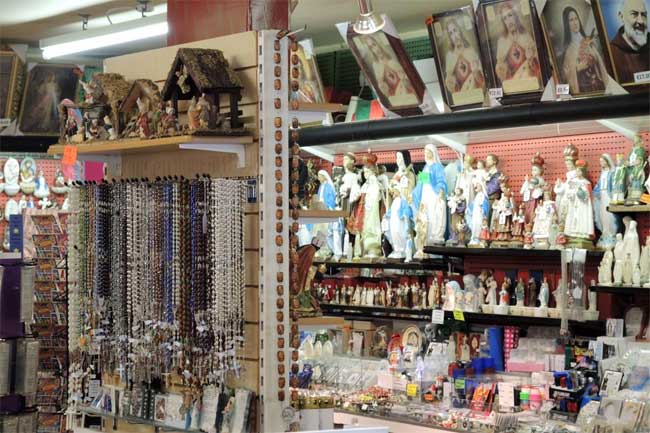
Pascal’s Wager After Vatican II

Father Dwight thinks that the arguments for becoming a Roman Catholic have to do with having more Christianity, not with whether or not you are saved:

So is there salvation outside the Church? Does that mean “There no salvation outside the Catholic Church?” The old guys said, “No Way.” The new guys say, “Well, you know the Church is bigger than the Catholic Church. Christ’s salvation extends to all who are baptized and have faith in Christ.”

Uh-huh. I get it.

“Furthermore, it may extend to all men and women of goodwill who follow the light to the best of their ability. They’re salvation is also through Christ for he is the source of all goodness, truth and beauty even if they don’t know it.”

OK. If you say so.

Well, good for them, but I’m not taking any chances.

I want more Christianity, not mere Christianity, and it is only within the great, graced riches of the Catholic Faith that I can hope for this wounded soul to be healed and for me to make my long journey home.

Why does more Christianity always involve less Christ? Liberal Protestants added western civilization and modern science to Christianity and abandoned the atonement. Neo-Calvinists add the transformation of culture and forget the Canons of Dort. Now in the post-Vatican II Church you get all the statues and rites and holy days without the assurance that you need them for salvation. I don’t know why Father Dwight considers that more. Where else do you go for salvation than to Jesus?

Cool or Wretched: Which Kind of Christian are You?

Here is what one of the apostles’ successors says makes Roman Catholicism “cool”:

Guilt. Pundits and comedians make fun of “Catholic guilt,” often described as an overactive conscience that makes us think everything is a sin. For example, when forgetting to floss, or not finishing all the food on your plate becomes confession material. But while people make fun of Catholics for their scrupulosity, in fact, having a little guilt is a healthy habit. It keeps us from getting into trouble and inspires us to do the right thing. Our world today would benefit from a little “Catholic guilt.”

What happened to that sense of the penalty for sin that Paul agonized in Romans 7?

21 So I find it to be a law that when I want to do right, evil lies close at hand. 22 For I delight in the law of God, in my inner being, 23 but I see in my members another law waging war against the law of my mind and making me captive to the law of sin that dwells in my members. 24 Wretched man that I am! Who will deliver me from this body of death? 25 Thanks be to God through Jesus Christ our Lord! So then, I myself serve the law of God with my mind, but with my flesh I serve the law of sin.

Funny how a little bit of guilt goes a long way — all the way to the cross.

How can you be scrupulous and turn guilt into something by which to appeal to youth?

How the Making of Saints Led to the Eating of Sausage

In other words, you don’t want to see how they make saints any more than you want to observe the making of sausage. Consider, for instance, Francis Oakley’s review of a new book on canonization:

During much of the first millennium of Christian history, when it came to the recognition of sanctity, spontaneity seems to have been the order of the day. That is to say, the initiative was usually taken at the popular local level in Christian communities where cults of martyrs, confessors, and other saintly individuals had welled up and found expression in rituals and offerings at the tombs of the deceased or pilgrimages to reputedly holy sites. Official ecclesiastical sanction for such cultic practices was at first no more than sporadic. In the latter part of that era, however, local ordinaries increasingly undertook to exercise at least a supervisory role in relation to such saintly cults. And in a third phase, the one on which Prudlo focuses in this book, the high medieval quickening of papal centralization led to the growing papal domination of the process of saintly canonization, culminating in the fourteenth century with what almost amounted to papal monopolization of the whole business. “Almost” because, as Prudlo prudently concedes, that development may not have been “fully completed” until Urban VIII in 1634 definitively reserved to the papacy the prerogative of canonization.

The church that Jesus founded? Hardly.

The implications of this process for papal infallibility are also intruiguing:

the accumulating discourse pertaining to infallibility in canonization provided a new vocabulary and a new lexicon with which to carry on development of the infallibility discussion into the Counter-Reformation and beyond. It is true that when the First Vatican Council came finally to define the dogma of papal infallibility it made no mention of infallibility in canonization and focused exclusively on the broader issue of ex cathedra papal doctrinal definitions on matters of faith and morals. But recondite though the canonization-infallibility nexus may be, Prudlo’s findings are directly and significantly pertinent to the ongoing debate about the historical origins of the infallibility dogma and any historians working henceforth in that conflicted field will certainly have to take those findings into account.

In other words, papal infallibility is bound up with the debatable practice of recognizing saints.

Notice too that the doctrine of infallibility was originally designed to restrict, not enhance, papal authority:

the doctrine had been advanced with the goal not of enhancing papal power but of limiting it via the insistence that popes were bound by the inerrant, irreformable teachings of their predecessors. It is not surprising, then, that Pope John XXII (1316–34), no theologian but a canonist of distinction, seeing the insistence on papal infallibility as an infringement upon the pope’s sovereignty, described it as a “pestiferous doctrine” and treated it accordingly as some sort of dangerous novelty.

Meanwhile, everyone should have known that if Paul could refer to the Corinthians as saints, such hoops and hurdles were hardly necessary or very sanctified.

Married Presbyterian Pastors

Protestants do not receive nearly the credit they should for seeing 500 years ago what George Weigel recently observed (and it took Hillary Clinton — a Methodist).

First, marriage can be a good thing:

The Church’s unique, Christ-given structure invests great authority in bishops. And that, in turn, puts a high premium on the ability of the bishop to know his weaknesses and learn from his mistakes. But to know and learn from his weaknesses and mistakes, the bishop has to recognize them – or be invited to recognize them, if one of a number of vices prevents him from seeing himself making mistakes. Wives and children do this charitable correction for husbands and fathers. But Catholic bishops don’t get that form of correction because they don’t have wives and children. So it has to come from somewhere else.

Second, regular assemblies of clergy (think presbyteries or classes) also have their advantages:

“Fraternal correction” among bishops is an ancient and honorable tradition in the Church. Patristic-era bishops practiced it with some vigor, the most famous case being the controversy between Cyprian of Carthage and Stephen, Bishop of Rome. Today, bishops’ respect for each other’s autonomy tends to mitigate against the practice of fraternal correction. Still, if “affective collegiality” means anything, it ought to mean having enough care for a brother-bishop, no matter his position in the episcopal college, to suggest to him that he is off-course, if that is one’s conscientious judgment, tempered by prayer.

Fraternal correction is a delicate instrument, to be used with care. If its use completely atrophies, however, the Church risks becoming an ecclesiastical version of Clintonworld.

Hello! The conciliarists of the 15th century knew this. But when you hold on to “venerable” institutions, it’s hard to change (or admit when you do).

TKNY Even in UK

Even while in Ireland, I could not evade Tim Keller. One morning while reading the magazine Standpoint, I read a column which contained this:

As well as being one of the great delaying mechanisms of modern times, YouTube is one of the great gifts of our age. It not only allows us to watch videos of cats and people falling over, but also serious discussions like the recent one between Tim Keller and the sociologist Jonathan Haidt at NYU. What a model discussion it was. Haidt (whose book The Righteous Mind is one of the best explanations of modern politics I know) is respectful towards religion while being an atheist. Keller is a deeply learned reader of philosophy and sociology, and a pastor. Perhaps most striking was the agreement from both speakers over not only what is broken in our culture but what might be done to fix it. Particularly interesting was the observation that our society’s rewarding of outrage (fuelled by social media) means that we are ever less-inclined to give people what we used to call “the benefit of the doubt”. Increasingly, we put the worst possible gloss on people’s words and intentions so that any discussion across boundaries (believers versus non-believers, Left versus Right) becomes almost impossible. Can the urge be resisted? Perhaps, but we would have to have the right role models. Haidt and Keller are certainly two such.

A deeply learned reader of philosophy and sociology? That does not sound like Machen’s “specialist in the Bible.” But how would the op-ed writers and journalists know whether a pastor was properly explaining God’s word?

In the same issue, though, I read a review of Rodney Stark’s book about anti-Catholic myths:

Few now believe in the teaching of Luther or Calvin on Justification, or sola scriptura, but, as we see in the case of Sir Simon Jenkins, the myths of Catholic iniquity are embedded in many a Briton’s sense of who they are. Just as the French do not like to admit that their philosophes paved the way for totalitarianism, or Americans that the founding fathers of their Land of the Free owned slaves, so no amount of historical research will persuade today’s sceptics and secularists that, from the fall of the Roman Empire to the rise of the nation state, the Catholic Church was the source of most that is best in our civilisation; and that death camps and gulags are only to be found when Christianity lost its hold on the conscience of Europeans.

Imagine if Tim Keller had spent as much time defending the imputed righteousness of Christ as making belief in God plausible. Would he be as popular as he is? One reason for asking is that all the hype about New York City has not put a dent in the Roman Catholic apologists’ argument that the future of western civilization hangs on the fortunes not of the Big Apple but The Eternal City.

In the hierarchy of cities, New York may have to get in line behind Rome. Doh!

Protest

When you see gross deficiency in the church, you don’t shrug. You object as Phil Lawler does over news of a new Roman Catholic church in Boston:

in the past 50 years, the Archdiocese of Boston has opened zero new parish churches. Over the same span, roughly 125 parishes have been shut down or merged into “cluster” units.

This might be understandable, if the Boston’s Catholic population had disappeared. But it hasn’t—at least not according to the official statistics. On paper, it has grown. There were about 1.8 million Catholics registered in the area covered by the Boston archdiocese 50 years ago; today the official figure is 1.9 million.

The trouble, of course, is that most of those 1.9 million Catholics aren’t practicing the faith. Consequently it should be no surprise that their sons don’t aspire to the priesthood. There were just over 2,500 priests working in the archdiocese 50 years ago; now there are fewer than 300. That’s right; nearly 90% of the priests are gone. If you can’t replace the priests, you can’t keep open the parishes.

Let’s be frank. These figures are not a cause for concern; they are a cause for horror. Panic is never useful, but something close to panic is appropriate here. Things have gone terribly, terribly wrong.

Lawler also identifies four possible responses:

A) “This is a disaster! Stop everything. Drop what you’re doing. “Business as usual” makes no sense; this is a pastoral emergency. We don’t just need another “renewal” program, offered by the same people who have led us into this debacle. We need to figure out what has gone wrong. More than that. We know that the Gospel has the power to bring people to Christ; therefore it follows that we have failed to proclaim the Gospel. The fault lies with us. We should begin with repentance for our failures.”

B) “Don’t worry. Times change, and we have to change with them. Religion isn’t popular in today’s culture, but the faith will make a comeback sooner or later. We just need to keep plugging away, to have confidence, to remember God’s promise that the Church will endure forever.” . . .

C) “It doesn’t really matter whether or not people go to church on Sunday. As long as we’re all nice people, God in his mercy will bring us all to heaven.”

D) “Don’t bother me with your statistics. Actually the faith is stronger than ever. Our parish/diocese is vibrant! You’re only seeing the negative.

Lawler takes no comfort from the idea common refrain that the gates of hell will not prevail against the church:

You see what’s wrong with argument B, don’t you? Yes, the Lord promised that the Church would last through the end of time. But he did not promise that the Archdiocese of Boston (or your own diocese) would last forever. The faith can disappear, indeed has disappeared, from large geographical areas—northern Africa, for instance.

If the Archdiocese of Boston won’t last, what about the global diocese centered in the Eternal City?

Every Member Ministry

Remember how the Second Vatican Council affirmed the priesthood of believers?

The baptized, by regeneration and the anointing of the Holy Spirit, are consecrated as a spiritual house and a holy priesthood, in order that through all those works which are those of the Christian man they may offer spiritual sacrifices and proclaim the power of Him who has called them out of darkness into His marvelous light. (Lumen Gentium 2.10)

Look where it leads:

Here is part of what the pope said:

And today Lutherans and Catholics, Protestants, all of us agree on the doctrine of justification. On this point, which is very important, he did not err.

No, no, no. Now see, this infuriates me as an apologist (and former Protestant). It is one thing to have to correct this nonsense when it comes from the late Anglican bishop Tony Palmer. But from the pope? I defend the poor man, but at times he exasperates me.

Turns out Lutherans and Roman Catholics don’t agree:

Now, it is true, that some consensus has been reached between Catholics and Lutherans on justification. But it is not at all true to say, as Pope Francis does, that we all “agree” now, as though there are no differences to speak of. And for him to say that Luther “did not err” on justification is just flat baloney.

I mean, for heaven’s sake, Luther taught justification by faith alone. The Council of Trent condemned this error. Was Trent wrong? Or was Pope Leo X wrong in Exsurge Domine?

Leo X condemned Martin Luther’s view that the sacraments give pardoning grace

Leo X condemned Martin Luther’s teaching that sin remains after baptism

Leo X condemned Martin Luther’s view that a just man sins in doing a good work

And in its Canons on Justification, the Council of Trent pronounced an anathema on the following views of Luther:

Canon 5 anathematized the view that Adam’s sin destroyed free will

Canon 7 anathematized the view that good works before justification are sinful

Canon 9 anathematized justification by faith alone

Canon 11 anathematized imputed righteousness

Canon 25 anathematized the view that good works are venial sins even for the just man

There are important differences between Protestants and Catholics, and ecumenism is of no use if we don’t treat them honestly. We can’t just pretend they are not there and wish them away. If Luther “did not err,” did the Church err? Should we all become Protestants?

Trent was right; Leo X was right. Luther did indeed err; and in this particular statement, so did Pope Francis. I love Pope Francis; he’s my Father; but no, no, no. He was wrong.

Move over papal audacity. Say hello to lay audacity.

Be Careful for What You Pine

If you want the world to be sacramental:

Living a sacramental worldview means, quite simply, viewing the world as sacrament. A redundant definition it might be, but often times the simplest explanations are the best. If we do truly believe that the Sacraments are moments in time where the invisible grace of God is made visible and tangible then seeing this same grace working constantly in and through our daily lives would only beg that we see the sacramental nature of daily life. This is not to say that every blade of grass is truly the transubstantiated body of Christ, but it does substantiate St. Ignatius’s charge to see God in all things.

You may wind up with the market as God:

In his most recent book, The Market as God, Harvey Cox argues that the market economy has become deified in our contemporary world. In formulating this argument, he identifies many parallels between the structures of Christianity and those of the capitalist economic system.

When Did Sex Become Orthodoxy?

This is how you know when the Church of England goes over the cliff:

I left the Church of England when, in 2008, it became clear what the inexorable trajectory had become. Wherever it leads, it doesn’t lead to orthodoxy and will always be shipwrecked on the rocks of secular liberalism and cultural Marxism. Secular liberalism rejects the Church’s notion of the complementarity of the sexes – male and female having separate and distinct roles within the economy of salvation – and cultural Marxism would do away entirely with the biblical teaching on marriage and the family. Both liberalism and Marxism reject the sanctity of life from conception to natural death.

Aside from the difficulties that Rome is not enduring with debates about marriage, divorce, and homosexuality (not to mention the sex scandal), why is sex such an indicator of sound doctrine? The only reproduction mentioned in the creed is the divine conception of the incarnate Christ.

But if you want to be on the Christian side of the culture wars, avoiding churches that ordain women and that prohibit abortion is apparently the preferred strategy for those who either have never heard of the NAPARC churches or who think evangelicalism is tacky.