Those Were Really the Days

Christendom, Schristendom:

I recently described the tumultuous years 1675-1685, and how they shaped the future of Europe and North America. Here, I want to explore the implications for the politics of religion in this era, and for some of the stereotypes we might have. Everyone knows that religion played a vital role in the Early Modern era: according to customary stereotypes, Protestants fought Catholics, Catholics fought Protestants, and Christians struggled against Muslims. All those statements are correct as far as they go, but they stand in need of some nuance. (Orthodox Christians also had their conflicts, but I will leave those out here).

As they say in Hail Caesar: Would that it were so simple …. [mirthless chuckle].

To recap briefly, I described the Protestant-led Hungarian/Magyar revolt against the (Catholic) Holy Roman Empire in the late 1670s. That in turn led to the Muslim Ottomans intervening on the side of the Hungarian rebels. The resulting war led to the siege of Vienna in 1683, and the ensuing battle, which really marked the end of Islamic expansion into Europe. Most historians would agree that this really marked a turning point in European (and world) history.

Looking at the battle of Vienna, several thoughts come to mind. For one thing, it is odd to realize just how late that happened, and how in fact it coincides so closely with an event like the settlement of Pennsylvania or (almost) the Salem witch trials – or indeed, the height of the Royal Society in London. It’s also sobering to think through the “might have been” of an Ottoman victory in that war, which might theoretically have extended Islamic power deep into southern Germany, and who knows how much further? If that had occurred, then the immediate cause would have been tensions and persecutions between Protestants and Catholics within the Holy Roman Empire.

Further afield, an Ottoman victory would, oddly, have been good news for France’s Most Christian King, Louis XIV (1643-1715). Both Louis and the Emperor Leopold were zealous Catholics, who (as we have seen) actively persecuted Protestants within their own realms, and both wished to uproot those Protestant minorities completely. Even so, dating back to the sixteenth century, the Catholic French had a long-standing entente cordiale with the Ottomans, on the basis that both had a common enemy in the Habsburgs. In the 1540s, the French allowed the Ottoman fleet to winter at their port of Toulon, and built mosques to make the Turkish forces feel welcome.

Recall that the Empire included what we would today call Germany and Belgium as well as Austria (and several other countries). When Louis tried to push the French border eastward to the Rhine, he was encroaching on Imperial territory. He was the Empire’s aggressive neighbor on the West, as the Ottomans were on the East. Cooperation made great sense, regardless of faith.

Hence, the revival of the alliance in the 1670s. The (Catholic) French originally supported the (Protestant) Hungarian/Magyar revolt, and later:
In 1679 and 1680, Louis XIV through his envoy Guilleragues encouraged the Ottoman Grand Vizier Kara Mustafa to intervene in the Magyar Rebellion against the Habsburg, but without success. Louis XIV communicated to the Turks that he would never fight on the side of the Austrian Emperor Leopold I, and he instead massed troops at the eastern frontier of France.

That is what gave the Ottomans the confidence to launch the assault on Vienna, although at the last minute in this campaign, Louis shifted his support to the Habsburgs. So much for any sense of Christian political unity, or indeed of Christendom as such.

A few years afterwards, Ireland witnessed the pivotal Battle of the Boyne (1690). The Protestant William III defeated the Catholic James II in a victory that established Protestant supremacy in the island for two centuries afterwards. Not surprisingly, the battle lives on as a potent myth for both sides in Irish religious divisions. William was “of Orange,” and still today, Protestant Orangemen proclaim King Billy’s triumph each year when they march on the anniversary of the Boyne, on July 12. Patriotic Irish Catholics see the Boyne as a national calamity.

Yet neither Catholics nor Protestants ever like to confront the full context of the battle. When Calvinist William triumphed in 1690, his victory was celebrated joyously by his international Catholic allies, including the Emperor Leopold, and the Pope, Alexander VIII. Austrian (Catholic) cathedrals sang a Te Deum to hymn the victory. Why? Because James II was allied to Louis XIV, and any defeat of Louis must be excellent news, not to mention long-overdue payback. My enemy’s enemy is my friend, and arguably a great Christian warrior.

Religious politics in this era were distinctly messy.

Would a Christian emperor like Constantine have prevented this? An infallible pope certainly did not.

What about a Christian lord like Jesus who sits at the Father’s right hand? In which case, Christ’s rule may have a lot less to do with Europe, America, South Africa, or Scotland and a lot more to do with NAPARC.

Disloyalty

Rod Dreher admits to feeling unpatriotic during his visit to Monticello:

I had a very disconcerting moment, an unusual feeling, I think, for an American to have in a place like Mr. Jefferson’s house. We stood with the guide in the parlor, admiring the oil portraits Jefferson hung along the wall — most of them of historical figures he admired. On the southern wall were three portraits in a row: Francis Bacon, Isaac Newton, and John Locke — described by Jefferson as “my trinity of the three greatest men the world has ever produced.” That, plus the marble bust of Voltaire flanking one side of the door in the entrance hall, really brought home to me how much a man of the Enlightenment Jefferson was. All the Founding Fathers were, but ignorant as I am about colonial history, I had not realized how deeply Jefferson identified with the Enlightenment.

As someone who has been doing a lot of reading lately in European intellectual history, and who has very mixed feelings about the Enlightenment, I was startled by the feeling that Jefferson was, well, wrong about some important matters. Obviously this is contestable, and I expect that most Americans would disagree. The only reason I bring it up was because I felt a bit profane, even unpatriotic, having those thoughts there…. I had a faintly similar sense of alienation. I wondered: Had I been alive during the Revolution, would I have been a Loyalist to the Crown, for the same reasons that being in Jefferson’s house and being confronted in his art by his Enlightened sensibilities made me feel so surprisingly alien.

Protestants don’t experience such a conflict in the presence of the Bible.

If Roman Catholics disagree with the pope, do they feel un-Christian? Can anything other than loyalty to the Bishop of Rome be acceptable in Roman Catholicism?

Grammatico-Historical Interpretation of the Constitution

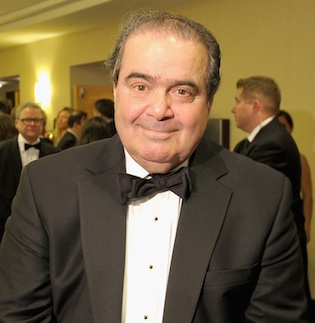
Lots of posts out there about Antonin Scalia as the faithful Roman Catholic. But the man sure sounded like he learned how to read the Constitution from Protestants:

Nonetheless, there is no escaping a verdict on his influence on American jurisprudence, and that verdict is not affected by the fact that he was a good buddy to prominent liberals. He was an advocate of two judicial ideologies, neither of which is intellectually tenable and which conflict with each other. Originalism was Scalia’s core ideological commitment, the idea that the Constitution should be interpreted as it was understood at the time of its ratification. He employed Originalism to question the idea that the Constitution is a “living document,” as liberal jurists held.

To be sure, there was a need for a conservative corrective after the high court starting snooping around the “penumbras” of the Constitution. As Justice Elena Kagan said in mourning Scalia’s death, “His views on interpreting texts have changed the way all of us think and talk about the law.” But, whether the Constitution is alive or not, the people whose government it intends to frame are most certainly alive and their circumstances change. Laws that cannot change with the lived circumstances of a people soon become disconnected from reality, and that disconnect will lead to the law being held in derision or ignored. . . .

Scalia’s other ideological commitment was to Textualism, the idea that the actual words must be interpreted in a kind of fundamentalist manner. This could conflict with Originalism. For example, an originalist would, like an historian, search for explanations as to what was intended by the drafters of a given text, to confirm that original intent and guarantee against latter day misinterpretations. But, Scalia famously loathed citations to legislative history. Textualism rests on the supposition that the Constitution is a self-interpreting text and if that were true, why would we need a Supreme Court? In practice, Textualism resulted in the conclusion that any given text meant exactly what Antonin Scalia thought it meant.

Of course, it’s not clear that Scalia’s hermeneutic was all positive. But it hardly sounds like it’s a product of deferring to the magisterium or to the development of dogma.

When Ecumenism and Environmentalism Collide

Pope Francis’ determination to meet with the Patriarch of Moscow involves several risks according to Massimo Faggioli:

First, there’s the political-diplomatic dimension of the meeting. The pope is going to meet the leader of a church that is seen more and more as part of the authoritarian regime of Vladimir Putin and an ideological support for his neo-imperial foreign policy. This criticism stresses the risks to Francis’s credibility, especially if considering the role of the Russian Orthodox Church in supporting Putin’s military actions in Syria and in Ukraine. (Kirill was, however, more cautious about Ukraine, given the potential consequences of the loss of Crimea and the war in eastern Ukraine for inter-Orthodox relations between Moscow and Kiev).

Second, there’s the internal politics of the Orthodox churches, in light not only of the historical rivalries between Moscow and Constantinople for supremacy within Eastern Orthodoxy, but also of the upcoming Great Synod of the Orthodox Churches on the Greek island of Crete in June. Some see Francis as naïve in regard as to how the patriarchate of Moscow could use the meeting to assert a new supremacy at a critical time for the future of the Orthodox churches. Here too the war in Ukraine factors into the equation.

Third, there’s the ecumenical dimension of the meeting. The Russian Orthodox Church has been far less engaged in ecumenical dialogue with the Catholic Church than the patriarch of Constantinople has; in agreeing to meet with Kirill, Francis is accused of sitting at the table with a leader who has not shown the minimum amount of ecumenical spirit required to start a conversation with the pope.

Professor Faggioli leaves out the risk to the environment. Since the Pope is meeting Kirill in Cuba, both church officials will be emitting lots of carbons into an environment on the brink of overheating.

How is this trip consistent with Pope Francis’ recent prayer video?

Two Cities or One?

Michael Sean Winters thinks Bishop Robert McElroy’s article on the religious duties of voters has merits, but I wonder after reading this paragraph:

Most important, a spiritual political conversion requires the orientation of soul that flows from the principle of solidarity that St. John Paul II powerfully outlined as a fundamental element of Catholic social teaching. This orientation reminds us that in society we must always understand ourselves to be bound together in God’s grace and committed, in the words of “On Social Concerns,” “to the good of one’s neighbor, with the readiness, in the Gospel sense, to lose oneself for the sake of the other rather than exploiting him.”

The implications of such a spiritual stance for discipleship in voting are clearly reflected in the Compendium of the Social Doctrine of the Church: “The principle of solidarity requires that men and women of our day cultivate a greater awareness that they are debtors of the society of which they have become a part.”

I get having a sense of belonging to the rest of the people in the society of which I am a member. I don’t get what grace has to do with this.

Is it really true that Christians understand themselves to be bound together with non-Christians in God’s grace? Or if we apply the antithesis that Augustine affirmed in his formulation of 2 cities, then are we only bound together in society with other Christians? That was the construction that led European Christians to wonder about where Jews and Muslims fit in Christendom, and John Calvin to wonder about where Michel Servetus fit in Geneva.

So once again, perhaps the Bishop needs to make clear the difference between the two kingdoms, one that affirms a spiritual antithesis and a social commonness. Blurring the two will get us to King Ferdinand and Queen Isabella.

Voluntary or Forced Exit

I was listening to another episode of the Glenn Loury Show today on the way to the office and Glenn (a few years ago now) brought up the book by Albert O. Hirschman, Exit, Voice, Loyalty. It’s about what happens when businesses or states break down and consumers or citizens need to decide whether to exit, voice dissent, or remain loyal. Hirschman doesn’t apply his argument to Christianity but I couldn’t help think of Roman Catholicism, the Reformation, and Roman Catholic defenders (at all costs, it seems) while Glenn was speaking.

I couldn’t find any reviews of Hirschman in the religious journals but Margaret O’Brien Steinfels did apply the book’s insights to the Roman Catholic Church a few years ago:

One out of every three Americans raised in the church is no longer a Catholic. These “formers” make up the second or third largest religious group in America (depending on whether Baptists are counted in their unity or diversity). In marketing terms, half these Catholics have chosen another brand of religion; the other half are “nones”—unaffiliated. It’s as if roughly 12 million people had forsaken Crest for Tom’s toothpaste, while the other 12 million stopped brushing their teeth altogether. Procter & Gamble, which makes Crest, would work hard to win back those customers: perhaps by banishing turquoise toothpaste or reducing the price. Not so the Catholic Church; it is not a manufacturer and need not be as enterprising as P&G. Does that mean lost customers are more valuable than lost sheep?

Albert O. Hirschman, a brilliant and iconoclastic economist (recently celebrated in a seven-hundred-page biography), laid out a plausible explanation for this kind of phenomenon in his classic study Exit, Voice, and Loyalty, which focuses on organizations that don’t function effectively and their dissatisfied members or customers. Some leave (the “exit” of the title); some stay (the “loyalty”). Hirschman asked why.

He recognized that exiting is easy if we’re talking toothpaste. Consumers dissatisfied with their usual brand can try another. Loyalty is more likely with organizations that invite a strong allegiance, possess a monopoly on something valued, or exact a high price for leaving—for example, families, religions, political parties, and totalitarian governments. Hirschman thinks that a strong sense of loyalty to the group makes exiting a tough, even unthinkable choice for discontented members. Instead, the dissatisfied voice their criticism rather than exit.

Back in the 1960s, when Hirschman was writing Exit, Voice, and Loyalty, voice was in vogue. Women were challenging patriarchy, Democrats protesting the war in Vietnam, Eastern European dissidents questioning Marxist orthodoxy, and Catholics debating Vatican II. These were the voices of critical members who would not or could not exit. Today the cost of exit has declined in all these arenas. Marriages became more egalitarian and divorce laws were relaxed. Ronald Reagan won the votes of FDR Democrats. The Soviet Union collapsed. The Catholic Church lost its monopoly on salvation.

Steinfels, on the progressive side of the church, could only think of Hirschman in the context of Vatican II, updating Roman Catholicism, and traditionalist opposition to such reforms. She did not think about the situation of Protestants in the sixteenth century who voiced their grievances and could not continue to do so because the hierarchy disenfranchised them within the church. This was not a voluntary but a coerced exit.

And yet, Steinfels point may have something to say to folks like Bryan and the Jasons (and their followers) who seem to embody a form of loyalty that approximates blind faith:

Some would argue that the Catholic Church, claiming a monopoly on truth as well as salvation, has no course correction to make. That has been the stand of recent popes and their episcopal appointees, who have rescinded or tinkered with Vatican II reforms and ruled out further change. Complaints have gone unheard, while conforming members have been embraced. And many have left.

Parents and friends of former Catholics now singing in a Baptist choir, serving on the vestry of an Episcopal parish, or meditating in a Buddhist monastery may be relieved that they’re still praying, still believing in something. Perhaps even the “lazy monopolists” consider that these sheep are not lost, simply misplaced. But what of the “nones,” those who abandon religion altogether or just drift away from it. We seem strangely indifferent to their exit. If 12 million people stopped brushing their teeth, we’d all take notice.

Though Hirschman is inventive in pursuing the combination and permutations of exit, voice, and loyalty that might insure an organization’s long-term survival, he recognizes that efforts to change an organization may come to nothing. He sums up this eventuality on a religious note: “the martyr’s death is exit at its most irreversible and argument at its most irrefutable.” It is ironic to think of those who give up their Catholic faith as martyrs, but their departure is at least as drastic as martyrdom. Lazy monopolists take note.

Actually, thinking of certain Protestants in the sixteenth and seventeenth centuries as martyrs is not all that ironic. Regarding those who appeal to circular arguments like motives of credibility or invincible ignorance as lazy sure looks obvious.

H. L. Mencken Wasn't Roman Catholic and He Could Write

First Christian presidents and now Peter Leithart explores Christian writers. Why do Christians feel the need to describe human activities in the context of sanctification? Isn’t that a tad provincial?

Leithart’s argument is that because Roman Catholics rely more on sacraments than Protestants who treat them as merely symbols, Roman Catholicism produces better writers:

Marburg is important not so much for what it achieved but as a symbol of what it failed to achieve. It provides a symbolic marker not only for the parting of the ways between Lutheran and Zwinglian, but also, for Zwinglians, the final parting of the ways between symbol and reality. J. P. Singh Uberoi claimed that “Spirit, word and sign had finally parted company at Marburg in 1529. For centuries, Christian sacramental theology had held symbol and reality together in an unsteady tension, but that alliance was ruptured by the Zwinglian view of the real presence. For Zwingli, “myth or ritual . . . was no longer literally and symbolically real and true.” In short, “Zwingli was the chief architect of the new schism and . . . Europe and the world followed Zwingli in the event.”

For many post-Marburg Protestants, literal truth is over here, while symbols drift off in another direction. At best, they live in adjoining rooms; at worst, in widely separated neighborhoods, and they definitely inhabit different academic departments.

Here is a thesis, which I offer in a gleeful fit of reductionism: Modern Protestants can’t write because we have no sacramental theology. Protestants will learn to write when we have reckoned with the tragic results of Marburg, and have exorcised the ghost of Zwingli from our poetics. Protestants need not give up our Protestantism to do this, as there are abundant sacramental resources within our own tradition. But contemporary Protestants do need to give up the instinctive anti-sacramentalism that infects so much of Protestantism, especially American Protestantism.

And Reformed Protestantism is particularly lacking:

Many Protestant churches (often the didactic ones) celebrate the Eucharist infrequently; many are deliberately, self-consciously anti-sacramental. Their worship consists of teaching but not doing, word but not sign. When they do celebrate the Supper, many Protestant churches are informed that it is a sign rather than a reality.

This is a simplification of what goes on in many Protestant churches. It is not, I think, a caricature.

The argument, based on the assumption and the assertion, comes in several stages: Churches whose worship focuses on didactic, doctrinal teaching are going to shape minds, imaginations, and hearts in a particular way. Churches with infrequent communion, and churches that treat communion as “mere sign” are also shaping the imaginative lives of their members.

Churches with didactic preaching and unsacramental worship, I submit, do not produce poets.

A poetic imagination is cultivated in churches where the beauty of Scripture is as important as its truth. Poetic imagination is cultivated in churches that celebrate Eucharist regularly. Every week, their worship climaxes with a great sacramental metaphor, a metaphor that is more than metaphor, a metaphor that also states (in some fashion) what is the case: “This is my body. This is my blood.”

By this argument, some forms of Protestantism – Anglicans with their prayer books and Eucharistic piety, Lutherans with their ins-withs-unders – are more conducive to cultivating poetic imagination than others.

What Leithart doesn’t consider apparently is that the logocentric quality of Protestantism, attention to the meaning of Greek and Hebrew involved in the study of Scripture, consideration of different biblical genres, or even the oratory involved in preaching — all of these could fire the imagination and fascinate young boys and girls with words in a way that could create good writing every bit as much as looking at statues, paintings, a wafer, and a chalice from which you’re never served.

At the same time, what does Leithart do with all those good writers who have no dog in the hunt of Christianity, like H. L. Mencken, who somehow learned to write even without going to church:

. . . the people of New York do even worse; they eat Chesapeake soft crabs fried in batter! What is cannibalism after that? I’d as lief eat a stewed archdeacon. Think of immersing a delicate and sensitive soft crab, the noblest of decapods, in a foul mess of batter, drenching it and blinding it, defacing it and smothering it — and then frying it in a pan like some ignoble piece of Pennsylvania scrapple. As well boil a cocktail, or a smelt, or a canvasback duck.

There is, of course, but one civilized way to prepare soft crabs for the human esophagus, and it goes without saying that it is the one way never heard of by the Greek bootblacks who pass as chefs in New York. It is, like all the major processes of the bozart, quite simple in its essence. One rids the crab of its seaweed, removes the devil, and then spears it with a long, steel fork upon the prongs of which a piece of country bacon, perhaps three inches long, has already made fast. Then one holds the combination over a brazier of glowing charcoal or a fire of hickory . . ., say three or four minutes.

What happens belongs to the very elements of cookery. The bacon, melted by the heat, runs down over the crab, greasing it and salting it, and the crab, thus heated, greased and salted, takes on an almost indescribable crispness and flavor. Nothing imaginable by the mind of man could be more delicious. It is a flavor with body, delicacy and character. Slap the crab upon a square of hot toast and then have at it. (“Callinectes Hastatus,” from The Impossible Mencken, 449)

The man could write and eat.

Where's Jesus?

Wouldn’t one of those answers that always work in response to any Sunday school question — the Bible, God, or Jesus — be the answer to the dilemma of God’s justice and divine mercy?

But when Pope Francis answers the question, he neglects Jesus and the cross, the ultimate confluence of justice and mercy:

“Sacred Scripture presents us with God as infinite mercy, but also as perfect justice. How are these two things reconciled? How can the reality of mercy be articulated with the need for justice?” the Pope said Feb. 3.

While these two characteristics can seem like opposites, “it’s precisely the mercy of God that brings the fulfillment of true justice,” Francis affirmed.

The Pope made his comments to pilgrims gathered in St. Peter’s Square for his weekly general audience. He recently began a new series of catechesis on the topic of mercy as it is understood in Scripture, in honor of the Jubilee of Mercy.

He said that when we think of justice, what might come to mind is an administration office where victims of an injustice appeal to a judge in court, asking that justice be done.
This, Francis noted, “is retributive justice, imposing a punishment to the guilty, according to the principle that each must be given what is due him.” While certain wrongs can be made right in this way, he said that it “still doesn’t bring true justice.”

Instead, it’s “only in responding with good that evil can be truly defeated,” the Pope said, explaining that this is what we find in the Bible

By helping the guilty person to see the evil done and by appealing to conscience, he can change. Such persons are able “to see their wrong and be open to the forgiveness offered,” Francis said, noting that this is also how families forgive each other, spouses and children included.

Might this be a window into the the problem of Roman Catholic laity not knowing church dogma? And don’t forget how the social justice designs of the mainline Protestant churches eventually made doctrine a trifle.

Today's Lesson in Ecclesiology

From the far right:

After Pope Benedict XVI resigned, there was a near-universal agreement among Church leaders that his successor should make it a top priority to bring the Roman Curia under more effective control: that is, to govern the Vatican well. In the daily conferences leading up to the 2013 conclave, one cardinal after another spoke out in favor of administrative reforms. Not surprisingly, after his election Pope Francis soon pledged himself to the cause of Vatican reform. It is not an easy task, and to date we have not seen the fruit of his efforts (except in Vatican financial affairs, where the reforms driven by Cardinal Pell are taking effect), but it will be fair to judge this pontificate on the Pope’s success or failure in streamlining and taming his own bureaucracy.

But the problems of Church governance do not stop at the Vatican walls. Especially because Pope Francis has indicated a desire for decentralized leadership, the Church will need bishops who govern effectively.

How often have you heard complaints about a bishop’s prayer life? Not often; very few people are presumptuous enough to judge the quality of another man’s prayers.

Have you heard complaints about a bishop’s teaching? Yes, occasionally. Frustrated Catholics will sometimes say that a bishop’s public statements on doctrinal issues have been confusing or misleading. Far more frequently there will be laments that the bishop remains silent when a clear teaching statement is necessary.

Still, by far the greatest source about a bishop’s performance will involve his governance. The appointment of pastors, the decisions to close parishes or schools, and the diocesan budget priorities will always be easy targets for critics. But even beyond that, the most common complaints involve not the bishop’s acts of governance, but his inaction: his failure to respond to complaints about liturgical abuse or parish mismanagement; his unwillingness to rebuke prominent Catholics who flout the teachings of the Church; his acceptance of religious-education programs that mislead young people and leave them ignorant; his tolerance for priests who have lapsed into complacency or worse.

Granted, lay Catholics should spend less time complaining about their bishops, and more time praying for them. Nevertheless it is instructive to see the nature of their complaints. We certainly need bishops who pray fervently and preach effectively. But we also need bishops who govern well. Above all, we need bishops who want to govern.

From the Protestant left:

You, as a baptized Christian and ordinary member of a church, are responsible for protecting the gospel and the gospel’s ministry in your church by discipling other church members.

Remember Ephesians 4:15–16. The church builds itself up in love as each part does its work. You have work to do to build up the church. And part of that includes the ministry of words. A few verses later, Paul says, “Speak the truth, each one to his neighbor, because we are members of one another” (v. 25). Speak truth to them, and help them to grow. Our words should be “good for building up someone in need, so that it gives grace to those who hear” (Eph. 4:29). Also, make yourself available to be spoken to. Are you willing to listen?

Basic Christianity involves building up other believers. It is a part of fulfilling the Great Commission and making disciples. Speaking of . . .

If through union with the second Adam God has reinstated you as a priest-king, your whole life should reflect the gospel in word and deed. You are an ambassador. Paul’s charge and example is worth repeating here:

He has committed the message of reconciliation to us. Therefore, we are ambassadors for Christ, certain that God is appealing through us. We plead on Christ’s behalf, “Be reconciled to God.” (2 Cor. 5:19b–20)

Every Christian has been reconciled, and thus every Christian has received this message of reconciliation. Therefore, we plead and we pray for sinners to be reconciled to God.

This, too, is a part of your job. The command to “Go and make disciples” belongs to you (Matt. 28:19).

From the moderate Calvinist middle:

1. Christ who has instituted government in his church has furnished some men, beside the ministers of the Word, with gifts for government, and with commission to execute the same when called thereto. Such officers, chosen by the people from among their number, are to join with the ministers in the government of the church, and are properly called ruling elders.

2. Those who fill this office should be sound in the faith and of exemplary Christian life, men of wisdom and discretion, worthy of the esteem of the congregation as spiritual fathers.

3. Ruling elders, individually and jointly with the pastor in the session, are to lead the church in the service of Christ. They are to watch diligently over the people committed to their charge to prevent corruption of doctrine or morals. Evils which they cannot correct by private admonition they should bring to the notice of the session. They should visit the people, especially the sick, instruct the ignorant, comfort the mourning, and nourish and guard the children of the covenant. They should pray with and for the people. They should have particular concern for the doctrine and conduct of the minister of the Word and help him in his labors.

As always, the one, the many, or the few.

Blame It on Christendom

Another way to read the Reformation:

I’ve been reading this week historian Brad Gregory’s study The Unintended Reformation: How A Religious Revolution Secularized Society. I had imagined it to be a somewhat polemical book that blamed the Reformation for all our modern woes. That was dumb of me. It’s a genealogy of ideas and events that led to our current condition.

It didn’t start with the Reformation. The ideas that laid the intellectual groundwork for the Reformation sprung out of Catholic theological debate two centuries earlier. The corruption of the Catholic Church, and the arrogant refusal of its leaders to heed calls to reform before it was too late, were very real and present. Luther had reason. He had the intellectual framework in place, and he had emotional cause: the utter rot within the Roman Catholic establishment.

That doesn’t make the Reformation right, of course, but one does see how it was all but inevitable. Once the break happened, it proved impossible to contain the forces unleashed. “Sola scriptura” proved an impossible standard for building a new church, because various Reformation leaders had their own ideas about what the Bible “clearly” said. The fracturing of the Reformation, and the arguments among various theological factions, were there from the beginning.