Saving the World

One light show at a time.

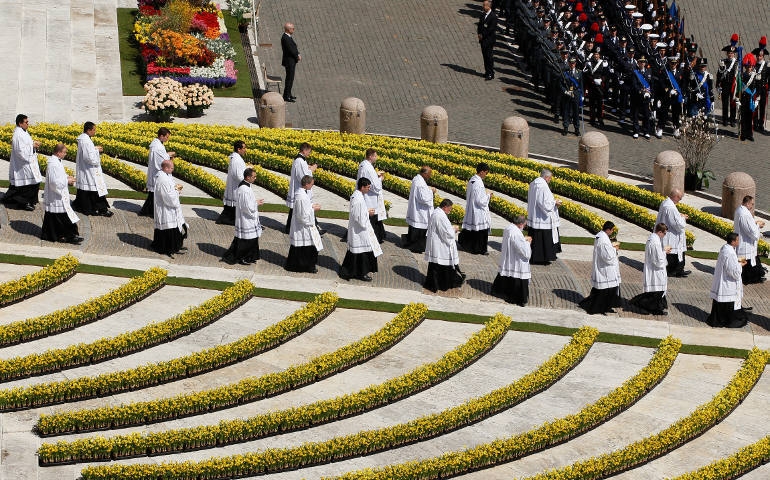
In case you missed it, the Vatican celebrated the Feast of the Immaculate Conception (yesterday) with a light show:

A mixture of fascination, curiosity and consternation is greeting a light show to be projected onto St. Peter’s basilica tomorrow — the Feast of the Immaculate Conception and the opening day of the Jubilee of Mercy.

A coalition of non-Catholic humanitarian, philanthropic and conservation groups along with the World Bank are staging the event. It will be the first time ever that images will be projected onto the 17th century basilica’s façade and Michelangelo’s cupola.

The organizers say the three hour event, called “Fiat Lux, Illuminating Our Common Home”, will tell the “visual story of the interdependency of humans and life on earth with the planet, in order to educate and inspire change around the climate crisis across generations, cultures, languages, religions and class.”

Archbishop Rino Fisichella, president of the Pontifical Council for the New Evangelization, called the event “unique” and said the illumination show “will present images inspired of Mercy, of humanity, of the natural world, and of climate changes.”

He added that the light show, whose images have been shown on various landmarks around the world, is meant to link Pope Francis’ environment encyclical Laudato Si’ with the United Nations Climate Change Conference (COP21) currently underway in Paris until Friday.

“It is our hope that this beautiful and contemporary work of public art will inspire citizens of the world to join together in a moment of compassion and to activate a global movement to protect humankind, our common home and precious endangered species,” said Carole Tomko, vice president of Vulcan, Inc., one of the groups sponsoring the event and which promotes initiatives to “change and improve the way people live, learn, do business and experience the world.”

Some conservative Roman Catholics have taken a page from Protestant iconoclasm and regard such a use of holy buildings as sacrilege:

The sense that St. Peter’s Basilica has been profaned is strong. The symbolic significance of the event is a Church immersed in darkness, but illuminated by the world, by the new climatist-religion-ideology (all financed by the World Bank Group which will now have to explain to us what politics compatible with the teaching of the Church it is promoting..)

The holy place par excellence, the heart of Christianity transformed on a maxi-screen for the show of the New World Power Ideology …and the Nativity Crib was left in darkness.

It does make you wonder what salvation means. If improving the environment can save the world, then what happened to the cross of Christ and the sacraments? Could it be that hell is empty (and will remain so) and so the church can now devote itself to more humanitarian and less heavenly causes? Did Balthasar really win at Vatican 2 as Commonweal suggests? Before Vatican 2, Rome was pretty clear where unbelievers went at death:

Any sin, for Augustine, is an unspeakable offense against God; particularly offensive was the sin of the first man who was singularly graced with an intimate “enjoyment of God” and who stood as the progenitor of the human race. His impiety in abandoning God was so great that it “merited eternal evil” in consequence of which “the whole of mankind is a ‘condemned mass’ [massa damnata]; for he who committed the first sin was punished, and along with him all the stock which had its roots in him.” According to Augustine, no one has the right to criticize that retribution as unjust, and the fact that some are released from it through the free bounty of God is ground for heartfelt thanksgiving.

The same severe doctrine of hell has been affirmed time and again in official church documents. The Fourth Lateran Council in 1215 declared that, at the end of time, “all will receive according to their deeds, good or evil, the former to their everlasting glory with Christ, the latter to perpetual punishment with the devil.” In his constitution of 1336, Benedictus Deus, Benedict XII solemnly defined that “the souls of those who die in actual mortal sin go down immediately after death into hell and suffer the pain of hell.” The Council of Florence in 1442 maintained that “not only pagans, but also Jews, heretics and schismatics” are precluded from salvation for they “will enter into eternal fire” unless they embrace the Catholic Church before their death. Similar declarations on hell and salvation were issued by the Council of Trent in the sixteenth century. Vatican I reinforced them in the nineteenth century. Vatican II did not revisit the solemn definitions of hell by earlier councils, but it did at least affirm that, yes, atheists can be saved.

But that changed when Balthasar and Kung met Barth:

Like Barth and Balthasar, Hans Küng too comes close to proposing universal salvation. And like them, he enlists the virtue of hope to support the idea. In his book Eternal Life, Küng’s critical discussion of hell begins with Jesus’s own words about hell, which, according to Küng, were figurative rather than literal: terms in the New Testament pertaining to final judgment—words like “hell,” “eternal,” ‘fire”—are to be taken as metaphors warning sinners of the delicate edge they’re dancing on. They are “meant to bring vividly before us here and now the absolute seriousness of God’s claim and the urgency of conversion in the present life,” Küng writes. No one should dismiss his or her responsibility to meet the demands of conversion, but how each of us meets them “remains a matter for God as merciful judge” in his “all-embracing final act of grace.” Like Balthasar, Küng maintains that judgment of the individual is in God’s hands; it would be “presumptuous for a person to seek to anticipate the judgement of this absolutely final authority. Neither in the one way nor in the other can we tie God’s hands or dispose of him. There is nothing to be known here, but everything to be hoped.”

Barth, Balthasar, and Küng all agonize over the question of universal salvation, which they treat not just as a theological puzzle but as a genuine mystery. Because we cannot answer the question with absolute certainty, it finally has to be left—in humility and hope—to the judgment of a loving God. This is as much of an affirmation as they dare to make.

What these three theologians show us, however, is that hope is a powerful virtue and not just a matter of wishful thinking. Hope always has its reasons, even earthly hopes. In the everyday sense of the word, a doctor’s skill is reason for his patient to hope for a cure, a worker’s good job performance a reason for her to hope for a promotion—though such hopes, subject to human limitations, can be disappointed. In the economy of salvation, however, the reason for hope is nothing less than the divine will—profoundly declared in the passion, death, and resurrection of Jesus: “For God sent the Son into the world, not to condemn the world, but that the world might be saved through him” (John 3:17). The clarity of this scriptural passage on God’s will reassures not only Christians but all mankind that our hope for salvation will be fulfilled—without exceptions.

But if U.S. parochial schools can reconsider their mission, maybe the Vatican can find it’s pre-Vatican 2 self:

“We don’t open Catholic schools to get kids into college,” Guernsey said. “We open Catholic schools to get them into heaven.”

Bringing Up the Rear

If Islam is going to develop into a religion of peace and tolerance, it doesn’t need either a Reformation or an Enlightenment, according to Daniel Philpott. Instead it needs a Vatican Council — preferable Vatican Council 2.0 since the first council was a tad militant and intolerant.

Here are the limitations of Protestantism and philosophy:

Protestant reformers enforced their orthodoxy with every bit the deadliness that Catholics employed. While England’s Queen Mary acquired the sobriquet “bloody” for her brutal restoration of Catholicism, her little sister Elizabeth was equally violent in reestablishing the Anglican Church.

The 18th century Enlightenment advanced individual religious freedom but was skeptical towards religion. The French Revolution, the Enlightenment’s political enactment, asserted the rights of man but severed the heads of men and women of faith.

Yes, lots of blood before 1800. But where’s the American exceptionalism? Where’s John Courtney Murray arguing for the Enlightenment tradition of natural law that shaped the founding of the United States? Maybe Philpott’s editor didn’t give him enough words to embrace the religious freedom that his bishops celebrate every fortnight for freedom:

Catholics must fight against forces seeking to remove the influence of religion from American culture, Archbishop William E. Lori of Baltimore told over 1,000 Catholics at a Mass beginning a 14-day campaign for religious freedom.

“In differing ways, both the Church’s teaching and our nation’s founding documents acknowledge that the Creator has endowed individuals with freedom of conscience,” said Archbishop Lori. “Such freedom goes to the heart of the dignity of the human person.”

The archbishop delivered the opening homily for the Fortnight for Freedom, the two-week period leading up to the Fourth of July that the bishops have dedicated as a time for prayer, education and advocacy for religious liberty.

That was 1776. But the real lesson of religious freedom, for Philpott, comes in 1965 (for the historically minded, notice the chronology and the Roman-centric w-w paradigm):

. . . western history contains a more promising pathway, ironically one found in the very religious body that the Reformation and the Enlightenment considered freedom’s greatest enemy: the Catholic Church.

It was in Second Vatican Council’s declaration, Dignitatis Humanae, on Dec. 7, 1965 — a date whose 50th anniversary is right around the corner — that the Church finally and authoritatively endorsed the human right to religious freedom.

While the Catholic Church’s road to religious freedom will not suit Islam in every respect, it shows how a religious community that for many centuries did not teach religious freedom could discover grounds for the principle that were rooted in its own teachings rather than in modern secularism.

Like Islam, Catholicism long predates the modern world. The period from which Dignitatis Humanae most dramatically departs is medieval Christendom, when the integrity of the Catholic faith was regarded as crucial for social order. Heresy was not merely a sin but an act of sedition.

Not the point of the post, but notice how this booster also notices what the rest of us without a dog in the fight of papal supremacy notice — namely, that Roman Catholicism changed from medieval to modern at the Second Vatican Council. Everyone sees this except for those who put their trust in ecclesiastical princes.

What is the point here, though, is how Rome is an example to Islam. Was it not the case that modern developments in Europe and North American finally forced bishops to open the church’s windows to modernity? In which case, it was not that the church embraced religious freedom on its own but “finally” — Philpott’s word — caught up to religious freedom in trails blazed by Americanists (and others). Of course, Protestantism did not usher in freedom of conscience. But Protestants did adjust much earlier than Rome. And Philpott gives Protestants no credit.

Instead, he thinks Muslims should look to Roman Catholics — who still celebrate the Battle of Lepanto.

Yup.

Those Were The Days

Makes you wonder why some want more religion in politics or why others object to Luther’s meager efforts at reform:

On Sunday May 9, 1527, an army descending from Lombardy reached the Janiculum. The Emperor, Charles V, enraged at Pope Clement VII’s political alliance with his adversary, the King of France, Francis I, had moved an army against the capital of Christendom. That evening the sun set for the last time on the dazzling beauties of Renaissance Rome. About 20,000 men, Italians, Spaniards and Germans, among whom were the Landsknecht mercenaries, of the Lutheran faith, were preparing to launch an attack on the Eternal City. Their commander had given them license to sack the city. All night long the warning bell of Campidoglio rang out calling the Romans to arms, but it was already too late to improvise an effective defense. At dawn on the 6th of May, favoured by a thick fog, the Landsknechts launched an assault on the walls, between St. Onofrio and Santo Spirito.

The Swiss Guards lined up around the Vatican Obelisk, resolute in their vow to remain faithful unto death. The last of them sacrificed their lives at the high altar in St. Peter’s Basilica. Their resistance allowed the Pope along with some cardinals the chance of escape. Across the Passetto di Borgo, the connecting road between the Vatican and Castel Sant’Angelo, Clement VII reached the fortress, the only bastion left against the enemy. From the height of the terraces, the Pope witnessed the terrible slaughter which initiated with the massacre of those who were crowding around the gates of the Castle looking for refuge, while the sick of Santo Spirito Hospital in Sassia were massacred, pierced by spears and swords.

This unlimited license to steal and kill lasted eight days and the occupation of the city nine months. We read in a Veneto account of May 10, 1527, reported by Ludwig von Pastor “Hell is nothing in comparison with the appearance Rome currently presents” (The History of Popes, Desclée, Rome 1942m, vol. IV, 2, p.261). The religious were the main victims of the Landsknechts’ fury. Cardinals’ palaces were plundered, churches profaned, priests and monks killed or made slaves, nuns raped and sold at markets. Obscene parodies of religious ceremonies were seen, chalices for Mass were used to get drunk amidst blasphemies, Sacred Hosts were roasted in a pan and fed to animals, the tombs of saints were violated, heads of the Apostles, such as St. Andrew, were used for playing football on the streets. A donkey was dressed up in ecclesiastical robes and led to the altar of a church. The priest who refused to give it Communion was hacked to pieces. The City was outraged in its religious symbols and in its most sacred memories”. (see also André Chastel, The Sack of Rome, Einaudi, Turin, 1983; Umberto Roberto, Roma capta. The Sack of the City from the Gauls to the Landsknechts, Laterza, Bari 2012).

Clement VII, of the Medici family, had paid no attention to his predecessor, Hadrian VI’s appeal for a radical reform of the Church. Martin Luther had been spreading his heresies for ten years, but the Roman Papal States continued to be immersed in relativism and hedonism. Not all Romans though were corrupt and effeminate, as the historian Gregorovius seems to believe. Not corrupt, were the nobles Giulio Vallati, Giambattista Savelli and Pierpaolo Tebaldi who hoisted a flag with the insignia “Pro Fide et Patria” and held the last heroic stance at Ponte Sisto. and neither were the students at Capranica College, who hastened to Santo Spirito and died defending the Pope in danger.

It is to that mass slaughter, the Roman ecclesiastical Institute owes its name “Almo”. Clement VII survived and governed the Church until 1534, confronting the Anglican schism following the Lutheran one, but witnessing the sack of the City and being powerless to do anything, was for him, much harder than death itself.

On October 17, 1528, the imperial troops abandoned a city in ruins. A Spanish eyewitness gives us a terrifying picture of the City a month after the Sack: “In Rome, the capital of Christendom, not one bell is ringing, the churches are not open, Mass is not being said and there are no Sundays nor feast days. The rich merchant shops are used as horse stables, the most splendid palaces are devastated, many houses burnt, in others the doors and windows broken up and taken away, the streets transformed into dung-heaps. The stench of cadavers is horrible: men and beasts have the same burials; in churches I saw bodies gnawed at by dogs. I don’t know how else to compare this, other than to the destruction of Jerusalem. Now I recognize the justice of God, who doesn’t forget even if He arrives late. In Rome all sins were committed quite openly: sodomy, simony, idolatry, hypocrisy and deceit; thus we cannot believe that this all happened by chance; but for Divine justice”. (L. von Pastor, History of Popes, cit. p. 278).

Pope Clement VII commissioned Michelangelo to paint the Last Judgment in the Sistine Chapel, conceivably to immortalize the dramas the Church had undergone during those years. Everyone understood that it was a chastisement from Heaven. There were no lack of premonitory warnings: lightening striking the Vatican and the appearance of a hermit, Brandano da Petroio, venerated by the crowds as “Christ’s Madman”, who, on Holy Thursday 1527, while Clement VII was blessing the crowds in St. Peter’s shouted: “sodomite bastard, for your sins Rome will be destroyed. Confess and convert, for in 14 days the wrath of God will fall upon you and the City.”

The year before, at the end of August, the Christian army had been defeated by the Ottomans on the field of Mohacs. The Hungarian King, Louis II Jagiellon died in battle and Suleiman the Magnificent’s army occupied Buda. The Islamic wave in Europe seemed unstoppable.

Yet, the hour of chastisement was, as always, the hour of mercy. The men of the Church understood how foolishly they had followed the allurements of pleasures and power. After the terrible Sack, life changed profoundly. The pleasure-seeking Rome of the Renaissance turned into the austere and penitent Rome of the Counter-Reformation.

Shrugs only go so far.

The Stakes Raised But Not Too High

Here is one quote that turned a Protestant Roman Catholic:

Make no mistake, my brothers, if anyone joins a schismatic he will not inherit God’s Kingdom. If anyone walks in the way of heresy, he is out of sympathy with the Passion. Be careful, then, to observe a single Eucharist. For there is one flesh of our Lord, Jesus Christ, and one cup of his blood that makes us one, and one altar, just as there is one bishop along with the presbytery and the deacons, my fellow slaves. In that way whatever you do is in line with God’s will.

That’s a plausible motivation for switching teams. If you don’t switch, you don’t inherit the kingdom of God. Stakes appropriately raised. Attention gained.

But then you need to remember it’s a post Vatican 2 world. In that case, becoming Roman Catholic is mainly about being a superior sort of Christian.

I’m a Better Christian as a Catholic

As a younger Evangelical, I was amongst the first to throw stones at my Catholic brethren. In fact, there were times and situations in which I wouldn’t even have considered them to be Christians.

“Catholics aren’t Christian,” right? And, sure, some likely aren’t.

But that needn’t be the case. My life, I hope, and my experience should serve to provide a contrasting picture against the one that many of us might have. My experience and many others, I should add.

The Catholic life, lived to its fullest, has been so incredibly enriching to me and my faith. Through a deeper focus on prayer, through my experience living amongst the saints, through a more global perspective, a deeper reverence for God in worship, and through a much more healthy and hearty view of sin I’ve become, far and away, a much better Christian than I ever thought I could be.

It’s not about being Christian or not. It’s not about entering the true church and leaving behind heresy. It’s like going from a Subaru to a Lexus.

Who are you to judge? Judge, but only up to the point short of condemnation. We’re all Christians now post 1965, but some Christians have more championship banners.

What If Luther Had Heard This?

Another pope has the chance to address the German bishops:

New structures keep being created, but the faithful are lacking. It is a sort of new Pelagianism, which leads to us putting our trust in administration, in the perfect apparatus. But an excessive centralisation only complicates the life of the Church and her missionary dynamic, instead of helping her (cf. Evangelii gaudium, 32). The Church is not a closed system, constantly revolving around the same questions and puzzles. The Church is alive, she responds to local people, she can make restless and stimulate. She has a face, which is not rigid. She is a Body that moves, grows and has feelings. And this belongs to Jesus Christ.

The current need is for pastoral reorientation, and also “to make [the structures of the Church] more mission-oriented, to make ordinary pastoral activity on every level more inclusive and open, to inspire in pastoral workers a constant desire to go forth and in this way to elicit a positive response from all those whom Jesus summons to friendship with himself” (Evangelii gaudium, 27). Certainly, the conditions are not necessarily favourable in modern society. A measure of worldliness still prevails. Worldliness deforms souls and stifles the awareness of reality.

We're Not Supposed to Notice

Boniface explains the confusion that many Protestants experience when reading older papal claims and try to parse infallibility:

It seems to me that there are certain dogmas or declarations of the Catholic Church that some in the Magisterium wish they could forget about. I’m thinking of declarations like those found in Unam Sanctam (1302), the Syllabus of Errors, the Council of Florence, etc. These declarations on issues such as the reality and eternality of hell, the necessity of membership in the Church for salvation, the permanent invalidity of Jewish ceremonial law, the condemnation of secular political concepts and many other such un-ecumenical positions stand out to them as embarrassing monuments of a bygone era. I think many in the Church would like to get rid of these declarations, if they could – and I am speaking not only of liberals, but of mainstream, even certain “conservative” members of the hierarchy. These teachings are like antiquated family heirlooms that one can’t get rid of but effectively hides by stuffing them in the attic.

Obviously and thankfully, these declarations cannot be gotten rid of. They can be ignored and wished away, but they will not go away. Definitive, infallible ex cathedra statements remain for all time and are irreformable of their very nature. No matter how much any bishop or cardinal would like to contradict or get rid of these dogmatic heirlooms, they cannot.

Yet, though these declarations will not go away, there is a way that the hierarchy has found to get around this problem. I have noticed that, in areas where the modern hierarchy takes vastly different positions than the traditional Church, novel positions are not given to the faithful by means of encyclicals or dogmatic statements, but are found throughout lower-level pronouncements, such as speeches, letters, addresses, bishops’ statements etc. By repeating these novel positions again and again in very low-level pronouncements, the faithful get accustomed to hearing certain novelties “from the Church” and over time come to accept them as “Church teaching.”

A classic example is the death penalty. Granted, JPII called for a lesser application of the death penalty in Evangelium Vitae; but besides this, most of the very strong words offered against the death penalty have come from bishop’s committees, papal speeches, statements and letters and articles in publications like L’Osservatore Romano and on Zenit. Many of these statements condemn capital punishment absolutely, in contradiction to Church teaching and tradition. The Catechism, the official teaching of the Church, of course says that capital punishment is licit and that the state cannot be denied the right to wield it. That is the official teaching and it cannot be altered. But, at every level lower than official teaching, capital punishment is condemned absolutely, and with such frequency that many orthodox Catholics no longer know that capital punishment is allowable. They have heard the voices of the popes and the bishops (in low-level pronouncements) condemn it so much that this erroneous position has effectively become “the Church’s teaching,” leading to a situation where something other than Church teaching takes the practical place of Church teaching while allowing the contrary and official position to remain in place.

Thus the strategy for “changing” Church teaching seems to be this: If you want to teach something contrary to what the Church has always taught, just do it at low enough levels of authority and eventually people will start to accept your low-level declarations as “Church teaching” if they are trumpeted about long enough.

Did the faculty of Auburn Seminary take over the Vatican? It’s not the letter of infallible statements but the spirit?

If only Denzinger were alive. He could fix this.

Help From Across the Pond

Additional returns on Protestant efforts to transform culture:

Taken together, Stewart, Sutton, and Wacker offer important new perspectives on the means by which America was born again. America has become a holy nation, but those who are most responsible for it so often refuse to recognize it. But these books also suggest the extent to which evangelicalism itself has been born again. In the course of the past century, even as its cultural power steadily increased, the “old-time religion” has been revolutionized. Across the board, the doctrinal and political specifics that once shaped popular Protestantism have given way to what evangelical-turned-Catholic sociologist Christian Smith has described as a “moralistic therapeutic deism.” This religious style mimics the structure of evangelical theology while advancing only a few of its ethical demands.

Investigating this trend, Todd M. Brenneman’s Homespun Gospel: The Triumph of Sentimentality in Contemporary American Evangelicalism (2014) analyses the rhetorical and media strategies of several best-selling evangelical ministers. Despite some differences, Brenneman argues, Max Lucado, Joel Osteen, Rick Warren, Joyce Meyer, and other celebrity preachers share a common exhortative style. Their pitch mixes ideas that are often atypical of the evangelical theological heritage in a mélange of unreason and sentiment. In their presentations, theology is reduced to clichés that reiterate the image of a “fatherly God desperately in love with his children…a God who is infatuated with human beings.” . . .

As the recent books discussed here suggest, the religious and political divisions that have so often beset born-again Protestants have become increasingly pronounced. In this era of “designer” religion, as believers become increasingly divided in their religious and political convictions, their moments of common purpose become ever more difficult to identify. Evangelical religion has won America at the price of its own evisceration. Contemporary evangelicals might have much more in common with those associated with “the heretical origins of the American republic” than they could ever have imagined. They tried to change the nation by re-inhabiting the zeitgeist, but the zeitgeist swallowed them in mid-transformation. For the evangelicals who made it all possible, the redemption of America has come at enormous cost.

Too bad evangelicals didn’t learn from Roman Catholics about the danger of identifying faith with place:

The West, still primitive, discovered through the Crusades the intensive culture, the accumulated wealth, the fixed civilized traditions of the Greek Empire and of the town of Constantinople. It discovered also, in a vivid new experience, the East. The mere covering of so much land, the mere seeing of so many sights by a million men expanded and broke the walls of the mind of the Dark Ages. The Mediterranean came to be covered with Christian ships, and took its place again with fertile rapidity as the great highway of exchange.

Europe awoke. All architecture is transformed, and that quite new thing, the Gothic, arises. The conception of representative assembly, monastic in origin, fruitfully transferred to civilian soil, appears in the institutions of Christendom. The vernacular languages appear, and with them the beginnings of our literature: the Tuscan, the Castilian, the Langue d’Oc, the Northern French, somewhat later the English. Even the primitive tongues that had always kept their vitality from beyond recorded time, the Celtic and the German [Footnote: I mean, in neither of the groups of tongues as we first find them recorded, for by that time each—especially the German—was full of Southern words borrowed from the Empire; but the original stocks which survived side by side with this new vocabulary. For instance, our first knowledge of Teutonic dialect is of the eighth century (the so-called Early Gothic is a fraud) but even then quite half the words or more are truly German, apparently unaffected by the Imperial laws and speech.] begin to take on new creative powers and to produce a new literature. That fundamental institution of Europe, the University, arises; first in Italy, immediately after in Paris—which last becomes the type and centre of the scheme.

The central civil governments begin to correspond to their natural limits, the English monarchy is fixed first, the French kingdom is coalescing, the Spanish regions will soon combine. The Middle Ages are born.

The flower of that capital experiment in the history of our race was the thirteenth century. Edward I. of England, St. Louis of France, Pope Innocent III., were the types of its governing manhood. Everywhere Europe was renewed; there were new white walls around the cities, new white Gothic churches in the towns, new castles on the hills, law codified, the classics rediscovered, the questions of philosophy sprung to activity and producing in their first vigor, as it were, the summit of expository power in St. Thomas, surely the strongest, the most virile, intellect which our European blood has given to the world.

Two notes mark the time for anyone who is acquainted with its building, its letters, and its wars: a note of youth, and a note of content. Europe was imagined to be at last achieved, and that ineradicable dream of a permanent and satisfactory society seemed to have taken on flesh and to have come to live forever among Christian men.

No such permanence and no such good is permitted to humanity; and the great experiment, as I have called it, was destined to fail.

While it flourished, all that is specially characteristic of our European descent and nature stood visibly present in the daily life, and in the large, as in the small, institutions, of Europe.

Our property in land and instruments was well divided among many or all; we produced the peasant; we maintained the independent craftsman; we founded coöperative industry. In arms that military type arose which lives upon the virtues proper to arms and detests the vices arms may breed. Above all, an intense and living appetite for truth, a perception of reality, invigorated these generations. They saw what was before them, they called things by their names. Never was political or social formula less divorced from fact, never was the mass of our civilization better welded—and in spite of all this the thing did not endure.

Ironic?

When the studios release Spotlight for viewing at the nation’s theaters, the Vatican cracks down on journalists:

The criminal charges against the two Italian journalists boil down to this: they practiced journalism. They found sources and persuaded them to give up confidential documents. That allowed them to report, in a more precise way, on important matters of public interest. A good portion of the reporters I know would have criminal records if this were a crime.

Criticism of what’s happened here seems curiously muffled – perhaps because Pope Francis has inspired so much hope. I’ve shared that excitement, and still do.

And I hope that Pope Francis will come to recognize this indictment for what it is: An attempt to interfere with the fundamental human right “to exchange information and ideas” — and a step backward for the church.

#DavidDaleidenmattersright?

At Least Pretty Good?

Is this what happens when the Bible has to take a number behind Homer and Aristotle?

Our students immerse themselves in the Great Books (the Western Canon), the Good Book (the Bible), and God’s “First Book” (nature)—all of which we consider necessary for a true liberal education. Our humanities curriculum starts our freshmen off in Homeric Greece and brings our seniors through modernity and postmodernity. In a time of cultural amnesia, this deep study in the sweep of Western literature, history, politics, and philosophy cultivates the intellect and the heart.

If an awakening can be “great,” if a revolution can be “glorious,” and if a canyon can be “grand,” can’t the Bible at least get a “pretty good”?

If in fact Christianity is a revealed religion as opposed to one that relies on communications from priests, shamans, or oracles, then why isn’t the Bible the final authority for Christian reflection? Even H. L. Mencken could figure this out:

I confess frankly, as a life-long fan of theology, that I can find no defect in his defense of his position. Is Christianity actually a revealed religion? If not, then it is nothing; if so, then we must accept the Bible as an inspired statement of its principles. But how can we think of the Bible as inspired and at the same time as fallible? How can we imagine it as part divine and awful truth and part mere literary confectionery? And how, if we manage so to imagine it, are we to distinguish betwen the truth and the confectionery? Dr. Machen answers these question very simply and very convincingly. If Christianity is realy true, as he believes, then the Bible is true, and if the Bible is true, then it is true from cover to cover. So answering, he takes his stand upon it, and defies the hosts of Beelzebub to shake him. As I have hinted, I think that, given his faith, his position is completely impregnable. There is absolutely no flaw in the arguments with which he supports it. If he is wrong, then the science of logic is a hollow vanity, signifying nothing. . . .

I have noted that Dr. Machen is a wet. This is somewhat remarkable in a Presbyterian, but certainly it is not illogical in a Fundamentalist. He is a wet, I take it, simply because the Yahweh of the Old Testament and the Jesus of the New are both wet – because the whole Bible, in fact, is wet. He not only refuses to expunge from the text anything that is plainly there; he also refuses to insert anything that is not there.

If the Bible is the word of God, then why do some spend so much time defending the words of church officers?

Shrugged and Always Shrugging

One shrug:

One of the most common takeaways from Synod 2015 is that it revealed deep “divisions” within the Catholic Church. While I will suggest that “divisions” is too strong a word, no one can deny that Synod 2015 demonstrated the existence of strong theological tensions within the body of Catholic bishops, and that this in turn points to disturbingly pronounced and conflicting conceptions within the Catholic faithful of what Catholic belief and practice is or ought to be. What did the evident tensions at Synod 2015 mean for the Church? What does the reality of ever more diverse and conflictive creedal alignments among the baptized mean, particularly for the Church in the US? Herewith, I offer some thoughts on both questions. . . .

[W]e can say here that we have come with some confidence to believe that a significant part of Christianity in the United States is actually only tenuously Christian in any sense that is seriously connected to the actual historical Christian tradition, but has rather substantially morphed into Christianity’s misbegotten step-cousin, Christian Moralistic Therapeutic Deism. This has happened in the minds and hearts of many individual believers, and, it also appears, within the structures of at least some Christian organizations and institutions. The language, and therefore experience, of Trinity, holiness, sin, grace, justification, sanctification, church, Eucharist, and heaven and hell appear… to be supplanted by the language of happiness, niceness, and an earned heavenly reward. It is not so much that U.S. Christianity is being secularized. Rather, more subtly, Christianity is either degenerating into a pathetic version of itself or, more significantly, Christianity is actively being colonized and displaced by a quite different religious faith.

Now, replace “Christianity” with “Catholicism” and “Christian” with “Catholic” in that paragraph, and I would suggest this describes the essential creed of thousands of American Catholics.

Such then is the complexity of our Church in the United States. As members of that Body, particularly as ministers, catechists, pastors and evangelists, we simply must understand—with serenity and faith—that this complexity generates tensions, and those tensions will likely continue to characterize the Church in the US for decades to come.

One might be tempted to ask whether we as a Church are not on the cusp of going the way of Judaism—as recently suggested by Daniel McGuire—a religion with “branches”—orthodox, conservative and reform. Do we today have “branches of Catholicism” in the Church? I think not. But tensions we do have, because Catholics embrace conflicting and even incompatible creedal commitments.

What to make of all this? Shall we despair? Shall orthodox Catholics allow themselves to be overcome by a bunker mentality—all the rest be damned? If we have taken it to heart that “a bruised reed he will not break, and a smoldering wick he will not snuff out,” then most assuredly, no. Rather, beyond the synods and beyond the tensions, let’s keep our focus on living a robust, orthodox and joyful Catholic faith—extending to our Catholic brothers and sisters who have yet to experience it, the means and opportunities for a personal encounter with Jesus Christ. Let’s do that with trust in the transforming power of his grace, the inscrutable depths of his Divine Mercy, and the sanctifying action of his Holy Spirit.

Two shrugs:

One of the most troubling things about American Catholics is their tendency to go off the deep end.

Conservative Catholics who are upset about the condition of the church and think Pope Francis is evil incarnate seem to be proliferating. . . .

I would therefore recommend to any Catholics who are in turmoil because the present pope isn’t to their liking or their church is not what they want or their bishop unsatisfactory to read some church history. Eamonn Duffy’s history of the papacy Saints and Sinners is a good one. When you read history of the church you’ll realize that turmoil and trouble have been with us since the time of the apostles. Might as well get used to it.

Does that mean you shouldn’t be upset or worried? No. Does that mean one should be complacent about heresy, corruption within and persecution from without? No. Be worried. That’s okay if it leads you to pray more.

What is troublesome is how much time people spend biting their nails and grumbling and posting angry blog articles or getting all worked up into a tizzy about stuff they can’t really do much about anyway.

This is one of the reasons I’ve started my new blog The Suburban Hermit –to get people to spend some time away from the church politics headlines, away from the head banging and nail biting and to try to build their life with Christ and deepen their life of prayer.

More time in work, prayer and reading (the Benedictine formula) will bring stability to your life. You’ll come to realize again, but at a heart level, that God is in charge. He loves his church. Everything will be all right in the end, and you can breathe easy.

Three shrugs:

You are worried about phantoms. The Church cannot alter the sacraments. The most that may happen is that the Church will face the fact that Caesar has decided to pretend that there is such a thing as gay marriage and that people involved in such arrangements require some form of pastoral care. Would you rather the Church simply reject them and their children? Christ comes to call not the righteous, but sinners. So that’s not an option. The desire of some Catholics to cut people off from the very opportunity of grace is as old as Donatism. The Church as a fortress and an engine of vengeance is not the gospel. She is bound to seek the lost.

Part of the problem is that people have no idea what this Synod is about. It is, like all conciliar actions, a time when the Church “holds herself in suspense” as Bp. Robert Barron puts it, and makes up her mind about things. It is supposed to hear from all sides so that it can sift wheat from chaff. The pope did something similar when drafting Humanae Vitae, consulting theologians who urged him to ditch the Church’s ancient tradition about artificial contraception. He declined to do so.

What this come down to is a test of your trust, not in Francis, but in Jesus Christ’s promise that the Holy Spirit will guide the Church into all truth. It is He, not Francis, who is the soul of the Church.

With that kind of resolve, faith, and hope, you’d have thought these folks could have overlooked all of Protestantism’s woes. But Protestantism is not the New York Yankees of Western Christianity.