The 2Ker's Burden

Charles Murray’s book, Coming Apart, has been receiving a lot of attention. It is a book about the growing divergence between elites and average Americans, and shows that the wealthy and well educated are far more conservative in their way of life than many assume. Ross Douthat at the New York Times has been largely favorable and at the conclusion of one of his posts, he writes something about traditional morality which suggests you don’t need to be a Christian or a social conservative to understand the value of good behavior.

Finally, Murray makes a very convincing case . . . for the power of so-called “traditional values” to foster human flourishing even in economic landscapes that aren’t as favorable to less-educated workers as was, say, the aftermath of the Treaty of Detroit. Even acknowledging all the challenges (globalization, the decline of manufacturing, mass low-skilled immigration) that have beset blue collar America over the last thirty years, it is still the case that if you marry the mother or father of your children, take work when you can find it and take pride in what you do, attend church and participate as much as possible in the life of your community, and strive to conduct yourself with honesty and integrity, you are very likely to not only escape material poverty, but more importantly to find happiness in life. This case for the persistent advantages of private virtue does not disprove more purely economic analyses of what’s gone wrong in American life, but it should at the very least complicate them, and suggest a different starting place for discussions of the common good than the ground that most liberals prefer to occupy. This is where “Coming Apart” proves its worth: Even for the many readers who will raise an eyebrow (or two) at Murray’s stringently libertarian prescriptions, the story he tells should be a powerful reminder that societies flourish or fail not only in the debates over how to tax and spend and regulate, but in the harder-to-reach places where culture and economics meet.

The 2k kicker is that the two-kingdom proponent has to say yes and no to this assessment (as Douthat, himself a Roman Catholic might admit). The happiness that Murray describes and that Douthat lauds is good and valuable for people and societies this side of glory as part of God’s providential care for his creation. But this happiness is not ultimate. The happiness of Christianity is paradoxically available not only to the well bred and well off, but also to thieves hung on crosses. And in some cases, human flourishing may actually prevent people from seeing their need for ultimate happiness.

This means that the danger of much conservatism, especially the kind promoted by neo-Calvinist inspired transformers and social conservatives, is to identify salvation with human flourishing. If you make that kind of identification, you also make it hard for people who lead sinful lives (which includes faithful spouses and productive businessmen) to see their need for a happiness that is only available to those who will admit that their incomes, stable families, and civic involvement count for nothing when it comes to spiritual flourishing.

The Bible is Not Off Limits But Only Settles So Much

Two of Old Life’s regular voices, Zrim and Jed, are having an interesting discussion — in response to a post questioning the political machinations of the hallowed Bonhoffer — about whether 2kers may legitimately appeal to the Bible in their civic duties. Zrim argues that the Bible forbids civil disobedience while Jed questions whether a 2ker may employ the Bible in this way.

Meanwhile, Rabbi Bret responds to me that his case for Ron Paul and paleo-conservatism come directly from biblical teaching on the fifth and eighth commandments.

Several points of clarification seem to be in order. First, 2kers do appeal to the Bible. They do so in their personal lives all the time. They even appeal to the Bible — you know, “my kingdom is not of this world,” does not come from Aristotle — to argue for legitimacy of 2k. Two-kingdom theology is thoroughly biblical (or at least tries to be) and its advocates don’t let differences between the kingdoms prevent them from seeing that — to borrow a line from the old E. F. Hutton commercials — when the Bible speaks, believers listen. As I have repeatedly insisted in different forums, the eighth commandment compels me to question whether I should shop at Walmart or at Gelzer’s Hardware. After Sam Walton is not my neighbor, the one whose welfare I am supposed to seek. But Mr. Gelzer is. The Bible gives some instruction about economics. I should try to apply to my life. I don’t see how that is inconsistent with 2k because it is not.

Second, this appeal to the Bible does not mean that I may require Rabbi Bret to shop locally or Jed to drink only the beers made by San Marcos breweries. Individual believers need to respect the consciences and interpretations of other believers. Some may eat meat offered to idols, and others won’t. Both will appeal to the Bible. But appealing to the Bible doesn’t settle whether believers will act in the same way about a host of matters.

Third, the critics of 2k — aside from uncharitably disregarding 2kers’ appeal to Scripture — can’t seem to fathom the difference between the claims made by individuals about biblical teaching and those of church officers and assemblies. For instance, because the Baylys’ believe the Bible compels them to protest at abortion clinics, they believe that church assemblies must call all believers to similar forms of protest. They even go a step farther and think that anyone who dissents from their application of Scripture disobeys the Bible. (Wow!) Meanwhile, folks like Rabbi Bret don’t seem to understand that his appeal to the fifth and eighth commandments for paleoconservatism leaves little room in the church for other perspectives, such as the Covenanters, libertarians, Democrats, or monarchists. Yet, the Reformed creeds insist that church assemblies should address only matters that are spiritual and ecclesiastical. In other words, when the church speaks as institutional church, she must have a biblical warrant. And that explains why the creeds don’t address education, math, or economics. The Bible doesn’t require God’s people to have a uniform method of delivering education, a base-ten system of math, or a commitment to free markets.

The bottom line is that the Bible does not solve the problems that critics of 2k think it does. If you believe in Christian liberty, which is premised upon the idea that Christians have liberty in matters where Scripture is silent — from whether or not to meet for worship at 11:00 on Sundays to whether or not to drive an SUV — then appealing to the Bible will not yield the unity or uniformity in politics or culture that Bible thumpers tout.

Can We Get a Little Moral Clarity Here?

In the light of Newt Gingrich’s recent surge in the polls, let’s see how the fortunes of the Religious Right are developing:

A weak week ago Mitt Romney was leading in the polls and some even talked about his sowing up the nomination after South Carolina and Florida.

Newt Gingrich’s ex-wife did an interview this week in which details of Newt’s infidelities were in full view.

South Carolina may be the most evangelical state in the union, prompting some to call for Christians to migrate to the Palmetto State.

Today, pundits are calling the South Carolina Republican primary a toss-up between Gingrich and Romney, despite Romney’s obvious practice of family values and Gingrich’s marital past.

So where does this lead? First, evangelicals rally behind Tim Tebow who disregards the fourth commandment. Second, evangelical leaders tried to identify Rick Santorum, a Roman Catholic who doesn’t even number the Ten Commandments (let alone interpret them) as evangelicals do (or used to). Now, apparently some evangelicals are willing to overlook the seventh commandment in favor of a conservative Republican.

I personally don’t care how evangelicals vote. Voting is not an act of devotion and is a matter of Christian liberty. But I do grow weary of the constant refrain of faith’s importance for politics when it is so obviously untrue, when a paucity of political ideas forces believers to wrap politics in Christian language. All of us are hypocrites. But not all of us make such a big deal of calling attention to our hypocrisy. If the Religious Right wants the rest of America to take them seriously, they need to acknowledge and explain their selectivity. I have advice — adopt 2k theology which means that you recognize the fallenness of the world and its politicians and so make the best of a bad situation. But if you’re going to insist that religion forms the only adequate basis for morality, and if you’re going to demand political candidates who have a faith that produces the kind of character needed for holding public office, then you better have a ready explanation for your vote for candidates who openly violate the Ten Commandments.

And it would also be good to explain how your identification of political acts with Christian devotion is not a violation of the First Commandment. Admittedly, Karl Barth had his problems as an interpreter of the Reformed tradition. But he certainly recognized the damnable error of investing political parties with religious significance (beyond the indefinite meanings supplied by providence).

Rich But Not Robust

The word robust is overused and has become a cliche. People use it now to add emphasis without considering alternatives — like vigorous, energetic, profound. A good example of the overuse of robust comes in Andrew Sandlin’s endorsement for John Frame’s new book, Escondido Theology:

Frame has lived to see a vocal segment of the robust, rich tradition in which he was educated transformed into a narrow sectarianism that anathematizes other orthodox, Bible-believing Christians; elevates theological and church tradition to near equal status with God s Word; and diminishes that Word as the norm for all of life and thought. This book is the agonizing jeremiad of an older prophet who sadly diagnoses a desiccating illness of a friend and offers a prescription for a wholesome healing.

This is another way of saying that another book has come out attacking 2 kingdom theology as sectarian and outside the Reformed tradition. I guess if you still think that Christian societies should exist — what to do with Roman Catholics, Jews, and Mormons is never really clear in this nostalgia for the Reformed nation- or city-state — then 2k theology may look bizarre. At the same time, if you have lived in the United States with its religious diversity as long as John Frame has, and if you have been an officer in one of the churches that uses the revised Westminster Confession as Frame does, then you may not be shocked to find that some contemporary Reformed authors actually follow the teaching not of James Jordan or Greg Bahnsen but of the Reformed churches.

But to bring up theonomists is to note a place at which the word rich applies. It is indeed rich for Sandlin to plug a book that argues 2k theology is outside the mainstream of Reformed thought when the author, Frame, has not been exactly in the center of Reformed teaching about worship and the regulative principle (for starters). It is also rich for Sandlin to suggest that 2k has anathematized other views when Frame is not too bashful in castigating former colleagues and present peers (in the Reformed churches).

And not to be missed on the rich front is that Frame had to find an obscure publisher, Whitefield Media Productions, for his blast against 2k. Not even the gracious editors at P&R, apparently, would take this screed. Meanwhile, the idiosyncratic and sideline proponents of 2k have found editors at out of the way presses like Zondervan, Eerdmans, and P&R.

I sure hope Frame does not believe in conspiracies.

Say Hello to Nelson Kloosterman, James Jordan, Tim Keller, and David Bayly

Theonomy and R. J. Rushdoony have never been so popular. Ever since Ryan Lizza’s piece on Michele Bachman in the New Yorker appeared, bloggers and columnists had been taking shots at the journalist for allegedly writing a hit piece on the congresswoman from Minnesota. The latest to weigh in is Michael Gerson, George W. Bush’s speech writer, and a columnist for the Washington Post. According to Gerson:

The Dominionist goal is the imposition of a Christian version of sharia law in which adulterers, homosexuals and perhaps recalcitrant children would be subject to capital punishment. It is enough to spoil the sleep of any New Yorker subscriber. But there is a problem: Dominionism, though possessing cosmic ambitions, is a movement that could fit in a phone booth. The followers of R.J. Rushdoony produce more books than converts.

So it becomes necessary to stretch the case a bit. Perry admittedly doesn’t attend a Dominionist church or make Dominionist arguments, but he once allowed himself to be prayed for by some suspicious characters. Bachmann once attended a school that had a law review that said some disturbing things. She assisted a professor who once spoke at a convention that included some alarming people. Her belief that federal tax rates should not be higher than 10 percent, Goldberg explains, is “common in Reconstructionist circles.”

The evidence that Bachmann may countenance the death penalty for adulterers? Support for low marginal tax rates.

Since theonomists recently dismissed me and other 2kers as infidels for not supporting the death penalty for adultery, Gerson’s words have a certain poignancy. As I argued at Front Porch Republic, the word Dominionism is proving to be a real distraction from a much bigger issue for Protestants who may not be as obscure as the Dominionists (wherever they are — do they have a website, journal, or institution?). Theonomy or Reconstruction may be acquired tastes among Reformed Protestants who hold neo-Calvinism dear, but a wide swath of conservative Calvinists — some whom Gerson knows — defend the Kuyperian view of the antithesis in ways that make the world safe for Michele Bachmann and many evangelicals who also see the social world in black and white categories. The reason for this convergence owes to a rejection of appeals to the light of nature in favor of special revelation and regenerate interpretations of the Bible alone (to be interpreted by regenerate people, mind you) for arriving at Total Truth. Such conservative Protestants may not follow theonomists in supporting the death penalty for disobedient adult covenant children, but they do believe the Bible should be the basis both for the public square and arguments about how the best way to run the public square.

As I pointed out in one comment at Greenbaggins:

. . . there are at least three different critiques of 2k but those critiques are also at odds:

1) the 16th century view of the magistrate and his duties to promote the true religion is one critique. (But this critique is marginal to contemporary Reformed communions because all the Presbyterian and Reformed churches of which most of us here are members have repudiated those views and revised our confessions).

2) the generally Kuyperian view that Christ is Lord of all things which reads the relationship between general and revelation in a particular way against 2k. (This is generally Kuyperian because this view is only implicit in Kuyper who also rejected the 16th century view of the magistrate and who also held up the ancient philosophers as models of political philosophy despite their lacking special revelation.) If someone could actually explain the Kuyperian view it would be very helpful and I have ask Mark many times for it and he keeps avoiding an answer.

3) there is the theonomist critique which is a reading of the law of recent vintage (though it may pull from earlier Reformed thinkers) and which has no standing in any of the Reformed churches represented here (as in people asking for the magistrate to execute adulterers).

These three critiques are not in agreement and the third would actually have to take as much issue with the first two as with 2k because those other positions don’t follow the law any more than 2k does (as theonomists understand the law).

So with all of this hostility, it would be useful for the critic to identify himself and what the model or standard is for which he stands. The first two critiques hold up part of a historical example and use that against 2k to show that 2k has departed from a certain standard. But the entire Reformed world has moved from those earlier expressions. So the first two critiques need to explain what the new model is now that Reformed churches have moved on.

Theonomists don’t really need to identify themselves. I generally get their objection. I just don’t see why theonomy is as much a problem for Calvin as it is for Kuyper.

In other words, the one position available to conservative Protestants for demonstrating that they do not hold a view of biblical law comparable to sharia — the 2k theology and its use of the order of creation and the moral sense that all people have — is anathema or nonsensical to many who call themselves neo-Calvinists, evangelicals, and theonomists. As I (the one in all about me) have also argued, at least the theonomists are consistent. But what folks like Gerson seem to be in denial about is the working assumption that prevents most evangelicals folks from embracing 2k — that God’s truth only comes from the Bible and the regenerate who alone have the capacity, through the lens of Scripture, to understand the created order aright.

This doesn’t make Bachmann or Keller, or Kloosterman, or the Baylys dominionists — the Federal Visionaries are another matter. But they are all using the same play book — an understanding of worldview that relies on the basic distinction between the redeemed and the lost. For that reason, outsiders like Lizza and others outside the Christian camp, may have trouble knowing when a Christian entering the public square is going to follow Scripture or not. I am still waiting to hear the argument that says we will follow biblical teaching for civil laws on marriage, sex, and murder but not on idolatry, blasphemy, or the Sabbath. Until the critics of 2k start to criticize each other — sort of the way that conservatives were wondering when feminists would turn on Bill Clinton for his dalliance with Monica — knowing how to distinguish Dominionists from the rest of the Bible-onlyists will require a special playbook.

Tim Bayly Does His Impersonation of St. Peter

Apparently the Brothers B have dyslexia, though I am open to other explanations for how they garble other peoples’ writings and ideas. Tim Bayly has written yet another blast of their loud trumpet against 2k theology. This time they identify with the plow boy who knows right from wrong and they pit the common person against the egg-head academics who argue for a two-kingdom perspective and do so by often invoking the apostle Paul. Never mind that the simple apostle, Peter, like the Baylys apparently, found Paul hard to understand sometimes. The plow boy in the Baylys is a cocky little fellow who knows what he knows and disregards any instruction even after he steps in a big pile of mule manure because he was reading Bayly Blog on his I-Phone.

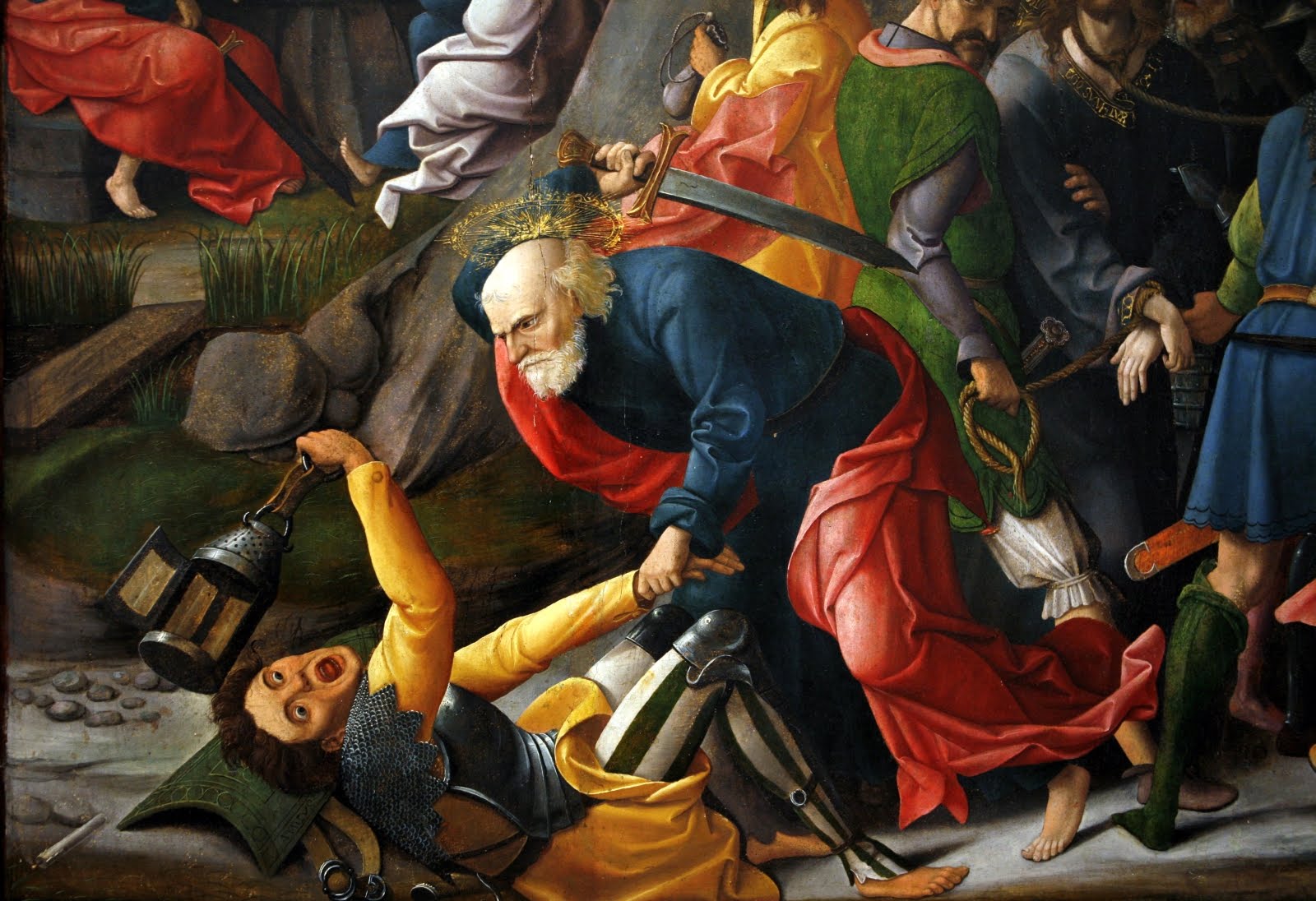
Aside from identifying with Peter’s roots as a man of the fishermen, the Baylys seem to be fond of rushing to judgment and action like the apostle did when evil is prevailing over the good. It was Peter, after all, who committed the only act of outright political defiance by the apostles when he raised the sword and took a swipe at one of the soldiers who arrested Jesus. Anyone with an ounce of sympathy for Christ can also appreciated Peter’s desire and courage in defense of his Lord at a time of great injustice. But Peter still didn’t understand, like the Baylys, that Christ’s kingdom comes not by a physical but a spiritual sword.

That is what 2k strives to clarify, the spiritual nature of the church.

But here is how the Baylys once again misrepresent 2k in tones quite out of tune with the love the repeatedly profess:

They [2k men] are fixated on silencing the voice of their fellow citizens who are religious, particularly those citizens who profess faith in Jesus Christ. Their endless political message is that no man may speak for God outside the privacy of his own home and church-house; and that if he does choose to speak as a citizen of these United States, he must be ever so careful to make it clear he’s not speaking for God or His Church. Our form of government requires him to parse his words and mince his sentences and nuance his tone so that no civil magistrate or fellow citizen will feel threatened by Christians-as-Christians, let alone Church-members-as-Church-members or Church-officers-as-Church-officers. This is the nature of our civil compact, and if religious people speak for God and His Church and people, they are violating that civil compact.

Wrong! The Bible actually requires ministers to parse their words carefully. And the Reformed interpretation of Scripture insists that ministers have a biblical warrant for when they declare what the Lord requires. And lo and behold, one of the doctrines the Bible teaches is liberty of conscience. Again, the egg-headed apostle Paul, did a good job of teaching a doctrine that plow boys and Brothers Bayly have trouble grasping when he talked about the liberty that Christians have to eat meat offered to idols.

According to the Bible, idolatry is wrong.
Also, according to the Bible, meat produced by idolatry is not wrong.
Also, according to the silence of Scripture, ministers are not required to shut down the butchers who sell the meat produced in false temples.

Let’s see about the Baylys red-letter edition of the Ten Commandments.

According to the Decalogue, murder is wrong.
Also, according to the Bible, the penalty for murder is not specified (unless you are a theonomist), which means Christians are free to support and oppose the death penalty.
Also, according to the Bible, ministers are not required to petition the government to punish murderers. Christians themselves as citizens may be free to do so.
But ministers cannot condemn as sinful something about which Scripture is silent.

In which case, the Baylys have substituted their word for the word of God in denouncing as sinful 2k theology.

Here’s the icing on the cake: 2k theology was the doctrine that informed J. Gresham Machen’s opposition to the church’s support for Prohibition and teaching Scripture in public schools. According to Machen:

. . . you cannot expect from a true Christian church any official pronouncements upon the political or social questions of the day, and you cannot expect cooperation with the state in anything involving the use of force. Important are the functions of the police, and members of the church, either individually or in such special associations as they may choose to form, should aid the police in every lawful way in the exercise of those functions. But the function of the church in its corporate capacity is of an entirely different kind. Its weapons against evil are spiritual, not carnal; and by becoming a political lobby, through the advocacy of political measures whether good or bad, the church is turning aside from its proper mission. . . .

Now, of course, the Baylys are not required to affirm Machen’s argument, and their previous credentials within a communion that excommunicated Machen might account for their lack of sympathy for his spirituality of the church idea. But if they are going to re-write the informal rules governing conservative Presbyterianism post-1950 and banish Machen from the list of worthies, they will need to do more than blow their trumpet. They might actually need to read and think about Machen’s reading of Scripture.

What's Good for the Immanentizer is Good for the Post-Millennialist

Alan Jacobs pushes back against Andrew Sullivan’s recent denunciation of Christianism. According to Sullivan:

Christians will look back on this period, I believe, with horror. The desire to control others’ lives and souls through politics is so anathema to the Gospels it will one day have to be exposed and ended. Until then, we just have to keep our spirits up and attend to our own failures as Christians, which, of course, are many.

Jacobs thinks he has the perfect antidote to Sullivan, and his name is Martin Luther King, Jr. Jacobs seems to think that King was doing what today’s Christians are doing, namely, arguing for conformity between the law of God and the laws of the United States:

[King] could have stayed in his prayer closet instead of politicking; he could have attended to his own failures as a Christian, which of course were many; he could have forgiven white Southerners instead of judging them. But no. He became an “outside agitator,” marching into ordinary American communities and telling them that their local laws, and indeed in some cases federal laws, were not to be obeyed — and why? Because they conflicted with the law of God! Notice the arrogance with which he associates his cause with God Himself. He even asserts that “human progress” only happens when “men [are] willing to be co-workers with God.” His whole vision for America is Christian and Biblical through and through: in his most famous speech he simply identifies the American situation with that of the Biblical Israel: “I have a dream that one day every valley shall be exalted, and every hill and mountain shall be made low, the rough places will be made plain, and the crooked places will be made straight; ‘and the glory of the Lord shall be revealed and all flesh shall see it together.'” Talk about “the desire to control other people’s lives and souls”!

Well, I’ll take the bait. King’s immanentized political theology and identification of the United States with Israel was as bad as Jerry Falwell’s or now Rick Perry’s. That doesn’t stop Jacobs who explains, “After all, Dr. King’s faith commitments were at least as encompassing in their scope, as universal in their claims, as publicly political as Rick Perry’s . . .” Thinking of the United States as the New Israel is wrong no matter who is doing it and no matter what the cause.

But Jacob’s comparison is far fetched for at least three reasons. First, the Christian or Religious Right has not faced the same sorts of obstacles that African Americans did and IN some cases still do. Trying to glom evangelical politics on to the Civil Rights movement is just plain bad form (and this is from someone who doesn’t care for the increased power of the federal government that came with Civil Rights legislation). Second, King was not running for president. sponsoring a prayer rally around the same time that you are contemplating entering the Republican bid for the presidential nomination is almost as tacky praying before a NASCAR race and thanking the Lord for a “smoking hot” wife. Third, King’s appeal was much more common at a time when mainline Protestants dominated public life and appealed to Christian theology for social reform. For some reason, evangelicals don’t seem to understand that the United States has changed a lot since 1963, along with the etiquette governing public speech about the United States as a Christian nation. If not everyone, including the media elites, believes the United States to be a biblical polity, then maybe you don’t bring up the Bible if you want to persuade the media elites. Maybe also you don’t pray in public with a humongous U.S. flag at your back.

One last point: when Christians enter the public square and start using theology for political purposes, Christian doctrine always, always, always suffers. It happened with the Social Gospel. It happened with Martin Luther King, Jr. It happened with Reinhold Niebuhr. And it’s happening with Rick Perry. Consider the following from a report about the recent prayer rally:

The lineup of speakers at The Response reflect the impact of new charismatic and Pentecostal movements, especially those emphasizing spiritual warfare and round-the-clock prayer and worship, and which have produced another sort of army. That one is not particularly intrigued by the horse race of politics, but rather focused more exclusively on the supremacy of Jesus and preparing for his return.

That caused some controversy for the organizers of Perry’s event, which included speakers and endorsers who follow the New Apostolic Reformation. The NAR’s strident language of spiritual warfare and emphasis on prophecy, signs, and wonders, has drawn scrutiny. But it has the same dominionist aims of the old religious right, even while employing some new rhetoric.

The NAR has also drawn criticism from conservative evangelical “discernment” ministries that consider it heretical—a criticism that Response organizers dismissed. A week before The Response, Marsha West, a conservative writer and editor of the website Email Brigade, wrote a scathing blog post; which she published on the website of Response host the American Family Association, and which was subsequently taken down. West complained that the NAR, which she considers unbiblical, was involved in The Response.

West told me in an email that she was “thoroughly disgusted with Christian Right leaders who have joined forces with a group that is, by definition, a Christian cult. Because of CR leader’s lack of discernment, the NAR is now becoming mainstream.” (According to her website, West also considers Mormonism, the emergent church, new age spirituality, word of faith, homosexuality, and more to be unbiblical.) In the NAR, she particularly identified Mike Bickle of the International House of Prayer, who played a big role in The Response. “[T]hese people are what the Bible calls ‘false prophets’… not true Christians,” West wrote. When I asked Garlow [Jim Garlow heads Newt Gingrich’s nonprofit, Renewing American Leadership]about West’s complaint, he shrugged it off, saying that he was not familiar with the term New Apostolic Reformation, even though he knew its founder, Peter Wagner. “I have a lot of confidence in him spiritually,” Garlow said of Wagner.

“There are a lot of theological differences here, but we’re focusing on one issue: Jesus,” Garlow added. “It’s not about whether Perry becomes president, it’s about making Jesus king.”

Does Jacobs actually believe Garlow? Can he not see that Sullivan is just a little bit justified in being skeptical about today’s “Christian” politics?

Who's Radical Now?

The Brothers Bayly are persistent in besmirching two-kingdom theology and its proponents but their latest swipe is rich indeed. They have reprinted a mysterious piece (impossible to find anywhere else on the Net) about the enormities of the Obama administration. Nathan Ed Schumacher is the author and Tim Bayly’s foreword runs ever charitably as follows:

This piece . . . demonstrates that the silence of Emergent and R2K men in the face of the wickedness and oppression in our public square is of the same fabric. Fear of man is a principle that knows no boundaries.

I keep wondering why fear of God pertaining to the ninth commandment, you know one of those laws that the Baylys would seem to want to prevail in the public square, does not inform the way these fellows write about Christians — not to mention officers — in the church. But I digress.

Schumacher, it seems, had a conversation with a graduate of a seminary on the West Coast – hmmm – about the woes of the nation and why more ministers were not speaking publicly about such matters. Schumacher contended with the seminary graduate that the difficulties facing the United States were not simply political but moral in nature. But the seminarian responded that the church should only speak to spiritual matters. Schumacher responded:

Here we have a spirituality radically disconnected from morality – an ethereal religion not connected to historic Christianity and its application of ethics to the real world. What kind of “spirituality” or theology is this that can disregard morals, ethics, and God’s Law and even silently abide open murder?

So what is Schumacher talking about when it comes to immorality in the United States? It turns out that morality is closely tied to politics.

We live in an astonishing time in America where the President is making open war domestically on the Constitution, and openly making unlawful wars internationally – such wars outlawed by the Constitution and long vested by the Rule of Law as war crimes and open murder – and formally recognized as such by the Nuremberg trials. When a President publicly usurps the Constitution, making an open show of violating its limits on exercising power, whether it be by his making illegal war, giving secret orders, punishing American soldiers for exposing truth, building secret prisons, operating torture chambers, running kidnapping operations (rendition), publicly asserting his right to kill American citizens with no trial or process, openly publicly stealing money via “bailouts”, taxing in violation of the Constitution, openly violating the Bill of Rights, creating illegal Federal agencies and programs, etc., ad nausem, then what does that mean according to the Principles of Law? It means, without question, that he has invoked the Law of Belligerents against the American people by acting as a belligerent upon the American people themselves, because publicly assaulting their Constitution is, in fact, an assault upon them. In other words, the President is openly making war upon the American people by these belligerent actions – actions which are open, public, and undeniable. If you don’t understand this, you are not paying attention. Our Constitution formally defines this as treason.

Schumacher’s solution is for the church to call a synod:

It is long past time for church Officers to convene formal and official church councils and synods all across this land to address the open lawlessness and public sin and crimes of what passes for “our government”- and to address the way forward. Nevertheless, it is probable that they can be expected to refuse to do this – and likely that they will always have a long list of lofty “spiritual reasons” as to why they cannot accept responsibility. But if church Officers, who are the official voices of moral authority, refuse to do this then there is a deafening silence and they cannot expect to be found faithful – and the rest of us will suffer the continuing consequences of their dereliction of duty – praying that God will raise up some “Thomas Beckets” who are jealous for the church, the Law of God, and who will have the courage to say “No” to our present political “king”.

In the comments on this post, the Baylys add a curious wrinkle to the clear overreach (clear according to what follows below). When one commentator brought up the example of the apostle Paul who did not seem to be overly upset by the rule or policies of Caligula, Tim and David ever lovingly responded:

. . . we don’t need to see it happening constantly with the Apostle Paul or John the Baptist or Jesus or Augustine or Calvin or Edwards or Machen in order to know that the R2K men are wrong when they oppose the church and her officers standing against theft, oppression, rampant gross immorality, the repudiation of the rule of law, and the massive bloodshed of the slaughter of hundreds of millions of wee ones.

When you find yourself arguing that John the Baptist is no model for pastors today, you should wonder whether, just maybe, your cowardice has gotten the best of your faith.

Two aspects of this response are striking. The first is the Bayly habit of hitting below the belt – that is, questioning masculinity rather than formulating an argument. The second is that the Bible really does not need to be our guide because the existing evils are so enormous. Paul, Jesus, and the rest of the apostles may not have led protests against their societies, but their silence is only an opening for the Baylys’ shouting. Never mind that a cardinal conviction of Reformed Protestantism is that officers in the church, whether individually or collectively, need a biblical warrant for using their authority.

I do wonder why the Baylys do not recognize how partisanly political their moral hectoring looks. It is not as if Obama is the first president to abuse the powers of the Constitution or propose questionable economic policies. Can the Baylys or Schumacher remember the former president’s apparent disregard for the Constitution in the Gulf War, the Medicare bailout, or the Patriot Act? Do they not know that Christians on the Left opposed Bush in terms remarkably similar to the way they castigate Obama, thus making party affiliation more than biblical interpretation the basis for moral posturing?

I also wonder if the Baylys have ever heard of the United States Civil War and the debates that Old School Presbyterians had over support for the federal government. The 1860s was a time of grave national crisis also driven by a hotly disputed moral issue and the Old School General Assembly of 1861 decided to address the matter through the clumsy Spring Resolution. Here we have a church doing exactly that for which Schumacher calls and the Baylys approve — an Assembly addressing a moral and political question. And yet, Charles Hodge, a man who voted for Lincoln, believed secession was treasonous, and that treason was immoral, opposed the church taking a stand on matters that literally broke the United States apart. Hodge wrote:

. . . a man who acts on the theory of secession, may be justly liable to the penalty of the civil law; he may be morally guilty in the sight of God; but he has committed no offense on which the church can take cognizance. We therefore are not inconsistent in asserting, 1. That secession is a ruinous political heresy. 2. That those who act on that doctrine, and throw off allegiance to the Constitution and the Union, are guilty of a great crime; and, 3. That nevertheless they are not amenable in this matter to the church. The question whether they are morally guilty, depends on the question whether their theory of the constitution is right. If they are right, they are heroes; if they are wrong, they are wicked rebels. But whether that theory is right or wrong it is not the province of the church to decide.

The reason why the church cannot decide such political and constitutional matters, even when morality is involved, is that the Bible does not address these topics. Hodge explained:

The church can only exercise her power in enforcing the word of God, in approving what it commands, and condemning what it forbids. A man, in the exercise of his liberty as to things indifferent, may be justly amenable to the laws of the land; and he may incur great guilt in the sight of God, but he cannot be brought under the censure of the church.

What the Baylys (as well as most critics of the spirituality of the church) miss is the distinction between morality and authority. The Baylys go knock-kneed whenever a 2k person suggests that a moral truth should not necessarily be advocated by the church. The Bayly logic seems to be that if it is right, then all authority must be used to execute the right. But biblical teaching would also prompt questions about who has authority to enforce the good. Just because I believe drivers who pass me on the right are wrong does not mean that I have power to pull those drivers over and lock them up in our basement. The Baylys desire to marshal the church’s power behind their interpretation of the Constitution (and their assessment of the culture wars) comes dangerously close to ecclesiastical vigilantism: the church can and should do whatever is right and not bother with the technicalities such as the confession of faith or Book of Church Order. Ironically, then, in the Baylys’ twisted logic, the very constitution of the church becomes expendable in the defense of the United States Constitution.

A related point that the Baylys miss is how radical their views are compared to the supposed radicality of 2k. Charles Hodge was by no means the most vociferous proponent of the spirituality of the church. But he could see the folly of positions like the Baylys on good 2k grounds. Hodge was not a radical and neither are 2k proponents. In contrast, the Baylys’ disregard for the constitution of their church and the teachings of their confession of faith several steps down the road to anarchy.

And they call 2kers antinomian? Call again.

Kingdom Sloppy: A Big Bowl of Wrong

Readers of Oldlife may think I am too hard on Kuyper and neo-Calvinism. I know of one reader and commenter who regularly replies that I am just pointing out errors but that neo-Calvinism in its purity is — well — pure. Another respondent has admitted to some flaws along the way but nothing inherently erroneous about neo-Calvinism per se.

And then I receive a deluge of examples that suggest neo-Calvinism is not simply prone to abuse by a few of its proponents. Instead, repeatedly, neo-Calvinism blurs the distinctions between the church and culture (what we used to call the world), and consistently does not recognize the fundamental difference between redemption and cultural activity. Herewith some examples (and I have the good Dr. K. to thank for several of them).

The first comes from James K. A. Smith in an article he wrote for Pro Rege in which he tried to argue for more of a liturgical component for neo-Calvinism. (I actually think Smith has a point, especially when he conceives of a church-college as a worshiping community in which liturgy should be at the center of campus life.) But to defend his view, he observes a tendency within neo-Calvinism (and he is pro-neo-Calvinist) that is precisely what Old Lifers detect in Kuyperianism:

Kuyper has been inherited in different ways in North America, yielding different Kuyperianisms. While Zwaanstra suggests that “ecclesiology was the core of [Kuyper’s] theology,” one quickly notes that it is the church as organism that is the “heart” of his doctrine. This emphasis, coupled with some other emphases in Kuyper, led to a strain of Kuyperianism that actually had little place for the church as institute in its understanding of Christian engagement with culture. Indeed, there have even been strains of Kuyperianism that have been quite anti-ecclesial. On the other hand, Kuyper himself clearly saw a crucial role for the church as institute and devoted a great deal of his time, energy, and gifts to its welfare and reform.

Next comes a quotation, which also came to my attention through Dr. K., which seems to run rough shod over distinctions between redemption and creation, such that Bach, bordeaux, and republican governments become the fruit of the Spirit.

Reformational Christians are not very accustomed to relating the working of God’s Spirit to nature and to culture. The under-appreciation of the broader work of the Spirit betrays an incorrect vision of the relationship between nature and grace. Here, too often the point of departure involves an antithesis between the general and the special working of the Spirit. Only the latter is saving.

For the Reformation, grace is not opposed to nature, but opposed to sin. By grace, a person does not become super-human, but genuinely human. Grace restores and redeems nature, but it adds nothing new to nature. “The re-creation is not a second, new creation. It introduces no new substance, but is essentially reformatory,” according to Herman Bavinck. . . .

The Bible connects the work of the Spirit also to the gift of art. That applies to devotional music, to be sure. But architects and visual artists like Bezalel and Oholiab were also filled with the Spirit of God in order to be able to do their creative work [Ex. 31.6; 36.1-2; 38.23].

Christians may pray for the working of the Holy Spirit in their own lives, but also for the corruption-restraining working of the Spirit in society. That working extends to the meetings of literary guilds, of the advertising review council, and of the film rating commission. Where the Holy Spirit is absent, the demons of terror have free reign.

Therefore the church prays for the world this petition as well: “Veni creator Spiritus”—Come, Creator Spirit! (Dr. H. van den Belt, “Focus op bekering mag zicht op vernieuwing aarde niet ontnemen,” Reformatorisch Dagblad [13 June 2011])

We can see where such blurring leads when we look at a new initiative at Redeemer Presbyterian Church. I learned about this one thanks to the ever watchful eyes of the Brothers Bayly. (It should also be mentioned that the good Dr. K. seems to approve of Tim Keller because of the New York pastor’s use of Kuyper.)

The Center for Faith and Work at Redeemer PCA/NYC is hosting a conference this fall on the gospel and culture. The vision for this conference sounds like this:

“And I saw the holy city, new Jerusalem,coming down out of heaven from God, prepared as a bride adorned for her husband.” Rev 21:2

In this great climax of redemption, we get a glimpse of where all of history is moving, and the scope of God’s redemptive purposes extends far beyond what we could have ever imagined. God is at work preparing his bride, and this bride is a holy city—a city designed and built by God Himself. God has intimately invited us into this redemptive story, and when we understand how the story ends, the way we see and engage the city around us changes. When we begin to realize that God cares for New York City, in all of its dimensions and sectors, our eyes become opened to see His love and care for all that we often overlook. Our hope for this conference is that you will begin to see how real the gospel is in every inch of our city and to leave with a renewed sense of purpose and calling as you see hope-filled glimpses of the great City of Peace that is to come.

What is striking about this understanding of the gospel in the city is that the gospel seems to be there even if the church isn’t proclaiming the gospel or transforming the culture. It sounds like this wing of Redeemer believes that the gospel is already there in NYC and so Christians need to become more sensitive to it so they can see how God is at work everywhere. So much for needing to transform the city. The church needs to be culturalized.

To add plausibility to this interpretation, consider that one day of the conference will be devoted to “glimpses,” that is, a “cultural event (1) based in New York City, (2) experienced in community, (3) which points toward evidence of God’s glory and Sovereignty over all things.” Conference participants may gain a glimpse by engaging in one of the following suggested activities:

STARTER IDEAS — Food Tour · Metropolitan Museum · BAM · NYPhil · Brooklyn Heights History Walk · Brooklyn Bridge Architecture Walk · The Morgan Library · Times Square “Branding” Walk · Off B’way · Carnegie Hall · City Opera · City Ballet · IFC · Angelika · Lincoln Square Cinema · Jazz @ Lincoln Center · Fashion Show · Joyce Dance · B.B. King’s · NY Historical Society · The MET · Rockwood Hall · Living Room · 92nd St.

I have had some very good meals in NYC. They were better temporally than the meal of the Lord’s Supper that I now eat weekly at our OPC congregation (though the bread made by the pastor’s wife is very good!!). But I never suspected that when dining on Osso Bucco I was actually experiencing the coming of the kingdom of grace or the relishing the fruit of the Holy Spirit. And I don’t think it is necessarily fundamentalist to distinguish peace, love, and joy from the creations of Winslow Homer and Woody Allen.

In which case, if the gospel can be construed so broadly, and if Kuyperianism has a tendency for the church as organism to outrun the church as institute, why won’t neo-Calvinists exert a little internal regulation and pot down the excess? For that matter, do the Allies at the Gospel Coalition really endorse Redeemer church’s understanding of the gospel and culture?

The culture cannot be saved — only created beings with souls can. But if you are in the habit long enough of thinking that cultures can be saved, then perhaps you start to adjust your understanding of the gospel and find salvation in the culture that you deem civilized (or hip).

Two Kingdoms, Two Liberties

And now for a different English perspective on political independence. This one comes from the men whom many conservative Presbyterians believe to be the “founding fathers” of Presbyterianism — namely, the Westminster Divines (not to be confused with the divines who teach at Westminster Seminary California). As near as I can tell, without yet sufficient funds to purchase James Dennison’s massive compilation of Reformed creeds, the Westminster Confession of Faith is one of the rare Reformed creeds to devote a chapter to liberty (I’m still looking for the chapter on union). And what is striking about their teaching about liberty is how far removed it is from the way many Christians in the United States conflate religious and political freedoms.

Here is the Divines’ statement on Christian liberty:

The liberty which Christ hath purchased for believers under the gospel consists in their freedom from the guilt of sin, the condemning wrath of God, the curse of the moral law; and, in their being delivered from this present evil world, bondage to Satan, and dominion of sin; from the evil of afflictions, the sting of death, the victory of the grave, and everlasting damnation; as also, in their free access to God, and their yielding obedience unto him, not out of slavish fear, but a childlike love and willing mind. All which were common also to believers under the law. But, under the new testament, the liberty of Christians is further enlarged, in their freedom from the yoke of the ceremonial law, to which the Jewish church was subjected; and in greater boldness of access to the throne of grace, and in fuller communications of the free Spirit of God, than believers under the law did ordinarily partake of. (20.1)

According to this teaching, British tyrants, loyalists who ran for cover to Canada, and American patriots to the extent that they trusted in Christ enjoyed the same liberty no matter where they stood on the matter of political independence.

In fact, the Divines go on to teach that Christian liberty has nothing to do with forms of political authority.

. . . because the powers which God hath ordained, and the liberty which Christ hath purchased, are not intended by God to destroy, but mutually to uphold and preserve one another, they who, upon pretense of Christian liberty, shall oppose any lawful power, or the lawful exercise of it, whether it be civil or ecclesiastical, resist the ordinance of God. (20.4)

That doubleness of mind — affirming both spiritual liberty and political submission — is one of the better expressions of two kingdom theology to exist. Of course, it is a hard truth to assimilate if one is committed to the singleness of mind that goes with pietistic notions of Christ’s Lordship. Saying that someone is free while also enslaved or oppressed appears to be illogical — sort of like saying someone is both a sinner and a saint. But it is a truth capable of affirmation if you don’t calculate the progress of the spiritual kingdom according to the arrangements of this world’s kingdoms.