It Takes a Populist to Know a Populist

Boniface notices another wrinkle of papal audacity:

The poor of the world oppressed by corrupt elites. The downtrodden encouraged to rise up and take their destiny into their own hands. The great leader, the pope, urging them on and joining his voices with those of the oppressed. A call to translate the popular emotional anxiety and social angst of the poor into community action. Is this language not dripping with populist rhetoric? And this speech is just one example; these types of statements from Pope Francis are legion.

The point is not whether Pope Francis is correct or not. In much of this, he certainly is. The poor of Latin America are oppressed. There is an elitist global cabal that would like nothing more than the economic enslavement of the downtrodden. That’s not the issue. The issue is that Pope Francis’ appeal is absolutely, definitively, without a doubt populist in nature.

Pope Francis is fundamentally a populist. It’s so intrinsic to his worldview he doesn’t even realize it. He recognizes demagoguery and populist appeals in leaders whose agenda is in conflict with his own, but fails to identify populist rhetoric in his own appeals. Steeped in the neo-Marxian populism of Latin America, his brand of Argentine populism does not seem like populism to him – to him it’s just, well, it’s just the way leaders speak.

Again, this is not a critique of the pope’s ideas or his initiatives. But it does demonstrate that his assertion that “populism” is essentially evil is untenable, for he himself is a populist, and populism cannot be “evil” when used by one’s opponents but Christlike when done by the pope – and Pope Francis is the world’s most prominent populist.

1776 and 1861

Brexit is more or less hardwired into the American outlook. But somehow we fought a war that cost close to 700,000 lives to preserve not a federation but a union, not a republic but a nation. That’s what makes America great (many suppose).

But H. L. Mencken thought otherwise. He saw that the Brexit of 1776 also implied the Secexit of 1861:

But let us not forget that it is oratory, not logic; beauty, not sense. Think of the argument in it! Put it into the cold words of everyday! The doctrine is simply this: that the Union soldiers who died at Gettysburg sacrificed their lives to the cause of self-determination — “that government of the people, by the people, for the people,” should not perish from the earth. It is difficult to imagine anything more untrue. The Union soldiers in that battle actually fought against self-determination; it was the Confederates who fought for the right of their people to govern themselves. What was the practical effect of the battle of Gettysburg? What else than the destruction of the old sovereignty of the States, i. e., of the people of the States? The Confederates went into battle an absolutely free people; they came out with their freedom subject to the supervision and vote of the rest of the country—and for nearly twenty years that vote was so effective that they enjoyed scarcely any freedom at all. Am I the first American to note the fundamental nonsensicality of the Gettysburg address? If so, I plead my aesthetic joy in it in amelioration of the sacrilege. H. L. Mencken, “Five Men at Random” 1922

Sacrilege? If you think the U.S. is holy. If it’s just one more liberal society, on the order of Canada or Switzerland, you might agree with Mencken.

When Philadelphia Fans Rooted for Dallas

Yesterday brought the sad news of Dallas Green’s death. Most of the memories of the manager of the 1980 Phillies’ team go back to his role that year in taking a squad that had so much talent but couldn’t cross the finish line to a pennant or championship. Here is one example.

But some of us remember Green when he was a lack luster pitcher. In his 8 years on the mound he had a record of 20-22, and an ERA of 4.26. For this Old Lifer, Dallas Green was part of the team that I first started to follow, the one that in 1964 collapsed at the end of the year and saw the Cardinals go to the World Series to play the Yankees. In that year, Green went 2-1 with an ERA of 5.79.

One of his losses that year was to the team to which the other Old Lifer in residence, Mr. Muether, is partial, namely, the New York Mets. The Mets are the archenemies of the Phillies, just as the Cowboys are the team that Eagles’ fans despise. In 1964, Green’s only loss was to the Mets. Green came in relief and gave up the run that went down as the game winner.

Green was by all accounts one of those baseball guys who esteemed grit and determination more than talent — which may square with his own abilities as a player. As a manager, he was not necessarily more successful, though he did take the Phillies to the promised land. He had an 8 year career of 454-478. Most of his wins (229) came with the Mets, which makes Green the rare baseball career that transcends Old Life rooting conflicts. Most of his losses also came during his four years with the Mets (283).

I don’t think Mr. Muether will deny a Phillies’ fan the pleasure of claiming that Green’s best years on earth were with the Phillies (a winning percentage as a manager of .565). For this Old Lifer, his orchestration of the 1980 championship was surely memorable. But even more lasting was the impression he made on the boy who became an Old Lifer. To see the green of that grass as the background for the red and white of those uniforms is an image that someone never forgets (until Alzheimer’s kicks in).

Perspective on Tim’s Toxic Teaching

W-w will not help you sort this out. Carol Howard Merritt cannot tell the difference between Tim Keller and Tim Bayly:

I know that people are angry that Tim Keller doesn’t believe in women in the pastorate. But, my friends, this goes much, much deeper than women not being able to be ordained as Pastors, Elders, and Deacons. Complementarianism means married women have no choice over their lives at all.

So as Princeton Theological Seminary celebrates Tim Keller’s theology, I will be mourning. As he presents his lecture and receives his $10,000 award, I will lament for my sisters who have been maligned and abused. So much of my ministry has been dedicated to aiding the victims of these poisonous beliefs. In these difficult days, when our president says that women’s genetalia is up for grabs by any man with power and influence, I hoped that my denomination would stand up for women, loud and clear. Instead we are honoring and celebrating a man who has championed toxic theology for decades.

God, help us.

Meanwhile, Justin Taylor can’t tell the difference between Old Life and Carol Howard Merritt.

What help would confessional Presbyterianism give? It could provide a standard for teaching that cuts through male headship, or women’s liberation, or macho heterosexuality as the bright lines of Christian identity.

And notice this. Tim Keller was riding the wave of progressivism that swept through America post-Bush II. The world was getting better, conversations about race were ongoing, the economy was sluggish but improving, tolerance was increasing, cities were becoming more the sites of church life, and Christian apologists were gaining a hearing in the outlets of the mainstream media. Christians really could make a difference. A moderate, New School Presbyterianism with ties to Baptistic Calvinists could recover the cooperative endeavors that fueled Carl Henry, Harold John Ockenga, and Billy Graham. These sensible and extremes-avoiding Protestants could fill the vacuum created by the mainline.

Except that mainstream world, as Merritt indicates, has its own orthodoxy. You can be sensible, moderate, hip — heck, you can even like The Wire and channel Machen — and not measure up.

Maybe it turns out that Keller reached more Christians to think that the skeptics were really friendly rather than reaching the skeptics. Maybe it turns out that New School Presbyterians have more in common with Old School Presbyterians. What if they acted like it?

When Did Christians Forget their Jewish Roots?

Maybe when Constantine tempted them to think that Christendom meant the end of exile and alienation?

But it sure would help if Christian-Americans thought about American society more the way Jewish-Americans do than the way people who used to be the Church of Scotland think.

Imagine if Rod Dreher had grown up not mainline Protestant but Jewish:

Dreher has frequently and sometimes testily responded to critics by saying he’s not calling for anybody to head for the hills. But that’s not what I’m asking about. The Lubavitch hasidim are as “in the world” as any strictly observant Jewish group I can think of. They send shlichim to the four corners of the earth to minister to Jews wherever they may be. They are all about outreach, and they try in a host of ways to meet the people they are reaching out to where they are. And they are certainly making sure that they have something to give the world before they give it — they are ferocious about deeply educating their kids, and traditional Judaism is all about imbuing every single action of every day with the sacred. If you wanted to point to a Benedict Option-like group that had unquestionably not withdrawn into itself and fled for the hills, they’d be a perfect candidate.

But they are also a group apart within a people apart, and they believe themselves to be precisely that. And I can assure you, that has a real impact on how other Jews perceive them and relate to them. I’m curious to know whether that is a dynamic the Benedict Option would inculcate within Christianity, and whether Dreher thinks that would be a problem if it did.

The answer, by the way, to Millman’s question is that Christians who read Peter know that Christianity has a set-apart dynamic:

9 But you are a chosen race, a royal priesthood, a holy nation, a people for his own possession, that you may proclaim the excellencies of him who called you out of darkness into his marvelous light. 10 Once you were not a people, but now you are God’s people; once you had not received mercy, but now you have received mercy.

11 Beloved, I urge you as sojourners and exiles to abstain from the passions of the flesh, which wage war against your soul. (1 Pet 2)

And then imagine what it would mean if Christian America was as fantastic an idea as Jewish America:

[Christian traditionalists] are more likely to win space to live according to their consciences to the extent that they are able to convince a majority that includes more liberal Christians and non-Christian believers, as well as outright secularists, that they are not simply biding their time until they are able to storm the public square. In addition, they will have to develop institutions of community life that are relatively low-visibility and that can survive without many forms of official support. The price of inclusion in an increasingly pluralistic society may be some degree of voluntary exclusion from the dominant culture.

There is no doubt that this will be a hard bargain for adherents of traditions that enjoyed such immense authority until recently. . . . The basis for coexistence must be a shared understanding that the Christian America for which some long and that others fear isn’t coming back—not only because it was Christian but also because it involved a level of consensus that is no longer available to us. There are opportunities for believers and nonbelievers alike in this absence.

Move Over Betsy De Vos

Is this another evangelical Plantinga about whom we need to know?

Adam Plantinga was interviewed recently in The Christian Century and addresses some tough issues. It’s worth reading the whole interview, but in case you don’t:

There’s a 90-10 rule in law enforcement: 90 percent of people are decent, 10 percent aren’t, and as a cop you deal with that 10 percent about 90 percent of the time.

All of this has a tendency to make you skeptical and disillusioned—to distort your worldview. It’s part of what’s known as compassion fatigue…. In its most damning strain, goodness starts to look something like weakness.

What the police must strive for is equality under the law. If that isn’t happening, attention must be paid. But in some people’s minds, every time a white police officer has a negative encounter with a black suspect, racism is clearly afoot. To be sure, racism is threaded through every institution in our country, from mortgage lending to how kids are disciplined in school.

But if a police controversy is about race only because some people arbitrarily decided to make it about race, the damage that can be done is much more than simply the Boy Who Cried Wolf syndrome. Accusations of racism are incendiary.

Some of these recent cases generate such a visceral reaction that they demand a response. The Walter Scott case in North Charleston, where the officer shot Scott while Scott was running away, looked to me like a straight-up assassination. The shooting of Terence Crutcher in Tulsa bears all the trappings of an officer tragically overreacting to a perceived threat.

The governor of Minnesota was quick to say that if Philandro Castile had been white, he wouldn’t have been shot by police. I’m not sure how fair that is, but it seemed to resonate with a lot of people as true. But if Michael Brown were a large white man going after Wilson’s gun after slugging him in the face, would Wilson have just brushed it off as the misguided antics of a fellow Caucasian? That doesn’t strike me as plausible.

So is this Plantinga any relation to THE evangelical Plantinga? Heck, yeah!

I came from a home that emphasized service. My father is a pastor and former president of Calvin Theological Seminary. My mother was a fourth-grade teacher in a Christian school. I was on the hunt for a real job—I wanted to kick down a door or two, protect folks who needed protecting, and go after violent felons. As an English major, I was also looking to do work where there would be some good stories. I believe I have found that.

Dutch and much (more than evangelical).

Who’s Afraid of NSA?

What with the news and controversy surrounding Edward Snowden and Wikileaks an average American might think his privacy no longer exists. Everything we do on-line or by phone is closely monitored by people who work deed deep in the federal government’s deep state.

Have I got good news for libertarians. On the way to the airport this morning I learned thanks to the Federalist Radio Hour that the reason the Affordable Care Act rolled out so poorly was that feds could not verify personal incomes of people signing up for the new health care plan. Enrollees entered their digits and the government had to go through too many layers of records, and even then could not tell how much someone made.

Imagine that. NSA and Homeland Security and the Defense Intelligence Agency may know your caloric intake thanks to the Fitbit you are wearing, but they can’t even tell how much you make.

Is this a great country, or what?

Spring Break with Tim

I did not plan it this way, but Tim Keller winds up being the subject this week. Reasons for further reflection on the oh so successful Manhattan pastor arise from the missus and my visit to Chicago, which has become a tradition. Truth be told, we are urbanists. We met in Philadelphia, knew something was going to knit us together after concluding that Woody Allen’s Annie Hall and Manhattan were about two of the best American movies ever made, and then found that life in the city was simply more intriguing (for us) than the suburbs in which we had both been reared (Levittown, PA and Levittown, NY — the odds?). Even living in Chestnut Hill, Philadelphia’s suburb in the city, for almost 15 years, we drew energy and — dare I say — inspiration from residing in the city. Going to Chicago is a way to recharge the urban batteries (though one-day trips to Ann Arbor have to tide us over).

I hope I’m proving my urban bona fides, and in so doing suggesting that Keller’s awareness of the city’s appeal is plausible (though I still don’t see much appreciation for Woody Allen in TKNY).

My criticisms of Keller, then, are two-fold. I object to his failure to carry out his duties as a Presbyterian church officer. He may be a good evangelical, even an urban one, but I don’t sense a minister who willingly conforms and belongs to the limits that come with belonging to a Reformed communion. Keller is not alone in that. Lot’s of Presbyterian pastors don’t conform to communion expectations. But as celebrity-Presbyterian-pastor-in-chief, Keller makes the way straight for coloring outside the lines.

The other objection is the way Keller benefits from being pro-urban New York City. As I indicated earlier this week, if you put Keller in Chicago or Seattle would his following be as large as it is? I doubt it. Along with this goes a sense that Keller doesn’t tell the whole truth about the city. Even as he seems to think he knows how to educate future urban pastors about how to do city ministry, I don’t think he acknowledges one simple reality — the city is gosh darn expensive. And that means you have trouble keeping families in cities once couples start rearing children. In Philadelphia, you may be able to commute relatively easily from the suburbs to Tenth Presbyterian Church. But once you leave New York’s five boroughs, you are a long way from Manhattan.

Now notice this: families are important to covenant religion.

Marriage was ordained for the mutual help of husband and wife, for the increase of mankind with legitimate issue, and of the church with an holy seed; and for preventing of uncleanness. (Confession of Faith, 24.2)

Families are the only good way of socializing the young. Yes, they have lots of problems. But would you rather the state through its foster system rear children or take your chances with a man and woman who don’t have the true, good, and beautiful figured out? Or how about the church? Is the church better equipped to rear children than parents? I don’t think so.

Why is it then that Keller has so little to say about families? The index to Center Church gives the family only three entries. Google searches reveal only a few sources. Here’s one right from Keller:

Why bring children into such a bleak world? Religious persons, however, have a profound assurance that in the future is final justice, or paradise, or union with God in some form. They have an over-arching hope that makes them more optimistic about bearing and raising children.

At this point you might think I would simply say “Yay for religion, it is the friend of the family!” It is not that simple. While secularism in the West tends to make an idol out of the individual and his or her needs, traditional religion has often made an idol out of the family. According to theologian Stanley Hauerwas of Duke University, Christianity was the very first religion or world-view that held up single adulthood as a viable way of life. Jesus himself and St. Paul were single. “One…clear difference between Christianity and Judaism [and all other traditional religions] is the former’s entertainment of the idea of singleness as the paradigm way of life for its followers.” (Stanley Hauerwas, A Community of Character, p.174.) Nearly all religions and cultures made an absolute value of the family and of the bearing of children. There was no honor without family honor, and there was no real lasting significance or “legacy” without leaving heirs. By contrast, the early church not only did not pressure women to marry but it institutionally supported poor widows so they were not forced to remarry as they were out in the culture at large.

Notice the standard third-way positioning. I’m not for singles, nor for families, but here is the via media. Great. But tell me how families are going to afford to live in Manhattan. And also why not tell parents how important they are for rearing children, catechizing, setting examples in the home? Any reflection also on if you can afford to live in Manhattan and both parents need to work, what do you do with a hiring a Christian nanny? Family in this Keller post is an abstraction (that does not dent his larger abstraction of the city).

I also found this, the urban pastor who came around to Keller’s idea that it takes a city to raise rear a child:

[Keller] acknowledges that three factors make it a hard place to raise kids. First, because of the prohibitive cost of everything you’ve got less disposable income to invest in your family. Secondly, he talks about the ‘physical logistics on the front nine’ make it harder to get round the city with small kids. In others words transporting small kids in the city can be a real pain. But after that, the ‘back nine’ is a real joy. Thirdly, the educational terrain is complex and hard to navigate since there are so many options and so little cash!

That is the problem. The solution? Kids turn out hip, believers, and real (really!?!).

That said he then lists eight counterbalancing factors that sway the pendulum in favour of staying put and not giving flight.

1. The kids will grow up thinking that they live in the real world rather than growing up in the suburbs and straining at the leash to get to the real world. Of course everywhere is the real world but they don’t think like that. The city is where it’s at and they know that. That’s why they want to escape surburbia or the regions as soon as they can. But if they grow up in the city they know that they live in the ‘real’ world.

2. The kids grow up knowing that you have a real faith. They want to believe that their parents’ faith is disconnected to reality. It gives them permission to be disparaging about Christianity. But they can’t do that if they know that you’ve had to work out your Christian discipleship in the real world. It undermines their desire for unbelief.

3. The kids will grow up and become self reliant, independent and confident because nothing freaks them out. As a country boy who went to sixth form with mates from the city who then moved to the ‘big smoke’ in his mid twenties, I’ve got to say he’s absolutely right on that one.

4. The kids grow up being adept at handling diversity. Most surbuban white kids don’t grow up with Muslim neighbours and Afro-Caribbean mates. But you do in the city. Their breadth of cultural engagement will far outweigh the kids who grow up out of town.

5. The kids grow up being pushed into family. The city is a relationally intense environment. It ‘forces’ families to spend lots of time together. The commute is less, the house is smaller, there aren’t any fields to escape to. It all adds up to lots of ‘face time’. If you’re into relating with your kids, that’s a good thing.

6. The kids grow up with Christian role models. In the suburbs kids grow up with a peer group. But do you really want them learning about the faith from their teenage mates? On reflection, not really. In the city they get to their teenage years and they see the Christian life being modelled by credible ‘trendy twenties’ whom they respect. In the suburbs they get to see the Christian life being lived out by guys with kids. But who grows up wanting to be like their Dad! In the city they don’t have to.

7. The kids grow up facing the issues. They’ll be exposed to a whole range of ethical issues a long time before the suburban or rural kids. Because London is like a massive University Campus we get to go to College with them before they’re even old enough to apply! They’ll come across homosexuality, drugs, alcohol, crime, sex and so on and we’ll be with them when they do. Unlike the parents in the suburbs who live out there to escape from it we have to confront it and get to help them deal with it.

8. The kids grow up without the pressure to conform. The city is so accommodating of diversity that it’s hard to think of a fad, fashion or obsession that it wouldn’t tolerate. And so the kids get to grow up being themselves, without having to become a carbon copy of others.

This is frankly a bizarre recommendation of the city. Great! Let’s rear kids so they don’t want to be like their dads #6.

Great! Billy and Susie grow up surrounded by sex, drugs, and crime #7. Retreating to the suburbs is so squaresville.

Sheesh.

What about kids who grow up without a smartphone because parents can’t afford one because rents are so high? Does Redeemer have a diaconate that helps families with the costs of living in the most expensive place in the United States?

And then I also saw this from Christopher Lasch:

If conservatism is understood to imply a respect for limits, it is clearly incompatible with modern capitalism or with the liberal ideology of unlimited economic growth. Historically, economic liberalism rested on the belief that man’s insatiable appetites, formerly condemned as a source of social instability and personal unhappiness, could drive the economic machine—just as man’s insatiable curiosity drove the scientific project—and thus ensure a never-ending expansion of productive forces. For the eighteenth-century founders of political economy, the self-generating character of rising expectations, newly acquired needs and tastes, and new standards of personal comfort gave rise to a form of society capable of indefinite expansion. Their break with older ways of thinking lay in the assertion that human needs should he regarded not as natural but as historical, hence insatiable. As the supply of material comforts increased, standards of comfort increased as well, and the category of necessities came to include goods formerly regarded as luxuries. Envy, pride, and ambition made human beings want more than they needed, but these “private vices” became “public virtues” by stimulating industry and invention. Thrift and self-denial, on the other hand, meant economic stagnation. “We shall find innocence and honesty no more general,” wrote Bernard Mandeville, “than among the most illiterate, the poor silly country people.” The “pleasures of luxury and the profit of commerce,” according to David Hume, “roused men from their indolence” and led to “further improvements in every branch of domestic as well as foreign trade.” Both Hume and Adam Smith argued that a growing desire for material comforts, wrongly taken by republican critics of commerce as a sign of decadence and impending social collapse, generated new employments, new wealth, and a constantly rising level of productivity.

Does living in New York City encourage its people to think about living within limits, to regard progress as folly, to be content with less? Is Keller for the city and all its unlimited possibilities? Or does he encourage self-restraint and find ways for his hearers to resist all of the conveniences and temptations of modern urban life? Isn’t he really in favor of a suburban existence #5 — responsible parents, respectful kids, not going into debt, refusing hedonism (except when recommended by co-ally John Piper) — in an environment that as Lasch indicates pushes residents to want to see material comforts increased. Of course, all of America encourages an identification with progress (unless you live in Hillsdale, Michigan). But in NYC this outlook is on steroids (see Lena Dunham).

What if the dangers of urban life are real?

Thanks to President Lyndon Johnson’s so-called “Great Society,” a buffet of new federal programs were established that have been pouring federal dollars into Philadelphia since the mid-1960s. How have those countless billions of tax dollars been spent? In the inner city where the federal dollars were spent by our Democratic politicians, public education is far worse than it was in the mid-’60s; violent crime is far worse; more children are living in poverty; more single-mother families, more homelessness, more hard drug use, more fear, etc. There is not one single criterion under the quality-of-life rubric that has improved in Philadelphia’s inner city since all those billions were brought into the city along with politicians’ photo-ops since the mid-’60s.

But Keller remains optimistic:

Keller believes Christians in New York cannot retreat into homogeneity. They’ll be regularly faced with people who fervently disagree with them. Keller’s church is a multi-ethnic one and even if the believers have a similar religious outlook, they hail from a variety of different backgrounds.

Keller believes serious Christians still belong in cities in general and New York in particular. But it’s a project that will take many more Tim Kellers and much more time. The results, says Keller, are “hard to see except in hindsight, with the perspective of several decades.”

Speaking of retreating into homogeneity, does Keller look at the church as a place of disagreement and diversity? Or has he led modern church planting into a homogeneous place where disagreement goes unanswered and unacknowledged? Can we have a discussion about Presbyterianism in the city? Can we talk about dying to sin and living to Christ in the city? Can we talk about family visitation and catechesis in the city? Or how about the regulative principle in the city?

I wish Tim Keller would think harder about cities and think about them in the light of critics of modernity like Lasch or Wendell Berry. That doesn’t fit with his ministry paradigm. Not reading those critics or interacting with them does not fit the pastor-who-answers-skeptics paradigm.

Postscript: I’d be glad to offer my services as an urban church consultant. I’m a trained social scientist, I like cities, and I’m even a church officer.

You Can Take the Curmudgeon out of Presbyterianism . . .

But you can’t take Presbyterianism out of the Curmudgeon.

The best priest we know serves up even more reasons for thinking New Calvinism is a sham:

Drs. Moore and Mohler have also been involved in another SBC fight. They are Calvinists in a denomination that has embraced evangelism and church growth of first of the Second Great Awakening sort (100 verses of “Just As I Am” waiting for one more sinner to be converted or one more backslider rededicate) and then of the church growth/contemporary church sort (rock bands, smoke machines, and preachers sitting on stools). But large number of Southern Baptists have embraced what they call “Calvinism” (How is a credo-baptist really a Calvinist?), or “the doctrines of grace” (“soteriological Calvinism, though one must also ask what kind of soteriological Calvinism denies a means of grace, baptism, to children?). The tension between traditional Baptists and the so-called Calvinistic Baptists is another fault line in the Convention, though a piece of plywood has been put over crack.

To keep it straight, the Gospel Coalition attracts and promotes Calvinists (think Tim Keller and the PCA) who do not minister as Calvinists, that is, Calvinists who look the other way when it comes to worship and the ministry of the word. To be sure, New Calvinists care about ministry, but their concern is for relevance, influence, size (matters). Their concern is not like Calvin’s or Bucer’s or Ursinus’ to make ministry conform to Scripture — Reformed according to the Word.

That is where tranformationalism goes. It sups with practices designed to be strategic, to win a hearing, to sit at the table. And all along, the freedom to minister word and sacrament, follow the regulative principle, administer church discipline is still overwhelmingly available. The problem is that the traditional means of grace and serious worship won’t rise above the hum drum of congregational life to amount to a movement, a following. Shouldn’t New Calvinists trust the God-ordained means of grace? Or do they know something God’s word doesn’t?

It reminds me of Hughes Oliphint Old’s point about contemporary worship:

In our evangelistic zeal we are looking for programs that will attract people. We think we have put honey on the lip of the bitter cup of salvation. It is the story of the wedding of Cana all over again but with this difference. At the crucial moment when the wine failed, we took matters into our own hands and used those five stone jars to mix up a batch of Kool-Aid instead. It seemed like a good solution in terms of our American culture. Unfortunately, all too soon the guests discovered the fraud. Alas! What are we to do now? How can we possible minister to those who thirst for the real thing? There is but one thing to do, as Mary the mother of Jesus, understood so very well. You remember how the story goes. After presenting the problem to Jesus, Mary turned to the servants and said to them, “Do whatever he tells you.” The servants did just that and the water was turned to wine, wine rich and mellow beyond anything they had ever tasted before.

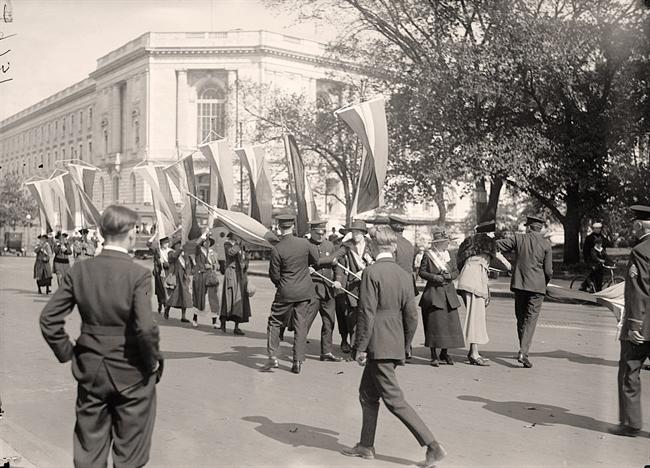
Female Lives Mattered

Looks like the Suffragettes were the opening act for Black Lives Matter:

The Maryland Suffrage News on the bogus sufferings of the suffragettes in Washington:

The Marylanders, rudely pushed and jostled, thought of the way the Baltimore police had protected them from a conventoin crowd, said to be quite as rough as an inauguration crowd, and longed for a squad of Marshal Farnan’s finest to clear the way for them.

Can it be that these are the same “finest” who have been so often accused, by suffragists and their vice-crusading allies, of conspiring to nullify the laws, of making corrupt bargains with law-breakers, of sharing in the profits of prostitution? Can it be that a cop is an archangel when he is with them, as he is an abominable rogue and hell-hound when he is against them?

…Cease, dear girls! Hold your crocodile tears! Stay your whoops for gore! The more you yell, the more you will convince the country that your parade was a clown show, that you yourself are silly cry-babies, that you are not fit for the crash and slambang of politics! Don’t you hear the antis laughing? Don’t you see the motive behind their sympathy? Have you no humor, no courage, no sportsmanship, no sense?