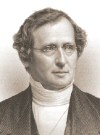
 I understand that for those observers of all holidays, but holy and secular, persevering a whole week between Christmas and New Year’s Day without a party can be an ordeal. I also know that for those vinegary Presbyterians who don’t observe the nativity of Christ in late December, non-observance can look downright acidic. The remedy for the neo- and paleo-sanctifiers of days is the birthday of Charles Hodge, who came into this world in that little burgh of Philadelphia on December 28, 1797. The great appeal of Hodge’s nativity is that for the strict Reformed it functions as a festive day close to Christmas and thus provides an outlet for all of that cooking, spirituous refreshment, and commercial enterprise bubbling up at years end in this greatest nation on God’s green earth. And for the not-so-strict neo-Presbyterians, Hodge’s birthday functions, midway between Christmas and New Year, as a way to turn the last week of the year into one long party.
Hodge’s birth has added significance because, as I am learning from Andrew Hoffecker’s fine biography of the Princeton theologian (forthcoming in the American Reformed Biographies), Hodge himself was not an observer of December 25th, like most low-church Protestants prior to the commercial success of Christmas, Mother’s Day, and Easter during the Victorian era. Hoffecker observes that when Hodge was preserving his thoughts and whereabouts during a period of supply preaching in the early 1820s he never mentioned Christmas.
Further evidence of Hodge’s silence on the Roman Catholic holiday comes from a letter he wrote on December 25, 1825 to his mother. In addition to demonstrating Hodge’s non-observance of Christmas, the letter has the Old Life advantage of making a plug for the two-kingdom that provides a proper understanding of days holy and common during a pilgrim’s life in this world. Here is the letter (which can be found in The Life of Charles Hodge, p. 97):
My Dear Mother:
Your dear little Mary Elizabeth was baptized this afternoon in the Oratory by Dr. Alexander. Notwithstanding the rain, the place of service was so near we found it easy to take our dear little treasure out to be consecrated to God in this delightful ordinance. I never appreciated so highly before the privilege of thus giving to God what is dearest to us on earth. We feel now as though she were not our own, but something lent to be cultivated and prepared through our agency for heaven. To be instrumental in thus training up one of the children of the Lord to be presented before Him without spot or blemish, is so delightful and honorable a task, that we cannot help hoping that He who has made the prospect of the duty so pleasant, will aid us in its performance. There is, too, so much ground to hope that our efforts will not be in vain that we can address ourselves to the duty with all possible cheerfulness. The application of the pure element of water is not only designed to represent the purifying influence of the Spirit upon the heart, but it seems to be the appointed pledge on the part of God, that if we sincerely devote our children to Him, and faithfully endeavor to bring them up for Him, He will bestow upon them the blessings signified by the ordinance, and contained in that gracious covenant to which it is attached. Hence the ordinance is represented as so important in the Scriptures. He that believeth and is baptized shall be saved. It certainly never was designed to be an empty form. And as it imposes the most solemn obligations, so it contains abundant encouragement to fulfil them. Our dear little children we have promised to educate for heaven, and as God shall enable us, we mean to perform our vows. To this every thing must be made secondary. To gain this world is not what we have promised to aim at. It must therefore never be the direct and primary object of pursuit. I have lately, in reading Bonaparte’s Russian Campaign, and the Life of Sheridan, been very much struck with the truth of the remark how little they really enjoy the world to whom the world is every thing. Bonaparte says the happiest part of his life was when he was a poor lieutenant. And Sheridan said the happiest part of his life was the short time he spent in a cottage. There is nothing lost, therefore, even as regards the present world, by seeking first the kingdom of God; that is, by making it the primary object of pursuit, seeing that godliness has the promise of the life that now is, and of that which is to come. We feel, therefore, determined, if God shall render us faithful to our purposes, to bring up your dear little grandchildren, as we are sure you would have us do, with the one object supremely in view of fitting them for heaven. I have great confidence in the effect of religious truth upon the infant mind. Children are so susceptible, their associations are so strong and lasting, that it does not seem strange that the effect of early education should so frequently be felt through life. And if we add to this God’s peculiar promises to those who endeavor to bring up a child in the way in which he should go, we shall see that there is abundant reason to hope that exertions properly directed will be crowned with success.
Your affectionate son,
C. H.
So if you go out tonight, hoist one in honor of Charles Hodge and his paleo-Presbyterian piety.
 Old Life