The New Republic Is Dead. . .

Long live the New New Republic.

I remember where I was when I heard that Mike Schmidt was retiring from playing third base for the Phillies. I was in the bedroom of our Wheaton, Illinois high rise apartment. I still remember also where I was when Phil Hendrie announced he was leaving the airwaves (only to return and then leave for podcasting). I was battling a nasty cold that turned into walking pneumonia from the comfort of the Mayflower Park Hotel in downtown Seattle. More recently, I remember exactly where I was when I heard that Rob da Bank was leaving BBC 1 to be an irregular stand-in at the BBC 6 Mix.

So when the New Republic blew up a month or so ago, I again experienced that feeling of being deprived of one of those aspects of personal identity that had marked (all about) me since I started graduate school in Baltimore thirty years ago (when Omar Little was crawling around in diapers). Several bloggers have commented on the events that led long-time editors and staff to abandon the Ship New Republic. Among those comments were several reflections about how important the magazine had been in forming an intellectual outlook.

I first caught wind of the change from Michael Sean Winters who may be excessively self-referential:

The New Republic is dead, or at least it is now brain dead. Yesterday, editor Frank Foer and literary editor Leon Wieseltier resigned as the changes undertaken by owner and Facebook zillionaire Chris Hughes became so oppressively obnoxious, Foer and Wieseltier could no longer stay. Even as I write those words this morning, it is difficult to believe. Needless to say, this is also personal for me. Frank is a friend and Leon is a very good friend.

My indebtedness to Leon is enormous. In 1993, he approached me about writing a book review for him. I did not hold an academic position: I was the manager of the café at Kramerbooks & Afterwords Café. But, I had gotten to know Leon over the years, he liked the way my mind worked, and he asked me to review a biography of Jose Maria Escriva, the founder of Opus Dei. It was my first real foray into publishing. Leon was not an easy editor, which is one of the reasons he is a great editor. He re-worked my draft from top-to-bottom, demanded more analysis here, less verbosity there, and the end result, much improved from his editing, made it into his pages. It was, of course, a thrill to be published in the pages of the venerable TNR. Walter Lippmann had helped start TNR! All the great liberal icons of the twentieth century had been published in its pages. How many of the writers we all turn to – Chait, Hertzberg, Kinsley, Cohn, Berkowitz, Scheiber, Judis, Wolfe – had gotten their start at TNR or been introduced to a wider audience in its pages. But, the real thrill was not being associated with such luminaries. The real thrill was being published by Leon.

At National Review, Carl Eric Scott acknowledged his own intellectual debt to TNR:

A once-great institution, killed by a pair of lofo-pandering facebook-enriched millennial jerks. I here voice my gratitude to all of those who made the magazine central to my political education in the 1990s. I wouldn’t be who I am today were it not for TNR.

I stopped my subscription sometime in 2008, and had stopped eagerly reading the magazine around 2005 or so. And not too long ago, when I had thought about re-subscribing, I found myself dissuaded by articles like the one that stooped to smearing Scott Walker as a racist on the basis of no evidence related to the man himself. But a couple weeks ago, when I saw the magazine’s 100th anniversary issue, well, I just had to pick it up. It is worth getting, incidentally—there’s some interesting stuff about the early Herbert Croly years, an undoubtedly softened account of the conflicts between owner Marty Peretz and the more-regular liberals at TNR during the 80s through early aughts, and in any case, the issue’s now worth owning simply as a memento of a lost age.

I agree about the feel of the magazine for the last five years or so, but the 100th anniversary issue was worth the wait (even though I suspected the issue would be too self-congratulatory; the piece by Hanna Rosin on Stephen Glass was riveting).

Noah Millman (who is almost always on a roll) chimed in:

I would like to say that I’m shaken by the dramatic shake-up just announced at The New Republic, which sees Franklin Foer and Leon Wieseltier leaving the – well, I was going to say the magazine, but it isn’t a magazine anymore apparently, but rather a “digital media company,” whatever that is. TNR, after all, was the magazine that introduced me to public intellectual life. I read it in the school library in high school – no, actually, I devoured it. It was clever, but also serious – political, but also literary. And, in the 1980s and 1990s, it was hard to imagine a magazine having more influence on the shape of debate. The first iteration of my politics were substantially shaped by its sensibility.

For me TNR was liveliest when Andrew Sullivan was editor, but even running up to Andrew, the magazine was always provocative and sharp. If I am too snarky or sputten, I owe it in part to TNR where being argumentative was a virtue. Maybe Christians are not supposed to be that way. Of late, after bingeing on Portlandia, I wonder if certain sensibilities really are impossible for believers, say, coming up with a lesbian couple co-owning a feminist bookstore. If so, TNR transformed me in a less than sanctified way.

On the positive side, the so-called back of the book, the books and arts section was always worth reading in its entirety. Not only did the editor of that section, Leon Wieseltier, attract writers such as John Updike (to review painting exhibitions), or historians like Gordon Wood, or literary critics, James Wood and Louis Menand, but his coverage of the fine and popular arts and reviews of books was so well done that it made other magazines superfluous. One of the reasons I gave up on Books and Culture, for instance, was that in one year’s worth of TNR Wieseltier and company would cover twice (maybe three times) as much as Christianity Today’s venture into a publication dedicated to books.

I will continue with another year of TNR just to see what becomes of it. Chances are, though, that the glory days of TNR are behind not simply because of a change in editorial personnel but also because the entire landscape of magazine publishing has changed. In that regard, Noah Milman should have the last word:

Which brings me to the realm of culture, and the fabled back of the book. I should caveat right up front that TNR and Wieseltier did a wonderful job of covering a wide array of subjects, of finding talented young critics and promoting them, and engaging in intellectual debate across the landscape of culture and academia. But I still have two bones to pick with the encomia.

The first and easiest bone to pick is that there is a wild, robust and in many cases very high quality discussion going on right now across a multitude of outlets and covering any cultural topic you like. What is relatively absent in the internet era are two things: widely-recognized gate-keepers to curate that discussion, and any kind of revenue model to sustain it. These are not problems that Leon Wieseltier had any idea of how to solve. (Nor does anyone else – something Andrew Sullivan acknowledges in his own lament for passing of the “sugar daddies of yore.”)

I am very, very eager to find a solution to that particular problem. Here at TAC, I am a tireless advocate for more cultural coverage for its own sake. I produce a bunch of it myself on this blog, and some of it for the magazine. But I recognize that the prevailing structure of the internet makes it not only very difficult to justify from a revenue perspective, but very difficult to justify from a curatorial perspective – because it’s not clear that a magazine like TAC could achieve the status of a trusted curator of this kind of discourse even if it wanted to.

So, again, the nostalgia for Wieseltier’s back-of-the-book is, to some extent, a nostalgia for an information market structure that no longer exists rather than for something TNR was uniquely and selflessly committed to. Another way of putting this is: back when TNR was TNR, The New York Review of Books was still The New York Review of Books, and The New Yorker was still The New Yorker.

We’re not in the hard-copy age any more, Toto.
If the Poor Become Middle Class, Are They Still Blessed?

Capitalism breeds attachment to material goods. I get it. It may even tempt — make that, cause — its users to measure happiness and the good life by worldly standards. But is socialism any different? If capitalism breeds haves, does pointing out what the have-nots don’t have really challenge materialist notions of wealth, standard of living, property, or means of production?

The Social Gospel has always struck me as just as materialist as high capitalism, though it is much more sanctimonious about it since for every Russell Conwell ten ministers publicly identify with the poor even while depending on market mechanisms for their wages. In other words, applying a materialist reading of the beatitudes — either pro-free markets or pro-redistribution — misses the point. A capitalist might say that free markets lift all boats and will take the poor off poverty rolls and put them in the suburbs with a mortgage and car loan payments. A socialist might say that the elimination of private property and free markets will distribute wealth to all citizens so that everyone has a home and a car. But what about when the home owner or sharer dies? What kind of home does he have then? Neither the capitalist or leftist reading of the Beatitudes addresses the matter of spiritual poverty, or the understanding that this world’s goods are inconsequential for the world to come, when the spiritually poor, whether financially rich or destitute, will inherit the kingdom of God (if they trust in Christ)?

These questions follow from Andrew Sullivan’s rebuke to Rush Limbaugh. Conservative talk radio’s supreme host is worthy of all sorts of criticism. But I don’t think Sullivan’s complaint hits the mark:

But the Pope is not making an empirical observation. In so far as he is, he agrees with you. What he’s saying is that this passion for material things is not what makes us good or happy. That’s all. And that’s a lot for Limbaugh to chew on. And if the mania for more and more materialist thrills distracts us from, say, the plight of a working American facing bankruptcy because of cancer, or the child of an illegal immigrant with no secure home, then it is a deeply immoral distraction. There’s something almost poignant in Limbaugh’s inability even to understand that material goods are not self-evidently the purpose of life and are usually (and in Jesus’ stern teachings always) paths away from God and our own good and our own happiness. Something poignant because it reveals a profound ignorance of one of the West’s deepest cultural inheritances in Christianity.

If Sullivan had wanted to show his spiritual understanding of Christianity, he might have re-written this line: “… if the mania for more and more materialist thrills distracts us from, say, the plight of a working American facing bankruptcy because of cancer the wages of sin and death, or the child of an illegal immigrant with no secure home without the assurance of God’s forgiveness through the cross of Christ, then it is a deeply immoral distraction.”

As it is, paychecks and housing appear to rank high in Sullivan’s understanding of Christianity. That makes him anti-materialist and separates him from Rush Limbaugh how?

What if We Thought about Marriage the Way We Think about Driving?

The fallout from the Supreme Court’s ruling on DOMA and California’s Proposition 8 continues to pile up. But even before the justices tallied their votes and wrote contrary opinions, some could see that the debate over gay marriage had lost its way and that marriage in the United States was in bad shape. For instance, in the same issue of The New Republic came two pieces that indicate why the current debates over marriage are missing the civil (as opposed to religious) point.

Michael Kinsley, who edited the magazine when Andrew Sullivan first tried the idea of gay marriage (1989), believes that Ben Carson’s remarks about homosexuality (on Hannity and Andrea Mitchell) revealed an orthodoxy on the left every bit as powerful (probably more) than most Christian communions:

There are those who would have you think that gays and liberals are conducting some sort of jihad against organized Christianity and that gay marriage is one of the battlefields. That is a tremendous exaggeration. But it’s not a complete fantasy. And for every mouth that opens, a dozen stay clamped shut. In the state of Washington, a florist refused to do the wedding of a long-time customer “because of my relationship with Jesus Christ.” Note that “long-time customer.” This woman had been happily selling flowers to the groom. She just didn’t want to be associated with the wedding. Now she is being sued by the state attorney general. DC Comics dropped writer Orson Scott Card’s planned Superman book when thousands signed a petition demanding it because of his many homophobic remarks.

Thought experiment: If you were up for tenure at a top university, or up for a starring role in a big movie, or running for office in large swaths of the country, would it hurt your chances more to announce that you are gay or to announce that you’ve become head of an anti-gay organization? The answer seems obvious. So the good guys have won. Why do they now want to become the bad guys?

In other words, gay marriage advocates are no more tolerant than their opponents who don’t tolerate gay marriage.

But what would the debate look like if we lowered the stakes from “I’m right, you’re a cretin,” to what is actually good for the righteous and cretins who have to live together and increasingly support each other through government programs, insurance, and other forms of imposed solidarity? In the same issue of TNR, for instance, came a story about the consequences of loneliness and an implicit brief for more and stronger marriages:

If we now know that loneliness, a social emotion, can reach into our bodies and rearrange our cells and genes, what should we do about it? We should change the way we think about health. James Heckman, a Nobel Prize–winning economist at the University of Chicago who tabulates the costs of early childhood deprivation, speaks bitterly of “silos” in health policy, meaning that we see crime and low educational achievement as distinct from medical problems like obesity or heart disease. As far as he’s concerned, these are, in too many cases, symptoms of the same social disorder: the failure to help families raise their children. . . . As nearly half of all marriages continue to end in divorce, as marriage itself floats further out of reach for the undereducated and financially strapped, childhood has become a more solitary and chaotic experience. Single mothers don’t have a lot of time to spend with their children, nor, in most cases, money for emotionally enriching social activities.

“As inequality has increased, childhood inequality has increased,” Heckman said, “So has inequality of parenting.” For the first time in 30 years, mental health disabilities such as ADHD outrank physical ones among American children. Heckman doesn’t think that’s only because parents seek out attention-deficit diagnoses when their children don’t come home with A’s. He thinks it’s also because emotional impoverishment embeds itself in the body. “Mothers matter,” he says, “and mothering is in short supply.”

Heckman has been analyzing data from two famous early-childhood intervention programs, the Abecedarian Project of the ’70s and the Perry Preschool project of the ’60s. Both have furnished ample evidence that, if you enroll very young children from poor families in programs that give both them and their parents an extra boost, then they grow up to be wealthier and healthier than their counterparts—less fat, less sick, better educated, and, for men, more likely to hold down a job. In the case of the Perry Preschool, Heckman estimated that each dollar invested yielded $7 to $12 in savings over the span of decades. One of the most effective economic and social policies, he told me, would be “supplementing the parenting environment of disadvantaged young children.”

I suspect that the author, Judith Shulevitz, TNR’s science editor, is in favor of gay marriage, given her status at TNR. But aside from the politics of homosexuality, folks who live in the United States actually care about the health of marriages and families. And I suppose that if people like Ms. Shulevitz understood that anti-gay marriage folks also care about the health of marriages and families and the well-being of their society, they might have a profitable conversation about what kind of policies states and the feds should have to bolster the family.

I understand that marriage is more basic or primal than car driving, but I do wonder if the Christian approach to gay marriage debates should have been more akin to the kind of reaction that would greet a proposal to allow drivers to use both the left and right side of the road. We could marshal statistics about the dangers of auto-driving that exist now when everyone already drives on the right side of the road. That might be enough to say, “you know, we have enough accidents already without throwing another wrinkle into navigating big pieces of machinery on wheels around our fair land.” We could also project what kind of fatalities and injuries might result from allowing driving on both sides of the road. This would likely close the debate. No reason to get huffy about the sin of driving on the left side (since the Brits already do). Just think about the temporal realities of driving and how to make it as safe as possible. Why not do the same with marriage as a civil (not religious) institution?

Evangelicalism – Politics = Christianity?

Andrew Sullivan’s first experience with megachurch Praise & Worship worship came during the memorial service for David Kuo, an aid to president George W. Bush, who recently succumbed to cancer (thanks to John Fea). Sullivan was surprised by what he saw:

I have never been to a mega-church service – which is something to be ashamed of, since I have written so often about evangelicalism’s political wing. And it was revealing. The theater was called a sanctuary – but it felt like a conference stage. There were no pews, no altar (of course), just movie-theater seats, a big complicated stage with a set, and four huge screens. It looked like a toned-down version of American Idol. I was most impressed by the lighting, its subtlety and professionalism (I’ve often wondered why the Catholic church cannot add lighting effects to choreograph the Mass). The lyrics of the religious pop songs – “hymns” doesn’t capture their Disney channel infectiousness – were displayed on the screens as well, allowing you to sing without looking down at a hymnal. Great idea. And the choir was a Christian pop band, young, hip-looking, bearded, unpretentious and excellent. Before long, I was singing and swaying and smiling with the best of them. The only thing I couldn’t do was raise my hands up in the air.

This was not, in other words, a Catholic experience. But it was clearly, unambiguously, a Christian one.

That right there is enough to put any serious Christian off evangelicalism. How you go from Wesley and Watts to Shane and Shane is, of course, the wonder, genius, and idiocy of evangelicalism in North America.

But Sullivan goes on to wonder about evangelicalism without its political baggage.

What I guess I’m trying to say is that so many of us have come to view evangelical Christianity as threatening, and in its political incarnation, it is at times. But freed from politics, evangelical Christianity has a passion and joy and Scriptural mastery we could all learn from. The pastors were clearly of a higher caliber than most of the priests I have known – in terms of intellect and command. The work they do for the poor, the starving, and the marginalized in their own communities and across the world remains a testimony to the enduring power of Christ’s resurrection.

To be sure, finding a form of evangelical Protestantism after 1820 that is not tied to a political cause is difficult since immanentizing the eschaton was not a temptation that evangelicals resisted — until the Scofield Reference Bible. But Sullivan’s reflections do make you think that the means of grace, even in the diluted form that evangelicals use, is a better testimony to the truths of the gospel than all of that politicking.

Speaking of Moral Ambiguity

I have been reading The New Republic since grad school days. It is not as good now as it was in the days when Andrew Sullivan was editor (and I don’t say this to pay him back for a mention of my book). Back then it was provocative, funny, and well written. Stephen Glass likely accounts for some of the magazine’s dullness these days. But the “back of the book,” the arts and book review section, continues to be one of the best. Where else can you read a put down like the following of Harold Bloom?

Bloom and I were once employed by the same academic department. I hasten to add, lest there be a question of bias, that my decade at Yale left me feeling little toward him one way or the other. I never even met the man. Having fulfilled the dream of academics everywhere by renouncing as many obligations toward his home department as practicably possible—meetings, committee assignments, duties in the graduate program, every responsibility except undergraduate teaching—Bloom had long since become, as he likes to put it, “a department of one.” I think I only saw him about three times.

Which is not to say he wasn’t sometimes on my mind. At a certain point during my sojourn at the institution, I started to develop the Heart of Darkness theory of the Yale English department. Conrad’s novel is about colonialism and racism and the shadowed reaches of the human heart, but it is also a dissection of bureaucracy. My first clue came when I realized that my chairman was a perfect double for the manager of the Central Station, that creepy functionary who has “no genius for organizing, for initiative, or for order even,” who “could keep the routine going—that’s all.” But what clinched it was the recognition of the role that Bloom played in the paradigm. Bloom was Mr. Kurtz. (Marlow, broken by his African ordeal, was any number of my senior colleagues, their souls crushed by the tenure process. The “pilgrims”—that pack of hopeful fools who set off into the jungle in pursuit of a chimerical fortune—were the graduate students.)

Since I have of late been defending celebrity academics (or their athletic coaches) from easy put downs, let me explain that the appeal of this depiction is what it says about American higher education. If folks believe that Division One athletics is a problem, they may also want to consider a system that employs professors not to assume normal faculty responsibilities.

But the point of this post is to call attention to the wonderful description of the moral perplexities that confronted the United Kingdom at the time of the Civil War in the United States. The following from a review of Amanda Foreman’s book, A World on Fire: Britain’s Crucial Role in the American Civil War (Random House, 2011), proves to this 2k equivocator that people in power seldom have an easy time determining the “right” thing to do:

FREEDOM is a rangy, broad-shouldered value, capable of heavy rhetorical lifting. Liberals had coalesced around another form of freedom: free trade, the bedrock of British industrialization. Abolitionism had taken root in the partly protectionist, largely rural soil of late eighteenth-century Britain. Now panting, shrieking trains ripped through a land studded by smokestacks and mines; conurbations crawled over hillsides like great black snakes. Touring the factory towns spawned by late industrialization, Friedrich Engels described the socially deadening grind of workers who toiled interminable shifts at the steam-powered looms, trudged home to fetid slums, supped on potato parings, and nursed their babies on gin.

Engels likened factory labor to enslavement, but Lancashire textile workers in fact owed their livelihood to American slaves. Rhymed Punch:

Though with the North we sympathize,

It must not be forgotten,

That with the South we’ve stronger ties,

Which are composed of cotton.

Textiles were Britain’s biggest business, and cotton from the deep South was its biggest source. The Union blockade of Southern ports snipped the supply line to millions of Britons reliant on the industry. The resulting “cotton famine” hit hard and fast: within a year, 400,000 British workers were unemployed or nearly so, putting their 1.5 million dependents at risk. State welfare cases quadrupled in months. Even the staunchest abolitionists, Prime Minister Palmerston included, had to see the crisis in Lancashire as a more pressing humanitarian problem for the government than the plight of far-off slaves. Recognizing the Confederacy, or at least evading the blockade, could restore the cotton supply, while joining the Union might deepen and prolong the suffering at home.

Then there was the political freedom that Liberals championed abroad: the freedom of people to govern themselves. Palmerston—whose “attitudes,” Foreman nicely observes, “had been formed in the age when wigs and rouge were worn by men as well as women”—had made his reputation as a defender of national self-determination, in Belgium, Greece, Italy, and Hungary. (Never mind that he also sent in gunboats to assert British power in the Middle East and China.) Why not the Confederate States of America? “The South fight for independence; what do the North fight for except to gratify passion or pride?” asked the home secretary. The rising Liberal star William Ewart Gladstone fancied he saw shades of Garibaldi in Jefferson Davis. “We may have our own opinions about slavery,” Gladstone declared the day after the Emancipation Proclamation ran in the Times, “we may be for or against the South, but there is no doubt that Jefferson Davis and other leaders … have made a nation.” (Gladstone, later revered as the “People’s William,” had delivered his maiden speech defending his plantation-owning father’s treatment of slaves.) Give the Confederacy political freedom, these men assumed, and freedom from slavery would follow.

What's Good for the Immanentizer is Good for the Post-Millennialist

Alan Jacobs pushes back against Andrew Sullivan’s recent denunciation of Christianism. According to Sullivan:

Christians will look back on this period, I believe, with horror. The desire to control others’ lives and souls through politics is so anathema to the Gospels it will one day have to be exposed and ended. Until then, we just have to keep our spirits up and attend to our own failures as Christians, which, of course, are many.

Jacobs thinks he has the perfect antidote to Sullivan, and his name is Martin Luther King, Jr. Jacobs seems to think that King was doing what today’s Christians are doing, namely, arguing for conformity between the law of God and the laws of the United States:

[King] could have stayed in his prayer closet instead of politicking; he could have attended to his own failures as a Christian, which of course were many; he could have forgiven white Southerners instead of judging them. But no. He became an “outside agitator,” marching into ordinary American communities and telling them that their local laws, and indeed in some cases federal laws, were not to be obeyed — and why? Because they conflicted with the law of God! Notice the arrogance with which he associates his cause with God Himself. He even asserts that “human progress” only happens when “men [are] willing to be co-workers with God.” His whole vision for America is Christian and Biblical through and through: in his most famous speech he simply identifies the American situation with that of the Biblical Israel: “I have a dream that one day every valley shall be exalted, and every hill and mountain shall be made low, the rough places will be made plain, and the crooked places will be made straight; ‘and the glory of the Lord shall be revealed and all flesh shall see it together.'” Talk about “the desire to control other people’s lives and souls”!

Well, I’ll take the bait. King’s immanentized political theology and identification of the United States with Israel was as bad as Jerry Falwell’s or now Rick Perry’s. That doesn’t stop Jacobs who explains, “After all, Dr. King’s faith commitments were at least as encompassing in their scope, as universal in their claims, as publicly political as Rick Perry’s . . .” Thinking of the United States as the New Israel is wrong no matter who is doing it and no matter what the cause.

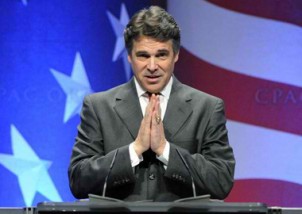
But Jacob’s comparison is far fetched for at least three reasons. First, the Christian or Religious Right has not faced the same sorts of obstacles that African Americans did and IN some cases still do. Trying to glom evangelical politics on to the Civil Rights movement is just plain bad form (and this is from someone who doesn’t care for the increased power of the federal government that came with Civil Rights legislation). Second, King was not running for president. sponsoring a prayer rally around the same time that you are contemplating entering the Republican bid for the presidential nomination is almost as tacky praying before a NASCAR race and thanking the Lord for a “smoking hot” wife. Third, King’s appeal was much more common at a time when mainline Protestants dominated public life and appealed to Christian theology for social reform. For some reason, evangelicals don’t seem to understand that the United States has changed a lot since 1963, along with the etiquette governing public speech about the United States as a Christian nation. If not everyone, including the media elites, believes the United States to be a biblical polity, then maybe you don’t bring up the Bible if you want to persuade the media elites. Maybe also you don’t pray in public with a humongous U.S. flag at your back.

One last point: when Christians enter the public square and start using theology for political purposes, Christian doctrine always, always, always suffers. It happened with the Social Gospel. It happened with Martin Luther King, Jr. It happened with Reinhold Niebuhr. And it’s happening with Rick Perry. Consider the following from a report about the recent prayer rally:

The lineup of speakers at The Response reflect the impact of new charismatic and Pentecostal movements, especially those emphasizing spiritual warfare and round-the-clock prayer and worship, and which have produced another sort of army. That one is not particularly intrigued by the horse race of politics, but rather focused more exclusively on the supremacy of Jesus and preparing for his return.

That caused some controversy for the organizers of Perry’s event, which included speakers and endorsers who follow the New Apostolic Reformation. The NAR’s strident language of spiritual warfare and emphasis on prophecy, signs, and wonders, has drawn scrutiny. But it has the same dominionist aims of the old religious right, even while employing some new rhetoric.

The NAR has also drawn criticism from conservative evangelical “discernment” ministries that consider it heretical—a criticism that Response organizers dismissed. A week before The Response, Marsha West, a conservative writer and editor of the website Email Brigade, wrote a scathing blog post; which she published on the website of Response host the American Family Association, and which was subsequently taken down. West complained that the NAR, which she considers unbiblical, was involved in The Response.

West told me in an email that she was “thoroughly disgusted with Christian Right leaders who have joined forces with a group that is, by definition, a Christian cult. Because of CR leader’s lack of discernment, the NAR is now becoming mainstream.” (According to her website, West also considers Mormonism, the emergent church, new age spirituality, word of faith, homosexuality, and more to be unbiblical.) In the NAR, she particularly identified Mike Bickle of the International House of Prayer, who played a big role in The Response. “[T]hese people are what the Bible calls ‘false prophets’… not true Christians,” West wrote. When I asked Garlow [Jim Garlow heads Newt Gingrich’s nonprofit, Renewing American Leadership]about West’s complaint, he shrugged it off, saying that he was not familiar with the term New Apostolic Reformation, even though he knew its founder, Peter Wagner. “I have a lot of confidence in him spiritually,” Garlow said of Wagner.

“There are a lot of theological differences here, but we’re focusing on one issue: Jesus,” Garlow added. “It’s not about whether Perry becomes president, it’s about making Jesus king.”

Does Jacobs actually believe Garlow? Can he not see that Sullivan is just a little bit justified in being skeptical about today’s “Christian” politics?

Oldlife.org 201: Wit and Sarcasm

The first installment in this series about this blog was to clarify what a blog is. One aspect that I did not mention was that the more successful blogs are provocative – that is, they agitate readers and that’s why people come back. The most successful blogger in the world arguably is Andrew Sullivan, the former editor of the New Republic, and his blog is hardly tepid.

This leads to the second point in need of clarification. Oldlife.org is the on-line presence of the Nicotine Theological Journal. Long before provocations started at this blog, the editors and authors of the NTJ were provoking readers and library patrons in hopes of thinking through the implications of Reformed faith and practice today, with a little levity and sarcasm thrown in. The editors’ inspiration was partly Andrew Sullivan whose time at the New Republic made it one of the most thoughtful, rancorous, and witty magazines on politics and culture at the time. But Sullivan was not the only inspiration. Other authors who wrote on serious matters with wit and sarcasm that provided models for the NTJ were Richard John Neuhaus, P. J. O’Rourke, Joseph Epstein, H. L. Mencken, and Calvin Trillin.

None of these sources, readers may object, are Reformed. Which raises the question whether Reformed authors may engage in wit and sarcasm when pursuing their convictions. Well, the answer is yes. If you spend much time in the polemical writings of the Old School and Princeton theologians, you will find a fair amount of wit and sarcasm. Here are a couple examples, the first from Charles Hodge after a seven-round dogma fight with Edwards Amasa Park (named for Jonathan Edwards – ahem) over theological method and the nature of Calvinism:

It is a common remark that a man never writes anything well for which he has “to read up.” Professor Park has evidently labored under this disadvantage. Old-school theology is a new field to him; and though he quotes freely authors of whom we, though natives, never heard, yet he is not at home, and unavoidably falls into the mistakes which foreigners cannot fail to commit in a strange land. He does not understand the language. He find out “five meanings of imputation!” It would be wearisome work to set such a stranger right at every step. We would fain part with our author on good terms. We admire his abilities, and are ready to defer to him in his own department. But when he undertakes to teach Old-school men Old-school theology it is very much like a Frenchman teaching an Englishman how to pronounce English. With the best intentions, the amiable Gaul would be sure to make sad work with the dental aspirations.

The second comes from Benjamin Warfield in one of the last pieces he ever wrote, an article objecting to the latest proposal (1920) to unite the largest Protestant denominations in the United States:

Now it is perfectly obvious that the proposed creed contains nothing which is not believed by evangelicals. and it is equally obvious that it contains nothing which is not believed by Sacerdotalists – by the adherents of the church of Rome for example. And it is equally obvious that it contains nothing which is not believed by Rationalists – by respectable Unitarians. That is as much as to say that the creed on the basis of which we are invited to form a union for evangelizing purposes contains nothing distinctively evangelical at all; nothing at all of that body of saving truth for the possession of which the church of Christ has striven and suffered through two thousand years. It contains only “a few starved and hunger-bitten” dogmas of purely general character – of infinite importance in the context of evangelical truth, but of themselves of no saving sufficiency. So far as the conservation and propagation of evangelical religion is concerned, we might as well for a union on our common acceptance of the law of gravitation and the rule of three.

By the way, these were a couple of quotes readily available from Hodge and Warfield. If you go farther into their works, along with those of Old Schoolers like Dabney and Thornwell you will find many more examples, sometimes of laugh out loud proportions.

One last source of inspiration for Oldlife.org and the NTJ is – duh – J. Gresham Machen. He did not show a lot of wit or sarcasm in his writings. But his polemics were nonetheless blunt, so much so that many who believed charity to be the only Christian virtue considered Machen mean and beyond the pale. But it is precisely Machen’s candor and warrior spirit that is worthy of emulation. The following is from a piece he wrote for an inter-faith gathering on the relations between Christians and Jews:

The fact is that in discussing matters about which there are differences of opinion, it is really more courteous to be frank – more courteous with that deeper courtesy which is based upon the Golden Rule. For my part, I am bound to say that the kind of discussion which is irritating to me is the discussion which begins by begging the question and then pretend to be in the interests of peace. I should be guilty of such a method if I should say to a Roman Catholic, for example, that we can come together with him because forms and ceremonies like the mass and membership in a certain definite organization are, of course, matters of secondary importance – if I should say to him that he can go on being a good Catholic and I can go on being a good Protestant and yet we can unite on common Christian basis. If I should talk in that way, I should show myself guilty of the crassest narrowness of mind, for I should be showing that I had never taken the slightest trouble to understand the Roman Catholic point of view. If I had taken that trouble, I should have come to see plainly that what I should be doing is not to seek common ground between the roman Catholic and myself but simply to ask the Roman Catholic to become a Protestant and give up everything that he holds most dear.

. . . So to my mind the most inauspicious beginning for any discussion is found when the speaker utters the familiar words: “I think, brethren, that we are all agreed about this . . .” – and then proceeds to trample ruthlessly upon the things that are dearest to my heart. Far more kindly is it if the speaker says at the start that he sees a miserable narrow-minded conservative in the audience whose views he intends to ridicule and refute. After such a speaker gets through, perhaps I may be allowed to say that I regard him as just as narrow-minded as he regards me, and then having both spoken our full mind we may part, certain not as brothers (it is ridiculous to degrade that word) but at least as friends.

None of this is to suggest that Oldlife.org pulls off the wit, sarcasm, polemics, or bluntness of the writers who have inspired this endeavor. It is only to point out that the tone and style of Oldlife.org is not over the top.

Why Conservatism Beats Biblicism

An earlier reference to Ross Douthat’s blog posts on gay marriage was intended to show that people in the mainstream secular media can hear an argument that is laced with Christian norms and not go running to the Supreme Court for an injunction to shut said arguer down. Douthat concluded his series of posts (defending his column in the New York Times) with a lengthy response to Andrew Sullivan, one of gay marriage’s most provocative and intelligent advocates.

The entire post is worth reading, just to see the wider implications of what might seem like a straightforwardly up or down moral matter — whether marriage is for one man and one woman or not. But he ends with an appeal to the nature of conservatism that Protestants who think of themselves as conservative should well consider. The reason has to do with the nature of conservatism, which is not about defending morality and opposing wickedness (the Bayly version) but rather concerns conserving as much as possible what humans (whether Christian or not) have learned and benefited from the past. Douthat writes:

The benefits of gay marriage, to the couples involved and to their families, are front-loaded and obvious, whereas any harm to the overall culture of marriage and childrearing in America will be diffuse and difficult to measure. I suspect that the formal shift away from any legal association between marriage and fertility will eventually lead to further declines in the marriage rate and a further rise in the out-of-wedlock birth rate (though not necessarily the divorce rate, because if few enough people are getting married to begin with, the resulting unions will presumably be somewhat more stable). But these shifts will probably happen anyway, to some extent, because of what straights have already made of marriage. Or maybe the institution’s long decline is already basically complete, and the formal recognition of gay unions may just ratify a new reality, rather than pushing us further toward a post-marital society. Either way, there won’t come a moment when the conservative argument, with all its talk about institutional definitions and marginal effects and the mysteries of culture, will be able to claim vindication against those who read it (as I know many of my readers do) as a last-ditch defense of bigotry.

But this is what conservatism is, in the end: The belief that there’s more to a flourishing society than just the claims of autonomous individuals, the conviction that existing prohibitions and taboos may have a purpose that escapes the liberal mind, the sense that cultural ideals can be as important to human affairs as constitutional rights. Marriage is the kind of institution that the conservative mind is supposed to treasure and defend: Complicated and mysterious; legal and cultural; political and pre-political; ancient and modern; half-evolved and half-created. And given its steady decline across the last few decades, it would be a poor conservatism that did not worry at the blithe confidence with which we’re about to redefine it.