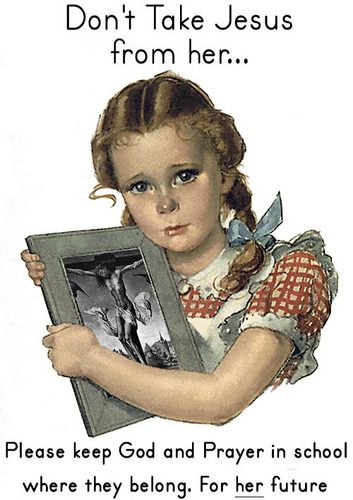
Those Were The Days

A big bowl of civil religion to put the culture wars in perspective:

Almighty God: Our sons, pride of our nation, this day have set upon a mighty endeavor, a struggle to preserve our Republic, our religion, and our civilization, and to set free a suffering humanity.

Lead them straight and true; give strength to their arms, stoutness to their hearts, steadfastness in their faith.

They will need Thy blessings. Their road will be long and hard. For the enemy is strong. He may hurl back our forces. Success may not come with rushing speed, but we shall return again and again; and we know that by Thy grace, and by the righteousness of our cause, our sons will triumph.

They will be sore tried, by night and by day, without rest — until the victory is won. The darkness will be rent by noise and flame. Men’s souls will be shaken with the violences of war.

For these men are lately drawn from the ways of peace. They fight not for the lust of conquest. They fight to end conquest. They fight to liberate. They fight to let justice arise, and tolerance and goodwill among all Thy people. They yearn but for the end of battle, for their return to the haven of home.

Some will never return. Embrace these, Father, and receive them, Thy heroic servants, into Thy kingdom.

And for us at home — fathers, mothers, children, wives, sisters, and brothers of brave men overseas, whose thoughts and prayers are ever with them — help us, Almighty God, to rededicate ourselves in renewed faith in Thee in this hour of great sacrifice. . . .

Give us strength, too — strength in our daily tasks, to redouble the contributions we make in the physical and the material support of our armed forces.

And let our hearts be stout, to wait out the long travail, to bear sorrows that may come, to impart our courage unto our sons wheresoever they may be.

And, O Lord, give us faith. Give us faith in Thee; faith in our sons; faith in each other; faith in our united crusade. Let not the keeness of our spirit ever be dulled. Let not the impacts of temporary events, of temporal matters of but fleeting moment — let not these deter us in our unconquerable purpose.

With Thy blessing, we shall prevail over the unholy forces of our enemy. Help us to conquer the apostles of greed and racial arrogances. Lead us to the saving of our country, and with our sister nations into a world unity that will spell a sure peace — a peace invulnerable to the schemings of unworthy men. And a peace that will let all of men live in freedom, reaping the just rewards of their honest toil.

Thy will be done, Almighty God.

Amen.

Can anyone guess the source (without using Google or some other search engine)?

Does this make the spirituality of the church look any more appealing?

American Exceptionalism as Civil Religion

Two Peters are debating the current health of American conservatism. Peter Beinart and Peter Berkowitz are assessing the hold that American exceptionalism has on Americans and who is to blame for this understanding’s decline.

I am less concerned about the merits of American exceptionalism or who is responsible for tarnishing the nation’s image than I am by the handy definition that of exceptionalism that both Peters use. Berkowitz summarizes:

Beinart is largely correct that elements of American exceptionalism that conservatives cherish —”our belief in organized religion, our belief that America has a special mission to spread freedom in the world, and our belief that we are a classless society where, through the free market, anyone can get ahead”— have eroded. But even where he is correct about the data, what he makes of it is fanciful and tendentious. His essay might look like an empirically driven analysis of the political impact of conservative ideas and policies, but it’s actually an ideologically driven interpretation of the facts.

That is an odd assortment of beliefs and one that I could imagine Canadians, Brits, and Europeans find a tad presumptuous. Christians might even take exception since a “belief in organized religion” is not exactly what the Lord would seem to require. It is almost as vague as Dwight Eisenhower’s line, “And this is how they [the Founding Fathers in 1776] explained those: ‘we hold that all men are endowed by their Creator…’ not by the accident of their birth, not by the color of their skins or by anything else, but ‘all men are endowed by their Creator.’ In other words, our form of government has no sense unless it is founded in a deeply-felt religious faith, and I don’t care what it is. With us of course it is the Judeo-Christian concept, but it must be a religion with all men are created equal.” (Even in its fuller expression, what on earth was Eisenhower thinking when he said “the Judeo-Christian concept”? Of what? Of the concept that includes Jewish and Christian stories where God chooses one set of people for salvation out of the rest of the human race?)

I wonder if one of the reasons for discontent with the 2k outlook is a lingering American exceptionalism among theonomists, transformationalists, and neo-Calvinists. The idea that religion makes for a healthy nation and that a nation that promotes religion or religious freedom around the world — whatever religion it is — runs on the sort of melding of the civil and the spiritual realms that afflicts those Protestants hot in pursuit of Christ’s Lordship over all walks of life. In (all about) my estimate, what makes 2k attractive is that it is suspicious of civil religion; 2kers generally can’t be snookered by presidential god-talk. And one of 2k’s critics’ greatest faults is that they relate the spiritual and the temporal in ways that make the world safe for civil religion.

Why Is it Godly Patriotism When We Do It, and Jihad When They Do It?

Making the world safe for Julia Ward Howe (thanks to our Iowa correspondent):

Holy war can seem like something that happened long ago or that happens far away — the Crusades of medieval Europe, for example, or jihadists fighting secular forces today. But since their country’s founding, Americans have often thought of their wars as sacred, even when the primary objectives have been political.

This began with the American Revolution. When colonists declared their independence on July 4, 1776, religious conviction inspired them. Because they believed that their cause had divine support, many patriots’ ardor was both political and religious. They saw the conflict as a just, secular war, but they fought it with religious resolve, believing that God endorsed the cause. As Connecticut minister Samuel Sherwood preached in 1776: “God Almighty, with all the powers of heaven, are on our side. Great numbers of angels, no doubt, are encamping round our coast, for our defense and protection.”

Several founding fathers were more theologically liberal than the typical evangelical Protestant of their day. Still, few were anti-religious, and the nation’s architects often stated that religion supported virtue, which was essential to patriotism. “A true patriot must be a religious man,” wrote Abigail Adams, wife of America’s second president.

George Washington believed so strongly in the religious case for patriotism that he demanded chaplains for the Continental Army. He appealed to the Continental Congress for higher pay for chaplains, and when one chaplain impressed the general, Washington went to great lengths to retain him.

That chaplain was Abiel Leonard, of Woodstock, Conn. Washington wrote letters to the governor of Connecticut and to Leonard’s church, hoping they would support the pastor’s extended service in the Army. In his letter to the governor, Washington wrote that Leonard had proved to be “a warm and steady friend to his country and taken great pains to animate the soldiers, and impress them with a knowledge of the important rights we are contending for.”

For Washington, chaplains not only supplied moral guidance but appealed for God’s support in battle, which was vital. He believed that the war’s outcome rested in God’s hands, and he ordered his soldiers to attend “divine service, to implore the blessings of heaven upon the means used for our safety and defense.”

We cannot fully understand the revolution without recognizing such appeals for God’s favor on the battlefield. Both the founders and ministers understood these ideas because they knew scripture, one of the major sources of American patriotism.

No problem here, though, because it’s a wonderful day in the neighborhood:

Talk of glorious causes has persisted from the revolution through the war on terror. Some Americans think of the United States as “God’s New Israel,” a nation on a divine mission, its wars blessed by God. Sometimes rhetoric makes this view obvious: Soon after Sept. 11, 2001, for example, the White House apologized after President George W. Bush used the word “crusade” to describe the battle against terrorism.

But references to religion can be subtler, or even obligatory, in political speeches. Consider President Obama’s July 4 speech from last year, in which he praised military sacrifices and ended with: “God bless you. God bless your families. And God bless these United States of America.”

We pass over such niceties as commonplace, almost dutiful, in political speech, but they are religious statements. Their roots go back to the revolution, when colonists — from evangelical preachers to founders such as Washington — asked for God’s blessing. Whatever century it is, our leaders often include some suggestion of the same biblical themes that filled revolutionary-era sermons, including sacrifice, courage for the fight and appeals for God’s providential blessings on America. We are, it seems, one nation under God after all.

Perhaps the reason American Christians permit blasphemy in their worship services is that the idolatry of U.S. civil religion has made them immune to it.

No peace, no justice.

This Guy Needs His Own Blog – Part 2 (Gamble vs. Lee)

Brian Lee has some very helpful and wise reflections on his decision to open Congress in prayer. I call it a capitulation to the nation’s civil religion. I believe this is fair even though it hurts to say it because Brian is a good friend and a Reformed pastor whom I respect. It is fair because (I won’t give reasons for befriending Brian) civil religion is precisely the theme by which Brian frames his post-prayer considerations:

Civil religion is thick in America. “God” is on our money, and in the Pledge of Allegiance, not to mention in the Declaration of Independence. We regularly ask him to bless America at ball games. And every session of the U.S. House and Senate opens with a prayer.

Recently the question of civil religion became very concrete for me. I was asked, as a pastor in Washington, D.C., to serve as guest chaplain for the U.S. House of Representatives, and open that body with prayer. The question of “Whether and what sort of civil religion shall we have in America?” quickly became “Should I pray in the House of Representatives? If so, how?”

But Brian went ahead and prayed even though he remains torn about whether he should have prayed. The whole piece is worth reading but I highlight the best reason he gives for not praying (even though he did — it’s confusing):

2) The difference between Congress and church.

Before you file this under “most obvious argument ever,” take a moment to consider exactly what the essential difference is. A church is a particular worshiping community, a creedal body, because it prays to a particular God. When I pray publicly in church, I therefore pray in the first person plural. That is, I pray in common and on behalf of every member of that community. While guests are welcome to observe and join in, there is no presumption they must do so. In doing so I presume for all to whom we are praying, and how we are praying, and why we expect our prayers to be answered.

To whatever degree “Christian” may describe America, we are quite obviously not a creedal nation. Membership in Congress is explicitly not subject to a religious test; it is in this sense an anti-creedal body. It is therefore impossible for me to pray before Congress as I pray in church, on behalf of the assembled body, for Congress does not have an agreed-upon God. However, while I may not be able to pray on behalf of people who don’t share my faith, I can certainly pray for them. In this way, I occasionally pray for sick unbelievers when I’m invited to visit them in the hospital.

Christians must not presume false unity within a pluralistic group by praying in the first person plural on their behalf. If we do pray in such settings, we must pray as individuals, to a particular God, for the group. And indeed, this seems to me most consistent with the pluralistic character of our polity, that we retain our religious distinctiveness even as we enter the public square, instead of pretending as though there is none.

That difference and the pervasiveness of civil religion would have been enough for me (feeling all full of my abstract self) to decline. Another reason is one that Richard Gamble highlights in his book, In Search of a City on a Hill. That is, American Christians (especially conservative ones) have been way too silent about the state taking over Christian language and ideas. Gamble writes:

Today, 50 years after the city on a hill first appeared in modern political rhetoric and nearly 400 years since John Winthrop shepherded his flock to New England’s shores, Americans are left with a secularized metaphor, politicized by the Left and the Right and nearing the point of exhaustion. The metaphor has been forced to carry an impossible load of nationalist, populist and collectivist aspirations. Americans have inherited two political cities looming so large in the media, the political culture and even the church, that together they have eclipsed the historical Winthrop and the biblical Jesus. The biblical metaphor, appropriated by the Puritans and reinvented by modern Democrats and Republicans, has been transformed so successfully into a national myth that few can see or hear these words without all of their modern political meaning attached. Even many Christians, how might be expected to guard their property more vigilantly, argue over which national values the politicized city should stand for and miss the fact that they have lost their metaphor. They argue over which party ought to build the city, over whether Kennedy’s or Reagan’s vision best defines the city, rarely stopping to consider whether Jesus ever had America in mind in the Sermon on the Mount. Such is the power of civil religion in twenty-first century America. Even if Americans manage to convince themselves, in spite of the evidence, that John Winthrop envisioned a glorious future for American ideals and institutions, can they really convince themselves that Jesus intended the United States to take up his disciples’ calling as a city on a hill? Distracted by a contest between two early political cities, Americans forget that the original city on a hill was neither Democrat or Republican. It was not even American. (178-79)

In other words, most of the critics of 2k who fault the notion of two kingdoms for secularizing politics, or culture, or child rearing, wind up secularizing Christianity by making it serve ends that are common (and even profane). At least 2kers are up front about the secular and try to preserve the uniqueness of Christianity. The integralists, the ones who want to see all of life whole with everything Christian, dumb Christianity down.

And it is for the reason that civil religion is so hard wired in American political discourse that I would have preferred that Brian Lee decline the invitation to pray before Congress. If he could have editorialized before praying, and explained that he was praying only as a minister, praying for (not with) Congress members, then perhaps it would have been useful. But as it is I fear that the huge appetite of American civil religion will swallow up his good prayer and thoughtful post-prayer reflections.

This Guy Needs His Own Blog – Part 1

As astute as these two critiques of Reagan’s civil theology are, they fail to consider one widely neglected but critical question: whether Reagan, or any American leader for that matter, should ever have called the United States the ‘city on a hill’ in the first place. Americans need not choose from among an anti-religious secularism that is deaf and blind to theology, or a low-voltage populist civil religion, or even a more chastened Puritan or Edwardsian sense of national election that keeps a place for divine judgment. The Christians among them can instead reserve divine election and the ‘city on a hill’ for the Christian church alone. Christians in the United States can think of themselves from an Augustinian perspective as, first and foremost, citizens of the City of God, living in tension with the world, and sojourning as pilgrims for a time within the current manifestation of the City of Man called ‘America’. Keeping their eternal citizenship in mind, they can object when either Democrats or Republicans co-opt any part of the church’s identity for their own use, no matter how good their intentions. They can live much of day-to-day life in common with their neighbours, but in the matter of worship, as Augustine wrote in the City of God, they must dissent. Part of that dissent means guarding the church’s unique identity and calling. (Richard M. Gamble, In Search of the City on a Hill, 161)

If presidents shouldn’t use the Bible to speak about the identity of the United States, how much more should ministers — specialists in the Bible — avoid identifying a nation with the city on a hill? And this is why the all-of-life Christianity that w-wists promote inevitably leads to identifying the nation in which 24-7 Christians live with the City of God. If my everyday activities are simply an extension of my spiritual duties, then everyday life in the United States must be an extension of God’s kingdom.

Augustinians are a rare breed.

Clash of Orthodoxies

The recent wailing and gnashing of teeth over the Boy Scouts’ interest in changing its policies about excluding homosexuals reminded me that long before social conservatives considered turning on the Boy Scouts for tolerating gays, confessional Protestants were giving the troops a thumbs down for very different reasons. They had nothing to do with sex and everything to do with the civil religion the Scouts wove through their materials and self-identity.

Case in point, the OPC in the 1950s appointed a committee to study whether its congregations might well sponsor Scout’s troops. What these confessional Presbyterians discovered was that the Boy Scouts’ understanding of God was a good bit off from the historic Christian view:

Scouting 1). Holds to a belief in a God. 2). Describes this God as the ruling and leading power in the universe, and the giver of favors and blessings. 3). Maintains that boys must learn to recognize this God, to admit their obligations to him, and to acknowledge gratefully his favors and blessings, if they are to grow into the best of citizens. 4). Requires all Scouts to promise on their honor to do their duty to this God, and feels that in so doing it does no violence to anyone’s religious convictions. 5). Desires to remain strictly non-sectarian in its attitude toward the religious training of the boys. 6). Requires mutual respect of religious convictions among the boys in carrying on Scouting activities. 7). Requires sponsor organizations to attend to the religious life of the boys. 8). Forbids sponsor organizations to force their religious practices on any boy contrary to his faith, because of his membership in a Unit.

Scouting evidently is anxious to insist upon religious training for the boys without telling the boys what religious training they should have. In attempting to do this, it runs into difficulties. To justify religious training it has to speak of a God. But to avoid offence to any religious group it tries to describe God in terms that all will approve. Then it proceeds to require general submission to this God. Since the aim of the movement is to develop the best kind of citizens, it really erects this policy as the ideal for the model citizen.

It might be too much to say that Scouting IS a religion. But it is clear that Scouting HAS a religion. And at the heart of that religion is the acceptance of a God supposedly recognized by Protestants, Catholics, and Jews, and accepted by them all. If this conclusion be correct, then it must be said that Scouting teaches a religion that is distinctly unbiblical and unchristian. A God acceptable to Catholics, Protestants, and Jews does not exist. Those who do not honor the Son do not honor the Father. And the Jews do not honor the Son. (John 5:23, I John 2:23, Luke 10: 16). In requiring the boys to promise to do their duty to a God understood to be acceptable to adherents of these three faiths, the Scout movement seems clearly to require submission to a God that does not exist. This is to teach a form of idolatry.

What the OPC’s report indicates is that social conservatives have a very different understanding from confessional Protestants about when the Scouts went (or may go) wrong. For the former, the issue is mainly about sex, which is not an insignificant consideration but hardly the first sign that the Scouts may not be on the side of the God of the Bible. Confessional Protestants, less hung up over sex (maybe), actually take God-language seriously and inspect an organizations claim’s on behalf of religion. For them, faith is even more important than sex.

In which case, contrary to James Davison Hunter’s argument about the Culture Wars, the “orthodox” party in the United States is actually divided. It is not the case that conservative Protestants, Roman Catholics, and Jews represent an orthodox counterpart to the liberal party in the culture wars. In point of fact, the believers for whom religion matters most, the truly orthodox, take issue with the sham orthodoxy that informs questions about marriage, homosexuality, and the family. Again, sex and families are important. But they are part of the common culture, not matters of religious orthodoxy.

To fail to see this difference is to have confused the politics of the civil kingdom with the politics of the eternal one. Put differently, civil religion is a poor imitation of ecclesiastical religion.

Koyzis Sees the Light?

At the First Things blog for evangelicals (is this a form of putting born-agains in a ghetto?) — Evangel — David Koyzis, frequent critic of 2k theology, raised objections about celebrating July 4th in church.

More than two decades ago I walked into the building of a megachurch near Chicago on the Sunday nearest the Independence Day holiday. I sat down prepared to worship the God who revealed himself uniquely in Jesus Christ, but I was disappointed by what I saw when I opened the bulletin. Every “hymn” was a national song of some sort, including the Star-Spangled Banner, America the Beautiful and My Country ‘Tis of Thee. At one point in the service the congregation was expected to recite the Pledge of Allegiance to the Flag, apparently substituting for the Creed, which was nowhere in sight. I chose not to remain for the service, got up and left, feeling somewhat cheated.

I am not opposed to expressions of patriotic loyalty, which have their place and time. But I strenuously object to devoting an entire Sunday liturgy to what in effect is a glorification of nation. Nor am I keen on the presence of a national flag in the sanctuary and other symbols of nationhood.

Koyzis goes on to suggest that churches should turn these holidays into a call for and celebration of justice. (Psst. Be careful lest Glenn Beck find out.)

The point of mentioning Koyzis discomfort with celebrations of the U.S. (he is a Canadian) in worship is that if he can feel such unease, then it is possible for him to imagine the discomfort that Reformed confessionalists experience when neo-Cal’s like Koyzis glorify plumbing, banking, or nation-governing (i.e., political theory) into full-time Christian service or kingdom work. I mean, if you can see that Christ’s kingdom transcends the boundary dividing upper and lower North America, can’t you consider that the activities in which Christians engage on the holy day is categorically different from their work on common days? Or is Koyzis the only one allowed to think that equating the work of redemption with the work of creation and providence is a function of flawed theology?

The Colonies’ Secession was Smart, the South’s Was Dumb

Maybe it is poor form at the national holiday to bring it up, but has anyone noticed the resemblance between 1776 and 1861? Sure, you can say that the Civil War involved more than preserving the union. Many Americans think the fight between North and South was to abolish slavery and preserve the union. But 1776 saw a similar dynamic – a group of slaveholders asserting their independence from a sovereign nation. So what am I missing?

One important difference could be intelligence. I remember being struck by the stupidity of southerners about twenty years ago during Independence Day festivities. (Mind you, I’m bi-regional so I can get away with speaking about my people this way.) I was surfing cable television on a Sunday evening – back when we had cable (and stupid enough to pay for television) and when Sabbatarian convictions were not where they should have been – and I came across the Independence Day worship service where Charles Stanley’s congregation in Atlanta was waxing patriotic by singing the “Battle Hymn of the Republic.” Not only did this manifest a dumb reading of history since this particular hymn was written for a war fought almost a century after the Revolutionary War. It was also stupid because these residents of greater Atlanta were singing a song that the North had concocted to whoop up support for – among other military matters – General Sherman’s raid on central Georgia. To borrow Fosdick’s line, what incredible folly!

Now I see, thanks to one of our southern correspondents, that southern Protestants are still very patriotic and still lacking intelligence about which hymns go with which American wars. Greg Garrison of the Birmingham News writes the following:

Every summer on the Sunday closest to the Fourth of July, a vast array of churches breaks out the red, white and blue bunting and patriotic songs like “The Battle Hymn of the Republic,” with salutes to the military and civil servants.

He goes on to report on the activities of various local congregations.

More Than Conquerors Faith Church will have its “Freedom Celebration” on Sunday at 10 a.m. with patriotic music and a procession of flags.

Pleasant Grove United Methodist Church will have its “Can America Still Trust in God?” worship service with patriotic music at 10:30 a.m. Lunch follows on the church picnic grounds.

St. Alban’s Episcopal Church will have patriotic music by Bobby Horton, Bill Bugg and others starting at 5 p.m., followed by a reading of the Declaration of Independence at 6:15 p.m. Sunday. . . .

It’s the most dramatic Fourth of July celebration ever for the church, said the Rev. Barry Vaughn, the rector.

“It will be the most patriotic thing we’ve done and people seem to be pretty excited about it,” Vaughn said. . . .

Briarwood Presbyterian Church will have its “Christianity in America” service on Sunday at 6 p.m., with patriotic music and a salute to the armed forces.

It will feature a musical tribute to America by the Alabama Philharmonic Orchestra, and arrangement of armed forces songs.

“It’s a tribute to those who served,” said the Rev. Clay Campbell, minister of music and worship pastor at Briarwood Presbyterian Church. “They enjoy putting on their uniforms and coming and being recognized.”

Campbell said that in the past, some have raised concerns that patriotic worship services are idolatrous and constitute worshipping the state.

“We’re not worshipping America,” he said. “We’re giving thanks to God for the blessing he’s placed on America.”

That may not be the way that some see it if Dinesh D’Souza is going to be your guest preacher tomorrow.

Dinesh D’Souza, author of “What’s So Great About Christianity,” will speak in the “Celebrate America” patriotic service at Valleydale Church on Sunday at 9:30 a.m.

D’Souza, a native of India who came to America at age 16 and became well-known as a political commentator and author of best-selling books on social issues, will talk about his love for his adopted country.

“Patriotism is entirely appropriate on this day,” D’Souza said in a phone interview. “The Christian foundation of America is that the root ideas of America are based on Christian influence and assumptions. You hear people talk about did Thomas Jefferson go to church regularly or did Ben Franklin believe in the Trinity. I don’t care if Jefferson believed in miracles. He sat down and asked where do rights come from. He could think of only one source, the Creator. That’s in the Declaration of Independence.”

Of course, there is an easy way for southerners to be smart about all this – it is the spirituality of the church option of psalm singing. Especially when Sunday coincides with July 4th, Psalm 146 is fitting:

1 Praise the LORD.
Praise the LORD, O my soul.

2 I will praise the LORD all my life;
I will sing praise to my God as long as I live.

3 Do not put your trust in princes,
in mortal men, who cannot save.

4 When their spirit departs, they return to the ground;
on that very day their plans come to nothing.

5 Blessed is he whose help is the God of Jacob,
whose hope is in the LORD his God,

6 the Maker of heaven and earth,
the sea, and everything in them—
the LORD, who remains faithful forever.

7 He upholds the cause of the oppressed
and gives food to the hungry.
The LORD sets prisoners free,

8 the LORD gives sight to the blind,
the LORD lifts up those who are bowed down,
the LORD loves the righteous.

9 The LORD watches over the alien
and sustains the fatherless and the widow,
but he frustrates the ways of the wicked.

10 The LORD reigns forever,
your God, O Zion, for all generations.
Praise the LORD.

If George Washington Is Orthodox, What About Barack Obama?

Glenn Beck and Peter Lillback have teamed up again to keep the sacred fire of a civil religion burning, a strange fire that appeals to both Republican Mormons and Republican Presbyterians. Soon after his appearance on the Glenn Beck show, Lillback posted an article for the host’s website on whether or not the founders were religious. (Lillback is responding to a post at Media Matters that contends that Lillback has distorted Washington’s views.)

To make his case, the president of Westminster (Philadelphia), much like he did in his book on Washington, quotes extensively from America’s first president and other founding era worthies. Here are a few of the proof texts for the importance of religion to the original United States government.

Lillback cites a 1776 resolution from the Continental Congress that called for a national fast:

In times of impending calamity and distress; when the liberties of America are imminently endangered by the secret machinations and open assaults of an insidious and vindictive administration, it becomes the indispensable duty of these hitherto free and happy colonies, with true penitence of heart, and the most reverent devotion, publickly to acknowledge the over ruling providence of God; to confess and deplore our offences against him; and to supplicate his interposition for averting the threatened danger, and prospering our strenuous efforts in the cause of freedom, virtue, and posterity.

Lillback also offers evidence from Ben Franklin to support the idea that the founders believed in the power of prayer:

In the beginning of the Contest with Great Britain, when we were sensible of danger we had daily prayer in this room for the Divine protection – Our prayers, Sir, were heard, and they were graciously answered. All of us who were engaged in the struggle must have observed frequent instances of a superintending providence in our favor.

To that kind providence we owe this happy opportunity of consulting in peace on means of establishing our future national felicity. And have we now forgotten that powerful Friend? Or do we image we no longer need His assistance?

I have lived, Sir, a long time, and the longer I live, the more convincing proofs I see of this truth: that God governs in the affairs of man. And if a sparrow cannot fall to the ground without his notice is it probable that an empire can rise without His aid? We have been assured sir, in the Sacred Writings that ‘except the Lord build the house, they labour in vain that build it (Ps. 127:1).’ I firmly believe this, and I also believe that without His concurring aid we shall succeed in this political building no better than the builder of Babel. We shall be divided by our little partial local interests; our projects will be confounded and we ourselves shall become a reproach and bye word down to future ages. I therefore beg leave to move that, henceforth, prayers imploring the assistance of Heaven and its blessing on our deliberation be held in this assembly every morning. . .and that one or more of the clergy of this city be requested to officiate in that service.

Where does all of this material lead? The point of this exercise, at least for Glenn Beck’s audience is to point out bias in both the media and academy against the idea that religion was important to George Washington and company. Lillback writes: “if truth matters to the media, and it must if Media is to really Matter, then the truth of George Washington’s words must really matter as well” He adds that “it is unmistakably clear for those who will read the original sources, and not blindly rely on the unsubstantiated historical revisionism that so often passes as scholarship today, that faith mattered greatly to our Founders.”

Is it just me or does Lillback raise the stakes of truth and impartiality in ways that may be a tad uncomfortable for himself? After all, can the media really be faulted for following the work of historians who have taught and written about eighteenth-century British politics instead of a Presbyterian parson whose own training was in sixteenth-century theology? (By the way, for an interesting, civil, educational, and religiously sympathetic discussion of the American founding, readers should go to American Creation.) Of course, Lillback has a 1,200-plus page book behind his claim. But doesn’t it seem a tad biased for this book to be published by Lillback’s own book imprint? So if Lillback wants to avoid the error of media bias or historical revisionism, then shouldn’t he found an outlet for his historical scholarship a few steps removed from his own editorial control?

This problem of bias becomes even trickier when you consider that Barack Obama has spoken favorably about Christianity and his own faith in ways even more Christo-centric than Washington. Recall, for instance, the current president’s words at the White House Easter prayer breakfast. (For the entire speech, go here.)

Of all the stories passed down through the gospels, this one in particular speaks to me during this season. And I think of hanging — watching Christ hang from the cross, enduring the final seconds of His passion. He summoned what remained of His strength to utter a few last words before He breathed His last breath.

“Father,” He said, “into your hands I commit my spirit.” Father, into your hands I commit my spirit. These words were spoken by our Lord and Savior, but they can just as truly be spoken by every one of us here today. Their meaning can just as truly be lived out by all of God’s children.

So, on this day, let us commit our spirit to the pursuit of a life that is true, to act justly and to love mercy and walk humbly with the Lord. And when we falter, as we will, let redemption — through commitment and through perseverance and through faith — be our abiding hope and fervent prayer.

If you were as inclined to read Washington’s generic affirmations of providence as charitably as Lillback does, wouldn’t you also be inclined to view Obama as an evangelical Christian? Well, the reply might be, “Obama tolerated Jeremiah Wright and so that indicates the flaws in his devotion.” But Washington’s associations were not always so clean or holy. As the folks over at American Creation have explored, Washington made favorable comments about the Universalists. One could also point out that Washington was a Freemason. So it’s not as if Washington’s faith is squeaky clean compared to Obama’s.

In which case, the reason why Washington gets an orthodox grade and Obama fails has more to do with politics than religion. Why a Federalist is more attractive to Republicans than a Democrat is not entirely obvious since the political antagonisms that divided Federalists from Democratic-Republicans during 1790s about how to be a republic free from European political pressures are a long way from issues that divide today’s Republicans and Democrats over how best to be a superpower – an entity that the founders would hardly recognize. I for one would prefer Washington’s politics to the current convictions that dominate the city named after him. But Lillback’s point is not supposed to be about politics. It’s supposed to be about taking religion seriously. So then shouldn’t we take Obama’s religion seriously? And shouldn’t Obama’s assertions indicate that the bias of secular, liberal America is not nearly as partial as Lillback and Beck assume? Or that there is plenty of bias to go round?

But if Lillback’s point is finally about the need for the media and academy to take religion seriously, perhaps he could have pointed the way by not making too much of the civil religion that went with being a colonial white Protestant of British descent. In fact, one way to take religion seriously would be to follow the counsel of the psalmist who advised not putting our trust in princes. This was the instruction that led Martin Luther to write, “That word above all earthly powers, no thanks to them abideth.” If the psalmist and Luther were right, then a serious approach to the religion of the Bible might well teach that the search for a Christian America is a foolish enterprise the fortunes of the kingdom of grace don’t depend on presidents, senators, or monarchs.

Taking religion seriously might also mean taking irreligion seriously. Part of the point of the exercise of finding a devout and orthodox George Washington appears to be to discredit those Americans who are not as inclined to think about Christianity the way that our first president did. If we can show that the American republic was originally much more friendly to religion than the current regime, the logic seems to go, then Christians have the upper hand over secularists when it comes to understanding the character and identity of the United States.

The problem with this debating tactic for Presbyterians who live in the United States – aside from the religious freedom granted by the Constitution – is that American Presbyterians’ own confession of faith recognizes a similar responsibility of the magistrate to protect the religion, as well as the irreligion, of all citizens. About a decade after John Witherspoon signed the Declaration of Independence, he helped to revise the Presbyterian Church’s confession of faith in a way that went like this:

Civil magistrates may not assume to themselves the administration of the Word and sacraments; or the power of the keys of the kingdom of heaven; or, in the least, interfere in matters of faith. Yet, as nursing fathers, it is the duty of civil magistrates to protect the church of our common Lord, without giving the preference to any denomination of Christians above the rest, in such a manner that all ecclesiastical persons whatever shall enjoy the full, free, and unquestioned liberty of discharging every part of their sacred functions, without violence or danger. And, as Jesus Christ hath appointed a regular government and discipline in his church, no law of any commonwealth should interfere with, let, or hinder, the due exercise thereof, among the voluntary members of any denomination of Christians, according to their own profession and belief. It is the duty of civil magistrates to protect the person and good name of all their people, in such an effectual manner as that no person be suffered, either upon pretense of religion or of infidelity, to offer any indignity, violence, abuse, or injury to any other person whatsoever: and to take order, that all religious and ecclesiastical assemblies be held without molestation or disturbance. (WCF, 23.3)

One way to read this piece of Lillback’s own confession is to suggest that Westminster’s president has not taken religious seriously enough. Not only does he seem to conflate civil religion with the genuine article, but he appears to have neglected his own communion’s teaching about the freedoms for believers and unbelievers that the state should protect. Rather than scoring points in the culture wars against liberals, Lillback’s argument boomerangs on everyone who thinks that taking religion seriously applies only to the “other” side.

If George Washington Gets A Pass, Why Not William Ernest Hocking?

Well, one reason is that Washington was the nation’s first president and the U.S. Capitol has a whole lot of hullabaloo about him as a divine-like being (see the image of Washington’s apotheosis). Hocking, by contrast, was merely a professor of philosophy at Harvard University. As positions go, teaching at Harvard is not too shabby, but it runs well behind the founding president of the greatest nation on God’s green earth.

But when you read the religious statements of each man, you do begin to scratch your head about the relative orthodoxy of George Washington, regarded by most professional historians to be a deistical member of the Masons, compared to the theological liberalism of Hocking, who wrote the controversial report on American Protestant foreign missions, Re-Thinking Missions (you know, the report that led Machen to found the Independent Board for Presbyterian Foreign Missions and to Machen’s conviction and suspension from ministry in the PCUSA).

Here is Washington’s statement regarding a national day of thanksgiving

Whereas it is the duty of all Nations to acknowledge the providence of Almighty God, to obey his will, to be grateful for his benefits, and humbly to implore his protection and favor–and whereas both Houses of Congress have by their joint Committee requested me “to recommend to the People of the United States a day of public thanksgiving and prayer to be observed by acknowledging with grateful hearts the many signal favors of Almighty God especially by affording them an opportunity peaceably to establish a form of government for their safety and happiness.”

Now therefore I do recommend and assign Thursday the 26th day of November next to be devoted by the People of these States to the service of that great and glorious Being, who is the beneficent Author of all the good that was, that is, or that will be–That we may then all unite in rendering unto him our sincere and humble thanks–for his kind care and protection of the People of this Country previous to their becoming a Nation–for the signal and manifold mercies, and the favorable interpositions of his Providence which we experienced in the course and conclusion of the late war–for the great degree of tranquillity, union, and plenty, which we have since enjoyed–for the peaceable and rational manner, in which we have been enabled to establish constitutions of government for our safety and happiness, and particularly the national One now lately instituted–for the civil and religious liberty with which we are blessed; and the means we have of acquiring and diffusing useful knowledge; and in general for all the great and various favors which he hath been pleased to confer upon us.

and also that we may then unite in most humbly offering our prayers and supplications to the great Lord and Ruler of Nations and beseech him to pardon our national and other transgressions–to enable us all, whether in public or private stations, to perform our several and relative duties properly and punctually–to render our national government a blessing to all the people, by constantly being a Government of wise, just, and constitutional laws, discreetly and faithfully executed and obeyed–to protect and guide all Sovereigns and Nations (especially such as have shewn kindness onto us) and to bless them with good government, peace, and concord–To promote the knowledge and practice of true religion and virtue, and the increase of science among them and us–and generally to grant unto all Mankind such a degree of temporal prosperity as he alone knows to be best.

And here is a statement from Hocking about the aim of missions:

The goal to which this way leads may be variously described, most perfectly perhaps in the single phrase, Thy Kingdom come. This is, and has always been, the true aim of Christian missions.

Its detail varies as we learn more of what is involved in it. It means to us now, as always, saving life. It means representing to the Orient the spiritual sources of western civilization, while its other aspects, technical and material, are being represented so vigorously in other ways. It means paving the way for international friendship through a deeper understanding. It means trying more definitely to strengthen our own hold on the meaning of religion in human life. Should we try to express this conception in a more literal statement it might be this: To seek with people of other lands a true knowledge and love of God, expressing in life and word what we have learned through Jesus Christ, and endeavoring to give effect to his spirit in the life of the world.

Whatever the merits of either statement, it is curious to note that Hocking at least mentions Jesus Christ while Washington rarely referred to the second person of the Trinity, except when using the conventional language of the Book of Common Prayer. (It is odd, by the way, for evangelicals to cling to the language of formal prayers when defending Washington’s piety when that same liturgical language was and is off limits in born-again worship where sincerity demands extemporaneous prayers and repudiates merely going through the motions of “prayer-book” religion.)

Which leads to the question: if we can make allowances for George Washington’s religious statements, don’t we have to extend the same generosity to Harry Emerson Fosdick, Hocking, and Pearl Buck? In other words, if you show charity to the American founders, don’t you have to extend the same to Protestant liberals? In which case, if we believed in the orthodoxy of the Founders, would we actually have communions like the OPC and the PCA?