The Burden of Being Presbyterian

From a recent review of Stonewall Jackson’s biography (thanks to our federal capital’s correspondent):

Though Jackson’s soldiers were in awe of him, he was a camp-and-battlefield tyrant who arrested and court-martialed subordinates for the slightest disappointment of his expectations. J. William Jones, an army chaplain and biographer of Robert E. Lee, believed that Jackson “probably put more officers under arrest than all others of our generals combined.” In August 1862, Jackson put a brigadier-general and five regimental commanders under arrest after discovering that some of their men had purloined, for firewood, a few rails from “a certain worm-fence at a little distance.”

But Jackson was also, for all his maniacal furies, a man of unusually intense Christian piety. James Power Smith, a member of Jackson’s staff, recalled that he “was that rare man . . . to whom religion was everything.” Beverley Tucker Lacy, a Presbyterian minister who served as a chaplain-at-large for Jackson’s troops, remembered that Jackson thought “every act of man’s life should be a religious act,” even “washing, clothing, eating.” Religion opened up in Jackson what amounted to a different personality. His prayers were “unlike his common quick & stern emphasis,” Lacy recorded. They were “tender, soft, pleading” and full of “confession of unworthiness.” He prayed with a self-effacement that carried “the doctrine of predestination to the borders of positive fatalism.”

One part Tim Bayly, one part John Piper.

Yowza.

Rebellions, Good and Bad

While Rush Hannivine (a conglomeration of Rush, Sean, and Mark) bemoan the federal government’s shut down of war memorials (and closing them to veterans), John Judis likens the Shutdown to one of the worst crises in American history. Since (all about) I am in the middle of a course on the Civil War and how Americans remember it and conjure its meaning, I was taken aback by any comparison of the current dysfunction in Washington (though it is constitutional dysfunction since the Constitution was designed with built-in dysfunction) to a war that took 640,000 lives and that forever underscores the dysfunctions of the founding (as in states vs. federal prerogatives or the legality of slavery). For all of the memorials that Americans have funded, built, and maintained, they don’t seem to be very adept at remembering arguably the bleakest part of U.S. history.

But Judis sticks to his comparison:

There is no simple explanation for why this is happening now, but there are precedents in American history for the kind of assault on government that the Republicans are mounting. First, there is the South of John Calhoun, which Sam Tannenhaus wrote about in The New Republic. Calhoun developed the doctrine of nullification—that states, claiming a higher Constitutional authority, could refuse to obey federal laws—in order to justify South Carolina’s opposition to tariffs adopted in 1828 and 1832. Calhoun’s doctrine became the basis of the state’s rights argument against attempts by the federal government to limit the expansion of slavery and a century later to enforce racial desegregation.

Secondly, there is the rise in 1937 of a conservative coalition of conservative Southern Democrats and rural Midwestern Republicans to block and repeal the New Deal through parliamentary maneuvers and investigations, which I wrote about two years ago. Calhounist nullification anticipates the anti-federal tactics of today’s Republican right. The conservative coalition of the late 1930s anticipates the composition of today’s Republican coalition and its grievance: the expansion of the federal safety net. Both of these older movements cited the United States Constitution as their authority for attempting to defy or dismantle the federal government. Like today’s Republican rightists, both older movements claimed to represent tradition and morality against a decadent modernity. They looked backwards. They were reactionary rather than conservative movements.

What happened to these movements gives some indication of what could happen to today’s Republican intransigents. The Calhounists precipitated a civil war, in which over 600,000 Americans died. The conservative coalition, on the other hand, faded temporarily from view and only reemerged in the last decades. That was because in 1941 Americans went to war against Nazi Germany and Japan. World War II unified Americans. In modern wars, the national government has to call upon all its citizens to do their part and to submerge their differences. Business made peace with labor; blacks served alongside whites. And that spirit of national unification lasted for 15 years after the war. It helped to give rise—although not without conflict—to a social compact between business and labor, an end to racial segregation and the preservation and expansion of New Deal programs like social security. If World War II had not intervened, it’s very likely that the conservative coalition would have grown stronger, and would have been able to stop the expansion of, if not undermine, social security.

Dismissing these rebellious Americans as reactionary is one way to make sense of U.S. history, but it stumbles and breaks its neck when U.S. administration after U.S. administration supports rebel groups in places like Syria and Egypt. Had a U.S. administration in 1861, say, opted for a two-state solution to the U.S. — which is what many Americans support in Israel — the South may have had the U.S.’s blessing in secession. In other words, Americans on both the left and the right are remarkably selective in how they celebrate freedom fighters, independence, and resistance to tyranny. What is still lacking is some kind of metric that says Muslim rebels are better than Christian southern rebels who are both inferior to deist Tea Party (original) rebels. Don’t get me wrong. I’m no advocate of rebellion at all times and in all places. But I do tire of making the South the whipping boy for defenders of the federal government when America has a long tradition of resisting the consolidation of power in the hands of centralized (national) authorities. If folks like Judis can seen the problem with Hitler or Assad, how about the NSA under Bush and Obama?

The other annoying part of Judis’ comparison is to suggest that the Shutdown may turn the U.S. into the Weimar Republic.

The civil war, as Marx once wrote, was a revolutionary clash that pitted one mode of production against another. Nothing so momentous is at stake today. It also pitted one region against another, and it was fought with rifles and men on horseback. The largest effect is likely to be continued dysfunction in Washington, which if it continues over a decade or so, will threaten economic growth and America’s standing in the world, undermine social programs like the Affordable Care Act, and probably encourage more radical movements on the right and the left. Think of Italy, Greece, or Weimar Germany. Or think about what the United States would have been like if World War II had not occurred, and if Europe, the United States, and Japan had failed to pull themselves out of the Great Depression.

This is the Chamber-of-Commerce take on the Shutdown — it’s bad for business and all those programs that the economy funds through taxation and regulation. What Judis seems to forget (again) is that if you want economic growth, at least the kind we now “enjoy” with a stock market that rises seemingly independent of employment rates, property values, manufacturing, or agricultural output, a civil war may be what the Chamber ordered. Here is a reminder from Allen Guelzo:

Northern financiers benefited in even more remarkable ways [from the Civil War]. The seven Democratic administrations that straddled the first six decades of the nineteenth century gave little if any encouragement to the development of American finance by holding the government’s role in the economy strictly to exchanges of specie. A good deal of the capitalization of American industry in the 1820s and 1830s had to be imported from abroad. But the war and the Republicans changed that: First, the threat of the civil war drove foreign investors off the American securities market, drove down demand, and allowed American investors to step into the vacuum; then, the Republicans dismissed the Democrats’ abiding suspicion of the financial markets and took the nation off the gold standard; finally, the immense amounts of money needed to carry on the war crated a new class of financiers — bankers, insurers and brokers such as Jay Cooke — who dealt in unprecedented volumes of cash and securities. The creation of the national banking system in 1863, and the subsequent disappearance of state bank currencies from Northern circulation, helped to further shift massive new amounts of financial power in the hands of financiers.

But there was a downside, one that may still be fresh in our memory:

Northern finance quickly outstripped the capacity of the Federal government to oversee and regulate it, and the financial community soon found itself agitating for a return to the gold standard, to to restrain the freewheeling dealings of the financial markets, but to slow down currency inflation and attach the markets to a standard independent of federal control. This meant, in effect, returning the United States to its dependence on the international flow of specie, especially through the hands of British financiers, and when the British financial markets failed in 1873, they carried Jay Cooke and other American financiers down with them.

Guelzo continues:

The most important change in the shape of the postwar American economy was organizational rather than industrial or agricultural; . . . Before the Civil War, only about 7 percent of American manufacturing was organized in corporations. . . . By 1900 corporations accounted for 69 percent of all manufacturing. . . “Now,” warned James A. Garfield in 1874, “a class of corporations unknown to the early law writers has arisen, and to them have been committed the vast powers of the railroad and the telegraph, the great instruments by which modern communities live, move, and have their being.” (Fateful Lightning, 519-21)

The lesson very could well be that original notion of too big to fail came with a refusal to allow the South to secede and thereby reduce the size of the U.S. By insisting on perpetual union and continuing to mock those who dissent from the federal government’s demands for uniformity and standardization, the U.S. has become the sort of imperial power against which its founders rebelled.

Mencken Day 2013

The missus and I had a thoroughly enjoyable romp through Baltimore last weekend for the annual Mencken Day festivities. (I have to admit I was thinking of Bunk, Jimmy, and Omar almost as much of Mencken and Machen.) September 12 is his birthday, but as you likely know, the 12th does not always come on a Saturday. So the Mencken Society and the Pratt Free Library readjust.

Among the treats was hearing Chuck Chalberg do his one-man show (an abbreviated version) of impersonating Mencken. His remarks drew upon Mencken’s attention-grabbing essay, “Calamity of Appomattox” (1930). Since I am teaching a course on Hollywood and the Civil War and have sometimes wondered what might have happened if the Confederate States of America had been able to secede, I reproduce a few excerpts from that essay:

No American historian, so far as I know, has ever tried to work out the probable consequences if Grant instead of Lee had been on the hot spot at Appomattox. How long would the victorious Confederacy have endured?

Could it have surmounted the difficulties inherent in the doctrine of States’ Rights, so often inconvenient and even paralyzing to it during the war? Could it have remedied its plain economic deficiencies, and become a self-sustaining nation?

How would it have protected itself against such war heroes as Beauregard and Longstreet, Joe Wheeler and Nathan D. Forrest? And what would have been its relations to the United States, socially, economically, spiritually and politically?

I am inclined, on all these counts, to be optimistic. The chief evils in the Federal victory lay in the fact, from which we still suffer abominably, that it was a victory of what we now call Babbitts over what used to be called gentlemen. I am not arguing here, of course, that the whole Confederate army was composed of gentlemen; on the contrary, it was chiefly made up, like the Federal army, of innocent and unwashed peasants, and not a few of them got into its corps of officers.

But the impulse behind it, as everyone knows, was essentially aristocratic, and that aristocratic impulse would have fashioned the Confederacy if the fortunes of war had run the other way. Whatever the defects of the new commonwealth below the Potomac, it would have at least been a commonwealth founded upon a concept of human inequality, and with a superior minority at the helm. It might not have produced any more Washingtons, Madisons, Jeffersons, Calhouns and Randolphs of Roanoke, but it would certainly not have yielded itself to the Heflins, Caraways, Bilbos and Tillmans.

The rise of such bounders was a natural and inevitable consequence of the military disaster. That disaster left the Southern gentry deflated and almost helpless. Thousands of the best young men among them had been killed, and thousands of those who survived came North. They commonly did well in the North, and were good citizens. My own native town of Baltimore was greatly enriched by their immigration, both culturally and materially; if it is less corrupt today than most other large American cities, then the credit belongs largely to Virginians, many of whom arrived with no baggage save good manners and empty bellies. Back home they were sorely missed.

First the carpetbaggers ravaged the land, and then it fell into the hands of the native white trash, already so poor that war and Reconstruction could not make them any poorer. When things began to improve they seized whatever was seizable, and their heirs and assigns, now poor no longer, hold it to this day. A raw plutocracy owns and operates the New South, with no challenge save from a proletariat, white and black, that is still three-fourths peasant, and hence too stupid to be dangerous. The aristocracy is almost extinct, at least as a force in government. It may survive in backwaters and on puerile levels, but of the men who run the South today, and represent it at Washington, not 5%, by any Southern standard, are gentlemen.

If the war had gone with the Confederates no such vermin would be in the saddle….the old aristocracy, however degenerate it might have become, would have at least retained sufficient decency to see to that. New Orleans, today, would still be a highly charming and civilized (if perhaps somewhat zymotic) city, with a touch of Paris and another of Port Said. Charleston, which even now sprouts lady authors, would also sprout political philosophers. The University of Virginia would be what Jefferson intended it to be, and no shouting Methodist would haunt its campus. Richmond would be, not the dull suburb of nothing that it is now, but a beautiful and consoling second-rate capital, comparable to Budapest, Brussels, Stockholm or The Hague. And all of us, with the Middle West pumping its revolting silo juices into the East and West alike, would be making frequent leaps over the Potomac, to drink the sound red wine there and breathe the free air.

My guess is that the two Republics would be getting on pretty amicably. Perhaps they’d have come to terms as early as 1898, and fought the Spanish-American War together. In 1917 the confiding North might have gone out to save the world for democracy, but the South, vaccinated against both Wall Street and the Liberal whim-wham, would have kept aloof—and maybe rolled up a couple of billions of profit from the holy crusade. It would probably be far richer today, independent, than it is with the clutch of the Yankee mortgage-shark still on its collar. It would be getting and using his money just the same, but his toll would be less. As things stand, he not only exploits the South economically; he also pollutes and debases it spiritually. It suffers damnably from low wages, but it suffers even more from the Chamber of Commerce metaphysic.

No doubt the Confederates, victorious, would have abolished slavery by the middle of the 80s. They were headed that way before the war, and the more sagacious of them were all in favor of it. But they were in favor of it on sound economic grounds, and not on the brummagem moral grounds which persuaded the North. The difference here is immense. In human history a moral victory is always a disaster, for it debauches and degrades both the victor and the vanquished. The triumph of sin in 1865 would have stimulated and helped to civilize both sides.

Today the way out looks painful and hazardous. But it will be hard to accomplish, for the tradition that the Union is indissoluble is now firmly established. If it had been broken in 1865, life would be far pleasanter today for every American of any noticeable decency. There are, to be sure, advantages in Union for everyone, but it must be manifest that they are greatest for the worst kinds of people.

On my lone visit to the battlefields of Gettysburg, I myself wondered if the United States would have even had the gumption and artillery to enter World War I. If Lee had been victorious in Pennsylvania, might the Germans have won in 1918, and might the world have been spared Hitler? History does have its complications.

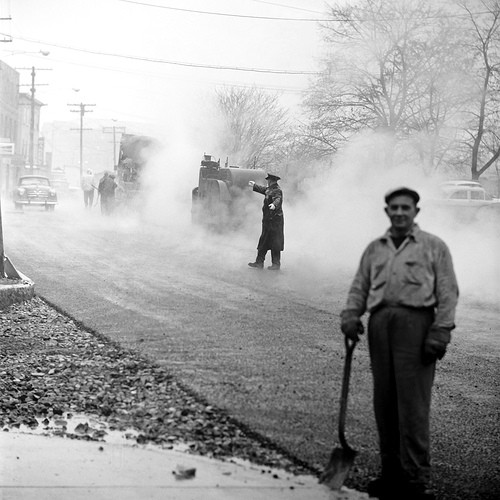
Two Kingdom Tuesday: Macadam or Concrete?

Does Christianity involve a conviction about roads and their construction? To hear some critics of 2k, the problem with distinguishing between a spiritual and an earthly kingdom is that it creates a vacuum of neutrality. Something is either sacred/religious or secular/non-religious. By granting a sphere that is not religious is to create a bogey that leaves neo-Calvinists, pietists, and theonomists spooked. Dualism (boo!) is scary enough. But to think of a sphere of human existence that doesn’t have religious meaning! It’s worse than making an appointment with the dentist.

This is why road construction – or at least choosing the surface of roads – is an interesting test case for the 2k critic. If nothing is neutral, if every square inch is Christ’s, if the Bible speaks to all of life, what is God’s will for road surfaces? Should a Christian always use macadam? Or is concrete okay? And if concrete is God’s will, should Christians and their congregations picket alongside roads that are being paved with macadam? Again, the basic premise of the anti-2k critique is that nothing is neutral and everything is religious. So do anti-2kers really want to hang the plausibility of their theory on a matter like road surfaces?

Most 2k critics never really consider road construction. They have their sights set on bigger targets. Politics, economics, art, medicine – those are outlets fitting for a healthy and vigorous worldview. And to suggest that Christianity doesn’t have the answers to these areas of human endeavor is to commit worldview antinomianism. Rabbi Bret is again useful for illustrating the point:

Dr. Darryl’s problem is that he honestly believes that Christianity, as promulgated in the Church, neither asks nor answers the question, “How shall than we live.” Dr. Darryl’s worldview believes that all attempts by the Church to speak God’s mind on this question for the public square is sinful. The consequence of Dr. Darryl’s worldview is that the Gospel’s impact in saving individual lives reaches no further than those individual personal lives. For Dr. Darryl, a medical doctor is saved by the Gospel but after being saved by the Gospel, Christianity, as promulgated by the church, has no word for the medical doctor on how he should speak about medical ethics. For Dr. Darryl, a public square Economist is saved by the Gospel but after being saved by the Gospel, Christianity, as promulgated by the church, has no word for the Economist on whether Keynesianism is consistent with the 7th commandment. For Dr. Darryl, a civil magistrate is saved by the Gospel but after being saved by the Gospel, Christianity, as promulgated by the church, has no answer for the civil magistrate on whether political or cultural Marxism is consistent with the 1st commandment. For Dr. Darryl the third use of the law, as it pertains to the public square, completely disappears. For Dr. Darryl God speaks clearly on how individuals get saved but God speaks only a incredibly contested word (i.e. – Darryl’s appeal to Natural Law) on how Christians as Christians should live.

Dr. Darryl has not escaped the fact that his worldview for the public square antinomianism that he would have the Church embrace, if pursued for the wrong reasons, is as much a form of works righteousness as is adopting a mandate on global warming or as adopting legislation that is pro-life.

So I’ll take Bret’s challenge and raise him one. Is road paving part of a Christian worldview? If not, then isn’t every 2k critic guilty of worldview antinomianism when it comes to paving streets? Doesn’t some level of reality exist that cannot be claimed as black or white, God’s kingdom or Satan’s? And if that’s the case, then why give 2kers such a hard time for worldview antinomianism when every Christian practices it at some level?

Now, the critics of 2k may be willing to concede this point but then counter that some areas of human endeavor still require a Christian worldview – especially those important arenas like public life. Here the logic seems to be that the important stuff needs a worldview of equal importance. We may be indifferent to the little things in life – though agrarians are rarely willing to concede that the things industrialists consider little really are – but we need Christianity to speak to the important matters.

What anti-2kers cannot seem to grasp is that as much as they would like Christianity to speak to all the important stuff, the Bible does not. Here it is useful to keep in mind Charles Hodge’s reasoning at the time when the Old School Presbyterian Church was being asked to support the Federal government in the emerging struggle between North and South — a time in the life of the U.S. that was a big deal. Hodge was a Republican. Hodge voted for Lincoln. Hodge wept when Lincoln was assassinated. Hodge believed in maintaining the union. He even called secession “a ruinous political heresy.” And yet, Hodge could find no reason for the church to remain anything but neutral on the political question of 1861. He wrote:

The church can only exercise her power in enforcing the word of God, in approving what it commands, and condemning what it forbids. A man, in the exercise of his liberty as to things indifferent, may be justly amenable to the laws of the land; and he may incur great guilt in the sight of God, but he cannot be brought under the censure of the church.

Eating meat sacrificed to idols was, the apostle tells us, a matter of indifference. To eat it, however, under the circumstances in which the Corinthians were placed, was a sin not only against their brethren, but against Christ. He [Paul] however expressly forbids the church interfering in the matter. To his own Master, in such cases, a man must stand or fall. Drinking wine, under some circumstances, may be a great sin, but it can never be made a ground of censure at the bar of the church. In like manner, an adherent of the Stuarts may have committed a great sin in refusing allegiance to the house of Hanover, and be justly punished by the state; but he could not be justly censured by the church. . . .

The government of South Carolina is in conflict with the government of the United States; and the Assembly decided that Presbyterians in that State, and everywhere else in this country, are under obligations to strengthen, support, and encourage the Federal Government. If the public mind were not so excited, and, therefore, prone to misapprehension and injustice, it would not be necessary for us to say again that we agree with this decision of the Assembly; we only deny their right to make it. We fully believe that the allegiance of the American citizen is to the Union, . . . . but we have no right to call upon the Assembly to adopt our interpretation of the Constitution, nor to make that interpretation the ground of its official action. (“State of the Country,” 1861)

So to make it clear, Hodge does not believe the Bible lays down a Christian position on a momentous matter such as the unity of a federal republic. He also believes that Christians have liberty to be on both sides of the issue, as long as they recognize and accept the civil penalties that may come with their position. But to condemn other Christians for their political convictions, when the Bible does not reveal a Christian position, is to bind their consciences illegitimately.

Of course, many 2k critics suffer from a depleted view of the church and are not clamoring for church censures against 2k indifference to the nickels and dimes of cultural and political life that need to be redeemed. But they do act as if such indifference is sin, when in fact they are doing exactly what fundamentalists do – claiming something to be divinely revealed as good or evil that Scripture itself does not reveal. In other words, the critics of 2k high-brow pietists – for them, everything is either holy or worldly; nothing exists in between.

So if worldview antinomianism is the charge, then let’s see the worldviewers swallow some macadam. Though it seems like an amazingly minor matter on which to hang an all encompassing world view.

The Colonies’ Secession was Smart, the South’s Was Dumb

Maybe it is poor form at the national holiday to bring it up, but has anyone noticed the resemblance between 1776 and 1861? Sure, you can say that the Civil War involved more than preserving the union. Many Americans think the fight between North and South was to abolish slavery and preserve the union. But 1776 saw a similar dynamic – a group of slaveholders asserting their independence from a sovereign nation. So what am I missing?

One important difference could be intelligence. I remember being struck by the stupidity of southerners about twenty years ago during Independence Day festivities. (Mind you, I’m bi-regional so I can get away with speaking about my people this way.) I was surfing cable television on a Sunday evening – back when we had cable (and stupid enough to pay for television) and when Sabbatarian convictions were not where they should have been – and I came across the Independence Day worship service where Charles Stanley’s congregation in Atlanta was waxing patriotic by singing the “Battle Hymn of the Republic.” Not only did this manifest a dumb reading of history since this particular hymn was written for a war fought almost a century after the Revolutionary War. It was also stupid because these residents of greater Atlanta were singing a song that the North had concocted to whoop up support for – among other military matters – General Sherman’s raid on central Georgia. To borrow Fosdick’s line, what incredible folly!

Now I see, thanks to one of our southern correspondents, that southern Protestants are still very patriotic and still lacking intelligence about which hymns go with which American wars. Greg Garrison of the Birmingham News writes the following:

Every summer on the Sunday closest to the Fourth of July, a vast array of churches breaks out the red, white and blue bunting and patriotic songs like “The Battle Hymn of the Republic,” with salutes to the military and civil servants.

He goes on to report on the activities of various local congregations.

More Than Conquerors Faith Church will have its “Freedom Celebration” on Sunday at 10 a.m. with patriotic music and a procession of flags.

Pleasant Grove United Methodist Church will have its “Can America Still Trust in God?” worship service with patriotic music at 10:30 a.m. Lunch follows on the church picnic grounds.

St. Alban’s Episcopal Church will have patriotic music by Bobby Horton, Bill Bugg and others starting at 5 p.m., followed by a reading of the Declaration of Independence at 6:15 p.m. Sunday. . . .

It’s the most dramatic Fourth of July celebration ever for the church, said the Rev. Barry Vaughn, the rector.

“It will be the most patriotic thing we’ve done and people seem to be pretty excited about it,” Vaughn said. . . .

Briarwood Presbyterian Church will have its “Christianity in America” service on Sunday at 6 p.m., with patriotic music and a salute to the armed forces.

It will feature a musical tribute to America by the Alabama Philharmonic Orchestra, and arrangement of armed forces songs.

“It’s a tribute to those who served,” said the Rev. Clay Campbell, minister of music and worship pastor at Briarwood Presbyterian Church. “They enjoy putting on their uniforms and coming and being recognized.”

Campbell said that in the past, some have raised concerns that patriotic worship services are idolatrous and constitute worshipping the state.

“We’re not worshipping America,” he said. “We’re giving thanks to God for the blessing he’s placed on America.”

That may not be the way that some see it if Dinesh D’Souza is going to be your guest preacher tomorrow.

Dinesh D’Souza, author of “What’s So Great About Christianity,” will speak in the “Celebrate America” patriotic service at Valleydale Church on Sunday at 9:30 a.m.

D’Souza, a native of India who came to America at age 16 and became well-known as a political commentator and author of best-selling books on social issues, will talk about his love for his adopted country.

“Patriotism is entirely appropriate on this day,” D’Souza said in a phone interview. “The Christian foundation of America is that the root ideas of America are based on Christian influence and assumptions. You hear people talk about did Thomas Jefferson go to church regularly or did Ben Franklin believe in the Trinity. I don’t care if Jefferson believed in miracles. He sat down and asked where do rights come from. He could think of only one source, the Creator. That’s in the Declaration of Independence.”

Of course, there is an easy way for southerners to be smart about all this – it is the spirituality of the church option of psalm singing. Especially when Sunday coincides with July 4th, Psalm 146 is fitting:

1 Praise the LORD.
Praise the LORD, O my soul.

2 I will praise the LORD all my life;
I will sing praise to my God as long as I live.

3 Do not put your trust in princes,
in mortal men, who cannot save.

4 When their spirit departs, they return to the ground;
on that very day their plans come to nothing.

5 Blessed is he whose help is the God of Jacob,
whose hope is in the LORD his God,

6 the Maker of heaven and earth,
the sea, and everything in them—
the LORD, who remains faithful forever.

7 He upholds the cause of the oppressed
and gives food to the hungry.
The LORD sets prisoners free,

8 the LORD gives sight to the blind,
the LORD lifts up those who are bowed down,
the LORD loves the righteous.

9 The LORD watches over the alien
and sustains the fatherless and the widow,
but he frustrates the ways of the wicked.

10 The LORD reigns forever,
your God, O Zion, for all generations.
Praise the LORD.