
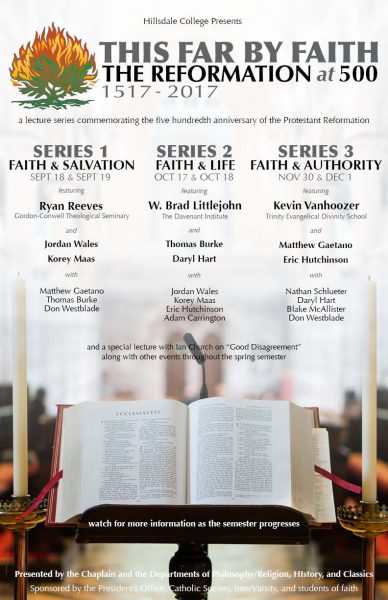
An academic institution where Protestants and Roman Catholics teach together sponsoring a conference about the Reformation is one thing, but a Presbyterian seminary holding a series of lectures on the Reformation that includes Roman Catholics and Protestants? That’s what’s happening at Covenant Theological Seminary this fall. The explanations do not add up:
“Though significant differences still divide Protestants and Catholics, there are real reasons to listen to each other, even learn from each other, so that we might give better testimony to Christ by loving one another across our differences,” said Ryan, professor of religion and culture at CTS and director of the seminary’s Francis A. Schaeffer Institute. “Our goal is to somehow get past lingering caricatures of each other’s positions to find the common ground we share as we seek to bear a more credible witness for the Lord before the watching world.”
Jerram Barrs, CTS professor of Christian studies and contemporary culture and one of the speakers at the lecture series, agrees. “It is important that we do not merely endlessly rehearse the reasons as to why the Reformation took place as if neither we nor the Roman Catholic Church have learned any more or changed in any manner since the 1500s.”
The lecture series will feature five speakers — two of them Catholic — discussing topics ranging from why the Reformation still matters today, to the pastoral legacy of the Reformation, to an evangelical and Catholic and Reformed view of faith and culture.
The part that stuck out to mmmeeeeEEEE was about “endlessly rehearsing the reasons as to why the Reformation took place.” Last time iiiiiIII checked, Protestants and Roman Catholics in the United States are seriously in need of learning the reasons for Luther’s original complaints and Rome’s rejection of Protestant proposals. Consider the following:
nearly half of U.S. Protestants today (46%) say faith alone is needed to attain salvation (a belief held by Protestant reformers in the 16th century, known in Latin as sola fide). But about half (52%) say both good deeds and faith are needed to get into heaven, a historically Catholic belief.
U.S. Protestants also are split on another issue that played a key role in the Reformation: 46% say the Bible is the sole source of religious authority for Christians – a traditionally Protestant belief known as sola scriptura. Meanwhile, 52% say Christians should look both to the Bible and to the church’s official teachings and tradition for guidance, the position held by the Catholic Church during the time of the Reformation and today.
When these two questions are combined, the survey shows that just three-in-ten U.S. Protestants believe in both sola fide and sola scriptura. One third of Protestants (35%) affirm one but not the other, and 36% do not believe in either sola fide or sola scriptura.
Pew’s findings corroborate Ligonier’s survey. (And Redeemer NYC’s outreach to skeptics isn’t doing much to put the sola in the Reformation.)
The thing is, works righteousness comes naturally to human beings. That’s why whenever you have the chance to bang the gong for the sufficiency of Christ and the insufficiency of human virtue (not to mention the sin of pride that virtue sometimes encourages), you take it.
 Old Life