
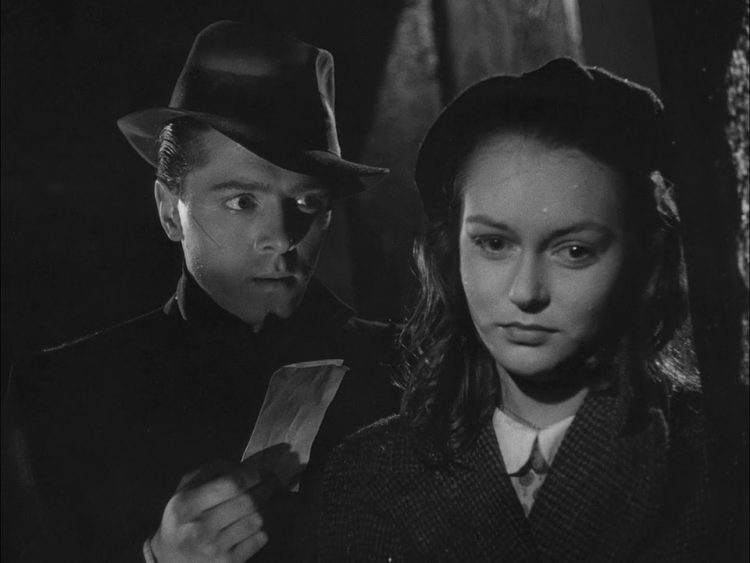
This week’s Mubi selection prompted a viewing of Brighton Rock, an allegedly classic British film noir based on Graham Greene’s novel of the same name.
Pinkie Brown is a small-town hoodlum whose gang runs a protection racket based at Brighton race course. When Pinkie murders a journalist called Fred Hale whom he believes is responsible for the death of a fellow gang-member, the police believe it to be suicide. This doesn’t convince Ida Arnold, who was with Fred just before he died, and she sets out to find the truth. She comes across naive waitress Rose, who can prove that Fred was murdered. In an attempt to keep Rose quiet Pinkie marries her. But with his gang beginning to doubt his ability, and his rivals taking over his business, Pinkie starts to become more desperate and violent. (from IMDB)
The Roman Catholic aspect of the movie was striking. Pinkie seems to know that God exists and will exact a penalty for his life of crime. His wife, Rose, is a Roman Catholic like Pinkie and also has a strong sense of right and wrong even while aiding and abetting her criminal husband. (Yes, the Roman Catholic version of antinomianism — think Mafia dons and whiskey priests — comes to mind.) Here is one description of Greene’s novel and his characters:
All of Greene’s novels were written after his conversion to Catholicism and a religious sense pervades most of them. However, Catholicism was not a vital ingredient in his fiction until Brighton Rock (1938) in which it was developed with a Manichean rigor. . . . In Brighton Rock, for example. Pinkie, the seventeen-year-old Catholic punk, seems possessed by evil and, therefore, in his own eyes—and in those of many of Greene’s readers—capable of being condemned to hell. Brighton Rock is easily classified as a religious novel. But Greene has commented in recent years that Pinkie’s actions were conditioned by the social circumstances in which he had been born and he could not, therefore, be guilty of mortal sin. . . .
[Greene] says, “I don’t believe in hell. I never have believed in hell. . . . They say God is mercy … so it’s contradictory.” (Many years earlier Greene wrote in Lawless Roads, a work of non-fiction: “One began to believe in heaven because one believed in hell, but for a long while it was only hell one could picture with a certain intimacy.” This view is quite close to that of Pinkie in Brighton Rock, except that Pinkie had difficulty in making the leap to a belief in heaven. Still, as Greene noted, one shouldn’t expect unchanging constancy in a writer.)
Greene was, obviously, all over the place when it came to faith. An excerpt from one of his books, which included an interview on faith, suggests he was not in step with the trads, the rads, or the trad-rads:
I don’t like the term ”sin”: It’s redolent of a child’s catechism. The term has always stuck in my throat, because of the Catholic distinction between ”mortal” and ”venial” sin. The latter is often so trivial as not even to deserve the name of sin. As for mortal sin, I find the idea difficult to accept because it must by definition be committed in defiance of God. I doubt whether a man making love to a woman ever does so with the intention of defying God! I always remember the example of a Dominican priest who found his life in Europe too easy and left for Africa, where he lived for years in a hut made out of old tin cans, only to discover that he was suffering from the sin of pride. He came back to England and confided to a friend that during all this time of hearing the confessions of the faithful, he had never come across a single mortal sin. In other words, for him, mortal sin didn’t exist. The word ”mortal” presupposes a fear of hell, which I find meaningless. This being the case, I fear that I’m a Protestant in the bosom of the church.
Vatican officials worried about Greene’s views (and especially the adultery that supplied material for his novels). But they gave him a long leash because England was Protestant and it wouldn’t look good to crack down on Roman Catholic novelists with so many Protestants watching:
Graham Greene and Evelyn Waugh, according to expert opinion, are to be considered the two major living English novelists: being Catholic they do credit to Rome’s faith, and they do credit to it in a country that is of Protestant civilization and culture. How can Rome be gruff and cruel? They are the successors of Chesterton and Belloc and, like them, rather than attempting to convert the small fry, strive to influence superior intelligences and the spirit of the age in a manner favorable to Catholicism. Their level, unlike that of a Bruce Marshall, is not that of average I.Q.s or, like the clergy in general, that of uneducated readers or pure professionals. Their level is the higher intelligentsia in the contemporary world which they sway and influence towards Rome …
All of this is fascinating, but what is striking about Greene’s novels (and the movies based on them), along with Waugh’s Brideshead Revisited, is that the point of becoming Roman Catholic is not to flourish as a human being or civilizationally. The believing characters like Rose, and the defiant non-practicing ones like Pinkie, do not look at Christianity as a way to live the good life. Theirs is a world haunted by moral choices and a God who judges them. Heaven and hell give meaning, not flourishing.
 Old Life