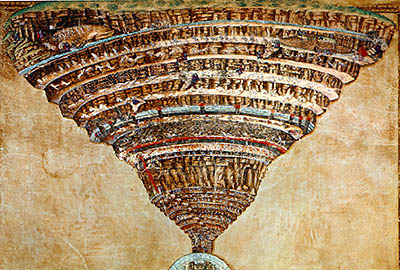
Christian Hell?

Mark Horne apparently thinks he has landed a damaging jab against 2k by ridiculing Jason Stellman’s point about the discontinuity between culture here and the new heavens and new earth – a point raised in Keith Mathison’s review of David VanDrunen’s new book, Living in God’s Two Kingdoms. Stellman wrote:

If my marriage to my wife will not survive into the age to come, then why would I think her wedding ring will? Sure, it’s a nice ring and very well-made, but it’s hardly a higher example of human productivity than our marriage is.

For what it’s worth, the absence of marriage in the new heavens and new earth would certainly seem to unravel arguments that look at redemption as the restoration of creation. If marriage existed as part of the created order and then vanishes in the glorified order, something is going on that seems to escape the average neo-Calvinist’s redemptive-historical horizon.

But Horne does not consider Stellman’s point for very long and rushes instead to his own – perhaps listening to too much Focus on the Family – about the difference that Christianity makes for marriages and child rearing. He writes:

If we use this principle for a generalized defense of R2K, then we must state that there are no such things as Christian marriages or Christian families. Jesus does not want us wasting our time talking about how husbands and wives should behave or raising their children according to God’s word. This is all a compromise of the Gospel and a confusion of law and grace. We should leave family issues to secular family counselors just as we should leave the economy to Bernanke.

(By the way, humans rear children; they raise cows. And I’ll take my chances with Bernake over Gary North running the economy.)

First, marriage is a legal status determined by the state. As such, Christian marriages do not exist unless we want to turn matrimony into a sacrament. But when you refuse the categories of holy, common, and profane, how else to make marriage meaningful except to baptize it?

Second, since marriage as an institution is not Christian but a creation ordinance that is open to all human beings (except for gay ones – lest anti-2k hysteria surface), then the issue is whether a Christian’s vocation is married or single. Christianity has to do with persons, not with institutions (other than the church). Christians who are married have clear instruction from Scripture about how they should conduct themselves as spouse or parent or both. But that does not mean that the institution of marriage (or the church for that matter) will survive in the new heavens and new earth. I mean, the Bible gives some instruction about the Lord’s Supper but does that mean we’ll still be observing that meal in remembrance of the Lord whom we see with our resurrected eyes?

Horne concludes with this whopper – the antithesis doesn’t come any more antithetical:

It is one or the other. Either you affirm that Jesus is “ruler of the kings of the earth” or you deny that it is “the Father, from whom every family in heaven and on earth is named.”

Huh? Since when does denial of Jesus as ruler of the earth unseat him as King of Kings and Lord of Lords? This is where the literal mindedness of 2k’s critics is most revealing. They do not seem to have any conception for Christ ruling all things in different ways (you know, some as redeemer and others as creator and redeemer). Which means in the case of marriage that Christ rules all marriages, whether entered by believers or unbelievers. And those people who deny Christ as Lord are no less married than those who confess his name. To implicitly question the legitimacy of unbelievers’ marriages is to throw all conventions that support a measure of good social order to the wind. The implication of Horne’s antithesis is – if you don’t have Christ in your heart, be who you really are, a hell raiser. Since I’ve had hell raisers as neighbors, I much prefer those unbelievers who follow the order of creation even if they can’t identify the creator in a multiple choice test.

And speaking of hell, I wonder if it has ever occurred to 2k critics like Mark Horne that Christ is Lord of both Heaven and Hell, and that his rule in those places is markedly different. If Christ is indeed Lord of the cursed and the blessed, then it may be possible to imagine that Christ’s rule in a Christian home will be different from his sovereignty within a secular family. And if this is the case, then Christians need neither force non-believers to live like Christians nor inaugurate the eschaton by having the state start the judgments that Christ will execute when he returns. In other words, if Christians will simply follow what their Lord has told them to do – attend the means of grace, live quiet and peaceful lives, and glorify God and love neighbors in their work – Christ, who is Lord, will take care of the rest.

Uncanny how Christ does that without our ruling in his name.
Act Two, Scene Three: How Soon They Forget

In his serialized review of VanDrunen’s Natural Law and the Two Kingdoms, Nelson Kloosterman finishes his inspection of the chapter on Calvin with the line, “Remember the Puritans.”

This is a curious appeal because Kloosterman’s memory may not be as good as his review of VanDrunen is long. His major objection to 2k appears to be that its advocates do not insist that Scripture is necessary for prescribing the duties of the civil magistrate. To VanDrunen’s point that Calvin did not believe civil government should be ruled solely by Scripture, Kloosterman finds an opening to insist that the Bible does inform at least part of the magistrates duties.

On the one hand, Kloosterman asks:

. . . if God’s natural law, embodied in OT Mosaic law, prohibits public blasphemy, and if this natural law ought to underlie civil enactments, then why should Dr. VanDrunen so vigorously oppose appeals to God’s requirements amid public policy discussions about moral issues covered by the Decalogue?

That would seem to mean that the civil magistrate is bound to uphold both tables of the law since Kloosterman is not only concerned about violations of the seventh commandment in the instance of gay marriage but also about instances of blasphemy covered in the third commandment.

Kloosterman also goes on to quote, as he is wont to do, from the Canons of Dort which give him the green light to insist that special revelation must be the lens through which to read general revelation (though he never seems to consider that this reading of Dort would prohibit all non-Christians from using natural law, whether as fathers or magistrates, since without regeneration they cannot properly interpret natural law). This is what Dort says:

There is, to be sure, a certain light of nature remaining in man after the fall, by virtue of which he retains some notions about God, natural things, and the difference between what is moral and immoral, and demonstrates a certain eagerness for virtue and for good outward behavior. But this light of nature is far from enabling man to come to a saving knowledge of God and conversion to him—so far, in fact, that man does not use it rightly even in matters of nature and society. Instead, in various ways he completely distorts this light, whatever its precise character, and suppresses it in unrighteousness. In doing so he renders himself without excuse before God” (III/IV.4, italics added).

Since Kloosterman italicizes those portions which correctly portray the limitations of natural man using natural law, he would seem to be saying that without Scripture, no one can interpret general revelation correctly. In fact, he said this in his interviews on Christ and culture at Reformed Forum.

But on the other hand comes Kloosterman’s selective memory, perhaps a function of having to venture beyond Queen Wilhelmina’s mints and wooden shoes. To VanDrunen’s point that Calvin did not use the Bible solely for civil matters, Kloosterman writes:

“Calvin did not believe,” we are told, “that the civil kingdom can be governed solely or primarily by the teaching of Scripture.” But who does believe that? Some of us insist that the civil kingdom (public society) should be governed in part by the teaching of Scripture, in connection, say, with issues like homosexual marriage and abortion, and even debasing monetary currency. But who among us has ever claimed that “the civil kingdom can be governed solely or primarily by the teaching of Scripture”?

Actually, as already mentioned, Kloosterman did claim that the Bible is the basis for civil government and its laws (and his invocation of Dort is further testimony to this point; how else to read the deficiency of natural revelation apart from the lens of Scripture?). But the curious aspect of Kloosterman’s concession that the Bible does not govern all of public life comes when he mentions those areas where the Bible should govern the civil magistrate – gay marriage and abortion.

What about blasphemy, mentioned in the previous quotation? And what about both tables of the law? Does the magistrate follow only the second table but get a pass on the first? Does this mean that the civil polity should tolerate blasphemy and idolatry, but not murder and stealing? If so, then how does this view follow biblical teaching or even show the usefulness of the Decalogue in civil government? Is Kloosterman really a closet advocate of 2k?

If he remembers the Puritans, he is. Because those English Protestants who fled the old country to establish a city on Beacon Hill were not at all reluctant to let the whole Decalogue (and even parts of the Pentateuch) inform their civil laws. To assist Dr. K’s memory, he might want to consider the following (only the first ten out of fifteen capital offenses) from The Laws and Liberties of Massachusetts (1647):

1. If any man after legal conviction shall have or worship any other God, but the lord god: he shall be put to death. Exod. 22. 20. Deut. 13.6. & 10. Deut. 17. 2. 6.

2. If any man or woman be a witch, that is, hath or consulteth with a familiar spirit, they shall be put to death. Exod. 22. 18. Levit. 20. 27. Deut. 18. 10. 11.

3. If any person within this Jurisdiction whether Christian or Pagan shall wittingly and willingly presume to blaspheme the holy Name of God, Father, Son or Holy-Ghost, with direct, expresse, presumptuous, or highhanded blasphemy, either by wilfull or obstinate denying the true God, or his Creation, or Government of the world: or shall curse God in like manner, or reproach the holy religion of God as if it were but a politick device to keep ignorant men in awe; or shal utter any other kinde of Blasphemy of the like nature & degree they shall be put to death. Levit. 24. 15. 16.

4. If any person shall commit any wilfull murther, which is Man slaughter, committed upon premeditate malice, hatred, or crueltie not in a mans necessary and just defence, nor by meer casualty against his will, he shall be put to death. Exod. 21. 12. 13. Numb. 35. 31.

5. If any person slayeth another suddenly in his anger, or cruelty of passion, he shall be put to death. Levit. 24. 17. Numb. 35. 20. 21.

6. If any person shall slay another through guile, either by poysoning, or other such devilish practice, he shall be put to death. Exod. 21. 14.

7. If any man or woman shall lye with any beast, or bruit creature, by carnall copulation; they shall surely be put to death: and the beast shall be slain, & buried, and not eaten. Lev. 20. 15. 16.

8. If any man lyeth with man-kinde as he lieth with a woman, both of them have committed abomination, they both shal surely be put to death: unles the one partie were forced (or be under fourteen years of age in which case he shall be seveerly punished) Levit. 20. 13.

9. If any person commit adulterie with a married or espoused wife; the Adulterer & Adulteresse shall surely be put to death. Lev. 20. 19. & 18. 20 Deu. 22. 23. 27.

10. If any man stealeth a man, or Man-kinde, he shall surely be put to death Exodus 21. 16.

I wonder if this is the system of law that Dr. K. would have the readers of Christian Renewal remember. Since he seems to shy away from putting people to death for adultery, Kloosterman would appear to be much closer to VanDrunen than he is either to Calvin or the Puritans whose notions of a Christian society perhaps only contemporary theonomists have the stomach to swallow.

In which case, what seems to motivate Dr. K.’s objections to 2k is pining for the sort of American society when liberal Protestants were running things and setting the standards for public life. Ramesh Ponnuru gave a useful description of the virtues of that wonderful time in American life in his essay, “Secularism and Its Discontents” (National Review, Dec. 2004) He wonders what would happen if religious conservatives actually achieved legislative success in the U.S. Their wish-list includes prohibiting abortion, restricting pornography, restraining experimentation on human embryos, and banning gay marriage. Some might like to have more prayer in public schools, and those who don’t home school would prefer that the public school teachers giving tips on condoms. But Ponnuru thinks this is hardly a return to John Winthrop’s Boston or John Calvin’s Geneva:

My point . . . is to note that introducing nearly every one of these policies – and all of the most conservative ones – would merely turn the clock back to the late 1950s. That may be a very bad idea, but the America of the 1950s was not a theocracy.

Likewise, Kloosterman’s critique of 2k is hardly a return to Massachusetts of 1647, Amsterdam of 1595, or to Zurich of 1550. If he could remember the Puritans, he might actually see how much in common he has with his Dutch-American nemesis, the lovely, the talented, David VanDrunen.

Act Two, Scene Two: Cheap Shot

Actually, the title should be plural since in one of his first reviews of VanDrunen’s Natural Law and the Two Kingdoms Nelson Kloosterman decided to insert a [sic] after VanDrunen’s phrase, “the Reformed tradition of natural law and the two kingdoms.” Kloosterman explained, “Because we are in danger of annoying our readers, we shall now desist from using ‘[sic]’ [which abbreviates the Latin sicut, which means ‘thus’ or ‘such’] as our way of identifying the author’s repeated, persistent, and unqualified use of the definite article to identify his construal as ‘the’ Reformed natural law and two kingdoms doctrine.”

Aside from the small-mindedness among the Dutch-American Reformed when they hear of a “Reformed” tradition that does not follow their way of doing and thinking, this is a petty remark and reveals the lengths to which Kloosterman will go in condemning 2k. I wonder when he will mention the typos in the book (if there are any). To younger writers out there, these are the sort of criticisms that should be left on the editing floor and any good editor would have it deleted it on grounds of impropriety and triviality – improper because the level of disagreement is already high and this detracts from the main point; trivial because the use of a definite article is not essential to Kloosterman’s argument.

But the pettiness continues in Kloosterman’s most recent part of his review — I guess he is really going to go through VanDrunen chapter by chapter. (Kloosterman better be hoping that Harold Camping is wrong about the date of Christ’s return and that a significant theological controversy does not prompt the editors of Christian Renewal to reserve inches for more important business.) In this stage of his response to VanDrunen – specifically, the chapter on Calvin – Kloosterman faults the Westminster professor for poor scholarship. VanDrunen uses John Bolt’s discussion of Calvin’s Christology to make a point about the difference between Christ’s rule as mediator and as creator. But because Bolt uses Calvin’s Christology to affirm Kuyper and because VanDrunen — who hasn’t tipped his hand on his own use of Calvin — uses Calvin’s Christology to understand Calvin’s views of the two kingdoms (views for which Kloosterman cannot account), Kloosterman judges VanDrunen to be a poor academic. He writes:

Bolt’s own application of the Christological distinction is the very opposite of the use to which VanDrunen puts it in his NL2K discussion of Calvin! Surely readers deserve better scholarship than this!

Since Bolt’s application of Calvin was not the point of VanDrunen’s argument, I don’t see what is shoddy about this scholarship. It surely seems that Bolt takes the extra Calvinisticum in one direction — the Kuyperian one — and VanDrunen and Calvin take it in another direction, namely, to distinguish between the temporal and spiritual realms. VanDrunen is simply using Bolt’s language to explain the extra Calvinisticum, not to claim Bolt as a proponent of 2k. But since Kloosterman cannot tell the difference between a work of description — which is what VanDrunen’s book is — and one of prescription, he can’t see the different purposes to which an author may use a quotation. Talk about overexcited.

The problem for Kloosterman is that he exhibits the very impoverished academic work of which he accuses VanDrunen. This comes in his complaints against VanDrunen’s conception of the kingdom of God. Kloosterman believes that VanDrunen should have consulted creedal and catechetical material, and if he had, he would have found in the Heidelberg Catechism, for instance, no such distinction between the redemptive and creational rule of Christ. Mind you, the logic here is unclear since Kloosterman affirms the Kuyperian distinction between the church as organism and church as institute. This dualism, though, is a good one that disallows distinguishing between the rule of Christ inside and outside the church. Apparently, for Kloosterman, Christ rules everywhere and everything through the church, both as institute and as organism. He goes on to quote John Bolt to show that the purpose of the church is to restore the world to its creational, God-intended course – as if that could happen short of judgment day. This is another way in which the church is part of the means by which Christ rules all things.

But the point that needs to be underscored is Kloosterman’s poor reading of Heidelberg:

. . . the Heidelberg Catechism (1563), Q/A 50, deals with the session of Jesus Christ: “Why is it added, And sitteth at the right hand of God? Because Christ ascended into heaven for this end, that He might there appear as Head of His Church, by whom the Father governs all things.” Surely in the history of interpretation, the church has understood this answer to acknowledge that God the Father rules all things through Jesus Christ, the incarnate, risen, and ascended Savior of the church! Especially the Scripture references undergirding this answer, Ephesians 1.20-23, Colossians 1.18, Matthew 28.18, and John 5.22, teach us that this confession of Jesus as Lord of all is eminently biblical.

Moreover, such royal activity accords with what we confess in Lord’s Day 12, Q/A 31, that Jesus Christ is our eternal King, who governs and defends us. To my knowledge, no interpreter of the Heidelberg has argued that the incarnate, risen, and ascended Jesus Christ is eternal King 9 of 11 of the church only. Rather, this incarnate, risen, and ascended Jesus Christ is eternal King of the universe!

Well, VanDrunen (nor does any 2k advocate) say that Christ is lord ONLY of the church. What kind of reading skills do Christian day schools teach (and do they give refunds)? What 2k advocates argue is a distinction between Christ’s lordship over those who do not confess him as lord, who do not bend the knee in worship, and those who do trust in Christ and are members of his church. That would appear to be an important difference – for instance, how Christ is lord of both Tim Keller and Tiger Woods. 2k teaches that Christ is lord of each man, but not in the same way. And the different rule is apparently what the very author of the Heidelberg Catechism had in mind when he explained the second petition of the Lord’s prayer in his commentary:

A kingdom in general is a form of civil government in which some one person possesses the chief power and authority, who, being possessed of greater and more excellent gifts and virtues than others, rules over all according to just, wholesome and certain laws by defending the good and punishing the wicked. The kingdom of God is that in which God alone rules and exercises dominion over all creatures; but especially does he govern and preserve the church. This kingdom is universal. The special kingdom of God that which he exercises in his church consists in sending the Son from the Father, from the very beginning of the world, that he might institute and preserve the ministry of the church, and accomplish his purposes by it that he might gather a church from the whole human race by his word and Spirit rule, preserve and defend it against all enemies raise it from death, and at length, having cast all enemies into everlasting condemnation, adorn it with heavenly glory, that God may be all in all, and be praised eternally by the church. (Commentary on the Heidelberg Catechism, pp. 632-33) [emphasis added for the reading impaired]

So contrary to Kloosterman’s claim that “we” know of no interpreter of Heidelberg who says that Christ is lord only of the church, I know of one author and interpreter of Heidelberg who does something very comparable to what Calvin does and what VanDrunen observes in Calvin. Surely, we could expect better theological scholarship than this.

And we find better theological scholarship in another Dutch-American Reformed theologian. Louis Berkhof follows Calvin and Ursinus in making a distinction between the universal lordship of Christ (Tiger Woods) and the special rule that he extends over his church (Tim Keller).

The Kingship of Christ over the universe is subservient to His spiritual kingship. It is incumbent on Christ, as the anointed King, to establish the spiritual kingdom of God, to govern it, and to protect it against all hostile forces. He must do this in a world which is under the power of sin and is bent onthwarting all spiritual endeavors. If that world were beyond His control, it might easily fustrate all His efforts. Therefore God invested Him with authority over it, so that he is able to control all powers and forces and movements in the world, and can thus secure a safe footing for His people in the world, and protect His own against all the powers of darkness. These cannot defeat His purposes, but are even constrained to serve them. Under the beneficent rule of Christ even the wrath of man is made to praise God. (Systematic Theology, pp. 410-11) [more emphasis added for neo-Calvinists]

Unless I missed something, Berkhof is talking about a rule by Christ that governs the works of all men outside the church (Tiger Woods) in such a way that nothing will ultimately harm those whom he governs as redeemer (Tim Keller). That sure sounds like a rule as creator that is universal rather than a rule as redeemer that is particular. After all, Tiger Woods does not know Christ as lord and redeemer (such as we can tell from the media). But Christ is still lord of him, the PGA, and Woods’ sponsors. That lordship is substantially different from Christ’s rule over Redeemer Presbyterian Church NYC (even if I wish that rule were a little more on the order of Reformed governance).

I don’t know why that is so hard to see. Calvin saw it. Ursinus saw it. Berkhof saw it. Kloosterman misses it. And that means that he is digging a deeper hole for himself the more he digs in against VanDrunen and 2k.

Nelson Kloosterman May Not Be But I Am Thankful for David VanDrunen

The reason is that Dave is a Calvinist who knows his Bible and is turning up the heat on that turkey we know as neo-Calvinism.

Ultimately, however, neo-Calvinism needs to be questioned not because of its struggle to accomplish what it set out to do but because it is so foreign to the message of the New Testament. The idea that the heart and soul of Christianity consists in the transformation of existing cultures is arrestingly and glaringly absent from New Testament teaching. Time and again the New Testament emphasizes the present suffering of Christians, the transitory and fleeting nature of the things of this world, heavenly citizenship, and the hope of the age to come. The things that it says about broader cultural affairs are so infrequent and so sparse – basically, submit to legitimate authority and work hard – that it is quite incredible to think that Christ and his apostles intended to instill a vision akin to the neo-Calvinist world and life view. The neo-Calvinist case from the New Testament rests upon a handful of scattered verses – the kingdom as a leaven, the groaning of creation, every thought captive, the kings of the earth bringing their glory into the new Jerusalem – that sound inspiring out of context but do not make the case intended. The burden of the New Testament is about as far away as imaginable from imparting an agenda of cultural transformation. . . .

Redemption does not put Christians back on track to accomplish the original goal of the First Adam through their own cultural work – Christ has already done that on their behalf perfectly and finally. Misunderstanding this point is perhaps the fatal flaw of neo-Calvinism. Until the day when Christ returns he has ordained that his people be pilgrims in this world and be gathered together in the church.

It would be difficult to overemphasize the importance of the fact that the church was the only institution that the Lord Jesus established in this world during his earthly ministry. . . . Christ came, in other words, not to transform the cultures of this world but to win the kingdom of God, the new creation, which will be cataclysmically revealed out of heaven on the last day, and to establish the church for the time being, as a counter-cultural institution that operates not according to the cultures of this world but in anticipation of the life of the age-to-come. (from Always Reformed: Essays in Honor of W. Robert Godfrey, pp. 148-49)

I know, I know, many who have read the Reformed tradition anachronistically through the lens of Abraham Kuyper and Herman Dooyeweerd will say that VanDrunen sounds like an Anabaptist or a fundamentalist. In point of fact, he sounds exactly like Calvin. That’s why Calvin has all that language of suffering, enduring, and looking for the world to come. (I do wonder when the Vossians will finally rally to VanDrunen’s side.)

Gobble, gobble.

Two-Kingdom Tuesday: Going Mainstream?

Terry Eastland, the publisher of The Weekly Standard, recently wrote a review essay of James Davison Hunter’s, To Change the World, and David VanDrunen’s, Natural Law and the Two Kingdoms. After reading these books, Eastland is scratching his head that critics of transformationalism like Hunter are so dismissive of 2k theology. He writes:

Oddly, To Change the World has little to say about two kingdoms, notwithstanding its rooting in a millennium and a half of Christian reflection. And what the book does say is a caricature: According to Hunter, the doctrine leads its adherents “to increasingly withdraw into their own communities with less and less interest in any engagement with the larger world.” Hunter fails to consider such evidence as VanDrunen has weighed and which supports the proposition that two-kingdoms doctrine encompasses the idea of promoting the welfare of society, or as Hunter himself might say, its “overall flourishing.”

That James Davison Hunter has no affinity for two kingdoms would seem surprising, since it is a doctrine that offers no support to the world changers he challenges at every turn. On the other hand, there is an ambiguity in To Change the World that makes one wonder whether Hunter’s dismissal of two kingdoms is a product of his sympathy for, yes, world changing. The ambiguity arises in his discussion of faithful presence, and it concerns the critical issue of redemption. For while Hunter emphasizes that “culture-making .  .  . is not, strictly speaking, redemptive or salvific in character,” and that “world building” is not to be confused with “building the Kingdom of God,” he also says that the church should “offer an alternative vision and direction” for prevailing cultural institutions and seek “to retrieve the good to which modern institutions and ideas implicitly or explicitly aspire.” Putting aside whether the church is even capable of offering such vision and direction, or of retrieving such goods, it would seem without authority to do so—unless it is now being charged with (to borrow a phrase) “redeeming the culture.”

Such is the allure of transformationalism that one of its most vigorous critics seems unable to abandon it. Even so, Hunter’s book is not without its redeeming features, notably a critique of the modern world that strikingly illumines the challenges that “difference” and “dissolution” pose for Christian engagement. Difference, meaning pluralism, “creates social conditions in which God is no longer an inevitability,” a development that renders “God-talk” with “little or no resonance” outside the church. Dissolution, meaning “the deconstruction of the most basic assumptions about reality,” makes it more difficult to “imagine that there is a spiritual reality more real than the material world we live in.”

Likewise, Hunter’s theology of faithful presence takes inspiration from the sensible teaching of that Epistle to Diognetus, and before that, from the wise counsel of Jeremiah. In his letter to the exiles living in the very different culture of Babylon—its king a pagan gentile—the prophet exhorted them to “seek [its] welfare” on the ground that “in its welfare you will find your welfare.”

David VanDrunen’s study is worth commending on account of the achievement it represents, for the two kingdoms doctrine, with its fascinating lineage, has not had the historian of theological acumen it deserved until now.

Like I wondered last week, all this favorable attention to 2k is scary. If it becomes too popular, it will surely lose its saltiness. Then again, we always have the Baylys, Kloostermans, and Brets of the world to keep us sinful.

If the Gospel Coalition Embraces It, Will 2k Lose Its Edge?

One of the smarter moves by 2k proponents was David VanDrunen’s to publish his sequel to Natural Law and the Two Kingdoms with Crossway, the firm with the most direct ties to the Gospel Coalition, thanks to Justin Taylor’s footprint in both organizations. So far 2k has come into print through outlier publishers, such as Jason Stellman’s Dual Citizens with Reformation Trust, an up-and-comer but not yet on a par with the Grand Rapids and Wheaton publishers; VanDrunen first published his Biblical Case for Natural Law with the Acton Institute and then his book on two kingdoms with Eerdmans – a publisher no longer regarded by sideline Presbyterians as safely orthodox; in my own case, I went to the independent trade publisher, Ivan R. Dee to produce A Secular Faith. With Living in God’s Two Kingdoms, VanDrunen has put 2k theology, with all of its initial oddities and counter-biblicist notions, squarely before the Tim-Keller loving, and John-Piper convicting masses.

Will 2k ever be the same?

Early returns suggest, yes. Here are a few of the responses to Taylor’s recent post on VanDrunen’s latest:

I’ve read VanDrunen’s book and I am surprised that you came to such positive conclusions about it. He makes a few valuable critiques of those who disagree with him, but the overall thrust of his thesis is, quite frankly, unbiblical. His exegesis is shoddy and he makes very dramatic assumptions about his theology’s continuity with historical figures. VanDrunen’s (and to a greater extent, D.G. Hart’s) iteration of two-kingdom theology does not cooperate well with Augustine’s, Calvin’s, or even Luther’s understanding of the Church’s call in the world. Reading this book can be valuable for a number of reasons, but please exercise careful discernment and wisdom before taking his claims too seriously.

John Frame’s book review on his prior book seems to suggest VanDrunen’s 2 kingdom view is unbiblical. I am thinking this book might be a waste of time.

I’m not sure which is worse. Unbiblical or waste of time. But acquiring a taste for 2k will clearly take some work.

I don’t actually believe VanDrunen will be visiting a Gospel Coalition conference soon as a plenary speaker. His arguments about “redeeming culture” and the nature of redemption will not go down easily with word-and-deed-based ministries or churches in pursuit of social justice (no matter how generous). But he has moved 2k from the sidelines to a seat at the mainstream born-again Baptyterian table. Maybe this book will turn out to be as momentous as the original Super Bowl, which brought the AFL and the NFL together for an annual game that led to the joining-and-receiving of leagues that had been previously at odds. Maybe too, in reverse of professional football’s expansion, VanDrunen’s sighting on the Gospel Coalition’s radar will prompt the allies in the Gospel Coalition to go back to church on Sunday evenings for a second service.

Worldview Demagoguery

One of Dr. K’s fans posted here part of a letter by a Reformed pastor who is also in agreement with the good doctor on the threat that 2k supposedly poses to vigorous and full-fledged Reformed Protestantism. That excerpt read:

We agree with Dr. Kloosterman’s assessment of what will happen in the Reformed community, as we know it, if these natural law, two-kingdom views espoused by Dr. Van Drunen and others, take root. We urge every reader of this magazine to exert the mental energy that will be required to follow the lines of argumentation that Dr. Kloosterman will present in upcoming articles. It is necessary for the peace of the church and survival of the Reformed faith with its Calvinistic world and life view. Please do not underestimate the importance of the struggle we are facing.

What is curious about this understanding of 2k’s threat is that again it does not accord with reality (or in denial, if you will). To be sure, Dr. K has also been guilty of construing the debate over Christianity and culture in fidelity-to-the-gospel proportions. But when you least expect it, he also provides evidence that undermines his very claims about the stakes of 2k. In an article for Christian Renewal where he discussed the Federal Visionists’ identification of baptism with regeneration, Dr. K appealed to one of those communions allegedly on the verge of losing its Reformed soul to the trickery of 2k:

Our purpose here is to warn readers about the inevitable deformative effects, within confessionally Reformed churches, of correlating a child’s physical birth (to believing parents) with that child’s spiritual birth from above. This view is an over-correction of another, admittedly deficient and non-covenantal, “revivalist paradigm” so common among evangelical Protestants, which denies to a child of believing parents any status or blessings different from those enjoyed by a child born to unbelieving parents. For a helpful analysis of these and related views, see the “Report of the Committee to Study the Doctrine of Justification” presented in June, 2006, to the 73rd General Assembly of the Orthodox Presbyterian Church.

Important to note here is that David VanDrunen chaired the committee responsible for this report and he contributed significant sections to it. Had Dr. K known this, he may not have cited it so favorably.

But since he did, Dr. K has proven the worried letter writer quoted above wrong. One of the communions where 2k is on the loose has not abandoned the Reformed faith but has actually stood remarkably well for the doctrines of grace (among others). What is more, in the case of VanDrunen himself, the logic of 2k does not lead to an abandonment of Reformed orthodoxy.

Not to be missed either is the 600 pound gorilla in the room of worldview triumphalism and lamentation. That would be the beast known as the Christian Reformed Church. Much as I enjoyed my time in that communion and regard highly many of its pastors and scholars, the CRC is emerging precisely as the communion that the fervid letter writer fears—a communion where the peace of the church and the survival of the Reformed faith are up for grabs. Now, the reasons for this state of affairs may not be solely the effects of worldview thinking and overreaching. But isn’t it a tad curious that the one communion where worldviewism is alive, well, and bursting at the seems (from neo-Calvinist steroids?) is the CRC? So where is the evidence that 2k leads to infidelity? And where is the acknowledgment from 2k critics that worldviewism also goes wobbly and is no guarantee of Reformed faithfulness?

At the very least, the critics of 2k should consider the evidence before predicting the effects of 2k on Reformed churches. But more helpful would be for the worldview critics of 2k to consider why a Reformed world-and-life-view has prompted former conservatives in the CRC to leave for other denominations or federations (out of respect to our good friends in the URC).

Act One, Scene Two: Kloosterman on Luther as Neo-Calvinist

I would not have thought it possible. “It” in this case is an effort to disassociate Martin Luther from two-kingdom theology. Most Reformed Protestants beyond the age of accountability understand intuitively, it seems, that Lutheranism goes wobbly in its Christian teaching because of the dualism that haunts it, thanks to Luther’s two-kingdom theology. Furthermore, when Reformed Protestants, like David VanDrunen, come along and speak favorably of 2k, they usually have to duck or else get hit with the epithetical cream pie of “Lutheran.”

But our good Dr. Kloosterman, the keeper of the neo-Calvinist flame (he likely prefers Calvinettes to GEMS as the name for Christian Reformed girls clubs), will have none of such a conventional understanding of Luther. In the third installment of his review of VanDrunen’s book on natural law and the two kingdoms (the second was on VanDrunen’s handling of Augustine), Kloosterman takes issue with VanDrunen on Luther. VanDrunen’s presentation is hardly controversial; he links Luther to previous developments stemming from Augustine’s doctrine of the two cities, and Gelasius’ teaching on the two swords. VanDrunen doesn’t even try to claim Luther as a proto-Reformed theologian.

But Kloosterman is so opposed to VanDrunen’s project that he will not even let VanDrunen’s discussion of Luther stand. For instance, Kloosterman accuses VanDrunen of a selective reading and quotes from the 1523 essay, “Temporal Authority,” where Luther writes of the Christian prince:

What, then, is a prince to do if he lacks the requisite wisdom and has to be guided by the jurists and the lawbooks? Answer: This is why I said that the princely estate is a perilous one. If he be not wise enough himself to master both his laws and his advisers, then the maxim of Solomon applies, ‘Woe to the land whose prince is a child’ (Eccles. 10:16). Solomon recognized this too. This is why he despaired of all law-even of that which Moses through God had prescribed for him-and of all his princes and counselors. He turned to God himself and besought him for an understanding heart to govern the people (I Kings 3:9). A prince must follow this example and proceed in fear; he must depend neither upon the dead books nor living heads, but cling solely to God, and be at him constantly, praying for a right understanding, beyond that of all books and teachers, to rule his subjects wisely. For this reason I know of no law to prescribe for a prince; instead, I will simply instruct his heart and mind on what his attitude should be toward all laws, counsels, judgments, and actions. If he governs himself accordingly, God will surely grant him the ability to carry out all laws, counsels, and actions in a proper and godly way.

Kloosterman seems to think that this adds up to a brief for his own position – namely, that special revelation must interpret natural revelation. On this basis Kloosterman has argued that a magistrate needs to take his cues from Scripture to rule in a truly just manner. Curiously enough, Luther did not answer his question – where should the prince look for wisdom? – as Kloosterman would, by pointing the prince to the Bible. The archetypal Lutheran in good 2k fashion merely speaks of the prince’s need for a godly attitude in discerning his duties.

This misinterpretation of Luther extends throughout Kloosterman’s installment and it is particularly ironic since Kloosterman’s point is that VanDrunen misinterprets Luther. Be that as it may, Kloosterman insists that Luther must not be chalked up on the side of dualism:

Our point is simple: When one surveys the breadth of Luther’s voluminous writings, the overwhelming impression is that for Luther, the Christian faith and the Christian religion did not exist alongside public life, but came to expression and functioned within public life. Whether speaking at the Diet of Worms or serving as mediator among the German princes, whether opposing public unrest and public heresy or defending good quality education, whether commenting on war and peace or on trade and money—in all of these roles, we meet Luther the preacher of the gospel and pastor of the German people. Yes, Luther knew how to distinguish the “spiritual” regiment from the “temporal” regiment, but he never separated them, nor did he retreat from entering the world’s domain in the name of God, with the Word of God.

There we have it – Luther the proto-Kuyperian. This surely will be news to the historians, theologians, Lutherans, and Reformed Protestants, who knew and know Luther to be 2k. Kloosterman’s reading is not at all unusual for a Kuyperian since neo-Calvinists, from Kuyper to the present, have a habit of reading the past in a way that always vindicates them and their world-and-life-view. Even so, his review suggests less a stroke of genius than a move of desperation to save the neo-Calvinist movement that used to have a monopoly – world dominators that they were – on what it means to be Reformed.

Act One, Scene One: Kloosterman, Worldview, and the Reformed Confession

The indefatigable slayer of 2k dragons, Nelson Kloosterman, has started a review series of David VanDrunen’s recent book on natural law and the two kingdoms. In his opening essay – will this one grow to twenty-one installments like his series on Klineanism and theonomy – he identifies the issue that makes VanDrunen’s position so alarming and worthy of extended critique:

. . . the disagreement—let this be clear from the outset—has never been about the existence of natural law or of two modes of divine rule in the world. In our current context, and in this ongoing discussion, that has never been the disagreement. The disagreement has involved, and continues to involve, the authority of Scripture, the authority of Jesus Christ, and the responsibility of Christians in the world. How is the Bible relevant to Christian living in today’s world? How is the lordship of Jesus Christ relevant to Christian living in today’s world? These have been, and remain, the questions that define the disagreement. Contemporary advocates of a certain construal of natural law and two kingdoms are unable to explain how either the Bible or the lordship of Jesus Christ are normative for Christians in their cultural life in today’s world. By contrast, contemporary advocates of Reformed worldview Christianity insist that the principles of God’s inscripturated revelation and of the lordship of King Jesus are normative for Christians in their cultural life in today’s world.

This is a helpful statement of what it is that troubles Kloosterman. But he has left out an important matter for Reformed Protestants, namely, what do our churches confess? Here the answer is not in Kloosterman’s favor since the Reformed Confessions say nothing about a Christian worldview as an article of the Christian faith. Nor has the notion of worldview been a consideration for determining churches of like faith and practice.

That puts Kloosterman in the awkward position of implicitly binding the conscience of VanDrunen and all those who don’t accept Dr. K’s version of Christian worldviewism. By making worldview the basis for his approval of other believers and their ideas, Kloosterman is establishing his own opinion and interpretation of the Bible as the criterion for unity in the faith. But let it be clear that he has no confessional basis for making a Christian worldview a requirement of authentic and faithful Christianity.

Anne Rice Quits Christianity and Endorses Bret McAtee

I feel somewhat responsible for Ms. Rice’s recent deconversion. At the risk of name dropping, let me explain. Back in 2007 during the Democratic primaries Rice wrote a very positive endorsement of my radically 2k book, A Secular Faith: Why Christianity Favors the Separation of Church and State. In that same post at her blog, Rice also endorsed Hilary Clinton. Those worried about the 2k infection could plausibly conclude that Hart and Clinton are in the same ballpark of a liberal and secular version of the United States and of Christianity. Rice was, at the time, recently out of the closet about her recovery of her Roman Catholic upbringing.

In the summer of 2007 she wrote:

To my readers:
Some time ago, I made an effort to remove from this website all political statements made by me in the past. Many of these statements were incomplete statements, and many were dated. And a good many of the emails I received about these statements indicated that they were confusing to my newer Christian readers. I felt, when I removed the material, that I was doing what was best for my personal vocation — which is, to write books for Jesus Christ.

My vocation at this time remains unchanged. I am committed to writing books for the Lord, and those books right now, are books about His life on Earth as God and Man. I hope my books will reach all Christians, regardless of denomination or background. This has become my life.

However, I have come to feel that my Christian conscience requires of me a particular political statement at this time.

I hope you will read this statement in a soft voice. It is meant to be spoken in a soft voice.

Let me say first of all that I am devoutly committed to the separation of church and state in America. I believe that the separation of church and state has been good for all Christians in this country, and particularly good for Catholics who had a difficult time gaining acceptance as Americans before the presidential election of John F. Kennedy. The best book I can recommend right now on the separation of church and state is A SECULAR FAITH, Why Christianity Favors The Separation of Church and State, by Darryl Hart. However there are many other good books on the subject.

Believing as I do that church and state should remain separate, I also believe that when one enters the voting booth, church and state become one for the voter. The voter must vote her conscience. He or she must vote for the party and candidate who best reflect all that the voter deeply believes. Conscience requires the Christian to vote as a Christian. Commitment to Christ is by its very nature absolute.

My commitment and my vote, therefore, must reflect my deepest Christian convictions; and for me these convictions are based on the teachings of Christ in the Four Gospels. . . .

To summarize, I believe in voting, I believe in voting for one of the two major parties, and I believe my vote must reflect my Christian beliefs.

Bearing all this in mind, I want to say quietly that as of this date, I am a Democrat, and that I support Hillary Clinton for President of the United States.

Though I deeply respect those who disagree with me, I believe, for a variety of reasons, that the Democratic Party best reflects the values I hold based on the Gospels. Those values are most intensely expressed for me in the Gospel of Matthew, but they are expressed in all the gospels. Those values involve feeding the hungry, giving drink to the thirsty, clothing the naked, visiting those in prison, and above all, loving one’s neighbors and loving one’s enemies. A great deal more could be said on this subject, but I feel that this is enough.

I want to add here that I am Pro-Life. I believe in the sanctity of the life of the unborn. Deeply respecting those who disagree with me, I feel that if we are to find a solution to the horror of abortion, it will be through the Democratic Party. . . .

I repeat: I am a Christian; I am a Democrat. I support Hillary Clinton for President of the United States.

If I receive emails on this issue, I will do my best to answer them.

Anne Rice
August 10, 2007

I tend to think that Rice missed the point of A Secular Faith, that what is more important when entering the voting booth is U.S. law and policy, not which party best embodies the gospel. But when a popular author endorses your book, to object is to look ungrateful. (Plus, I don’t have Anne’s digits.)

Now she says that she is dropping her Christian identity:

I remain committed to Christ as always but not to being “Christian” or to being part of Christianity. It’s simply impossible for me to “belong” to this quarrelsome, hostile, disputatious, and deservedly infamous group. For ten years, I’ve tried. I’ve failed. I’m an outsider. My conscience will allow nothing else. . . .

In the name of Christ, I refuse to be anti-gay. I refuse to be anti-feminist. I refuse to be anti-artificial birth control. I refuse to be anti-Democrat. I refuse to be anti-secular humanism. I refuse to be anti-science. I refuse to be anti-life. In the name of Christ, I quit Christianity and being Christian. Amen.

If Ms. Rice had been able to read Dave VanDrunen’s new book on two-kingdom theology she might have worked out better her commitment to the separation of church and state and belief in the Bible. I confess, I did not give her enough help in A Secular Faith.

But if Rice supported Hilary Clinton for Christian reasons, then her renunciation of the church must also mean a switch in politics. That raises the possibility of voting for Republicans and maybe even endorsing Bret McAtee if he decides to run for the Senate again. But that doesn’t make sense because Bret is anti-gay rights. I’m confused.

At least I have a political theology to help with the confusion – you look to the state for law and to the church for gospel; if you look the wrong way, you’re sure to get hit in the crossfire.