Buyer Beware

A common refrain among converts to Roman Catholicism is a lament about the sorry state of Protestantism, especially the mainline Protestant churches. Betsy Fox Genevose spoke for many when she described the lack of Christianity she had experienced while growing up a Protestant:

Throughout my non-churchgoing, non-believing adult years, I had always considered myself a Christian in the amorphous cultural sense of the world. Having been reared on the Bible and Protestant hymns, I was conversant with the language and basic tenets of Christianity. I had, moreover, been reared with a deep respect for the great Hebrew prophets, assorted Protestant leaders and Catholic saints, and even the unique value of Jesus Christ as the preeminent exemplar of loving self“sacrifice. Never, I am grateful to say, did I, like too many secular intellectuals, denigrate or disdain believing Christians, whom I had always been inclined to regard with respect. But for long years, I did not give much thought to joining their number.

So why is it that the communion that was supposed to elevate former Protestants and give them a better grade of faith is entering into ecumenical discussions with one of the churches, mainline Lutherans, that sent Protestants in search of witness firm on sex and the body?

Nearly 500 years after Martin Luther nailed his 95 theses to the Castle Church door, the largest Lutheran denomination in the U.S. has approved a declaration recognizing “there are no longer church-dividing issues” on many points with the Roman Catholic church.
The “Declaration on the Way” was approved 931-9 by the 2016 Evangelical Lutheran Church in America Churchwide Assembly held last week at the Ernest N. Morial Convention Center in New Orleans.

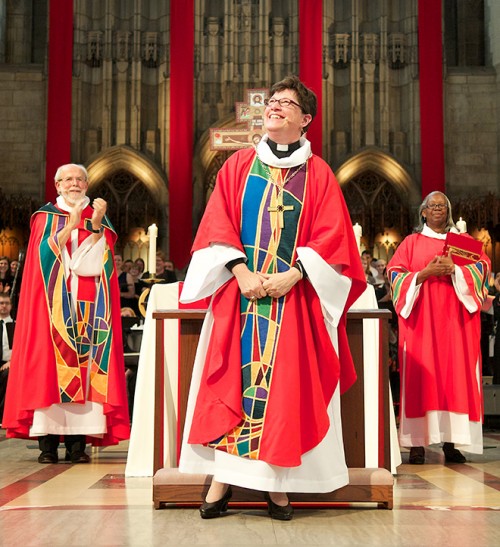
ELCA Presiding Bishop Elizabeth A. Eaton called the declaration “historic” in a statement released by the denomination following the Wednesday vote.

That’s right. A female bishop welcomed the news of entering into closer relations with church that will not ever ordain women.

But some Roman Catholics are not happy (the unhappy Lutherans are already in a different synod — LCMS):

The ecumenical drive has been part of the check-list of popes before the current pontiff. The joint worship service has been described by both the Vatican and the Lutheran World Federation as a “commemoration” rather than a “celebration” in order to avoid further controversy. Some Catholics, especially traditionalists, have criticized the prospect of a pope celebrating a schism. Another issue that has traditionalist Catholics and some clerics baleful is the issue of the differing theologies held by the Catholic Church and Lutherans regard the nature and the confection of the Eucharist.

On the upside, Betsy Fox Genovese, who died in 2003, will not have to witness her church’s pursuit of unity with her former church.

Prexit

State sovereignty goes hand in hand with ecclesiastical sovereignty, or it sure looks like it.

Michael Lind explains the phenomenon of Trump and what it means for Democrats and Republicans:

The culture war and partisan realignment are over; the policy realignment and “border war” — a clash between nationalists, mostly on the right, and multicultural globalists, mostly on the left — have just begun.

***

For the nationalists, the most important dividing line is that between American citizens and everyone else—symbolized by Trump’s proposal for a Mexican border wall. On the right, American nationalism is tainted by strains of white racial and religious nationalism and nativism, reinforced by Trump’s incendiary language about Mexicans and his proposed temporary ban on Muslims entering the U.S.

But while there is overlap between nationalists and racists, the two are not the same thing. The most extreme white nationalists don’t advocate nationalism as a governing philosophy in our multiracial country; they hope to withdraw from American life and create a white homeland within the nation-state. Nationalism is different than white nationalism, and a populist American nationalism untainted by vestiges of racial bigotry might have transracial appeal, like versions of national populism in Latin America.

The rise of populist nationalism on the right is paralleled by the rise of multicultural globalism on the center-left.

For multicultural globalists, national boundaries are increasingly obsolete and perhaps even immoral. According to the emerging progressive orthodoxy, the identities that count are subnational (race, gender, orientation) and supranational (citizenship of the world). While not necessarily representative of Democratic voters, progressive pundits and journalists increasingly speak a dialect of ethical cosmopolitanism or globalism — the idea that it is unjust to discriminate in favor of one’s fellow nationals against citizens of foreign countries.

Now watch (thanks to our W. Michigan correspondent) how church affairs line up with temporal politics, with ecumenists (globalists) on the left opposing the constraints of denominationalists (nationalists) on the right:

Many who witnessed the continuing denominational imprisonment of the Lord’s body and blood experienced ecumenical agony. The late Emilio Castro, the WCC general secretary who hired me, was a Methodist pastor who yearned for eucharistic sharing. He would say, “I’m not even asking the Catholics (or Orthodox) to recognize the validity of the Lord’s Supper that we Methodists celebrate. I’m simply asking them to accept that I see the body and blood of Jesus Christ fully present in their Eucharist.”

In spring 1994 I sat in a restaurant with Castro and his longtime Orthodox friend and WCC colleague Ion Bria, a priest in the Romanian Orthodox Church. The two lifted their wine glasses and said to each other with tears in their eyes, “Someday, before we die, we shall be able to share the body and blood together, with our churches’ blessings.” But they never did. Nor, if they were still living, could they do so today.

So I returned to ecclesiastical disobedience. That became more complicated once I was elected general secretary of the Reformed Church in America. When I assumed that post, I didn’t know all that would be demanded of me as general secretary, but I knew I couldn’t go forward without retreating. I knew I needed regular times away, with a spiritual director, and the nourishment of Christ’s body and blood. A Carmelite retreat center near my home in New Jersey provided all this.

As a church official, I wanted more than ever to show absolute respect for my Catholic hosts. But their invitation to receive at the table was unambiguous. On my retreat days, I’d often be invited to read one of the scriptures at their eucharistic service.

Indifference to church polity and theology like this is why confessional Protestants exited from the modern ecumenical movement.

Arguably the most astounding aspect of contemporary ecumenical discussions is that the leader of the only true church is also apparently indifferent to ecclesiastical laws:

This tension in how we understand the Eucharist is one that, remarkably, Pope Francis himself has acknowledged. Last November he met with a Lutheran congregation in Rome and responded to one member, Anke de Bernardinis, who is married to a Catholic and who asked what it would take for them to receive the Eucharist together. The pope’s spontaneous ten-minute answer was revealing, unprecedented, and even stunning.

Francis said, “I ask myself the question. To share the Lord’s banquet: is it the goal of the path, or is it a viaticum (food or provision accompanying one on a journey) for walking together?” He posed that question rather than give the doctrinal response—that she could either become Catholic or continue to pray with her husband over the pain of a divided church.

Pope Francis went on to focus on baptism. “I ask myself. But don’t we have the same baptism? If we have the same baptism, shouldn’t we be walking together?” Then he went further. “The supper? There are questions that only if one is sincere with one’s self and the little theological light that one has, must be responded to on one’s own. See for yourself. This is my body. This is my blood. Do this in remembrance of me—this is a viaticum that helps us to journey on.”

And Francis didn’t stop there, going on to address the classic dividing line over the meaning of Christ’s “real presence.” The pope recalled a Protestant pastor and friend who told him, “We believe that the Lord is present there.” So he said to the Lutheran woman, “You believe that the Lord is present. And what’s the difference? There are explanations and interpretations, but life is bigger than explanations and interpretations.”

Having noted the trademark tension between official policy and actual practice, Pope Francis concluded by saying he would not “dare to give permission to do this” but then repeated, “One Lord, one faith, one baptism. Talk to the Lord, and then go forward. And I wouldn’t dare—I don’t dare say anything more.”

In ecumenism, as in diplomacy, ambiguity can be a helpful tool, allowing room for movement on issues where formal agreement is not yet possible. Pope Francis opened the door more than a crack.

Since We’re Talking about Talking

The Pertinacious Papist cautions Roman Catholic apologists about how to talk to confessional Protestants (via Greg Krehbiel). An excerpt:

Get Over Jack Chick Already

Along with these accusations of hard hearts and thick skulls comes the staple of apologetic discussion: your apologists are meaner than ours. Yes, we all know that some anti-Catholics misrepresent Catholicism. Guess what? It goes the other way, too. And yes, we all know that some people can be very mean. Guess what? People are sinners. I even heard a rumor that one of the apostles wasn’t a choir boy.

Along those lines, former Protestants who have converted to Catholicism are not necessarily experts on any form of Protestantism, including the one they left, and they can misrepresent Protestant doctrine. Do you trust a former Catholic’s knowledge of Catholicism? Then don’t expect Protestants to trust a convert’s view of Protestantism.

When it comes to the “your apologist beats up old ladies” argument, the best thing to do is to get over it. Or, as a friend says in a slightly different context, “don’t feed the energy creature.”  I’s best to ignore rude noises at the dinner table, and I think we can treat the apologetic variety of those rude noises the same way. Fussing and whining about how mean the other guy is just makes you a crybaby.

23,000 Denominations

Some Catholics have the apologetic equivalent of Alzheimers. They criticize Protestantism because there are (so the story goes) 23,000 separate Protestant denominations, all teaching different things. And then a minute later the Catholic apologist will speak to a Methodist as if he is a Baptist, or a Lutheran as if he’s a Pentecostal. If they all teach different things, then for heaven’s sake don’t treat all Protestants the same.

It is very annoying to a confessional Presbyterian to be treated as if he’s guilty of the same errors as the non-denominational charismatic. Listen to what the other guy is really saying without putting his words through an apologetic filter that says “this guy is a Protestant, and I’ve read all about those guys.” You may find that you have more common ground than you suspected.

BAD HABIT: Learning about Protestant doctrine from Catholic sources.
BAD HABIT: Learning about generic Protestant doctrine and applying it to all Protestants.
REMEDY: Let your Protestant friend speak for himself. Listen to what he’s saying without imposing any doctrinal template on his words. . . .

No One Ever Heard of ____ Until the Reformation

It’s very common for a Catholic apologist to argue that Protestant doctrine is unhistorical, that nobody held to Protestant positions until the Reformers came along and invented them all out their fevered brains. (Remember, of course, that there are all kinds of Protestants, and on many issues the Reformers would be on the Catholic side arguing against many modern Protestant beliefs.)

The claim goes like this. “No one ever heard of sola scriptura, or sola fide, or doubted the canonicity of the deuterocanonical books, [or whatever,] until Martin Luther.”

Really now. Have you read all the Christian theologians of east and west from the time of Christ until 1517? If you’re particularly ambitious, you may have read bits and pieces from a very small sample of the church fathers. The Reformers were serious scholars, and they also read the church fathers. They did not believe their doctrines to be novelties, and only an expert on the history of doctrine is qualified to say that they were. And there are experts on both sides of that question.

Pointing out the contrast between the faith of the early church and the faith of your modern Protestant friend is a very effective apologetic tool. It’s very easy to show how Catholic doctrine developed from the faith of the early church, and it’s very hard to show any continuity between the early church and the faith of Bethel Bible Church down the road. So don’t spoil a good argument with claims you can’t prove or defend.

BAD HABIT: Asserting a universal negative.
BAD HABIT: Repeating extravagant claims you read in apologetic literature that the apologist himself could not possibly have known.
REMEDY: Stick to what you really know.

What’s that Verse Scott Hahn Uses?

Every once in a while I meet someone on the train, or in a store, and I get a sense that person is an Evangelical Christian. I spent a lot of years among Evangelicals, and I got to know their mannerisms. Sometimes it’s a certain tone of voice, or a choice of words. When someone’s been baptized into Evangelicalism, it starts to wear off on him. It makes a difference.

Scripture is the same way. When you start talking to someone about the faith, it’s very obvious who has and who has not devoted himself to Bible reading. It comes out.

Again and again I’ve run across well meaning Catholic apologists who seem to know Scott Hahn better than they know their Bibles. Believe me, it shows, and every decently trained Protestant is going to spot it and recognize that apologist for what he is. The Protestant will know that the Catholic is just proof-texting — that he hasn’t internalized the text. It’s just something he cites to prove his point, and when he does read the Bible, it’s only to find ammunition for the next battle. The Protestant will assume that the Catholic apologist lacks a personal relationship with Christ, and he’ll have all the more reason to mistrust Catholic arguments.

If you’re that apologist, it’s time to stop, retire, apologize to your opponents, wish them well, and spend some time (a few years, perhaps) getting to know God through His word. Donate all your apologetics books to your priest and spend the next few years reading nothing but the Bible and the catechism. Your goal isn’t to find 25 reasons why Protestants are wrong about Baptism. Your goal is to listen to what God says to you about your soul.

When apologetics is a distant memory, if you still feel the call to witness to other Christians about the Catholic faith, praise the Lord. You’ll be better prepared.

BAD HABIT: Using the Bible like a tool to win arguments with other Christians.
REMEDY: Quit apologetics, major in Bible study and work on your personal relationship with Jesus.

What Good is an Infallible Bible?

“What good is an infallible Bible without an infallible church to interpret it?” I’ve heard that too many times to count. What good is an infallible Bible? That any Christian can seriously ask the question defies belief. We want to know what God is like. We want to know how He regards us, and what we have to do to please Him, and here we have, not just a document, and not just a pretty good document, but the very words of God.

What good is the Bible? That kind of language makes Protestants roll their eyes. “Those Catholics really don’t get it, do they?” Any serious Evangelical knows scores of people whose lives have been miraculously transformed by reading the Bible. Besides that, the Evangelical himself has personally experienced God speaking to him in the words of Scripture.

When a Catholic says, “What good is an infallible Bible?” he has given up any claim to credibility with that Evangelical. It would be like asking a man who was just rescued from the desert, “What good is water without a crystal glass to drink it in?”

BAD HABIT: Trying to magnify the church and Catholic doctrine by disparaging the Bible.
REMEDY: Always speak of the Bible reverently. Read Psalm 19 and 119 and learn to regard the Bible the way king David did. Never, ever even consider saying “What good is the Bible?” You’d be better off to cut out your tongue and chop off your fingers.

Now, some will complain that I’ve missed the point of the question. The Catholic doesn’t mean to disparage the usefulness of the Bible, but the usefulness of the Bible as the sole guide for the church. I’ll get to that, but I felt it necessary to point out the horrible blunder that is made by making the point by criticizing the Bible.

The Catholic apologist looks around at the mess in the Protestant world and wonders why Baptists interpret the Bible one way while Presbyterians, Lutherans, Methodists and the Assembly of God all interpret it differently. He concludes, correctly, that the Bible alone is not a sufficient guide to regulate faith and life.

It is clear that something else is necessary, and that something else is an authoritative church.

But the Catholic apologist typically makes two errors while making this argument. The first is to imply that authority requires infallibility, which is clearly not true since parents and governments have authority but are not infallible. The second error is to claim that infallible Scripture requires, in the very nature of the case, an infallible interpreter: that it does no good to have infallible Scripture unless someone can tell us infallibly what it says.

The obvious reply to the question “What good is an infallible Bible without an infallible church?” is “What good is an infallible church without an infallible church interpreter?”

Just as the Catholic criticizes the variety of opinion among those who confess the authority of an infallible Bible, so the Protestant can criticize the variety of opinion among those who confess the authority of an infallible church. Traditionalists come to mind.

The problem is that there has to be a break in the chain somewhere. God is infallible, we are not. If we diagram the progression from God’s infallible self-revelation to our fallible perception of that revelation — for simplicity’s sake let’s just say the steps are A then B then C then D — the infallible part has to get lost somewhere. It starts off infallible in God’s mind and ends up a muddled mess in mine. It really doesn’t matter where you put the transition; the logical problem is the same. We can ask, “What good is an infallible A without an infallible B?” just as well as we can ask “What good is an infallible C without an infallible D?” It’s simply the wrong question.

The Protestant confesses that Scripture is infallible, but the church that tells us which books belong in Scripture is not. The Catholic confesses that the Magisterium is infallible, but the ministers who teach us what the Magisterium says are not. Both have to move from an infallible something to a fallible something, so the Catholic apologist has to guard against unleashing an attack dog that bites his own leg.

BAD HABIT: Tossing around infallibility as if it solves everything.
REMEDY: Focus on the need for an authoritative church. Once that is established, then work on infallibility.

The Mystery of Dialogue

Another blog is up and running and it targets yet again Calvinists for ecumenical dialogue with Roman Catholics (most of whom converted from Protestantism to Roman Catholicism). This ecumenical endeavor, however, is different from Bryan and the Jasons Called to Communion. In fact, Bryan Cross would likely be fairly dismissive of “Catholics and Calvinists” (CaC vs. CtC). Cross once identified two kinds of ecumenism, one false, and one true. The former is wrong because it is — well — liberal:

That is because it seems to seek its goal of achieving general agreement about doctrine by way of compromise. So those who think a particular doctrine is essential feel pressured to drop their belief that this doctrine is an essential doctrine in order to attain some unity with those who think that that doctrine is adiaphorous (i.e. indifferent, non-essential). The very nature of the goal of this type of ecumenicism makes this kind of compromise essential to ecumenical progress. As someone said to me a while back, “True ecumenicism means everybody has to compromise.” And the necessary result of such a methodology is a least-common-denominator minimalism regarding doctrine, an acceptance as sufficient of something far short of the unity in communion to which Christ calls all His people.

In contrast for Cross, true ecumenism comes from recognizing the truth and unity of Roman Catholicism:

. . .this ecumenicism has complete agreement on doctrine as its goal, or more precisely, complete agreement on what each person believes to be essential doctrine. Moreover, and perhaps most importantly, it rejects compromise regarding what anyone believes to be truly essential as a means of achieving its goal. As a result, there is no pressure to compromise in order to attain this ecumenicism’s goal. Instead of proposing compromise as a means to reaching a watered-down unity, this type of ecumenicism recognizes that we are not fully united until we are doctrinally united on every doctrine about which anyone believes to be essential. In this ecumenicism we do not sweep our essential doctrinal differences under the rug. We even straightforwardly, and in genuine charity and sincerity, remind each other that the other person’s position, from the point of view of our own tradition, is nothing less than heresy.

That is not exactly a conversation starter and explains why discussions with Bryan and the Jasons generally descend to Dr. Dave Bowman’s conversation with H.A.L. 9000.

How then is CaC different from CtC? Put simply from this observer’s perspective, it’s the difference between the pre- and post-Vatican II church. While Bryan and the Jasons reflect a no-salvation/truth-outside-the-church outlook, CaC seems to embrace Vatican II’s ecumenism:

Our refusal to engage in “sheep stealing” is not merely a rhetorical front, as if that posture itself were a guise under which to carry on a still-deeper project of effecting conversions. It is also not a bracketing of theological questions for the time being, as if we will for a time carry on a project of “ground-clearing” only to then change gears and begin bringing in the sheep. We recognize that this a pervasive – and deeply problematic – style of Catholic and Reformed engagement, and we repudiate it in no uncertain terms.

Rather, our approach is rooted in the ecclesiological vision articulated by the Second Vatican Council and by other leading ecumenists that there are genuine gifts cultivated by the Holy Spirit outside the boundaries of those churches in communion with the Bishop of Rome that are genuinely beneficial to the churches which are in such communion, and which lead these churches into a deeper desire for union. We want to understand those gifts more clearly, and we want to help other Roman Catholics understand the under-appreciated richness of the Reformed tradition more deeply. We do this while seeking, of course, to have our own views as Roman Catholics – devoted first to Scripture and then to the Roman Catholic tradition expressed in such thinkers as St. Augustine, St. Thomas Aquinas, John Henry Cardinal Newman, and the great theologians of the twentieth century – come to be better understood by our brothers and sisters in the Reformed tradition.

An initial observation is this: why don’t CaCers engage in dialogue with CtCers? After all, it sure looks like Roman Catholics are on different pages when it comes to church unity and what to make of Reformed Protestants.

That conversation might then include discussions of Vatican II and the apparent rupture of the church’s understanding of its relationship to those outside the church (both other professing Christians and non-Christians). In fact, since CaC is interested in the shared use of scholasticism by Roman Catholics and Protestants, the dialogue it promotes might include trying to reconcile a church that was for much of its modern intellectual history committed to Thomism and then after 1965 opened itself to non-scholastic methods (and more). In other words, I don’t understand (maybe a dumb Protestant) how you invoke both scholasticism and Vatican II on theological discussion since the former achieved remarkable clarity and the latter was purposefully equivocal.

That difference between Vatican II and scholasticism also brings up the tricky matter of the Council of Trent. Why is it that the church that relied on scholasticism as its method for articulating theological and dogmatic truth did not open dialogue with but condemned Protestantism? Trent was not an invitation to dialogue. It put an end to it. So the challenge for CaCers is how to read 16th- and 17th-century theological sources as a way to pursue what Vatican II had in mind when those old sources drew clear lines between truth and error and pursued ecumenism far more along the lines that Bryan Cross advocates than what Pope Francis embodies.

The larger point here is one about Roman Catholics understanding Roman Catholicism. Instead of trying to understand Calvinism, making sense of Rome’s fits and starts and changes might be much more useful for dialogue (whether ecumenical or academic). For Protestants like mmmmeeeeeeEEEE, Roman Catholicism looks like a moving target. That is a mystery that needs much more attention from Roman Catholics than appreciating Luther or Calvin. In fact, as Mark Massa has argued, it is a mystery up to which the post-Vatican II church is still catching:

. . . the widespread acceptance of the seemingly self-evident truth that things change will make it increasingly difficult to propound or defend Church teaching and practice by appealing to timeless, static categories of propositional truth. This applies most particularly to the intellectual tradition of scholastic natural law, which the Catholic tradition has relied on for presenting its most important teachings since the thirteenth century. The fractious nonrecption of Paul VI’s encyclical on birth control, if nothing else, illustrates this with startling clarity. Whatever the truth of Paul VI’s teaching, the massive noncompliance accorded his encyclical shows that the great majority of American Catholics did not form their consciences along the lines of such moral reasoning, and have not since. There are of course many possible reasons for this lack of compliance on the part of the vast majority of practicing Catholics on an issue that the hierarchical Church has termed “serious matter.” Some of those reasons may indeed involve personal ignorance, sinful willfulness, or just plain selfishness. But an important reason for that noncompliance, what I would label as the main reason, is that the classical unchanging world it presupposes no longer makes sense to the vast majority of the faithful in the United States. What Bernard Lonergan so elegantly called the “transition from a classicist world view to historical mindedness” in fact describes the intellectual revolution that mainstream Catholics underwent during the sixties.

Whatever the strengths of that older classicist worldview — and it served the Catholic Church extraordinarily well for centuries — it can no longer provide plausible explanations for Church teaching . . . . The older intellectual categories of scholastic natural law, first enunciated so brilliantly by St. Thomas Aquinas in the thirteenth century, appear unable to accomplish that now. Perhaps the intellectual justification offered in its place to explain Catholic teaching will represent the most important long-term fruit of the intellectual revolution sponsored by historical consciousness in Catholic Christianity. Time will tell.

Some of us are still waiting for converts to Roman Catholicism to have a conversation with clergy and academics like Massa. It sure doesn’t seem like a meaningful conversation can take place between confessional Protestants and Roman Catholics as long as one side is so uncertain about that for which it stands.

Postscript: Comments should be open at a cite committed to dialogue.

When Ecumenism and Environmentalism Collide

Pope Francis’ determination to meet with the Patriarch of Moscow involves several risks according to Massimo Faggioli:

First, there’s the political-diplomatic dimension of the meeting. The pope is going to meet the leader of a church that is seen more and more as part of the authoritarian regime of Vladimir Putin and an ideological support for his neo-imperial foreign policy. This criticism stresses the risks to Francis’s credibility, especially if considering the role of the Russian Orthodox Church in supporting Putin’s military actions in Syria and in Ukraine. (Kirill was, however, more cautious about Ukraine, given the potential consequences of the loss of Crimea and the war in eastern Ukraine for inter-Orthodox relations between Moscow and Kiev).

Second, there’s the internal politics of the Orthodox churches, in light not only of the historical rivalries between Moscow and Constantinople for supremacy within Eastern Orthodoxy, but also of the upcoming Great Synod of the Orthodox Churches on the Greek island of Crete in June. Some see Francis as naïve in regard as to how the patriarchate of Moscow could use the meeting to assert a new supremacy at a critical time for the future of the Orthodox churches. Here too the war in Ukraine factors into the equation.

Third, there’s the ecumenical dimension of the meeting. The Russian Orthodox Church has been far less engaged in ecumenical dialogue with the Catholic Church than the patriarch of Constantinople has; in agreeing to meet with Kirill, Francis is accused of sitting at the table with a leader who has not shown the minimum amount of ecumenical spirit required to start a conversation with the pope.

Professor Faggioli leaves out the risk to the environment. Since the Pope is meeting Kirill in Cuba, both church officials will be emitting lots of carbons into an environment on the brink of overheating.

How is this trip consistent with Pope Francis’ recent prayer video?

My Jaws Just Got Tighter

A few days ago, Terry Mattingly, of gotcha journalism fame, mocked the Washington Post for inserting a hyphen into Marco Rubio’s comments about Jesus. Here’s the quotation:

For the next few minutes, Rubio sounded more like a Sunday school teacher than a presidential candidate holding an early January town hall. He talked about John the Baptist, he referred to Jesus as “God-made man,” and he explained his yearning to share “eternity with my creator.”

Mattingly thinks that hyphen shows how little the Washington Post’s reporters know about Nicene Christianity (even though without the hyphen it the phrase “God made man” sounds strange when applied to the eternal son of God):

…for Trinitarian Christians, Jesus is not a “man,” “God-made” but, rather, “God made man” (or perhaps “God, made man”).

This may seem like rather picky stuff, and it is. However, it’s hard to name a more central doctrine in the Christian faith than the Holy Trinity. Wasn’t there someone on the Post copy desk who has taken Christianity 101, or was this simply a bad day when it came time to handle this particular piece of copy?

Now, it’s possible that the original copy for this story actually stated that Rubio “referred to Jesus as ‘God – made man’ ” and that turned into you know what?

So, will the heretical hyphen simply vanish in the online version of this story? Here is hoping that the Post editors actually do the right thing and, perhaps with the help of someone at the Catholic University of America, produce a correction. I cannot wait to read it.

Applying that logic to the church instead of newspapers, what does Mr. Mattingly think about Pope Francis’ decision to celebrate the Protestant Reformation (posted by Rod Dreher)?

Nearly 500 years ago, Martin Luther nailed his 95 theses to the door of a German church, beginning the Protestant Reformation that led millions to break with the Roman Catholic Church and ushered in more than a century of conflict and war.

On Monday, the Vatican announced that Pope Francis will participate in a joint Lutheran-Catholic worship service in Sweden this October, kicking off a series of events planned for 2017 to commemorate the 500th anniversary of the Reformation.

The effort to mend relations with Protestants has been on the agenda of many popes before Francis, but it is a delicate endeavor. The worship service in Sweden was billed by its sponsors, the Vatican and the Lutheran World Federation, as a “commemoration,” not as a “celebration,” in order to avoid any inappropriate note of triumphalism. Some Catholics have criticized the notion of a pope celebrating the anniversary of a schism.

Some of those Roman Catholics who object to Lutheranism almost as much as the Obedience Boys do say this about the pope’s recent warming up to Lutherans:

According to Edward Pentin, a group of Lutheran pilgrims were given communion in St. Peter’s Basilica itself this week. What is significant here is that communion was offered to them unilaterally by the celebrants of the Mass — the Lutherans themselves were expecting to receive only a blessing, and the celebrants knew they were not Catholics.

It is scarcely possible that this happened without the knowledge of the Basilica authorities. Are we now seeing the practical effects of Francis’ ambivalent words on holy communion for Lutherans?

You would also think that if you knew your Canons of Trent the way Mattingly expects the Post’s reporters to know the Nicene Creed or the way we might expect the pope to know conciliar teaching, you wouldn’t be all that ready to celebrate Martin Luther. After all, Luther not only disobeyed the magisterium, but was inhuman:

Before the bar of every rational and decent person, does Luther not convict himself of utter inhumanity?

Before the bar of all that is reasonable in moral exhortation – from parental to educational to civil and criminal, does he not convict himself of a crime against all law? Is he, therefore, anarchical?

Before the bar of Catholic Dogma, supreme criterion on earth of what we know is and is not part of and/or in harmony with the Deposit of Faith, does he not convict himself of heresy?

Before the God whom we ought to honor, to whom we ought to ascribe only what is good and true and fitting, does he not convict himself of great blasphemies, greater even than the Gnostics who first attempted to ruin the Church? For the Gnostics distinguished two gods, one good and one evil. Does not Luther add to the evil by subtracting from the number of Gods, folding that Evil, which all right reason and right faith and common decency vomit out as execrable, into the one God?

So why would a Roman Catholic pontiff make amends with a church (a liberal one at that) started by such a person as Luther? And why wouldn’t Mattingly apply the same standards to Rome as he does to Washington?

The Bodh Gaya Declaration

Ecumenism and inter-religious dialogue always emerge from social and political, not theological, convictions, as the Manhattan Declaration showed in its capacity to apply the fig leaf of ecumenism to the private parts of shouting matches about American culture. But the Vatican, with its universal jurisdiction, can always outdo American Christians who can be so parochial about the size of the Big Apple. Pope Francis has his sights set on a collaborative endeavor with Buddhists:

The Pontifical Council for Interreligious Dialogue (PCID), in collaboration with the Catholic Bishops’s Conference of India and Religions for Peace, held the Vatican’s fifth Buddhist-Christian Colloquium February 12-13, 2015 at Bodh Gaya, India. Bodh Gaya is the site of the Buddha’s enlightenment and was chosen for a dialogue since it has temples and monasteries from many different types of Buddhists.

The theme was “Buddhists and Christians Together Fostering Fraternity” and the goal was to build a foundation for interreligious peacebuilding. Sixty leaders of both religions from eight countries took part in discussing the following topics: “We belong to One Human Family,” “From a Culture of Diversity to a Culture of Solidarity,” “Fraternity, a Prerequisite for Overcoming Social Evils,” “Fraternity wipes away Tears,” and “Together Fostering Fraternity: The Way Forward.” This is an example of how the pope’s new “dialogue of fraternity” seeks a higher level of relational engagement in order to address social ills.

Participants agreed that it is not religion per say that causes conflict, but individuals who exploit religion for personal, commercial and political gains. They agreed to return home and pursue the following in the spirit of fraternity:

• Strengthen interfaith connections in communities, neighbourhoods, educational institutions, and places of worship
• Build programs of interreligious awareness and peacebuilding for children, youth, and families in educational institutions and workplaces
• Forget and forgive the past negative history of conflict and violence and move forward to build peace-loving people in solidarity
• Train younger generations in formation houses to overcome prejudice, study other religions, and build solidarity
• Build interreligious fraternity (brotherhood/sisterhood) to support and revitalize family life in order to make society prosper.

… Now, Pope Francis is expanding the dialogue further by emphasizing the need to develop a sense of “fraternity” as a foundation for the dialogue of action that addresses the social ills of our world. True solidarity in such action must be based on fraternity in its original sense of “brotherhood/sisterhood.” The papers presented on this third day discussed two topics: the notion of “Fraternity among Human Beings” in Christianity and Buddhism, and “Building a Fraternal World” together.

The final day of the dialogue was devoted to exploring social issues in the United States that the participants felt need to be addressed today, and how Buddhist-Catholic collaborations of fraternal interreligious social action could be advanced in the United States. The participants had a private audience with Pope Francis who encouraged them to “plant seeds of peace” in their cities. In their Joint Statement, the participants agreed to return to the US and explore together the following kinds of joint interreligious social action initiatives:

• Addressing global climate change on the local level
• Creating outreach programs for youth
• Collaborating in prison/jail ministries and restorative justice matters
• Developing resources for the homeless such as affordable housing
• Educating and providing resources to address the issue of immigration
• Collaborating to create projects with local Catholic parishes and Buddhist communities to address neighborhood social issues
• Developing social outreach programs for value education to families

… I conclude with the words of Pope Francis about this new dialogue of social action: “This interreligious experience of fraternity, each always respecting the other, is a grace.” (Press Conference on Board the Flight from Colombo to Manila, January 15, 2015)

I hope Susan, James, and Mermaid know that bickering with Presbyterians at Old Life does not count as interreligious dialogue. Statues of Buddha can be purchased here.

Ecumenism vs. Going It Alone

The discussion of Larycia Hawkin’s situation continues.

Rod Dreher thinks Wheaton is right to protect its theological borders since it has refused employment to Roman Catholics:

Wheaton does police its margins carefully. Catholics are not allowed to teach there, not because Wheaton’s leadership think Catholics are bad people, but because they do not believe a faithful Catholic can affirm the institution’s standards. If I were a professor, as an Orthodox Christian, I couldn’t teach there either. Do I think that is excessive? Probably. But I admire Wheaton’s willingness to take a hard stand, even when they are mocked by outsiders. It requires the kind of courage and confidence that one doesn’t often see among Christian churches and institutions these days, and that will be desperately needed in the years to come, by all of us.

But Noah Toly, one of the first Wheaton faculty wonders if the goal posts move when Wheaton talks about theological borders:

The standard to which Dr. Hawkins is being held is that of “theological clarity” in embodying the identity of the college and Statement of Faith. It is immensely important to recognize this. Faculty may hold various controversial positions within the bounds of the Statement of Faith. The more complex those positions, the more they demand a sort of clear articulation – otherwise, they invite misunderstanding. The standard of theological clarity is not, in and of itself, problematic. But the operationalization of that standard is fraught. (Adam Laats’ commentary on this is good, if slightly overstated.) Is the same level of nuance, subtlety, complexity, and elaboration required of everyone? Or, given the insistence that theological clarity is particularly important when we participate in various movements and initiatives, is the same level of nuance, subtlety, complexity, and elaboration required regardless of the political, social, and cultural affinities of those movements? Has the college itself transparently offered faculty and other constituents the same level of nuance, subtlety, complexity, and elaboration that now seems required of us?

Exactly. This is why I hope Wheaton does not eliminate Hawkins from its faculty. The college is mainly “evangelical,” but faculty have hardly agreed on the meaning of the institution’s minimalist statement of faith.

Dreher also invokes a piece by Alan Jacobs written almost a decade ago when Wheaton let go a faculty member who converted to Roman Catholicism. Jacobs wondered if Wheaton was wise to rely on its own brand of conservative Christianity:

…throughout much of American history and late into the twentieth century, evangelicals and Catholics had little to do with one another. They came, by and large, from different ethnic groups; they lived in different neighborhoods and even in different regions of the country; they went to different schools—in short, they were socialized into American culture in dramatically different ways. Throughout much of its history Wheaton College’s leaders would have reacted with horror at the thought of Catholics on the faculty—but they would have been highly unlikely to entertain that thought in the first place. Catholic scholars would have been equally unlikely to think of teaching at Wheaton. Duane Litfin is right to say that Wheaton is getting hammered for taking a position that, as recently as thirty years ago, scarcely anyone on either side of the Reformational divide would have questioned.

But times have changed. And here is where the correctness of Hochschild’s position comes in. He is not the only Catholic to look at Wheaton’s Statement of Faith and think, “Yes, that suits me very well.” Having served on hiring committees a number of times in Wheaton’s English department, I have seen dozens of applications from Catholic scholars who see nothing in Wheaton’s self-description that would rule them out.

But I sure wish Jacobs had considered where Roman Catholics may be coming from when looking at Wheaton’s doctrinal affirmation. After all, their bishops’ ecumenical discussions on justification have been with the most liberal sector of Lutheran communions:

Acting as it does as a summary and analysis of five decades of Lutheran-Catholic dialogue, 2015’s Declaration on the Way: Church, Ministry, and Eucharist will undoubtedly be a helpful touchstone in future ecumenical discussions between the two traditions. For that reason, the representatives of the Evangelical Lutheran Church in America and the Bishop’s Committee for Ecumenical and Interreligious Affairs (United States Conference of Catholic Bishops) who authored the work are to be commended. The document is worthy of careful reading.

Of course, it is also important to note that the synthesis presented here represents an understanding of Lutheranism not necessarily shared by all churches who claim the name. The Lutheran side of these dialogues has been primarily represented by churches of the Lutheran World Federation (LWF). Other Lutheran churches, like those represented by the International Lutheran Council (ILC), may not agree in every respect with the Lutheran position as presented in these past dialogues, even as they praise other elements of the discussions.

Meanwhile, the bishop responsible for identifying doctrine infallibly helped to produce a video that has him walking along side religious expressions far more objectionable than the Evangelical Lutheran Church in America.

The Politics of the Holy Spirit

Michael Sean Winters first argues that the Second Vatican Council was revolutionary:

Douthat also insists that there was nothing revolutionary about Vatican II. I do not want to get hung up on semantics. If he wishes to make a Burkean point, that there is a difference between reform and innovation, and revolutionaries innovate, I am mostly in agreement, but while the Council did not itself innovate per se, it reformed a lot. Through much of the nineteenth and the first-half of the twentieth century, Rome carried on an extensive correspondence with the American hierarchy on the subject of interreligious events. The officials in Rome did not like the idea of a Catholic priest saying a prayer at a civic event alongside ministers of other religions. What caused Rome to change its mind? In the postwar era, they recognized that the needed America as a bulwark against communism and that non-Catholics would be needed too. Now, interreligious events characterize all local churches and all papal trips. If that is not a revolution, I am not sure what is and, I dare say, it might even qualify as an innovation, a necessary one to be sure and novel only because previously no country, like the U.S. had experienced the admixture of religious groups to the extent that we did.

And among confessional Protestants like Missouri Synod Lutherans and Presbyterians, participating in interreligious services can still get a pastor in trouble. Separated brothers or more like distant cousins seven times removed.

But Winters thinks the Holy Spirit was responsible for the revolution:

Most egregiously, not once does one grasp in his analysis of Vatican II that the Holy Spirit was active in the deliberations of the Council, and that this is not only testified to by those who participated in it, but by our Catholic beliefs about the Spirit’s presence in the Church. If the Spirit was not active at Vatican II, why should we think it was active at Trent or Nicaea? One can deride, as Douthat does, those who invoked “the spirit of the Council” to justify positions that were actually in conflict with the texts of the Council, but there really was a “spirit of the Council” and Pope Francis is not wrong to invoke it. Yes, the “spirit of the Council” was invoked to justify silly things but not by Pope Francis or Cardinal Kasper.

So will Winters allow that the Holy Spirit was also behind the U.S. Constitutional Convention or England’s Really Exceptional Glorious Revolution? Lots of churches adjusted to liberalism. American Presbyterians did in 1789. It took the Vatican longer. But why invoke the third person of the Trinity for something so ordinary?

The dangers of exceptionalism are everywhere.

Today's Theme is Breadth

After hearing from Pastor Sauls on the valuable contributions from those who disagree, we read Mark Jones who has his own objections to the narrow road. Maybe Pastor Sauls qualifies as one of Jones’ Reformed irenics since the former is not beholden to Reformed orthodoxy. But I suspect Sauls would fall short because he doesn’t know enough historical theology. Those who do know the breadth of the Reformed tradition as Jones does are different from and less appealing than the Truly Reformed who read the Reformed confessions in a wooden manner (unlike someone trained in historical theology):

Among this group, I sometimes worry that their zeal for Confessional fidelity – a noble zeal, in and of itself – can sometimes reflect an overly restricted reading of the diversity of the Reformed tradition and our Reformed confessional history. They can read our confessions in a somewhat a-historical manner. Thus they tend to draw the lines of orthodoxy quite narrowly, excluding views from the tradition that have quite a bit of historical precedent. We must admit: our tradition has lots of diversity. Lots. And this diversity is present in the way our Confessions were formed, if one reads them carefully (e.g., the nature of Adam’s reward is ambiguous).

A recognition of diversity leads to an awareness of how narrow our conservative Presbyterian world in North America is:

When we consider the Christian world, and just how broad it is, it doesn’t make much sense for us in the Reformed Confessional tradition to be too narrow. We are, after all, a tiny minority. We should, as far as we are able, and without compromising our confessional heritage, embrace or respect other Christian traditions, viewpoints, and values. It is actually a firm confidence in our Reformed Confessional heritage that allows us to do this.

If I may be allowed a minute at the historical microphone, let me assert that historical theology is not church history. And church history teaches a couple of lessons that Dr. Jones’ historical theology apparently leaves out.

First, a confession is not a work of historical theology. It is a legal standard for a Christian communion. Does it mean that it doesn’t have a history or that context isn’t important for understanding the words and arguments of the Confession? No. But it does mean that a confession for a specific denomination functions in a very different way from a theologian highly regarded by people in a theological tradition. The Confession of Faith is a secondary standard for the PCA and the OPC. John Calvin and John Owen are not such legal standards. And the reason churches have confessions is very different from the aim that animates historical theologians; churches need criteria and consensus for ordination and discipline while historical theologians, like Dr. Jones at least, can marvel at the diversity.

Second, church history also teaches why some Presbyterian communions are narrow. The reason is that some Presbyterian communions became broad — as in Leffert Loetscher’s Broadening Church, the history of the PCUSA. In addition, one of the reasons mainline Presbyterians celebrated breadth owed in part to the discovery of Christians in other parts of the world and a concomitant recognition of how seemingly foreign the West’s creeds and confessions were to non-Westerners.

Dr. Jones may not be celebrating breadth and diversity in the same way, but when he lectures us about history, I wish he would take more history into account.