Communicants, Siblings, Friends, and Others

When you have a comprehensive view (w-w) of the world, when you think that your faith informs (or should) everything you do, hard are those distinctions that 2k so readily supplies, like — this is the church so Christian rules apply, this is not the church so freedom applies.

This problem is no less challenging for Roman Catholics than for neo-Calvinists since both are in the comprehensiveness business of showing how faith relates to EVERYthing a Christian does. Cathleen Kaveny took the comprehensiveness and catholicity of Rome in an arresting direction when she accused Richard John Neuhaus and the First Things crowd of partisanship and undermining the bonds of Roman Catholic unity:

Some conservative Catholics have blamed Pope Francis for sowing division among the members of the Body of Christ. But the charge is more properly lodged against one of the heroes of conservative Catholicism: the late Richard John Neuhaus.

It was Neuhaus, after all, who advanced the view that conservative Roman Catholics have more in common with orthodox Jews and Evangelical Protestants than they do with progressive members of their own religious communities. In fact, that view was an operational premise of First Things magazine under his leadership. This approach is based on a thoroughly distorted view of religious realities and commitments.

Does honoring Jesus as the Son of God count as a commonality? Like their conservative counterparts, progressive Roman Catholics acknowledge the divinity of Jesus Christ, and find the interpretive key to the Hebrew Bible in the New Testament. Orthodox Jews do not—indeed, must not—treat Jesus as the Messiah foretold in the Book of Isaiah. It would be blasphemous for them to do so.

Does living in the grace imparted by the sacraments count as a commonality? Both progressive and conservative Roman Catholics believe that God’s grace is channeled through the seven sacraments. Many Evangelical Protestants do not have the same view of grace or the sacraments; they often view the Eucharist as a memorial of a past event, not a way of being present with Christ here and now.

In trying to find common ground with evangelicals, then, Neuhaus was not truly Roman Catholic but actually Protestant:

Ultimately, Neuhaus’s focus was on nurturing these commonalities in the American political context—he was building a political movement. For a variety of partially overlapping reasons, conservative Roman Catholics, Evangelical Protestants, and orthodox Jews were inclined to vote Republican in political elections. Along with George Weigel and Robert George, Neuhaus coached Republican politicians in Catholic-speak to win national elections. . . . But here’s the irony of Neuhaus’s project: in treating theological belief and commitment as mere instruments of political will, Neuhaus’s view of religion resonated more with Feuerbach, Marx, and Leo Strauss than with the church fathers. In separating his own church of the politically pure from the hoi polloi of the body of Christ, his ecclesiology better reflects Protestant sectarianism than Roman Catholicism.

For the record, I too took issue with Evangelicals and Catholics Together for putting politics ahead of theology and for locating Christian unity not in ecclesiastical contexts but in parachurch groupings.

But Rusty Reno didn’t particularly care for Kaveny’s shot at Neuhaus. And so he tried to justify finding fellowship among religious people who were political liberals and then got mugged by reality:

many of the founding figures who played such a prominent role in First Things, as well as early readers like me, came to some shared conclusions. We became less and less impressed with the modern conceit that ours is a time of the unprecedented. We became more and more convinced that our traditions contained an inherited wisdom—a divine revelation—that provides greater insight into the human condition than any modern method, mentality, or revolution. Again, in the magazine’s early years, it was an exciting and invigorating to find others who were coming to the same post-liberal conclusions, whether they were Jewish, Catholic, or Protestant.

That is mainly true but does not represent the nature of Evangelicals and Catholics Together. Otherwise, ECT should have been called Evangelicals and Liberal Protestants and Roman Catholics and Mormons and Jews and Stanley Hauerwas Together. But at least Reno recognizes different layers of commonality:

When it comes to many things that are important to me, I have more in common with friends than with my brother. But my brother’s still my brother. It in no way compromises the truth of our fraternal bond for me to link arms with those with whom I have more in common politically, intellectually, or even theologically. The same goes for the sacramental bond that units us in Christ.

That is more or less a 2k point. But a 2ker would not call a magazine about religion and public life First Things. It’s not elegant but Penultimate Things or Proximate Things or Common Things would work better.

That left Michael Sean Winters to settle the debate and he did so (in neo-Calvinist-friendly ways) by taking issue with Reno’s separation of life into different spheres:

There may be “other dimensions” as Reno notes, but surely, for the Christian, those other dimensions need to be related to “what matters most.” It was this dualism between the Catholic faith and Catholic morality that stalked Neuhaus’s writings and continues to afflict the journal he founded. This dualism not only colored Neuhaus’ judgment, but it kept much of his otherwise enjoyable controversial writings at a fairly superficial level. It also led him to overlook the failings of his own team, both in politics and in religion: His defense of the Iraq War and of Fr. Maciel were stains on Neuhaus’ intellectual project that deserve attention and explanation by those who champion him.

. . . Reno, too, puts his sacramental beliefs in one silo, and his moralizing in another, and never the two need challenge each other. That is not how Catholics think when we are thinking at our best.

Apparently, 2k thinking is a no-no for Roman Catholics as much as it is for neo-Calvinists. Everything belongs to God. Or the papacy has universal jurisdiction (which is a topic for discussion in its own right). Which makes it hard to justify solidarity with people of a different faith.

But if you limit that solidarity to the church and find all sorts of room for cooperation outside the church, problem solved. Why does that solution seem so impious?

Giving New Meaning to Evangelicals and Catholics Together (or to the Call)

One way of finding this meaning is to look at the increase of calls to a communion called the Evangelical Catholic Church.

In the wake of media coverage of Fr. James Radloff’s recent highly public departure from the Roman Catholic Church to seek incardination into the Evangelical Catholic Church as an active priest, the little known denomination had received 80 inquiries from former and current Catholic priests about reaffiliation as of May 6.
According to ECC spokesman William Morton, ECC Bishop James Wilkowski also “has in hand 19 inquiries from Roman Catholic women who have earned their Masters of Divinity Degrees and are considering their options with us.”

Formed in 1997, the ECC allows single or married male and female deacons, priests and bishops; grants “marital dissolution”; encourages divorced or remarried Catholics to return to “the full sacramental life of Catholicism”; recognizes same-sex marriages; and accepts birth control.

This sounds like the Evangelical Presbyterian Church of the Roman Catholic world.

(Thanks to John Fea) Then there is news that evangelical Protestants affirm Roman Catholic teaching more than Roman Catholics do. And this has implications for the so-called Religious Right and the ecumenism in the trenches of which ECTers are fond of invoking:

The 2007 Pew Poll found that 42% of Catholics expressed support for same-sex marriage versus 36% of the population as a whole. In terms of trends, 40% of Catholics supported same-sex marriage in 2001 with that number increasing to nearly 60% by 2014. By contrast, only 13% of Evangelicals favored same-sex marriage in 2001 and just 23% approve of it today.

Writing in The Atlantic, PRRI’s Robert Jones gets at the truth behind these numbers: “there is more support for official Roman Catholic Church positions among white evangelical Protestants than among Catholics.” But, as he notes, this isn’t a new trend; it’s the result of a two-decade long effort to cultivate “a new evangelical flock to compensate for the loss of lay Catholic support on cultural issues like abortion and same-sex marriage.”

The real Catholic-Evangelical convergence is between the Republican leadership, the Catholic bishops, right-wing Catholics, and rank-and-file Evangelicals, a coalition that was cemented by Karl Rove with his aggressive outreach to “conservative” Catholics during the Bush administration. But the fact that a big chunk of moderate and progressive Catholics are missing from this coalition continues to be lost on many in the media. It’s as if as long as the bishops are vocal in their objections to progressive polices and someone in the public is making noise, there’s a tendency to attribute it to “Catholics.” How else to explain the PPRI number that only 37% of Catholics oppose the contraception mandate in the Affordable Care Act, when the widespread perception that Catholics were broadly disapproving of it helped gin up early and critical opposition?

I’m sure Jason and the Callers have already factored these numbers into their call.

Infallibility In Denial

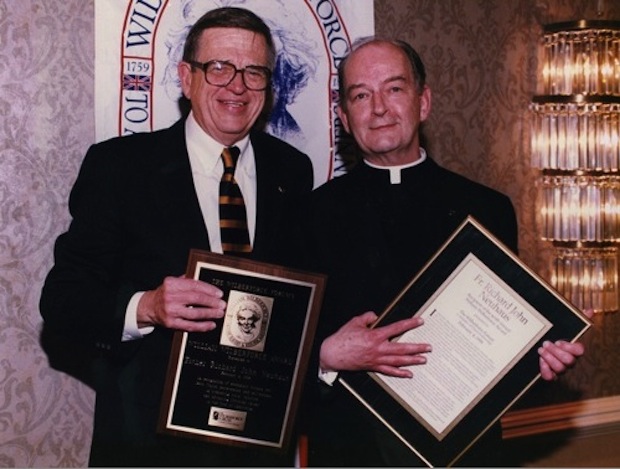
Here I thought we had entered a new era of warm relations between Protestants and Roman Catholics. We are almost twenty years from the first iteration of Evangelicals and Catholics Together. The architects of that project, Richard John Neuhaus and Chuck Colson have passed from the scene but the George brothers (in name only), Timothy and Robbie, have extended the spirit of culture war cooperation with the Manhattan Declaration. Add to mix Mark Noll and Carolyn Nystrom’s Is the Reformation Over? and you have a setting in which the lines dividing Rome, Geneva, Wittenburg, and Wheaton are increasingly fuzzy. That could be a reason for Protestants to convert to Rome since the differences aren’t great. But it could also be a reason to remain Protestant. If the differences aren’t significant, why bother putting up with bad liturgical music when you can keep the lousy praise band in your own congregation?

And then along comes the ex-Prots who write at Called to Communion to remind all the partyers that a curfew exists and, oh, by the way, they also called the cops if we don’t break up the revelry. CTC’s heavy handed insistence on older Roman Catholic verities is laudable in many respects but comes as a complete surprise to the world of Protestant-Roman Catholic relations. If some wonder why objections to CTC have been so pronounced at Old Life of late, the reason has something to do with how out of synch CTC seems to be with the rest of the Roman Catholic world and the vibe Protestants get from that Roman universe. Instead of telling us how much we share in common with them the way most Roman Catholics do these days, CTC is there to remind us how far Protestants fall short of the fullness of glory that is Rome. Like I say, this bracing splash of alcohol on the wound is welcome at a time when differences between Rome and Protestants look increasingly like personal preference.

At the same time, the other wrinkle in CTC’s project is how little they seem to notice that Rome is not a monolith of fidelity to the teachings of the pope, magisterium, and church councils. The Jesuits, Roman Catholic higher education in the United States, and the nuns are all examples of Roman Catholics out of sync with official church teaching and practice. But when you search around at CTC, you find more about problems among Reformed Protestants than you do about the nuns. Perhaps it is a function of a poor search engine, but if you want to know about the deficiencies of President Obama receiving an honorary doctorate from the University of Notre Dame, you’re not going to find it readily at CTC.

CTC’s lack of attention to problems in the Roman Catholic Church has me wondering if CTCers’ insistence on infallibility in ways that would have made Benjamin Warfield’s head swim is responsible for this apparent hiding from Rome’s difficulties. Could it be that if you are so committed to an innerant church hierarchy, you’re predisposed deny errors in your communion?

To illustrate the point, I refer to the recent remarks at Old Life about development of doctrine and certain caricatures of Rome that may have surfaced. In one of my comments, I believe, I questioned the persuasiveness of an exegetical case for Rome’s view of justification since it didn’t seem to me that the Bible figures all that prominently in CTC defenses of Rome (minus Matt. 16:18 which is for CTCers what John 3:16 is for Free Will Baptists). Jason Stellman responded that this was a bit of a cheap shot since Roman Catholics care about the Bible do do exegesis. Only children who are ignorant make the mistake of saying that Roman Catholics don’t read and know their Bibles.

Well, that’s not what David Carlin says over at CatholiCity:

According to the poll, 25 percent of Evangelical Protestants read the Bible daily, as do 20 percent of other Protestants, while daily Bible-reading is done by only 7 percent of Catholics. Now this result didn’t bother me very much, since one can be very familiar with, and very greatly influenced by, a book without reading it on a daily basis. I myself don’t read the Bible daily; nor do I give a daily reading to Plato or Shakespeare; and it’s years since I read Matthew Arnold’s Culture and Anarchy. Yet I know that all these writing have had a strong influence on the way I look at life and the world.

Far more disturbing was the poll result that showed that 44 percent of Catholics “rarely or never” read the Bible, while this is true of only 7 percent of Evangelicals and 13 percent of non-Evangelical Protestants. The level of religious vitality must be very low in a Christian church in which 44 percent of the membership almost never bothers to read the Bible.

Carlin explains this phenomenon by appealing to Trent, and part to the sacramental nature of the church:

All this changed, officially at least, at Vatican II, which dropped the Church’s 400-year-old “defensive mode of being.” Lay Catholics were now at long last given the green light to read the Bible; indeed, they were encouraged to read it. Yet today, nearly a half-century later, 44 percent of American Catholics “rarely or never” read the Bible, and only 7 percent read it on a daily basis. How can this be?

Part of the answer, of course, is inertia. Four centuries of a certain policy cannot be changed immediately overnight – any more than an aircraft carrier at sea can make a turn of 180 degrees on a dime. Another part of the answer is the sacramentalism of the Catholic Church: To save your soul, it is more important to participate in the sacraments than to read the Bible. But a third part of the answer is, alas, that the leadership of the Church (I mean its bishops and priests) have not stressed the importance of Bible-reading for shaping the Christian mind and heart.

Carlin’s point about Trent’s defensiveness on Bible reading is confirmed by an article in the old New Catholic Dictionary (1910) on Bible Reading by Laity (the date is important because this is a description of the Roman Catholic Church prior to Vatican II:

The Council strictly prohibited the reading of all heretical Latin versions, unless grave reasons necessitated their use. The Council itself did not forbid the reading of the new Catholic translations, although even these later fell under the ban of the Index Commission which Trent set up for the supervision of future legislation regarding the Bible. In 1559 the Commission forbade the use of certain Latin editions, as well as German, French, Spanish, Italian, and English vernacular vereions. Two centuries later, however, it modified the severity of this legislation by granting permission for the use of all versions translated by learned Catholic men, provided they contained annotations derived from the Fathers, and had the approval of the Holy See. Our present discipline grows out of the decree, “Officiorum ac Munerum,” of Leo XIII. This decree states that all vernacular versions, even those prepared by Catholic authors, are prohibited if they are not, on the one hand, approved by the Apostolic See, or, on the other hand, supplied with proper annotations and accompanied by episcopal approbation. However, it contains a provision whereby, for grave reasons, biblical and theological students may use non-Catholic editions as long as these do not attack Catholic dogma.

This does not prove that Roman Catholics can’t or should not do exegesis. The point instead is about the conservative Roman Catholics who are more intent on showing Protestantism’s errors than the problems in their own ecclesiastical home. And I cannot help but think that an emphasis on infallibility produces a culture in which denial is a habit of mind if not a w-w.