
This and That's Big Adventure


For those who may be wondering why N.T. Wright is speaking at the church of one of the founders of the Gospel Coalition – as in justification by faith alone coalition – Justin Taylor may have a clue. Here is a quotation from a piece in Christianity Today from 2008 on Keller and the gospel:

Tim Keller and his Redeemer Presbyterian Church in New York City fall somewhere between Wright and Dever. Writing for Leadership [JT: , Keller answered this year’s question for the Christian Vision Project, “Is our gospel too small?” (The article is not yet available online.) In so doing he took a stab at defining the gospel. “Through the person and work of Jesus Christ, God fully accomplishes salvation for us, rescuing us from the judgment for sin into fellowship with him, and then restores the creation in which we can enjoy our new life together with him forever.”

It’s the last clause of this sentence that makes the difference. Is God’s plan to renew creation part of the gospel message? If so, is it the center of the gospel or a peripheral component of the Good News? Again, how you answer these questions affects how you will live, and how you will expect fellow church members to act.

“When the third, ‘eschatological’ element is left out, Christians get the impression that nothing much about this world matters,” Keller wrote. “Theoretically, grasping the full outline should make Christians interested in both evangelistic conversions as well as service to our neighbor and working for peace and justice in the world.”

______________

Doug Wilson is sounding more and more like Mark Horne.

So, saving faith yields, trembles, and embraces. It yields obedience, it trembles at threats, and it embraces promises. But its principal acts are accepting, receiving, and resting upon Christ alone for justification. These are indeed its principal acts, but saving faith does other things. It hunts down the red law passages and yields obedience to them. It comes across passages which threaten divine displeasure, and saving faith trembles at these red law passages also. But what is saving faith doing responding to the law passages at all? Don’t the law passages just beat you up? No — in the broader context they are part of God’s saving intention for us. They are gospel. They are totus lex, part of the covenant of grace.

Then what do you do with Paul’s assertion that “the law is not of faith”? Or what do you do with the Protestant protest against Rome that we are saved not by works but by faith?

______________

Apparently Craig Higgins, who pastors one of the congregations in the Redeemer New York network of Redeemer-like churches in the New York vicinity, is still a Presbyterian. Will N. T. Wright tempt him to become an English Christian?

______________
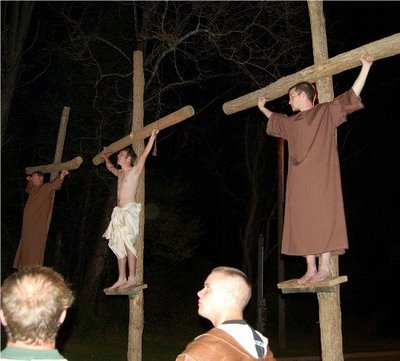
If abortion is an abomination, why isn’t this blasphemy?

______________

When Will Justin Taylor Notice?

pie chartActually, even if Taylor doesn’t, for the Gospel Coalition Michael Pohlman does notice, and holds open the possibility that multi-site churches may be a fulfilment of the Great Commission. Still, the blog watch on Tim Keller has been remarkably silent about the feature story in USA Today about multi-site churches in which Redeemer NYC figured prominently (especially compared to the reaction from his lecture at Google and the recent story in New York Magazine). In one of the bigger surprises after the USA Today story, Keller’s fiercest on-line critics, the Bayly Brothers, praised the NYC pastor their “hero.”

This could be, as observed previously, an indication of the kind of media outlets that count among those who follow Keller. USA Today and the “700 Club” don’t achieve the same degree of cool as do Google and New York Magazine.

But the silence could also stem from some less than appealing associations that Keller owns thanks to the story — ties that Keller’s proponents would rather not notice. According to USA Today, multi-site churches make sense from the perspective of efficiency and maximizing resources:

It’s a growth strategy that works for churches of any size because it doesn’t require new buildings or fighting for zoning or parking space, says Scott Thumma, professor of sociology of religion at Hartford Seminary, where the institute is based.

“They just rent a couple of extra theaters and high schools and put together a church in a box. Most pastors wouldn’t give this as the primary reason, but clearly it’s a distinct advantage,” says Thumma, co-author of a 2008 study examining eight years of growth and change in megachurches.

Of the USA’s 100 largest churches, 67% now have two or more sites and 60% of the 100 fastest-growing churches also have multiple sites, according to the annual listings of the USA’s largest churches in Outreach magazine’s October issue.

Then there is the pastor from Oklahoma, a multi-site proponent like Keller, who is apparently following the business model of Filene’s Basement. Craig Groeschel’s LifeChurch.tv is “the second-largest church in the USA. By video some 26,776 see his sermons at at 13 meeting sites or campuses from Phoenix to Albany, N.Y.

The report adds, “Groeschel sees the multi-site route as a way to offer a classic evangelical message — “the Bible is true and salvation is only by grace’ — at bargain volume rates. His website boasts that LifeChurch.tv reached 1 million people in July, at a cost of 7 cents each. ‘For us, multisite is only a tool, nothing more,’ he says.”

Of course, Keller is not using video and the story concludes with a contrast between Keller and Driscoll. Keller prefers taxis and public transportation to Driscoll’s use of video to deliver his sermons.

Not to be missed are differences among Gospel Coalition leaders over multi-site church mechanisms of delivery. While Keller has disavowed video, John Piper’s Bethlehem Baptist uses it for its three-campuses-as-one-congregation model.

Whatever the reason, it is odd that when an evangelical pastor receives favorable coverage in a national newspaper, the pastor’s supporting cast of bloggers do not mention the article. It could be a valuable discomfort with multi-site churches, or that the story did not include a pie chart.