Not Winning

Even if evangelicals think they are:

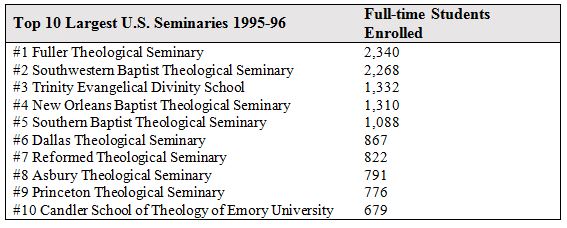
Since the 1995-96 academic school year, Princeton Theological Seminary has seen 30 percent fewer full-time enrolled students. Reformed Theological Seminary saw a 33 percent decrease to 547 full-time students while Candler School of Theology experienced a 39 percent drop to 414 full-time students.

Joe Carter spins this as victory for the Gospel Allies:

Kenneth Kantzer, the late academic dean of Trinity Evangelical Divinity School, once said that in 1890 all of the Protestant theological seminaries in the United States—with the notable exception of Harvard—were evangelical. Forty years later, though, almost all of them had become liberal (i.e., denied basic tenets of orthodoxy). By the 1950s, only four of the top ten largest seminaries were sponsored by evangelical denominations. Of those four, three were part of the SBC, which was struggling at the time to take back control of its schools from liberal professors.

By the 1990s, the trend had shifted once again back toward conservative evangelicalism. After the “conservative resurgence” in the SBC, all six of the denomination’s seminaries were solidly orthodox. And by 1995, only two liberal-leaning seminaries remained on the list of top ten schools by enrollment (Princeton at #9 and Candler School of Theology at #10).

Doesn’t he know that for some Southern Baptists, evangelical is a “Yankee” word.

And what does he not understand about Kenneth Kantzer’s reasons for leaving Fuller Seminary?

Roman Catholic apologetics are catchy.

If You Want to Engage the Culture, Don’t Publish with Crossway

Isn’t this the flip side of Tim Challies’ advice about reading the “right” books?

If you are an academic and you publish with a famous university press, that is wonderful for your career. If you go with a vanity press, that can sink your career. That division of presses also matters in defining whether a particular issue is part of mainstream debate, or way off on the disreputable fringe.

The problem in all this, though, is that some presses are very strong and reputable within particular fields, but that fact need not be known to university authorities. I can imagine a junior professor trying to argue to a department head or dean that a title with such a firm should be counted as equal in prestige to a leading university press, and struggling to make the case. Please understand, that would not be a fair situation, but I could see it happening.

Let me take a specific example. I am currently using a book that came out from Inter-Varsity Press some fifteen years ago. It is a really excellent piece of work, scholarly and well written, and IVP is a very strong and well known publisher from the evangelical point of view. Hence my surprise, recently, when I tried unsuccessfully to find a copy in the very large and wide-ranging library at Penn State University. They had other works by this author, but not that particular title. Like many major university libraries, Penn State has standing orders with certain mainstream publishers, and acquires pretty much everything they put out. That principle does not extend to well known evangelical presses like IVP, Eerdmans, Baker, Thomas Nelson, and so on. The more library budgets shrink, the harder they cut back on any presses they don’t see as absolutely core and necessary.

In itself, that decision is not disastrous for me, because if I want a copy of the book in question I can get it through inter-library loan. But the underlying attitude demands attention. These libraries are assuming that the presses in question are not fully respectable houses for academic work, they are partisan or denominational, and therefore they do not demand the same credibility as even minor university presses.

Maybe that explains why TKNY doesn’t publish with the company that subsidized the gospel allies.

UPDATE: a multi-author 16-page tract is not a book, and I’m guessing Ross Douthat hasn’t read it.

Ye Must Be Baptized Again

Tim Challies keeps explaining what he is not. This time, it’s paedobaptist — not.

What is curious about the post, aside from how circumstantial Challies’ theological evolution is/was, is his adoption of the Gospel Coalition policy of looking the other way:

I suppose I am credobaptist rather than paedobaptist for the very reason most paedobaptists are not credobaptists: I am following my best understanding of God’s Word. My position seems every bit as obvious to me as the other position seems to those who hold it. What an odd reality that God allows there to be disagreement on even so crucial a doctrine as baptism. What a joy, though, that we can affirm that both views are well within the bounds of orthodoxy and that we can gladly labor together for the sake of the gospel.

But if credos and paedos can all get along, why did Challies have to be re-baptized? He admits that he was baptized as an infant in an Anglican church. But then he became a Baptist:

When we moved to our new home we began attending Baptist churches. We eventually settled into one and, in order to become a member, I had to be baptized as a believer. By then my convictions had grown and deepened enough that I believed it was the right thing to do. Since that day my convictions have grown all the more.

If both views are within the bounds of orthodoxy, why don’t Baptists (Reformed or not) recognize Presbyterian or Anglican baptisms? Or why don’t Baptists like Challies object to Presbyterians like Tim Keller for baptizing unbelievers? I grew up Baptist and was baptized sometime during my misspent adolescence. So far, the PCA, CRC, and OPC have not required re-baptism of mmmmmeeeeeEEEEEE.

Another Difference between New and Paleo Calvinists

New Calvinists are mean but don’t know it.

Jonathan Merritt was an unlikely person to confirm a point made here before, namely, that when you define orthodoxy you also draw lines that to outsiders will look unloving and mean. (Think undergraduates at Oberlin seeking protection from disquieting perceptions.) For a while New Calvinists and their allies at the Gospel Coalition have portrayed Paleo Calvinists as mean. Now with Merritt what goes around comes around.

He observes that New Calvinists are full of criticism (and instructions on how to do it):

The website’s archives read like a how-to handbook for criticizing. TGC managing editor Matt Smethhurst tackles how to criticize fellow Christians. Blogger Jared Wilson lays out when you should criticize your pastor. Popular blogger Justin Taylor explains how to criticize your non-Christian friends and how to criticize another person’s theology and how to criticize the evangelical movement at-large.

Their rebukes are not always theoretical. TGC bloggers regularly express sharp disapproval of theologians, pastors, authors, and politicians using strong language. When writer Thabiti Anyabwile wanted to criticize homosexuality, for example, he encouraged readers to recover their “gag reflex” and focus on the “yuck factor.” Setting aside the many–and I mean many–problems with this way of thinking, Anyabwile’s approach is not exactly a silver-plated conversation starter in a non-Christian culture. You can’t transform a culture while you’re browbeating, rebuking, name-calling and gagging. That’s not a recipe for cultural engagement, but rather cultural enragement.

Then there is New Calvinists’ refusal to entertain criticisms themselves:

Most people who have been blocked by TGC say they were punished for questioning the coalition’s disastrous defense of Sovereign Grace Ministries, a prominent Calvinist ministry that was embroiled in a sexual abuse scandal. TGC personalities connected to SGM continued to express support and friendship for those involved with the scandal even as it became clear that Sovereign Grace leaders were complicit. Many who questioned TGC’s stance were blocked. Some who merely used Twitter handles such as #istandwithsurvivors were similarly punished by TGC.

TGC’s blocking spree has swept in countless pastors, seminary professors, bloggers, and others. One person told me they were blocked for challenging their comments about transgender people, while another said they were punished for questioning their stance on “biblical masculinity.” Several told me they were blocked for retweeting someone else’s critique, while others — like Northern Seminary professor Geoff Holsclaw — said they had no idea why TGC blocked them. . . .

A pattern of offering criticism while not being able to receive it, according to Dr. Leon Seltzer of Psychology Today, is a characteristic trait of narcissism. As Seltzer writes, “Deep down, clinging desperately not simply to a positive but grandiose sense of self, [narcissists are] compelled at all costs to block out any negative feedback about themselves.”

Finally, Merritt points out the problem of belonging to a club instead of a church:

TGC has established a system where in order to be a part of the network, one has to believe a set of doctrines that are more specific than some denominations. Basically, you have to be a conservative Calvinist protestant who holds particular views about gender roles, reads the Bible in a certain way, understands human sexuality like they do, etc. If you don’t agree to these positions, you’re out. And those who add their church to the directory of TGC-approved congregations are encouraged to police others. The site asks members to “report a church that doesn’t align with TGC’s Foundation Documents.”

The word “coalition” is defined as “a combination or alliance, especially a temporary one between persons, factions, states, etc.” But the structure of TGC allows for almost no diversity among its members–certainly none that would be noticeable to anyone who is not a Christian insider. So, technically-speaking, The Gospel Coalition is not a coalition at all; they are a club.

If the New Calvinists were more ecclesial and less parachurchian, they might not lose their critical side. And contrary to Merritt who thinks engaging culture is a positive, if New Calvinists were churchly they wouldn’t worry about the culture so much. Belonging to a church and working within its structures would not make them less critical, though Robert’s Rules supplies a structure for critique that takes away some of criticism’s sting. The best thing that might happen to New Calvinists if they looked to the church instead of the club, they would not be so doctrinaire about so many peripheral matters. The visible church has a way of focusing your outlook (not sure what happened to Pope Francis).

Another Solution to Celebrity Pastors — Modesty

I’m betting (if I were a gambling man) that celebrity pastors are a bigger problem for God’s people than transgender bathrooms. At least, Denny Burk Jared Wilson concedes that famous ministers are a problem, though he writes at the website that would not have a following if not for — wait for it — celebrity pastors. Here’s how celebrity happens:

. . . we participate in the highest elevation of a pastor’s platform as we can manage and then load him up with all the expectation we can muster. The result, naturally, is that he is top-heavy and prone to toppling.

BurkWilson adds that “pastoral smallness and obscurity” have their own problems, but “the most prominent dangerous temptations in pastoral bigness are these idolatries — worship of the celebrity pastor by his fans and himself.”

The possible fix for the celebrity pastor include:

1. Transition your “video venue” satellite campuses to church plants or at the very least install live preaching.

2. No more book deals for gifted preachers who are not gifted writers.

3. Discerning the credibility of our experts.

4. Actual parity among elders.

What about recognizing that celebrity pastor is an oxymoron?

1. Celebrity pastors are not really celebrities. Bruce Springsteen and Scarlett Johansson are celebrities. D. A. Carson and John Piper are not. And if Protestants long for pastors with celebrity appeal, they may show a greater degree of worldliness than they should. What it says about an organization — Gospel Coalition — that thrives on celebrity is something that the celebrity pastors and professors may want to consider the next time their schedules permit them to meet.

2. Pastors are not celebrities. First, they are undershepherds. They serve their lord and master, and are mere stewards of the mysteries of God (1 Cor. 4:1) — sort of like butlers. Unlike celebrities who avoid rubbing shoulders with the people and who hire servants to do work beneath them, pastors need to live and move and have their livelihood among smelly sheep (at least they’re not goats).

Second, real pastors serve a local congregation. That means real pastors have much more the fame footprint of a local television news show anchor than they do a Hollywood, NBA, or network star. Who outside eastern Michigan knows the NBC anchor for the 5:00 news show? I don’t. In other words, the genuine audience for a pastor is the local congregation, the one who called him. Fame outside the congregation is an indication that something is wrong.

What if the pastor writes books? Depends on whether the books are good, pretty good, or great. Great books won’t be so until they stand the test of time. Will Tim Keller’s books still be in print in fifty years? That’s one test of greatness. Simply having someone with fame write a book is no indication of merit. The bookshelves are full of promotional materials designed to feed off and enhance celebrity.

3. Celebrities can’t pastor. This may go without saying since celebrity is something that increases fame but decreases access. A pastor has to be available to his people almost 24/7. But imagine a celebrity pastor like Tim Keller paying a family visit. If he does, great. Chances are, with celebrity come handlers, schedules, and limitations to access. A celebrity is remote, a pastor is accessible.

What about recognizing that celebrity is unbecoming sanctification (where are the obedience boys now that we need them?)?

This is where the New Calvinists may want to take a little instruction from the original Calvinist (and notice the connections between 2k and piety that is modest in its affects and aspirations). Here is John Calvin’s commentary on the sons of Zebedee’s exchange with Christ about greatness (celebrity?) in the savior’s kingdom:

Their ignorance was worthy of blame on two accounts; first, because their ambition led them to desire more than was proper; and, secondly, because, instead of the heavenly kingdom of Christ, they had formed the idea of a phantom in the air. As to the first of those reasons, whoever is not satisfied with the free adoption of God, and desires to raise himself, such a person wanders beyond his limits, and, by unseasonably pressing himself forward beyond what was proper for him to do, is ungrateful to God. Now to estimate the spiritual kingdom of Christ according to the feeling of our flesh is highly perverse. And, indeed, the greater the delight which the mind of man takes in idle speculations, the more carefully ought we to guard against them; as we see that the books of the sophists are stuffed with useless notions of this sort.

Can you drink the cup which I shall drink? To correct their ambition, and to withdraw them from this wicked desire, he holds out to them the cross, and all the annoyances which the children of God must endure. As if he had said, “Does your present warfare allow you so much leisure, that you are now making arrangements for a triumphal procession?” For if they had been earnestly employed in the duties of their calling, they would never have given way to this wicked imagination. In these words, therefore, those who are desirous to obtain the prize before the proper time are enjoined by Christ to employ themselves in attending to the duties of piety. And certainly this is an excellent bridle for restraining ambition; for, so long as we are pilgrims in this world, our condition is such as ought to banish vain luxuries. We are surrounded by a thousand dangers. Sometimes the enemy assails us by ambush, and that in a variety of ways; and sometimes he attacks us by open violence. Is he not worse than stupid who, amidst so many deaths, entertains himself at his ease by drawing pictures of a triumph?

Our Lord enjoins his followers, indeed, to feel assured of victory, and to sing a triumphal song in the midst of death; for otherwise they would not have courage to fight valiantly. But it is one thing to advance manfully to the battle, in reliance on the reward which God has promised to them, and to labor with their whole might for this object; and it is another thing to forget the contest, to turn aside from the enemy, to lose sight of dangers, and to rush forward to triumph, for which they ought to wait till the proper time.

The advance of the kingdom of grace does not come from great awakenings or grand gestures or bestsellers or big conferences. It comes through Gideon’s small band, an obscure Palestinian kingdom, a suffering savior, and apostles who died as martyrs. It is time more than ever for New Calvinists to get over George Whitefield.

Not New But Laodecian Calvinism

Trevin Wax argues for yet another third-way that keeps Calvinists and Arminians together in the big tent also known as the Southern Baptist Convention. As the second largest communion (if a convention qualifies) in the United States only behind Roman Catholics, forgive me if I seem to yield to the temptation of membership envy.

What if such girth comes precisely because ministers and congregations are free to follow their own theological convictions? In other words, how big would the SBC be if it had to choose between Calvinism and Arminianism?

But Wax doesn’t think that decision is necessary. He even thinks that kind of variety will make the SBC stronger (as in iron-sharpening-iron, I guess):

In the past, I’ve surmised that God may be using our Southern Baptist diversity on this issue for our overall health. I know many disagree with the idea that our diversity may be a good thing. Some Calvinists believe the SBC would be stronger if everyone shared their soteriological views and other Southern Baptists believe the SBC would be stronger if there were no Calvinists at all. I understand these perspectives, but my strong belief in God’s sovereignty gives me confidence that God will use our differing conclusions for the good of His people.

Not to sound patronizing, but Wax clearly ignores Calvinist history. Calvinists and Arminians don’t coexist. Think Canons of Dort. Think Dutch-American Calvinist disdain for “methodism.” Think Orthodox Presbyterian and Christian Reformed Church rejection of invitations to join the National Association of Evangelicals.

Of course, someone could argue that Calvinists and Arminians should put aside their differences and work together within the same commvenion. If I were Wax, I would not want to be in that land of doctrinal goo because the precedents for doctrinal toleration (or indifferentism) are not good. Contrary to Tom Nettles, it’s not departures from Calvinism that lead to liberalism (though positive estimates of human agency generally undermine Christianity). It’s actually calls for people who disagree so fundamentally to “get along” that produce the flabbiness that is Protestant liberalism.

New Calvinist Exceptionalism

After the recent controversies surrounding Darrin Patrick, C. J. Mahaney, and James MacDonald, I was surprised to see Jeff Jue be so positive about the New Calvinism. He even appeals to the spirit of J. Gresham Machen and Westminster Seminary:

It is committed to the Reformed tradition.

The theme of this year’s T4G was “We Are Protestant: The Reformation at 500,” and the theme of TGC’s 2017 National Conference will be “No Other Gospel: Reformation 500 and Beyond” (April 3 to 5 in Indianapolis; browse list of speakers and talks, and register here). Reformed theology is at the heart of WTS, and it’s what we’ve been teaching since J. Gresham Machen founded the seminary in 1929. So it’s a great encouragement to partner with others who share our commitment to the Reformed tradition.

In 2014 John Piper gave a series of lectures at WTS on the New Calvinism. At one point he stated, “There would be no New Calvinism without Westminster Seminary.” He was referring to the numerous influential books written by WTS faculty members. Perhaps it was an overstatement, but Piper’s comment reminded me of the historical connection between WTS and the New Calvinism.

To Serve the Local Church

Just as WTS is an independant organization with a confessional identity wanting to serve the church, the same is true of sister ministries like T4G and TGC.

And while we have some differences among us, the New Calvinist movement—as represented this week by T4G—is an opportunity to share the rich truths of the Reformation with yet another generation of pastors and churches.

I would have thought that Carl Trueman’s jab on the Gospel Coalition’s “Machismozing” was more typical of that Old Westminster spirit.

But what do I know? It is the season of spin.

Identity Economics

I thought that neo-Calvinism was supposed to do away with the sacred-secular distinction that led fundamentalists to produce the Christian Yellow Pages — you know, the phone book that allowed Christian consumers to buy goods and services from Christian providers of goods and services. Well, even in the hipster land of urban Protestantism, the logic of every square inch only extends to redeemed businesses. Bethany explains:

But we also believe that God is working in areas beyond literature, academia, and journalism. In fact, as our Theological Vision for Ministry makes clear, we have a vision for a church that equips its people to think out the implications of the gospel on how we do everything—from teaching to plumbing to accounting. “Such a church will not only support Christians’ engagement with culture, but will also help them work with distinctiveness, excellence, and accountability in their trades and professions.”

This Christmas, our faith and work channel—Every Square Inch—wants to celebrate products made by companies founded by Christian entrepreneurs. As entrepreneurs, they created something from nothing and, along the way, have given people jobs, contributed to the economy, engaged in ethical business practices, been generous with their neighbors, and expressed the creativity of God.

This guide isn’t comprehensive. There are thousands of outstanding Christian-led companies, and I welcome your suggestions in the comments. Also, each company featured makes many products, not just the ones below, so I encourage you to explore. These items are simply “my favorite things.” I hope you that enjoy the guide and—even if you don’t find anything in it—that you’re encouraged to see God at work.

Aside from projecting a kind of insularity that conflicts with Redeemer NYC’s cosmopolitanism, Bethany fails to explain how exactly non-Christians fail to give people jobs, contribute to the economy, engage in ethical business practices, be generous to neighbors, and express the creativity of God. That sacred-secular distinction might come in handy and let Christians recognize the creational norms that govern not just sanctified but all human existence.

Maybe the explanation for Christians’ superiority is that only Christians can create “something from nothing.” If so, Bethany doesn’t understand ex nihilo or the omnipotence of God (where are TGC’s theological editors?). She also does not seem to agree with President Obama. Bethany appears to have us believe that Christian entrepreneurs “did build that.”

How Red State.

Reimagine Humility

Bethany Jenkins gives us a window into the path to true humility (thanks to our southern correspondent):

To live out the fullness of our liberty, though, we must get rid of our arrogant, controlling, slow-to-hear, quick-to-speak, know-it-all spirits. In a 1995 sermon titled “Growth Through Hearing Truth,” Tim Keller highlights three characteristics of a proud heart:

A proud heart argues for every one of its convictions because it can’t distinguish between major and minor points. Instead, it says: “Any belief—because it’s mine—is a major belief.”
A proud heart either enjoys or avoids confronting, but never confronts with tears.
A proud heart is unhappy with life and, instead of receiving it as a gift, always gripes about how things are going.

The opposite of a proud and angry heart is humility, not self-control. And it’s our internal postures—not our external circumstances—that determine our happiness.

But why doesn’t humility involve submitting to God’s revealed will? Jenkins’ lesson in humility stemmed from a difficult encounter at the check-out line — wait for it — on Sunday:

On Sunday afternoon, in the checkout line at the grocery store, I put a man on trial. He made no argument and offered no defense, but I judged him guilty.

I went there to pick up three things—fruit, deli meat, and club soda. When I got to the only open line, there was just one man ahead of me. This is going to be quick, I assumed.

After the cashier started ringing up his items, though, he decided it was a good time to ask where the premade guacamole was. “Aisle 5,” she said. Then he left his place in line to find it.

When he returned a few minutes later, the cashier had finished scanning his items and customers had started lining up, but his hands were empty. He hadn’t found the guacamole. “It’s on aisle 7,” another store employee said. “On the bottom shelf.” The man again went to search.

Five minutes later, with eight customers now in line, he finally checked out. And I was annoyed. Why did he wait and ask the cashier? Why didn’t he ask someone else before he got in line? How could he inconvenience the rest of us like this? The only reasonable answer, I concluded, was that he was rude, incompetent, and narcissistic.

As I walked home, though, I wondered why my heart went so easily to judgment and anger, not to grace and mercy. Why did I spend so much time mentally logging the reasons he was guilty, not the reasons he might need grace? Why did my time need so much defending?

I know it’s easy to throw the Reformed Protestant penalty flag on this one and emerge as the righteous one who keeps the law, though actually keeping the Lord’s Day holy is difficult and sometimes means having to go without food items for one day that you forgot to pick up on Saturday, not to mention trying not think about “worldly employments and recreations” on Sunday. In the heat of the pennant race, avoiding baseball scores until Monday morning is one thing, but not thinking about the game being played is a whole other layer of sanctity. It’s also easy to take a shot at the Gospel Allies who promote sanctification and a holistic gospel but then publish a piece that so flagrantly acknowledges conduct that would have gotten any Christian for almost 1950 years in trouble with his session or priest. Can’t the Allies at least acknowledge a diversity of views on the Lord’s Day and walk circumspectly around it? If I get flack for talking about The Wire, can’t Jenkins get push back for breaking the Fourth Commandment? (And what exactly is Tim Keller teaching Jenkins?)

But aside from the letter of the law or even ignoring a law, might the means of grace be a way to learn the humility that Jenkins thought she found? What if sanctifying the Lord’s Day is in fact a means of grace? And what if submitting to God’s law is a way to say not my but your will be done, not my convenience because I didn’t order my week but your teaching on how order our lives in this world? What if the piety that the pietists seek is right there before them in the not so hip or urban ways of Reformed Protestantism — two services on the Lord’s Day regulated by and filled with Scripture, catechesis, family visitation, family worship, and not doing worldly things on Sunday? Imagine how much humility that gospel coalition might yield.

The Real Peril of Discovery

National (Roman) Catholic Reporter has two stories about the Doctrine of Discovery that raise intriguing questions for those who put their hopes in papal supremacy, authority, antiquity, and infallibility.

First, the Doctrine (which is not what attorneys do):

The first bull of consequence was issued in 1436 and titled Romanus Pontifex, he said. It concerned “the concession of the right of domination over the Guanches people” and the Canary Islands, which was taken over by the crown of Castile, a medieval state in the Iberian Peninsula.

The bull marked the first time the papacy “made it look as though no one was living there,” or had any ownership over the land being pursued by European powers, “because there were no Christians there,” Newcomb said.

That “pattern of thought” then began marching through history.

In 1452, the papal bull Dum Diversas instructed the Portuguese crown “to invade, capture, vanquish, and subdue all Saracens, pagans, and other enemies of Christ, to put them into perpetual slavery, and to take away all their possessions and property.”

In 1454, another bull titled Romanus Pontifex furthered that thinking, sanctifying the seizure of non-Christian lands in parts of Africa and restating the legitimacy of enslaving non-Christian people.

In 1493, after Christopher Columbus’ fateful voyage, Inter Caetera granted Ferdinand and Isabella “full and free power, authority, and jurisdiction of every kind,” over almost all of the Americas, save for a portion of modern-day Brazil and a few island outposts.

Notice again that the social teaching of the church was going on a long time before Leo XIII, but it’s not always so congenial to modern sensibilities, so Roman Catholic social thought winds up being predominantly a 20th-century concern.

Second, what the progressive Roman Catholics want the papacy to do:

The letter called on the pope to “formally and publicly repudiate and rescind the Dum Diversas Bull of 1452, and other related bulls, which grant the Pope’s blessing ‘to capture, vanquish, and subdue the Saracens, pagans, and other enemies of Christ and put them into perpetual slavery and to take all their possession and their property.’ We also call upon the Pope to repudiate and rescind the Inter Caetera Bull of 1493 that granted authority to Spain and Portugal to ‘take all lands and possessions’ so long as no other Christian ruler had previously claimed them. These bulls instilled the Doctrine of Discovery, the papal sanctioning of Christian enslavement and power over non-Christians.”

The letter stated the papacy had done some positive work regarding the rights of indigenous peoples — such as Pope Emeritus Benedict XVI’s supporting the U.N. Declaration on the Rights of Indigenous Peoples, and Pope John Paul II’s asking of forgiveness for the misdeeds “of the sons and daughter of the church” — but not nearly enough.

(Recently, Pope Francis asked forgiveness in South America “not only for the offenses of the church herself, but also for crimes committed against the native peoples during the so-called conquest of America.”)

The Loretto letter included a message from the Philadelphia Yearly Meeting of Religious Friends (Quakers), which stated:

“You [as Pope] have the power and responsibility to do more, by issuing a new papal bull that formally, directly, unequivocally rescinds and revokes the Doctrine of Discovery and the horrible, cruel, un-Christian language in those bulls that denigrates entire peoples with no justification.”

Comeaux said the Loretto letter was sent to the Vatican and to the U.S. Conference of Catholic Bishops. She said the Loretto community received no response from the Vatican. U.S. bishops’ conference president Archbishop Joseph Kurtz sent a note with a “polite thank you for including me,” she said.

The sisters have contacted Kurtz, who heads the Louisville, Ky., archdiocese, and “he’s expressed interest in getting more information,” she said, “and we’re preparing [that] for him.”

The important question is why a pope should be believed in apology when we haven’t believed the truth of an earlier utterance. If the encyclicals supporting the Doctrine of Discovery were wrong, why isn’t the papal statement that says the Doctrine of Discovery was wrong and asks for forgiveness also erroneous? How do you know when the pope is right? When he conforms to modern notions of fairness and equality? But what if in 500 years, in some sort of Mad Max world, when the current civilization has collapsed and another phase of globalization is starting, with certain people discovering people previously unknown, and the former interact with the latter the way that Europeans treated natives in America, it makes sense to colonize and enslave? If those explorers and exploiters discover papal apologies for the Doctrine of Discovery and judge those apologies to be out of synch with the times, might a pope apologize for the apologies?

One last thought, do the progressive Roman Catholics always think that what comes latest (what is up-to-date) is the best guide to truth? In other words, since we moderns find Christopher Columbus barbaric (even though in Columbus’ day he was considered civilized), is whatever is most recent the way things are supposed to be? That’s an odd view for people who are looking for a papal apology since the papacy is (apparently) an ancient institution. If you really want Roman Catholicism to be up to date, don’t you get rid of the papacy altogether? Who actually believes in ecclesiastical monarchs (except perhaps the gospel allies in their most celebrated status)?