Comparing Christian Liberal Arts Colleges (part two)

The first of these posts compared Hillsdale College and Covenant College as Christian liberal arts colleges by their course requirements in each respective institution’s core curriculum. This follow up calls attention to Professor Jay Green’s initial suspicions about Hillsdale calling itself a Christian college because its mission is more civilizational than confessional.

Any two-kingdom confessional Protestant who read Dr. Green’s first column had to be amused if not frustrated by the way he positioned Covenant College along with its peer institutions in the Coalition for Christian Colleges and Universities (CCCU). Evangelical colleges (some of them turned universities) have for almost forty years marched under the banner of the integration of faith and learning. They converted to the Neo-Calvinist cause somewhere around the time that Francis Schaeffer popularized Abraham Kuyper among American evangelicals. This was also around the time that evangelical faculty and students began to read The Reformed Journal and discovered how darned smart Calvin College (now university) professors were (sometimes they were even funny). With the integration of faith and learning came the elixir of w(orld-and-life-vie)w. In that intellectually pietistic hothouse, faculty and students attempted to bring every square inch of the arts and sciences under the Lordship of Christ. One goal of these institutions was to redeem or transform the culture, and a primary way to do that was to bring a Christian perspective to every single human activity — from goat breeding to Division III men’s football. If you think that sounds sort of civilizational, you’re right.

Reformed confessionalists of the two-kingdom type pushed back against the line blurring that such w(orld-vie)w thinking encouraged. The church and the world were separate categories, just as were general and special revelation. Christianity might require a definite perspective on Christ’s deity or the place of the Hebrew monarchy in the plan of redemption. But on matters of interpreting Andrew Jackson’s electoral victory in 1828, Christians had liberty to come to differing conclusions, most of which would depend on the best scholarship produced overwhelmingly by unregenerate scholars who had no trace of a Christian w(orld-and-life-vie)w.

In other words, confessional Protestantism, not the kind to which Dr. Green appeals, produced critics of the confessional-non-civilizational-but-nevertheless-cultural-integration of faith and learning or transformation of culture that institutions like Covenant College promoted. From a truly confessional Reformed perspective, the mission of many evangelical colleges was civilizational. And that transformationalist outlook and mission undermined a churchly or confessional understanding of Christianity irrespective of what it meant for higher education.

But now Dr. Green has tried to use confessionalism to undermine Hillsdale’s claims to be a Christian college. Again, he has largely recanted his original piece. But the argument he initially made is useful for gaining clarity about confessional Protestantism.

One point in particular bears mentioning. In his first piece about Hillsdale, Dr. Green worried that civilizational Christian colleges would make the work of confessional Christian colleges more difficult:

As Christian nationalism grows more attractive and widely accepted, some colleges are feeling pressure to shift toward defining themselves by their civilizational rather than their confessional priorities. I’m guessing that development offices find it easier to raise money for a college actively committed to saving Western Civilization than for one that promises only to walk in the way of Jesus.

Claiming to be taking the high ground where Jesus walked over against those in the ditches of saving Western Civilization has an inspiring WWJD-feel, but it does not actually describe well “the way of Jesus” in which evangelical colleges that are part of the CCCU execute their Christian mission. Dr. Green said specifically that institutions that belong to the CCCU are “‘Christian’ in the sense that their faculty (and sometimes their students) submit to clear statements of faith.”

But when you look at the CCCU website, here‘s what you will find in reply to the question, “What is Christian Higher Education?”

First, we integrate biblical truth not just into “spiritual” aspects of the institution but throughout the academic enterprise. Our professors pursue academic excellence because they are committed to God as the author of truth, and that truth has implications for every academic discipline. The classroom and the laboratory are just as much arenas of Christian integration as the college chapel.

There is the classic Neo-Calvinist move of blurring the spiritual and temporal, sacred and secular. All of life is religious and so all of religion is civilizational or cultural

Second, we are committed to the moral and spiritual formation of students. Education that instructs the mind without deepening the soul is not true learning. Our schools seek to develop students who, in the words of the Old Testament prophet, “act justly and love mercy and walk humbly with their God” (Micah 6:8). . . . This task gives meaning and coherence to every part of the academy, from the classroom to the fine arts studio, from the internship placement to the residence hall and the athletic field.

Again, in the Neo-Calvinist world of higher education, it’s hard to see where civilization begins and confessional ends because an activist, civilizational Christianity is co-extensive with confession — though so far the confession of faith has little theology (but lots of justice).

Third, we are committed to graduating students who make a difference for the common good as redemptive voices in the world. Our schools offer a wide variety of academic programs because we believe that Christians are called to use their vocations as vehicles to bring the good news of Jesus Christ to a fallen world. Our graduates . . . play a redemptive and restorative role in the world as doctors, teachers, marketers, engineers, parents, soccer coaches, and in a host of other ways. In other words, we are private religious institutions that exist for the public good and contribute to human flourishing. 

So integration of faith and learning extends across the curriculum to redeem and transform the world, one that has many civilizations in need of redemption. One has to suppose that if successful, graduates will build redeemed civilizations that could well qualify as Christian. And how is such a transformationalist understanding of Christian education any less civilizational than Hillsdale College’s self-professed Christian identity?

To Dr. Green’s credit, he does acknowledge that CCCU institutions might do better at being explicitly Christian in their mission.

To hear a call for confessional Christianity is encouraging. But in Dr. Green’s case, his brief for confessional Christian colleges needs the clarity that comes from distinguishing the arts, sciences, and theology as separate branches of learning, the way Protestants did before Kuyper.

Comparing Christian Liberal Arts Colleges (part one)

Professor Jay Green’s thoughts about Covenant College and Hillsdale College have come and gone but his two articles do raise a couple of questions that may be worthy of further comment. The first has to do with the curriculum of a Christian college. The second has to do with that vexing question of Christ and culture, which runs to notions about transforming culture or integrating faith and learning. This post is about the former — curriculum — and it will read like a college catalogue because it relies on course descriptions from Covenant and Hillsdale to compare the religious dimension of a liberal arts college purporting to be Christian.

In his first post, professor Green distinguished between civilizational and confessional Christian colleges. Part of the difference stems from whether faculty actually need to affirm (believe) Christian statements of faith. At Covenant they do. For Green, Hillsdale is different because it “is a civilizational Christian college” in the sense of “acknowledging and honoring the strategically important role the faith played in laying the foundations of both Western Civilization and the American Founding.” He knows that many faculty at Hillsdale “also embrace Christianity in a confessional sense.” But because belief is not required at Hillsdale, “less time and attention are given to using Christian insights to critique things like Western Civilization and the American Founding.”

By the way, somewhere in here is a big point about ecclesiology and whether colleges should function like churches.

Not to be missed as well is an apparent assumption that Green does not develop — the idea that if you believe and teach Christianity you will critique Western Civilization and the American Founding. Does he mean to suggest that true believers will automatically be skeptical of the West and the United States? Or will they simply be willing to be critical, just as they would criticize Chinese or Islamic civilization and China and Indonesia? Or is he simply hinting that because Hillsdale is not sufficiently critical of the West and America — it is very political according to Green — the college loses its Christianness.

Whatever Green means about the relationship between Western civilization, the United States, and Christianity, his understanding of a confessional college leaves out what the apostle Paul included, namely, that those who preach the gospel out of envy or spite should be praised as long as they preach the gospel. That is, no matter the motives of the preacher or the faculty member, the content of what they preach or teach should be of first importance.

If catalogues are revealing, here is Covenant College’s description of basic courses in their core curriculum.

COR 100 The Christian Mind
This course is designed to introduce newly enrolled students to the general scope and distinctive emphases of a Covenant College education. The first portion of the course focuses on our calling in Christ and some of its implications for the task of being a student. The second portion introduces students to the Reformed tradition; and the third portion invites students to join with the faculty in addressing challenges that the tradition currently faces. 2 hours.

COR 225 Cultural Heritage of the West I
This course fosters cultural literacy by surveying important philosophical, theological, literary, scientific, and aesthetic ideas which have shaped Western culture. It begins with the earliest origins of Western culture in ancient Semitic (including Old Testament) and Greek cultures, then considers the transformation of these earlier influences successively in Roman culture, the rise of Christianity, the medieval synthesis of classical and Christian sources, and the Renaissance and Reformation. The course includes exposure to important works or primary sources, critiqued from a Christian perspective. 3 hours.

COR 226 Cultural Heritage of the West II
This course fosters cultural literacy by surveying important philosophical, theological, literary, scientific, and aesthetic ideas which have shaped Western culture. It considers the emergence of Modernism in the physical and social sciences from roots in the Renaissance and the Enlightenment as well as the effect of later reactions like Romanticism and Existentialism. The effect of these philosophical and scientific ideas on literature and other arts is also explored. The course includes exposure to important works or primary sources, critiqued from a Christian perspective. 3 hours.

Hillsdale in contrast spends a lot more time with the West’s cultural heritage though its catalogue says less about teaching from a “Christian perspective.” As part of the core curriculum students at Hillsdale take at least six courses — two in history, two in English, and two in Philosophy and Religion — that add up to 18 hours (ten more than Covenant). Here is what those courses are supposed to cover.

HST 104 The Western Heritage to 1600 3 hours The course will focus on the development of political cultures in Western Europe before 1600. It begins with a consideration of Mesopotamian and Hebrew civilizations and culminates in a survey of early modern Europe. The purpose of the course is to acquaint students with the historical roots of the Western heritage and, in particular, to explore the ways in which modern man is indebted to Greco-Roman culture and the Judeo-Christian tradition.

HST 105 The American Heritage 3 hours This course, a continuation of HST 104, will emphasize the history of “the American experiment of liberty under law.” It covers from the colonial heritage and the founding of the republic to the increasing involvement of the United States in a world of ideologies and war. Such themes as the constitutional tensions between liberty and order, opportunity in an enterprising society, changing ideas about the individual and equality, and the development of the ideal of global democracy will be examined. Attention will also be given to themes of continuity and comparison with the modern Western world, especially the direct Western influences (classical, Christian and English) on the American founding, the extent to which the regime was and is “revolutionary,” and the common Western experience of modernization.

ENG 104 Great Books in the Western Tradition: Ancient to Medieval 3 hours This course will introduce the student to representative Great Books of the Western World from Antiquity to the Middle Ages. Selections may include the Bible and works by authors such as Homer, Aeschylus, Sophocles, Plato, Aristotle, Vergil, Ovid, Augustine, and Dante. The writing content includes a variety of writing exercises that incorporate traditional compositional and rhetorical skills.

ENG 105 Great Books in the British and American Traditions 3 hours A continuation of English 104 but with a focus on Great Books in the British and American traditions. English authors may include Chaucer, Shakespeare, Milton, Swift, Wordsworth, Dickens, Yeats, Eliot; American authors may include Thoreau, Hawthorne, Melville, Whitman, Dickinson, Twain, Frost, Hemingway, Faulkner, and O’Connor. The writing emphasis continues with a variety of writing exercises that incorporate traditional compositional and rhetorical skills.

PHL 105 The Western Philosophical Tradition 3 hours A general overview of the history of philosophical development in the West from its inception with the Pre-Socratic philosophers of ancient Greece to the 20th century Anglo-American and Continental traditions. The contributions of seminal thinkers and innovators such as Socrates, Plato, Aristotle, Augustine, Aquinas, Descartes, Locke, Hume, Kant, Mill, and Nietzsche are studied. Major works by these and other important philosophers are read, analyzed, and discussed with the aim of understanding what they argued for and against in regard to metaphysical, epistemological, and ethical issues. The course investigates to what extent they influenced their own and subsequent societies, how these philosophical systems create varying views of the world and human life, and how they address the perennial questions humans universally ask, existential questions such as, “Is there purpose and meaning in life?”; epistemological questions such as, “What are the limits of human knowledge?”; metaphysical questions such as, “What is the ultimate nature of the reality in which we live?”, “Is there life after death?”, “Are humans identical to their brains?”; and ethical questions such as, “What is the fundamental criterion of right and wrong human action?” In short, the course examines the main Western philosophical thinkers and traditions in an effort to understand what they have taught, why they have so taught, and how they have helped form and shape Western civilization.

REL 105 The Western Theological Tradition 3 hours A survey of the history of Western theology, analyzing and exploring the teachings of the various theological traditions that have influenced Western Civilization. Given the dominant influence of Christianity on Western culture and society over the past 2000 years, the course makes clear the theological teachings of the major Christian traditions that have prospered and played a significant role in shaping Western societies. The connections between theology and notions of proper community and individual life, theology’s influence on Western metaphysics and ethics, and the influence theology has had on the development of modern institutions and enterprises, such as modern science, are explored. In addition, the conceptual innovations about the nature of man and his abilities which theological disputes over the nature of God and Christ have provided are pointed out and discussed. Moreover, particular notions of the religious life and of the role of religion in life that have dominated Western thought on these matters are also explored. In short, students are instructed in the basic teachings of that faith that has dominated and, until recently, to a large extent directed the course of Western civilization in order to understand how religious belief informs self-understanding, provides a comprehensive view of reality, and, by instilling a vision of human life, its purpose and proper comportment, shapes the larger culture.

One aspect to notice, irrespective of the personal convictions of professors, Hillsdale’s curriculum is set up to present Christian context for the West and American government and culture. This instruction may be too friendly to Western culture and the United States, but it is very positive about Christianity. No specific confessional tradition claims to be at the center of Hillsdale’s Christian identity (though some faculty may try). But for Hillsdale to call itself a Christian college hardly looks like a bait and switch.

What is also striking is that Hillsdale delivers these courses on the West and America through specific academic departments. These courses are both in the core and at the beginning of a sequence of an academic major. Because they are not set apart in an interdisciplinary “Core” area which may be staffed by sociologists, English professors, historians, or musicians, Hillsdale’s “Core” curriculum is not set apart in a nebulous, required, general education or interdisciplinary part of the curriculum, something that students check off before getting to real courses in English, history, and philosophy. At Hillsdale, the core courses are the real courses (even if students still check boxes when taking them because of curricular requirements). This likely accounts for why Hillsdale has so many majors in English, history, and philosophy.

The exception to this pattern at Covenant are the required “Core” courses in Bible and Theology.

BIB 111 Old Testament Introduction
This course introduces the basic theological themes, chronological framework, and literary character of the Old Testament with a focus on Genesis – Kings. It aims to provide: 1) the foundations for theological interpretation of the Old Testament, giving special attention to the covenantal framework for redemptive history; and 2) an introduction to critical theories concerning the authorship, canonicity, integrity and dating of the documents. 3 hours.

BIB 142 New Testament Introduction
The course will deal with 1) questions of introduction (authorship, canon, inspiration, integrity of the documents, dating, etc); 2) beginning hermeneutics; 3) inter-testamental history as a background to the New Testament, as well as 4) a study of the historical framework of the New Testament as a whole, and key theological concepts. 3 hours.

BIB 277 Christian Doctrine I
A survey of the major doctrines of the Christian faith. First semester investigates the biblical data on Scripture, God, man and Christ. Second semester investigates the biblical data on the Holy Spirit, salvation, Church and last things. The Westminster Confession of Faith and Catechisms serve as guidelines and resources. 3 hours.

BIB 278 Christian Doctrine II
A survey of the major doctrines of the Christian faith. First semester investigates the biblical data on Scripture, God, man and Christ. Second semester investigates the biblical data on the Holy Spirit, salvation, Church and last things. The Westminster Confession of Faith and Catechisms serve as guidelines and resources. 3 hours.

These four courses give Covenant a leg up on Hillsdale, especially if you are a Presbyterian. Covenant requires two courses that survey study of Scripture, and two that summarize Christian doctrine. These arguably constitute the most confessional pieces of Covenant’s education. But because professor Green is more concerned with what faculty believe and profess, he spends little time in his published pieces on curriculum and academic departments.

What may be the most important difference between the two colleges is the way they conduct a liberal education. Both schools advertise themselves as liberal arts colleges. But at least at their websites, Hillsdale uses language that informed a long line of liberal arts colleges in the United States. Covenant’s statements are much less liberal education-inflected and bear some of the conviction of a Bible college where the Bible is pre-eminent and the arts and sciences are second string.

Consider this answer at Covenant to the FAQ, what makes Covenant different from other top-rate liberal arts colleges?

At Covenant, why you learn something is every bit as important as what you learn. Here, you will learn to see God in every facet of your life, and you will be personally taught by acclaimed professors who could teach virtually anywhere in the world and choose to be here.

At Hillsdale’s website the following describes the College’s commitment to a liberal arts core curriculum:

Liberal learning produces cultivated citizens with minds disciplined and furnished through wide and deep study of old books by wise authors. . . . It does so by leading forth students into a consideration of what has been called, “the best that has been thought and said.”

For what it’s worth, until the so-called fundamentalist controversy, Protestant denominational colleges (even Free Will Baptists) had no trouble offering a Christian and liberal education. Those colleges offered way more courses in the arts and sciences than they did in Bible and theology. Then when the mainline Protestant denominations started to go liberal (theologically) and dabbled with notions of God revealing himself as much through literature as through Scripture, fundamentalist-leaning Protestants turned to the Bible as the core of the college curriculum — first at Bible colleges and then at liberal arts schools like Wheaton, Gordon, and Westmont. How Hillsdale pulled off what it has — a return to the Protestant denominational Christian liberal arts college without being exclusively Protestant — is anyone’s guess.

If professor Green is a bit befuddled in pigeonholing Hillsdale College, he is not alone.

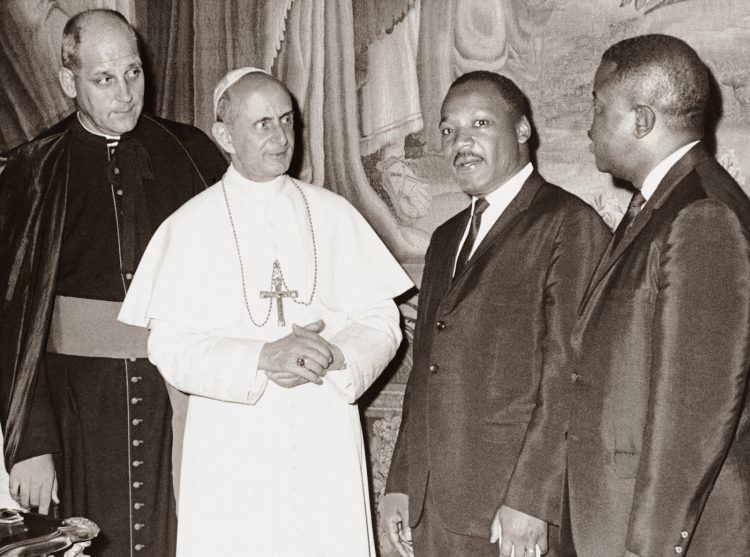
Was Martin Luther King, Jr. Headed toward the Roman Catholic Church?

Quotations from his “Letter from a Birmingham Jail” suggest he may have:

One may well ask: “How can you advocate breaking some laws and obeying others?” The answer lies in the fact that there are two types of laws: just and unjust. I would be the first to advocate obeying just laws. One has not only a legal but a moral responsibility to obey just laws. Conversely, one has a moral responsibility to disobey unjust laws. I would agree with St. Augustine that “an unjust law is no law at all.”

Now, what is the difference between the two? How does one determine whether a law is just or unjust? A just law is a man-made code that squares with the moral law or the law of God. An unjust law is a code that is out of harmony with the moral law. To put it in the terms of St. Thomas Aquinas: An unjust law is a human law that is not rooted in eternal law and natural law. Any law that uplifts human personality is just. Any law that degrades human personality is unjust.

After all, most roads in the West lead not merely to Rome but to Vatican City.

Goooooooooooooooooalllll!!!!!

When John Fea gets it right, he gets it (mainly). He recently reflected on life in a small town:

Messiah is located in Mechanicsburg, Pennsylvania. Mechanicsburg is not a very cosmopolitan place. Many of my neighbors have lived in the town for multiple generations. Some young people get out of town after graduation and never come back, but many never leave. We have all the usual problems associated with small towns. Race-relations could be better. Drug deals go down in the convenience store parking lots. The wealthy members of our town cloister in their gated communities. But this is where we decided to raise our family.

When we arrived in Mechanicsburg our daughters–Allyson and Caroline– were ages four and one. They attended kindergarten through high school in Mechanicsburg Area School District. We chose to live in the Mechanicsburg School District as opposed to the larger regional Cumberland Valley School District (with more opportunities) because we wanted a smaller, more intimate community for our kids. Both of them have thrived in this district and we have never regretted our choice.

Some folks in town who know me may think it is odd that I am writing about the sense of community I feel in Mechanicsburg. As an introvert, I tend to keep to myself. I would rather watch my kids play sports seated alone than join a crowd of cheering fans. I am not very good at small talk. I coached my girls in basketball when they were in elementary school, but I got disgusted with the politics, the ambitious parents, and the way many of those parents treated the selfless staff of our town’s recreation department, so I stopped. I have not participated as much in the local life of my community largely because of the time I spend investing in the life of Messiah College. But I have tried to serve when asked. I could do better.

Then he mixes in Friday Night Lights for fathers without sons (with apologies to Texans):

I thought about my relationship with this community again as I sat in the cold last night and watched the Mechanicsburg Girls Soccer team play their final home game of the season. It was the second round of the Pennsylvania Interscholastic Athletic Association’s District 3 playoffs. The girls won 4-0 over a team from Berks County and advanced to the District semifinals on Monday night at Hershey Park Stadium. They are now 20-0 and ranked 21st in the nation. A great story is developing here in small-town Mechanicsburg. My daughter Caroline plays a minimum number of minutes each game, but she has been an intricate part of a team that is making local history. She has been playing soccer with many of the seniors on this team since she was eight-years-old. Some of these girls are her best friends. Mechanicsburg is Caroline’s community. This place has shaped her life in so many good ways.

Caroline had mixed emotions last night. Her team will play again next week and, if things go well, will try to make a run in the state tournament. Yet the sadness of playing her last game on her home field with her friends was palpable as she walked across the field to meet us. Her tears were a mixture of joy for the blessing of an undefeated season (so far) and sadness that it was all nearing an end. I fought them back as well.

From Hillsdale, Mechanicsburg looks like it’s on the grid. It’s a suburb of Harrisburg (the state capital for the geographically challenged) and only 40 minutes from Lancaster, and 90 from Baltimore. In Hillsdale you are 90 minutes from Ann Arbor, 2 hours from Birmingham (there is one in Michigan and it is spectacular!), and 4 hours from Chicago.

The irony is that I started my college career at Messiah. The college was about half the size that it is now. And the name of our dorm floor, for inter-mural athletics, was The American House. That sounded patriotic but was actually the name of a bar in Mechanicsburg where some of the lads went to drink PBR (on tap!!). At the time, 18-year olds could drink (Kavanaugh-like), though that was not exactly how Messiah’s dean of students understood it. But apparently no one in the administration knew the reference or they simply thought our joke was silly and ignored it. Over time I found the college so far removed from urban life that I transferred to Temple in my sophomore year (after doing one semester at Messiah’s center city campus). Now I teach at a college 2/3 the size of Messiah and am even farther from the East Coast than I was in the remote setting of south central Pennsylvania.

The Lord works in mysterious ways.

I have no regrets about Hillsdale. It is the best job of my career and a wonderful school. But sometimes I wonder what it would be like to teach somewhere like Messiah, where access to the Northeast corridor is much easier.

All of which may explain why Fea and I have different reactions to Americans and evangelicals who voted for Trump. John concedes that he was somewhat sympathetic to anti-elitism in America after hearing graduate students at a recent conference:

There was a sense of confidence in their speech as they talked about their prestigious advisers and the quality of the graduate programs where they earned their Ph.Ds. They did not seem overly worried about landing a job. Rather, their complaints focused more on the fact that so many jobs were located in rural communities in so-called “Red States” where they did not want to live. Their conversation was infused with the kind of cosmopolitan snobbishness that I often hear in academic circles. As I listened to them talk, I thought that maybe all those Trump voters and Fox News watchers are correct about the “coastal elites.”

Yet, that disdain for coastal snobbishness has not stopped Fea from sounding like the Never Trumpers who live and work on the coasts (with the exception of Austin or St. Louis thrown in). If he lived in rural Michigan would he see through Michael Gerson’s coastal elitism?

We Got This Not

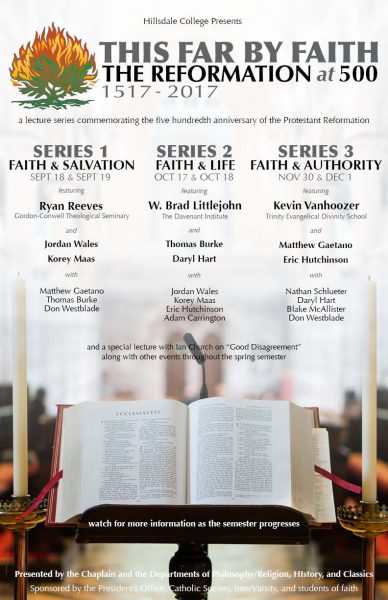
An academic institution where Protestants and Roman Catholics teach together sponsoring a conference about the Reformation is one thing, but a Presbyterian seminary holding a series of lectures on the Reformation that includes Roman Catholics and Protestants? That’s what’s happening at Covenant Theological Seminary this fall. The explanations do not add up:

“Though significant differences still divide Protestants and Catholics, there are real reasons to listen to each other, even learn from each other, so that we might give better testimony to Christ by loving one another across our differences,” said Ryan, professor of religion and culture at CTS and director of the seminary’s Francis A. Schaeffer Institute. “Our goal is to somehow get past lingering caricatures of each other’s positions to find the common ground we share as we seek to bear a more credible witness for the Lord before the watching world.”

Jerram Barrs, CTS professor of Christian studies and contemporary culture and one of the speakers at the lecture series, agrees. “It is important that we do not merely endlessly rehearse the reasons as to why the Reformation took place as if neither we nor the Roman Catholic Church have learned any more or changed in any manner since the 1500s.”

The lecture series will feature five speakers — two of them Catholic — discussing topics ranging from why the Reformation still matters today, to the pastoral legacy of the Reformation, to an evangelical and Catholic and Reformed view of faith and culture.

The part that stuck out to mmmeeeeEEEE was about “endlessly rehearsing the reasons as to why the Reformation took place.” Last time iiiiiIII checked, Protestants and Roman Catholics in the United States are seriously in need of learning the reasons for Luther’s original complaints and Rome’s rejection of Protestant proposals. Consider the following:

nearly half of U.S. Protestants today (46%) say faith alone is needed to attain salvation (a belief held by Protestant reformers in the 16th century, known in Latin as sola fide). But about half (52%) say both good deeds and faith are needed to get into heaven, a historically Catholic belief.

U.S. Protestants also are split on another issue that played a key role in the Reformation: 46% say the Bible is the sole source of religious authority for Christians – a traditionally Protestant belief known as sola scriptura. Meanwhile, 52% say Christians should look both to the Bible and to the church’s official teachings and tradition for guidance, the position held by the Catholic Church during the time of the Reformation and today.

When these two questions are combined, the survey shows that just three-in-ten U.S. Protestants believe in both sola fide and sola scriptura. One third of Protestants (35%) affirm one but not the other, and 36% do not believe in either sola fide or sola scriptura.

Pew’s findings corroborate Ligonier’s survey. (And Redeemer NYC’s outreach to skeptics isn’t doing much to put the sola in the Reformation.)

The thing is, works righteousness comes naturally to human beings. That’s why whenever you have the chance to bang the gong for the sufficiency of Christ and the insufficiency of human virtue (not to mention the sin of pride that virtue sometimes encourages), you take it.