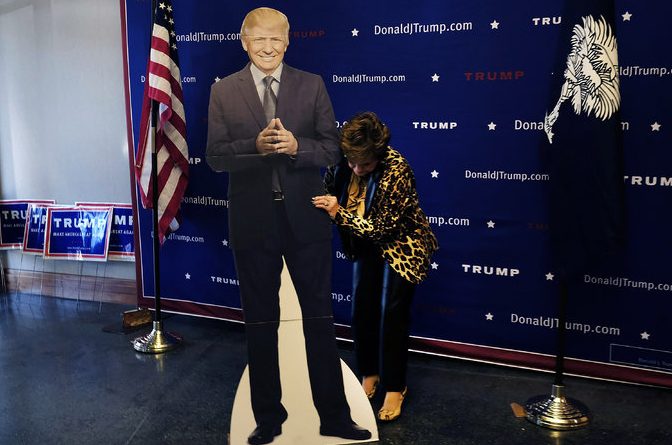
He Dehumanized First

With all the talk of human dignity these days, and all the recognition that Donald Trump doesn’t recognize it in Mexicans and Muslims, what happened to the capacity to recognize Trump himself as human? In other words, why don’t Christian historians model the charity and perspective in discussing Trump that they expect the Republican to display? John Fea (sorry to write so much about you big guy but you know, iron-sharpening-iron and all) once again sees what so many already see:

As Christian students of the past they strive to tell the stories of all human beings. The goal of such teaching and writing is not political correctness, but a fundamental belief in the dignity of individuals. Everyone’s story counts.

When Trump disparages women and people of different races and religions he dehumanizes them. He sends the message that some human beings are not as important as others. In the process he fails to recognize the Imago Dei in all of God’s human creation.

Historians know a few things about this kind of dehumanizing rhetoric. We have studied its manifestation in the past and are trained to recognize it in the present.

I have already commented on evangelical historians who seem to pride themselves on the value they add to discussion of the present.

But I don’t for the life of me understand why the historians who are so quick to condemn Trump don’t admit that the really challenging part of studying the past is to humanize characters like the Republican nominee. How a scholar does that is not obvious and that is why they pay historians the big bucks. To look beyond the surface and see the wider set of circumstances that contribute to a human being’s assets and liabilities is what makes history valuable (and for me fun).

Regarding a person in merely moral categories doesn’t measure up to the standards of good historical knowledge. It does what everyone else already does. And when done in the name of evangelical history it actually shows that born-again historians have a moral imagination but little removed from Jerry Falwell (Sr.) or James Dobson. What they did to President Clinton, evangelical historians are ready and willing to do to Donald Trump.

Move Over David Barton, Make Room for Eric Mataxas

Donald Trump has struck a nerve. Why even I had a hard time not thinking of the presumptive GOP presidential nominee when last week reviewing a book about nineteenth-century Protestantism in the U.S.

Trump is the nearest reason I can fathom for the pronounced attention Eric Mataxas has received from two prominent evangelical historians. Because Metaxas endorsed Trump, because evangelicals seem to be moving their support increasingly to Trump, and because evangelical historians identify with evangelicalism but evangelicals not as much, some professors may feel the need to create distance between their public persona and the larger evangelical feng shui.

Now it turns out that one of those historians has joined other historians in signing a letter opposing Trump’s candidacy. That same historian, John Fea (don’t mean to pick on you today, big fella), wonders about the intellectual chops of Metaxas when he writes that Metaxas’ book is “an intellectual mess” that demonstrates the ongoing validity of Mark Noll’s lament about the scandal of the evangelical mind.

What about the intellectual coherence of the historians who oppose Trump? They start this way:

Today, we are faced with a moral test. As historians, we recognize both the ominous precedents for Donald J. Trump’s candidacy and the exceptional challenge it poses to civil society. Historians of different specialties, eras and regions understand the enduring appeal of demagogues, the promise and peril of populism, and the political uses of bigotry and scapegoating. Historians understand the impact these phenomena have upon society’s most vulnerable and upon a nation’s conscience. The lessons of history compel us to speak out against a movement rooted in fear and authoritarianism. The lessons of history compel us to speak out against Trump.

Do these historians really want to invoke morality when it is evangelicals and the social conservatives who regularly complain about America’s moral decline? Invoke morality selectively? Like when it’s about professional duties but not about what happens sex happens. And is the work of historical understanding really a moral enterprise? Did we somehow go back to the days of the academic Protestant establishment when Jews and people of color were scarce on university and college campuses? Those were times when professors sometimes talked about morality.

But let morality go. What about the intellectual prowess that historians bring to assess Trump? What part of the past do these historians draw upon to show the dangers of populism (or even fascism)? I read the letter and I don’t see any — ANY!!! — historical references. Believe it or not, it’s all about Trump:

Donald Trump’s record of speeches, policies and social media is an archive of know-nothingism and blinding self-regard. Donald Trump’s presidential campaign is a campaign of violence: violence against individuals and groups; against memory and accountability; against historical analysis and fact.

The Trump candidacy is an attack on our profession, our values, and the communities we serve. No less than his sham “Trump University,” Donald Trump’s contempt for constructive, evidence-based argumentation mocks the ideals of the academy, whether in the sciences or the liberal arts. Academia is far from the only profession endangered by Trumpism. Donald Trump bullies and suppresses the press, and seeks to weaken First Amendment protections as President. Trump singles out journalists for attack and mocks physical disabilities. Both the judiciary and individualjudges face public threats from Trump. Non-white, non-male professionals and civil servants are irredeemably compromised in Donald Trump’s eyes.Judges are disqualified from service because of their ethnicity; women Presidential candidates succeed only because of their gender; the President of the United States is under suspicion as illegitimate and alien because of his skin color and heritage.

Those are all fair points. But it doesn’t take a Ph.D. or tenured job in history to notice those defects in Trump’s candidacy. So what gives? Why is Trump so much inside so many’s heads?

To John Fea’s credit, he tries to explain why he signed:

I signed this document because I believe that historians, as historical thinkers, have a LOT to offer when it comes to critiquing political candidates. The emphasis in the letter on evidence-based arguments, the respect for the dignity of all humanity, the importance of context, the uses of the past in political discourse, the commitment to a civil society (rooted, presumably, in the kind of empathy that historical thinking brings), and the very fact that making America great AGAIN is ultimately a statement about the past. Trump runs roughshod over all these things.

But all the letter says about context and evidence is to say that historians affirm that stuff and they do so in a not so self-deprecating way:

We interrogate and take responsibility for our sources and ground our arguments in context and evidence.

And if historians are so good at context, where have they been on the context for relations between blacks and police? It’s not like cop shootings and cops being shot has not been in the news.

Like I say, Trump changes everything (and I’m still not voting for him).

Where's Waldo Wednesday: Word Count

Assessing the historical significance of a person is not an activity that suits quantification. But when historians put together reference words such as dictionaries and encyclopedias, they need to assign word counts for subjects to control the project’s size and scope. In which case, the people with the more important biographies receive more space or words.

I made this point during Sunday school talks on J. Gresham Machen last Spring and continue to think the point has some merit. The standard biographical reference work for the United States, Oxford University Press’ American National Biography gives a window into the collective mind of professional historians and how they judge a figure’s significance. Online access allows readers to generate a quick list of word counts for those persons who made the editors’ cut.
Here is a sampling of presidential word counts:

George Washington 8,025
James Buchanan 3,150
Abraham Lincoln 11,125
Woodrow Wilson 8,400
Ronald Reagan 9,900

Buchanan’s tally as the president consistently rated the worst (but Pennsylvania’s lone national executive) makes sense, but surprising is that Washington takes a back seat to Wilson and Reagan. Lincoln is, well, St. Abraham.

Here are some Reformed theologians:

Charles Hodge 2,925
Benjamin Warfield 1,525
John Williamson Nevin 1,450
Archibald Alexander 1,250
John Witherspoon 2,550

And here are some figures from the Presbyterian controversy of the 1920s:

Henry Sloane Coffin 1,100
Robert E. Speer 1,375
Charles Erdman 850
Clarence Macartney 1,025
William Jennings Bryan 3,500
J. Gresham Machen 1,325

Of course, Bryan was more than a Presbyterian controversialist and his running for the presidency three times on the Democratic ticket explains why he receives more space than Buchanan.
Finally, the tallies for Orthodox Presbyterian notables (or would be OP’s):

Cornelius Van Til 0
John Murray 0
Geerhardus Vos 0

I guess, when the lights and cameras were packed up, the OPC’s theologians looked a lot less interesting to historians.

So what does this have to do with union with Christ? I have engaged consistently with union advocates about the doctrine’s relative importance and have asked repeatedly why the doctrine does not receive more coverage in the Reformed creeds and confessions. The response often is that the Holy Spirit does not merit a separate chapter in the Westminster Confession but that doesn’t make it unimportant. The point that usually follows is that union was so important to the Divines that they did not need to assert it. But I continue to wonder about this argument and a handy search of the Westminster Standards reveals the following word counts:

Union 6
Spirit 79

Some may want to claim that because union and communion go together in the Standards, then references to “communion” should also be counted. In which case, the same should go for all uses of spirit, as in “spiritual.” Here are the results:

Union and communion 33
Spirit and spiritual 114

Which leads me to continue to wonder about the import of union with Christ for defining Reformed orthodoxy. I do not deny that it is there or that the Divines wrote about it in their personal writings. But if it were so crucial to Reformed soteriology – and if it were so important for delineating Reformed and Lutheran doctrine – then you would think union would receive more words and space. After all, the Divines were not bashful as going into specifics.