Fair and Balanced

From our Canadian correspondent comes word of a 1926 New York Times headline that reported on one of J. Gresham Machen’s sermons about the condition of American Protestantism.

Church Teaching Scored–Professor Machen Says the World Is Full of
Quack Remedies For Sin–Calls for More Pessimism

Not many people — believers or not — find pessimism inspiring. But at Old Life pessimism is our bread and butter because, as Machen observed, Christianity is the religion of the broken heart. Maybe the sentimentalists over at the Gospel Coalition would have a better read on angry Calvinism if they understood better the depressing disposition that animates Protestants who belong to Reformed churches.

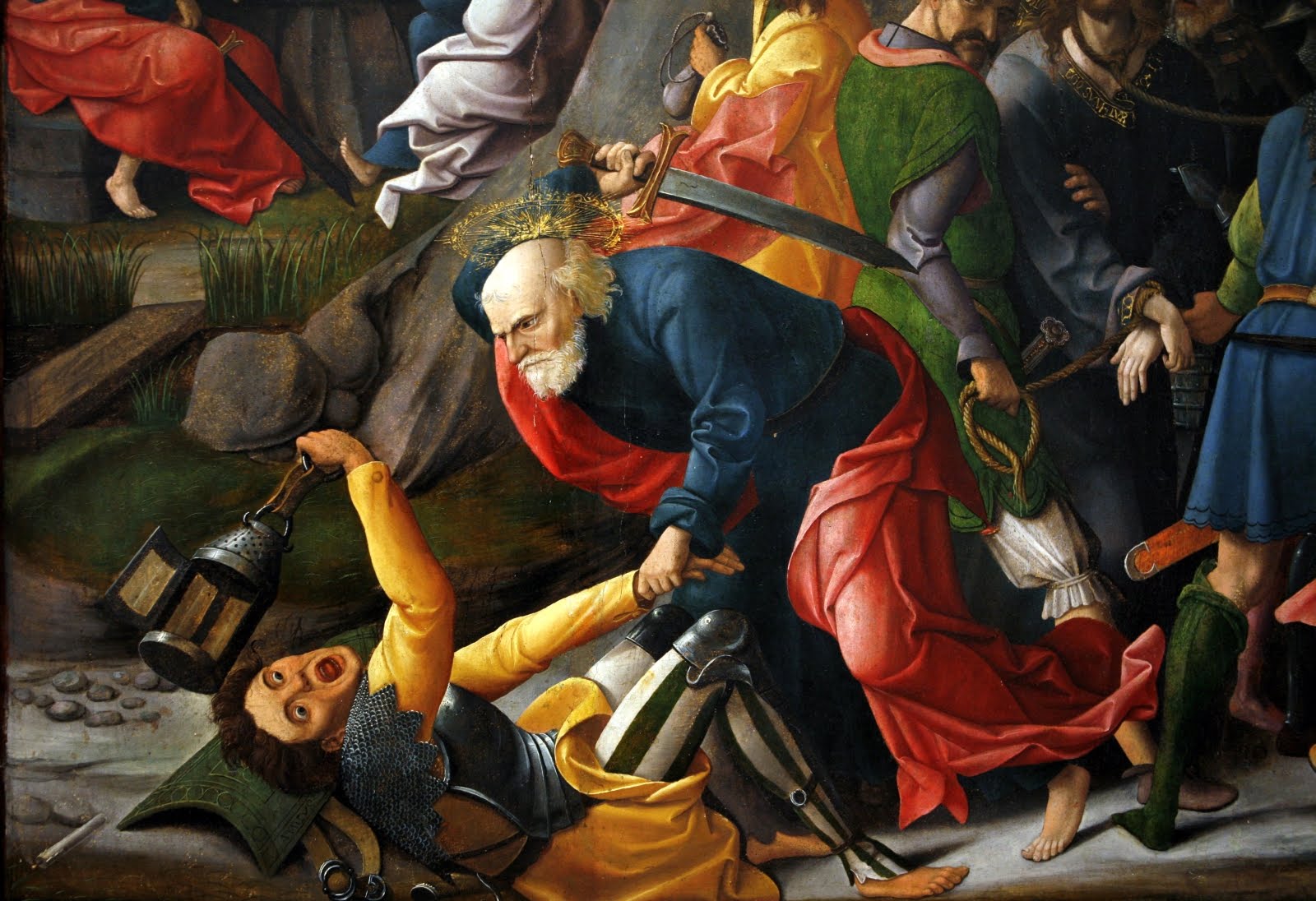
Tim Bayly Does His Impersonation of St. Peter

Apparently the Brothers B have dyslexia, though I am open to other explanations for how they garble other peoples’ writings and ideas. Tim Bayly has written yet another blast of their loud trumpet against 2k theology. This time they identify with the plow boy who knows right from wrong and they pit the common person against the egg-head academics who argue for a two-kingdom perspective and do so by often invoking the apostle Paul. Never mind that the simple apostle, Peter, like the Baylys apparently, found Paul hard to understand sometimes. The plow boy in the Baylys is a cocky little fellow who knows what he knows and disregards any instruction even after he steps in a big pile of mule manure because he was reading Bayly Blog on his I-Phone.

Aside from identifying with Peter’s roots as a man of the fishermen, the Baylys seem to be fond of rushing to judgment and action like the apostle did when evil is prevailing over the good. It was Peter, after all, who committed the only act of outright political defiance by the apostles when he raised the sword and took a swipe at one of the soldiers who arrested Jesus. Anyone with an ounce of sympathy for Christ can also appreciated Peter’s desire and courage in defense of his Lord at a time of great injustice. But Peter still didn’t understand, like the Baylys, that Christ’s kingdom comes not by a physical but a spiritual sword.

That is what 2k strives to clarify, the spiritual nature of the church.

But here is how the Baylys once again misrepresent 2k in tones quite out of tune with the love the repeatedly profess:

They [2k men] are fixated on silencing the voice of their fellow citizens who are religious, particularly those citizens who profess faith in Jesus Christ. Their endless political message is that no man may speak for God outside the privacy of his own home and church-house; and that if he does choose to speak as a citizen of these United States, he must be ever so careful to make it clear he’s not speaking for God or His Church. Our form of government requires him to parse his words and mince his sentences and nuance his tone so that no civil magistrate or fellow citizen will feel threatened by Christians-as-Christians, let alone Church-members-as-Church-members or Church-officers-as-Church-officers. This is the nature of our civil compact, and if religious people speak for God and His Church and people, they are violating that civil compact.

Wrong! The Bible actually requires ministers to parse their words carefully. And the Reformed interpretation of Scripture insists that ministers have a biblical warrant for when they declare what the Lord requires. And lo and behold, one of the doctrines the Bible teaches is liberty of conscience. Again, the egg-headed apostle Paul, did a good job of teaching a doctrine that plow boys and Brothers Bayly have trouble grasping when he talked about the liberty that Christians have to eat meat offered to idols.

According to the Bible, idolatry is wrong.
Also, according to the Bible, meat produced by idolatry is not wrong.
Also, according to the silence of Scripture, ministers are not required to shut down the butchers who sell the meat produced in false temples.

Let’s see about the Baylys red-letter edition of the Ten Commandments.

According to the Decalogue, murder is wrong.
Also, according to the Bible, the penalty for murder is not specified (unless you are a theonomist), which means Christians are free to support and oppose the death penalty.
Also, according to the Bible, ministers are not required to petition the government to punish murderers. Christians themselves as citizens may be free to do so.
But ministers cannot condemn as sinful something about which Scripture is silent.

In which case, the Baylys have substituted their word for the word of God in denouncing as sinful 2k theology.

Here’s the icing on the cake: 2k theology was the doctrine that informed J. Gresham Machen’s opposition to the church’s support for Prohibition and teaching Scripture in public schools. According to Machen:

. . . you cannot expect from a true Christian church any official pronouncements upon the political or social questions of the day, and you cannot expect cooperation with the state in anything involving the use of force. Important are the functions of the police, and members of the church, either individually or in such special associations as they may choose to form, should aid the police in every lawful way in the exercise of those functions. But the function of the church in its corporate capacity is of an entirely different kind. Its weapons against evil are spiritual, not carnal; and by becoming a political lobby, through the advocacy of political measures whether good or bad, the church is turning aside from its proper mission. . . .

Now, of course, the Baylys are not required to affirm Machen’s argument, and their previous credentials within a communion that excommunicated Machen might account for their lack of sympathy for his spirituality of the church idea. But if they are going to re-write the informal rules governing conservative Presbyterianism post-1950 and banish Machen from the list of worthies, they will need to do more than blow their trumpet. They might actually need to read and think about Machen’s reading of Scripture.

Why Do Reformed Think They Are Evangelical?

If Reformed Protestantism is basically evangelical then how do you account for the major divisions that have occurred among American Presbyterians? The fundamentalist controversy apparently has nothing at stake for the Reformed/evangelical consensus since Machen and other conservative Presbyterians were fighting liberalism and EVERYONE knows that liberalism is bad. (Of course, the problem here is that Machen’s evangelical colleagues at Princeton were some of his biggest opponents – the revival friendly Charles Eerdman and Robert Speer.)

According to this consensus the Presbyterian opposition to revivalism during the Second Pretty Good Awakening is also easy to explain. Charles Finney and company were delinquent on theology and possibly practice (revivalism and new measures instead of just plain revival). So the Second Pretty Good Awakening proves nothing.

Then there is the First Pretty Good Awakening where Calvinists promoted revivals. This is the golden-age for the Reformed/Evangelical consensus. But what about the Old Side critics? Well, as I learned at Westminster and from Leonard Trinterud, the Old Side were proto-liberals, propounding a rationalistic theology with Enlightenment echoes, and they were drunks, falling off their horses on the way home from presbytery thanks to a heavy elbow.

In the recent exchange with Ken Stewart over at the Christian Curmudgeon I came across another explanation for the apparent tension between Reformed Protestants and evangelicals – which is, blame the Dutch. In response to differences of interpretation about revivalism, Stewart wrote to the Curmudgeon:

I think we disagree is in our estimation of the danger posed by Hart and his school of writers. Westminster Escondido, in a strange continuity with Calvin Seminary Grand Rapids (these schools are usually at loggerheads) are centers from which revival is disparaged. So important a church historian as George Marsden (raised in the OPC) termed Darryl Hart’s book on American presbyterianism “anti-evangelical” because of its steady misrepresentation of the Great Awakening. So, while from your vantage point, you are aware of Hart, from mine – I think he and his allies represent a danger so great that it needs to be countered.

When pushed on the fact that George Marsden, who studied with Cornelius Van Til, who was very critical of evangelicalism, Stewart responded:

I don’t dispute CVT’s anti-evangelical posture; in fact I would suggest that the influx of CRC faculty into WTS in the 1930’s fundamentally shifted the young WTS away from its Princeton heritage, which had been decidedly the other way. When one stands back from this, it makes us realize that the whole conservative Reformed tradition in this country has been influenced far more by Grand Rapids theology than is generally acknowledged. I am not demonizing the CRC in this particular respect; I am simply highlighting the fact that throughout the 20th century, there have been rival versions of the Reformed faith jockeying with one another for dominance.

What is fairly amusing about this reply is that the Dutch-Americans at Calvin Seminary were responsible for printing a review that Stewart wrote of Recovering Mother Kirk, which was hardly flattering of the book’s author or his interpretation of the Reformed tradition. If the Dutch-American Reformed mafia wanted to enlarge their control of the interpretation of American Protestantism, they fell asleep when reading Stewart’s submission.

Stewart and others who reject the argument that Reformed and evangelical are at odds gain a lot of traction by suggesting that Reformed critics of evangelicalism construe Reformed and evangelical Protestantism as fundamentally at odds or separate entities. The proponents of an evangelical-friendly Reformed faith also like to point out that Reformed churches have made lots of room for evangelicalism and even revivalism. So both conceptually and historically, supposedly, the Reformed critics of evangelicalism are flawed.

But for this critic, it is obvious that evangelicals and Reformed are both Protestant and so overlap at certain points, both religiously and historically. Experimental Calvinism arose in the context of Reformed churches (especially when the prospects for reforming the national churches were looking bleak) and Reformed and Presbyterians churches have been friendly to evangelicalism (though I wish they were not).

What the proponents of the consensus are incapable of doing is accounting for the splits that have occurred within Reformed churches over evangelicalism (even without the presence of Dutch Reformed). The Old Side and the Old School split from their Presbyterian peers because the pro-revivalists believed subscription and polity were secondary to conversion and holy living. And so it has always been with evangelicalism. It is inherently anti-formal in the sense that forms to not matter compared to the experience of new birth or ecstatic worship. Evangelicals are also inherently inconsistent about this because since we exist as human beings in forms (i.e., bodies that are either male or female), we cannot escape formalism of some kind. Either way, on the matter of forms – creeds, worship, and polity – those who promote revivals or consider themselves evangelical are indifferent. The Spirit unites, not the forms. The same goes for different shades of evangelicalism: for the Gospel Coalition it is the gospel not the forms that unite; and for the Baylys and other “do this and live” types, it is the law not the forms that unites. Sticklers for the regulative principle, the system of doctrine, or presbyterian procedure are simply ornery obstacles to uniting Protestants on what is truly important.

What should not be missed either is that when Presbyterian particularists insist that forms matter, that the word reveals forms, and that the word and the Spirit work in conjunction, the response is invariably that the particularlists are mean and lack the fruit of the Spirit. Why? Because they do not recognize the presence of the Spirit.

And so to bring a little more light on the matter from one of those nefarious Dutch-Reformed types (though he is actually German), here is a useful reflection from Richard Muller on the impulses within evangelicalism that lead away from the insights of the Reformation(if only he had been editing the Calvin Theological Journal when Stewart reviewed Recovering Mother Kirk):

Even more than this, however, use of the language of personal relationship with Jesus often indicates a qualitative loss of the traditional Reformation language of being justified by grace alone through faith in Christ and being, therefore, adopted as children of God in and through our graciously given union with Christ. Personal relationships come about through mutual interaction and thrive because of common interests. They are never or virtually never grounded on a forensic act such as that indicated in the doctrine of justification by faith apart from works – in fact personal relationships rest on a reciprocity of works or acts. The problem here is not the language itself: The problem is the way in which it can lead those who emphasize it to ignore the Reformation insight into the nature of justification and the character of believer’s relationship with God in Christ.

Such language of personal relationship all too easily lends itself to an Arminian view of salvation as something accomplished largely by the believer in cooperation with God. A personal relationship is, of its very nature, a mutual relation, dependent on the activity – the works – of both parties. In addition, the use of this Arminian, affective language tends to obscure the fact that the Reformed tradition has its own indigenous relational and affective language and piety; a language and piety, moreover, that are bound closely to the Reformation principle of salvation by grace alone through faith alone. The Heidelberg Catechism provides us with a language of our “only comfort in life and in death” – that “I am not my own, but belong – body and soul, in life and death to my faithful Savior, Jesus Christ” (q. 1). “Belonging to Christ,” a phrase filled with piety and affect, retains the confession of grace alone through faith alone, particularly when its larger context in the other language of the catechism is taken to heart. We also have access to a rich theological and liturgical language of covenant to express with both clarity and warmth our relationship to God in Christ.

Even so, the Reformed teaching concerning the identity of the church assumes a divine rather than a human foundation and assumes that the divine work of establishing the community of belief is a work that includes the basis of the ongoing life of the church as a community, which is to say, includes the extension of the promise to children of believers. The conversion experience associated with adult baptism and with the identification of the church as a voluntary association assumes that children are, with a few discrete qualifications, pagan-and it refuses to understand the corporate dimension of divine grace working effectively (irresistibly!) in the perseverance of the covenanting community. It is a contradictory teaching indeed that argues irresistible grace and the perseverance of the saints and then assumes both the necessity of a particular phenomenology of adult conversion and “decision.” (“How Many Points?” Calvin Theological Journal, Vol. 28 (1993): 425-33 posted at Riddelblog)

The Law Coalition

While working on a talk for a conference last week hosted and attended by academic conservatives, I revisited the Manhattan Declaration. My point was that so many who think themselves conservative think they also take religion seriously by injecting faith into public affairs. But what ends up happening most often is that the complexities and depth of faith are sacrificed for the sake of a common cause, and that commonality is almost exclusively moral and comes from the Second Table of the Decalogue. Listen, for instance, to the way that the Manhattan Declaration’s writers (and the Baylys and Rabbi Bret may well want to follow along) turn the sanctity of human life, traditional marriage, and religious liberty into “the Gospel.”

We are Christians who have joined together across historic lines of ecclesial differences to affirm our right—and, more importantly, to embrace our obligation—to speak and act in defense of these truths. We pledge to each other, and to our fellow believers, that no power on earth, be it cultural or political, will intimidate us into silence or acquiescence. It is our duty to proclaim the Gospel of our Lord and Savior Jesus Christ in its fullness, both in season and out of season. May God help us not to fail in that duty.

Which gospel would that be exactly? The one professed by Southern Baptists, Roman Catholics, or Eastern Orthodox? J. Gresham Machen, in one of the quotations I used recently, might have a very different understanding of such joint endeavors:

I am bound to say that the kind of discussion which is irritating to me is the discussion which begins by begging the questino and then pretensd to be in the interests of peace. I should be guilty of such a method if I should say to a Roman Catholic, for example, wthat we can come together with him because forms and ceremonies like the mass and membership in a certain definite organization are, of course, matters of secondary importance – if I should say to him that he can go on being a good Cathoilc and I can go on being a good Protestant and yet we can unite on comon Christian basis. If I should talk in that way, I should show myself guilty of the crassest narrowness of mind, for I should be shoing that I had never taken the slightest trouble to understand the Roman Catholic point of view. If I had taken that trouble, I should have come to see plainly that what I should be doing is not to seek common ground between the roman Catholic and myself but simply to ask the Roman Catholic to become a Protestant and give up evertyhing that he holds most dear.

In other words, if Trent still matters, or the the Westminster Confession still matters, the signers of the Manhattan Declaration were in serious denial about the gospel.

What is also important to observe, though, is that they are also in mega-denial. For the law that they affirm, merely calling it the gospel, is only a few brief rules outlined in Scripture. For starters, God’s law also says a fair amount about worship and church polity that again would drive Roman Catholics and Protestants not together but apart — can you say the Mass, or how about apostolic succession? (The same can be asked of the Gospel Coalition — are they ignoring the means of grace, or ecclesiology in order to affirm a meager understanding of the gospel?)

So why is it conservative to affirm the law as revealed in holy writ during public debates if you don’t affirm all of the law? And how conservative can it be to rename the law “gospel”? This is not conservative. It is actually liberal and may border on being modernist.

But saying so makes you an antinomian and a secularist? Shazam!

An Anniversary that Deserves More than a Mug

The Orthodox Presbyterian Church turns 75 today. Festivities have so far included lectures, presentations from the General Secretaries of the Assembly’s standing committees, a banquet tonight, and the opportunity to purchase handsome coffee mugs. Thankfully, the Assembly’s organizers resisted the chief temptation of our time — t-shirts (which are fine to wear under shirts with collars but should be reserved for the boudoir or basketball court).

The OPC has also produced two new books to mark the event, Confident of Better Things, a collection of essays edited by John Muether and Danny Olinger, and Between the Times: The Orthodox Presbyterian Church in Transition, 1945 to 1990 by yours truly.

The latter title covers a number of important episodes during the period when second generation Orthodox Presbyterians decided what to do with the legacy and heritage of Machen, Van Til, Murray, Stonehouse, Young, and Woolley. It includes chapters on the creation of the Trinity Hymnal, the formation of Great Commission Publications, Westminster Seminary’s relationship to the OPC, relations with the PCA and RPCES, and the demise of the Presbyterian Guardian.

One of the more interesting parts of this middle period was the OPC’s desire and protracted effort to merge with the Christian Reformed Church. To honor the anniversary and whet readers’ appetites, the following is an excerpt from chapter seven, “The OPC and the Christian Reformed Church, 1956-1973”:

The OPC’s dependence on theologians and churchmen from immigrant backgrounds characterized its first three decades of existence and gave to the denomination a unique character and international outlook. Westminster Seminary was the source of this foreign presence. Names such as Cornelius Van Til, Ned B. Stonehouse, and R. B. Kuiper were not common fare among American Presbyterians. And even though John Murray’s name was more common than Dutch family names among Presbyterians whose ties to Scotland and Ireland were apparent in the colonial era and first half of the nineteenth century, even his Presbyterianism — the Scottish Free Presbyterian Church — differed in important respects from the American tradition out of which the OPC came. Yet, the OPC did not simply find a place for these foreign Calvinists, as if the church were a haven for the world’s Reformed masses struggling to be free. If anything these Dutch and Scottish Calvinists helped to preserve the conservative Presbyterianism they had learned at Princeton Seminary and that Machen had established at Westminster. In turn, these hyphenated Presbyterians helped to define the the OPC. Because the denomination had emerged from the northern Presbyterian mainline church, it was obviously American in its formal expressions. But because of the presence of foreign leadership — a point that the OPC’s critics never tired of making — the church was also un-American.

The Dutch-American connection was particularly strong and a significant influence upon the OPC’s ecumenical relationships before 1970. Here the ties went back again to Old Princeton. Geerhardus Vos’ decision to complete his theological studies — after transferring from Calvin Seminary — at Princeton Seminary and Princeton’s subsequent appointment of Vos in 1892 as professor of biblical theology established a unique kinship between conservative American Presbyterians and Dutch-American Calvinists of which the OPC was practically the sole beneficiary. Of course, the relationship also benefitted the Dutch communion. As an ethnic religious body on the margins of Anglo-American culture and Protestantism, the CRC was naturally looking for ways to assimilate. Conservative Presbyterians at Princeton and Westminster were particularly attractive half-way houses from ethnic isolation to mainstream respectability. But again, not to be missed in this relationship is the leadership of Dutch-Americans within the OPC. The church did not merely provide a comfortable home for ethnic Calvinists who hoped to be successful in the United States on American terms. In fact, the situation was almost the reverse. The OPC became a comfortable home for Reformed orthodoxy and Presbyterian practice because hyphenated Calvinists assumed positions of leadership in the denomination.

The downside of ethnic leadership, as disaffected critics never ceased to mention, was the OPC’s difference from other conservative Protestants who followed the ethos and piety of American Christianity more than a Reformed faith less encumbered by United States developments. The upside was an ability to see the Reformed faith without the blinders of national pride or patriotic civil religion. So appealing was this international Calvinism that the OPC almost decided to unite with the Christian Reformed Church. In fact, at a time when American Protestants were increasingly identifying Christianity with the American “way of life,” the OPC was contemplating ways to establish closer ties to Dutch-American Reformed Protestants.

Oldlife.org 201: Wit and Sarcasm

The first installment in this series about this blog was to clarify what a blog is. One aspect that I did not mention was that the more successful blogs are provocative – that is, they agitate readers and that’s why people come back. The most successful blogger in the world arguably is Andrew Sullivan, the former editor of the New Republic, and his blog is hardly tepid.

This leads to the second point in need of clarification. Oldlife.org is the on-line presence of the Nicotine Theological Journal. Long before provocations started at this blog, the editors and authors of the NTJ were provoking readers and library patrons in hopes of thinking through the implications of Reformed faith and practice today, with a little levity and sarcasm thrown in. The editors’ inspiration was partly Andrew Sullivan whose time at the New Republic made it one of the most thoughtful, rancorous, and witty magazines on politics and culture at the time. But Sullivan was not the only inspiration. Other authors who wrote on serious matters with wit and sarcasm that provided models for the NTJ were Richard John Neuhaus, P. J. O’Rourke, Joseph Epstein, H. L. Mencken, and Calvin Trillin.

None of these sources, readers may object, are Reformed. Which raises the question whether Reformed authors may engage in wit and sarcasm when pursuing their convictions. Well, the answer is yes. If you spend much time in the polemical writings of the Old School and Princeton theologians, you will find a fair amount of wit and sarcasm. Here are a couple examples, the first from Charles Hodge after a seven-round dogma fight with Edwards Amasa Park (named for Jonathan Edwards – ahem) over theological method and the nature of Calvinism:

It is a common remark that a man never writes anything well for which he has “to read up.” Professor Park has evidently labored under this disadvantage. Old-school theology is a new field to him; and though he quotes freely authors of whom we, though natives, never heard, yet he is not at home, and unavoidably falls into the mistakes which foreigners cannot fail to commit in a strange land. He does not understand the language. He find out “five meanings of imputation!” It would be wearisome work to set such a stranger right at every step. We would fain part with our author on good terms. We admire his abilities, and are ready to defer to him in his own department. But when he undertakes to teach Old-school men Old-school theology it is very much like a Frenchman teaching an Englishman how to pronounce English. With the best intentions, the amiable Gaul would be sure to make sad work with the dental aspirations.

The second comes from Benjamin Warfield in one of the last pieces he ever wrote, an article objecting to the latest proposal (1920) to unite the largest Protestant denominations in the United States:

Now it is perfectly obvious that the proposed creed contains nothing which is not believed by evangelicals. and it is equally obvious that it contains nothing which is not believed by Sacerdotalists – by the adherents of the church of Rome for example. And it is equally obvious that it contains nothing which is not believed by Rationalists – by respectable Unitarians. That is as much as to say that the creed on the basis of which we are invited to form a union for evangelizing purposes contains nothing distinctively evangelical at all; nothing at all of that body of saving truth for the possession of which the church of Christ has striven and suffered through two thousand years. It contains only “a few starved and hunger-bitten” dogmas of purely general character – of infinite importance in the context of evangelical truth, but of themselves of no saving sufficiency. So far as the conservation and propagation of evangelical religion is concerned, we might as well for a union on our common acceptance of the law of gravitation and the rule of three.

By the way, these were a couple of quotes readily available from Hodge and Warfield. If you go farther into their works, along with those of Old Schoolers like Dabney and Thornwell you will find many more examples, sometimes of laugh out loud proportions.

One last source of inspiration for Oldlife.org and the NTJ is – duh – J. Gresham Machen. He did not show a lot of wit or sarcasm in his writings. But his polemics were nonetheless blunt, so much so that many who believed charity to be the only Christian virtue considered Machen mean and beyond the pale. But it is precisely Machen’s candor and warrior spirit that is worthy of emulation. The following is from a piece he wrote for an inter-faith gathering on the relations between Christians and Jews:

The fact is that in discussing matters about which there are differences of opinion, it is really more courteous to be frank – more courteous with that deeper courtesy which is based upon the Golden Rule. For my part, I am bound to say that the kind of discussion which is irritating to me is the discussion which begins by begging the question and then pretend to be in the interests of peace. I should be guilty of such a method if I should say to a Roman Catholic, for example, that we can come together with him because forms and ceremonies like the mass and membership in a certain definite organization are, of course, matters of secondary importance – if I should say to him that he can go on being a good Catholic and I can go on being a good Protestant and yet we can unite on common Christian basis. If I should talk in that way, I should show myself guilty of the crassest narrowness of mind, for I should be showing that I had never taken the slightest trouble to understand the Roman Catholic point of view. If I had taken that trouble, I should have come to see plainly that what I should be doing is not to seek common ground between the roman Catholic and myself but simply to ask the Roman Catholic to become a Protestant and give up everything that he holds most dear.

. . . So to my mind the most inauspicious beginning for any discussion is found when the speaker utters the familiar words: “I think, brethren, that we are all agreed about this . . .” – and then proceeds to trample ruthlessly upon the things that are dearest to my heart. Far more kindly is it if the speaker says at the start that he sees a miserable narrow-minded conservative in the audience whose views he intends to ridicule and refute. After such a speaker gets through, perhaps I may be allowed to say that I regard him as just as narrow-minded as he regards me, and then having both spoken our full mind we may part, certain not as brothers (it is ridiculous to degrade that word) but at least as friends.

None of this is to suggest that Oldlife.org pulls off the wit, sarcasm, polemics, or bluntness of the writers who have inspired this endeavor. It is only to point out that the tone and style of Oldlife.org is not over the top.

Huh?!?

Over at Ref21, Ligon Duncan supplies a drive-by quote from Herman Bavinck that the Mississippi pastor directs against John Williamson Nevin. Here is the the Bavinck quote:

In a comparatively sound church life, it is possible to assume that as a rule the children of the covenant will be born again in their youth and come to faith and conversion ‘in stages and gracefully.’ But when the world penetrates the church and many people grow up and live for years without showing any fruits worthy of faith and repentance, then the serious-minded feel called to warn against trusting one’s childhood regeneration and one’s historical faith in Christian doctrine and to insist on true conversion of the hearts, and experiential knowledge of the truths of salvation. Against a dead orthodoxy, Pietism and Methodism, with their conventicles and revivals, always have a right to exist. (Herman Bavinck, Reformed Dogmatics, 3:583)

Then comes this pithy postscript:

And, yes, I know I’m being provocative with the title. But Nevin is not the answer to what ails us.

The post has no links, and as is Ref21’s wont, no place for comments (no peace, no justice!).

So I wonder what made Duncan think of Nevin in connection with Bavinck. Was the Dutch theologian writing against his American counterpart directly? The quotation doesn’t suggest so. Or did David Strain, from whom Duncan obtained the Bavinck quotation, have a recent reading session with the Mercersburg Theology? (I actually follow David’s blog and have not seen activity there in some time. Of course, the Internet is not the only way for David and Ligon to communicate since they both minister in the PCA in Mississippi.)

But even more mysterious is what Ligon means by Nevin not being the answer. The only folks in conservative Presbyterian circles who advocate Nevin regularly are the Federal Visionaries. I know I myself may be charged with such an accusation, but the record is pretty clear that my prescriptions for our communions run more toward Machen than Nevin (as much as I respect the latter’s critique of revivalism).

Still, the funny thing is that the Federal Visionaries’ efforts to blur the lines between faith and faithfulness are very similar to those of the Methodists and Pietists whom Bavinck commends against a dead orthodoxy. After all, the point of turning faith into faithfulness is to get people to take seriously not just the sacraments but all those endeavors to create Christendom and establish the rule of Christ and God’s law. Federal Vision may be wrong orthodoxy but it is hardly dead. In which case, their recommendation of Nevin is a way to obtain exactly what Bavinck wants — “fruits worthy of faith and repentance,” that is, lots of godliness of a experimental Calvinist kind but rooted in the church (where pastors wear clerical collars of odd pastel hues). Federal Vision is no faith for slouches.

At the same time, Bavinck may want to consider Nevin’s critique of revivalism because sometimes children of the covenant are already showing fruits that don’t measure up to the enthusiasts’ standards or their constant laments about dead orthodoxy. As I read Nevin, the point of Christian devotion is not to stick out like a sore thumb but to wear one’s faith organically, or quietly, peacefully (or in Presbyterian parlance, decently and in order). The reason is that calling attention to one’s devotion can readily destroy devotion with selfishness and pride. Even more pressing for Bavinck and recommenders like Duncan is to consider the oxymoronic assertion that a child of the covenant, not in open rebellion, but attending the means of grace and trying to trust the Lord in family devotions and private prayer, and still submitting to godly parents, needs to convert. Convert from what? Pious ways?

As I say, Huh?!?

The Spirituality of the Church at the Westminster California Conference on Machen

I had the wonderful opportunity to speak last night at the WSC conference, Christianity & Liberalism Revisted. My topic was “The Perennial Machen,” which I changed to “The Perennial Problem with Machen.” Since evangelicals, neo-Calvinists, and even secular do-gooders malign the doctrine of the spirituality of the church, I attempted in one point to explain the doctrine and to show that it was an important if not necessary piece of Machen’s widely lauded critique of Protestant modernism in Christianity & Liberalism.

Here is an excerpt of my talk and a lengthy quotation from the conclusion of Machen’s book:

The other part of THE BOOK’s last chapter on the church that deserves attention is the doctrine of the spirituality of the church. This conviction continues to be misunderstood, and is often denounced as a cover for Christians and churches who want to forsake their obligations to contribute to social well-being. To be sure, this doctrine became prominent among Old School Presbyterians at a time when American Christians debated slavery and the U.S. Constitution. But it was a teaching that extended back before the nineteenth century and tapped Augustine’s remarkable insights into the differences between the city of God and the city of man. What the spirituality of the church taught Machen especially was that the church was a spiritual institution with spiritual means for spiritual ends. Because of salvation’s fundamentally spiritual character, believers could not identify the fortunes of the kingdom of God with the empire of Rome or the industrializing republic of the United States.

This was the insight that prompted Machen’s conclusion to THE BOOK. The solution to the crisis over liberalism, as he argued, was for the churches to “face the facts, and regain their integrity while yet there is time.” This needed to happen immediately because so many of the denominational bureaucracies were under control by official either modernist themselves or indifferent to it. Another solution was to form new churches because the existing works could not satisfy “the fundamental needs of the soul.” Whatever the solution, he wrote:

There must be somewhere groups of redeemed men and women who can gather together humbly in the name of Christ, to give thanks to Him for His unspeakable gift and to worship the Father through Him. Such groups alone can satisfy the needs of the soul. At the present time, there is one longing of the human heart which is often forgotten – it is the deep, pathetic longing of the Christian for fellowship with his brethren. . . . There are congregations, eve in the present age of conflict, that are really gathered around the table of the crucified Lord; there are pastors that are pastors indeed. But such congregations, in many cities, are difficult to find. Weary with the conflicts of the world, one goes to Church to seek refreshment for the soul. And what does one find? Alas, too often, one find only the turmoil of the world. The preacher comes forward, not out of a secret place of mediation and power, not with the authority of God’s Word permeating his message, not with human wisdom pushed far into the background by the glory of the Cross, but with human opinions about the social problems of the hour or easy solutions of the vast problems of sin. Such is the sermon. And then perhaps the service is closed by one of those hymns breathing out the angry passions of 1861 . . . Thus the warfare of the world has entered even into the house of God. And sad indeed is the heart of the man who has come seeking peace. Is there no refuge from strife? . . . . Is there no place where two or three can gather in Jesus’ name, . . . to forget human pride, to forget the passions of war, to forget the puzzling problems of industrial strife, and to unite in overflowing gratitude at the foot of the Cross? If there be such a place, then that is the house of God and that the gate of heaven. And from under the threshold of that house will go forth a river that will revive the weary world.

The church as the house of God, the gate of heaven, a place for weary souls seeking refuge from the conflicts of this world through the cross of Christ – that is actually what the spirituality of the church begins with and it is precisely how Machen concluded his important book.

If this is why God gave us the church, why would anyone want it to meddle in civil law, social policy, or economic development? Don’t we have other institutions to do that? And aren’t the affairs of law, policy, and economics trivial compared to the fellowship of the redeemed person with the infinite God through the work of Jesus Christ?

Good and Necessary Consequence?

Mike Horton often laments that the evangelicals who become excited about confessional Protestant theology often do not realize that the new teachings and practices they adopt are at odds with older parts of their born-again devotion and conviction. Mike likens this to a notebook in which the student puts in new pages but neglects to take out the old and erroneous pages. In which case, someone might insert a page for worship that is formal, liturgical, and reverent, and fail to remove the page that says it’s okay to go home after the service and watch professional football.

To Rabbi Bret’s credit, his intellect is keen enough to see the tensions among pages in his notebook. He recently posted his disagreement with J. Gresham Machen on the pastor’s responsibility to master and minister the Word of God. In his convocation address for Westminster Seminary, Machen asserted:

We are living in an age of specialization. There are specialists on eyes and specialists on noses, and throats, and stomachs, and feet, and skin; there are specialists on teeth—one set of specialists on putting teeth in, and another set of specialists on pulling teeth out—there are specialists on Shakespeare and specialists on electric wires; there are specialists on Plato and specialists on pipes. Amid all these specialties, we at Westminster Seminary have a specialty which we think, in comparison with these others, is not so very small. Our specialty is found in the Word of God. Specialists in the Bible—that is what Westminster Seminary will endeavor to produce.

But Bret thinks this is too narrow a reading of Scripture or the work of ministers.

The idea that being alone a specialist on what is in the Bible is enough to successfully minister in our current culture is just not true unless included in that idea of Bible specialty is also the ability to take what’s in the Bible and apply it every area of life.

For example, what’s in the Bible will never tell us about existentialism or post-modernism, or communism but can any minister really be of any value if they have no understanding of how these philosophies are impacting the people he is seeking to minister God’s word from?

If ministers are to specialize what ministers need to specialize in is integration, or inter-disciplinary studies. Is a minister prepared if he specializes on what is in the Bible, while along the way, discovering that Jesus Christ is Lord of all, if the minister doesn’t know what that might begin to look like in family life, the law realm, or the educational realm?

Ministers simply have to understand that Christian theology is the integrating point that gives unity to all the differing specialties. The Bible is that integrating point and because it is that integrating point what the Bible has to say between its covers, covers all areas that aren’t explicitly between its covers. If we do not believe that God’s word is the integrating point that gives unity to diversity then the world we live in will not be a Universe but a Multi-verse where all the particulars (specialties) can find no relation to one another.

So again, to Bret’s credit, he sees that he needs to take the Machen page out of his notebook to accommodate his biblicism and world-view pages. We appreciate the clarity and honesty.

What deserves attention, though, is that the Bible nowhere says that the ministry needs to be the integration point for all specialties. Somehow I missed that in Paul’s instructions to Timothy on ministering the word (2 Tim 3:14-4:4). Paul is fairly clear about ministering the word and the sufficiency of Scripture. The apostle himself knew a thing or two about Greek philosophy but he doesn’t tell Timothy to master Epicureanism or Stoicism – as if your average first-century or twenty-first Christian is trying to implement the ‘ism’s of the mind in his everyday activities; even the mental people – academics or pastors – are never so self-conscious.

Also questionable is Bret’s belief that someone could actual be the master of all specialties in order to integrate them. Given Bret’s own reading of economics, politics, or history, I’d say he might spend a little more time with the experts before thinking that he is the master of all intellectual insights and capable of definitive judgments. Ironically, it seems that Bret follows Machen in thinking he is an expert on the Bible and because the Bible speaks to all of life, the good Rabbi is an expert on all of life. Again I say, huh?

Bret’s comments are another important reason for 2k – which is to reign in excessive interpretations of the religious meanings of culture, not to mention the pride that generally comes with such assessments.

But to Bret’s credit, he does sense that he needs to give up Machen to retain Rushdoony. We continue to be amazed and amused that he keeps the CRC page.

I Believe the Bible Requires Me to Avoid Movies, and If You Go See a Movie You Don’t Believe the Bible – Huh?


I learned 2k from J. Gresham Machen. If 2k critics were to spend a little time with the chief founder of Westminster Seminary they might be less alarmed. They might also see in the mirror staring back at them the liberal Protestants who tried Machen for breaking his ordination vows.

Here is where 2k critics might see some resemblance between themselves and liberals (you can also throw in fundamentalists for good measure but you need to fight alarm with alarm). In 1926 Machen was up for promotion at Princeton Seminary to become the professor of apologetics and ethics. General Assembly needed to approve this promotion because Princeton was (and still is) an agency of the Assembly. At the gathering of 1926 Machen’s foes reported that he had voted against a motion in his presbytery (New Brunswick – yes, the one established for the Tennents and other “white hot” Presbyterians) that called for the church to support the 18th Amendment and the Volstead Act – that is, Prohibition. Mind you, Machen believed drunkenness to be sin and he believed the church had a duty to call people to repent of such sins.

But that wasn’t good enough. Because he did not support the 18th Amendment, his foes believed he was antinomian. And an antinomian should never be allowed to teach ethics, which has historically always been part of the apologetics division at Princeton and Westminster.

So the Assembly denied Machen his promotion.

Critics of 2k do the same when they say:

1) We are antinomian. Actually, we believe in the law, and may actually do a better job upholding the First Table than those 2k critics who don’t have an evening service and use praise songs in their morning assemblies.

2) We favor abortion. Actually, we oppose the shedding of innocent life. But some of us may not feel called to march at abortion clinics or to engage in political discussions from the pulpit. (Some say we don’t oppose it earnestly enough, but those people don’t actually know us to be able to see how earnest we are.)

3) We favor gay marriage. Actually, 2k advocates believe homosexuality is sin and homosexual sex is not the kind of intimacy to be practiced in marriage. But again, following the example of Machen, favoring an amendment to the Constitution is not the same as regarding homosexuality a sin.

4) We don’t believe in Christian education. Actually, we do. But we don’t believe that only one form of delivery (or two) is lawful. We believe that parents should make that call under the oversight of elders who have no jurisdiction to declare that certain kinds of schools are unlawful (because the Bible doesn’t say so). We also have reservations about Christian interpretations of biology, Shakespeare, and U.S. history. Much of the time, these “Christian” interpretations are as far fetched as appeals to Scripture for prohibiting beer.

5) We take Christian liberty too far. Actually, we don’t. As I have indicated, I don’t shop at chain stores partly because of the 8th commandment, which tells me (along with help from Wendell Berry) that the love of neighbor requires me as much as possible to support local businesses owned by my real neighbors, not by distant corporations. Can I require members of the church where I am an elder to follow my practices? After all, I believe Scripture calls me to this form of economic behavior. Isn’t Scripture binding on all Christians? Well, it is, but Scripture also isn’t air tight about the businesses we patronize. I may suggest the value of shopping locally, and how this seems to encourage love of neighbor. But it’s my application of Scripture and my wife’s cross to bear (especially when traveling); it’s not warrant for declaring other Christians who shop at Walmart to be in sin.

6) We deny the Lordship of Christ. Actually, we affirm it and recognize it everywhere, all the time. We so believe in the Lordship of Christ that we think it exists even when bad rulers occupy office, when non-Christian scientists denounce Christianity, or when evangelicals go to see a Woody Allen movie. Who among us could unseat Christ’s sovereign rule?

7) We deny the authority of the Bible. Actually, we don’t. All the 2k advocates I know believe that Scripture is infallible, inerrant, and the only rule for faith and life. What sometimes gives us the creeps is the identification of God’s will with a person’s interpretation of Scripture. History has shown that people make mistakes when interpreting the Bible. 2kers cannot be forced to submit to faulty interpretations of the Bible. After all, 2k appeals to Scripture for its truthfulness and that appeal doesn’t seem to convince the Brothers Bayly or Rabbi Bret’s of the world. According to their logic, they don’t believe the Bible because they disagree with my interpretation of it.

As I say, huh?