Let My Old School People Go

The Baylys not too long ago wondered why conservatives in the PCA were so agitated by the Federal Visionaries but calm about Tim Keller. They had a point even if one could return the favor and ask the brothers who are fraternally out of their minds why they are so worked up about Keller and seemingly indifferent to the dangers of Federal Vision (hint: antinomianism versus neo-nomianism goes a long way to explain the difference).

But the recent verdict in the trial of Peter Leithart suggests that the Baylys misunderstand the PCA altogether. Watching the release of different parts of the transcript has been jaw-droppingly astounding. The defense’s cross-examination of a witness against Leithart — Lane Kiester — was something worthy of a Hollywood production. Now comes Jason Stellman’s closing statement for the prosecution (which refers to the committee’s treatment of Kiester). Here are a few excerpts:

When Dr. Leithart was asked, why is it that people misrepresent you or misunderstand you. I was happy to hear that question asked from a member of this commission. That’s a question that I have often desired to ask of various proponents of the Federal Vision or the New Perspective on Paul. Why is it that your critics somehow never seem to be able to represent you fairly in your own estimation? Why is it that you’re never quoted fairly or in context? Why is that anyone who disagrees with you is somehow always misrepresenting you or failing to understand what you’re saying? And a follow up question would be, and why is it that all these people who misunderstand what you’re saying are all misunderstanding you to be saying the same thing? The answer that Dr. Leithart gave was, well, the reason that I’m so often misrepresented is a clash of paradigms. And I think he’s absolutely right. However, I would describe it as a clash of systems of doctrine. . . .

The Westminster Larger Catechism 69 teaches that our union with Christ is “manifested” by our “partaking of the virtue of his mediation, in [our] justification, adoption, [and] sanctification.” WLC 77 distinguishes justification from sanctification, insisting that while the latter is owing to the infusion of grace, the former is the result of the “imputation of Christ’s righteousness.”

TE Leithart writes:

The Protestant doctrine has been too rigid in separating justification and sanctification, more rigid certainly than Scripture itself…. Justification and definitive sanctification are not merely simultaneous, nor merely twin effects of the single event of union with Christ (though I believe that is the case). Rather, they are the same act.”

The confessional, Reformed doctrine of justification (which TE Leithart calls “illegitimately narrow” and “distorted”) teaches that justification is a legal declaration of God, based upon the work of Christ, by which the obedience and satisfaction of Jesus are imputed to the sinner by faith alone. TE Leithart’s desire to see justification as a “deliverdict” (or, a delivering verdict) that contains within it the deliverance of God’s people from the power of sin (which our Confession calls “sanctification”) is to collapse what Reformed theology has always distinguished (and we have already heard expert testimony to the fact that definitive sanctification is much more closely related to progressive sanctification than it is to justification).

The entire statement is valuable and Jason deserves great helpings of gratitude for his courageous stand against the vagaries and errors of the Visionaries.

But the recent verdicts acquiting Federal Visionaries by two presbyteries within the PCA raise yet again questions about the state, coherence, and discipline of the Presbyterian Church in America. Yes, the denomination has studied Federal Vision and disapproved at the General Assembly level. But life on the ground in the PCA appears to be very different from what the Assembly does. Some have been circulating the website of a congregation in the South which describes a female counselor as a pastor (though since our correspondents in the South and Northwest sent word her title has changed). The Baylys have continued to notice the feminist friendly practices of Redeemer Presbyterian Church in New York City.

But even in much less controversial ways, pastors and congregations in the PCA give evidence of uncertainty about matters Reformed. Over at Vintage73, a blog of young PCA pastors, one contributor comments on three pastoral mistakes he has made so far in his ministry. One was thinking that Rick Warren’s Purpose Driven Church would be fix what ailed his congregation:

2. Going for the silver bullet- this is the ministry mistake of thinking the latest and greatest will solve all of your problems. A few years ago we were all told that using the “40 Days of Purpose” would increase attendance and giving! Great! How do I order? Where do I sign? Churches of all stripes were using it. Sadly, silver bullets only work on werewolves (or so I’m told). Now the silver bullet may be the latest and greatest in technological advancement. “Hey, if we get a Facebook page, start a Twitter account, and use some video that will turn Andy Stanley green with envy, we’ll turn this thing around!” It’s not that we can’t glean some insights from others, but if you think you’ve found the mystery method that will solve all of your ministry’s problems that doesn’t involve theological reflection, prayer, and repentance, my advice is to take your shiny ammo back to where you got it. Here’s an idea: What about starting with a renewed commitment to the primary tools God put in the church’s toolbox such as the ministry of the Word, prayer, sacraments, worship, and fellowship? Just a thought.

This fellow seems to think that his understands it a mistake to was thinking that churches have easy cures. He also indicates a commitment to the means of grace. But even more basic was the problem of a Reformed pastors contemplating using dubious schemes from a Southern Baptist minister. If he Presbyterian pastors simply had a conviction about following Reformed teachings and practices and using Reformed sources, he Rick Warren’s methods would never have had appeal to PCA pastors considered Warren’s project.

In other words, the PCA seems to need a broken windows ecclesiology. This is the idea that if you pay attention to the little things — like what books you use in Bible studies and Sunday school, elements and order of worship, national flags in the auditorium, avoiding both the church and secular holiday calendar — the big things (Federal Vision and Keller) take care of themselves. This means that a communion that practices a level of ecclesiastical policing (i.e. discipline) at the local level will inevitably reflect that same discipline at the denominational level and in turn will likely discourage the less disciplined to affiliate or join.

Which is another way of saying that the reason why certain figures in the PCA get away with what they get away with owes to the ethos of the communion itself. Folks in the PCA show discomfort with putting limits on its officers and agencies. If Keller and the Federal Visionaries find a home in the PCA it is because the PCA is increasingly spacious. Why the denomination has lost that older sense of combating the broadening effects of liberalism is a real question. When it started the PCA was not exclusively an Old School church. But its officers and members had a shared sense of needing to oppose error and that denominations have a record of going off course. Now that liberalism is supposedly defeated, the PCA does not exhibit such wariness. Only the Old Schoolers have it and some dismiss them as crazy TR’s because — well — everyone in the PCA loves Jesus (as if liberals did not). But for Presbyterians, liberalism was not the only problem. In fact, non-Reformed communions, teachings, and practices were also erroneous. To tolerate or overlook their errors was a form of liberalism.

I cannot fathom how the ending to this denominational story will be happy.

Is This Where Neo-Calvinism Leads?

Our favorite PCA blogger (why? He’s more my age than Stellman) has adapted an older article from the Nicotine Theological Journal for his blog, calling it “Bye, Bye Kuyper.” Here is an excerpt:

Christians have come to believe that they worship God as much in their weekday jobs as they do on the Lord’s Day gathered with the congregation to pray, sing, read, and preach. In fact, Monday can be more important than Sunday. Sunday’s gathering is justified not by offering God acceptable worship and dispensing the means of grace, but only if it has some good effect on one’s work and leisure Monday through Saturday.

Ministers who lead in worship, preach the Word, and administer the sacraments are doing nothing more important than the politician or housewife (or husband) or professor of physics or laborer. In fact he may be doing something less important as he provides only the spiritual inspiration for those who really advance the kingdom. The Christian school is as important as the Church, perhaps more important if we want to prepare our young people to conquer the world for Christ.

The whole thing has led to a denigration of the traditional mission of the church. Churches are embarrassed to say that they have no more to offer than the ordinary means of grace. Ministers feel they must apologize if they do no more than preach the Word, administer the sacraments, show lost sheep the way to the fold, and help make sure the gathered sheep have the provision and protection they need as they make their way to the heavenly sheepfold. The world, it is contended, will rightly condemn the church if it does not see the “practical effects” of its existence (hence the church must distribute voters’ guides to promote Christian political agendas, create faith-based ministries to provide cradle to grave welfare, put on get seminars so everybody can communicate and have good sex, and offer concert seasons and art shows to provide the congregants and community with cultural experiences).

I know that not all Kuyperians approve of the way Kuyperianism has been domesticated. But what I am still waiting for is an account of neo-Calvinism that avoids the unhinging of the church that The Christian Curmudgeon describes. It is one thing to say that voters’ guides are a problem. It is another, though, to say that voting is kingdom work. It seems to me that Kuyperians are so reluctant to give in to the spirituality of the church that they end up making the world safe for both Jim Skillen and Jim Wallis.

Christian Hell?

Mark Horne apparently thinks he has landed a damaging jab against 2k by ridiculing Jason Stellman’s point about the discontinuity between culture here and the new heavens and new earth – a point raised in Keith Mathison’s review of David VanDrunen’s new book, Living in God’s Two Kingdoms. Stellman wrote:

If my marriage to my wife will not survive into the age to come, then why would I think her wedding ring will? Sure, it’s a nice ring and very well-made, but it’s hardly a higher example of human productivity than our marriage is.

For what it’s worth, the absence of marriage in the new heavens and new earth would certainly seem to unravel arguments that look at redemption as the restoration of creation. If marriage existed as part of the created order and then vanishes in the glorified order, something is going on that seems to escape the average neo-Calvinist’s redemptive-historical horizon.

But Horne does not consider Stellman’s point for very long and rushes instead to his own – perhaps listening to too much Focus on the Family – about the difference that Christianity makes for marriages and child rearing. He writes:

If we use this principle for a generalized defense of R2K, then we must state that there are no such things as Christian marriages or Christian families. Jesus does not want us wasting our time talking about how husbands and wives should behave or raising their children according to God’s word. This is all a compromise of the Gospel and a confusion of law and grace. We should leave family issues to secular family counselors just as we should leave the economy to Bernanke.

(By the way, humans rear children; they raise cows. And I’ll take my chances with Bernake over Gary North running the economy.)

First, marriage is a legal status determined by the state. As such, Christian marriages do not exist unless we want to turn matrimony into a sacrament. But when you refuse the categories of holy, common, and profane, how else to make marriage meaningful except to baptize it?

Second, since marriage as an institution is not Christian but a creation ordinance that is open to all human beings (except for gay ones – lest anti-2k hysteria surface), then the issue is whether a Christian’s vocation is married or single. Christianity has to do with persons, not with institutions (other than the church). Christians who are married have clear instruction from Scripture about how they should conduct themselves as spouse or parent or both. But that does not mean that the institution of marriage (or the church for that matter) will survive in the new heavens and new earth. I mean, the Bible gives some instruction about the Lord’s Supper but does that mean we’ll still be observing that meal in remembrance of the Lord whom we see with our resurrected eyes?

Horne concludes with this whopper – the antithesis doesn’t come any more antithetical:

It is one or the other. Either you affirm that Jesus is “ruler of the kings of the earth” or you deny that it is “the Father, from whom every family in heaven and on earth is named.”

Huh? Since when does denial of Jesus as ruler of the earth unseat him as King of Kings and Lord of Lords? This is where the literal mindedness of 2k’s critics is most revealing. They do not seem to have any conception for Christ ruling all things in different ways (you know, some as redeemer and others as creator and redeemer). Which means in the case of marriage that Christ rules all marriages, whether entered by believers or unbelievers. And those people who deny Christ as Lord are no less married than those who confess his name. To implicitly question the legitimacy of unbelievers’ marriages is to throw all conventions that support a measure of good social order to the wind. The implication of Horne’s antithesis is – if you don’t have Christ in your heart, be who you really are, a hell raiser. Since I’ve had hell raisers as neighbors, I much prefer those unbelievers who follow the order of creation even if they can’t identify the creator in a multiple choice test.

And speaking of hell, I wonder if it has ever occurred to 2k critics like Mark Horne that Christ is Lord of both Heaven and Hell, and that his rule in those places is markedly different. If Christ is indeed Lord of the cursed and the blessed, then it may be possible to imagine that Christ’s rule in a Christian home will be different from his sovereignty within a secular family. And if this is the case, then Christians need neither force non-believers to live like Christians nor inaugurate the eschaton by having the state start the judgments that Christ will execute when he returns. In other words, if Christians will simply follow what their Lord has told them to do – attend the means of grace, live quiet and peaceful lives, and glorify God and love neighbors in their work – Christ, who is Lord, will take care of the rest.

Uncanny how Christ does that without our ruling in his name.

Stellman Nails It

N. T. Wright’s recent appearance at the Evangelical Theological Society has most evangelical biblical and theological professors swooning the way that teenaged females greeted the Beatles almost fifty years ago. What is it with the American obsession with English accents (or Scottish for that matter)? In response to a post by Doug Wilson on yet further discussion of Wright’s views in which Wilson criticizes Scott Clark, Stellman spots the subtext of Wilson’s beef with Clark:

But when you stop and think about it, it becomes immediately clear that the errors for which Clark faults Wright are the very same errors for which he faults Wilson. Wilson’s mocking dismissal of Clark’s disagreements with the New Perspective, therefore, can seemingly be explained by the fact that they also apply to the Federal Vision.

It would appear, then, that the reason Wilson wants people like Clark banned from the New Perspective discussion is not really because of the overly-scrupulous nature of his attacks, but because those attacks aren’t narrow enough to just zero in on Durham, but they also set their sights upon Moscow, Idaho. In a word, Wilson’s problem isn’t that Clark is too nitpicky, it’s that he’s not nitpicky enough, for if he would agree to pinpoint only those errors of Wright’s that Wilson agrees are erroneous, then all would be well and Clark would welcomed back into the discussion. But since his attacks on Wright are broader than what Wilson is comfortable with, he is branded a mere irritant and dismissed with a wave of the hand.

Not only a ding ding ding ding moment, but Stellman’s outlook is further proof that 2k is far more reliable than its hysterical opponents suppose. In fact, we are still waiting for the anti-2k folks to step up to the plate on justification.

If the Gospel Coalition Embraces It, Will 2k Lose Its Edge?

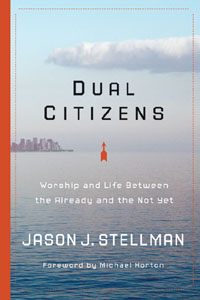
One of the smarter moves by 2k proponents was David VanDrunen’s to publish his sequel to Natural Law and the Two Kingdoms with Crossway, the firm with the most direct ties to the Gospel Coalition, thanks to Justin Taylor’s footprint in both organizations. So far 2k has come into print through outlier publishers, such as Jason Stellman’s Dual Citizens with Reformation Trust, an up-and-comer but not yet on a par with the Grand Rapids and Wheaton publishers; VanDrunen first published his Biblical Case for Natural Law with the Acton Institute and then his book on two kingdoms with Eerdmans – a publisher no longer regarded by sideline Presbyterians as safely orthodox; in my own case, I went to the independent trade publisher, Ivan R. Dee to produce A Secular Faith. With Living in God’s Two Kingdoms, VanDrunen has put 2k theology, with all of its initial oddities and counter-biblicist notions, squarely before the Tim-Keller loving, and John-Piper convicting masses.

Will 2k ever be the same?

Early returns suggest, yes. Here are a few of the responses to Taylor’s recent post on VanDrunen’s latest:

I’ve read VanDrunen’s book and I am surprised that you came to such positive conclusions about it. He makes a few valuable critiques of those who disagree with him, but the overall thrust of his thesis is, quite frankly, unbiblical. His exegesis is shoddy and he makes very dramatic assumptions about his theology’s continuity with historical figures. VanDrunen’s (and to a greater extent, D.G. Hart’s) iteration of two-kingdom theology does not cooperate well with Augustine’s, Calvin’s, or even Luther’s understanding of the Church’s call in the world. Reading this book can be valuable for a number of reasons, but please exercise careful discernment and wisdom before taking his claims too seriously.

John Frame’s book review on his prior book seems to suggest VanDrunen’s 2 kingdom view is unbiblical. I am thinking this book might be a waste of time.

I’m not sure which is worse. Unbiblical or waste of time. But acquiring a taste for 2k will clearly take some work.

I don’t actually believe VanDrunen will be visiting a Gospel Coalition conference soon as a plenary speaker. His arguments about “redeeming culture” and the nature of redemption will not go down easily with word-and-deed-based ministries or churches in pursuit of social justice (no matter how generous). But he has moved 2k from the sidelines to a seat at the mainstream born-again Baptyterian table. Maybe this book will turn out to be as momentous as the original Super Bowl, which brought the AFL and the NFL together for an annual game that led to the joining-and-receiving of leagues that had been previously at odds. Maybe too, in reverse of professional football’s expansion, VanDrunen’s sighting on the Gospel Coalition’s radar will prompt the allies in the Gospel Coalition to go back to church on Sunday evenings for a second service.

Confession of Faith or Health Care Legislation?

My confession of faith is not the Westminster Confession. It is the confession of my communion, the Orthodox Presbyterian Church. Of course, our confession bears many resemblances to the Westminster Confession. But if folks look at the publication of our confession, neatly produced by the Committee on Christian Education, it reads, the “Confession of Faith and Catechisms of the Orthodox Presbyterian Church with Proof Texts” (the proof texts are especially all the OPC’s). Again, the OPC did rely upon standards handed down from the Westminster Divines, adopted by the Scottish Kirk, and then in 1729 by the Synod of Philadelphia for the communion that was taking shape in the British colonies in North America. Still, when OPC officers subscribe our confession and catechisms, they are embracing documents that are different from those produced during the 1640s, and also with different understandings (because of the development of history) of several of the doctrines taught.

Many of the controversies in our current setting stem from originalists who insist that the contemporary church has abandoned the original sense of the Standards, and those who seek a different elaboration of Reformed theology. I myself find that I am on different sides of this debate, on the one hand wanting to find room for genuine theological developments within our communions, and on the other, realizing the folly and danger that usually attends adapting to the times.

Jason Stellman wants to break through the impasse and proposes the writing of a new confession. At his blog he writes:

Here’s where a new confession comes in. What is needed is the ability to avoid the task of divining the ever-elusive “system of doctrine,” the confession-within-the-confession, the bits and pieces of our doctrinal standards that really matter. But as long as we theoretically subscribe to the Westminster Confession and Catechisms but allow countless exceptions to be taken to them, we leave ourselves no choice but to scratch our heads over whether things like refraining from recreation on the Sabbath and 6/24 creation are intrinsic to the system. My proposal is simply that if we all agree that something is not intrinsic to the system, then why not omit it altogether? Then, once we have identified what our system of doctrine actually is, we can confess it strictly and with confidence. It is just this kind of approach—one that calls for strict subscription to the system of doctrine but allows laxity on incidental matters—that could potentially be the impetus for an ecumenical Reformed church consisting of believers from British Presbyterian and Continental Reformed backgrounds.

Maybe it comes from having studied with Scott Clark, but Stellman has a point. And though I can’t find it at Scott’s blog, he has for many years been maintaining that we need a new confession of faith, one that reflects both the tradition and the developments in theology since 1647. And while I can’t identify precisely the points of the argument, I think it runs something like this: if we continue to hold creeds and catechisms written in the sixteenth and seventeenth centuries, they run the risk of functioning like dictionaries – reference works we simply pull off the shelf when an ordination exam comes along or when going to a trial, but seldom used in the day-to-day life of a congregation and its broader communion. Richard Muller has proposed a helpful remedy to this situation, one that makes our adopted creeds and confessions part of the warp and woof of church life (in corporate and family worship, and in member’s piety).

But another way to give us more ownership of our confessional standards is to write a new one.

The more I study the history of the Reformed churches, the more sense this proposal makes. The Westminster Assembly was an incredibly complicated affair, and the issues before that body are virtually unknown to contemporary readers (unless you’re Chad Van Dixhoorn). For instance, here is what Philip Benedict writes about the Divines:

The majority of the delegates who favored a presbyterial-synodal form of church government worked to bring the others around to their position by demonstrating the form’s biblical basis point by point.; but the exegesis proved a time-consuming, contentious business. As the divines puzzled over Scripture, the clash of arms realigned the political situation. The New Model Army proved more successful that the Scottish forces in the warfare against the king and did a better job of claiming credit for joint victories. As the army’s power increased, the Independents and Erastians within the assembly grew more assertive and forces the initiation of regular consultations with Parliament, which was less sympathetic to clerical independence. As in the cities of Germany and Switzerland in the first century of the Reformation, the issue of who controlled excommunication became a bone of contention. . . . The new form of church government for England finally decided upon in conjunction with Parliament and spelled out in measure of August 1645 and March 1646 approximated the presbyterial-synodal churches of Scotland, France, and the Netherlands . . . . But it contained major compromises with Erastian and congregationalist concerns . . . . These accommodations displeased the Scottish envoys, who castigated the new system as a “lame Erastian presbytery.”(Benedict, pp. 400-401)

Aside from questions of church polity and ecclesiastical authority, England was also facing antinomianism and neo-nomianism churning out of sixteenth-century debates over predestination. Puritan practical divinity was also in the air, as were debates over prayer books and liturgical forms. The point is that the confession can be read as a historical document to see what was animating Reformed English and Scottish churchmen in the seventeenth century. In fact, it needs to be read this way if it is going to function as a reliable standard (has anyone heard of grammatical-historical exegesis?). And as a state-appointed committee, its documents can also be read like Obama’s recent health care provision – a statement that bears all the compromises that come with politics, which is the art of compromise.

But such historical investigation and political intrigue is a long way from embracing the Westminster Confession as our own confession of faith. For that reason, I do believe that Stellman and Clark are on to something. Maybe if the NAPARC churches ever adopted Bob Godfrey’s proposal for a federated denomination of Reformed churches, their first item of business would be to call an assembly to write a Reformed confession for the twenty-first century.