
The BeeBee’s don’t seem to care for Kenneth Woodward’s complaint about the Democrats’ politics of righteousness, but the former religion editor for Newsweek and ongoing Roman Catholic makes a lot of sense. Who knew the Democrats were the Moral Majority before Jerry Falwell formed the Moral Majority?
The party’s alienation from the white working class began in the streets of Chicago outside the 1968 Democratic National Convention. There, antiwar protesters and activists for a host of countercultural causes fought the police of Mayor Richard J. Daley while the nation watched on television. As President Bill Clinton later observed in the first volume of his memoirs, Vietnam was only one point of contention in what was really a wider clash between generations, social classes and moral cultures:
“The kids and their supporters saw the mayor and the cops as authoritarian, ignorant, violent bigots. The mayor and his largely blue-collar police force saw the kids as foul-mouthed, immoral, unpatriotic, soft, upper-class kids who were too spoiled to appreciate authority, too selfish to appreciate what it takes to hold a society together, too cowardly to serve in Vietnam …”
The 1968 convention marked the end of the New Deal coalition that had shouldered Franklin Roosevelt, Harry Truman, John F. Kennedy and Lyndon B. Johnson to the White House. It wasn’t that white working-class Americans turned away from the party so much as that political reformers representing the young, the newly wealthy, the suburban and the higher educated deliberately cut party ties with them. “Boss” Daley, the authoritarian Irish Catholic mayor from the blue-collar Bridgeport neighborhood, became the poster boy for all that was “bigoted” and socially regressive in neighborhood-based, white ethnic America.
The new era
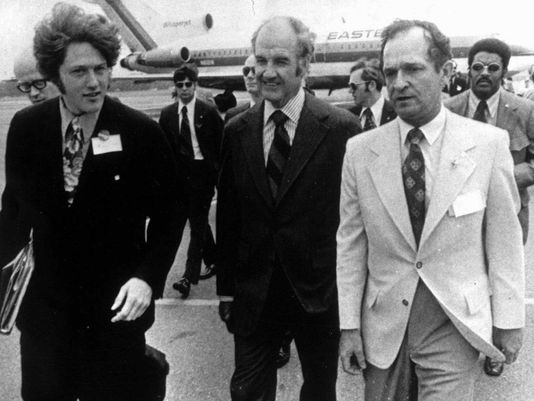
Over the next four years, a commission on party structure and delegate selection, with Sen. George McGovern as chairman, introduced a series of reforms ensuring that, culturally as well as politically, the delegates to the 1972 Democratic convention would resemble the young activists who had battled the police in Chicago more than delegates who had been seated inside. The McGovern Commission, as it came to be called, established state primaries that, in effect, abolished the power of the old city and state bosses, most of whom came from white ethnic stock. The commission also established an informal quota system for state delegations to assure greater representation of racial minorities, youths and women that by 1980 became a mandate that half of every state delegation must be women.
The 1972 Democratic platform formally introduced the party’s commitment to identity politics. Rejecting “old systems of thought,” the platform summoned Democrats to “rethink and reorder the institutions of this country so that everyone — women, blacks, Spanish speaking, Puerto Ricans, Native Americans, the young and the old — can participate in the decision-making process inherent in the democratic heritage to which we aspire.” There was also this: “We must restructure the social, political and economic relationships throughout the entire society in order to ensure the equitable distribution of wealth and power.” The delegates put flesh on these lofty moral commitments by adding a plank commending the forced busing of students in order to achieve racial balance in public schools. Blue-collar Boston exploded.
McGovern naively took for granted the traditional party loyalty of union leaders and the white working class. But these pillars of the New Deal collation recognized that McGovern’s creation of a new “coalition of conscience” built around opposition to the war, identity politics and a redistribution of wealth excluded some of their own conscientiously held moral convictions. McGovern went on to lose every state but Massachusetts and the District of Columbia — and with them the party allegiance of blue-collar workers, union leaders and — what often amounted to the same voters — conservative Roman Catholics.
Jimmy Carter was not a member of McGovern’s coalition of conscience: He had his own powerful sense of moral righteousness, one he derived from his Southern Baptist heritage of personal rectitude rather than McGovern’s secularized Methodist heritage of moral uplift and social reconstruction. There was much in that mix that was admirably righteous, especially the instinct to protect racial and sexual minorities from social oppression. The problem is that pursuing righteousness by expanding individual rights at the expense of communal values often creates greater social conflict. As sociologist Robert Bellah argued in 1991, “rights language itself offers no way to evaluate competing claims.” One side wins, the other loses.
Shazzam! You mean that entering the public square with the certainty that you are pursuing holiness and your opponents are depraved is bad for The Union? You mean “I’m right and you’re wrong” is divisive? Who knew? (Actually, most married couples do.)
 Old Life