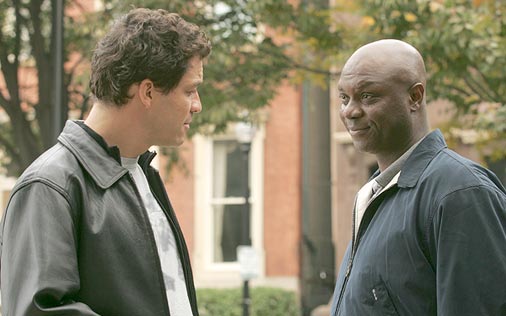
Do I Need a Strategy for Dining on Sweetbreads?

After having seen Inside Llewyn Davis for a second time — it is growing on the Harts — I am intrigued by the exchange between Trevin Wax and Alissa Wilkinson about Christians watching movies. Wilkinson advocates seeing movies, in part, as a way of knowing what our neighbors are talking about. This facility will allow us to love them better and perhaps even evangelize. Wax thinks the idea of watching The Wolf of Wall Street as either neighbor love or pre-evangelism is a stretch. In the narrow confines of this debate, Wax largely has a point, though his fears of “heading down a rocky terrain without any brake system working on our vehicle” is at odds with the no-brakes approach of the apostle Paul who said everything is lawful. (Paul’s brake was whether something was beneficial either for us or other believers — a pretty complicated question but not necessarily so if you’re not blogging about what movies you see.)

What is missing from this classic evangelical approach to culture — either it helps with evangelism or it needs to bolster our moral posture — is (all about) I. What if I watch a movie simply because I like it, that is, I enjoy certain actors (George Clooney) or directors (Joel Coen) or writers (Ethan Coen) and I go out of my way to follow what they do. It is like acquiring a taste for a kind of food that some people might find objectionable — like sweetbreads (the thymus and pancreas of calves or lambs). If it’s on the menu, I generally order it. And if the Coens come out with a movie I see it. Why? A theological explanation could be that this is how God has providentially overseen my life so that I am predisposed to sweetbreads and the Coens.

That is way more theology than I think is necessary to justify such mundane affairs as food and movies. I understand that simply “enjoying” something can be a route to escapism or obesity — that is, not critically reflecting on what we watch or eat. But I see no reason why we can’t have a fuller account of enjoyment as a sufficient reason for seeing a film. If all things are lawful, maybe they are also enjoyable.

Noah Millman's On a Roll

First he renders Inside Llewyn Davis a great movie (I left the theater scratching my head about a good movie that defied the Coen’s conventions):

There’s a poetic rightness to the fact that “Inside Llewyn Davis,” one of the best films of the year, was not nominated for Best Picture by the Academy of Motion Picture Arts and Sciences. The latest from the Coen Brothers, “Inside Llewyn Davis” does just about everything it can to alienate voters, starting with the fact that it’s about a raging misanthrope. Like “Her” but in the opposite emotional key, this is another story where form and subject are perfectly mated, and where the story wouldn’t work at all if they were not.

The Coen Brothers have always been interested in losers. But never before have they gotten us so close to the heart of one of those losers, and a loser who knows that he deserves to win, and knows he just isn’t going to, and is consumed by the bitterness of that condition. Like “A Serious Man,” this feels like a very personal film for them, but whereas “A Serious Man” wrestled with origins – specifically their Jewish identity – “Inside Llewyn Davis” wrestles with destiny, and the possibility of not having one.

Played with wonderful naturalism by relative newcomer Oscar Isaac, Llewyn Davis is a folk singer in New York in 1961, right before folk is about to explode out of its niche with the emergence of Bob Dylan. But Llewyn isn’t going anywhere. He can’t afford even a rathole apartment downtown, and crashes on the couches of the vanishingly few New Yorkers who don’t hate his guts. One of them is his more successful friend’s wife (Carey Mulligan, giving a nicely subtle performance – watch her eyes while she sings), who informs him she’s knocked up, possibly by him. Another is an uptown academic couple who are faultlessly generous with him, and whose generosity he rewards by lashing out, cursing, saying he feels like a trained poodle.

He’s got more than his share of rotten luck – beaten up by inexplicably malevolent cowboys, robbed of even his minimal royalties by his rotten manager, trapped for hours on the way to Chicago with an outlandishly insulting old jazz man who won’t stop poking him with his canes (the only out-and-out Coen grotesque in the film, played by John Goodman). But he also makes his own bad luck, telling his sister (Jeanine Serralles) to throw out his old stuff (including his old mariner’s license, which he turns out to need), refusing royalties on a ridiculous novelty song that his friend (the one he cuckolded, played with delightfully deadpan squareness by Justin Timberlake) wrote so that he can get the cash quicker (only to see the song do well), and, when he finally gets a chance to audition for a manager who could really take him places (F. Murray Abraham), picking an obscure and depressing song guaranteed to turn him away. And his response to every piece of bad mazel he suffers is the same, whether he’s obviously implicated or not: a sour conviction that it figures, that the universe has it in for him one way or another.

With one exception. In what is certainly a screenwriting joke (given the ubiquity of Blake Snyder’s book) this deeply unattractive character does one noble thing. He saves a cat. Or tries to.

Then Millman wonders about the value of using w-w to debate atheists who use Pat Robertson as an interlocutor:

If I understand [Ross Douthat’s] argument now, it is that the new atheists’ worldview lacks “coherence” – whereas other world views, including some other varieties of atheism, would not lack that coherence so drastically.

I suspect that’s true. But what I would say in response is that virtually nobody has a “coherent” worldview. I’m pretty sure I don’t. And it’s only a certain sort of personality that feels a psychic need for a worldview characterized by coherence. I might even go further and say that some religions are more prone to seek that particular grail than others. I’d certainly rank Catholicism far higher on the “seeks coherence” scale than, say, Judaism, or the LDS Church, to say nothing of faith traditions like Hinduism that don’t even have a clear mechanism for defining the boundaries of inclusion and exclusion, and that hence by definition cannot provide that kind of coherence.

If guys like Bryan Cross were to read more Millman and watch more movies by the Coens, would the Call to Communion be funnier and more effective?

What Kind of Witness Do Presbyterians Have Anymore?

Over at the Imaginative Conservative I ran across this intriguing tidbit of church history:

Did you know that Christmas celebrations were banned in Scotland until 1958? I certainly didn’t, not until my son started working on his sixth grade “Christmas around the World” report. I haven’t looked up what the English did in this regard (Scotland always has had a good deal of autonomy within Britain, and never stopped following its own legal code). But it seems the good Presbyterians of the established Church of Scotland (“the Kirk,” ironically enough for traditional conservatives) thought Christmas was a Catholic holiday, best stamped out with criminal penalties for unwholesome celebrations (pretty much anything outside of church), along with persistent tolling of bells to make sure everybody went to work on the day.

Bruce Frohnen, the author who uses this piece of trivia to introduce reasons for celebrating Christmas and Epiphany, goes on to say that times have changed and the old reasons for Presbyterians not celebrating Christmas have changed as well:

None of this is intended as a complaint against Presbyterians. In our secular age those of us who’ve “got religion” need to let bygones be bygones—especially when it comes to wrongs with their origins dating back a long way, and which aren’t really relevant to the character of people or religious practice today. What’s more, as they say, “at least they took us seriously.”

This is a curious line of reasoning since it suggests that those who take religion seriously (the “got religionists”) have no reason to take the old reasons for differences between Presbyterians and Roman Catholics seriously. But if the “got religion” crowd does believe religion to be important, then doesn’t that belief extend beyond a generic conservative Christianity doing battle with secularists and egalitarians? Doesn’t it lead all the way to what traditional Presbyterians and traditional Roman Catholics have believed traditionally about practices like the church calendar (redundancy intended)? This is not to say that beliefs change. Presbyterians (in the U.S. anyway) revised their confession in 1789 on the subject of the civil magistrate. Roman Catholics “developed” their doctrine of the church at Vatican II such that salvation now is possible outside the Roman Catholic Church. Still, despite changes and developments, what is a traditional Presbyterian to do who still objects to the “doctrines and commandments of men” implied in the liturgical calendar used by Rome, Moscow, and Canterbury (not to mention Dort)? Can confessional Presbyterians find a seat at the pro-religion, cultural conservative table if they bring up objections to other conservative faiths on the basis of their own conservative faith?

This is, by the way, an important example of why religion — at least conservative faith — is not glue that keeps cultural conservatives together that many scholars and journalists suppose. The religion of the culture warriors (in James Davison Hunter’s old categories) may bring them together, but it is more likely going to be some kind of ecumenical, broadly tolerant religion that stresses morality (the way the old liberal Protestants did), not one that tells Protestants they are in danger if they don’t fellowship with the Bishop of Rome or that tells Presbyterians they should not observe man-made holidays.

Either way, it is remarkable that even mainline Presbyterian churches like the Kirk as little as a half-century ago would not observe the liturgical calendar. Not even the Orthodox Presbyterian Church had that kind of tenacity — just look at the hymns devoted to the birth of the baby Jesus in the Trinity Hymnal.

But if you are thinking about holidays and wondering how to bring in the New Year with a good movie, the Harts recommend Hudsucker Proxy (1994), a Coen Brothers production that ranks right up there with Miller’s Crossing. Hudsucker is set at the end of 1958 — talk about harmonic convergence — the year that the Kirk started observing Christmas, and stars Tim Robbins and Paul Newman. We are planning on some sparkling shiraz to go with the popcorn and should be in bed by 10:30. Woot!

Why Exclude Walter and the Dude?

Viewers of “The Big Lebowski” may well remember one of many memorable lines from Walter Sobchak. This one comes in the context of a discussion with Donny about the merits of nihilism. Walter will have none of an outlook that believes in nothing. As he explains to Donny, “Say what you like about the tenets of National Socialism, Dude, at least it’s an ethos.”

That line came to mind when reading a recent Christianity Today editorial about Chuck Colson and his efforts to unite Roman Catholics and Evangelicals in an Abraham-Kuyper like coalition to oppose “spiritual nihilism.”

Colson, like Kuyper, was concerned about the effects of modernism and later postmodernism on contemporary culture. And like Kuyper, he believed that unless believers are equipped with the critical tools of worldview thinking, they are unlikely to make any headway in redeeming culture.

When Colson and Richard John Neuhaus formed Evangelicals and Catholics Together (ECT), their new Protestant-Catholic initiative, the group focused its initial statement on the common mission of the church in the third millennium. That mission, their 1994 document said, involved contending together “against all that opposes Christ and his cause.” In “developed societies,” that included “widespread secularization” that had descended “into a moral, intellectual, and spiritual nihilism that denies not only the One who is the Truth but the very idea of truth itself.”

Within the framework of Kuyper’s vision, this was an excellent summary of what Protestants and Catholics needed to address together.

As commendable as it may be for Christians to combat nihilism, why would this be a project that would exclude religiously conflicted folks like the Dude’s good friend and bowling team member, Walter? Lots of people who are not Christians oppose nihilism. Some of them are Christian. Some are Muslim. Some are Mormon. Some profess no God. If you want to oppose nihilism, then why not broaden the tent?

It could be that Christians think they alone have the true basis for a proper opposition. Or it could be that “spiritual nihilism” is different from Karl Hungus’ version of nihilism. But it does seem to me to be a form of shooting yourself in the foot when you make a common cultural cause into a matter of the gospel of our Lord and Savior, Jesus Christ.

Postscript: are neo-Calvinists really comfortable with Colson carrying the water for Kuyper’s legacy?

As If I (all about me) Needed Another Excuse to See "A Serious Man" Again

With the recent start of Mad Men’s fifth season, the critics have been piling praise high and deep for a show that as much as I watch leaves me cold. The reviewer for Terry Gros’ Fresh Air gassed on about the show’s finely textured characters. Puh-leeze. This seemed like a desperate attempt by a university professor with a radio gig to find a way on to the invitation-list for one of Hollywood’s upcoming galas. Mad Men is entirely lacking, in my not so humble estimation, in character development and the other factor that develops characters — dialogue. So I see Don Draper brood over which babe he is going to bed next. So Don has a complicated past and multiple identities. I wouldn’t want to have a meal with him (especially if I cross dressed). In comparison I’d be all over a meal or pint with Jimmy, Bunk, Bunnie, or Carcetti — from The Wire. I’d like to add Omar to the list, but I’m doubting a fellow on that side of the law would want to dine with this egg-headed honkie. Nor do I imagine that in real life such a social outing would be safe.

What Mad Men does have is atmosphere. And for us baby-boomers who were too young and too fundamentalist to know about the world of advertising and New York City life in the fast lane, Mad Men evokes an era and a world that is heavy on eye-candy. It allows us to see the world our parents did everything to prevent us from seeing.

But you can’t get by only on atmosphere, which is why the Coen Brothers are gems in the world of not-so-Indie cinema. They do atmosphere incredibly well. Just see Miller’s Crossing (their homage to the gangster genre) or Barton Fink (their homage to post-modernism). But in addition to atmosphere, the Coens add humor, irony (several helpings), and the Montaignian twist of things not being what they seem.

This is a long winded way of recommending a recent post by Noah Millman, a guy trained in economics who used to blog at the American Scene and now does so regularly for the American Conservative. Millman is the first to write (at least the first I’ve read) about the opening scene in A Serious Man and make sense of it, a movie that, by the way, captures the mood of an era and I suspect does well with Jewish-American life in the land of Lake Wobegone. Millman also supplies a reading of the movie based on Job which makes complete sense and completely missed me — perhaps because my biblical w-w is defective or because I spent too much time in the movie trying to figure out the opening scene. Here’s part of Millman writes about the Coens’ modern-day Job (he compares it to Tree of Life):

“The Tree of Life” is a snapshot of the moment when Job hears the voice out of the whirlwind. Jack has “kept it together” for years, decades, but for whatever reason today the defenses have broken down, and he is face to face with questions he has buried since he was a young man. (As the festival musaf liturgy says: “in the face of our sins were we exiled from our land,” which I take to mean: now, conscious of our exile, unable to make expiation through the Temple, we cannot escape a confrontation with our sins.) And he – we – see God’s answer: look at the dinosaurs! I made them, they lived, and thrived, and then I took them all away, and you never even knew them. And somehow Jack sees: yes, You will take them all, You will take us all, to where I do not know, but if I remember that, perhaps I can accept that taking my brother was just . . . taking back what was Yours. And I can make that a gift to you.

“A Serious Man” stops just before this point. The whirlwind comes – and the movie stops. This seems like an ending that endorses Larry’s moral confusion – even the whirlwind doesn’t mean anything – but, notwithstanding the Coen brothers’ evident lack of interest in piety, I question that. The filmmakers’ anger at Larry, at the smallness both of his seriousness and of his sins, and, by extension, at the entire middle-class insular Jewish culture in which they were reared, burns forth from the screen. The whirlwind doesn’t speak – the idea that the “wonders of creation” constitute some kind of answer to Larry (or Job) is simply mocked. But they did not make this movie arbitrarily. They made it for a reason. This perspective, this anger, is itself a version of God’s answer out of the whirlwind, and a meaningful one, as surely as Malick’s film is, and the Coen brothers, in abusing poor Larry so mercilessly, are playing the part of God in the story. They want to shake him out of who he is, into something, well, more like what they are, what Larry’s son, presumably, grew up to be.

I may disagree with Millman about the Coens’ “anger” or attempt to play God — I am not sure they are all that firm in their convictions. But it is the best reading of the film I’ve seen and invites another viewing — which will further predispose me with the Season Five version of Don Draper.

What Bushy Top and Stringer Bell Might Teach Us About Mr. Laden

After saying my morning prayers (see, I am devout), tending to the livestock, and fixing the coffee, I tuned into my favorite radio show (my wife’s most hated) to learn not only that Phillies had lost but that Osama Bin Laden had lost his life. To hear sports-talk radio hosts commenting on life, death, and terrorism was obviously strange, though they would have also been my path to news of 9-11 if streaming audio were available back in the dark days of Windows XP.

But even stranger and more inappropriate was to listen to sports fans chime in with glee about Mr. Laden’s death. To treat this man’s execution and burial like another Joe Blanton loss is clearly not fitting. What the event seems to call for is a ceremony – akin to the one in which President participated at the National Cathedral after 9/11. My Old Life sensibility tempts me to conclude that our culture cannot ceremonialize the death of a national enemy because we are no longer a ceremonial culture – too much Praise & Worship worship. But this would be a cheap shot in the worship wars. What is actually the case is that human beings have a long history of celebrating an enemy’s death in a manner more appropriate to a sporting even. Just think of what the Italians did to Mussolini. The communist Partisans captured him, executed him, and then hung him by his feet in a public square in Milano where the locals proceeded to jeer and throw rocks. Don’t underestimate human vindictiveness.

But don’t underestimate either the dark side of this bright moment in this chapter in the chronicles of justice. Since I have been re-watching Season Three of The Wire – the season where the fate of the drug lords, Stringer Bell and Avon Barksdale is settled – I have thought about the events of last night through the lens of human frailty so brilliantly depicted in that award-winning HBO series.

First, I heard on NPR that one of the oddities about Mr. Laden’s compound was that such a massive and expensive place would not have either internet or phone service. Boy, does that have The Wire written all over it. To evade the special unit given the task of catching Avon, which had used a fairly sophisticated system of wire taps, even to be able to track disposable phones, the head of the entire drug enterprise went without a phone altogether. To contact him, people had to talk to his minions, or executive minions. Mr. Laden didn’t need to be a fan of The Wire to see the logic of going without electronic communication, but sometimes life does imitate art.

Second, if Mr. Laden were an American citizen selling drugs or directing terror, chances are the authorities would not have had the freedom to kill him on sight. Their first action would have been to capture him, read him his rights, and then start the wheels of U.S. jurisprudence rolling – which might involve some roughing up behind closed doors in police office buildings. But if Mr. Laden were like Avon, he would likely still be alive (if he did not resist arrest).

Third, what kind of strategy did the American military use in killing Mr. Laden? In The Wire the mayor and police chief are often more interested in symbolic victories – declines in statistics, or drugs piled on tables for journalists to see and photograph – than the real source of the problem. In other words, they are more interested in winning re-election than in strategic allocation of resources. In which case, was Mr. Laden a target of military and intelligence officials? Or was he a trophy for administrators in the Pentagon to maintain budgets and for the White House to look tough on terror?

Another layer in managing the publicity of Mr. Laden’s death is the relationship among the United States, its Western and middle-Eastern allies, and Pakistan. Military and civilian authorities are choosing their words carefully to prevent embarrassment for the Pakistanis. What The Wire’s police chief Burrell says to his Colonels is different from what he says to the mayor behind closed doors which is different from what Burrell says to the press. Another instance of personal, professional, and civic calculations is Tommy Carcetti’s decision to run for mayor of Baltimore. As one of the few white councilmen in the city, the only shot he has to defeat the black incumbent is if another black councilman runs in the Democratic primary and splits the African-American vote, thereby letting Tommy emerge as the great white hope – who even during the mayoral campaign is calculating how to manage city politics in a way that will allow him to run for state (governor) and or federal (senator) office. Celebrators should not let Mr. Laden’s death prevent them from seeing the layers of interests – what the Coen brothers do when exploring the mixed motives of their characters – that inform presidents, generals, chiefs of staff, kings, ministers of parliament and journalists in their massaging of, taking credit for, or distancing from this event.

Last, celebrators should remember the experience of Bushy Top, Jimmy McNulty, once he finally hit his target. Jimmy had to do some real soul searching about whether he was going after Avon and Stringer for the sake of the city, his commander, or personal fulfillment – colleagues did tell him he needed to get a life. To the degree that his own identity was bound up with convicting one of B&B Enterprises’ co-owners, Jimmy also saw how incomplete he was. The defeat of Avon and Stringer turned out to be a thin reed on which to hang Jimmy’s search for meaning. The death of Mr. Laden will generate great ebullience. Americans should beware of the rapid and scary descent on the other side of this roller coaster ride.

What in anyway does any of this have to do with Reformed faith and practice? In keeping with the neo-Puritan insistence on application, the theological payoff of a Wired reading of Mr. Laden’s death is this: although the Bible teaches human depravity God’s word doesn’t really explore it in its amazing and complicated depth – as in the wickedness that clings to the best of human actions – the way that productions like The Wire do, or the Coen Brothers’ movies, or even the occasional French film like Jean de Florette. To be alert to the variety and tenacity of human sinfulness, you need to look at the poignant portrayals of human existence that come from some of the best artistic expressions (though the Old Testament has its moments).

What the Bible does teach is the remedy for sin. Its salvation is not a government that enforces God’s law or even that reinforces the rule of law, as good as those forms of rule may be. The only remedy is a savior whose work of redemption is so amazing that he could even, pending faith and repentance, save Mr. Laden from his obvious sin.