 In his serialized review of VanDrunen’s Natural Law and the Two Kingdoms, Nelson Kloosterman finishes his inspection of the chapter on Calvin with the line, “Remember the Puritans.â€
This is a curious appeal because Kloosterman’s memory may not be as good as his review of VanDrunen is long. His major objection to 2k appears to be that its advocates do not insist that Scripture is necessary for prescribing the duties of the civil magistrate. To VanDrunen’s point that Calvin did not believe civil government should be ruled solely by Scripture, Kloosterman finds an opening to insist that the Bible does inform at least part of the magistrates duties.
On the one hand, Kloosterman asks:
. . . if God’s natural law, embodied in OT Mosaic law, prohibits public blasphemy, and if this natural law ought to underlie civil enactments, then why should Dr. VanDrunen so vigorously oppose appeals to God’s requirements amid public policy discussions about moral issues covered by the Decalogue?
That would seem to mean that the civil magistrate is bound to uphold both tables of the law since Kloosterman is not only concerned about violations of the seventh commandment in the instance of gay marriage but also about instances of blasphemy covered in the third commandment.
Kloosterman also goes on to quote, as he is wont to do, from the Canons of Dort which give him the green light to insist that special revelation must be the lens through which to read general revelation (though he never seems to consider that this reading of Dort would prohibit all non-Christians from using natural law, whether as fathers or magistrates, since without regeneration they cannot properly interpret natural law). This is what Dort says:
There is, to be sure, a certain light of nature remaining in man after the fall, by virtue of which he retains some notions about God, natural things, and the difference between what is moral and immoral, and demonstrates a certain eagerness for virtue and for good outward behavior. But this light of nature is far from enabling man to come to a saving knowledge of God and conversion to him—so far, in fact, that man does not use it rightly even in matters of nature and society. Instead, in various ways he completely distorts this light, whatever its precise character, and suppresses it in unrighteousness. In doing so he renders himself without excuse before God†(III/IV.4, italics added).
Since Kloosterman italicizes those portions which correctly portray the limitations of natural man using natural law, he would seem to be saying that without Scripture, no one can interpret general revelation correctly. In fact, he said this in his interviews on Christ and culture at Reformed Forum.
But on the other hand comes Kloosterman’s selective memory, perhaps a function of having to venture beyond Queen Wilhelmina’s mints and wooden shoes. To VanDrunen’s point that Calvin did not use the Bible solely for civil matters, Kloosterman writes:
“Calvin did not believe,†we are told, “that the civil kingdom can be governed solely or primarily by the teaching of Scripture.†But who does believe that? Some of us insist that the civil kingdom (public society) should be governed in part by the teaching of Scripture, in connection, say, with issues like homosexual marriage and abortion, and even debasing monetary currency. But who among us has ever claimed that “the civil kingdom can be governed solely or primarily by the teaching of Scripture�
Actually, as already mentioned, Kloosterman did claim that the Bible is the basis for civil government and its laws (and his invocation of Dort is further testimony to this point; how else to read the deficiency of natural revelation apart from the lens of Scripture?). But the curious aspect of Kloosterman’s concession that the Bible does not govern all of public life comes when he mentions those areas where the Bible should govern the civil magistrate – gay marriage and abortion.
What about blasphemy, mentioned in the previous quotation? And what about both tables of the law? Does the magistrate follow only the second table but get a pass on the first? Does this mean that the civil polity should tolerate blasphemy and idolatry, but not murder and stealing? If so, then how does this view follow biblical teaching or even show the usefulness of the Decalogue in civil government? Is Kloosterman really a closet advocate of 2k?
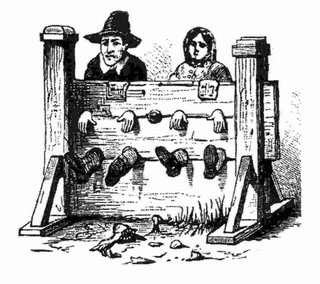
If he remembers the Puritans, he is. Because those English Protestants who fled the old country to establish a city on Beacon Hill were not at all reluctant to let the whole Decalogue (and even parts of the Pentateuch) inform their civil laws. To assist Dr. K’s memory, he might want to consider the following (only the first ten out of fifteen capital offenses) from The Laws and Liberties of Massachusetts (1647):
1. If any man after legal conviction shall have or worship any other God, but the lord god: he shall be put to death. Exod. 22. 20. Deut. 13.6. & 10. Deut. 17. 2. 6.
2. If any man or woman be a witch, that is, hath or consulteth with a familiar spirit, they shall be put to death. Exod. 22. 18. Levit. 20. 27. Deut. 18. 10. 11.
3. If any person within this Jurisdiction whether Christian or Pagan shall wittingly and willingly presume to blaspheme the holy Name of God, Father, Son or Holy-Ghost, with direct, expresse, presumptuous, or highhanded blasphemy, either by wilfull or obstinate denying the true God, or his Creation, or Government of the world: or shall curse God in like manner, or reproach the holy religion of God as if it were but a politick device to keep ignorant men in awe; or shal utter any other kinde of Blasphemy of the like nature & degree they shall be put to death. Levit. 24. 15. 16.
4. If any person shall commit any wilfull murther, which is Man slaughter, committed upon premeditate malice, hatred, or crueltie not in a mans necessary and just defence, nor by meer casualty against his will, he shall be put to death. Exod. 21. 12. 13. Numb. 35. 31.
5. If any person slayeth another suddenly in his anger, or cruelty of passion, he shall be put to death. Levit. 24. 17. Numb. 35. 20. 21.
6. If any person shall slay another through guile, either by poysoning, or other such devilish practice, he shall be put to death. Exod. 21. 14.
7. If any man or woman shall lye with any beast, or bruit creature, by carnall copulation; they shall surely be put to death: and the beast shall be slain, & buried, and not eaten. Lev. 20. 15. 16.
8. If any man lyeth with man-kinde as he lieth with a woman, both of them have committed abomination, they both shal surely be put to death: unles the one partie were forced (or be under fourteen years of age in which case he shall be seveerly punished) Levit. 20. 13.
9. If any person commit adulterie with a married or espoused wife; the Adulterer & Adulteresse shall surely be put to death. Lev. 20. 19. & 18. 20 Deu. 22. 23. 27.
10. If any man stealeth a man, or Man-kinde, he shall surely be put to death Exodus 21. 16.
I wonder if this is the system of law that Dr. K. would have the readers of Christian Renewal remember. Since he seems to shy away from putting people to death for adultery, Kloosterman would appear to be much closer to VanDrunen than he is either to Calvin or the Puritans whose notions of a Christian society perhaps only contemporary theonomists have the stomach to swallow.
In which case, what seems to motivate Dr. K.’s objections to 2k is pining for the sort of American society when liberal Protestants were running things and setting the standards for public life. Ramesh Ponnuru gave a useful description of the virtues of that wonderful time in American life in his essay, “Secularism and Its Discontents†(National Review, Dec. 2004) He wonders what would happen if religious conservatives actually achieved legislative success in the U.S. Their wish-list includes prohibiting abortion, restricting pornography, restraining experimentation on human embryos, and banning gay marriage. Some might like to have more prayer in public schools, and those who don’t home school would prefer that the public school teachers giving tips on condoms. But Ponnuru thinks this is hardly a return to John Winthrop’s Boston or John Calvin’s Geneva:
My point . . . is to note that introducing nearly every one of these policies – and all of the most conservative ones – would merely turn the clock back to the late 1950s. That may be a very bad idea, but the America of the 1950s was not a theocracy.
Likewise, Kloosterman’s critique of 2k is hardly a return to Massachusetts of 1647, Amsterdam of 1595, or to Zurich of 1550. If he could remember the Puritans, he might actually see how much in common he has with his Dutch-American nemesis, the lovely, the talented, David VanDrunen.

 Old Life